DOSE NON-LIN EAR ITY OF THE DO SIM E TRY SYS TEM AND
POS SI BLE MON I TOR UNIT ER RORS ON MED I CAL LIN EAR
AC CEL ER A TORS USED IN CON VEN TIONAL AND
IN TEN SITY-MOD U LATED RA DI A TION THER APY
by
Wazir MUHAMMAD 1,2*, Sang HOON LEE 3*, Khan ALAM 4, Muhammad MAQBOOL 5, and Gulzar KHAN 1 1
De part ment of Phys ics, Kyungpook Na tional Uni ver sity, Daegu, Re pub lic of Ko rea 2
De part ment of Med i cal Phys ics, In sti tute of Nu clear Med i cine On col ogy and Ra dio ther apy (INOR), Abbottabad, Pa ki stan
3
School of En ergy En gi neer ing, Kyungpook Na tional Uni ver sity, Daegu, Re pub lic of Ko rea 4
In sti tute of Phys ics and Elec tron ics, Uni ver sity of Peshawar, Khy ber Pakhtunkhwa, Pa ki stan 5
De part ment of Phys ics and As tron omy, Ball State Uni ver sity, Muncie, Ind., USA
Scientific pa per DOI: 10.2298/NTRP1204368M
The pur pose of this work is to study dose non-lin ear ity in med i cal lin ear ac cel er a tors used in con ven tional ra dio ther apy and in ten sity-mod u lated ra di a tion ther apy. Open fields, as well as the en hanced dy namic wedge ones, were used to col lect data for 6 MV and 15 MV pho ton beams ob tained from the VARIAN lin ear ac cel er a tor. Beam sta bil ity was checked and con firmed for dif fer ent dose rates, en er gies, and ap pli ca tion of en hanced dy namic wedge by cal -cu lat ing the charge per mon i tor unit. Mon i tor unit er ror was cal -cu lated by the two-ex po sure method for open and en hanced dy namic wedge beams of 6 MV and 15 MV pho tons. A sig nif i cant mon i tor unit er ror with max i mum val ues of ±2.05931 mon i tor unit and ±2.44787 mon -i tor un-it for open and en hanced dy nam-ic wedge beams, re spec t-ively, both en ergy and dose rate de pend ent, was ob served both in the open pho ton beam and en hanced dy namic wedge fields. How ever, it ex hib ited cer tain ir reg u lar pat terns at en hanced dy namic wedge an gles. Dose mon i tor unit er ror ex ists only be cause of the over shoot phe nom ena and elec tronic de lay in dose co in ci dent and in te grated cir cuits with a de pend ency on the dose rate and pho ton en -ergy. Mon i tor unit er rors are in de pend ent of the ap pli ca tion of en hanced dy namic wedge. The ex is tence of mon i tor unit er ror de mands that the dose non-lin ear ity of the lin ear ac cel er a tor do sim e try sys tem be pe ri od i cally tested, so as to avoid sig nif i cant dosimetric er rors.
Key words: mon i tor unit er ror, dose non-lin ear ity, lin ear ac cel er a tor, en hanced dy namic wedge
IN TRO DUC TION
The con cept of timer er ror (TE) is an es tab lished fact for Co-60 teletherapy units. It arises when the source is par tially ob scured due to the me chan i cal mo ment of the source in tran si tion from the off to on po si tion [15]. The con cept of this type of timer er ror is ap -plied to those ma chines in which the me chan i cal mo ment of the ra dio ac tive source is in volved in ir ra di -at ing pa tients, i. e., brachytherapy, Co-60 teletherapy units, etc. [2, 6]. How ever, the over shoot ef fect caused by the con trol loop in the Varian DMLC sys tem (V4.8) (i. e., ~65 ms) to mon i tor and halt the ir ra di a tion of a seg ment may re sult in a frac tion ally larger mon i tor
unit (MU) than the planned. As a re sult, the ac tual MU de liv ered may dif fer from the planned. The ef fect de -pends on the de liv ery rate (MU per min ute) and is most pro nounced in lowdose re gions. Sim ply, the over -shoot is the de liv ery rate mul ti plied by the con trol loop de lay time in terms of ab so lute MU [7]. Al though Xray beams in lin ear ac cel er a tor (LINAC) are pro -duced in a dif fer ent man ner from those pro -duced by the Co-60 teletherapy ma chine, TE/mon i tor unit er ror (MUE) can still be ap plied to LINAC, as well [2, 7]. Dif fer ent ap proaches by dif fer ent man u fac tur ers have been ap plied in or der to ren der dose in te gra tion and ther a peu tic tech niques ac cu rate enough to give a low prob a bil ity of MUE [2]. But, due to the elec tronic de -lay in dose in te gra tion and co in ci dence cir cuits, the timer may not mea sure the treat ment time ac cu rately, pro duc ing an er ror in the dose de liv ery to the pa tient * Cor re spond ing au thor's e-mail: [email protected] (S. Hoon Lee)
[2, 7]. The dif fer ence be tween ir ra di a tion time and the time cal cu lated by the dose in te grated cir cuits can be re ferred to as MUE on LINAC. To en sure an ac cu rate de liv ery of the pre scribed dose to the pa tient, the MUE LINAC must be cal cu lated and ap plied to ir ra di a tion time [8]. The in ter na tional atomic en ergy agency (IAEA) has rec om mended a qual ity con trol (QC) test (tol er ance < 1%) for mea sure ments of TE on a Co-60 teletherapy unit, but no such rec om men da tions or guide lines have been set or ap proved for LINAC [3, 4]. A gen eral view of LINAC is that, at the mo ment, TE/MUE is neg li gi ble, as far as con tem po rary LINAC are con cerned [9]. Biggs [2] in ves ti gated TE only for elec tron beam LINAC used in intraoperative ra di a tion ther apy. A sig nif i cant en ergy-in de pend ent and dose-rate de pend ent TE has been found by him. The TE was in ves ti gated for elec tron en er gies of 6, 9, 12, and 15 MeV, with dose rates of 300 and 600 MU per minute and at all en er gies of 900 MU per minute and MU set tings be tween 50 and 2000. Al though Biggs has stated in his stud ies that TE may have se ri ous con se quences in the im ple men ta tion of in ten sitymod u lated ra di a tion ther apy (IMRT) [2], there are no ex per -i men tal mea sure ments -in ex -is tence -in sup port of h-is claim. His study has also failed to pro vide any mea -sure ments for pho ton beams. More over, the study was done for LINAC used in intraoperative ra di a tion ther -apy, in volv ing very large dose rates op tions (i. e., 300, 600 and 900 MU per minute), but we know that the over shoot has the most pro found ef fect in lowdose re gions [7]. The sta bil ity of the LINAC do sim e try sys -tem is very im por tant for ac cu rate dose de liv ery in con ven tional ra dio ther apy and IMRT [7]. There fore, the study has been de signed to in ves ti gate the dose nonlin ear ity of the LINAC do sim e try sys tem by cal -cu lat ing beam sta bil ity in dif fer ent clin i cal con di tions, along with MUE for 6 and 15 MV pho ton beams pro -duced for con ven tional ra dio ther apy and IMRT with dose rates of 80, 160, 240, and 320 MU per minute. Beam sta bil ity and MUE were also in ves ti gated for the said pur pose in the ap pli ca tion of en hanced dy namic wedge (EDW) on a VARIAN LINAC.
METH ODS AND MA TE RI ALS
A do sim e try sys tem in side the treat ment head of a med i cal LINAC is used to mea sure MU de liv ered to the pa tient. It con sists of two sep a rately sealed dual trans mis sion ion iza tion cham bers with com pletely in -de pend ent bi as ing power sup plies and read out electrometers, termed as pri mary and sec ond ary cham bers. To mea sure the ad di tional pa ram e ters like beam en ergy, ra dial and trans verse beam flat ness and sym me try, the ion iza tion cham bers have been de -signed so that their elec trodes are di vided into sev eral sec tors. The de sign of the elec trodes and sec tors de -pends on the man u fac turer of the ma chine. Lit er a ture
shows that the re sponse of elec tronic cir cuits in high ra di a tion fields is dose rate-de pend ent [10, 11]. The peak volt age (or cur rent) of the tran sis tors and di odes is pro por tional to the dose rate over a cer tain range of dose rates, with ev i dence of some non-lin ear be hav ior [12]. Sil i con di odes, es pe cially PIN di odes, are reg u -larly used as beam mon i tors and do sim e ters in LINAC sys tems, be cause their photocurrent is pro por tional to the dose rate and the to tal charge col lected is pro por -tional to the to tal dose [9, 13]. On the other hand, the method of EDW is a treat ment de liv ery tech nique of Varian LINAC in which the wedged dose pro file is pro duced by the mo tor- con trolled mo tion of a collimator jaw from the open to the closed po si tion dur ing treat ment [14-17]. Dur ing treat ment, dif fer ent parts of the field are ex posed to pri mary beams for dif -fer ent time du ra tions, while the jaw speed and dose rate are con tin u ously changed dur ing ir ra di a tion [17]. Seven types of EDW with wedge an gles of 10°, 15°, 20°, 25°, 30°, 45°, and 60° can be pro duced by Varian CLINAC 2100C.
The do sim e try sys tem should be lin ear, ac cu rate and ca pa ble of turn ing off the ra di a tion beam when the pro grammed ir ra di a tion time passes, so as to en sure an ac cu rate dose to the pa tient. To check the lin ear ity and ac cu racy of the do sim e try sys tem, a FC65G (for mally Wellhofer, ac tive vol ume of 0.65 cm3) Farmertype ion iza tion cham ber at tached to a PTW UNIDOS E uni ver -sal do sim e ter and a Wellhofer Blue Wa ter Phan tom was used to mea sure the charge for dif fer ent MU (i.e., 1500 MU) set ups. The phan tom has a po si tional ac cu -racy of ±0.5 mm per axis and a reproducibility of ±0.1 mm. Mea sure ments were per formed for both open (non-wedged) and EDW fields with a fixed field size (10 cm ´ 10 cm) at 100 cm SSD for 6 MV and 15 MV pho ton beams pro duced by a Varian CLINAC 2100C. In open fields, the mea sure ments were taken on the cen -tral axis, at a depth of 10 cm for MU set tings of 1, 5, 10, 25, 50, 100, 150, 200, 250, 300, 350, 400, and 500 MU at dose rates of 80, 160, 240, and 320 MU per min ute. In the pres ent study, four wedges with wedge an gles of 15°, 30°, 45°, and 60° were used. For EDW fields, mea -sure ments were made for MU set tings of 25, 50, 100, 150, 200, 250, 300, 350, 400, and 500 MU. As the dose rate con tin u ously changes dur ing ir ra di a tion, the dose rate ef fect can not be stud ied for EDW fields. The cham -ber was placed in a 0.5 cm gap at the thin end of the EDW an gle, so as to avoid the de crease in beam in ten -sity due to the pres ence of EDW. To com pare the re sults of MUE for the EDW beams to the cor re spond ing ref er -ence open beams ones, it is needed that the experimental con di tions for both must be the same. There fore, the open beam mea sure ments were per -formed for the same ex per i men tal set-up as set tled for the EDW fields.
MU set tings be tween 1-500 MU and 25-500 MU for open beams and EDW beams, re spec tively, in or der to an a lyze beam sta bil ity. The MUE was cal cu lated for both open and EDW fields of 6 MV and 15 MV pho ton beams, by means of the two-ex po sure method used for TE in the Co-60 teletherapy unit, as de scribed in eq. 1 [1, 5].
MUE MU R MU R
R R
= ±
-1 2 2 1
1 2
(1)
where R1 and R2 are the dose read ings ob tained for MU set tings, MU1 and MU2 re spec tively, on LINAC. Equa tion 1 was used to cal cu late the MUE for all pos -si ble com bi na tions of MU.
RE SULTS AND DIS CUS SION
The cal cu lated rel a tive charge per MU (nC/MU) at all avail able dose rates (i. e., 80, 160, 240, and 320 MU per minute) for open fields of 6 MV and 15 MV pho ton en er gies, is shown in fig. 1. A con stant and lin ear be hav -ior of nC/MU against MU is ob served for dose rates at both en er gies above the 25 MU set ting, as shown in fig. 1. In con trast, a slightly vari able be hav ior is ob served while plot ting nC/MU against MU be low the 25 MU set tings, as shown in fig. 1, for all dose rates and both en er -gies. Re sults show that the beams are well sta ble above the 25 MU set tings. Fur ther more, no ef fect of ei ther en -ergy or dose rate was ob served on nC/MU.
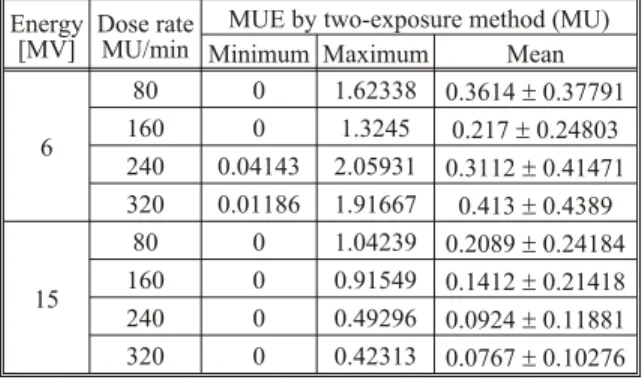
The cal cu lated rel a tive charge per MU (nC/MU) for the ap pli ca tion of EDW fields of 6 MV and 15 MV pho ton en er gies is shown in fig. 2. The same graph i cal pat tern while plot ting nC/MU against MU for EDW fields as open beams is ob served for both 6 MV and 15 MV, as shown in fig. 2(a) and (b). The vari a tion in nC/MU against MU for both en er gies stud ied shows beam sta bil ity with the ap pli ca -tion of EDW. The beam sta bil ity for a par tic u lar dose rate and MU set tings < 22 MU can not be checked be cause the dose rate does not re main con stant and con -strained on MU set tings with the ap pli ca tion of EDW. The MUE was cal cu lated for open fields, as well as for the im ple men ta tion of EDW in pho ton beams of 6 MV and 15 MV (see, tabs. 1, 2). The en ergy ef fect and dose rate ef fect on MUE was in ves ti gated for the open fields of pho ton en er gies un der study and for avail able dose rates (i. e., 80, 160, 240, and 320 MU per minute). For open fields of 6 MV and 15 MV pho -ton beams, the MUE was cal cu lated at dif fer ent dose rates (i. e., 80, 160, 240 and 320 MU per minute) with the help of equa tion 1 (i. e., the two-ex po sure method). The re sults are sum ma rized in tab. 1. A sig nif i cant MUE with a max i mum er ror of ±2.05931 MU was ob served for open pho ton beams of 6 MV and 15 MV en er gies (tab. 1). Fig ure 3 shows that, as the dose rate in -creases from 80 to 320 MU per minute, the mean value of MUE for 15 MV de creases while, in con trast, no reg u lar pat tern for the mean value of MUE can be ob
-Fig ure 1. Charge per MU (nC/MU) vs. MU de liv ered at listed dose rates in open field of (a) 6 MV pho ton beams and (b) 15 MV pho ton beams
served for the 6 MV pho ton beam. Fur ther more, smaller mean val ues of MUE were ob served for 15 MV, as com pared to the 6 MV pho ton beam at the same dose rate, as shown in fig. 3. Over all, the MUE has in creased be hav ior with a de crease in en ergy. MUE was also cal cu lated for the im ple men ta tion of EDW (i. e., 150, 300, 450, and 600), for both 6 MV and 15 MV pho ton beams (tab. 2). A sig nif i cant MUE with
a max i mum value of ±2.44787 was ob served in EDW fields, for both 6 MV and 15 MV pho tons beam en er gies. When the mean value of the MUE trend was com -pared with the in crease in the EDW an gle, no reg u lar pat tern was found as the EDW an gle in creased from 150 to 600, for both 6 and 15 MV pho ton beams, as shown in fig. 4. No re la tion of MUE was es tab lished with the ap pli ca tion of EDW from the above re sults. This goes to show that the MUE is in de pend ent of the ap pli ca tion of EDW for both en er gies. The vari a tion in MEU ex ists due to the fact that, dur ing its ap pli ca tion, the dose rate con tin u ously changes.
The ac tual dose com ing out of the ma chine needs to be re li able and pre dict able in or der to fully re al ize the ben e fits of a more so phis ti cated and ad vanced treat ment plan ning and im age guid ance tech niques and en sure an ad e quate dose to the tu mor. How ever, the do sim e try sys tem used in side the treat ment head of the LINAC to mea sure the MU to be de liv ered to the pa tient is con tin u ously ex posed both to high-en ergy X-rays pro duced by the ma chine and the sec ond ary neu trons pro duced as a re sult of X-rays. In short, the sys tem al ways op er ates in a high ra di a tion ex po sure en vi ron ment. Hence, it is vi tal to check the MUE from time-to-time, so as to re move pos si ble er rors in the read ings of the planned dose to the pa tients that might oc cur due to a con tin ual ex po sure to ra di a tion. This not only con firms the cor rect dose to the pa tient, but also en sures the pre cise use of the stateoftheart equip ment de vel oped for the treat ment. MUE was also cal cu lated for the ap pli ca tion of EDW, be cause dy nam i -cally-wedged fields are gen er ated by the sweep ing mo tion of a field-de fin ing el e ment (jaw) dur ing beam-de liv ery time. This me chan i cal mo tion re quires a close syn chro ni za tion with the do sim e try sys tem and, thus, the said in ter ac tion has the po ten tial of lead ing to de vi a tions from the in tended dose. Sim i lar ef -fects have been iden ti fied in dy namic de liv ery sys tems us ing MLC mo tion to mod u late the beam dur ing beam on. An in ves ti ga tion into this ef fect for dy namic Ta ble 1. Min i mum, max i mum, and mean stan dard de vi a tions
of MUE, cal cu lated by two-ex po sure method for tab u lated dose rates for an open field of 6 MV and 15 MV pho ton beams
Energy [MV]
Dose rate MU/min
MUE by two-exposure method (MU) Minimum Maximum Mean
6
80 0 1.62338 0.3614 ± 0.37791 160 0 1.3245 0.217 ± 0.24803 240 0.04143 2.05931 0.3112 ± 0.41471 320 0.01186 1.91667 0.413 ± 0.4389
15
80 0 1.04239 0.2089 ± 0.24184 160 0 0.91549 0.1412 ± 0.21418 240 0 0.49296 0.0924 ± 0.11881 320 0 0.42313 0.0767 ± 0.10276
Ta ble 2. Min i mum, max i mum, and mean stan dard de vi a tions of mon i tor unit er ror (MUE), cal cu lated by two-ex po sure method for tab u lated wedge an gles of 6 MV and 15 MV pho ton beams
Energy [MV]
EDW [angle]
MUE by two-exposure method (MU) Minimum Maximum Mean
6
0° 0.08913 0.97691 0.37064 ± 0.20218 15° 0 2.44787 0.26549 ± 0.46895 30° 0 0.45704 0.15972 ± 0.15905 45° 0 1.5625 0.26579 ± 0.32772 60° 0 0.84507 0.1946 ± 0.20093
15
0° 0.17805 1.16742 0.44653 ± 0.22891 15° 0 1.35747 0.2401 ± 0.33101 30° 0.01082 0.75988 0.20354 ± 0.13424 45° 0 1.9084 0.25401 ± 0.34438 60° 0 1.1655 0.23924 ± 0.31073
Fig ure 3. Mean MUE for dif fer ent dose rates cal cu lated with the two-ex po sure method for open beams of 6 MV and 15 MV
wedges has not yet been re ported in lit er a ture. The pres ent study is a foot note for such a sit u a tion.
Our re sults have shown that the beam is highly sta ble at all en er gies, dose rates and EDW. Fur ther -more, they prove the lin ear be hav ior of the do sim e try sys tem in side the treat ment head of the LINAC. As the beam is highly sta ble at all en er gies, dose rates and EDW, the MUE ex ists only be cause of the over shoot phe nom ena and elec tronic de lay in the dose co in ci dent and in te grat ing cir cuits. The ef fect of MUE on dose rates is greater at low dose rates, as the over shoot phe -nom e non is more prom i nent at low dose rates [7]. MUE is in de pend ent of the ap pli ca tion of EDW, be cause the cir cuit de signed for jaw move ment and con -trol dur ing its ap pli ca tion works in de pend ently of the dose in te grated and co in ci dence cir cuits. The to tal MU de liv ered is al ways the same, as in open beam ther apy the dose in te grated and co in ci dence cir cuit’s sig nal ter mi nates the beam in de pend ently of the EDW con trol loop. It may, thus, be con cluded that MUE is in de -pend ent of the ap pli ca tion EDW, while it shows some de pend ency on the dose rate and en ergy of the pho ton beam. As the elec tronic cir cuits are highly sen si tive to ra di a tion and the fact that ra di a tion may re sult in dis -place ment dam age in these cir cuits [9], the check of the dose lin ear ity of the LINAC do sim e try sys tem can act as a qual ity con trol test for this type of dam age.
CON CLU SIONS
Sig nif i cant MUE with max i mum val ues of ±2.05931 MU and ±2.44787 MU for open and EDW beam, re spec tively, have been ob served. They are dose rate and beam en ergy de pend ent, while in de pend ent of the ap pli ca tion of EDW. Fur ther more, it has been ob -served that the beam is sta ble with the ap pli ca tion of EDW, both in re la tion to the dose rate or ei ther of the two en er gies. The MUE is in de pend ent of the ap pli ca tion of EDW, be cause the EDW con trol loop is in de -pend ent of dose in te grated and co in ci dence cir cuits. There fore, the pres ence of MUE is due to the over shoot phe nom e non of elec tronic de lay in dose co in ci dent and in te grated cir cuits with a de pend ency on pho -ton en ergy. The ex is tence of MUE re quires that ev ery LINAC be pe ri od i cally tested for the ex is tence of pos si ble MUE, as a means of avoid ing sig nif i cant do sim e -try er rors. Fur ther more, pe ri odic checks of the dose lin ear ity of LINAC do sim e try sys tems may serve as a qual ity con trol test for the dam age in dose in te grated and co in ci dence cir cuits, due to the con tin u ous ex po -sure to ra di a tion.
AC KNOWL EDGE MENT
This re search was fi nan cially sup ported by the Min is try of Ed u ca tion, Sci ence Tech nol ogy (MEST)
and the Na tional Re search Foun da tion of Ko rea (NRF) through the Hu man Re source Train ing Pro ject for Re gional In no va tion (2012H1B8A2026280) and by the sec ond stage of the Brain Ko rea 21 Pro ject in 2012.
AU THOR CON TRI BU TIONS
Study was de signed by W. Mu ham mad, and ex -per i ments were also car ried out by W. Mu ham mad. The o ret i cal anal y sis was car ried out by W. Mu ham -mad, S. Hoon Lee, K. Alam, M. Maqbool, and G. Khan. All the au thors an a lyzed and dis cussed the re -sults. The manu script was writ ten by W. Mu ham mad and the fig ures were pre pared by K. Alam and G. Khan.
REF ER ENCES
[1] Orton, C. G., Seibert, J. B., The Mea sure ment of Teletherapy Unit Timer Er rors, Phys. Med. Biol., 17 (1972), 2, pp. 198-205
[2] Brigs, P. J., Ev i dence for a Sig nif i cant Timer Er ror on a Lin ear Ac cel er a tor: Con se quences for a Spe cial Ther apy Ap pli ca tion, Phys. Med. Biol., 43 (1998), 10, pp. 3139-3143
[3] Andreo, P., et al., In ter na tional Atomic En ergy Agency (2005), Im ple men ta tion of the In ter na tional Code of Prac tice on Do sim e try in Ra dio ther apy (TRS-398): Re view of test ing Re sults, TEC-DOC-1455, IAEA, Vi enna
[4] Samat, S. B, Ev ans, C. J., Kadni, T., Timer Er ror: the Pos si bil ity of Con fu sion Aris ing from two Dif fer ent Sign Con ven tions, The Brit ish Jour nal of Ra di ol ogy, 74 (2001), 879, pp. 290-293
[5] Heales, J .C., Harrett, A., Blake, S., Timer Er ror and Beam Qual ity Vari a tion Dur ing “RampUp’’ of a Su -per fi cial X-Ray Ther apy Unit, Br. J. Radiol., 71 (1998), 852, pp. 1306-1309
[6] Shoujun, Z., et al., RealTime Im ageGuided Ra di a -tion Ther apy: A Sur vey, Pro ceed ings, 3rd In ter na tional Con fer ence on Bioinformatics and Bio med i cal En gi -neer ing, June 11-13, Beijing, China, 2009, pp. 1-6
[7] Ezzell, G. A., Chungbin, S., The Over shoot Phe nom e -non in Step-and-Shoot IMRT De liv ery, Jour nal of Ap -plied Clin i cal Med i cal Phys ics, 2 (2001), pp. 138-148
[8] Kriminski, S., Alex, N. Li., Solberg, T. D., Dosimetric Characteristics of a New Linear Accelerator Under Gated Operation, Jour nal of Ap plied Clin i cal Med i -cal Phys ics, 7 (2006), 1, pp. 65-76
[9] Nath, R., et al., Amer i can As so ci a tion of Phys i cists in Med i cine (Sep tem ber 1994), AAPM Code of Prac tice for Ra dio ther apy Ac cel er a tors (TG 45), Pub lished by Amer i can In sti tute of Phys ics for AAPM, USA
[10] Barnaby, H. J., et al., Anal y sis of Bi po lar Lin ear Cir -cuit Re sponse Mech a nism for High and Low Dose Rate To tal Dose Re sponse, IEEE Trans. Nucl. Sci., 43 (1996), 6, pp. 3040-3048
[11] Pease, R., et al., En hanced LowDoseRate Sen si tiv -ity of a Low-Drop out Volt age Reg u la tor, IEEE Trans. Nucl. Sci., 45 (1998), 6, pp. 2571-2576
LINAC, Pro ceed ings, Par ti cle Ac cel er a tor Con fer -ence, Knox ville, Tenn. USA, 2005, pp. 2363-2365
[13] Prado, K. L., et al., En hanced Dy namic Wedge Fac -tors at Off-Axis Points in Asym met ric Fields, Jour nal of Ap plied Clin i cal Med i cal Phys ics, 4 (2003), 1, 75-84
[14] Klein, E. E., et al., Mul ti ple Ma chine Im ple men ta tion of En hanced Dy namic Wedge, Int. J. Radiat. Oncol., Biol., Phys., 40 (1998), 4, pp. 977-985
[15] Gib bons, J. P., Cal cu la tion of En hanced Dy namic Wedge Fac tors for Sym met ric and Asym met ric Fields, Med. Phys., 25 (1998), 8, pp. 1411-1418
[16] Beavis, A. W., Weston, S. J., Whit ton, V. J., Im ple -men ta tion of the Varian EDW Into a Com mer cial RTP Sys tem, Phys. Med. Biol., 41 (1996), 9, pp. 1691-1704
[17] Klein, E., et al., Do sim e try and Clin i cal Im ple men ta -tion of Dy namic Wedge, Int. J. Radiat. Oncol. Biol. Phys., 31 (1995), 3, pp. 583-592
Re ceived on April 5, 2012 Ac cepted on No vem ber 5, 2012
Vazir MUHAMAD, Sang HUN LI, Kan ALAM, Muhamad MAGBUL, Gulzar KAN
NELINEARNOST DOZE DOZIMETRIJSKOG SISTEMA I MOGU]E GRE[KE MONITORSKE JEDINICE MEDICINSKIH LINEARNIH AKCELERATORA KORI[]ENIH U UOBI^AJENOJ I PROMENQIVOG INTENZITETA TERAPIJI
U radu je prou~ena nelinearnost doza kod lineranih akceleratora koji se koriste u uobi~ajenoj radioterapiji promenqivog intenziteta. Kori{}ena su otvorena poqa i poqa sa
dinami~ki poja~anim probijawem za prikupqawe podataka iz fotonskih snopova energija 6 MeV i
15 MeV na VARIAN linearnom akceleratoru. Odre|ivawem koli~ine naelektrisawa po
monitorskoj jedinici i normalizovane koli~ine naelektrisawa po monitorskoj jedinici, proverena je i potvr|ena stabilnost snopa za razli~ite ja~ine doza, energija i primenu dinami~kog probijawa. Gre{ka monitorske jedinice izra~unata je metodom dvostrukog izlagawa za otvorene i
dinami~ke poja~ane snopove fotona energija 6 MeV i 15 MeV.
Kod oba snopa je uo~ena zna~ajna gre{ka monitorskih jedinica sa maksimalnim
vrednostima od ±2.44787 monitorskih jedinica za dinami~ki poja~ani snop i sa izrazitom
zavisno{}u od energije i ja~ine doze. Gre{ka monitorske jedinice pokazala je odre|eno neregularno pona{awe od ugla dinami~ki poja~anog probijawa. Ona postoji samo zbog fenomena prebacivawa i ka{wewa u koincidentnim integrisanim kolima, uz zavisnost od energije i ja~ine doza, a nezavisna je od primene dinami~kog probijawa. Weno postojawe zahteva periodi~no testirawe nelinearnosti linearnih akceleratora kako bi se izbegle zna~ajne dozimetrijske gre{ke.
Kqu~ne re~i: gre{ka monitorske jedinice, nelinearnost doze, linearni akcelerator,