RESEARCH ARTICLE
Polymorphisms in
NFKB1
and
TLR4
and
Interaction with Dietary and Life Style
Factors in Relation to Colorectal Cancer in a
Danish Prospective Case-Cohort Study
Tine Iskov Kopp1*, Vibeke Andersen2,3,4, Anne Tjonneland5, Ulla Vogel6
1National Food Institute, Technical University of Denmark, 2860 Søborg, Denmark,2Organ Center, Hospital of Southern Jutland, 6200 Aabenraa, Denmark,3Institute of Regional Health Research, University of Southern Denmark, 5000 Odense, Denmark,4Medical Department, Regional Hospital Viborg, 8800 Viborg, Denmark,5Danish Cancer Society Research Center, 2100 Copenhagen, Denmark,6National Research Centre for the Working Environment, 2100 Copenhagen, Denmark
Abstract
Maintenance of a balance between commensal bacteria and the mucosal immune system is crucial and intestinal dysbiosis may be a key event in the pathogenesis of colorectal can-cer (CRC). The toll-like receptor 4 (TLR4) is an important pattern-recognition receptor that regulates inflammation and barrier function in the gut by a mechanism that involves activa-tion of the nuclear factor–κB (NF-κB) transcription factor. Dietary and life style factors may impact these functions. We therefore used a Danish prospective case-cohort study of 1010 CRC cases and 1829 randomly selected participants from the Danish Diet, Cancer and Health cohort to investigate three polymorphisms inNFKB1andTLR4and their possible in-teractions with diet and life style factors in relation to risk of CRC. Homozygous carriage of the variant allele of theTLR4/rs5030728 polymorphism was associated with increased risk of CRC (incidence rate ratio (IRR) = 1.30; 95% confidence interval (CI): 1.05–1.60; P = 0.02 (gene-dose model); IRR = 1.24; 95%CI: 1.01–1.51; P = 0.04 (recessive model)). Del-carri-ers of theNFKB1/rs28362491 polymorphism had a 17% (95%CI: 1.03–1.34; P = 0.02)
in-creased risk of CRC compared to homozygous carriers of the ins-allele. However, none of these risk estimates withstood adjustment for multiple comparisons. We found no strong gene-environment interactions between the examined polymorphism and diet and life style factors in relation to CRC risk.
Introduction
Colorectal cancer (CRC) is the third most common cancer type in men and the second in women worldwide [1]. Hereditary factors are estimated to contribute to only 35% of the risk [2] emphasizing the importance of environmental factors in the etiology of CRC. Indeed,
PLOS ONE | DOI:10.1371/journal.pone.0116394 February 23, 2015 1 / 15
OPEN ACCESS
Citation:Kopp TI, Andersen V, Tjonneland A, Vogel U (2015) Polymorphisms inNFKB1andTLR4and Interaction with Dietary and Life Style Factors in Relation to Colorectal Cancer in a Danish Prospective Case-Cohort Study. PLoS ONE 10(2): e0116394. doi:10.1371/journal.pone.0116394
Academic Editor:Jeffrey S Chang, National Health Research Institutes, TAIWAN
Received:August 21, 2014
Accepted:December 9, 2014
Published:February 23, 2015
Copyright:© 2015 Kopp et al. This is an open access article distributed under the terms of the Creative Commons Attribution License, which permits unrestricted use, distribution, and reproduction in any medium, provided the original author and source are credited.
Data Availability Statement:All relevant data are within the paper and its Supporting Information files.
dietary and lifestyle factors have been intensively studied for their role in colorectal carcinogen-esis; and alcohol, smoking, obesity and high meat intake are now established risk factors for CRC [3–5]. Intake of red and processed meat has the potential of inducing cancer by chemical carcinogens formed during cooking of meat at high temperatures [6], production of toxic fer-mentation compounds [7–9] or by inducing inflammation due to changes in bacterial compo-sition [10]. Conversely, fibre, fruit and vegetables provide short-chain fatty acids (SCFAs) to the colonic epithelium by fermentation of unabsorbed dietary fibre and starch [11–15]. The SCFA butyrate is important for colonic integrity [14], inhibits growth of cancer cellsin vitro [16,17] and has anti-inflammatory properties mainly by the inhibition of nuclear factor—κB (NF-κB) activation [18].
Toll-like receptors (TLR) are important pattern-recognition receptors that regulate inflam-mation and barrier function in the gut thereby maintaining a balance between commensal bac-teria and the mucosal immune system [19,20]. The receptor for gram-negative bacbac-terial lipopolysaccharide (LPS), TLR4, regulates cell proliferation in response to cell injury through induction of cyclooxygenase 2 expression [21] in a cascade that involves activation of NF-κB and epidermal growth factor [22] suggesting that TLR4 is an important element in the transi-tion from inflammatransi-tion to neoplasia [19]. Indeed, increased expression of TLR4 has been linked to development of inflammation-associated neoplasia [23–26]. In addition, we have pre-viously found evidence that inflammation may contribute to CRC carcinogenesis. Thus, geneti-cally determined high IL-1βand COX-2 levels were associated with increased risk of CRC [27]. Dysbiosis in the gut may be a key event in the pathogenesis of both inflammatory bowel dis-eases (IBD) and CRC. Using functional single nucleotide polymorphisms (SNPs) and their in-teraction with diet and life style may reveal important pathways for colorectal carcinogenesis [28]. SinceTLRpolymorphisms have been associated with IBD [29], we aimed to examine a possible mutual mechanism for IBD and CRC.
We have previously shown that carriage of the variant del-allele of the functional ins/del NFKB1/rs28362491 polymorphism is associated with increased risk of CRC and interacted with meat intake in a subset of the current study group [30] in agreement with results from two other studies also reporting increased risk of CRC among variant carriers of the polymorphism among a Malaysian [31] and a Swedish population [32], but not a Chinese study group [32]. A functional SNP inTLR4(rs4986790) has been extensively studied and has been associated with neoplastic progressionin vitro[33], aggressive human colon cancer [33], IBD [34–37] and CRC [38–40]. However others were not able to find an association between CRC and the SNP [41– 43]. In a Canadian study [44], intake of dietary saturated fatty acids was inversely related to blood level of high density lipoprotein cholesterol in individuals homozygous for theTLR4/ rs5030728 G-allele.TLR4/rs5030728 may therefore interact with dietary components in the gut.
Thus, we expected that inflammation is an important factor in colorectal carcinogenesis and thus examined whether diet and life style factors (non-steroidal anti-inflammatory drugs (NSAID) and smoking) modify CRC risk by altering the mucosal immune response in the gut via interacting with TLR4 and NF-κB. We therefore evaluated three polymorphisms inNFKB1 andTLR4and their possible interaction with diet and life style factors in a prospective cohort of 1010 CRC cases and 1829 randomly selected participants from the Danish Diet, Cancer and Health Study.
Material and Methods
Studied subjects
The Diet, Cancer and Health study is an ongoing Danish cohort study designed to investigate the relation between diet, lifestyle and cancer risk [45]. The cohort consists of 57,053 persons,
Inflammatory Polymorphisms and Colorectal Cancer
PLOS ONE | DOI:10.1371/journal.pone.0116394 February 23, 2015 2 / 15
Health cohort”also from the Danish Council for Independent Research; Medical Sciences (grant no. 09-073597) (www.ufm.dk). The funders had no role in study design, data collection and analysis, decision to publish, or preparation of the manuscript.
recruited between December 1993 and May 1997. All the subjects were born in Denmark, and the individuals were 50 to 64 years of age and had no previous cancers at study entry. Blood samples and questionnaire data on diet and lifestyle were collected at study entry.
Follow-up and endpoints
Follow-up was based on population-based cancer registries. Between 1994 and 31th December 2009, 1010 CRC cases were diagnosed. A sub-cohort of 1829 persons was randomly selected within the cohort. 28 persons were both cases and sub-cohort due to the used study design [46]. 245 with missing genotype data and 16 with missing data on risk factors were excluded. All information on genotypes and diet and lifestyle factors was available for 915 CRC cases and 1719 sub-cohort members.
Dietary and lifestyle questionnaire
Information on diet, lifestyle, weight, height, medical treatment, environmental exposures, and other socio-economic factors were collected at enrolment using questionnaires and interviews and has been described in details elsewhere [27,47–49]. In short, the food-frequency question-naire, diet consumption was assessed in 12 categories of predefined responses, ranking from ‘never’to‘eight times or more per day’. The daily intake was then calculated by FoodCalc [45]. Smoking status was classified as never, past or current. Persons smoking at least 1 cigarette daily during the last year were classified as smokers. NSAID use (“Aspirin”,“Paracetamol”, “Ibupro-fen”, or“Other pain relievers) was assessed as2 pills per month during one year at baseline.
Genotyping
Buffy coat preparations were stored at minus 150°C until use. DNA was extracted as described [50]. The DNA was genotyped by LGC KBioscience (LGC KBioscience, Hoddesdon, United Kingdom) by PCR-based KASP genotyping assay (Error! Hyperlink reference not valid.www. lgcgenomics.com/).NFKB1/rs28362491 was analysed and reported for a subset of the current study group [30]. Two of the polymorphisms (NFKB1/rs28362491 andTLR4/rs4986790) were chosen based on known functionality and their association with CRC [30–33] and IBD [34–37] from a literature search. TheTLR4/rs5030728 polymorphism, on the other hand, has no known functionality. However,TLR4/rs4986790 is tightly linked withTLR4/rs5030728 (D’: 1.0; r2: 0.017) using Haploview version 4.2 (Broad Institute of MIT and Harvard, Cambridge) [51] with HapMap3 Genome Browser release #2 (Phase 3) [52]; and sinceTLR4/rs5030728 has a higher minor allele frequency in Caucasians thanTLR4/rs4986790 (0.305 vs. 0.035), this poly-morphism is more suitable for gene-environment interaction analyses. To confirm reproduc-ibility, genotyping was repeated for 10% of the samples yielding 100% identity.
Statistical analysis
Deviation from Hardy-Weinberg equilibrium was assessed using a Chi-square test.
Incidence rate ratios (IRR) and 95% Confidence Interval (CI) were calculated according to the principles for analysis of case-cohort studies using an un-weighted approach [46]. Age was used as the time scale in the Cox regression models. Tests and confidence intervals were based on Wald’s tests using the robust estimate of the variance-covariance matrix for the regression parameters in the Cox regression models [53] as previously described [27,46,48,54–61].
All models were adjusted for baseline values of risk factors for colorectal cancer such as body mass index (BMI) (kg/m2, continuous), use of hormone replacement therapy (HRT) (never/past/current, among women), intake of dietary fibre (g/day, continuous), and red meat
Inflammatory Polymorphisms and Colorectal Cancer
and processed meat (g/day, continuous) and in addition to suspected risk factors such as NSAID use (yes/no) and smoking status (never/past/current). Cereals, fibre, fruit and vegeta-bles were also entered linearly. All analyses were stratified by gender, so that the basic (underly-ing) hazards were gender specific. For all the polymorphisms, IRR was calculated separately for heterozygous and homozygous variant allele carriers. ForTLR4/rs4986790 andNFKB1/ rs28362491, variant allele carriers were subsequently grouped for interaction analyses since no recessive effects were observed.TLR4/rs5030728 was inferred both in a gene-dose and a reces-sive mode in the subsequent analyses.
Moreover, we assessed weekly use of NSAID based on the results of a study of colorectal cancer within the Diet, Cancer and Health cohort [62] reporting that long-term consistent use of Aspirin or Non-Aspirin NSAID appears necessary to achieve a protective effect. However, there were no differences in risk estimates between monthly or weekly use, consequently, to maintain the statistical power in the strata; we used monthly NSAID use in the analyses.
The likelihood ratio test was used for interaction analyses between the studied polymor-phisms and intake of red and processed meat, dietary fibre, cereals, fish, fruits, vegetables, alco-hol intake, smoking status and NSAID use. In interaction analyses where the dietary factors were entered as categorical variables, tertile cutpoints were based on the empirical distribution among male and female cases, respectively. The possible interactions were investigated using the likelihood ratio test.
All analyses were performed using SAS version 9.3 (SAS Institute Inc., Cary, NC). A p<0.05 was considered to be significant. Moreover, to test for multiple comparisons, Bonferroni cor-rection was used.
Ethics statement
All participants gave verbal and written informed consent. The Diet, Cancer and Health study was approved by the National Committee on Health Research Ethics (journal nr. (KF) 01–345/ 93) and the Danish Data Protection Agency.
Results
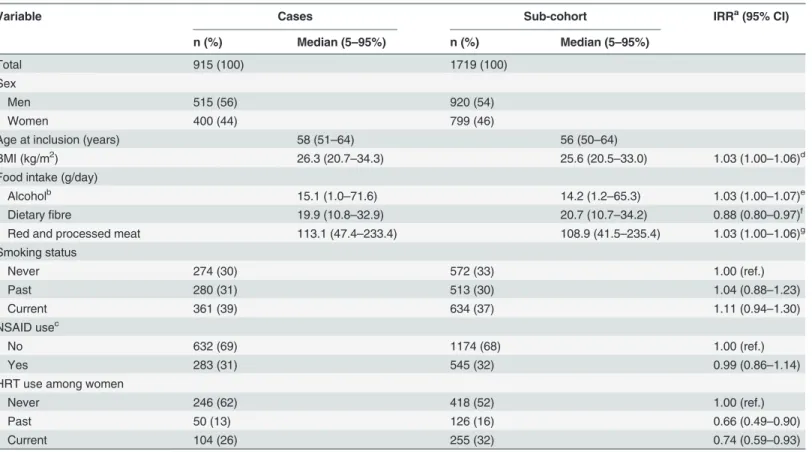
Baseline characteristics of the study population are presented inTable 1. Among sub-cohort members, the genotype distribution of the SNPs did not deviate from Hardy-Weinberg equilib-rium (results not shown).
Associations between polymorphisms and CRC
Homozygous variant carriers of theTLR4/rs5030728 polymorphism were at 1.30-fold (95%CI: 1.05–1.60) increased risk of CRC in a gene-dose model and at 1.24-fold (95%CI: 1.01–1.51) in-creased risk of CRC compared to wild type and heterozygous carriers in a recessive model (Table 2). Moreover, carriers of theNFKB1del-allele had a 17% (95%CI: 1.03–1.34) increased risk of CRC compared to homozygous carriers of the ins-allele (Table 2). These risk estimates did not, however, reach statistically significance after Bonferroni correction. There was no inter-action between the two risk genotypesTLR4/rs5030728 andNFKB1/rs28362491 but on the other hand, there was no additive effect of being homozygous carrier of both variant alleles (S1 Table).
Gene-environment analyses
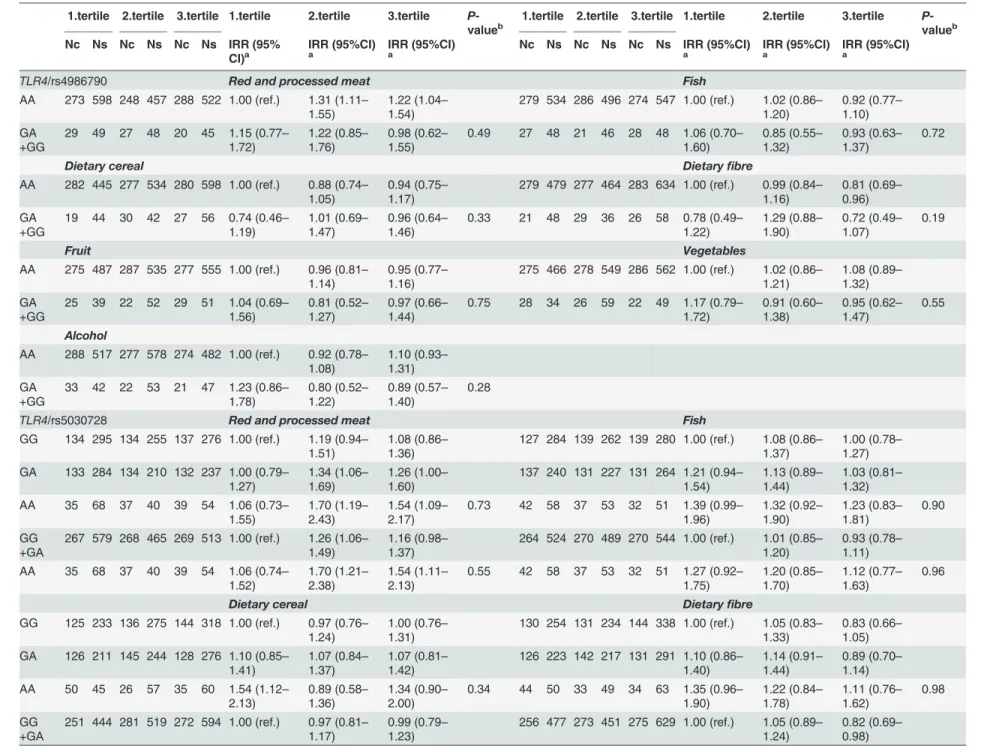
We found no interaction between any of the dietary factors and the studied polymorphisms in relation to risk of CRC in the linear analyses (S2 Table). In the tertile analyses, there was weak interaction betweenTLR4/rs5030728 and intake of vegetables (Gene-dose model: P-value for
Inflammatory Polymorphisms and Colorectal Cancer
interaction (Pint) = 0.05; Recessive model: Pint= 0.03) (Table 3). Moreover, a borderline statisti-cally significant interaction between meat intake and theNFKB1/rs28362491 polymorphism (Pint= 0.06) was found (Table 3). For ins-carriers, risk estimates were comparable across ter-tiles of meat intake. Conversely, among del-carriers, intake of meat in the second (IRR = 1.46; 95%CI: 1.17–1.83) and third tertile (IRR = 1.24; 95%CI: 0.99–1.56) was associated with risk of CRC, whereas del-allele carriers were not at risk in the first tertile with low meat intake (IRR = 0.98; 95%CI: 0.78–1.23). With regard to alcohol, variant carriers ofNFKB1/rs28362491 and ho-mozygous A-allele carriers ofTLR4/rs5030728 were associated with CRC risk compared to the homozygous wild type carriers among participants with a low intake of alcohol. Furthermore, for variant carriers of all three polymorphisms, a low intake (first tertile) of alcohol was associ-ated with the highest CRC risk compared with moderate (second tertile) intake—which was as-sociated with the lowest risk—and high alcohol intake (third tertile) (Table 3).
There was no interaction between NSAID use or smoking status and the studied genotypes (S3andS4Tables). Among non-smokers (S4 Table), however, theTLR4/rs5030728
Table 1. Baseline characteristics of the study participants by selected demographic and established CRC risk factors.
Variable Cases Sub-cohort IRRa(95% CI)
n (%) Median (5–95%) n (%) Median (5–95%)
Total 915 (100) 1719 (100)
Sex
Men 515 (56) 920 (54)
Women 400 (44) 799 (46)
Age at inclusion (years) 58 (51–64) 56 (50–64)
BMI (kg/m2) 26.3 (20.7–34.3) 25.6 (20.5–33.0) 1.03 (1.00–1.06)d
Food intake (g/day)
Alcoholb 15.1 (1.0
–71.6) 14.2 (1.2–65.3) 1.03 (1.00–1.07)e
Dietaryfibre 19.9 (10.8–32.9) 20.7 (10.7–34.2) 0.88 (0.80–0.97)f
Red and processed meat 113.1 (47.4–233.4) 108.9 (41.5–235.4) 1.03 (1.00–1.06)g
Smoking status
Never 274 (30) 572 (33) 1.00 (ref.)
Past 280 (31) 513 (30) 1.04 (0.88–1.23)
Current 361 (39) 634 (37) 1.11 (0.94–1.30)
NSAID usec
No 632 (69) 1174 (68) 1.00 (ref.)
Yes 283 (31) 545 (32) 0.99 (0.86–1.14)
HRT use among women
Never 246 (62) 418 (52) 1.00 (ref.)
Past 50 (13) 126 (16) 0.66 (0.49–0.90)
Current 104 (26) 255 (32) 0.74 (0.59–0.93)
Values are expressed as medians (5th and 95th percentiles) or as fractions (%).
a
IRRs for CRC—mutually adjusted.
b
Among current drinkers.
c
NSAID use is defined as2 pills per month during one year.
d
Risk estimate per 2 kg/m2increment of BMI.
e
Risk estimate for the increment of 10 g alcohol per day.
f
Risk estimate for the increment of 10 g dietaryfibres per day.
g
Risk estimate for the increment of 25 g red and processed meat per day.
doi:10.1371/journal.pone.0116394.t001
Inflammatory Polymorphisms and Colorectal Cancer
polymorphism demonstrated gene-dose effect which is comparable with the results seen among participants with low intake of alcohol (Table 3). In a model where the risk of CRC was inferred per 25 g intake of meat per day subdivided by NSAID use, the risk of CRC by meat in-take increased in a dose-dependent manner among variant allele carriers ofTLR4/rs5030728 in the absence of NSAID use, but not among NSAID-users (S5 Table). Thus, meat intake was not associated with risk among homozygous carriers of the wild type allele, whereas meat intake was associated with a 4% increased risk per 25 g meat/day (95%CI: 1.00–1.09) among heterozy-gotes and 11% increased risk among homozygous variant allele carriers (95%CI: 1.02–1.22). However, there were no statistically significant interactions (S5 Table).
Discussion
In the present study, we found that homozygous variant carriage ofTLR4/rs5030728 and vari-ant carriage of theNFKB1/rs28362491 polymorphism were associated with increased risk of CRC, but not after correction for multiple testing. We only found weak interactions with a few dietary factors and, thus, we were not able to reproduce the previously found interaction be-tween theNFKB1/rs28362491 polymorphism and meat intake. The lack of association between TLR4/rs4986790 and CRC found in the present study could possibly be due to the very low var-iant allele frequency in the Danish population. Only one person was homozygous varvar-iant allele carrier. We therefore cannot exclude that the functional effect of this SNP affects
colorectal carcinogenesis.
TheNFKB1/rs28362491 polymorphism has rather consistently been associated with CRC
risk [30–32], and to some extend also IBD [29,63,64]. As previously described [65,66],NFKB1 encodes the p50/p105 subunits of the transcription factor NF-κB. NF-κB consists of homo- or Table 2. IRR for CRC in relation to the studied polymorphisms.
ncases(%) nsub-cohort(%) IRRa(95% CI) IRRb(95% CI) P-valuec
TLR4 rs4986790
AA 839 (92) 1577 (92) 1.00 (ref.) 1.00 (ref.)
-GA 76 (8) 141 (8) 0.99 (0.79–1.25) 1.00 (0.79–1.26) 0.98
GG 0 (0) 1 (0) - -
-GA+GG 76 (8) 142 (8) 0.99 (0.79–1.25) 1.00 (0.79–1.26) 0.97
rs5030728
GG 405 (44) 826 (48) 1.00 (ref.) 1.00 (ref.)
-GA 399 (44) 731 (43) 1.10 (0.96–1.26) 1.11 (0.96–1.27) 0.16
AA 111 (12) 162 (9) 1.30 (1.06–1.61) 1.30 (1.05–1.60) 0.02
GA+AA 510 (56) 398 (23) 1.14 (1.00–1.30) 1.14 (1.00–1.30) 0.05
AA vs. GG+GA 111 (12) 162 (9) 1.24 (1.02–1.52) 1.24 (1.01–1.51) 0.04
NFKB1 rs28362491
Ins/Ins 320 (35) 679 (60) 1.00 (ref.) 1.00 (ref.)
-Ins/Del 449 (49) 787 (46) 1.19 (1.03–1.37) 1.19 (1.03–1.37) 0.02
Del/Del 146 (16) 253 (15) 1.13 (0.93–1.37) 1.14 (0.94–1.38) 0.18
Ins/Del+Del/Del 595 (65) 1040 (61) 1.17 (1.02–1.34) 1.17 (1.03–1.34) 0.02
aCrude
—adjusted for age and sex.
bIn addition, adjusted for smoking status, alcohol intake, HRT status (women only), BMI, use of NSAID, intake of red and processed meat, and
dietaryfibre.
cP-value for the adjusted estimates.
doi:10.1371/journal.pone.0116394.t002
Inflammatory Polymorphisms and Colorectal Cancer
Table 3. IRR for CRC for tertiles of intake of dietary factors for the studied polymorphisms.
1.tertile 2.tertile 3.tertile 1.tertile 2.tertile 3.tertile P -valueb
1.tertile 2.tertile 3.tertile 1.tertile 2.tertile 3.tertile P -valueb
Nc Ns Nc Ns Nc Ns IRR (95% CI)a
IRR (95%CI)
a IRR (95%CI)a Nc Ns Nc Ns Nc Ns IRR (95%CI)a IRR (95%CI)a IRR (95%CI)a
TLR4/rs4986790 Red and processed meat Fish
AA 273 598 248 457 288 522 1.00 (ref.) 1.31 (1.11–
1.55)
1.22 (1.04–
1.54)
279 534 286 496 274 547 1.00 (ref.) 1.02 (0.86–
1.20)
0.92 (0.77–
1.10) GA
+GG
29 49 27 48 20 45 1.15 (0.77–
1.72)
1.22 (0.85–
1.76)
0.98 (0.62–
1.55)
0.49 27 48 21 46 28 48 1.06 (0.70–
1.60)
0.85 (0.55–
1.32)
0.93 (0.63–
1.37)
0.72
Dietary cereal Dietaryfibre
AA 282 445 277 534 280 598 1.00 (ref.) 0.88 (0.74–
1.05)
0.94 (0.75–
1.17)
279 479 277 464 283 634 1.00 (ref.) 0.99 (0.84–
1.16)
0.81 (0.69–
0.96) GA
+GG
19 44 30 42 27 56 0.74 (0.46–
1.19)
1.01 (0.69–
1.47)
0.96 (0.64–
1.46)
0.33 21 48 29 36 26 58 0.78 (0.49–
1.22)
1.29 (0.88–
1.90)
0.72 (0.49–
1.07)
0.19
Fruit Vegetables
AA 275 487 287 535 277 555 1.00 (ref.) 0.96 (0.81–
1.14)
0.95 (0.77–
1.16)
275 466 278 549 286 562 1.00 (ref.) 1.02 (0.86–
1.21)
1.08 (0.89–
1.32) GA
+GG
25 39 22 52 29 51 1.04 (0.69–
1.56)
0.81 (0.52–
1.27)
0.97 (0.66–
1.44)
0.75 28 34 26 59 22 49 1.17 (0.79–
1.72)
0.91 (0.60–
1.38)
0.95 (0.62–
1.47)
0.55
Alcohol
AA 288 517 277 578 274 482 1.00 (ref.) 0.92 (0.78–
1.08)
1.10 (0.93–
1.31) GA
+GG
33 42 22 53 21 47 1.23 (0.86–
1.78)
0.80 (0.52–
1.22)
0.89 (0.57–
1.40)
0.28
TLR4/rs5030728 Red and processed meat Fish
GG 134 295 134 255 137 276 1.00 (ref.) 1.19 (0.94–
1.51)
1.08 (0.86–
1.36)
127 284 139 262 139 280 1.00 (ref.) 1.08 (0.86–
1.37)
1.00 (0.78–
1.27) GA 133 284 134 210 132 237 1.00 (0.79–
1.27)
1.34 (1.06–
1.69)
1.26 (1.00–
1.60)
137 240 131 227 131 264 1.21 (0.94–
1.54)
1.13 (0.89–
1.44)
1.03 (0.81–
1.32) AA 35 68 37 40 39 54 1.06 (0.73–
1.55)
1.70 (1.19–
2.43)
1.54 (1.09–
2.17)
0.73 42 58 37 53 32 51 1.39 (0.99–
1.96)
1.32 (0.92–
1.90)
1.23 (0.83–
1.81)
0.90
GG +GA
267 579 268 465 269 513 1.00 (ref.) 1.26 (1.06–
1.49)
1.16 (0.98–
1.37)
264 524 270 489 270 544 1.00 (ref.) 1.01 (0.85–
1.20)
0.93 (0.78–
1.11) AA 35 68 37 40 39 54 1.06 (0.74–
1.52)
1.70 (1.21–
2.38)
1.54 (1.11–
2.13)
0.55 42 58 37 53 32 51 1.27 (0.92–
1.75)
1.20 (0.85–
1.70)
1.12 (0.77–
1.63)
0.96
Dietary cereal Dietaryfibre
GG 125 233 136 275 144 318 1.00 (ref.) 0.97 (0.76–
1.24)
1.00 (0.76–
1.31)
130 254 131 234 144 338 1.00 (ref.) 1.05 (0.83–
1.33)
0.83 (0.66–
1.05) GA 126 211 145 244 128 276 1.10 (0.85–
1.41)
1.07 (0.84–
1.37)
1.07 (0.81–
1.42)
126 223 142 217 131 291 1.10 (0.86–
1.40)
1.14 (0.91–
1.44)
0.89 (0.70–
1.14) AA 50 45 26 57 35 60 1.54 (1.12–
2.13)
0.89 (0.58–
1.36)
1.34 (0.90–
2.00)
0.34 44 50 33 49 34 63 1.35 (0.96–
1.90)
1.22 (0.84–
1.78)
1.11 (0.76–
1.62)
0.98
GG +GA
251 444 281 519 272 594 1.00 (ref.) 0.97 (0.81–
1.17)
0.99 (0.79–
1.23)
256 477 273 451 275 629 1.00 (ref.) 1.05 (0.89–
1.24)
0.82 (0.69–
0.98)
(Continued)
Table 3. (Continued)
1.tertile 2.tertile 3.tertile 1.tertile 2.tertile 3.tertile P -valueb
1.tertile 2.tertile 3.tertile 1.tertile 2.tertile 3.tertile P -valueb
Nc Ns Nc Ns Nc Ns IRR (95% CI)a
IRR (95%CI)
a
IRR (95%CI)
a
Nc Ns Nc Ns Nc Ns IRR (95%CI)
a
IRR (95%CI)
a
IRR (95%CI)
a
AA 50 45 26 57 35 60 1.48 (1.09–
1.99)
0.85 (0.57–
1.28)
1.28 (0.88–
1.87)
0.10 44 50 33 49 34 63 1.30 (0.94–
1.78)
1.17 (0.82–
1.67)
1.06 (0.74–
1.52)
0.79
Fruit Vegetables
GG 139 264 135 275 131 287 1.00 (ref.) 0.98 (0.77–
1.24)
0.91 (0.70–
1.18)
132 250 130 289 143 287 1.00 (ref.) 1.03 (0.80–
1.31)
1.16 (0.90–
1.50) GA 126 212 136 260 137 259 1.10 (0.87–
1.40)
0.98 (0.78–
1.25)
1.07 (0.83–
1.39)
136 187 129 269 134 275 1.28 (1.01–
1.62)
1.06 (0.83–
1.35)
1.15 (0.88–
1.50) AA 35 50 38 52 38 60 1.26 (0.88–
1.82)
1.24 (0.87–
1.76)
1.21 (0.83–
1.75)
0.92 35 63 45 50 31 49 1.02 (0.70–
1.47)
1.75 (1.26–
2.44)
1.44 (0.96–
2.15)
0.05
GG +GA
265 476 271 353 268 546 1.00 (ref.) 0.94 (0.79–
1.12)
0.94 (0.77–
1.15)
268 437 259 558 277 562 1.00 (ref.) 0.93 (0.78–
1.11)
1.03 (0.84–
1.26) AA 35 50 38 52 38 60 1.21 (0.85–
1.71)
1.18 (0.85–
1.65)
1.15 (0.81–
1.65)
0.98 35 63 45 50 31 49 0.90 (0.64–
1.28)
1.56 (1.15–
2.13)
1.28 (0.88–
1.88)
0.03
Alcohol
GG 133 267 135 306 137 253 1.00 (ref.) 0.98 (0.78–
1.25)
1.23 (0.97–
1.57) GA 150 246 128 261 121 224 1.23 (0.97–
1.54)
1.07 (0.84–
1.36)
1.21 (0.94–
1.55) AA 38 46 36 64 37 52 1.70 (1.19–
2.42)
1.14 (0.79–
1.65)
1.37 (0.95–
1.98)
0.41
GG +GA
283 513 263 567 258 477 1.00 (ref.) 0.92 (0.78–
1.09)
1.10 (0.93–
1.31) AA 38 46 36 64 37 52 1.53 (1.10–
2.14)
1.03 (0.73–
1.46)
1.24 (0.88–
1.75)
0.33
NFKB1/rs28362491 Red and processed meat Fish
I/I 112 238 102 225 106 216 1.00 (ref.) 1.01 (0.78–
1.31)
1.06 (0.82–
1.37)
99 228 116 214 105 237 1.00 (ref.) 1.09 (0.84–
1.41)
0.95 (0.72–
1.26) I/D+D/
D
190 409 203 280 202 351 0.98 (0.78–
1.23)
1.46 (1.17–
1.83)
1.24 (0.99–
1.56)
0.06 207 354 191 328 197 358 1.25 (0.98–
1.58)
1.20 (0.94–
1.53)
1.13 (0.88–
1.44)
0.76
Dietary cereal Dietaryfibre
I/I 105 187 101 212 114 280 1.00 (ref.) 0.87 (0.66–
1.15)
0.91 (0.68–
1.22)
104 202 112 201 104 276 1.00 (ref.) 1.05 (0.81–
1.36)
0.75 (0.58–
0.99) I/D+D/
D
196 302 206 364 193 374 1.10 (0.87–
1.39)
1.04 (0.81–
1.32)
1.13 (0.85–
1.50)
0.76 196 325 194 299 205 416 1.14 (0.90–
1.44)
1.16 (0.92–
1.46)
0.97 (0.77–
1.23)
0.66
Fruit Vegetables
I/I 113 218 107 216 100 245 1.00 (ref.) 0.96 (0.74–
1.25)
0.88 (0.66–
1.17)
105 199 114 240 101 240 1.00 (ref.) 1.16 (0.89–
1.50)
1.11 (0.83–
1.49) I/D+D/
D
187 308 202 371 206 361 1.15 (0.91–
1.45)
1.07 (0.85–
1.35)
1.12 (0.87–
1.45)
0.70 198 301 190 368 207 371 1.31 (1.04–
1.65)
1.19 (0.94–
1.52)
1.33 (1.03–
1.71)
0.37
(Continued)
Table 3. (Continued)
1.tertile 2.tertile 3.tertile 1.tertile 2.tertile 3.tertile P -valueb
1.tertile 2.tertile 3.tertile 1.tertile 2.tertile 3.tertile P -valueb
Nc Ns Nc Ns Nc Ns IRR (95% CI)a
IRR (95%CI)
a
IRR (95%CI)
a
Nc Ns Nc Ns Nc Ns IRR (95%CI)
a
IRR (95%CI)
a
IRR (95%CI)
a
Alcohol
I/I 104 230 111 254 105 195 1.00 (ref.) 1.08 (0.83–
1.40)
1.32 (1.01–
1.73) I/D+D/
D
217 329 188 377 190 334 1.45 (1.15–
1.83)
1.16 (0.92–
1.48)
1.36 (1.08–
1.73)
0.09
a
Analysis adjusted for smoking status, alcohol intake, HRT status (women only), BMI, use of NSAID, intake of red and processed meat, and dietaryfibre. b
P-value for interaction between polymorphisms and dietary factors for the adjusted estimates
Women: Tertiles of red and processed meat (<74.7773 g, 74.7773 g<and<102.086 g,>102.086 g),fish (<27.2196 g, 27.2196 g<and<43.6676 g,>43.6676 g), dietaryfibre (<16.9701 g, 16.9701 g<and<22.0983 g,>22.0983 g), cereals (<135.539 g, 135.539 g<and<190.481 g,>190.481 g), fruit (<141.858 g, 141.858 g<and<266.488 g,> 266.488 g), vegetables (<121.870 g, 121.870 g<and<213.721 g,>213.721 g), laktose (<7.54871 g, 7.54871 g<and<17.1355 g,>17.1355 g), dairy products (<218.144 g, 218.144 g<and<454.235 g,>454.235 g), alcohol (<4.31931 g, 4.31931 g<and<12.9957 g,>12.9957 g).
Men: Tertiles of red and processed meat (<116.935 g, 116.935 g<and<159.387 g,>159.387 g),fish (<33.3477 g, 33.3477 g<and<52.7767 g,>52.7767 g), dietaryfibre (<17.5748 g, 17.5748 g<and<22.4931 g,>22.4931 g), cereals (<166.378 g, 166.378 g<and<233.859 g,>233.859 g), fruit (<90.9913 g, 90.9913 g<and<193.509 g,> 193.509 g), vegetables (<105.532 g, 105.532 g<and<186.459 g,>186.459 g), laktose (<7.93777 g, 7.93777 g<and<17.2082 g,>17.2082 g), dairy products (<217.360 g, 217.360 g<and<461.449 g,>461.449 g), alcohol (<14.4960 g, 14.4960 g<and<37.1134 g,>37.1134 g).
doi:10.1371/journal.pone.0116394.t003
Inflamma
tory
Polymorphi
sms
and
Colorecta
lCancer
PLOS
ONE
|DOI:10.137
1/journal.p
one.0116394
February
23,
2015
9/1
heterodimers of a number of different subunits p65, p50, p105, C-rel and relB [67,68] and the combination determines target gene specificity. As a p65/p50 heterodimer, the complex is pro-inflammatory [68], whereas the p50 homodimer has anti-pro-inflammatory properties
[65,67,69,70]. The relative abundance of p50/p65 heterodimers and p50 homodimers will therefore determine the magnitude of inflammation by balancing the pro-inflammatory and anti-inflammatory response [67]. TheNFKB1/rs28362491 polymorphism generates a deletion of four nucleotides in the promoter region causing lowered transcription levels and conse-quently partial depletion of p50 [63]. In agreement with this, it was found that the mRNA levels ofNFKB1were lower in colon biopsies of healthy tissue from homozygous del-carriers com-pared to heterozygotes [71]. This disfavours the anti-inflammatory response since the forma-tion of the pro-inflammatory p65/p50 heterodimer depends on the concentraforma-tion of p50, whereas the formation of the anti-inflammatory p50 homodimer depends on the concentration of p50 squared [65].
TheTLR4/rs5030728 polymorphism has not yet been linked to CRC [20] and its function is unknown [72].TLR4/rs4986790, which has been associated with IBD and CRC, is tightly linked withTLR4/rs5030728. It is therefore not clear which of the two polymorphisms is the bi-ologically relevant one. However, our results indicate that carriage ofTLR4/rs4986790 was not associated with risk of CRC, whereas carriage ofTLR4/rs5030728 was associated with risk. This suggests that the risk conferred byTLR4/rs5030728 carriage was not caused by linkage with TLR4/rs4986790. Interestingly, variant carriage of theTLR4/rs5030728 A-allele has been asso-ciated with beneficial response to anti-TNF therapy among patients with IBD [73], implying that these patients may have a higher baseline activity or expression of TLR4.
The twoTLR4SNP are present on several commonly used GWAS arrays (https://www. broadinstitute.org/mpg/snap/ldsearch.php) whereas the ins/delNFKB1/rs28362491 polymor-phism is not monitored linkage in GWAS [65]. None of the two TLR4 SNPs were associated with CRC in GWAS. However, our main focus was to search for gene-environment tions, rather than identifying loci with strong associations to CRC. Gene-environment interac-tions are rarely assessed in GWAS.
We did not find any strong indications of gene-environment interactions. For variant carri-ers ofNFKB1/rs28362491 and homozygous A-allele carriers ofTLR4/rs5030728, risk of CRC among low meat consumers was lower compared to medium and high meat consumers, who had risk estimates between 1.24 and 1.70 indicating a stronger role of meat in colorectal carci-nogenesis among subjects with genetically determined high inflammatory response. Alterna-tively, meat intake covaries with other life style factors thatper seinduce an inflammatory response that we have not been able to adjust for.
The found interaction with vegetables andTLR4/rs5030728 in the present study is not di-rectly interpretable and could be due to small groups in the tertiles. However, vegetables seemed to slightly increase the risk of CRC in the present study, which should be addressed in other prospective studies.
We had limited statistical power to detect gene-environment interactions. However, the prospective study design used in this study is well suited for gene-environment interaction analyses due to the collection of dietary and life style factors before diagnosis, eliminating the risk of recall bias. Changing in dietary and life style habits during follow-up is, however, possi-ble, but is not expected to result in differential misclassification between cases and the compari-son group. In addition, the present study group is homogenous consisting of Danes and two of the studied polymorphisms have high allele frequencies. Using the present study group, we have previously found gene-environment interactions between diet andIL10rs3024505 (Pint; meat = 0.04, fish = 0.007, fibre = 0.0008, vegetables = 0.0005),IL1BC-3737T (Pint; NSAID use = 0.040),PTGS2G-765C (Pint; meat = 0.006, fibre = 0.0003, fruit 0.004), andPTGS2
Inflammatory Polymorphisms and Colorectal Cancer
T8473C (Pint; fruit = 0.03) andPTGS2A-1195G (Pint;fibre 0.020 and current smoking = 0.046) [27]. We adjusted risk estimates for suspected risk factors and carefully selected the polymor-phisms based on function and/or previously findings on association with dietary factors, CRC or IBD. However, none of the analyses withstood adjusting for multiple testing. Thus, we can-not rule out that our findings are due to chance and they should therefore can-not be considered as significant associations.
In conclusion, this study was not able to demonstrate associations between the studied poly-morphisms in the inflammatory mediator genesNFKB1andTLR4as none of the found associ-ations withstood adjustment for multiple comparisons. We found no strong gene-environment interactions between the examined polymorphisms and diet and life style factors in relation to CRC risk.
Supporting Information
S1 Table. IRR for CRC in relation to combinations ofNFKB1/rs2836249 andTLR4/
rs5030728 genotypes.
(DOCX)
S2 Table. Interaction between dietary factors and the studied polymorphisms in relation to CRC risk.
(DOCX)
S3 Table. Interaction between NSAID use and the studied polymorphisms in relation to CRC risk.
(DOCX)
S4 Table. Interaction between smoking status and the studied polymorphisms in relation to risk of CRC.
(DOCX)
S5 Table. Interaction between NSAID use and the studied polymorphisms per 25 g red and processed meat intake per day in relation to CRC risk.
(DOCX)
Acknowledgments
We thank Nick Martinussen and Katja Boll for technical assistance with data managing; and Jane Christensen for statistical consulting. The project was supported by a PhD stipend from the Danish Research Councils in the programme‘An integrated approach to risk-benefit as-sessment of human health effects of food and food contaminants’(Forskeruddannelse 2009– 10), and by a Mobility PhD grant (09–06 7572) from the Danish Council for Independent Re-search (www.ufm.dk) and as part of the project:“Beef versus pork consumption in the etiology of cancers in the colon and rectum: investigations performed within the Diet, Cancer and Health cohort”also from the Danish Council for Independent Research; Medical Sciences (grant no. 09–073597) (www.ufm.dk). The funders had no role in study design, data collection and analysis, decision to publish, or preparation of the manuscript.
Author Contributions
Conceived and designed the experiments: TIK VA UV. Performed the experiments: TIK. Ana-lyzed the data: TIK. Contributed reagents/materials/analysis tools: AT. Wrote the paper: TIK.
Inflammatory Polymorphisms and Colorectal Cancer
References
1. Ferlay J, Soerjomataram I, Ervik M, Dikshit R, Eser S, et al. (2014) GLOBOCAN 2012 v1.0, cancer inci-dence and mortality worldwide: IARC CancerBase no. 11 [internet].
2. Lichtenstein P, Holm NV, Verkasalo PK, Iliadou A, Kaprio J, et al. (2000) Environmental and heritable factors in the causation of cancer—analyses of cohorts of twins from sweden, denmark, and finland. N Engl J Med 343: 78–85. PMID:10891514
3. Durko L, Malecka-Panas E (2014) Lifestyle modifications and colorectal cancer. Curr Colorectal Cancer Rep 10: 45–54. PMID:24659930
4. Cogliano VJ, Baan R, Straif K, Grosse Y, Lauby-Secretan B, et al. (2011) Preventable exposures asso-ciated with human cancers. J Natl Cancer Inst 103: 1827–1839. doi:10.1093/jnci/djr483PMID: 22158127
5. Huxley RR, Ansary-Moghaddam A, Clifton P, Czernichow S, Parr CL, et al. (2009) The impact of dietary and lifestyle risk factors on risk of colorectal cancer: A quantitative overview of the epidemiological evi-dence. Int J Cancer 125: 171–180. doi:10.1002/ijc.24343PMID:19350627
6. Santarelli RL, Pierre F, Corpet DE (2008) Processed meat and colorectal cancer: A review of epidemio-logic and experimental evidence. Nutr Cancer 60: 131–144. doi:10.1080/01635580701684872PMID: 18444144
7. Le Leu RK, Young GP (2007) Fermentation of starch and protein in the colon: Implications for genomic instability. Cancer Biol Ther 6: 259–260. PMID:17426435
8. Cummings JH, Hill MJ, Bone ES, Branch WJ, Jenkins DJ (1979) The effect of meat protein and dietary fiber on colonic function and metabolism. II. bacterial metabolites in feces and urine. Am J Clin Nutr 32: 2094–2101. PMID:484528
9. Geypens B, Claus D, Evenepoel P, Hiele M, Maes B, et al. (1997) Influence of dietary protein supple-ments on the formation of bacterial metabolites in the colon. Gut 41: 70–76. PMID:9274475
10. Le Leu RK, Young GP, Hu Y, Winter J, Conlon MA (2013) Dietary red meat aggravates dextran sulfate sodium-induced colitis in mice whereas resistant starch attenuates inflammation. Dig Dis Sci 58: 3475–3482. doi:10.1007/s10620-013-2844-1PMID:23990000
11. Bingham SA, Day NE, Luben R, Ferrari P, Slimani N, et al. (2003) Dietary fibre in food and protection against colorectal cancer in the european prospective investigation into cancer and nutrition (EPIC): An observational study. Lancet 361: 1496–1501. PMID:12737858
12. Murphy N, Norat T, Ferrari P, Jenab M, Bueno-de-Mesquita B, et al. (2012) Dietary fibre intake and risks of cancers of the colon and rectum in the european prospective investigation into cancer and nutri-tion (EPIC). PLoS One 7: e39361. doi:10.1371/journal.pone.0039361PMID:22761771
13. Bingham SA (1990) Mechanisms and experimental and epidemiological evidence relating dietary fibre (non-starch polysaccharides) and starch to protection against large bowel cancer. Proc Nutr Soc 49: 153–171. PMID:2172992
14. De Preter V, Rutgeerts P, Schuit F, Verbeke K, Arijs I (2013) Impaired expression of genes involved in the butyrate oxidation pathway in crohn’s disease patients. Inflamm Bowel Dis 19: E43–4. doi:10. 1002/ibd.22970PMID:22508661
15. Young GP, Hu Y, Le Leu RK, Nyskohus L (2005) Dietary fibre and colorectal cancer: A model for envi-ronment—gene interactions. Mol Nutr Food Res 49: 571–584. PMID:15864783
16. Whitehead RH, Young GP, Bhathal PS (1986) Effects of short chain fatty acids on a new human colon carcinoma cell line (LIM1215). Gut 27: 1457–1463. PMID:3804021
17. Heerdt BG, Houston MA, Augenlicht LH (1997) Short-chain fatty acid-initiated cell cycle arrest and apo-ptosis of colonic epithelial cells is linked to mitochondrial function. Cell Growth Differ 8: 523–532. PMID:9149903
18. Segain JP, Raingeard de la Bletiere D, Bourreille A, Leray V, Gervois N, et al. (2000) Butyrate inhibits inflammatory responses through NFkappaB inhibition: Implications for crohn’s disease. Gut 47: 397–
403. PMID:10940278
19. Abreu MT (2010) Toll-like receptor signalling in the intestinal epithelium: How bacterial recognition shapes intestinal function. Nat Rev Immunol 10: 131–144. doi:10.1038/nri2707PMID:20098461
20. Slattery ML, Herrick JS, Bondurant KL, Wolff RK (2012) Toll-like receptor genes and their association with colon and rectal cancer development and prognosis. Int J Cancer 130: 2974–2980. doi:10.1002/ ijc.26314PMID:21792899
21. Fukata M, Chen A, Klepper A, Krishnareddy S, Vamadevan AS, et al. (2006) Cox-2 is regulated by toll-like receptor-4 (TLR4) signaling: Role in proliferation and apoptosis in the intestine. Gastroenterology 131: 862–877. PMID:16952555
Inflammatory Polymorphisms and Colorectal Cancer
22. Hornef MW, Normark BH, Vandewalle A, Normark S (2003) Intracellular recognition of lipopolysaccha-ride by toll-like receptor 4 in intestinal epithelial cells. J Exp Med 198: 1225–1235. PMID:14568981
23. Garlanda C, Riva F, Veliz T, Polentarutti N, Pasqualini F, et al. (2007) Increased susceptibility to colitis-associated cancer of mice lacking TIR8, an inhibitory member of the interleukin-1 receptor family. Can-cer Res 67: 6017–6021. PMID:17616656
24. Xiao H, Gulen MF, Qin J, Yao J, Bulek K, et al. (2007) The toll-interleukin-1 receptor member SIGIRR regulates colonic epithelial homeostasis, inflammation, and tumorigenesis. Immunity 26: 461–475. PMID:17398123
25. Fukata M, Hernandez Y, Conduah D, Cohen J, Chen A, et al. (2009) Innate immune signaling by toll-like receptor-4 (TLR4) shapes the inflammatory microenvironment in colitis-associated tumors. Inflamm Bowel Dis 15: 997–1006. doi:10.1002/ibd.20880PMID:19229991
26. Fukata M, Abreu MT (2007) TLR4 signalling in the intestine in health and disease. Biochem Soc Trans 35: 1473–1478. PMID:18031248
27. Andersen V, Holst R, Kopp TI, Tjonneland A, Vogel U (2013) Interactions between diet, lifestyle and IL10, IL1B, and PTGS2/COX-2 gene polymorphisms in relation to risk of colorectal cancer in a prospec-tive danish case-cohort study. PLoS One 8: e78366. doi:10.1371/journal.pone.0078366PMID: 24194923
28. Andersen V, Holst R, Vogel U (2013) Systematic review: Diet-gene interactions and the risk of colorec-tal cancer. Aliment Pharmacol Ther 37: 383–391. doi:10.1111/apt.12180PMID:23216531
29. Bank S, Skytt Andersen P, Burisch J, Pedersen N, Roug S, et al. (2014) Polymorphisms in the inflam-matory pathway genes TLR2, TLR4, TLR9, LY96, NFKBIA, NFKB1, TNFA, TNFRSF1A, IL6R, IL10, IL23R, PTPN22, and PPARG are associated with susceptibility of inflammatory bowel disease in a dan-ish cohort. PLoS One 9: e98815. doi:10.1371/journal.pone.0098815PMID:24971461
30. Andersen V, Christensen J, Overvad K, Tjonneland A, Vogel U (2010) Polymorphisms in NFkB, PXR, LXR and risk of colorectal cancer in a prospective study of danes. BMC Cancer 10: 484–2407–10–484.
31. Mohd Suzairi MS, Tan SC, Ahmad Aizat AA, Mohd Aminudin M, Siti Nurfatimah MS, et al. (2013) The functional-94 insertion/deletion ATTG polymorphism in the promoter region of NFKB1 gene increases the risk of sporadic colorectal cancer. Cancer Epidemiol 37: 634–638. doi:10.1016/j.canep.2013.05. 007PMID:23806437
32. Lewander A, Butchi AK, Gao J, He LJ, Lindblom A, et al. (2007) Polymorphism in the promoter region of the NFKB1 gene increases the risk of sporadic colorectal cancer in swedish but not in chinese popula-tions. Scand J Gastroenterol 42: 1332–1338. PMID:17852842
33. Eyking A, Ey B, Runzi M, Roig AI, Reis H, et al. (2011) Toll-like receptor 4 variant D299G induces fea-tures of neoplastic progression in caco-2 intestinal cells and is associated with advanced human colon cancer. Gastroenterology 141: 2154–2165. doi:10.1053/j.gastro.2011.08.043PMID:21920464
34. Browning BL, Huebner C, Petermann I, Gearry RB, Barclay ML, et al. (2007) Has toll-like receptor 4 been prematurely dismissed as an inflammatory bowel disease gene? association study combined with meta-analysis shows strong evidence for association. Am J Gastroenterol 102: 2504–2512. PMID: 17850411
35. Brand S, Staudinger T, Schnitzler F, Pfennig S, Hofbauer K, et al. (2005) The role of toll-like receptor 4 Asp299Gly and Thr399Ile polymorphisms and CARD15/NOD2 mutations in the susceptibility and phe-notype of crohn’s disease. Inflamm Bowel Dis 11: 645–652.
36. Franchimont D, Vermeire S, El Housni H, Pierik M, Van Steen K, et al. (2004) Deficient host-bacteria in-teractions in inflammatory bowel disease? the toll-like receptor (TLR)-4 Asp299gly polymorphism is as-sociated with crohn’s disease and ulcerative colitis. Gut 53: 987–992. PMID:15194649
37. De Jager PL, Franchimont D, Waliszewska A, Bitton A, Cohen A, et al. (2007) The role of the toll recep-tor pathway in susceptibility to inflammarecep-tory bowel diseases. Genes Immun 8: 387–397. PMID: 17538633
38. Kutikhin AG, Yuzhalin AE, Volkov AN, Zhivotovskiy AS, Brusina EB (2014) Correlation between genetic polymorphisms within IL-1B and TLR4 genes and cancer risk in a russian population: A case-control study. Tumour Biol.
39. Pimentel-Nunes P, Teixeira AL, Pereira C, Gomes M, Brandao C, et al. (2013) Functional polymor-phisms of toll-like receptors 2 and 4 alter the risk for colorectal carcinoma in europeans. Dig Liver Dis 45: 63–69. doi:10.1016/j.dld.2012.08.006PMID:22999059
40. Boraska Jelavic T, Barisic M, Drmic Hofman I, Boraska V, Vrdoljak E, et al. (2006) Microsatelite GT polymorphism in the toll-like receptor 2 is associated with colorectal cancer. Clin Genet 70: 156–160. PMID:16879199
Inflammatory Polymorphisms and Colorectal Cancer
41. Omrane I, Baroudi O, Kourda N, Bignon YJ, Uhrhammer N, et al. (2014) Positive link between variant toll-like receptor 4 (Asp299Gly and Thr399Ile) and colorectal cancer patients with advanced stage and lymph node metastasis. Tumour Biol 35: 545–551. doi:10.1007/s13277-013-1075-6PMID:23949880
42. Davoodi H, Seow HF (2011) Variant toll-like receptor4 (Asp299Gly and Thr399Ile alleles) and toll-like receptor2 (Arg753Gln and Arg677Trp alleles) in colorectal cancer. Iran J Allergy Asthma Immunol 10: 91–99. doi:010.02/ijaai.9199PMID:21625017
43. Landi S, Gemignani F, Bottari F, Gioia-Patricola L, Guino E, et al. (2006) Polymorphisms within inflam-matory genes and colorectal cancer. J Negat Results Biomed 5: 15. PMID:17062130
44. Cuda C, Badawi A, Karmali M, El-Sohemy A (2011) Polymorphisms in toll-like receptor 4 are associat-ed with factors of the metabolic syndrome and modify the association between dietary saturatassociat-ed fat and fasting high-density lipoprotein cholesterol. Metabolism 60: 1131–1135. doi:10.1016/j.metabol.2010. 12.006PMID:21306745
45. Tjonneland A, Olsen A, Boll K, Stripp C, Christensen J, et al. (2007) Study design, exposure variables, and socioeconomic determinants of participation in diet, cancer and health: A population-based pro-spective cohort study of 57,053 men and women in denmark. Scand J Public Health 35: 432–441. PMID:17786808
46. Barlow WE, Ichikawa L, Rosner D, Izumi S (1999) Analysis of case-cohort designs. J Clin Epidemiol 52: 1165–1172. PMID:10580779
47. Andersen V, Christensen J, Ernst A, Jacobsen BA, Tjonneland A, et al. (2011) Polymorphisms in NF-kappaB, PXR, LXR, PPARgamma and risk of inflammatory bowel disease. World J Gastroenterol 17: 197–206. doi:10.3748/wjg.v17.i2.197PMID:21245992
48. Andersen V, Egeberg R, Tjonneland A, Vogel U (2012) Interaction between interleukin-10 (IL-10) poly-morphisms and dietary fibre in relation to risk of colorectal cancer in a danish case-cohort study. BMC Cancer 12: 183–2407–12–183.
49. Tjonneland A, Overvad K, Haraldsdottir J, Bang S, Ewertz M, et al. (1991) Validation of a semiquantita-tive food frequency questionnaire developed in denmark. Int J Epidemiol 20: 906–912. PMID:1800429
50. Miller SA, Dykes DD, Polesky HF (1988) A simple salting out procedure for extracting DNA from human nucleated cells. Nucleic Acids Res 16: 1215. PMID:3344216
51. Barrett JC, Fry B, Maller J, Daly MJ. (2005) Haploview: Analysis and visualization of LD and haplotype maps. Bioinformatics 21: 263–265. PMID:15297300
52. International HapMap Consortium (2003) The international HapMap project. Nature 426: 789–796. PMID:14685227
53. Barlow WE (1994) Robust variance estimation for the case-cohort design. Biometrics 50: 1064–1072. PMID:7786988
54. Andersen V, Ostergaard M, Christensen J, Overvad K, Tjonneland A, et al. (2009) Polymorphisms in the xenobiotic transporter multidrug resistance 1 (MDR1) and interaction with meat intake in relation to risk of colorectal cancer in a danish prospective case-cohort study. BMC Cancer 9: 407–2407–9–407.
55. Vogel U, Christensen J, Dybdahl M, Friis S, Hansen RD, et al. (2007) Prospective study of interaction between alcohol, NSAID use and polymorphisms in genes involved in the inflammatory response in re-lation to risk of colorectal cancer. Mutat Res 624: 88–100. PMID:17544013
56. Andersen V, Christensen J, Overvad K, Tjonneland A, Vogel U (2011) Heme oxygenase-1 polymor-phism is not associated with risk of colorectal cancer: A danish prospective study. Eur J Gastroenterol Hepatol 23: 282–285. doi:10.1097/MEG.0b013e3283417f76PMID:21191307
57. Andersen V, Agerstjerne L, Jensen D, Ostergaard M, Saebo M, et al. (2009) The multidrug resistance 1 (MDR1) gene polymorphism G-rs3789243-A is not associated with disease susceptibility in norwegian patients with colorectal adenoma and colorectal cancer; a case control study. BMC Med Genet 10: 18–
2350–10–18.
58. Andersen V, Egeberg R, Tjonneland A, Vogel U (2012) ABCC2 transporter gene polymorphisms, diet and risk of colorectal cancer: A danish prospective cohort study. Scand J Gastroenterol 47: 572–574. doi:10.3109/00365521.2012.668933PMID:22428913
59. Hansen RD, Krath BN, Frederiksen K, Tjonneland A, Overvad K, et al. (2009) GPX1 pro(198)leu poly-morphism, erythrocyte GPX activity, interaction with alcohol consumption and smoking, and risk of co-lorectal cancer. Mutat Res 664: 13–19. doi:10.1016/j.mrfmmm.2009.01.009PMID:19428376
60. Hansen RD, Sorensen M, Tjonneland A, Overvad K, Wallin H, et al. (2008) A haplotype of polymor-phisms in ASE-1, RAI and ERCC1 and the effects of tobacco smoking and alcohol consumption on risk of colorectal cancer: A danish prospective case-cohort study. BMC Cancer 8: 54–2407–8–54.
61. Hansen RD, Sorensen M, Tjonneland A, Overvad K, Wallin H, et al. (2007) XPA A23G, XPC Lys939Gln, XPD Lys751Gln and XPD Asp312Asn polymorphisms, interactions with smoking, alcohol and dietary factors, and risk of colorectal cancer. Mutat Res 619: 68–80. PMID:17363013
Inflammatory Polymorphisms and Colorectal Cancer
62. Friis S, Poulsen AH, Sorensen HT, Tjonneland A, Overvad K, et al. (2009) Aspirin and other non-steroi-dal anti-inflammatory drugs and risk of colorectal cancer: A danish cohort study. Cancer Causes Con-trol 20: 731–740. doi:10.1007/s10552-008-9286-7PMID:19122977
63. Karban AS, Okazaki T, Panhuysen CI, Gallegos T, Potter JJ, et al. (2004) Functional annotation of a novel NFKB1 promoter polymorphism that increases risk for ulcerative colitis. Hum Mol Genet 13: 35–
45. PMID:14613970
64. Borm ME, van Bodegraven AA, Mulder CJ, Kraal G, Bouma G (2005) A NFKB1 promoter polymorphism is involved in susceptibility to ulcerative colitis. Int J Immunogenet 32: 401–405. PMID:16313306
65. Vogel U, Jensen MK, Due KM, Rimm EB, Wallin H, et al. (2011) The NFKB1 ATTG ins/del polymor-phism and risk of coronary heart disease in three independent populations. Atherosclerosis 219: 200–
204. doi:10.1016/j.atherosclerosis.2011.06.018PMID:21726863
66. Kopp TI, Friis S, Christensen J, Tjonneland A, Vogel U (2013) Polymorphisms in genes related to in-flammation, NSAID use, and the risk of prostate cancer among danish men. Cancer Genet 206: 266–
278. doi:10.1016/j.cancergen.2013.06.001PMID:23880210
67. Pereira SG, Oakley F (2008) Nuclear factor-kappaB1: Regulation and function. Int J Biochem Cell Biol 40: 1425–1430. PMID:17693123
68. Perkins ND (2007) Integrating cell-signalling pathways with NF-kappaB and IKK function. Nat Rev Mol Cell Biol 8: 49–62. PMID:17183360
69. Cao S, Zhang X, Edwards JP, Mosser DM (2006) NF-kappaB1 (p50) homodimers differentially regulate pro- and anti-inflammatory cytokines in macrophages. J Biol Chem 281: 26041–26050. PMID: 16835236
70. Ghosh S, May MJ, Kopp EB (1998) NF-kappa B and rel proteins: Evolutionarily conserved mediators of immune responses. Annu Rev Immunol 16: 225–260. PMID:9597130
71. Andersen V, Vogel U, Godiksen S, Frenzel FB, Saebo M, et al. (2013) Low ABCB1 gene expression is an early event in colorectal carcinogenesis. PLoS One 8: e72119. doi:10.1371/journal.pone.0072119 PMID:23977225
72. Gast A, Bermejo JL, Claus R, Brandt A, Weires M, et al. (2011) Association of inherited variation in toll-like receptor genes with malignant melanoma susceptibility and survival. PLoS One 6: e24370. doi:10. 1371/journal.pone.0024370PMID:21931695
73. Bank S, Andersen PS, Burisch J, Pedersen N, Roug S, et al. (2014) Associations between functional polymorphisms in the NFkappaB signaling pathway and response to anti-TNF treatment in danish pa-tients with inflammatory bowel disease. Pharmacogenomics J.
Inflammatory Polymorphisms and Colorectal Cancer