Determination of Juice Removal Difficulty from Mash Cake in Cassava
Mash Dewatering Operation
Oladele Peter KOLAWOLE1*, Leo S. AGBETOYE2, Semion A. OGUNLOWO2, and
Taiwo SAMUEL3
1
International Institute of Tropical Agriculture Ibadan, Nigeria
2
Agricultural Engineering Department, Federal University of Technology Akure, Nigeria
3
Agricultural/Mechanical Engineering Department, Olabisi Onabanjo University Ago-Iwoye, Nigeria
E-mail(s): [email protected]; [email protected]; [email protected]; [email protected]
*
Corresponding author: Phone: 2348037192399
Abstract
Cassava processing equipment operators have limited knowledge; this
militates against the success recorded in the research so far in cassava mash
dewatering. New dewatering schemes to make food processing economical to
handle are in progress. Common dewatering processes use a variety of
mechanical means such as screw presses and belt presses. Experiments were
conducted using three samples of TMS 4(2) 1425 variety while evaluating the
difficulty of separating juice from mash cake. Average specific cake
resistance (α) of 5×10¹¹ m/kg was obtained confirming that it is moderately
easy to dewatering.
Keywords
Mash Cake; Cassava; Mash; Dewatering; Cake Resistance; Cassava juice;
Introduction
Cassava, are both important household food security and income generating crops in
many African countries [1]. Well over five million people in Africa depend on this crop for
food, feed and income. Many of these people are the poorest of the poor. Cassava is in used
more in processed forms for food [2]. Cassava represents an important part of the economies
of most regions of Africa. However, due to the perishability of the crop (table 1), processing
is necessary to increase shelf-life [3].
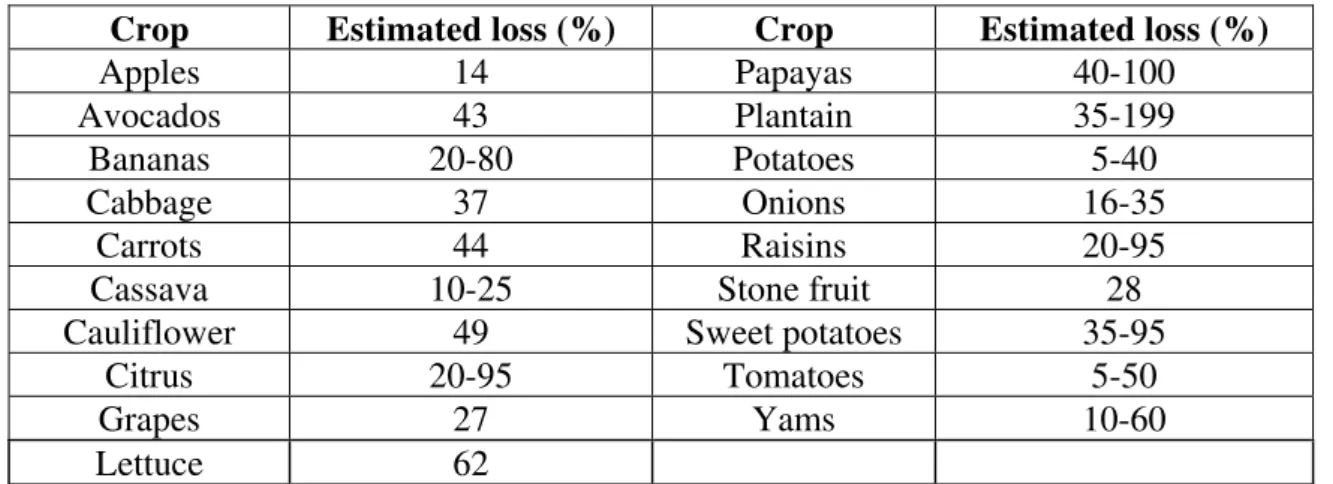
Table 1. Crop losses in less-developed countries
Crop Estimated loss (%) Crop Estimated loss (%)
Apples 14 Papayas 40-100
Avocados 43 Plantain 35-199 Bananas 20-80 Potatoes 5-40 Cabbage 37 Onions 16-35
Carrots 44 Raisins 20-95
Cassava 10-25 Stone fruit 28
Cauliflower 49 Sweet potatoes 35-95
Citrus 20-95 Tomatoes 5-50
Grapes 27 Yams 10-60 Lettuce 62
Source : http://www.nepadst.org/platforms/foodloss.shtml
Overcoming the perishability of the crops, enhancing nutritional value and adding
economic value through processing are the main ways of enlarging food security in Africa.
Available technologies for processing roots and tubers limit these crops from reaching their
full potential as sources of both food and income [4]. The development and introduction of
new processing technologies offer potential to improve food security and local
industrialization [5]. Research information on mechanization of planting and harvesting of
cassava are available [6]. There are on-going researches on manual and mechanized
processing of cassava [7]. Mechanized cassava processing is now established activity and
there are several cassava processing plants [11]. Despite the steady increase in the rate of
adoption of mechanized cassava processing there are factors which militate against the
adoption of the technology. Mechanized cassava processing is often not a viable venture
because the products have to compete with traditional products which are under-priced. The
tuber the juice has to be removed and this juice is toxic [8]. Removal of juice from cassava is
one of the most difficult processes [7]. Cassava processors cannot afford large and costly
equipment they often depend on local ways and dewatering methods available [9]. Cassava
processing equipment operators in traditional and small scale cassava processing plants also
have limited managerial capabilities and training due to little formal education and this
militates against the success recorded in the research so far in cassava mash dewatering.
Cake dewatering process involved removal of filtrate trapped within the void-age of a
filter cake. This is done by the application of de-saturating forces on the cake. The force may
be mechanical, as when the cake is compressed to reduce its void volume and at the same
time its moisture content or the force may be hydrodynamic to effect displacement of the
retained filtrate by sucking or blowing air through the cake. De-watering by compressing
reduces the cake moisture content although the saturation remains at unity. It is desirable to
be able to predict the level of discharge from a filter, and the time required to reach that level.
Both factors are of considerable practical importance as subsequent processing steps usually
impose limitations on the acceptable moisture level in the discharged solids. The cake solids
constitute the final product, and the cake must be transported bone dry. The criteria are to
minimize the cost of thermal drying by minimizing the amount of moisture to be removed. In
many processes efficient dewatering of the cake is economically beneficial. If the void
volume of a filter cake is completely filled with a fluid, it is said to be saturated with that
fluid. If the voids are only partially filled by a fluid, the fractional volume of voids occupied
by the fluid is referred to as the saturation S of that fluid. For simplicity and uniformity it is
usual practice to express the saturation in terms of the wetting fluid.
S = (Volume of wetting fluid in cake) / (Void volume of cake) (1)
A second term commonly used to express the quantity of liquid held by the cake is the
moisture content, defined as the weight of liquid in the cake per unit weight of dry solids, i.e.:
s
ρ ρ 1 S
M ⋅
∈ −
∈
= (2)
where M= Moisture content, ∈ = Volume of void divided by volume of cake, ρ= liquid
density and ρs= cake density.
For any particular pressure gradient across the cake, residual filtrate will drain from
the voids until a balance between the capillary forces and the drainage force is obtained;
liquid is withdrawn from the cake. The liquid remaining gives rise to a ‘residual equilibrium
saturation’ or 'irreducible saturation’. The final cake moisture content is dependent on the
process variables, the properties of the liquid and the structure of the cake [11].
New dewatering schemes to make food processing economical to handle are well
known. Common dewatering processes use a variety of mechanical means such as screw
presses, belt presses, and vacuum filters etc. How difficult can it be to remove juice from
cassava mash cake?
The objective of this paper was to determine ease of removing the juice during
dewatering cassava mash.
Material and Method
Mash was made from cassava tuber by grating, a TMS 4(2) 1425 variety was used
Cassava mash cake is a compressible material and the specific resistance α changes with the
pressure drop across the cake, the function α: α=f(Δp)
(3)
α=α0(Δpc)n (4)
From Kolawole et al., (2007) the cake resistance can be rated as average cake
resistance αav. Darcy's basic filtration equation relating the flow rate Q of a filtrate of
viscosity through a bed of thickness L and face area A to the driving pressure Δp can we
written in the form:
L p A K
Q= Δ (5)
where K = the permeability and R = the resistance to juice flow, then the medium thickness
divided by the permeability will give the value of the resistance R =L/K. The resistant from
the filter as R and mash cake as Rc, then L=(R+Rc)K. Equation 5 can be written as:
R p A
Q= Δ (6)
R ) A / V ( c α pA Q + Δ = (7)
and in reciprocal form, equation 7 can be written as:
p A R p A V c α dV dt
2Δ + Δ
= (8)
Thus giving time per unit flow, the mathematical simplicity of the equations defines
two constants a1 and b1: a1 =
αμ
c and b1 = R . The experimental determination of α and R,was done in the form:
b aV V t + = (9) where p A 2 a a 21
Δ
= and
p A
b
b 1
Δ
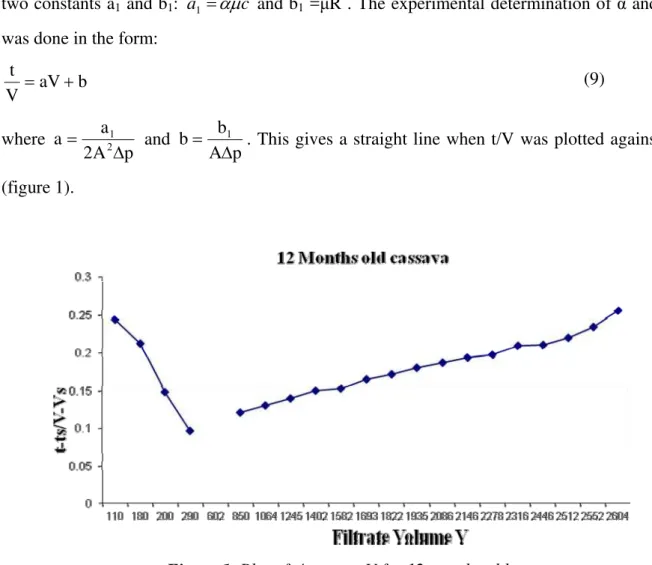
= . This gives a straight line when t/V was plotted against V
(figure 1).
Figure 1. Plot of t/v versus V for 12 months old cassava
The increasing resistance of cakes with pressure, was obtained with test data from
constant pressure operations the function α=f(Δp) was employed directly using equation:
m c p p p=Δ +Δ
Δ (10)
where Pc is the pressure on cake and Pm is the pressure receive by filter medium and pressure
at wish the moisture content of the cassava mash meets the processing requirement, 46-50%
Sample A
At a pressure of ΔP = 48300 N/m², of water is 0.001Ns/M² (Adopted for cassava
juice at 200C). C is the concentration of cassava juice obtained from the pressed water
18kg/m³. Area of cylindrical press radius = 0.03m = π r² = 0.0707m²
Slope = 5714286s/m6 a = 5714286s/m6
Intersect = 75000s/m3 b = 40600s/m³
Vs = 0.000602m³ b + aVs = intersect ∆P = 48300 N/m² a=α c/2A2∆P
=0.001 b = R/A∆P
C = 18kg/m3 α = 2A2a∆P/ c
A = 0.0707m2 α = 1.533×10¹¹m/kg
Sample B
b= R/(∆P×A)
R= (∆P×A×b)/ = 1.386×10¹¹/m
Sample C
From a=α /2A²∆P →α = 2A²∆Pa / C=5.365×10¹¹
R calculated from b = µR/AΔP = 7776s/m³
R = A ΔPb ÷ = 2.6654×10¹¹ s/m3 = 0.001Ns/m
Slope = 114,427 861 S/m6 C = 18kg/m³
Intersect = 1,160,00 S/m³ A = 0.0707m²
Vs = 0.00173m³ b+aVs = intersect
ts =180sec b= 962,039.80
ΔP = 48300N/m²
Calculating α from a = α C→α=2A²Δpa/ C = 3.0696 x 10¹¹ m/kg
b = C/ AΔP
R = AΔPb/ = 3.285 x 10¹¹/m
From the samples, average specific cake resistance (α), m/kg .
Sample A: α is 1.533 × 10¹¹m/kg ;
Sample C: α is 3.0696 × 10¹¹ m/kg.
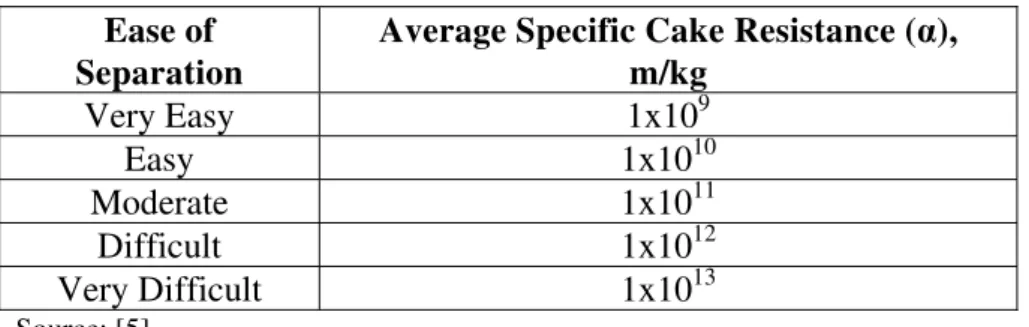
The results above were compared with Table 2.
Table 2. Ease of Separation
Ease of Separation
Average Specific Cake Resistance (α), m/kg
Very Easy 1x10⁹
Easy 1x10¹⁰
Moderate 1x10¹¹
Difficult 1x10¹²
Very Difficult 1x10¹³ Source: [5]
Results and Discussion
From table 2, it was confirmed that average specific cake resistant of 1X10¹¹ is a
moderate ease to separate. Cassava mash has average resistance of 5X10¹¹ this will be
moderate when it comes to ease of juice separation from the cake. Separating mash cake from
liquids is an important step in cassava mash processing; this operation is known as
dewatering. Methods for doing this depend on the discovered qualities and how well the solid
and liquid are mixed together. These experiments prove that separating cassava cake from the
liquids in a grated mash cannot be accomplished with very easy.
Solid-liquid mixtures of mash is heterogeneous, this consists of two distinct separation
boundaries. The result of this experiment proved that machines may be needed. Moderate
force required for the liquid to be separated from solid will need the use of pressure to reduce
the liquid level. Decantation as a method may rely on sedimentation, if coarse particles of the
solid are heavier than the liquid, it will not settle down at the bottom due to the interaction of
solid and liquid. If the liquid is poured out, the mixture will still need additional means to
force the liquid out. Filtration method may be selected to separate the mixtures of the mash
through a porous material. The insoluble solid might be trapped in residue this may require
more pressure to force out the liquid. Filtration in addition to little pressure to expression the
liquid may be passing through the filters. The liquid will not be in pure form since pressure
was used, finer filter may help if the smaller particles are needed for other uses in form of
starch for laundry.
Overcoming the perishability of cassava through research is the only way to
enhancing the nutritional value and economic value of cassava. Making processing easy is the
main way of enlarging food security in the world. The limits associated with available
technologies for processing roots and tubers crops are now receiving attention; the crops are
reaching their full potential as sources of both food and income.
Conclusion
This report made it clear that cassava mash cake is not ease to dewater but processing
with simple machine can increase the shelf-life. New technologies for processing the roots
and tubers can now be scientifically developed. Introduction of processing technologies will
offer potentials to improve food security and local industrialization. This information will go
a long way to assist design engineers and food technologists to improve cassava processing.
Acknowledgements
Innovator of Tomorrow (IOT) grant of Science and Technology Education Post-Basic
(STEP-B) Project in Nigeria is acknowledged for its financial support for this work.
References
1. Kolawole O.P., Agbetoye L.A.S, Ogunlowo A.S., Cassava Mash Process Handling.
Proceedings of the Second International Conference on Chemical Engineering and
Advance Materials CEAM2010-VF Nov 15th to 26th, 2010, pp. 97-111. Available at:
2. Hartman P., Value Addition Key to Cassava Revolution in Nigeria, Former Director
General of IITA Speech to Stake Holders Forum, CFC-funded Cassava Value Chain
Project in Nigeria Implemented by IITA, 2011, Available at:
http://www.thisdaylive.com/articles/value-addition-key-to-cassava-revolution-in-nigeria/9881.
3. Kolawole O.P., Agbetoye L.A.S., Ogunlowo A.S., Samuel T.M., Effect of Speed and Back
Pressure on the Performance of Screw Press in Dewatering of Cassava Mash Greener,
Journal of Science Engineering and Technological Research, 2012, 2(1), p. 017-023,
Available at: www.gjournals.org.
4. Olusegun H.D., Ajiboye T.K., The Design, Construction and Testing of a Vertical
Squeeze Cassava Pulp Dewatering Machine, International Journal of Engineering and
applied Sciences, 2010, 2, 27-43.
5. Adzimah S.K., Gbadam E.K., Modification of the Designs of Cassava Grating and
Cassava Dough Pressing Machines into a Single Automated Unit. European Journal of
Scientific Research ISSN 1450-216X, 2009, 38(2), 306-314. Available at:
http://www.eurojournals.com/ejsr.htm.
6. Kolawole O.P., Agbetoye L.A.S., Ogunlowo A.S., Sustaining World Food Security with
Improved Cassava Processing Technology: The Nigeria Experience Sustainability, 2010,
2, 3681-3694. Available at: www.mdpi.com/journal/sustainability.
7. Abass A., Rweyendela V., Chisawilo P., Training on cassava processing, market
expansion for cassava products, and development of a combined cassava grater, IITA
Work Planning Week4-10 Dec., 2003.
8. Oyegbami A., Oboh G., Omueti O., Cassava Processors’ Awareness of Occupational and
Environmental Hazards Associated with Cassava Processing in South-Western Nigeria.
Ajfand Online, 2010, 10(2), Available at: www.Ajfand.net/Issue32/PDFs/
Oyegbimi1985.pdf
9. Kolawole O.P., Agbetoye L.A.S., Ogunlowo A.S., Cassava Mash Dewatering
Parameters. Int. J. Food Eng., 2007, 3, Article 4, Available at:
10.Leu W., Principles of Compressible Cake Filtration, Encyclopedia of Fluid Dynamics,
Vol. 5 ,in ed: NP Cheremisinoff, Editor, Gulf Publishing, Houston, 1986.
11.Sanni L., Alenkhe B., Edosio R., Patino M., Dixon A., Technology Transfer in
Developing Countries: Capitalizing on Equipment Development .Journal of Food,