Trophic ecology of
Mugil liza
at the southern limit of its distribution (Buenos
Aires, Argentina)
In order to get to know the habitat and feeding habits
of
Mugil liza
on the southern coast of Buenos Aires
province, 65 specimens obtained at two sampling
si-tes - the San Blas bay (SBB) and the mouth of the
Quequén-Salado river (QSR) - during spring
(No-vember 2012) and summer (February 2013) were
analyzed. Specimens were measured, sexed and
wei-ghed, their stomachs were removed and their
stoma-ch contents weighed and analyzed under the
stereos-copic microscope. The specimens were adults, 28-49
cm in length and weighing 380-1100 g. Population
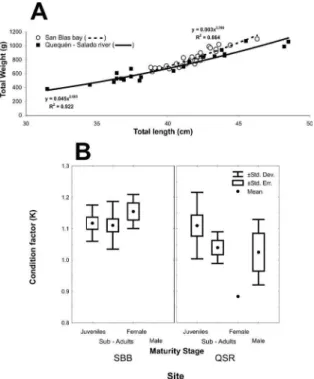
growth was higher in the SBB (TW: 0.003*TL3.36),
than in RQS (TW: 0.045*TL2.61). About 98% of
the stomachs had some content, their repletion rate
being of between 0.4 and 1.2%. About 75% of the
stomachs contained very ine sand with few benthic
organisms (algae, copepods, foraminifera), whereas
the remaining 25% of stomachs contained coarse
sand and a greater presence of benthic fauna
(am-phipods, bivalves, gastropods and coral organisms).
The linear relationship between the weight of
sto-mach contents and the total weight and length of the
ish showed that the rates of growth (slope) were the
same at both sites, but intercept values were signii
-cantly higher for San Blas bay (test parallelism;
p
<
0.001).
A
bstrAct
Gustavo Thompson
1,*, Roberta Callico Fortunato
1, Ignacio Chiesa
2, Alejandra Volpedo
11 Instituto de Investigaciones en Producción Animal, Facultad de Ciencias Veterinarias, Universidad de Buenos Aires - INPA (CONICET-UBA)
(Av. Chorroarin 280. CABA, Buenos Aires, Argentina)
2 Museo Argentino de Ciencias Naturales "Bernardino Rivadavia" (CONICET)
(Buenos Aires, Argentina)
*Corresponding author: [email protected]
Financial Support: Universidad de Buenos Aires, UBACYT 20620110100007 Agencia Nacional de Promoción Cientíica y Tecnológica, PICT BICENTENARIO PICT Nº 2010-1372 CONICET, PIP 11220120100479CO
Descriptors:
Mugil liza
, Diet, Organic matter,
Sediments.
Para conhecer o habitat e os hábitos alimentares de
Mugil liza
na costa sul de Buenos Aires, 65
exem-plares obtidos durante a primavera (novembro de
2012) e o verão (fevereiro de 2013) foram
anali-sados em duas áreas de amostragem: na Baía San
Blas (SBB) e na foz do rio Quequén-Salado (QSR).
Os exemplares foram medidos, pesados, o sexo foi
identiicado, os estômagos foram removidos e os
conteúdos estomacais pesados e analisados sob
este-reomicroscópio. Os espécimes de
M. liza
eram
adul-tos com comprimenadul-tos entre 28-49 cm e pesos entre
380-1100 g. O crescimento populacional foi maior
na SBB (TW: 0,003*TLx3,36), do que na QSR
(TW: 0,045*TL^2,61). Em 98% dos estômagos, ha
-via conteúdo estomacal e o índice de repleção variou
entre 0,4 e 1,2%. Um total de 75% dos conteúdos
estomacais foi composto de areia muito ina, com
pouca presença de organismos bentônicos (algas,
copépodas, foraminíferos), enquanto que em 25%
dos estômagos havia areia grossa, com um aumento
da presença de organismos da fauna bentônica (an
-fípodas, bivalves, gastrópodes e corais). As relações
lineares entre o peso do conteúdo estomacal e o peso
total e comprimento do peixe mostraram que as
ta-xas de crescimento (inclinação) foram as mesmas
em ambas as áreas de amostragem, mas os valores
do intercepto foram signiicativamente maiores na
Baía San Blas (teste
t
;
p
< 0,001).
r
esumo
INTRODUCTION
Mugil liza is a species found in the coastal waters exten-ding from Rio de Janeiro (Brazil) to Argentina, being most common in the South of São Paulo State and in estuarine regions of Lagoa dos Patos, Río de La Plata, Samborombón Bay and Mar Chiquita (COUSSEAU et al., 2005; ACUÑA PLAVAN et al., 2010; FISCHER et al., 2011; LORENZO et al., 2011; GARBIN et al., 2014). The taxonomic status of M. liza has not yet been deined; FRAGA et al. (2007) sug -gest that M. liza and M. platanus should be treated as a sin-gle species and considered part of M. cephalus (a species of cosmopolitan distribution, WHITFIELD et al., 2012), be-cause of the limited level of genetic divergence between the two species. DURAND et al. (2012) proposed the existence of the ‘M. cephalus species complex’ which would consist of up to 14 species, which already includes M. cephalus, M. liza, and M. platanus. On the other hand, HERAS et al. (2009) suggest that Mugil platanus and M. liza should be regarded as a single species closely related to but distinct from M. cephalus, while GONZALEZ CASTRO et al. (2008) noted that M. platanus (M. liza) differs from M. cephalus because of its mitochondrial ADN, morphometric and meristic characters.
Information on the life history of the Mugillidae fami-ly is available onfami-ly at the local level, there being no global view (WHITFIELD et al., 2012); mullet larval stages feed on plankton in the marine environment and a month after
they reach the postlexion larval stage they migrate to the
coast; juvenile and sub-adult stages develop in estuarine waters and change their diet from planctophagous to de-tritivorous, feeding mainly on detritus and benthic micro-algae (DE SILVA, 1980). Adults migrate to open water to spawn and complete their cycle, and evidence suggests that there are no changes in the diet with the increase in the size of the body.
Detritivorous ishes are considered to transform
the environment they inhabit, so knowledge of their fe-eding habits and the interrelation of this species with the environment is essential for the management of this cross-border resource; however, feeding studies on the area of the distribution of M. liza (M. platanus) are very few. JEREZ; CHRISTIANSEN (1987) studied the stoma-ch contents of 3 specimens from the Mar Chiquita lagoon, ACHA (1990) studied the diet of juveniles up to 60 mm SL in Samborombón Bay and Mar Chiquita estuary, while OLIVEIRA; SOARES (1996) recorded the diet of juve-niles and adults of these mugillidae in Sao Paulo, Brazil.
The purpose of this study was to get to know the eco-logical habitat and feeding ecology of M. liza at the sou-thern limit of its distributional range, covering San Blas bay and the mouth area of the Quequén-Salado river (on the south coast of Buenos Aires province, Argentina).
MATERIAL AND METHODS
Specimens of M. liza were obtained at two sampling sites - Quequén-Salado river and San Blas bay (Figure 1) - in spring (November 2012) and summer
(February 2013) - using different ishing gear in each
place. Specimens were measured (TL: total length in mm), weighed (TW: total weight in g) and their maturation stage (juvenile, sub-adults and adults) determined by macrosco-pic description of the gonads, in accordance with ESPER et al. (2000, 2001), GONZALEZ CASTRO et al. (2009). The stomach was removed and opened longitudinally. The stomach content was weighed (SWC) and preserved in al-cohol 80%. Function TW: a•TL^b was used to obtain the weight-length relation at each sampling site and
matura-tion stage was determined to detect signiicant growth sta -ge (FROESE, 2006). The condition factor (k) was estima-ted by K: TW/TL3, following RICKER (1975). Functions SWC: a•TW + b and SWC: a•TL + b were used to calcu-late the relationship of the stomach content’s weight to the total weight and length. Parameters a and b of each equa-tion were calculated using the generalized least squares
method. In order to determine if there were signiicant di
-fferences between the two sampling sites, the coeficients
a and b of each of the above relationships were compared (ZAR, 1999). The rate of stomach repletion was estima-ted according to ALBERTINI-BERHAUT (1974), where CR: SWC•100/TW. Possible differences in CR value be-tween sampling sites and maturation stage were analyzed using a two-factor ANOVA. Due to the small number of specimens analyzed, maturation stages were grouped in two levels: juveniles and adults (sub-adults, females and males). Each stomach’s contents were analyzed under the stereoscopic microscope (40 x). The predominant texture of the sediments registered in the stomach was described according to the Wentworth scale (WENTWORTH, 1922)
and benthic organisms were individualized and identiied
occurrence could be estimated: %F: (Ni/Nt)•100, where Ni is the number of stomachs in which the food item was found and Nt is the total number of stomachs. Percentage of number (%N), volume (%V), index of relative impor-tance (IRI) and index of absolute imporimpor-tance (AI) could not be estimated since the food items would need to be physically discriminated (and their number, volume and weight estimated), which was impossible because of the presence of organic remains. The presence of total organic matter (% dry weight) in the stomach content was estima-ted by the difference in weight between the dry weight of stomach contents, after being dried at 90º C for 72 h and the weight of the ash after the combustion of samples in
a mufle furnace at 450º C for 24 hours (as modiied by
SARGENT et al., 1983). Possible differences in concen-trations between sampling sites, maturation stages and se-diment types were analyzed using a three-factor ANOVA.
0.88 to 1.28, being similar in juveniles of both sites but
sig-niicantly greater in adults in SBB than in RQS (Figure 2B).
About 98% of the stomachs had some content. The
stoma-ch content weight of the spring samples was signiicantly
lower than that of the summer ones in QSR (ANOVA, F1, 28:33.00 p < 0.001), so only that the inter-site comparison of the summer samples was undertaken. The relationships between stomach content weight and total length and
wei-ght were signiicant (0.001 < p < 0.028; Figure 3, 4). The comparison of these functions between the two sampling sites showed that the rates of increase (slope) were the same (parallelism test t; p > 0.13) while the a (intercept) values
were signiicantly higher in SBB that in QSR (parallelism
test t; p < 0.001). The a (intercept) parameter may be con-sidered an indicator of good physiological condition in a population, given the conditions in a certain environment (PAULY, 1984). The index of stomach repletion showed values between 0.4 and 1.2%, which indicates a
predomi-nance of half-illed stomachs. There is no signiicant diffe -rence between juveniles and adults and it is only slightly higher in SBB than in QSR (ANOVA F1.42:3.79 p = 05), so M. liza incorporated somewhat more sediments in SBB than in the QSR. About 80% (SBB) and 75% (QSR) of
stomach contents consisted of very ine sand, silt and clay
with a slight presence of benthic organisms - which differed between sites and seasons (%F < 11%, copepods, foramini-fera, algae, etc. Table 2). Over 38% of juveniles had food items in their stomach content with this type of sediment, while this happened to less than 11% of adults. In the rest of the specimens their stomachs presented mainly coarse sands and a greater presence of benthic fauna, which diffe-red according to the sampling site (%F > 40%; Table 2). All the juveniles analyzed with this type of sediments in their stomach content presented food items. Coral organisms and nematodes were recorded in the area of QSR. On the other hand, amphipods, bivalves and gastropod molluscs were found in individuals of the SBB area. Among the amphi-pod specimens of the family Corophiidae, Ampeliscidae, Phoxocephalidae, Lysianassidae, Ochlesidae and Aoridae were recorded. Most amphipods were in good condition and
their concentration luctuated between 4 and 67 individuals
per stomach.
Content of total organic matter (n = 57) ranged from 2.7 to 7% and differed between the types of sediment that were recorded in the stomachs; their concentrations being
signiicantly greater in the case of stomachs with sedi
-ments composed of very ine sand and silt than in the case
of stomachs containing coarse sand. However, in these
Figure 1. Geographical location of sampling sites, and main rivers in the area. Coastal bathymetry is also shown.
RESULTS
Size distribution was assessed for each season, site and maturity stage of a total of 65 M. liza specimens analyzed
(Table 1). There were no signiicant differences between
sites for total length and weight values. The rate of allo-metric increase (b) of the length - weight relationship,
showed no signiicant difference as between juveniles and
Table 1. Range of total length and number of M. liza specimens (n) analyzed by sampling area and season
Total length range (mm)
J SA F M
RQS - SP 285-407 (12) 416 (1) 449-457 (2) 438 (1) RQS - SU 315-381 (12) 404-433 (5) 440-482 (2) 440-485 (3) SBB - SU 388-419 (9) 391-434 (14) 434-463 (4)
-RQS: Quequén-Salado river; SBB: San Blas Bay; SP: Spring; SU: Summer; J: Juvenile; SA: Sub-adult; F: Female; M: Male.
Figure 2. A. Total weight to total length relationship for Mugil liza
specimens in both sampling areas. B. Condition factor (k) for each maturation stage at both sites. RQS: Quequén-Salado river; SBB: San Blas bay.
Figure 3. Total stomach content to total weight relationship for
Mugil liza specimens in both sampling sites. Trendlines and linear
equation are shown. Black dots indicate stomach content with coarse
sand sediment type and white dots content with very ine sand-clay
sediment type.
Figure 4. Total stomach content to total length relationship for
Mugil liza specimens at both sampling sites. Trendlines and linear
equation are shown. Black dots indicate stomach content with coarse
sand sediment type and white dots content with very ine sand-clay
sediment type.
latter one there was a greater percentage of total organic matter in the food due to the presence of benthic
organis-ms, mainly amphipods (Table 2). In the case of ine sand
and silty sediments, the total amount of organic matter in
the stomach content was signiicantly higher in SBB than
in QSR (3-way ANOVA, F1.39:5.46, P:0.02) and higher in adults than in juveniles (3-way ANOVA, F1.39:5.59, p = 0.02) (Figure 5). This result is in agreement with the higher weight to total length relationship and higher con-dition factor determined for SBB specimens.
DISCUSSION
Mugil liza showed differences in its trophic ecology at the southern limit of its distributional range. The northern
Table 2. Percentage occurrence of food items (%) in M. liza stomach content, by sampling area, season, predominant sediment type
Gastropods Foraminifers Algae Copepods Ostracods Bivalves Amphipods Nematodes Coralline rests
RQS-SP-FS 8 8 8 - - - -RQS-SU-FS 11 - - 6 6 6 - - -SBB-SU-FS - - - 5 - 5 RQS-SU-CS - - - 50 75 SBB-SU-CS 40 - - - - 40 80 -
-RQS: Quequén-Salado river; SBB: San Blas bay; SP: Spring; SU: Summer; FS: ine sand sediment type: CS: coarse sand sediment type.
Figure 5. Percentage of organic matter contribution (mean, standard error) in stomach content of Mugil liza, by main sediment type in the stomach and sampling place: (QSR) Quequén-Salado river and (SBB) San Blas bay.
characteristics determined differences between the ben-thic communities, on which M. liza feeds, of the two sites
(BREMEC; LASTA, 1998). These were relected in the
dissimilar benthic fauna registered in the stomach content of the southern (SBB) and northern (QSR) samples which were also dissimilar as regards the type of sediment found in the stomach content of M. liza at each site. The level of
the taxonomic identiication of benthic organisms in the food content did not permit a more speciic comparison between sites. This is, however, the irst study to show am -phipods in the diet of M. liza, since previous reports on the stomach contents of M. liza indicate the presence of
ben-thic diatoms and dinolagellates together with copepods
and other metazoa (OLIVEIRA; SOARES, 1996; JEREZ; CHRISTIANSEN, 1987).
Several papers have concluded that mugilids feed on microalgae, detritus, sediments and metazoa (ODUM & HEALD, 1975; KING, 1988; OLIVEIRA; SOARES, 1996). Our results suggest that the diet of Mugil liza is
based on organisms associated with ine sediments - both
in the case of juveniles and adults. However, only 35% of stomach contents showed some recognizable bentho-nic organism beyond the sediments, which points to the importance of the organic matter associated with the sediments. The importance of organic matter and detritus
as food for mugilids has been described for the tropical estuarine habitats characterized by the presence of man-groves (OLIVEIRA; SOARES, 1996). Detritus has a high energetic value due to the complex ecosystem that orga-nic matter-bacteria-fungi-protozoa form as a single unit (ODUM; HEALD, 1975).
The differences in mean organic matter found in each type of stomach content and between sites suggest that M. liza uses different habitats, related to varied local
dep-ths. The high contribution of stomach content with ine
sediments in both areas corroborated the preference of
mugilids for a ine clay-silt rather than a coarser bottom
(ODUM; HEALD, 1975). Fine sediment particles ha-ve organic matter absorbed or adsorbed, so the smaller the particle the larger is its relative food value (ODUM, 1968). RUBIO et al. (2000) found a good correlation
be-tween organic matter and ine-grained sediments in an
environment in Spain; deeper waters were characterized
by iner sediments because of low energy levels and hi -gher values of organic matter, while shallow waters were characterized by coarse sediments and lower values of organic matter. CARRANZA-EDWARDS et al. (2005) found sandy (coarse) sediments (with less organic
mat-ter) near the coastline, and iner ones (with more plenti -ful organic matter) in deep waters, in Southern Mexico. Despite those authors, the contribution of organic mat-ter regismat-tered in the sediments in this present study was among the lowest detected for the stomach content of mugilids [8-31% for Mugil liza (ACHA, 1990); 5.9-9.8% for Mugil cephalus (ODUM, 1970); 5-30% for Chelon labrosus (HICKLING, 1970)]. The small contribution of organic matter in the sediments and lower condition factors than those described for northern populations of M. liza during summer (GARBIN et al., 2014) may be indicative of the nutritional condition of this species at the southern limit of its distributional range.
of total length, and simultaneous studies of local benthic fauna. In addition to and in the light of the importance of organic matter in the diet of M. liza and the presen-ce of organic and inorganic toxic substanpresen-ces associated with sediments at the southern limit of its distribution (BOTTÉ et al., 2010; ROSSO et al., 2013), it is impor-tant that the intake and accumulation of these elements through the diet of M. liza should be analyzed. Our re-sults show a different habitat-species relationship at the southern limit of the distributional range of M. liza and thus it is necessary to investigate other methods of study
for the identiication of different populations of M. liza on the Buenos Aires coast (applied parasite studies, ge-netics, otolith microchemistry, etc.).
ACKNOWLEDGEMENTS
The authors wish to thank the Universidad de Buenos Aires and the Agencia Nacional de Promoción
Cientíica y Tecnológica for the funding received from
UBACYT 20620110100007 and PICT BICENTENARIO PICT-2010-1372, respectively.
REFERENCES
ACHA, E. M. Estudio anatómico-ecológico de la lisa (Mugil liza) durante su primer año de vida. Frente Marit., v. 7, p. 37-43, 1990.
ACUÑA PLAVAN, A.; PASSADORE, C.; GIMÉNEZ, L. Fish assemblage in a temperate estuary on the uruguayan coast: seasonal variation and environmental inluence. Braz. J. Oceanogr., v. 58, n. 4, p. 299-314, 2010.
ALBERTINI-BERHAUT, J. Biologie des stades juveniles de Te-leosteens Mugilidae Mugil auratus Risso 1810, Mugil capito Cuvier 1829 et Mugil saliens Risso 1810. Aquaculture, v. 4, n. 2, p. 13-27, 1974.
ALIOTTA, S.; SPAGNUOLO, J. O.; GINSBERG, S. S.; GELÓS, E. M. Sedimentos de fondo-subfondo y aspectos geomorfoló-gicos de la plataforma continental entre el estuario de Bahía Blanca y bahía Anegada, provincia de Buenos Aires. AAS Revista, v. 6, n. 1/2, p. 19-35, 1999.
BOTTÉ, S. E.; FREIJE, R. H.; MARCOVECCHIO, J. E. Distri-bution of several heavy metals in tidal lats sediments within Bahia Blanca Estuary (Argentina). Water. Air Soil Pollut., v. 210, n.1/4, p. 371-388, 2010.
BREMEC, C.; LASTA, M. Mapeo sinóptico del macrobentos asociados a la dieta en fondos de alimentación de la corvina rubia Micropogonias furnieri en el área de El Rincón, No-viembre, 1994. INIDEP Inf. Tec., v. 21, p. 117-132, 1998. CARBONE, M. E.; PICCOLO, M. C.; PERILLO, G. M.
Mor-phology and physical parameters of the Claromecó Creek Es-tuary, Argentina. An. Inter. J. Mar. Sci., v. 21, n. 2, p. 55-63, 2005.
CARRANZA-EDWARDS, A.; ROSALES-HOZ, L.; URRUTIA--FUCUGAUCHI, J.; SANDOVAL-FORTANEL, A.; MO-RALES DE LA GARZA, E.; LOZANO SANTA CRUZ, R. Geochemical distribution pattern of sediments in an active continental shelf in Southern Mexico. Cont. Shelf Res., v. 25, n. 4, p. 521-537, 2005.
COUSSEAU, M. B.; GONZÁLEZ CASTRO, M.; FIGUEROA, D. E.; GOSZTONYI, A. E. Está presente Mugil liza Valen-ciennes 1836 (Teleostei: Mugiliformes) en aguas argentinas? Rev. Biol. Mar. Oceanogr., v. 40, n. 2, p. 133-140, 2005. DE SILVA, S. S. Biology of juvenile grey mullet: a short review.
Aquaculture, v. 19, n. 1, p. 21-36, 1980.
DURAND, J. D.; CHEN, W. J.; SHEN, K. N.; FU, C.; BORSA, P. Genus-level taxonomic changes implied by the mitochondrial phylogeny of grey mullets (Teleostei: Mugilidae). C. R. Bio-logies, v. 335, n. 10, p. 687-697, 2012.
ESPER, M. D. L. P.; DE MENEZES, M. S.; ESPER, W. Escala de desenvolvimento gonadal e tamanho de primeira maturação de fêmeas de Mugil platanus Günther, 1880 da Baía de Para-naguá, Paraná, Brasil. Acta Biol. Par., v. 29, p. 255-263, 2000. ESPER, M. D. L. P.; DE MENEZES, M. S.; ESPER, W. Época
reprodutiva de Mugil platanus (Günther, 1880), Pisces Mugi-lidae da Baia de Paranaguá (Paraná, Brasil). Acta Biol. Par., v. 30, p. 5-17, 2001.
FISCHER, L. G.; PEREIRA, L. E. D.; VIEIRA, J. P. Peixes estua-rinos e costeiros. 2nd ed. Rio Grande: Pallotti, 2011. FRAGA, E.; SCHNEIDER, H.; NIRCHIO, M.;
SANTA-BRIGI-DA, E.; RODRIGUES-FILHO, L. F.; SAMPAIO, I. Molecu-lar phylogenetic analyses of mullets (Mugilidae, Mugilifor-mes) based on two mitochondrial genes. J. Appl. Ichthyol., v. 23, n. 5, p. 598-604, 2007.
FROESE, R. Cube law, condition factor and weight-length re-lationships: history, meta-analysis and recommendations. J. Appl. Ichthyol., v. 22, n. 4, p. 241-253, 2006.
GARBIN, T.; CASTELLO, J. P.; KINAS, P. G. Age, growth, and mortality of the mullet Mugil liza in Brazil’s southern and sou-theastern coastal regions. Fish. Res., v. 149, p. 61-68, 2014. GONZÁLEZ CASTRO, M.; HERAS, S.; COUSSEAU, M. B.;
ROLDÁN, M. I. Assessing species validity of Mugil platanus Günther, 1880 in relation to Mugil cephalus Linnaeus, 1758 (Actinopterygii). Ital. J. Zool., v. 75, n. 3, p. 319-325, 2008. GONZÁLEZ CASTRO, M.; ABACHIAN, V.; PERROTTA, R.
G. Age and growth of the striped mullet, Mugil platanus (Ac-tinopterygii, Mugilidae), in a southwestern Atlantic coastal lagoon (37º32´S-57º19W): a proposal for a life-history mo-del. J. Appl. Ichthyol., v. 25, n. 1, p. 61-66, 2009b.
HERAS, S.; ROLDÁN, M. I.; CASTRO, M. G. Molecular phylo-geny of Mugilidae ishes revised. Rev. Fish. Biol. Fish., v. 19, n. 2, p. 217-231, 2009.
HICKLING, C. F. A contribution to the natural history of the en-glish grey mullets [Pisces, Mugilidae]. J. Mar. Biol. Ass. UK., v. 50, n. 3, p. 609-633, 1970.
HYNES, H. B. N. The food of fresh-water sticklebacks (Gasterosteus aculeatus and Pygosteus pungitius), with a re-view of methods used in studies of the food of ishes. J. Anim. Ecol., v. 19, p. 36-58, 1950.
JEREZ, B.; CHRISTIANSEN, H. E. Estudio anatómico e histológico del sistema digestivo de la lisa (Mugil liza) de la laguna Mar Chiquita, y breve comentario sobre su alimentación. Publ. Com. Téc. Mix. Fr. Mar., v. 3, p. 79-91, 1987.
KING, R. P. New observations on the trophic ecology of Liza grandisquamis (Valenciennes, 1836) (Pisces: Mugilidae) in the Bonny river, Niger Delta, Nigeria. Cybium, v. 12, n. 1, p. 23-36, 1988.
LORENZO, M. I.; ASTARLOA, J. M.; NORBIS, W.; COU-SSEAU, M. B. Long term fish assemblages as units of management in a temperate estuary (Rio de la Plata-SW Atlantic Ocean). Braz. J. Oceanogr., v. 59, n. 1, p. 43-59, 2011.
ODUM, W. E. The ecological significance of fine particle selection by the striped mullet Mugil cephalus. Limnol. Oceanogr., v. 13, n. 1, p. 92-98, 1968.
ODUM, W. E. Utilisation of the direct grazing and plant de-tritus food chains by the striped mullet Mugil cephalus. In: STEELE J. H. (Ed.). Marine food chains. Berkeley & Los Angeles: University of California Press, 1970. p. 222-240.
ODUM, W. E.; HEALD, E. J. The detritus-based food web of an estuarine mangrove community. In: CRONIN, L. E. (Ed.). Estuarine, Research. New York: Academic Press, 1975. p. 265-286.
OLIVEIRA, I.; SOARES, L. Alimentacao da tainha Mugil platanus Günther, 1880 (Pisces: Mugilidae), da região estuarino-lagunar de Cananéia, São Paulo, Brasil. Bol. Inst. Pesca., v. 23, p. 95-104, 1996.
PALMA, E. D.; MATANO, R. P.; PIOLA, A. R. A numeri-cal study of the Southwestern Atlantic Shelf circulation: Stratified ocean response to local and offshore forcing. J. Geophys. Res., v. 113, p. 1-22, 2008.
PAULY, D. Fish population dynamics in tropical waters: a manual for the use with programmable calculators. Pe-nang: ICLARM, Studies and Reviews, 1984.
PICCOLO, M. C.; PERILLO, G. M. The Argentina estua-ries: a review. In: PERRILLO G. M.; PICCOLO, M.C.; PINO-QUIVARA, M. (Eds.). Estuaries of South America. Berlin, Heidelberg: Springer, 1999. p. 101-132.
PIOLA, A. R.; RIVAS, A. L. Corrientes en la plataforma con-tinental. In: Boschi, E. E. (Ed.). El Mar Argentino y sus recursos pesqueros. Tomo 1: Antecedentes históricos de las explotaciones en el mar y las características ambientales. Mar del Plata: INIDEP, 1997. p. 119-132.
RICKER, W. E. Computation and interpretation of biological sta-tistics of ish populations. Bull. Fish. Res. Board Can., v. 191, p. 382, 1975.
ROSSO, J. J.; SCHENONE, N. F.; CARRERA, A. P.; CIRELLI, A. F. Concentration of arsenic in water, sediments and ish species from naturally contaminated rivers. Environ. Geo-chem. Health, v. 35, n. 2, p. 201-214, 2013.
RUBIO, B.; NOMBELA, M. A.; VILAS, F. Geochemistry of ma-jor and trace elements in sediments of the Ria de Vigo (NW Spain): an assessment of metal pollution. Mar. Pollut. Bull., v. 40, n. 11, p. 968-980, 2000.
SARGENT, J. R.; HOPKINS, C. C. E.; SEIRING, J. V.; YOUNG-SON, A. Partial characterization of organic material in surfa-ce sediments from Balsfjorden, northern Norway, in relation to its origin and nutritional value for sediment-ingesting ani-mals. Mar. Biol., v. 76, n. 1, p. 87-94, 1983.
WENTWORTH, C. K. A scale of grade and class terms for clastic sediments. J. Geol., v. 30, n. 5, p. 377-392, 1922.
WHITFIELD, A. K.; PANFILI, J.; DURAND, J. D. A global review of the cosmopolitan lathead mullet Mugil cephalus Linnaeus 1758 (Teleostei: Mugilidae), with emphasis on the biology, genetics, ecology and isheries aspects of this appa -rent species complex. Rev. Fish. Biol. Fish., v. 22, n. 3, p. 641-681, 2012.
WRIGHT, R. C, Miliolidea (foraminiferos) recientes del estuario del Rio Quequen Grande. Museo Argentino, de Ciencias Na-turales. Hidrobiologia, v. 2, p. 225-256, 1968.