Life history traits inluence in gonad composition of two sympatric species of
latish
Paralichthys orbignyanus
and
Paralichthys
patagonicus
are latish with different life history
traits, having in common the condition of breeding
in seawater.
Paralichthys patagonicus
remain
their whole life in open seawater and
Paralichthys
orbignyanus
are sometimes found in brackish water
bodies. As marine and estuarine food webs have
different fatty acid (FA) compositions, the aim of this
study was to characterize the gonadal maturation of
P. orbignyanus
and
P. patagonicus
females through
the analysis of lipid content and FA proile in order
to understand to what extent life history traits are
relected in the ovarian composition. During gonadal
maturation lipid content increased and FA proiles
changed in both species, but the lipid increase was
greater in
P. orbignyanus
. The N-3FA and n-3HUFA
proportions increased in both species but were
higher in
P. orbignyanus
. The differences between
the lifestyles of these species were relected in the
ovarian FA proile mainly as a result of differences in
their FA metabolism, causing a greater accumulation
of n-3FA and n-3HUFA in
P. orbignyanus
than in
P. patagonicus
. The higher lipid accumulation in
P.
orbignyanus
’ ovaries could indicate that this species,
feeding in brackish water bodies, has the possibility
of storing more energy than
P. patagonicus
.
A
bstrAct
Juan Luis Gadea Alvarez
1,2,*, Martín Bessonart
1,3, Larisa Magnone
1, Florencia Féola
3, María Salhi
11 Laboratorio de Recursos Naturales, Facultad de Ciencias, Universidad de la República
(Iguá 4225 CP 11400 Montevideo, Uruguay)
2 Departamento de Acuicultura, Dirección Nacional de Recursos Acuáticos (DINARA) - Ministerio de Ganadería Agricultura y Pesca (Constituyente 1497 CP 11200 Montevideo, Uruguay)
3 Estación Biológica, DINARA, Parque Nacional Cabo Polonio (Cabo Polonio CP 27202 Rocha, Uruguay)
*Corresponding author: [email protected]
Descriptors:
Fatty acid proile, Lipid content, Gonadal
maturation.
Paralichthys patagonicus
e
Paralichthys orbignyanus
apresentam diferentes atributos nas suas histórias
de vida, embora ambas se reproduzam no mar.
Paralichthys patagonicus
permanece toda a vida em
águas abertas, enquanto
P. orbignyanus
é comumente
encontrado em corpos de água salobra. Considerando
que redes alimentares marinhas e estuarinas têm
diferente composição de ácidos graxos (FA), o objetivo
deste estudo foi caracterizar a maturação gonadal de
fêmeas de
P. orbignyanus
e
P. patagonicus
analisando
o conteúdo lipídico e peril FA, a im de estabelecer
se as diferenças nas histórias de vida são reletidas na
composição do ovário. Durante a maturação gonadal,
em ambas as espécies, houve aumento do teor lipídico
e o peril FA mudou, mas o incremento foi maior em
P. orbignyanus
. As proporções de N-3FA e n-3HUFA
aumentaram em ambas as espécies, mas foram
maiores em
P. orbignyanus
. As diferenças entre
os estilos de vida destas espécies foram reletidas
no peril de FA dos ovários, principalmente como
resultado das diferenças no metabolismo de FA,
causando maior acúmulo de n-3FA e n-3HUFA em
P.
orbignyanus
. O maior acúmulo de lipídios nos ovários
de
P. orbignyanus
poderia indicar que esta espécie, ao
se alimentar em águas salobras, tem a possibilidade
de armazenar mais energia do que
P. patagonicus
.
r
esumo
Descritores:
Perfil de ácidos graxos, Conteúdo
lipídico, Maturação gonadal.
INTRODUCTION
In the Argentinian-Uruguayan Common Fishery Zone (ZCP), Paralichthys patagonicus (JORDAN, 1889) and Paralichthys orbignyanus (VALENCIENNES, 1839)
are the latishes of greatest commercial importance (FABRÉ; DÍAZ DE ASTARLOA, 1996; DÍAZ DE ASTARLOA; MUNROE, 1998; DIÁZ DE ASTARLOA, 2002; HAIMOVICI; ARAÚJO, 2005; RICO, 2010). P. orbignyanus can be described as a marine/estuarine
eu-ryhaline teleost (SAMPAIO; BIANCHINI, 2002) which enters estuaries and is usually more abundant in shallow coastal waters (FABRÉ; DÍAS DE ASTARLOA, 1996; DÍAZ DE ASTARLOA; MUNROE, 1998), coastal lagoons (SILVEIRA et al,. 1995; RIVERA et al., 2001; NORBIS; GALLI, 2004) and in the mouths of rivers and streams (PLAVAN et al., 2010). This ability to live in estuarine environments together with its wide tolerance to environ-mental factors such as salinity and pH (WASIELESKY et al., 1997; SAMPAIO et al., 2001, 2002) and its high market price, make P. orbignyanus an interesting
candi-date for aquaculture (ROBALDO, 2003; BAMBILL et al., 2006; RADONIC et al., 2007; SAMPAIO et al., 2007; RADONIC; MACCHI, 2009; LANES et al., 2010).
The main difference between the lifestyles of
P. patagonicus and P. orbignyanus seems to be that P. patagonicus remains all its life in open water, while P. orbignyanus usually lives in brackish coastal water
bodies. However, both species depend on the marine environment for reproduction (SILVEIRA et al., 1995; ROBALDO, 2003; CERQUEIRA, 2005; SAMPAIO et al., 2007; CECCON et al., 2010; MILITELLI, 2011).
P. orbignyanus gametes and larvae can only survive
and develop in seawater due to their anatomical and physi-ological characteristics. Therefore these ishes depend on seawater to reproduce although they can also live in brack-ish waters (CERQUEIRA, 2005; SAMPAIO et al., 2007).
Besides sharing the place where they breed, these species also share the breeding season. The spawning season of P. orbignyanus extends from October to April
(SILVEIRA et al., 1995; ROBALDO, 2003), with a peak of reproductive activity between January and April (LANES et al., 2010), while that of P. patagonicus lasts
from September to February with a peak of maximum reproductive activity in November (MACHI; DÍAZ DE ASTARLOA, 1996). During the rest of the year outside the breeding season it is usual to ind P. orbignyanus
feed-ing in brackish waters, coastal lagoons or rivers, whereas
P. patagonicus spends the resting phase feeding in the
marine environment.
Fish, like all vertebrates studied thus far, require cer-tain long chain polyunsaturated fatty acids (PUFA) for their normal development and reproduction (SARGENT et al., 1999a, 2002). Such PUFA are called essential fatty acids (EFA) and they include members of the n-3 and the n-6 series. In their biologically active form the EFA are docosahexaenoic acid (DHA, 22:6 n-3), eicosapentaenoic acid (EPA, 20:5 n-3) and arachidonic acid (ARA, 20:4 n-6), distinctively called highly unsaturated fatty acids (HUFA). Usually, terrestrial vertebrates and freshwater ishes are capable of producing DHA and EPA from lin-olenic acid (LNA, 18:3n-3) and ARA from linoleic acid (LA, 18:2n-6). In such species LNA and LA are dietary EFA. However, marine ishes cannot perform these con-versions eficiently, therefore they must obtain DHA, EPA and ARA directly from the diet (SARGENT et al., 1999a, 1999b, 2002).
Marine and brackish water food webs have different fatty acid (FA) compositions and it is not clear whether marine ishes can meet their FA requirements in brackish water (ALFARO et al., 2006; RICHOUX; FRONEMAN, 2008; ARTS et al., 2009; KOUSSOROPLIS et al., 2011). Marine ecosystems are rich in PUFA, mainly HUFA of the n-3 series (n-3HUFA) such as DHA and EPA. These n-3HUFA are provided by organisms such as diatoms and lagellates which are at the base of marine food webs (ARTS et al., 2009). In estuarine ecosystems saturated FA (SAFA) are predominant over monounsaturated FA (MUFA) and PUFA (ALFARO et al., 2006; RICHOUX; FRONEMAN, 2008; KOUSSOROPLIS et al., 2011), therefore DHA and EPA are less abundant in these ecosys-tems than in seawater.
As marine and estuarine food webs have different FA composition, the aim of this study was to characterize the gonadal maturation of P. orbignyanus and P. patagonicus
females through the analysis of lipid content and FA proile in order to understand to what extent life history traits are relected in the ovarian composition.
MATERIAL AND METHODS
F
ishsamplinganddatacOllectiOnP. orbignyanus and P. patagonicus adult females were
season (summer) were not included in this analysis due to the low number of samples obtained and the extreme vari-ability observed in the ovarian composition.
P. orbignyanus females collected during fall and winter
were obtained in mid-May and mid-July, respectively, from artisanal isheries in “Laguna de Rocha”, a brackish water coastal lagoon semi-connected to the ocean in southeastern Uruguay. Females collected during spring were captured in the Rio de la Plata and the adjacent Atlantic coastal areas from November to December during a coastal survey of the National Committee for Aquatic Resources (DINARA, B/I “Aldebarán”). P. patagonicus females collected in
the fall were captured in March-April during a DINARA coastal survey. Coastal industrial isheries in Montevideo port gave us females collected during winter and spring in mid-August and late October, respectively. All P. patagoni-cus samples were captured in the Rio de la Plata and the
adjacent Atlantic coastal areas. Flounder species were iden-tiied according to COUSSEAU; PERROTA, 2000.
Total length, total weight and gonad weight of each ish collected were measured. Samples of gonads were stored at -20º C for biochemical analysis. The bodily con-dition of individuals was estimated using Fulton´s condi-tion factor (K) (RICKER, 1975), as follows:
at a rate of 2º C min-1 and maintained at 212º C for 13 min.
FA were identiied by comparing retention times of methyl ester standards (Supelco) using a well characterized ish oil as a reference.
s
tatisticalanalysisData were analysed statistically using a one-way anal-ysis of variance (ANOVA) and Student´s t-test for means comparison (SOKAL; ROHLF, 2009). The signiicance level was set at p < 0.05.
RESULTS
O
varian cOmpOsitiOn and cOnditiOn FactOr thrOughOutthereprOductivecycleThe evolution of ovarian composition and condition factor during the reproductive cycle is shown in Table 1. Total lipids was signiicantly lower in fall than in win-ter and spring for both species. Besides, P. orbignyanus
showed a signiicantly higher amount of lipids in spring than in the other seasons. Moisture content was constant in ovaries of both species. The condition factor (K) in
P. patagonicus was signiicantly higher in spring, whereas
no signiicant differences between winter and fall were seen. In P. orbignyanus the K value remained constant
throughout the three seasons (Table 1).
c
OmpOsitiOnOFOvariesandcOnditiOn FactOrindiFFerentseasOns(
cOmparisOn betweenspecies)
Total lipid content in the ovaries of P. orbignyanus
was higher than in those of P. patagonicus’in winter and
spring, while no signiicant differences between species were found in the fall (Table 1). The moisture content was signiicantly different only in winter, resulting in a higher value in P. orbignyanus. The K value in winter
and fall was signiicantly higher in P. orbignyanus than in P. patagonicus, while in spring no signiicant differences
between species were seen (Table 1).
O
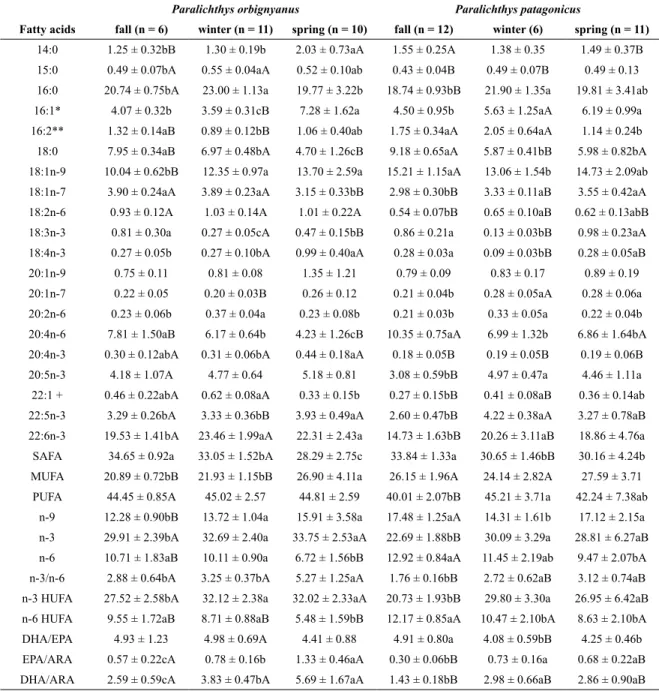
varyFattyacidprOFileduringthe reprOductivecycleThe evolution of the ovarian FA proile throughout the reproductive cycle of P. patagonicus and P. orbignyanus
is shown in Table 2. In all ovarian samples analysed 41 FA were identiied, representing over 95% of all FA detected.
K = 100 (TW/TL3)
where K is Fulton’s condition factor, TW is total ish weight and TL is the total length.
b
iOchemicalanalysisTable 1. Moisture evolution (%) and total lipids (% dry weight) of ovaries and condition factor (K) of P. orbignyanus and P. patagonicus throughout the reproductive cycle.
Paralichthys orbignyanus Paralichthys patagonicus
fall (n = 6) winter (n = 11) spring (n = 10) fall (n = 12) winter (6) spring (n = 11)
Moisture 82.72 ± 2.75 83.95 ± 2.54A 83.27 ± 3.15 82.76 ± 1.67 81.22 ± 0.56B 81.94 ± 1.49 Total lipid 4.45 ± 1.21c 5.55 ± 0.62bA 13.29 ± 4.26aA 3.92 ± 0.34b 4.92 ± 0.35aB 5.05 ± 1.33aB
K 1.13 ± 0.04A 1.10 ± 0.07A 1.04 ± 0.22 1.01 ± 0.06bB 0.98 ± 0.10bB 1.06 ± 0.01a
Results are expressed as means ± SD; n = number of samples; within a row, means without a common superscript lowercase letter differed signiicantly between seasons for each species and values without a common superscript uppercase letter differed signiicantly between both species in the same season (ANOVA, p < 0.05).
PUFA were predominant in both species, followed by SAFA and inally by MUFA. The SAFA percentage was signiicantly higher in the fall for both species, showing signiicant differences between winter and spring in
P. orbignyanus. Only in P. orbignyanus was the MUFA
percentage signiicantly different between seasons, being higher in spring than in the other seasons. The predominant SAFA were 16:0 and 18:0, while the predominant MUFA were 18:1n-9 and 18:1n-7. The PUFA percentage remained constant in P. orbignyanus, while in P. patagonicus this
value was signiicantly lower in the fall. In both species the predominant PUFA were DHA, ARA and EPA. N-3 FA, n-3 HUFA and DHA proportions were signiicantly lower in fall than in winter and spring for both species, while the opposite was observed for n-6 FA, n-6 HUFA and ARA. The EPA percentage was signiicantly lower in fall than in winter and spring in P. patagonicus,
while in P. orbignyanus it remained constant throughout
the reproductive cycle. In P. patagonicus the 18:2n-6
proportion was signiicantly higher in winter than in fall and spring, while in P. orbignyanus it remained constant
throughout the reproductive cycle. In contrast, the 18:3n-3 percentage was signiicantly lower in winter than in fall and spring for both species. The 18:4n-3 proportion was higher in spring than in winter for both species, particularly for P. orbignyanus. The DHA/EPA ratio in P. patagonicus
was lower in the fall than in winter and spring, and in P. orbignyanus no signiicant differences were found at any
time during the reproductive cycle. Meanwhile, for both species DHA/ARA and EPA/ARA ratios were lower in fall than in winter and spring (Table 2).
O
varianFattyacidprOFileindiFFerent seasOns(
cOmparisOnbetweenspecies)
A comparison of the ovarian FA proile between the two species is shown in Table 2. In spring, propor-tions of SAFA, MUFA and PUFA showed no signiicant
differences. In fall, the PUFA percentage was signii-cantly higher in P. orbignyanus, while in P. patagonicus
the MUFA percentage was signiicantly higher in fall and winter. In winter the SAFA proportion was signiicantly higher in P. orbignyanus. Except in winter, when no
sig-niicant variations were found, the proportions of n-3 FA and n-3 HUFA were signiicantly higher in P. orbignyanus
than in P. patagonicus. Differences in n-3 HUFA
propor-tions in spring were mainly determined by variapropor-tions in minor n-3 HUFA, such as 22:5n-3 and 20:4n-3, since no signiicant differences between species were found in EPA and DHA proportions in spring. The percentage of 18:3n-3 was signiicantly higher in P. orbignyanus in winter and in P. patagonicus in spring, while in fall no signiicant
dif-ferences between both species were observed. Meanwhile proportions of n-6 FA and n-6 HUFA were signiicantly higher in P. patagonicus than in P. orbignyanus in the
three seasons studied. However, the ARA percentage was higher in P. patagonicus in fall and spring, while in
winter no signiicant differences between the two spe-cies were found. The percentage of 18:2n-6 was always signiicantly higher in P. orbignyanus. The DHA/EPA
ra-tio only showed signiicant differences between the two species in winter, it being higher in P. orbignyanus. The
EPA/ARA and DHA/ARA ratios were signiicantly higher in P. orbignyanus in the three seasons studied (Table 2).
DISCUSSION
It is well known that ishes experience different chang-es in their biochemical composition throughout their life-time in response to diet variations, environmental factors and reproductive cycles (HUYNH et al., 2007; PÉREZ et al., 2007; HUANG et al., 2010; XU et al., 2010).
Table 2. Fatty acid proile evolution during the reproductive cycle (% of total fatty acids) in the ovaries of P. orbignyanus and P. patagonicus.
Paralichthys orbignyanus Paralichthys patagonicus
Fatty acids fall (n = 6) winter (n = 11) spring (n = 10) fall (n = 12) winter (6) spring (n = 11)
14:0 1.25 ± 0.32bB 1.30 ± 0.19b 2.03 ± 0.73aA 1.55 ± 0.25A 1.38 ± 0.35 1.49 ± 0.37B 15:0 0.49 ± 0.07bA 0.55 ± 0.04aA 0.52 ± 0.10ab 0.43 ± 0.04B 0.49 ± 0.07B 0.49 ± 0.13 16:0 20.74 ± 0.75bA 23.00 ± 1.13a 19.77 ± 3.22b 18.74 ± 0.93bB 21.90 ± 1.35a 19.81 ± 3.41ab 16:1* 4.07 ± 0.32b 3.59 ± 0.31cB 7.28 ± 1.62a 4.50 ± 0.95b 5.63 ± 1.25aA 6.19 ± 0.99a 16:2** 1.32 ± 0.14aB 0.89 ± 0.12bB 1.06 ± 0.40ab 1.75 ± 0.34aA 2.05 ± 0.64aA 1.14 ± 0.24b 18:0 7.95 ± 0.34aB 6.97 ± 0.48bA 4.70 ± 1.26cB 9.18 ± 0.65aA 5.87 ± 0.41bB 5.98 ± 0.82bA 18:1n-9 10.04 ± 0.62bB 12.35 ± 0.97a 13.70 ± 2.59a 15.21 ± 1.15aA 13.06 ± 1.54b 14.73 ± 2.09ab 18:1n-7 3.90 ± 0.24aA 3.89 ± 0.23aA 3.15 ± 0.33bB 2.98 ± 0.30bB 3.33 ± 0.11aB 3.55 ± 0.42aA 18:2n-6 0.93 ± 0.12A 1.03 ± 0.14A 1.01 ± 0.22A 0.54 ± 0.07bB 0.65 ± 0.10aB 0.62 ± 0.13abB 18:3n-3 0.81 ± 0.30a 0.27 ± 0.05cA 0.47 ± 0.15bB 0.86 ± 0.21a 0.13 ± 0.03bB 0.98 ± 0.23aA 18:4n-3 0.27 ± 0.05b 0.27 ± 0.10bA 0.99 ± 0.40aA 0.28 ± 0.03a 0.09 ± 0.03bB 0.28 ± 0.05aB
20:1n-9 0.75 ± 0.11 0.81 ± 0.08 1.35 ± 1.21 0.79 ± 0.09 0.83 ± 0.17 0.89 ± 0.19
20:1n-7 0.22 ± 0.05 0.20 ± 0.03B 0.26 ± 0.12 0.21 ± 0.04b 0.28 ± 0.05aA 0.28 ± 0.06a 20:2n-6 0.23 ± 0.06b 0.37 ± 0.04a 0.23 ± 0.08b 0.21 ± 0.03b 0.33 ± 0.05a 0.22 ± 0.04b 20:4n-6 7.81 ± 1.50aB 6.17 ± 0.64b 4.23 ± 1.26cB 10.35 ± 0.75aA 6.99 ± 1.32b 6.86 ± 1.64bA 20:4n-3 0.30 ± 0.12abA 0.31 ± 0.06bA 0.44 ± 0.18aA 0.18 ± 0.05B 0.19 ± 0.05B 0.19 ± 0.06B 20:5n-3 4.18 ± 1.07A 4.77 ± 0.64 5.18 ± 0.81 3.08 ± 0.59bB 4.97 ± 0.47a 4.46 ± 1.11a
22:1 + 0.46 ± 0.22abA 0.62 ± 0.08aA 0.33 ± 0.15b 0.27 ± 0.15bB 0.41 ± 0.08aB 0.36 ± 0.14ab 22:5n-3 3.29 ± 0.26bA 3.33 ± 0.36bB 3.93 ± 0.49aA 2.60 ± 0.47bB 4.22 ± 0.38aA 3.27 ± 0.78aB 22:6n-3 19.53 ± 1.41bA 23.46 ± 1.99aA 22.31 ± 2.43a 14.73 ± 1.63bB 20.26 ± 3.11aB 18.86 ± 4.76a SAFA 34.65 ± 0.92a 33.05 ± 1.52bA 28.29 ± 2.75c 33.84 ± 1.33a 30.65 ± 1.46bB 30.16 ± 4.24b MUFA 20.89 ± 0.72bB 21.93 ± 1.15bB 26.90 ± 4.11a 26.15 ± 1.96A 24.14 ± 2.82A 27.59 ± 3.71
PUFA 44.45 ± 0.85A 45.02 ± 2.57 44.81 ± 2.59 40.01 ± 2.07bB 45.21 ± 3.71a 42.24 ± 7.38ab n-9 12.28 ± 0.90bB 13.72 ± 1.04a 15.91 ± 3.58a 17.48 ± 1.25aA 14.31 ± 1.61b 17.12 ± 2.15a n-3 29.91 ± 2.39bA 32.69 ± 2.40a 33.75 ± 2.53aA 22.69 ± 1.88bB 30.09 ± 3.29a 28.81 ± 6.27aB n-6 10.71 ± 1.83aB 10.11 ± 0.90a 6.72 ± 1.56bB 12.92 ± 0.84aA 11.45 ± 2.19ab 9.47 ± 2.07bA n-3/n-6 2.88 ± 0.64bA 3.25 ± 0.37bA 5.27 ± 1.25aA 1.76 ± 0.16bB 2.72 ± 0.62aB 3.12 ± 0.74aB n-3 HUFA 27.52 ± 2.58bA 32.12 ± 2.38a 32.02 ± 2.33aA 20.73 ± 1.93bB 29.80 ± 3.30a 26.95 ± 6.42aB n-6 HUFA 9.55 ± 1.72aB 8.71 ± 0.88aB 5.48 ± 1.59bB 12.17 ± 0.85aA 10.47 ± 2.10bA 8.63 ± 2.10bA DHA/EPA 4.93 ± 1.23 4.98 ± 0.69A 4.41 ± 0.88 4.91 ± 0.80a 4.08 ± 0.59bB 4.25 ± 0.46b EPA/ARA 0.57 ± 0.22cA 0.78 ± 0.16b 1.33 ± 0.46aA 0.30 ± 0.06bB 0.73 ± 0.16a 0.68 ± 0.22aB DHA/ARA 2.59 ± 0.59cA 3.83 ± 0.47bA 5.69 ± 1.67aA 1.43 ± 0.18bB 2.98 ± 0.66aB 2.86 ± 0.90aB
Results are expressed as means ± SD; n = number of samples; within a row, means without a common superscript lowercase letter differed signiicantly between seasons for each species and means without a common superscript uppercase letter differed signiicantly between species in the same season (ANOVA, p < 0.05). * includes n-9, n-7 and n-5 isomers; ** includes n-3 and n-4 isomers; + includes n-11, n-9 and n-7 isomers.
resting phase (from the end of one breeding season to the beginning of the new breeding season), together with important changes in FA proile throughout the reproduc-tive cycle. The accumulation of lipid reserves in gonads in marine teleosts has been widely studied (TAKAMA et al., 1985; CHATZIFOTIS et al., 2004; GARRIDO et al., 2007; HUYNH et al., 2007). The lipid mobilization to the gonads supplies raw material, energy and EFA
necessary for the genesis and normal egg development (SARGENT et al., 2002).
FA composition of the ovaries of P. orbignyanus and P. patagonicus showed a typical marine proile, mainly
the season even in P. orbignyanus females collected in a
brackish coastal lagoon semi-connected to the ocean. In both species PUFA was composed mostly of n-3HUFA. It is known that HUFA affect ishes’ re-production either directly or through their metabolites (SARGENT et al., 2002). As marine ishes are not able to synthesize their own HUFA eficiently they must ob-tain them from their diet (SARGENT et al., 1999a, 1999b, 2002). Lipid and FA composition of broodstock diet has been identiied as one of the most important di-etary factors determining reproductive success in ishes (IZQUIERDO et al., 2001). In some species, it has been observed that n-3HUFA content in broodstock diets in-creases fecundity, fertilization, egg quality and larval via-bility (FERNÁNDEZ-PALACIOS et al., 1995; FURUITA et al., 2000). Thus, taking into account the high levels of n-3HUFA observed in the ovaries of P. patagonicus and P. orbignyanus, high diet requirements of n-3HUFA could
be expected.
Gonads of both species had particularly high levels of ARA, which exceeded the EPA proportion in almost all the specimens analyzed, mainly those captured during the resting phase. In other ish species studied the EPA/ARA ratio in gonads and eggs is greater than 1 (GARRIDO et al., 2007; HUYNH et al., 2007; HUANG et al., 2010; XU et al., 2010), even in other latishes such as Solea senegalensis
(NORAMBUENA et al., 2012) and Paralichthys adspersus
(WILSON, 2009). The selective retention of ARA has been observed in other estuarine ishes and it has been attributed to the environmental stress conditions to which ishes are exposed (KOUSSOROPLIS et al., 2011). There is evidence that ARA is important in generating an appropriate physi-ological response to environmental stress, such as changes in salinity (BELL; SARGENT, 2003).
Regarding bodily condition, the K values showed differences between the two species throughout the year. Such differences could be caused by their different life-styles. According to the K values, P. patagonicus females
were in better physical condition at the beginning of the spawning season than during the resting phase. On the oth-er hand, the physical condition of P. orbignyanus females
remained constant throughout the reproductive cycle. K values in P. patagonicus were signiicantly lower than
in P. orbignyanus during the resting phase but they were
similar for both species at the beginning of the spawning season. On the other hand, although the ovarian lipid con-tent increased signiicantly in both species during gonadal maturation, it was signiicantly higher in P. orbignyanus.
We believe that during the cold seasons (fall and winter) there is less food available for latishes in the sea, which could be relected in a decrease of K values and a reduced accumulation of lipids in P. patagonicus’ gonads during
the resting phase. P. orbignyanus would not be affected by
the lower availability of food during the cold season be-cause it can live in brackish water courses probably taking refuge during adverse months in estuarine environments where more food is available. On the other hand, another factor to be considered is that osmoregulation is an en-ergy expensive process (TSENG; HWANG, 2008), there-fore for a euryhaline ish such as P. orbignyanus it might
be more economical to live in an isosmotic environment. The isosmotic point estimate for P. orbignyanus is 10.9‰
(SAMPAIO; BIANCHINI, 2002), the salinity likely to be found in a brackish coastal lagoon such as “Laguna de Rocha” (CONDE et al., 2000). However, it is also known that in P. orbignyanus, as in other species, growth
hor-mone levels increase after suffering hyperosmotic stress, whereby the highest growth rates in P. orbignyanus would
be obtained in seawater (MEIER et al., 2009). Despite this, SAMPAIO et al., 2001 observed no signiicant varia-tions in the growth rates of P. orbignyanus cultured at
sa-linities such as 30ppt and 11ppt. Thus, the combined effect of sparing energy with osmoregulation and getting more food by remaining in brackish water environments could allow P. orbignyanus to maintain a stable condition
fac-tor throughout the year, unlike P. patagonicus that lives
in seawater all the year round. We need further research into lipid and FA composition of ish muscle in order to establish whether P. orbignyanus females were better fed
than P. patagonicus during the recovery phase.
The ability of P. orbignyanus to maintain its condition
factor stable and accumulate lipids in its tissues during cold seasons based mainly on an estuarine diet, does not explain the higher amount of n-3HUFA accumulated in their gonads than in those of P. patagonicus, which feed
solely in seawater. Comparing FA proiles between the two species, we observed that the proportions of n-3 FA and n-3HUFA were higher in P. orbignyanus, while n-6 FA and
the n-6HUFA proportions were higher in P. patagonicus,
contrary to what we expected to ind considering their different lifestyles. Assuming that the estuarine diet of
P. orbignyanus is poorer in n-3HUFA than in the marine
diet of P. patagonicus, the proportion of n-3HUFA found
in P. orbignyanus equivalent to or even higher than that
found in P. patagonicus could be explained by a selective
FA which appear in low concentration in their diet. This ability has been observed in other estuarine ishes of high trophic level, presenting more FA such as n-3HUFA than that found in their diet. Such selective retention of HUFA has been associated with a limited availability of this FA in the food web and also clearly shows an eficient ability to retain FA (KOUSSOROPLIS et al., 2011). P. orbignyanus
is a high trophic level predator in coastal lagoons (RODRÍGUEZ-GRAÑA et al., 2008), so the accumulation of certain FA which are found in low proportion in their estuarine diet, such as n-3HUFA, is to be expected. Additionally we could consider the possibility of a greater ability of P. orbignyanus to elongate and desaturate LNA
to DHA and EPA. This is in accordance with the higher proportion of 18:4n-3 and 20:4n-3 (the intermediate metabolites in the process to elongate and desaturate LNA to DHA EPA) (SARGENT et al., 2002) found in
P. orbignyanus compared to that in P. patagonicus. This
ability is shared with many vertebrates; it is not, however, common in marine ishes (SARGENT et al., 1999a, 1999b, 2002) although there is strong evidence suggesting that turbot (Scophthalmus maximus), another species of latish,
has the ability to transform LNA and LA, respectively, into EPA and ARA (SARGENT et al., 2002). However, this is a hypothesis and further laboratory experiments are needed to establish whether P. orbignyanus is capable of
selecting and retaining FA which are in low concentration in its diet or if they are capable to elongating and desaturating LNA eficiently. Furthermore, it was observed that the proportion of LA was greater in P. orbignyanus
throughout its reproductive cycle, probably relecting the FA composition of its estuarine diet. This FA is abundant in terrestrial/continental food webs such as freshwater streams and may also be abundant in estuaries (ALFARO et al., 2006; RICHOUX; FRONEMAN, 2008; KOUSSOROPLIS et al., 2011) being much rarer in the marine environment (SARGENT et al., 2002. ARTS et al., 2009).
In brief, differences between the lifestyles of these two species are relected in the ovarian FA proile mainly as a result of differences in their FA metabolism, causing higher accumulation of n-3 FA and n-3 HUFA in P. orbyg-nyanus than in the more oceanic P. patagonicus latishes.
The greater accumulation of lipids in the ovaries of
P. orbignyanus could indicate that this species, feeding in
brackish water bodies, is able to accumulate more energy than P. patagonicus, but to conirm this hypothesis further
studies of muscle lipid and FA composition are needed.
ACKNOWLEDGEMENTS
We would like to thank the Dirección Nacional de Recursos Acuáticos (DINARA) for providing us with bio-logical samples from the B/I Aldebarán coastal surveys. We are also grateful to the ishermen working at Rocha lagoon for allowing us access to the biological samples of
P. orbignyanus during their work. We also thank the
anon-ymous reviewers for their supportive comments which helped us in the preparation of this manuscript.
REFERENCES
ALFARO, A. C.; THOMAS, F.; SERGENT, L.; DUXBURY, M. Identiication of trophic interactions within an estuarine food web (northern New Zealand) using fatty acid biomarkers and stable isotopes. Estuar. Coast. Shelf Sci., v. 70, n. 1/2, p. 271-286, 2006.
ARTS, M. T.; BRETT, M. T.; KAINZ, M. J. (Eds.). Lipids in Aquatic Ecosystems. New York: Springer, 2009. 377 p. BAMBILL, G. A.; OKA, M.; RADONIC, M.; LOPEZ, A. V.;
MÜLLER, M. I.; BOCCANFUSO, J. J.; BIANCA, F. A. Broodstock managenent and induced spawning of
loun-der Paralichthys orbignyanus (Valenciennes, 1839) under a
closed recirculated system. Rev. Biol. Mar. Oceanogr., v. 41, n. 1, p. 45-55, 2006.
BELL, J. G.; SARGENT, J. R. Arachidonic acid in aquaculture feeds: current status and future opportunities. Aquaculture, v. 218, n.1/4, p. 491-499, 2003.
CERQUEIRA, V. R. Egg development of Paralichthys orbignya-nus (Valenciennes, 1839). Braz. Arch. Biol. Techn., v. 48, n.
3, p. 459-465, 2005.
CHATZIFOTIS, S.; MUJE, P.; PAVLIDISA, M.; AGREN, J.; PAALAVUO, M.; MÖLSÄ, H. Evolution of tissue composi-tion and serum metabolites during gonadal development in the common dentex (Dentex dentex). Aquaculture, v. 236, n,
1/4, p. 557-573, 2004.
CHRISTIE, W. W. Lipid analysis: isolation, separation, identi-ication, and structural analysis of lipids. Oxford: Pergamon Press, 1982. 207 p.
CONDE, D.; AUBRIOT, L.; SOMMARUGA, R. Changes in UV penetration associated with marine intrusions and freshwater discharge in a shallow coastal lagoon of the southern Atlantic Ocean. Mar. Ecol. Prog. Ser., v. 207, p. 19-31, 2000. COUSSEAU, M. B.; PERROTTA, R. B. Peces Marinos de
Argentina: biología, distribución y pesca. Mar del Plata: INIDEP-SAGPyA, 2004. 167 p.
DÍAZ DE ASTARLOA, J. M. A review of the latish isheries of the south Atlantic Ocean. Rev. Biol. Mar. Oceanogr., v. 37, n. 2, p. 113-125, 2002.
DÍAZ DE ASTARLOA, J. M.; MUNROE, T. A. Systematics, dis-tribution and ecology of comercially important paralichthyid lounders occurring in Argentinian-Uruguayan waters ( Para-lichthys, Paralichthyidae): an overview. J. Sea Res., v. 39, n.
FABRÉ, N. N.; DÍAZ DE ASTARLOA, J. M. Pleuronectiformes de importancia comercial del Atlántico sudoccidental, entre los 34º30´ y 55º S. Distribución y consideraciones sobre su pesca. Rev. Invest. Des. Pesq., v. 10, p. 45-55, 1996. FERNÁNDEZ-PALACIOS, H.; IZQUIERDO, M. S.;
ROBAI-NA, L.; VALENCIA, A.; SALHI, M.; VERGARA, J. Effect of n-3 HUFA level in broodstock diets on egg quality of gil-thead seabream (Sparus aurata L.). Aquaculture, v. 132, p.
325-337, 1995.
FOLCH, J. M.; LEES, M.; SLOANE STANLEY, G. H. A simple method for the isolation and puriication of total lipids from animal tissues. J. Biol. Chem., v. 226, n. 1, p. 497-509, 1957. FURUITA, H.; TANAKA, H.; YAMAMOTO, T.; SHIRAISHI,
M.; TAKEUCHI, T. Effects of n-3 HUFA levels in broodstock diet on the reproductive performance and egg and larval qual-ity of the Japanese lounder, Paralichthys olivaceus.
Aquacul-ture, v. 187, n. 3/4, p. 387-398, 2000.
GARRIDO, S.; ROSA, R.; BEN-HAMADOU, R.; CUNHA, M. E.; CHÍCHARO, M. A.; VAN DER LINGEN, C. D. Effect of maternal fat reserves on the fatty acid composition of sardine
(Sardina pilchardus) oocytes. Comp. Biochem. Phys. B., v.
148, n. 4, p. 398-409, 2007.
HAIMOVICI, M.; ARAÚJO, J. N. Paralichthys patagonicus
(Jordan, 1889). In: ROSSI, C. L. W.; CERGOLE, M. C.; ÁVILA-DA-SILVA, A. O. (Eds.). Análise das Principais Pes-carias Comerciais da Região Sudeste-Sul do Brasil: Dinâmica Populacional das Espécies em Exploração. Série Documentos Revizee-Score Sul. São Paulo: IOUSP, 2005. p. 116-123. HUANG, X.; YIN, Y.; SHI, Z.; LI, W.; ZHOU, H.; LV, W.
Lip-id content and fatty acLip-id composition in wild-caught silver pomfret (Pampus argenteus) broodstocks: Effects on gonad
development. Aquaculture, v. 310, n. 1/2, p. 192-199, 2010. HUYNH, M. D.; KITTS, D. D.; HU, C.; TRITES, A. W.
Com-parison of fatty acid proiles of spawning and non-spawning Paciic herring, Clupea harengus pallasi. Comp. Biochem.
Phys. B., v. 146, n, 4, p. 504-511, 2007.
IZQUIERDO, M. S.; FERNÁNDEZ-PALACIOS, H.; TACON, A. G. J. Effect of broodstock nutrition on reproductive per-formance of ish. Aquaculture, v. 197, n. 1/4, p. 25-42, 2001. KOUSSOROPLIS, A. M.; BEC, A.; PERGA, M. E.;
KOUTRA-KIS, E.; BOURDIER, G.; DESVILETTES, C. Fatty acid transfer in the food web of a coastal Mediterranean lagoon: Evidence for high arachidonic acid retention in ish. Estuar. Coast. Shelf Sci., v. 91, n. 3, p. 450-461, 2011.
LANES, C. F. C.; OKAMOTO, M. H.; BIANCHINI, A.; MARINS, L. F.; SAMPAIO, L. A. Sperm quality of Brazilian lounder Paralichthys orbignyanus throughout the
reproduc-tive season. Aquac. Res., v. 41, p. 199-207, 2010.
MACHI, G. J.; DÍAZ DE ASTARLOA, J. M. Ciclo Reproduc-tivo y Fecundidad del Lenguado Paralichthys patagonicus
Jordan, en Jordan y Goss 1889. Rev. Invest. Des. Pesq., v. 10, p. 73-83, 1996.
MEIER, K. M.; FIGUEIREDO, M. A.; KAMIMURA, M. T.; LAURINO, J.; MAGGIONI, R.; PINTO, L. S.; DELLAGOS-TIN, O. A.; TESSER, M. B.; SAMPAIO, L. A.; MARINS, L. F. Increased growth hormone (GH), growth hormone recep-tor (GHR), and insulin-like growth facrecep-tor I (IGF-I) gene tran-scription after hyperosmotic stress in the Brazilian lounder
Paralichthys orbignyanus. Fish Physiol. Biochem., v. 35, p.
501-509, 2009.
MILITELLI, M. I. Paralichthys patagonicus spawning areas
and reproductive potential in the Bonaerense Coastal Zone, Argentina (34º-42ºS). Lat. Am. J. Aquat. Res., v. 39, n. 1, p. 131-137, 2011.
NORAMBUENA, F.; ESTEVEZ, A.; BELL, G.; CARAZO, I.; DUNCAN, N. Proximate and fatty acid compositions in muscle, liver and gonads of wild versus cultured broodstock of Senegalese sole (Solea senegalensis). Aquaculture, v.
356-357, p. 176-185, 2012.
NORBIS, W.; GALLI, O. Hábitos de alimentación del lenguado
Paralichthys orbignyanus (Valenciennes, 1842) en una
lagu-na costera somera del Atlántico Sur: Rocha, Uruguay. Cienc. Mar., v. 30, n. 4, p. 619-626, 2004.
PLAVAN, A. A.; PASSADORE, C.; GIMENEZ, L. Fish assem-blage in a temperate estuary on the uruguayan coast: seasonal variation and environmental inluence. Braz. J. Oceanogr., v. 58, n. 4, p. 299-314, 2010.
PÉREZ, M. J.; RODRÍGUEZ, C.; CEJAS, J. R.; MARTÍN, M. V.; JEREZ, S.; LORENZO, A. Lipid and fatty acid content in wild white seabream (Diplodus sargus) broodstock at
differ-ent stages of the reproductive cycle. Comp. Biochem. Phys. B., v. 146, n. 2, p. 187-196, 2007.
RADONIC, M.; MACCHI, G. J. Gonadal sex diferentiation in cultured juvenile founder, Paralichthys orbignyanus
(Valen-ciennes, 1989). J. World Aquac. Soc., v. 40, n. 1, p. 129-133, 2009.
RADONIC, M.; MÜLLER, M. I.; LÓPEZ, A. V.; BAMBILL, G. A.; SPINEDI, M.; BOCCANFUSO, J. J. Improvement in lounder Paralichthys orbignyanus controlled spawning in
Argentina. Cienc. Mar., v. 33, n. 2, p. 187-196, 2007. RICO, M. R. Pesquería de lenguados en el ecosistema costero
bonaerense al norte de 39º S. Frente Marít., v. 21, p, 129-135, 2010.
RICHOUX, N.; FRONEMAN, P. Trophic ecology of dominant zooplankton and macrofauna in a temperate, oligotrophic South African estuary: a fatty acid approach. Mar. Ecol. Prog. Ser., v. 357, p. 121-137, 2008.
RICKER, W. Computation and interpretation of biological statis-tics of ish populations. Bull. Fish. Res. Board Can., v. 191, 1975. p. 382.
RIVERA, A.; GARCÍA, S. B.; DÍAZ DE ASTARLOA, J. M. Feeding Ecology of Flatish Juveniles (Pleuronectiformes) in Mar Chiquita Coastal Lagoon (Buenos Aires, Argentina). Estuaries, v. 24, n. 6A, p. 917-925, 2001.
ROBALDO, R. B. Estudo comparativo da reproduçao do lin-guado Paralichthys orbignyanus (Valenciennes,1839) no
ambiente e em cativeiro. PhD Thesis. Rio Grande: Fundação Universidade Federal do Rio Grande, 2003. 190 p.
RODRÍGUEZ-GRAÑA, L.; CALLIARI, D.; CONDE, D.; SELLANES, J.; URRUTIA, R. Food web of a SW Atlantic shallow coastal lagoon: spatial environmental variability does not impose substantial changes in the trophic structure. Mar. Ecol. Prog. Ser., v. 362, p. 69-83, 2008.
SAMPAIO, L. A.; BIANCHINI, A. Salinity effects on osmoregu-lation and growth of the euryhaline lounder Paralichthys
or-bignyanus. J. Exp. Mar. Biol. Ecol., v. 269, p. 187-196, 2002.
SAMPAIO, L. A.; BIANCHINI, A.; CERQUEIRA, V. R. Growth of juvenile Brazilian lounder, Paralichthys orbignyanus
SAMPAIO, L. A.; FREITAS, L. S.; OKAMOTO, M. H.; LOU-ZADA, L. R.; RODRIGUES, R. V.; ROBALDO, R. B. Ef-fects of salinity on Brazilian lounder Paralichthys orbignya-nus from fertilization to juvenile settlement. Aquaculture, v.
262, n. 2/4, p. 340-346, 2007.
SARGENT, J.; BELL, G.; McEVOY, L.; TOCHER, D.; ESTE-VEZ, A. Recent developments in the essential fatty acid nutri-tion of ish. Aquaculture, v. 177, n. 1/4, p. 191-199, 1999a. SARGENT, J.; McEVOY, L.; ESTEVEZ, A.; BELL, G.; BELL,
M.; HENDERSON, J.; TOCHER, D. Lipid nutrition of ma-rine ish during early development: current status and future directions. Aquaculture, v. 179, p. 217-229, 1999b.
SARGENT, J. R.; TOCHER, D. R.; BELL, J. G. The lipids, In: HALVER, J. E.; HARDY, R. W. (Eds.). Fish Nutrition. 3. ed. San Diego: Elsevier, 2002. p. 181-257.
SILVEIRA, M. P. M.; COUSIN, J. C. B.; HAIMOVICI, M. Estru-tura ovárica e testicular do linguado Paralichthys orbignya-nus (Valenciennes, 1939). Atlântica, v. 17, p. 135-152, 1995.
SOKAL, R. R.; ROLHF, F. J. Introduction to Biostatistics. 2. ed. New York: Dover Publications, 2009.
TAKAMA, K.; LOVE, R. M.; SMITH, G. L. Selectivity in mobi-lization of stored fatty acids by maturing cod, Gadus morrhua
L. Comp. Biocheam. Physiol., v. 80B, n. 4, p. 713-718, 1985. TSENG, Y. C; HWANG, P. P. Some insights into energy metabo-lism for osmoregulation in ish. Comp. Biocheam. Physiol. C., v. 148, n. 4, p. 419-429, 2008.
WASIELESKY, Jr., W.; BIANCHINI, A.; SANTOS, M. H. S.; POERSCH, L. Tolerance of juvenile latish Paralichthys or-bignyanus to acid stress. J. World Aquacult. Soc., v. 28, n. 2,
p. 202-204, 1997.
WILSON, R. Dietary effects of n-3 highly unsaturated fatty acid levels on egg and larval quality, and the fatty acid composi-tion of the eggs of Chilean lounder Paralichthys adspersus
broodstock. Aquac. Res., v. 40, n. 12, p. 1400-1409, 2009. XU, J.; YAN, B.; TENG, Y.; LOU, G.; LU, Z. Analysis of nutrient
composition and fatty acid proiles of Japanese sea bass
Late-olabrax japonicus (Cuvier) reared in seawater and freshwater.