R
EVIEWA
RTICLE Revista Brasileira de FisioterapiaEvidence based practice guidelines for
management of low back pain: physical
therapy implications
Diretrizes de prática clínica baseada em evidências para avaliação e tratamento
de lombalgia: implicações para fisioterapia
Carlos E. Ladeira
Abstract
Background: Low back pain (LBP) is the most common disorder seen in physical therapy practice. There are several hundred clinical trials on the management of LBP. To summarize these trials, researchers wrote Evidence Based Practice (EBP) guidelines. This article reviewed the implications of EBP guidelines recommendations for physical therapy practice. Objectives: To review the recommendations for conservative management of LBP published in EBP guidelines since 2002. Methods: Searches were performed on the following databases: Google web searching engine, Medline, Cochrane Library, and the Guideline Clearing House. Guidelines published in English and addressing conservative management of LBP were included. Results: Thirteen multidisciplinary and three mono-disciplinary guidelines met the inclusion criteria. LBP was triaged into three groups: with red flags, with radiculopathy, or non-specific. Patients without red flags could be safely managed without specialist referral. Patient education was recommended for all patients with LBP. There was an agreement to advise spine manipulation for patients with acute and sub-acute non-specific LBP. There was a consensus to recommend exercises for acute, sub-acute, and chronic LBP. Few guidelines addressed conservative management of LBP with radiculopathy. Overall, the guidelines did not offer specific advice for manipulation (hypomobility or instability) and exercise (stabilization or directional preference).
Conclusion: Multidisciplinary guidelines focused on primary care and lacked details significant for physical therapy practice. There is a need for mono-disciplinary physical therapy guidelines to improve the balance between evidence and professional relevance.
Keywords: evidence based practice; guidelines; physical therapy; low back pain.
Resumo
Contextualização: Lombalgia é o sintoma mais comum tratado por Fisioterapeutas. Existem centenas de estudos controlados aleatorizados que lidam com o tratamento de lombalgias. Para resumir tais centenas de artigos, pesquisadores escreveram guias de prática clínica baseados na evidência (PBE) para orientar clínicos a lidarem com tal problema. Objetivos: Revisar as implicações clínicas dos guias de PBE para o tratamento de lombalgia. Métodos: Esta revisão incluiu guias publicados a partir de 2002. A pesquisa dos guias foi feita nos seguintes websites e base de dados: Google, Medline, Cochrane Library e a Guideline Clearing House. Guias escritos em inglês e que abordavam o tratamento conservador de lombalgia foram incluídos. Resultados: As diretrizes (13 multidisciplinares e três monodisciplinares) dividiram a lombalgia em três grupos: com bandeira vermelha, com radiculopatia e não específica. Lombalgias sem bandeira vermelha podem ser tratadas sem encaminhamento médico. A educação do paciente sobre o curso natural benigno da lombalgia foi recomendado para pacientes sem bandeira vermelha. A manipulação foi recomendada para lombalgia não especifica aguda e subaguda e exercícios foram recomendados para lombalgia não específica aguda, subaguda e crônica. Poucas diretrizes fizeram recomendações para lombalgia com radiculopatia. Elas não ofereceram recomendações específicas para manipulação (hipomobilidade versus instabilidade) e exercícios (estabilização versus preferência direcional). Conclusão: A maioria das diretrizes era multidisciplinar (cuidado primário de lombalgia), com poucos detalhes relevantes para o Fisioterapeuta. Faltam diretrizes monodisciplinares de Fisioterapia para equilibrar evidência científica com relevância clínica profissional.
Palavras-chave: prática baseada em evidências; Fisioterapia; lombalgia.
Received: 28/04/2011 – Revised: 06/05/2011 – Accepted: 07/06/2011
Physical Therapy Program, Nova Southeastern University, Fort Lauderdale, Florida, United States of America
Correspondence to: Carlos E. Ladeira, Physical Therapy Program, College of Allied Health and Sciences, Nova Southeastern University, Ft. Lauderdale, FL, USA, 33328, email: [email protected]
Introduction
Low back pain (LBP) is the fifth most common reason for a patient to visit a physician’s office in the United States of
America (USA)1. LBP is the most common musculoskeletal
condition seen by physical therapists in the USA2. Low back
pain is the most common musculoskeletal problem seen in
Australia3. In Italy, LBP is the third most common reason for
a medical visit4. LBP reached an epidemic rate worldwide.
The lifetime incidence of an acute episode of LBP ranges from 60% to 90%, and 30% of those with LBP may develop
a chronic condition2,5. LBP may prevent patients from
retur-ning to work and impair individuals to engage in activities required for daily living. LBP health-care costs may vary
from $20 to $50 billion dollars a year in the USA6. Because
of the socio-economic consequences of LBP, it is important that physical therapists engage in the most efficient and effective management practices available for LBP. Evidence-based practice (EBP) is the gold standard clinical method for clinicians to reach the best possible patient outcomes
with the lowest health-care cost2,7,8. The importance of
en-gaging in EBP for LBP becomes evident in light of stringent health insurance guidelines and the increasingly high cost of LBP care.
EBP is the process of making clinical decisions based on an integration of the best available evidence with patient
values and clinical expertise7. Because of the high incidence,
prevalence, and recurrence rates of LBP, at least five hundred randomized controlled trials on the management of LBP have been conducted. To facilitate the use of EBP, resear-chers have summarized these randomized controlled trials into clinical practice guidelines to help clinicians to make decisions about the best healthcare for LBP. Clinical prac-tice guidelines are “systematically developed statements to assist practitioner and patient decisions about appropriate health care for specific clinical circumstances. Their purpose is to make explicit recommendations with a definite intent
to influence what clinicians do9.” Clinical practice guidelines
function to influence clinical decision making by presenting the clinician with clear recommendations about what to do in particular situations. The purpose of this article was to discuss the recommendations of EBP guidelines for the management of LBP and their implications for physical therapy practice; more specifically, the implications of EBP guideline recommendations for direct access and physician referral as well as the conservative management of LBP with exercise, physical activity, spine manipulation (low velocity non-thrust and high velocity amplitude thrust techniques), and electro-physical agents; for the acute, sub-acute, and chronic stages of LBP.
Methods
Only guidelines published in English were included. To be included, the guidelines had to have recommendations for: (a) specialist referral, (b) conservative care (invasive and non-pharmacological intervention) for non-speciic LBP, and (c) conservative care for LBP with radiculopathy. We included inter-vention recommendations with grade A or B level of evidence (A = strong recommendation based on multiple high quality studies [systematic review or randomized controlled trial], B = mode-rate recommendation based on at least a single high quality study). he review was performed in the Google web searching engine and the Medline, the Cochrane Library, and the Guideline Clearing House databases. he search terms guidelines, practice guidelines, evidence based practice, and back pain were used.
Results
Practice Guidelines
here were seventeen EBP guidelines for the management
of LBP published prior to 200110, these were not included in the
current review because they were outdated and, based on the AGREE Instrument for assessment of clinical practice
guideli-nes; they had poor methodology quality10. he current review
in-cluded guidelines published from 2002 to 2010 because they had good methodology quality and also because they were updated
to relect contemporary practice11,12. Clinical guidelines need to
be updated whenever new information becomes available in a
clinical area12 and in physical therapy practice, there have been
new clinical trials based on a new LBP classiication system13-15
that were not discussed in the literature prior to 2001.
he search identiied seventeen EBP guidelines1,3-5,16-28 for
the management of back pain that were published on or after the year of 2002. he American Osteopathic Association guide-line was not included in this review because it only evaluated the use of osteopathic manipulative therapy for the manage-ment of back pain, it did not evaluate common conservative means to manage back pain (i.e. physical activity, exercise, education, electro-physical agents, behavioral counseling) and it excluded spine manipulation practiced by health care
pro-fessionals other than osteopathic physicians26. he remaining
sixteen guidelines were included in the present review. he reviewed guidelines stressed the importance of history taking and physical examination to triage patients with LBP into: (a) patients likely to have serious pathologies, (b) patients with LBP and radiculopathy, and (c) patients with non-speciic LBP. his ini-tial LBP triage separated patients with red and yellow lag signs and symptoms from patients who could be managed without
specialist referral, without additional diagnostic imaging tests, and without invasive procedures1,4,5,16,19,20,22-25,28. Red lags were
de-signed to identify patients with LBP associated with speciic spine pathologies that require physician specialist referral1,5,23. Yellow
lags were designed to identify patients with psychiatric disorders, emotional problems, or socioeconomic issues who could develop chronic pain and long-term disability (including work loss), and who might require specialist referral19-21.
Patients requiring specialist referral
All sixteen guidelines identiied for this study made recom-mendations for specialist referral1,3-5,16-25,27,28. Any patient who
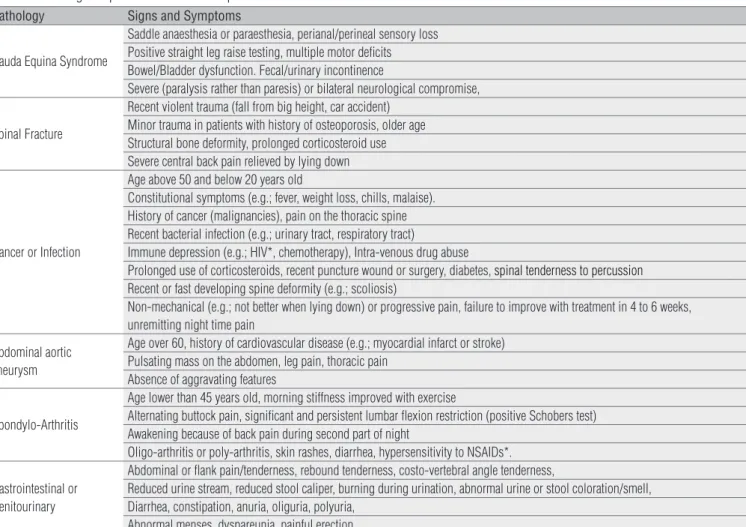
presented with red lags indicating suspicion of cancer, infection, cauda equina syndrome, spondyloarthritis, spinal fracture, visceral (gastrointestinal and genitourinary) referred pain, and abdominal aortic aneurism need to be sent to a specialist (Table 1).
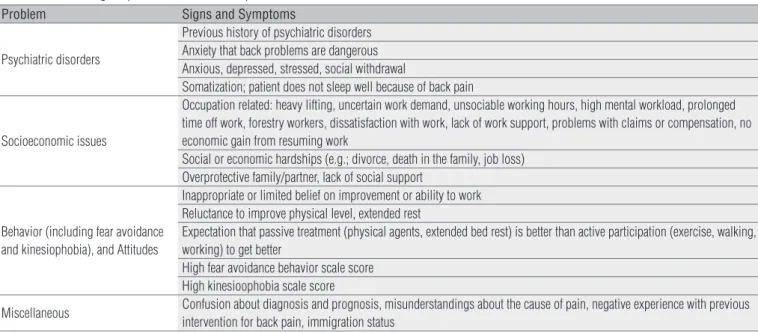
In addition to red lags indicating the likelihood of serious spinal pathology, the published EBP guidelines for LBP also described yellow lags for patients who should be referred to psychologists and other behavioral therapists. From sixteen
EBP guidelines, thirteen discussed or mentioned yellow lags (Table 2) as a predictor for prolonged disability1,3-5,16-20,22,24,27,28. In the initial management of patients with LBP ( irst four or six weeks), only patients with clear signs of psychopathology re-quire specialist referral (e.g.; depression, anxiety, somatoform, and substance abuse disorders)19,20. Patients with
kinesiopho-bia29 and fear avoidance behavior (FAB) do not require
specia-list referral in this initial management of LBP19,20.
Interventions for acute low back pain
EBP guidelines deined acute LBP based on duration of symptoms after onset rather than intensity of symptoms (Tables
3 and 4). Four guidelines1,4,22,25 deined acute LPB as pain lasting
four weeks or less. Nine guidelines5,17,18,20,21,23,24,27,28 deined acute
LBP as pain lasting six weeks or less. hree guidelines3,16,19
de-ined acute LBP as pain lasting less than twelve weeks. Sixteen
guidelines1,3-5,16-25,27,28 addressed the management of non-speciic
acute LBP with conservative intervention (Table 3). he physical therapy intervention recommendations for patients with non-speciic LBP were fairly consistent among the guidelines.
Pathology Signs and Symptoms
Cauda Equina Syndrome
Saddle anaesthesia or paraesthesia, perianal/perineal sensory loss Positive straight leg raise testing, multiple motor deficits Bowel/Bladder dysfunction. Fecal/urinary incontinence
Severe (paralysis rather than paresis) or bilateral neurological compromise,
Spinal Fracture
Recent violent trauma (fall from big height, car accident) Minor trauma in patients with history of osteoporosis, older age Structural bone deformity, prolonged corticosteroid use Severe central back pain relieved by lying down
Cancer or Infection
Age above 50 and below 20 years old
Constitutional symptoms (e.g.; fever, weight loss, chills, malaise). History of cancer (malignancies), pain on the thoracic spine Recent bacterial infection (e.g.; urinary tract, respiratory tract)
Immune depression (e.g.; HIV*, chemotherapy), Intra-venous drug abuse
Prolonged use of corticosteroids, recent puncture wound or surgery, diabetes, spinal tenderness to percussion
Recent or fast developing spine deformity (e.g.; scoliosis)
Non-mechanical (e.g.; not better when lying down) or progressive pain, failure to improve with treatment in 4 to 6 weeks, unremitting night time pain
Abdominal aortic aneurysm
Age over 60, history of cardiovascular disease (e.g.; myocardial infarct or stroke) Pulsating mass on the abdomen, leg pain, thoracic pain
Absence of aggravating features
Spondylo-Arthritis
Age lower than 45 years old, morning stiffness improved with exercise
Alternating buttock pain, significant and persistent lumbar flexion restriction (positive Schobers test) Awakening because of back pain during second part of night
Oligo-arthritis or poly-arthritis, skin rashes, diarrhea, hypersensitivity to NSAIDs*.
Gastrointestinal or Genitourinary
Abdominal or flank pain/tenderness, rebound tenderness, costo-vertebral angle tenderness,
Reduced urine stream, reduced stool caliper, burning during urination, abnormal urine or stool coloration/smell, Diarrhea, constipation, anuria, oliguria, polyuria,
Abnormal menses, dyspareunia, painful erection
NSAIDs=Non-Steroidal Anti-inflammatory Drugs; HIV=Human immunodeficiency virus. Table 1. Red flags for patients with low back pain.
he most common recommendation from these sixteen guidelines was patient education. After patient education, spine manipulation1,4,5,16,18,19,21-25,27 and exercise16-18,21,23-25,27 were the most
common therapeutic intervention recommended for patients with non-speciic acute LBP. However, these guidelines did not provide speciic recommendations for criteria to select patients for exercises or spine manipulation as well as criteria to select type of exercise to be used for intervention. he exception of this lack of speciicity was the guidelines from the American College
of Occupational and Environmental Medicine (ACOEM)21 that
recommended the use of clinical prediction rules13 to select
pa-tients with non-speciic LBP to be treated with spinal manipula-tion. his latter recommendation was based on physical therapy
practice and research indings13.
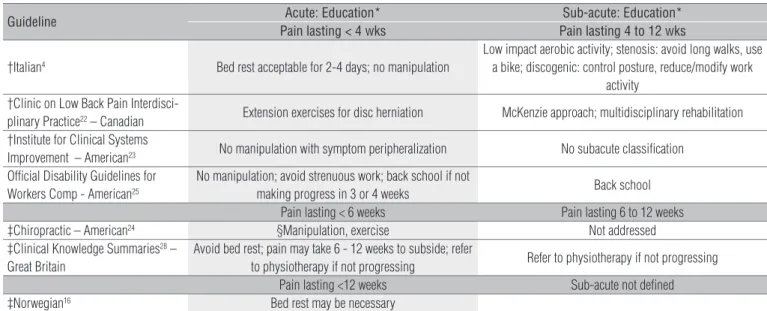
Only six guidelines provided recommendations for patients with acute LBP and radiculopathy, Table 4. he most common recommendation for patients with acute LBP and radiculopa-thy was education. hese guidelines indicated that LBP with radiculopathy take longer to recover than non-speciic low back pain, up to four or six weeks to improve after the initial onset
Problem Signs and Symptoms
Psychiatric disorders
Previous history of psychiatric disorders Anxiety that back problems are dangerous Anxious, depressed, stressed, social withdrawal
Somatization; patient does not sleep well because of back pain
Socioeconomic issues
Occupation related: heavy lifting, uncertain work demand, unsociable working hours, high mental workload, prolonged time off work, forestry workers, dissatisfaction with work, lack of work support, problems with claims or compensation, no economic gain from resuming work
Social or economic hardships (e.g.; divorce, death in the family, job loss) Overprotective family/partner, lack of social support
Behavior (including fear avoidance and kinesiophobia), and Attitudes
Inappropriate or limited belief on improvement or ability to work Reluctance to improve physical level, extended rest
Expectation that passive treatment (physical agents, extended bed rest) is better than active participation (exercise, walking, working) to get better
High fear avoidance behavior scale score High kinesioophobia scale score
Miscellaneous Confusion about diagnosis and prognosis, misunderstandings about the cause of pain, negative experience with previous intervention for back pain, immigration status
Table 2. Yellow flag for patients with low back pain.
Guidelines Intervention
Pain lasting < 4 weeks (Education*)
†Italian4 Manipulation after 2-3 weeks and before 6 weeks
†American College of Physicians & American Pain Society1 Heat at home, manipulation for patients without progress
† CLIP – Canadian22 Manipulation
‡ Official Disability Guideline for Workers Compensation -American25 Manipulation & exercise for patients without progress.
Pain lasting < 6 weeks (Education*)
† Dutch Physiotherapy17 Home exercise program
† Dutch Manual Therapy18 Manipulation and exercise
† European5 Manipulation for patients without progress
‡ American College of Occupational & Environmental Medicine21 Aerobic Exercise, Fear Avoidance Behaviour training, manipulation for patients
meeting CPR
† Institute for Clinical Systems Improvement – American23 Exercise & manipulation if not better in 2 weeks; home ice/heat
‡ Chiropractic – American24 Manipulation, manipulation together with exercise
‡ CKS28 & NICE27 – Great Britain If patient not progressing in 2 weeks follow sub-acute pain
Pain lasting <12 weeks (Education*)
‡ Norwegian16 Manipulation if not better in 2 weeks; exercise after 4 or 6 weeks
† Australian3 Wrapped heat at home
† New Zealand19 Manipulation first 4 or 6 weeks; multidisciplinary rehab when barriers to return
to work are identified
Table 3. Evidence based practice guidelines intervention for non-specific acute low back pain.
CKS=Clinical Knowledge Summaries; CLIP=Clinic on Low Back Pain Interdisciplinary Practice; CPR=clinical prediction rules; FBA=fear avoidance behavior; NICE=National Institute of Health and Clinical Excellence; *Education (all guides): stay active, avoid bed rest, and reassure that pain is benign, return to work as soon as possible; †Guideline evaluated and with good methodology; ‡Guideline not evaluated for quality.
of symptoms. he second most common recommendation for patients with radiculopathy was that spine manipulation was contraindicated for patients with radiculopathy4,22,23, with one
exception. he American guideline for chiropractic back care24
recommended the use of manipulation to treat patients with radiculopathy (Table 4).
Two22,24 out of six guidelines recommended exercise for
management of acute radiculopathy. he Clinic in Low Back
Pain Interdisciplinary Practice (CLIP)22 guideline made speciic
recommendation for extension exercises to manage patients with disc herniation. he Oicial Disability Guideline for
Workers25 recommended back school for patients with
radi-culopathy after three weeks of the initial onset of symptoms when the patient was not making progress. No guideline con-tradicted the use of exercise or back school in the management of acute radiculopathy.
Interventions for Sub-acute Low Back Pain
he deinitions of sub-acute LBP varied (Tables 4 and 5).
Four guidelines1,4,22,25 deined sub-acute LBP as pain lasting from
4 to 12 weeks. Eight guidelines deined sub-acute LBP as pain lasting from 6 to 12 weeks5,17,18,20,21,24,27,28. Four guidelines3,16,19,23
did not separate acute from sub-acute LBP for management purposes. Eleven guidelines1,4,5,17,18,21,22,24,25,27,28 addressed the
management of non-speciic sub-acute LBP with conservative interventions (Table 5).
Eleven guidelines1,4,5,17,18,20-22,24,25,27,28 addressed the
inter-vention of non-speciic sub-acute LBP with education and exercise. From eleven guidelines, ive recommended the use of manipulation for patients with non-speciic sub-acute LBP,
four recommended multidisciplinary teamwork, and three
recommended back school. he Italian guideline4 for LBP
con-traindicated spine manipulation and recommended aerobic exercises and avoidance of end-range of motion exercises for patients with sub-acute symptoms who had lumbar instability (diagnosed with radiography).
hree guidelines addressed the conservative intervention
of sub-acute LBP with radiculopathy4,22,25. he most common
recommendation from these latter guidelines was patient edu-cation (Table 4). Besides eduedu-cation, there was not a consensus for intervention of patients with sub-acute LBP and
radiculopa-thy. he Italian guideline4 separated LBP with radiculopathy into
discogenic and stenotic for intervention purposes; it recommen-ded low impact aerobic activity for both discogenic and stenotic diagnoses and ofered diferent exercise/activity options for each
of these diagnoses (Table 4). he CLIP guideline22 recommended
the McKenzie exercise approach when prescribing exercises for patients with sub-acute LBP and radiculopathy. he Clinical
Knowledge Summaries (CKS)28 guideline recommended that
pa-tients with LBP and radiculopathy without progress be referred for physical therapy, this guideline entrusted the care of patients with radiculopathy without progress to physical therapists as
clinical specialists. he Oicial Disability Guideline for Workers25
recommended back school for patients with sub-acute LBP and radiculopathy similarly to the management of patients with acute LBP and radiculopathy.
Interventions for chronic low back pain
Nine guidelines addressed interventions for
chro-nic non-speciic LBP (Table 6). One practice guideline23
Guideline Acute: Education* Sub-acute: Education*
Pain lasting < 4 wks Pain lasting 4 to 12 wks
†Italian4 Bed rest acceptable for 2-4 days; no manipulation
Low impact aerobic activity; stenosis: avoid long walks, use a bike; discogenic: control posture, reduce/modify work
activity †Clinic on Low Back Pain
Interdisci-plinary Practice22 – Canadian Extension exercises for disc herniation McKenzie approach; multidisciplinary rehabilitation
†Institute for Clinical Systems
Improvement – American23 No manipulation with symptom peripheralization No subacute classification
Official Disability Guidelines for Workers Comp - American25
No manipulation; avoid strenuous work; back school if not
making progress in 3 or 4 weeks Back school
Pain lasting < 6 weeks Pain lasting 6 to 12 weeks
‡Chiropractic – American24 §Manipulation, exercise Not addressed
‡Clinical Knowledge Summaries28 –
Great Britain
Avoid bed rest; pain may take 6 - 12 weeks to subside; refer
to physiotherapy if not progressing Refer to physiotherapy if not progressing
Pain lasting <12 weeks Sub-acute not defined
‡Norwegian16 Bed rest may be necessary
Table 4. Evidence based practice guidelines intervention for acute and subacute low back pain with radiculopathy.
* Education (all guides): stay active, return to work gradually and as soon as possible, educate that back pain with radiculopathy may take longer to recover than non-specific back pain; †Guideline evaluated and with good methodology; ‡Guideline not evaluated for quality; §Level of research evidence quality C or fair.
deined chronic LBP as pain lasting six weeks or more and eight guidelines1,4,17,18,20-22,24 deined LBP as pain lasting twelve
weeks or more. All guidelines recommended patient education and exercise for the management of chronic non-speciic LBP. here was a consensus for education, but not for the type of exercise recommended for non-speciic chronic LBP. All gui-delines recommended some type of exercise (core stability, individualized program, graded progressively, aquatic therapy,
exercise based on behavioral principles, under supervision) that required a clinical specialist for prescription. he Italian
guideline4 recommended patients with chronic LBP and signs/
symptoms of vertebral instability to be managed like patients with instability as described in sub-acute LBP. he ACOEM
gui-deline21 recommended the use of FAB training and the Dutch
guideline for Manual herapy18 recommended the use of
beha-vioral principles when prescribing exercises for patients with
Guideline
Pain > 4 weeks < 12 weeks
†Italian4 Aerobic activity, behavioral counseling; for instability, avoid end-range exercise
and end-range activity, no manipulation
†American College of Physicians & American Pain Society1 Exercise, manipulation, multidisciplinary rehab, behavioral counseling
† CLIP – Canadian22 Exercises, Multidisciplinary rehab
‡ Official Disability Guideline for Workers Compensation -American25 Active rehabilitation (exercise, avoid physical agents)
Pain > 6 weeks < 12 weeks
† Dutch Physiotherapy17 Same as acute, address yellow flags for chronic pain
† Dutch Manual Therapy18 Same as acute, address yellow flags for chronic pain
† European5 Multidisciplinary intervention for patients out of work; exercise, manipulation
‡ American College of Occupational & Environmental Medicine21 Aerobic Exercise, *FAB training
† Institute for Clinical Systems Improvement – American23 No subacute classification
‡ Chiropractic – American24 Manipulation, graded exercises in work settings
‡ CKS28 & NICE27 – Great Britain Manipulation, acupuncture, exercise; behavioral counseling if above fails
CKS=Clinical Knowledge Summaries; CLIP=Clinic on Low Back Pain Interdisciplinary Practice; FBA=fear avoidance behavior, NICE=National Institute of Health and Clinical Excellence; *Education (all guides): stay active, avoid bed rest, reassure that pain is benign, and return to work as soon as possible; †Guideline evaluated and with good methodology; ‡Guideline not evaluated for quality.
Table 5. Evidence based practice guidelines intervention for non-specific sub-acute low back pain.
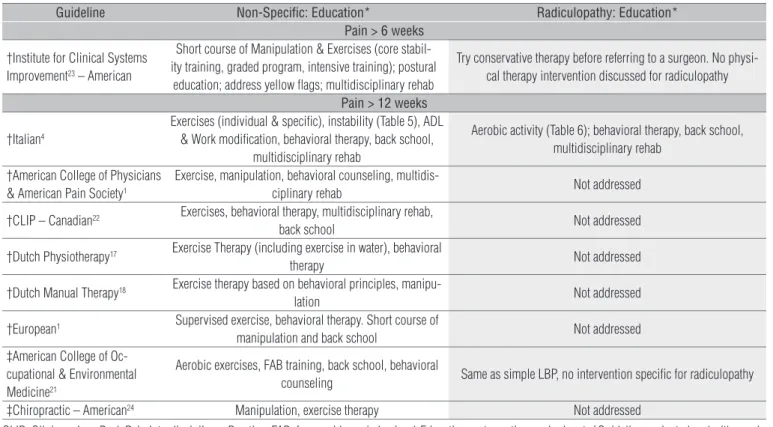
Guideline Non-Specific: Education* Radiculopathy: Education*
Pain > 6 weeks
†Institute for Clinical Systems Improvement23 – American
Short course of Manipulation & Exercises (core stabil-ity training, graded program, intensive training); postural
education; address yellow flags; multidisciplinary rehab
Try conservative therapy before referring to a surgeon. No physi-cal therapy intervention discussed for radiculopathy
Pain > 12 weeks
†Italian4
Exercises (individual & specific), instability (Table 5), ADL & Work modification, behavioral therapy, back school,
multidisciplinary rehab
Aerobic activity (Table 6); behavioral therapy, back school, multidisciplinary rehab
†American College of Physicians & American Pain Society1
Exercise, manipulation, behavioral counseling,
multidis-ciplinary rehab Not addressed
†CLIP – Canadian22 Exercises, behavioral therapy, multidisciplinary rehab,
back school Not addressed
†Dutch Physiotherapy17 Exercise Therapy (including exercise in water), behavioral
therapy Not addressed
†Dutch Manual Therapy18 Exercise therapy based on behavioral principles,
manipu-lation Not addressed
†European1 Supervised exercise, behavioral therapy. Short course of
manipulation and back school Not addressed
‡American College of Oc-cupational & Environmental Medicine21
Aerobic exercises, FAB training, back school, behavioral
counseling Same as simple LBP, no intervention specific for radiculopathy
‡Chiropractic – American24 Manipulation, exercise therapy Not addressed
Table 6. Evidence based practice guidelines intervention for chronic low back pain.
CLIP=Clinic on Low Back Pain Interdisciplinary Practice; FAB=fear avoidance behavior. * Education = stay active, no bed rest; †Guideline evaluated and with good methodology; ‡Guideline not evaluated for quality.
chronic non-speciic LBP. he recommendation about exercise based on behavioral principles was based on physical therapy
practice and research indings17,29.
Six guidelines1,4,17,20-22 recommended behavioral counseling
or therapy for chronic non-speciic LBP (Table 6). Four
gui-delines recommended multidisciplinary rehabilitation1,4,22,23
and/or back school4,20-22 for chronic non-speciic LBP. Four
guidelines recommended spine manipulation1,18,20,24 for
ma-nagement of chronic non-speciic LBP. No guideline contrain-dicated spine manipulation as an intervention of chronic non-speciic LBP.
hree guidelines4,21,23 addressed the intervention of chronic
LBP and radiculopathy with conservative procedures (Table 6). he recommendations for chronic LBP with radiculopathy were also inconsistent among guidelines. he Italian
guideli-nes4 separated patients with disc herniation from stenosis to
recommend diferent types of aerobic activity just like for sub-acute LBP as described above; it also recommended behavioral therapy, multidisciplinary rehabilitation, and back school for patients with radiculopathy. he Institute for Clinical
Sys-tem Improvement (ICSI)23 recommended that patients with
chronic radiculopathy be managed conservatively irst before referral for a surgeon is considered. However, he ICSI guide did not specify what type of conservative intervention should be used in patients with chronic LBP and radiculopathy. he
ACOEM guideline21 did not separate patients with non-speciic
LBP from those with LBP and radiculopathy for conservative intervention.
Discussion
Sixteen guidelines1,3-5,16-25,27,28 met our inclusion criteria.
Ten1,3-5,17-20,22,23 of these sixteen guidelines were previously
eva-luated and had good methodological quality11. From the six
re-maining guidelines not previously evaluated, two27,28 were not
evaluated because they were very recently published, two21,25
were not evaluated because they included patients with LBP in
occupational settings, one16 because it did not have an English
version when it was irst published, and another24 guideline for
unknown reasons. From the guidelines that were not evaluated, three were European16,27,28 and three were American21,24,25. All
European guidelines not previously evaluated, one Norwegian16
and two British27,28, had similar recommendations (Tables 3-6)
to other European5,20 guidelines with good methodology. From
the three American guidelines not previously evaluated21,24,25,
the guideline for chiropractic care of LBP had contradicting recommendation for intervention of LBP with radiculopathy, see below. he recommendations for specialist referral were similar from the ten guidelines1,3-5,17-20,22,23 previously evaluated
and the six guidelines16,21,24,25,27,28 that had not been previously
evaluated.
Many guidelines made speciic recommendations for specialist referral. Patients presenting with cauda equina syn-drome and abdominal aortic aneurism required immediate
referral and possibly emergency care4. Patients with high fever
(>380 C or 100.40 F) lasting longer than 48 hours, progressive
neurological signs and symptoms (i.e.; paresis to paralysis, pe-ripheralization of pain), or unrelenting night pain not relived by postural changes required urgent consultation within 24
hours23. A single red lag (e.g.; age over 50) was not enough to
indicate specialist referral, but a patient presenting with a clus-ter of red lags (e.g.; age over 50, non-mechanical pain, thoracic spine pain) should deinitely be referred for medical
consulta-tion28. hese guidelines give physical therapists the conidence
to manage patients with LBP without red lags in direct access without medical referral.
he majority of patients seeking care for LBP do not have a speciic pathology or disease responsible for their symptoms, 85% to 95% of patients with low back pain do not have red
lags1,5 and therefore not requiring physician specialist referral
(Table 1). Approximately 2% or less of patients with back pain
may have visceral diseases (gastrointestinal or genitourinary)30.
Only 1% or less has a neoplasm1,5. he chances for someone
to have back pain associated with infection, ankylosing
spon-dylitis, or abdominal aortic aneurysm is even smaller than 1%5.
About 3-4% of patients with back pain may present with a spinal
fracture5. One hundred percent of patients with cancer may be
screened out based on a history of cancer (positive likelihood
ratio= 14.7), unexplained weight loss (positive likelihood ratio= 2.7), failure to improve after 1 month (positive likelihood ra-tio= 3.0), and age older than 50 years (positive likelihood rara-tio= 2.7)1. Urinary retention has 90% sensitivity to rule out patients with cauda equina compromise, 1/10000 patients without urinary retention may have cauda equina syndrome1. Patients with compression fractures may best be screened out with age (>50 years old sensitivity 0.84, speciicity 0.61, positive like-lihood 2.20, negative likelike-lihood 0.26; >70 years old sensitivity 0.22, speciicity 0.96, positive likelihood 5.5, negative likelihood 0.88)30. Osteomyelitis may best be rule out with spinal tender-ness to percussion (0.86 sensitivity, speciicity 0.61, positive li-kelihood 2.1, negative lili-kelihood 0.23)30. hese likelihood ratios help physical therapists to make referrals grounded on clinical evidence. Physical therapists may safely manage patients wi-thout red lags (with or wiwi-thout radiculopathy) in any stage of LBP (acute, sub-acute, or chronic), but should refer patients wi-thout clinical progress for physician specialists or psychologists particularly in the sub-acute and chronic phase of LBP1,5,22,23.
As noted in a recent evaluation of clinical practice guide-lines for LBP31, the majority of the guidelines published over
the last eight years addressed the most important conserva-tive interventions for acute (sixteen out of sixteen) and sub-acute (eleven out of sixteen) non-speciic LBP (Tables 4 and 6). he number of guidelines addressing chronic LBP (nine out of sixteen) was a little over half of that for acute LBP. he intervention choices for non-speciic LBP were similar in the majority of the guidelines (Tables 4) for acute (education, exercises, and spine manipulation), sub-acute (same as acute plus back school, behavioral counseling, or multidisciplinary rehabilitation), and chronic LBP (education and exercise plus back school, behavioral counseling, or multidisciplinary reha-bilitation). However, no more than six guidelines addressed the conservative intervention of acute LBP with radiculopathy and only three guidelines addressed the conservative intervention of sub-acute and chronic LBP with radiculopathy.
here was an overwhelming consensus to use education to manage acute, sub-acute, and chronic back pain, whether the patient had radiculopathy or not, (Tables 4 to 6). he goal to educate the patient in the acute and sub-acute stages of LBP was to keep the patient active and to inform the patient that non-speciic LBP has a benign natural course to prevent the symptoms to become chronic. he education for LBP with radiculopathy was similar to non-speciic LBP, the main dife-rence was that the patient would be forewarned that his/her symptoms could take up to six weeks to get better, but overall, LBP with radiculopathy is also a condition that naturally im-proves without invasive interventions. he purpose of educa-tion in the sub-acute and chronic phase of LBP was to keep the patient active and functional; it was also very important to address any yellow lags (Table 2) that could be preventing the patient to have a full functional recovery1,5,17,19,20,23.
here was a consensus to use exercise for the management of patients with non-speciic acute, sub-acute, and chronic LBP. Fifty percent of the guidelines recommended exercise for acute (Table 4) and 100% recommended exercise to manage sub-acute (Table 4) and chronic non-speciic LBP (Table 6). here was an overwhelming consensus to use exercise for non-speciic sub-acute and chronic LBP; however, there was not a consensus for the type of exercise to be used. In general, the guidelines recommended exercises for non-speciic acute, sub-acute, and chronic LBP to keep the patient active and improve or maintain lexibility, muscle strength, and aerobic endurance. hese guidelines generally emphasized an exercise program to prevent functional decline without exacerbating patient’s symptoms rather than a proactive exercise approach
designed to speed up functional recovery15. Few guidelines
discussed or recommended exercise for acute, sub-acute, or chronic LBP with radiculopathy (Table 5). Two guidelines
recommended exercises for patients with acute22,24 and
sub-acute4,22 radiculopathy and only one guideline recommended
exercise for chronic radiculopathy4. he guidelines did not have
a consensus for the type of exercise to recommend for patients with LBP and radiculopathy.
here was a consensus for the indication of spine manipu-lation for non-speciic acute (75%) and subacute LBP (50%); while only 45% of the guidelines recommended manipulation for non-speciic chronic LBP. here was a consensus (86%) not to recommend spine manipulation for patients with LBP and
radiculopathy and three guidelines4,22,23 even contraindicated
the use of spine manipulation for patients with radiculopathy.
he exception to this was the Chiropractic Guideline24 for LBP
that recommended spine manipulation for acute LBP with ra-diculopathy. However, the chiropractic guideline for LBP was mono-disciplinary and based on a consensus from
chiroprac-tor experts24. he chiropractic guideline could have allowed
the self-interest of the profession bias the recommendation in favor of spine manipulation disregarding a systematic analysis of the literature32.
After education, exercise, and spine manipulation; the most common conservative interventions for patients with LBP were multidisciplinary rehabilitation, back school, and behavioral counseling. hese interventions were recommen-ded for patients with non-speciic sub-acute (80%) and chro-nic LBP (77%) as well as patients with sub-acute and chrochro-nic LBP with radiculopathy (100%). he overall purpose of these interventions were to address yellow lags that may hinder functional recovery, to teach coping strategies to assist the pa-tient to deal better with his/her symptoms, to provide further education on back pain epidemiology and prevention, and to ofer vocational training to reintroduce the patient to his/her job or to assist the patient to transition to a new job. he New
Zealand guidelines19 and the Dutch guidelines17,18 made speciic
recommendations on how to handle motivational problems to improve patient prognosis, these recommendations could be useful in physical therapy practice in conjunction with exercise and spine manipulation to manage patients particularly in the sub-acute and chronic phases of LBP.
he majority of guidelines did not ofer explicit recommen-dations for the use of spine manipulation to treat non-speciic
LBP (instability or hypermobility versus hypomobility)33. his
majority also did not make clear exercise recommendations for LBP with or without radiculopathy (stabilization or direc-tional preference)15,31. he guidelines triaged LBP without red
lags into two groups of patients for conservative intervention: either non-speciic LBP or LBP with radiculopathy. his triage system dates back from 1994 when the Agency for Health Care Policy and Research published the irst clinical practice
guide-line for LBP in the United States34. While this broad triage of
patients may be useful in primary care to screen patients to refer to physician specialists and imaging tests, this triage may
be becoming outdated to guide conservative intervention of
patients without red lags15,33,35. he current and newer system
of LBP classiication for conservative intervention of LBP re-cognizes more than two groups of patients with non-speciic LBP (manipulation group with joint hypomobility and stabi-lity group with lumbar instabistabi-lity) and at least four groups of patients with LBP and radiculopathy (speciic exercise groups with extension, lexion, or lateral shift preference; or traction)36.
LBP intervention based this newer classiication system of LBP have been shown to give better outcome results than LBP
tre-atment based on EBP practice guidelines15,33,35.
In the last ive years, a few clinical practice guidelines have started to recognize the new classiication system of LBP to
recommend conservative intervention33. he ACOEM
guide-lines21 recognized clinical prediction rules13 to select patients
from the non-speciic LBP triage to recommend spine mani-pulation (manimani-pulation group for patients with hypomobility).
he CLIP guideline22 recognized the McKenzie approach for
LBP endorsing exercises based on lexion, extension, and late-ral shift preference for patients with radiculopathy. he Italian
guideline4 recognized that LBP without radiculopathy could
be divided into a lumbar instability group and a non-speciic group, and that LBP with radiculopathy could be divided into a disc herniation (extension preference) group and a spinal stenosis group ( lexion preference) for conservative interven-tion. Following this recent ive-year trend to utilize the new system of LBP classiication to recommend conservative care, it is likely that the updates or new editions of LBP guidelines would start to recognize this new system of LBP classiication to recommend conservative intervention.
he reason why the recommendations for exercise and spine manipulation in the majority of the guidelines were so general may be because they were multidisciplinary with a
pri-mary care focus often deviating from routine specialist care32.
Mono-disciplinary guidelines tend to be more detailed and
more clinically relevant for professionals from the same
disci-pline32. here was a gap in the literature for mono-disciplinary
physical therapy guidelines with a focus on conservative care of LBP. However, to retain a balance between evidence and professional relevance, these mono-disciplinary guidelines need be an ofspring of or be peer-reviewed by a parent
multi-disciplinary guideline32, similar to the guidelines from the
Ame-rican College of Radiology37 being an ofspring of the American
College of Medicine1.
Conclusion
here is a need for new mono-disciplinary guidelines addressing the physical therapy management of LBP. hese guidelines could be based on the International Classiication of Functioning of the World Health Organization following the examples of guidelines recently published for neck and heel pain38,39. Physical therapy guidelines could also be based on the
new system of LBP classiication36; non-speciic LBP
subdivi-ded into stabilization and manipulation groups and LBP with radiculopathy divided in directional preference and traction groups. One sub-classiication of patients that should be added to the latter system of LBP classiication is the group of patients that responds to exercise based on behavioral principles as
des-cribed in recent LBP practice guidelines17,18,21 and recent
physi-cal therapy literature40,41. his would be the group of patients
with LBP and yellow lags17,18 or high Fear Avoidance Behaviour
(FBA) scores21. his latter group of patients responds best to an
exercise approach (graded exposure or graded exercise) based on behavioral principles. Future mono-disciplinary practice guidelines for conservative care of LBP would not only improve physical therapist adherence to guidelines, but it would also reduce fragmentation in care by achieving consistency across professions and delivering common messages.
References
1. Chou R, Qaseem A, Snow V, Casey D, Cross JT Jr, Shekelle P, et al. Diagnosis and treatment of low back pain: a joint clinical practice guideline from the American College of Physicians and the American Pain Society. Ann Intern Med. 2007;147(7):478-91.
2. Philadelphia Panel. Philadelphia Panel evidence-based clinical practice guidelines on selected rehabilitation interventions for low back pain. Phys Ther. 2001;81(10):1641-74.
3. Australian Acute Musculoskeletal Pain Guidelines Group. Evidence based management of acute pain. Acute low back pain. 2003.
4. Negrini S, Giovannoni S, Minozzi S, Barneschi G, Bonaiuti D, Bussotti A, et al. Diagnostic therapeutic flow-charts for low back pain patients: the Italian clinical guidelines. Eura Medicophys. 2006;42(2):151-70.
5. van Tulder M, Becker A, Bekkering T, Breen A, del Real MT, Hutchinson A, et al. Chapter 3. European guidelines for the management of acute nonspecific low back pain in primary care. Eur Spine J. 2006;15 Suppl 2:S169-91.
6. Pai S, Sundaram LJ. Low back pain: An economic assessment in the United States. Orthop Clin North Am. 2004;35(1):1-5
7. Sackett DL, Rosenberg WM, Gray JA, Haynes RB, Richardson WJ. Evidence based medicine: What it is and what it isn’t. BMJ. 1996;312(7023):71-2.
8. Ritter B. Considering evidence-based practice. Nurse Pract. 2001;26(5):63-5.
9. Appraisal of Guidelines for Research & Evaluation (AGREE) Instrument. The agree collaboration. Appraisal of guidelines for research & evaluation (agree) instrument. 2001;2006.
10. van Tulder MW, Tuut M, Pennick V, Bombardier C, Assendelft WJ. Quality of primary care guidelines for acute low back pain. Spine (Phila Pa 1976). 2004;29(17):E357-62.
11. Bouwmeester W, van Enst A, van Tulder M. Quality of low back pain guidelines improved. Spine (Phila Pa 1976). 2009;34(23):2562-7.
12. Shekelle P, Eccles MP, Grimshaw JM, Woolf SH. When should clinical guidelines be updated? BMJ. 2001;323(7305):155-7.
13. Childs JD, Fritz JM, Flynn TW, Irrgang JJ, Johnson KK, Majkowski GR, et al. A clinical prediction rule to identify patients with low back pain most likely to benefit from spinal manipulation: A validation study. Ann Intern Med. 2004;141(12):920-8.
14. Clare HA, Adams R, Maher CG. A systematic review of efficacy of McKenzie therapy for spinal pain. Aust J Physiother. 2004;50(4):209-16.
15. Fritz JM, Delitto A, Erhard RE. Comparison of classification-based physical therapy with therapy based on clinical practice guidelines for patients with acute low back pain: A randomized clinical trial. Spine (Phila Pa 1976). 2003;28(13):1363-71; discussion 1372.
16. The Norwegian Back Pain Network -The communication unit. Acute low back pain. Interdisciplinary clinical guidelines Oslo; 2002.
17. Bekkering GE, Hendriks HJM, Koes BW, Oostendorp RAB, Ostelo RWJG, Thomassen JMC, et al. Dutch physiotherapy guidelines for low back pain. Physiotherapy. 2003;89(2):82-96.
18. Heijmans WFGJ, Hendriks HJM, van der Esch M, Pool-Goudzwaard A, Scholten-Peeters GGM, van Tulder MW, et al. Kngf-guideline manual therapy on low back pain; 2003.
19. New Zealand Guidelines Group. New zealand low back pain guide; 2004.
20. Airaksinen O, Brox JI, Cedraschi C, Hildebrandt J, Klaber-Moffett J, Kovacs F, et al. Chapter 4. European guidelines for the management of chronic nonspecific low back pain. Eur Spine J. 2006;15 Suppl 2:S192-300.
21. Hagmann KT. Low back disorders. Occupational medicine practice guidelines: Evaluation and management of common health problems and functional recovery in workers. Elk Grove Village (IL): American College of Occupational and Environmental Medicine (ACOEM); 2007.
22. Poitras S, Rossignol M, Dionne C, Tousignant M, Truchon M, Arsenault B, et al. An interdisciplinary clinical practice model for the management of low-back pain in primary care: The CLIP project. BMC Musculoskelet Disord. 2008;9:54.
23. Thorson DC, Jorgenson-Rathke J, Hecht S, Campbell R, Buttermann G, Kramer C, et al. Adult low back pain. Clinical practice guidelines. 2008.
24. Globe GA, Morris CE, Whalen WM, Farabaugh RJ, Hawk C; Council on Chiropractic Guidelines and Practice Parameter. Chiropractic management of low back disorders: Report from a consensus process. J Manipulative Physiol Ther. 2008;31(9):651-8.
25. Work Loss Data Institute. Low back - lumbar & thoracic (acute & chronic) Corpus Christi (TX): Work Loss Data Institute; 2008.
26. American Osteopathic Association. American osteopathic association guidelines for osteopathic
manipulative treatment (omt) for patients with low back pain. 2009.
27. Savigny P, Kuntze S, Watson P, Underwood M, Ritchie G, Cotterell M, et al. Low back pain: Early management of persistent non-specific low back pain guidelines. 2009.
28. CKS. Back pain - low with and without radiculopathy. Clinical kowledge summaries. 2009.
29. Kernan T, Rainville J. Observed outcomes associated with a quota-based exercise approach on measures of kinesiophobia in patients with chronic low back pain. J Orthop Sports Phys Ther. 2007;37(11):679-87.
30. Jarvik JG, Deyo RA. Diagnostic evaluation of low back pain with emphasis on imaging. Ann Intern Med. 2002;137(7):586-97.
31. Arnau JM, Vallano A, Lopez A, Pellise F, Delgado MJ, Prat N. A critical review of guidelines for low back pain treatment. Eur Spine J. 2006;15(5):543-53.
32. Breen AC, van Tulder MW, Koes BW, Jensen I, Reardon R, Bronfort G. Mono-disciplinary or multidisciplinary back pain guidelines? How can we achieve a common message in primary care? Eur Spine J. 2006;15(5):641-7.
33. Brennan GP, Fritz JM, Hunter SJ, Thackeray A, Delitto A, Erhard RE. Identifying subgroups of patients with acute/subacute “Nonspecific” low back pain: Results of a randomized clinical trial. Spine (Phila Pa 1976). 2006;31(6):623-31.
34. Bigos SJ, Bowyer ROR, Braen GR, Brown K, Deyo R, Scott H, et al. Acute low back problems in adults. Clinical practice guideline. 1994;14.
35. Hall H, McIntosh G, Boyle C. Effectiveness of a low back pain classification system. Spine J. 2009;9(8):648-57.
36. Childs MJD, Fritz JM, Cleland JA. Subgrouping patients with low back pain: Evolution of a classification approach to physical therapy. J Orthop Sports Phys Ther. 2007;37(6):290-302.
37. Davis PC, Wippold FJ, Brunberg JA, Cornelius RS, De LA Paz RL, Dormont D, et al. ACR appropriateness Criteria® low back pain. Reston (VA): American College of Radiology (ACR); 2008.
38. Childs JD, Cleland JA, Elliott JM, Teyhen DS, Wainner RS, Whitman JM, et al. Neck pain: Clinical practice guidelines linked to the international classification of functioning, disability, and health from the orthopedic section of the American Physical Therapy Association. J Orthop Sports Phys Ther. 2008;38(9):A1-A34.
39. McPoil TG, Martin RL, Cornwall MW, Wukich DK, Irrgang JJ, Godges JJ. Heel pain--plantar fasciitis: Clinical practice guildelines linked to the international classification of function, disability, and health from the orthopaedic section of the American Physical Therapy Association. J Orthop Sports Phys Ther. 2008;38(4):A1-A18.
40. George SZ, Zeppieri G. Physical therapy utilization of graded exposure for patients with low back pain. J Orthop Sports Phys Ther. 2009;39(7):496-505.
41. de Jong JR, Vlaeyen JW, Onghena P, Goossens ME, Geilen M, Mulder H. Fear of movement/(re) injury in chronic low back pain: Education or exposure in vivo as mediator to fear reduction? Clin J Pain. 2005;21(1):9-17; discussion 69-72.