R
EVIEWA
RTICLE Revista Brasileira de FisioterapiaGlobal Postural Re-education:
a literature review
Reeducação postural global: uma revisão da literatura
Rosana M. Teodori1, Júlia R. Negri2, Mônica C. Cruz3, Amélia P. Marques4
Abstract
Background: The Global Postural Re-education (GPR) method has been widely used in clinical practice, with reported benefits for prevention and rehabilitation of musculoskeletal dysfunctions. In parallel with almost two decades of clinical implementation, research studies have tested and verified the effectiveness of GPR in treating different clinical conditions and have also compared this method with other physical therapy resources. However, few studies focused on the verification of the principles of mechanisms of action defended by the author of the method making the arguments in favor of the method weak. Objective: To perform a critical systematic review of the effects of physical therapy intervention that use the GPR method. Methods: We searched Medline, SciELO, LILACS and PeDRO, from 2000 to 2010, considering the key words: Global Postural Re-education, global and active stretching. Results: We found 25 studies, 13 about GPR and 8 about global and active stretching in addition to three books and a thesis. After analysis, 20 references were included. Conclusions: Some of the studies indicated that the GPR method was more effective than other physical therapy interventions, while others demonstrated similar results of GPR when compared to other physical therapy interventions. Studies showed benefits of the GPR in improving the respiratory muscle strength, chest expansion, maximal respiratory pressure and in reducing pain, loss of urine in incontinent women, increasing flexibility, the electromyographic activity in temporomandibular disorders and postural stability in lower limb orthopedic alterations. Methodological limitations observed suggest the need for greater rigor in future research.
Keywords: Global Postural Re-education; global stretching; active stretching.
Resumo
Contextualização: O método de Reeducação Postural Global (RPG) tem sido utilizado na clínica com relatos de benefícios para a prevenção e recuperação de disfunções musculoesqueléticas. Após duas décadas de aplicação, estudos têm verificado sua eficácia no tratamento de diferentes condições clínicas e ele tem sido comparado com outros recursos fisioterapêuticos. Entretanto, são poucos os estudos voltados à comprovação dos princípios defendidos pelo autor do método, o que torna frágeis as argumentações em favor dele. Objetivo: Realizar, com base na literatura científica, uma análise crítica dos efeitos da intervenção fisioterapêutica utilizando o método RPG. Métodos: Pesquisaram-se as bases de dados Medline, SciELO, LILACS e PeDRO, de 2000 a 2010, considerando os unitermos: RPG, alongamento global e alongamento ativo. Resultados: Foram encontrados 25 estudos, sendo 13 relacionados ao método RPG e oito aos alongamentos global e ativo, além de três livros e uma tese. Após análise, 20 referências foram utilizadas. Conclusões: Parte dos estudos aponta que o método RPG é mais efetivo, enquanto outros mostram resultados similares a outros métodos de intervenção fisioterapêutica. Estudos indicam benefícios do método na melhora da força muscular respiratória, expansibilidade torácica, mobilidade toracoabdominal e da pressão respiratória máxima, além de reduzir a dor, a perda de urina em mulheres incontinentes, melhorar a flexibilidade, a atividade eletromiográfica nas disfunções temporomandibulares e a estabilidade postural em alterações ortopédicas de membros inferiores. Limitações metodológicas observadas sugerem a necessidade de maior rigor em futuras pesquisas.
Palavras-chave: reeducação postural global; alongamento global; alongamento ativo.
Received: 26/11/2010 – Revised: 21/02/2011 – Accepted: 03/03/2011
1Post-graduate program of Physical Therapy, Faculty of Health Sciences, Universidade Metodista de Piracicaba (UNIMEP), Piracicaba, SP, Brazil 2Department of Physical Therapy, Faculty of Americana (FAM), Americana, SP, Brazil
3Department of Physical Therapy, Universidade da Amazônia (UNAMA), Belém, PA, Brazil
4Department of Physical Therapy, Speech Therapy and Occupational Therapy, Faculty of Medicine (FM), Universidade de São Paulo (USP), São Paulo, SP, Brazil
Correspondence to: Rosana Macher Teodori, UNIMEP, Faculdade de Ciências da Saúde, Programa de Pós-graduação em Fisioterapia, Laboratório de Plasticidade Neuromuscular, Rod. do Açúcar, Km 156, Taquaral, CEP 13.400-911, Piracicaba, SP, Brasil, e-mail: [email protected]
Introduction
In the early 50’s, the French physical therapist Françoise Mézières developed through careful observation, an proposal that revolutionized the way to exercise the body: the anti gym-nastique. he innovation proposed by Mézières was based on the following observation: each time and individual tried to de-crease the curvature of a spinal segment, the curve moved to another segment. hus, it was necessary to consider the body as a whole and approach it as such. In this theory, all deforma-tions are caused by a shortening of the posterior muscles as an inevitable consequence of daily movements1.
Philippe-Emmanuel Souchard taught the Mézières Me-thod for 10 years at the Mézières Center, in southern France. He substantiated the GPR method on his deep knowledge of anatomy, biomechanics, kinesiology and osteopathy. Fields that allowed him to base the method now known as the Global Posture Re-education (GPR)2.
Conventional physical therapy often uses static stretching, which consists of stretching a single muscle or muscles group until a tolerable point and sustained it for approximately 30 seconds3. he GPR method is based on the global stretching
of anti gravitational muscles and the stretching of muscles that are organized on muscle kinetic chains for approxima-tely 15 to 20 minutes. In both cases, compensations are not allowed4.
Many physical therapists in Brazil and in other countries have used the GPR method with satisfactory results. Although the method is widely used clinically, the literature is still scarce and provide controversial results or results that do not support the use of GPR over segmental stretching.
he objective of this study is to perform a critical litera-ture review of the efects of the physical therapy technique named GPR.
Methods
Medline, SciELO, LILACS and PeDRO databases as well as books and theses were searched for the period between 2000 and 2010 using the keywords: GPR, global stretching and active stretching. he articles were selected by reading the abstract excluding those that did not use GPR or did not clearly report the research methods.
Results
Twenty-ive studies were identiied and from those 13 used the GPR method (two literature reviews, one case study
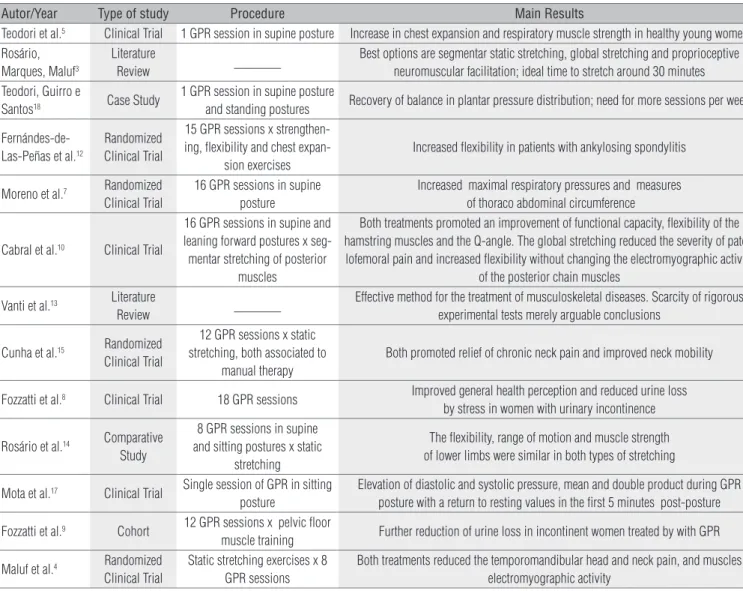
and ten clinical trials) and 8 used global and active stretching. here were also three books and one thesis. Based on the ex-clusion criteria 5 studies were excluded and therefore 20 were included in the review. he types of study, methodology and main results for the studies involving the GPR method are shown in Table 1.
Discussion
Qualitative and quantitative analysis that use scientifi-cally accepted methods are essential to provide scientific evidence to therapeutic intervention. Studies with such characteristics have been published more frequently over the last decades. The work by Teodori et al.5 presented
quan-titative data on chest expansion and maximal respiratory pressures and demonstrated the positive effect of a single session of the “frog on the floor with closed arms” posture, on respiratory muscle strength and thoracic mobility in healthy individuals. Souchard6 believes that changes in
res-piratory mechanics are due to excessive shortening of the respiratory muscle chain. Considering that the shortening of the anterior-inner arm chain may contribute to the limi-tation of chest expansion, Moreno et al.7 studied the effect
of the posture “frog on the floor with open arms” to increase stretching of the respiratory chain muscles. The increase in maximal respiratory pressures and chest expansion reported reinforces the importance of the chosen posture, as well as a longer treatment program rather than a single session of stretching. The results also provide support for establishing appropriate sessions length for treatment in the clinic.
In the study by Fozzatti et al.8 there was no definition of
which postures of the GPR method were used; the women’s age ranged from 23 to 72 years, which can affect muscle condition and its response to treatment; and the complaint time of stress urinary incontinence (SUI) ranged from 1 to 23 years, which may reflect the diversity of functional con-dition of the pelvic floor muscles. Furthermore, the authors did not mention whether the women were nulliparous, and the study had no control group. Despite these limitations it is still possible that the GPR method favors a balance be-tween the lumbar lordosis, the rotation axis of hip joints, the transverse abdominal muscles and the mobility of the thoracic diaphragm, both responsible for maintaining intra-abdominal pressure, as discussed by the authors of the study. However, it is essential that the inclusion criteria are strictly considered when selecting patients to participate in scientific studies.
In the study by Fozzatti et al.9 in which all of the postures
of the GPR method were used with an emphasis on those that
simulated daily activities that provoke incontinence (stan-ding, sitting, bending forward), there was an improvement in lexibility, elasticity and strength of the pelvic loor muscles. In this study, the number of deliveries ranged from zero to nine, most of them of vaginal type. But the patients’ age ran-ged widely (30 to 72 years), as well as the symptoms duration time (1 to 20 years). hese limitations are common in clinical trials because even in specialized attention centers of certain health disorder, such as in SUI, there is great variability of the patient population. It is attributed to the postures performed, the role of rebalance between the structures of the lumbar spine and pelvis afecting the response of the pelvic loor muscles to stress and variations in intra-abdominal pressure. he authors suggested the need for further controlled studies in view of the advantages of the GPR method as it is not inva-sive and does not produce side efects.
The results obtained by Cabral et al.10 in women with
patellofemoral syndrome showed that the GPR method
promoted a decrease in pain that was attributed to the overload of proprioceptive stimuli especially produced by the “skier” posture. This result is of extreme importance for clinical practice and favors the selection of the GPR method. Pain after injury can predispose muscle spasm restricting joint movement. McHugh and Cosgrave11 emphasized that
stretching promotes increased joint range of motion due to decreased passive resistance to stretching, ie, decrease in muscle stiffness or increase in muscle compliance, espe-cially when the duration of stretching is longer, contributing to pain decrease, which reinforces the results obtained in the study by Cabral et al.10. However, other mechanisms
re-lated to the decrease in pain need to be studied within the global stretching scope, which would reaffirm the GPR me-thod as a form of preferential treatment in various postural disorders and orthopedic conditions.
Most studies included in this review were randomized clinical trial and the most common objective was to compare
Autor/Year Type of study Procedure Main Results
Teodori et al.5 Clinical Trial 1 GPR session in supine posture Increase in chest expansion and respiratory muscle strength in healthy young women
Rosário, Marques, Maluf3
Literature
Review _______
Best options are segmentar static stretching, global stretching and proprioceptive neuromuscular facilitation; ideal time to stretch around 30 minutes Teodori, Guirro e
Santos18 Case Study
1 GPR session in supine posture
and standing postures Recovery of balance in plantar pressure distribution; need for more sessions per week
Fernándes-de-Las-Peñas et al.12
Randomized Clinical Trial
15 GPR sessions x strengthen-ing, flexibility and chest
expan-sion exercises
Increased flexibility in patients with ankylosing spondylitis
Moreno et al.7 Randomized
Clinical Trial
16 GPR sessions in supine posture
Increased maximal respiratory pressures and measures of thoraco abdominal circumference
Cabral et al.10 Clinical Trial
16 GPR sessions in supine and leaning forward postures x seg-mentar stretching of posterior
muscles
Both treatments promoted an improvement of functional capacity, flexibility of the hamstring muscles and the Q-angle. The global stretching reduced the severity of patel-lofemoral pain and increased flexibility without changing the electromyographic activity
of the posterior chain muscles
Vanti et al.13 Literature
Review _______
Effective method for the treatment of musculoskeletal diseases. Scarcity of rigorous experimental tests merely arguable conclusions
Cunha et al.15 Randomized
Clinical Trial
12 GPR sessions x static stretching, both associated to
manual therapy
Both promoted relief of chronic neck pain and improved neck mobility
Fozzatti et al.8 Clinical Trial 18 GPR sessions Improved general health perception and reduced urine loss
by stress in women with urinary incontinence
Rosário et al.14 Comparative
Study
8 GPR sessions in supine and sitting postures x static
stretching
The flexibility, range of motion and muscle strength of lower limbs were similar in both types of stretching
Mota et al.17 Clinical Trial Single session of GPR in sitting
posture
Elevation of diastolic and systolic pressure, mean and double product during GPR posture with a return to resting values in the first 5 minutes post-posture
Fozzatti et al.9 Cohort 12 GPR sessions x pelvic floor
muscle training Further reduction of urine loss in incontinent women treated by with GPR
Maluf et al.4 Randomized
Clinical Trial
Static stretching exercises x 8 GPR sessions
Both treatments reduced the temporomandibular head and neck pain, and muscles electromyographic activity
Table 1. Description of study type, methods and main results.
GPR=Global Postural Re-education.
the effectiveness of the GPR method with other resources, considered by the author as “conventional”. The results obtained in some of these studies confirmed the benefits of the method5,7,10,12,13, while others suggested that the
treat-ment was similar to other conventional resources4,14,15.
Even considering the studies in which interventions based on the GPR method were found to be effective, one must carefully analyze the study’s method. In this respect, it is observed that, in most of the studies considered here, the intervention method was based on one or two postures advocated by the GPR method, previously set for implemen-tation on all subjects that comprised the sample. Since the choice of postures employed in a GPR session depends on data obtained in specific examination, consisting of history, postural assessment and correction maneuvers16, the
inclu-sion of subjects into groups subjected to a common thera-peutic approach should take in consideration subgroups of patients with similar postural patterns and with indication for the treatment through the investigated postures. Howe-ver, only the study by Moreno et al.7 used postural patterns
as an inclusion criterion for sample selection.
Another aspect to consider is the “sessions length”, which ranged from 2017 to 60 minutes15. In five clinical trials
the intervention time was less than 50 minutes4,5,7,10,17. As
the prolonged time of maintenance of stretch is one of the arguments in favor of the GPR method, it is noteworthy that in two of the trials with shorter sessions5,12 the results of the
intervention favored the GPR method with respect to the investigated parameters.
The number of sessions also varied, as well as reports of follow-up after the intervention. Teodori, Guirro and Santos18
found the presence of muscle rebalance after a single session of GPR, with progressive loss of results in the weeks follo-wing the intervention. Maluf et al.4 applied eight sessions of
GPR in patients with temporomandibular disorders, noting improvement in pain and in electromyographic activity of muscles involved in the joint, but during the following two months there was a slight decrease of the gains.
A common concern of physical therapists after correc-tive intervention is how long the result are maintained. Timson19 argues that the increase in the number of
sarco-meres in series and reorganization of collagen after sustai-ned stretching usually are reversed when the stimulus to stretching is removed. Ben and Harvey20 performed daily
sessions of 30 minutes of sustained stretching for six weeks on healthy and active individuals and observed an increase in discomfort tolerance associated with stretching, but no increase in muscle extensibility, which suggests the need for
a treatment program involving a larger number of treatment sessions when using the GPR method.
Cunha et al.15 found similar results in chronic neck pain
and neck mobility when comparing the effects of global stretching and conventional static stretching, both in com-bination with manual therapy. In this study, unlike what was observed in others studies, all gains were maintained six weeks after the end of treatment.
It is also important to consider other differences ob-served between the different methodologies used in the studies. In the study by Fernández-de-Las-Peñas et al.12,
the intervention was applied in groups of patients with ankylosing spondylitis. The groups were supervised by the therapist during the performance of postures (standing with anterior tilt, frog in the air, frog on the floor, sitting and stan-ding against the wall) with the absence of manual contact. The manual contact of the therapist has an important role in tactile and proprioceptive stimulation, facilitating the perception of movements and postures that need to be cor-rected during the stretch. Thus, it would be interesting to investigate whether the individualized intervention could bring even greater benefit to these patients.
Regarding the clinical trials, criteria related to the metho-dological quality of the studies, such as the presence of sample size calculation5,8,10,12,17, control group8,17 and the blinding of
the researchers responsible for results assessment5,8-10,17 were
attended by only a portion of the studies reviewed which li-mits the conclusion of this review regarding the efectiveness of the method suggesting the need for greater methodological rigor in future studies.
Conclusion
he results of some of the reviewed studies suggest that the GPR method is more efective under the analyzed conditions while the results of others suggest that the GPR method has similar results as segmental stretching. he studies reported beneits of GPR in improving respiratory muscle strength, chest expansibility, thoracic and abdominal mobility and maximal respiratory pressure, as well as decrease in pain and in urine loss in women with urinary incontinence and improvement in lexibility, in electromyographic activity in temporomandibu-lar disorders and in postural stability in lower limb orthopedic disorders.
In most studies, there was no detailed description of the GPR postures performed limiting comparison between the diferent studies.
References
1. Bertherat T. O corpo tem suas razões: antiginástica e consciência de si. São Paulo: Martins Fontes; 1977.
2. Marques AP. Reeducação Postural Global: um programa de ensino para a formação de fisioterapeutas [Tese]. Instituto de Psicologia – USP; 1995.
3. Rosário JLR, Marques AP, Maluf AS. Aspectos clínicos do alongamento: uma revisão de literatura. Rev Bras Fisioter. 2004;8(1):83-8.
4. Maluf SA, Moreno BG, Crivello O, Cabral CM, Bortolotti G, Marques AP. Global postural reeducation and static stretching exercises in the treatment of myogenic temporomandibular disorders: A randomized study. J Manipulative Physiol Ther. 2010;33(7):500-7.
5. Teodori RM, Moreno MA, Fiore Junior JF, Oliveira ACS. Alongamento da musculatura inspiratória por intermédio da reeducação postural global (RPG). Rev Bras Fisioter. 2003;7(1):25-30.
6. Souchard PE. Reeducação Postural Global: método do campo fechado. São Paulo: Ícone; 1987.
7. Moreno MA, Catai AM, Teodori RM, Borges BLA, Cesar MC, Silva E. Efeito de um programa de alongamento muscular pelo método de Reeducação Postural Global sobre a força muscular respiratória e a mobilidade toracoabdominal de homens jovens sedentários. J Bras Pneumol. 2007;33(6):679-86.
8. Fozzatti MCM, Palma P, Herrmann V, Dambros M. Impacto da reeducação postural global no tratamento da incontinência urinária de esforço feminina. Rev Assoc Med Bras. 2008;54(1): 17-22.
9. Fozzatti C, Herrmann V, Palma T, Riccetto CL, Palma PC. Global Postural Re-education: na alternative approach for stress urinary incontinence? Eur J Obstet Gynecol Reprod Biol. 2010;152(2):218-24.
10. Cabral CMN, Yumi C, Sacco ICN, Casarotto RA, Marques AP. Eficácia de duas técnicas de alongamento muscular no tratamento da síndrome femoropatelar: um estudo comparativo. Fisioter Pesqui. 2007;14(2):48-56.
11. McHugh MP, Cosgrave CH. To stretch or not to stretch: the roleof stretching in injury prevention and performance. Scand J Med Sci Sports. 2010;20(2):169-81.
12. Fernández-de-Las-Peñas C, Alonso-Blanco C, Morales-Cabezas M, Miangolarra-Page JC. Two exercises interventions for the management of patients with ankylosing spondylitis: a randomized controlled trial. Am J Phys Med Rehabil. 2005;84(6):407-19.
13. Vanti C, Generali A, Ferrari S, Nava T, Tosarelli D, Pillastrini P. La Rieducazione Posturale Globale nelle patologie muscolo-sheletriche: evidenze scientifiche e indicazioni cliniche. Reumatismo. 2007;59(3):192-201.
14. Rosário JLP, Sousa A, Cabral CMN, João SMA, Marques AP. Reeducação Postural Global e alongamento estático segmentar na melhora da flexibilidade, força muscular e amplitude de movimento: um estudo comparativo. Fisioter Pesqui. 2008;15(1):12-8.
15. Cunha ACV, Burke TN, França FJR, Marques AP. Effect of global posture reeducation and of static stretching on pain, range of motion, and quality of life in women with chronic neck pain: a randomized clinical trial. Clinics. 2008;63(6):763-70.
16. Souchard PE. Fundamentos da reeducação postural global: princípios e originalidade. São Paulo: É realizações; 2009.
17. Mota YL, Barreto SL, Bin PR, Simões HG, Campbell CSG. Respostas cardiovasculares durante a postura sentada da Reeducação Postural Global (RPG). Rev Bras Fisioter. 2008;12(3):161-8.
18. Teodori RM, Guirro ECO, Santos RM. Distribuição da pressão plantar e localização do centro de força após intervenção pelo método de Reeducação Postural Global: um estudo de caso. Fisioter Mov. 2005;18(1):27-35.
19. Timson BF. Evaluation of animal models for the study of exercise-induced muscle enlargement. J Appl Physiol. 1990;69(6):1935-45.
20. Ben M, Harvey LA. Regular stretch does not increase muscle extensibility: a randomized controlled trial. Scand J Med Sci Sports. 2010;20(1):136-44.