O
RIGINALA
RTICLE Revista Brasileira de FisioterapiaEffect of aquatic physical therapy on pain and state
of sleep and wakefulness among stable preterm
newborns in neonatal intensive care units
Efeitos da fisioterapia aquática na dor e no estado de sono e vigília de
recém-nascidos pré-termo estáveis internados em unidade de terapia intensiva neonatal
Carine Vignochi¹, Patrícia P. Teixeira², Silvana S. Nader³
Abstract
Objective: To evaluate the effects of aquatic physical therapy on pain and on the cycle of sleep and wakefulness among stable hospitalized premature infants. Method: This study was characterized as an uncontrolled clinical trial on a time series and included 12 clinically stable newborns of gestational age less than 36 weeks who were hospitalized in a neonatal intensive care unit (NICU). After selection, the newborns were placed in a liquid medium for aquatic physical therapy lasting 10 minutes. Movements to stimulate flexor posture and postural organization were performed. The sleep-wakefulness cycle was assessed using the adapted Brazelton (1973)* scale and pain was assessed by the occurrence of signs of pain according to the Neonatal Facial Coding System (NFCS) scale; and physiological parameters. Results: In relation to states of sleep and wakefulness, before the physical therapy, the newborns’ behavior varied from fully awake with vigorous body movements to crying. After the physical therapy, the states of sleep ranged from light sleep with closed eyes to some body movement. These values presented statistically significant differences (p<0.001). The score on the pain assessment scale also decreased from 5.38±0.91 to 0.25±0.46, with p < 0.001 after the intervention. The vital signs remained stable. Conclusion: It is suggested that aquatic physical therapy can be a simple and effective method for reducing pain and improving sleep quality among preterm infants in NICUs. Controlled studies with larger numbers of subjects are needed in order to generalize the results.
Article registered of the Clinical Trials under the NCT00785837.
Key words: aquatic physical therapy, preterm, neonatology.
*Brazelton TB. Neonatal Behavioral Assessment Scale. London: Clinics in Developmental Medicine; 1973.
Resumo
Objetivos: Avaliar os efeitos da fisioterapia aquática na dor e no ciclo de sono e vigília de bebês prematuros estáveis hospitalizados. Métodos:
A pesquisa caracterizou-se como ensaio clínico não controlado de séries temporais. Foram incluídos 12 recém-nascidos clinicamente estáveis com idade gestacional inferior a 36 semanas internados em unidade de terapia intensiva neonatal. Após serem selecionados, os recém-nascidos foram colocados no meio líquido, onde foi iniciada a fisioterapia aquática, com duração de 10 minutos, na qual foram realizados movimentos que estimulam as posturas flexoras e a organização postural. Foram avaliados os ciclos sono e vigília por meio da escala de avaliação do ciclo de sono e vigília adaptada de Brazelton, a presença de sinais de dor por meio da escala Sistema de Codificação da Atividade Facial Neonatal (NFCS), além de parâmetros fisiológicos. Resultados: Em relação aos estados de sono e vigília, antes da fisioterapia, os recém-nascidos apresentaram comportamentos que variaram entre totalmente acordados, com movimentos corporais vigorosos e choro. Após a fisioterapia, os estados de sono variaram entre sono leve com olhos fechados e algum movimento corporal. Esses valores apresentaram diferenças estatisticamente significativas (p<0,001). O escore da escala de avaliação de dor também diminuiu de 5,38±0,91 para 0,25±0,46 com p<0,001 após a intervenção. Os sinais vitais mantiveram-se estáveis. Conclusão: Sugere-se que a fisioterapia aquática pode ser um método simples e efetivo na redução da dor e na melhora da qualidade do sono de bebês prematuros em UTI Neonatal. Tornam-se necessários estudos controlados e com maior número de indivíduos para a generalização dos resultados. Artigo registrado no Clinical Trials sob o número NCT00785837.
Palavras-chave: fisioterapia aquática; pré-termo; neonatologia.
*Brazelton TB. Neonatal Behavioral Assessment Scale. London: Clinics in Developmental Medicine; 1973.
Received: 24/10/2008 – Revised: 31/07/2009 – Accepted: 18/08/1009
¹ Department of Physical Therapy Universidade Luterana do Brasil (ULBRA), Canoas (RS), Brazil ² Department of Neonatology, Hospital Universitário, ULBRA
³ Department of Pediatrics, ULBRA
Correspondence to: Carine Moraes Vignochi, Rua Dona Gabriela, 264/504, CEP 90850-010, Porto Alegre (RS), Brasil, e-mail: [email protected]
Introduction
According to Gaspardo, Linhares and Martinez1, there
is evidence that newborns, even preterm ones, have the neurological ability of feeling pain. Pain reduction among newborns avoids potential risks and waste of energy in an attempt to compensate the difficulty of adaptation to the extra-uterine environment. By studying pain among
new-born infants, Anand2 concluded that it is one important
harmful factor of the extra-uterine environment. In addition, when pain is not treated, it can cause several deleterious ef-fects, such as metabolic alterations, increase in the level of circulating hormones and in the susceptibility to infections, alterations of cerebral blood flow, hypoxia and modifica-tions in the patterns of sleep and wakefulness, other than behavioral changes.
Procedures used to relieve pain can improve homeosta-sis and stability among newborns and are essential for the
immature neonates’ care and support1. Among the various
pain relief procedures, the improvement in sleep cycles is essential for the subject’s neurodevelopment, learning skills,
memory and preservation of brain plasticity2. Studies
indi-cate that bathing techniques can reduce crying and anguish
and improve behavior and sleep quality1. The
tactile-kines-thetic stimulation has shown itself to be effective in pain
reduction3.
Due to the complexity of neonatal intensive care units (NICUs), pain relief procedures and multidisciplinary therapy programs focusing on the newborns’ comfort are necessary.
This study intends to assess the effects of aquatic physi-cal therapy on the improvement of sleep quality and pain reduction among stable premature infants hospitalized in NICUs.
Methods
The study was an uncontrolled clinical trial on a time series, in which the participants acted as their own controls before undergoing the physical therapy intervention. The study sample was recruited by convenience through a con-secutive selection of newborns that fulfilled the inclusion criteria.
he study was conducted at the NICU of the Hospital Luterano in Porto Alegre (RS) - Brazil, from July 2005 to June 2007. A sample of 12 subjects was estimated based on a previ-ously performed pilot study, which considered a 0,99 efect size and standard deviation of 0.313 to provide an 80% power for detecting a diference in neonatal facial coding system (NFCS) scores after the therapeutic procedure (alpha of 0.05).
The inclusion criteria were: clinically stable prema-ture newborns with gestational age of less than 36 weeks, who presented behavioral abnormalities and were given permission to bathe by the pediatrician. Examples of behavioral abnormalities included intolerance to touch, excessive crying, pain signs according to the NFCS scale and difficulty to change from a state of crying and agita-tion to deep sleep after 60 minutes or less. The presence of these abnormalities was assessed by pediatricians and physical therapists at the NICU. The exclusion criteria were: clinically unstable premature infants who presented temperature alterations, contraindications to immersion baths, neurological problems, or who needed ventilatory support, as well as those with signs of infectious process or facial congenital malformations that would derail the use of the NFCS assessment scale.
Some physiological parameters were assessed in this study, such as mean blood pressure (MBP), body temperature (TAX),
cardiac frequency (CF), saturation of oxygen (O2 SAT) and
breathing frequency (BF). he NFCS, developed by Grunau &
Craig, was used to assess pain3. Scores on the NFCS are
deter-mined by the presence or absence of eight facial movements: frowning, eyelid compression, deepening of the nasolabial furrow, open lips, vertical or horizontal mouth stretch, tense tongue and trembling of the chin (i.e. one point is assigned for each observed facial movement). he presence of pain is con-sidered when the score exceeds three points (Appendix 1).
he neonatal behavioral assessment scale (NBAS), adapted
from Brazelton4, was used for the analysis of the newborns’
behavior during sleep and wakefulness states. his scale pro-vides a score for each state of sleep or wakefulness of the infant (Appendix 2).
To perform the aquatic physical therapy, a standard plastic cot was used. he cot was sterilized with a solution of chlo-rhexidine and 70% alcohol and placed next to the incubator. he water temperature was kept at 37 ºC by use of a water thermometer model zls-1270.
For the veriication of the physiological variables (MBP, TAX,
CF, O2 SAT and BF), a Dixtal monitor with a pediatric adaptor
was used. he researchers responsible for this procedure were specialists in neonatology who had received a 30-day training to follow the protocol of aquatic physical therapy and to use the assessment scales.
The infants who fulfilled the inclusion criteria were selected to receive the study intervention. Participants were wrapped in a towel with their bodies semi-inflected and then were gently placed in the liquid environment, where the physical therapy was applied for 10 minutes. The aquatic physical therapy included smooth and slow move-ments of the trunk and pelvis. The participant performed
Table 1. Sample characteristics.
Mean (sd) n=12
GA 31.25±2.25
DL 25.75±14.23
Gender (%) 6F 6M
F: 50% M: 50%
GA=gestational age; DL=days of life; sd=standard deviation; F=female; M=male. sliding movements in the liquid environment, which also promoted tactile-kinesthetic stimulation and facilitated a flexed posture induced by buoyancy. At the end of the proce-dure, the participants were removed from the cot and, while maintaining their posture, they were wrapped in a towel and taken to the incubator. The variables related to pain, sleep quality and physiological parameters were registered at the following time-points: 15 minutes before treatment; during the aquatic physical therapy; immediately, 30 and 60 min-utes after treatment.
In order to compare the mean pain assessed by the NFCS at the different time-points, a repeated measures analysis of variance (ANOVA) was performed. Using the same statisti-cal test and time-points, the mean values of physiologistatisti-cal variables were also evaluated. For the results of the NBAS, the Friedman test with correction for Kendall’s coefficient of concordance was applied, due to its equivalence to the repeated measures ANOVA for categorical variables. For
data analysis, the Statistical Package for the Social Sciences (SPSS) software was used.
he study was approved by the Research Ethics Committee of the Universidade Luterana do Brasil (ULBRA), Canoas, (RS), Brazil, in December 2006 (CEP-ULBRA 2006-397H). Newborns whose guardians read and signed the informed consent form were included in the study.
Results
he sample consisted of 12 premature newborns (six female and six male) with mean gestational age of 31.25 weeks (Table 1).
Physiological variables
Mean blood pressure
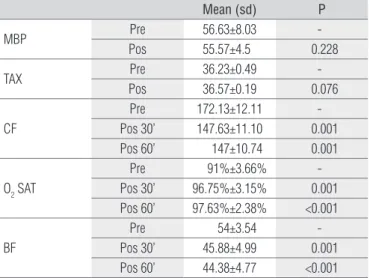
Before the aquatic physical therapy procedure, the MBP was 56.63±8.03. After aquatic physical therapy, a small decrease in the MBP was observed (55.57±4.5), but this diference was not signiicant (p=0.228) (Table 2).
Body temperature
he mean TX (measured in degrees Celsius) was 36.23 ± 0.49 before the aquatic physical therapy procedure, and 36.57±0.19 after the procedure. his diference was not signiicant (p=0.76) (Table 2).
Cardiac frequency
Before the aquatic physical therapy procedure, the mean CF (measured in heart beats per minute) was 172.13±12.12. he mean CF was decreased to 157.25±16.21 ive minutes after the procedure (p=0.013), and to 147.63±1.10 30 minutes after the procedure (p=0.001) (Table 2).
Saturation of oxygen
he mean O2 SAT was signiicantly increased from pre- to
post-intervention until 60 minutes after the aquatic physical
therapy procedure (p<0.001). he mean O2 SAT was 91%±3.66%
before the procedure and 95.75%±3.24% ive minutes after the procedure (p=0.002) (Table 2).
Breathing frequency
A statistically signiicant reduction was observed in BF af-ter the end of the aquatic physical therapy procedure (p<0.001). he mean BF (measured in respiratory movements per minute) was 54±3.54 before the procedure, 48.88±5.24 ive minutes after the procedure (p=0.006), 45.88±4.99 30 minutes after the proce-dure (p=0.001) and 44.38±4.77 60 minutes after the proceproce-dure (p<0.001) (Table 2).
Table 2. Physiologic parameters during the study.
sd=standard deviation; p=significance index; CI 95%=confidence interval of 95%; MBP Pre=mean blood pressure before the procedure; MBP Pos=mean blood pressure after the procedure; TAX Pre=body temperature before the procedure; TAX Pos=body temperature after procedure; CF Pre=cardiac frequency before the procedure; CF pos 30’=cardiac fre-quency after 30 minutes procedure; CF Pos 60’=cardiac frefre-quency after 60 minutes of the procedure; O2 SAT Pre=saturation of oxygen before the procedure; O2 SAT 30’=saturation of oxygen after 30 minutes of the procedure; O2 SAT 60’=saturation of oxygen after 60 minutes of the procedure; BF Pre=breathing frequency before the procedure; BF Pos 30’=breathing frequency after 30 minutes of the procedure; BF Pos 60’=breathing fre-quency after 60 minutes of the procedure.
Mean (sd) P
MBP Pre 56.63±8.03
-Pos 55.57±4.5 0.228
TAX Pre 36.23±0.49
-Pos 36.57±0.19 0.076
CF
Pre 172.13±12.11
-Pos 30’ 147.63±11.10 0.001
Pos 60’ 147±10.74 0.001
O2 SAT
Pre 91%±3.66%
-Pos 30’ 96.75%±3.15% 0.001 Pos 60’ 97.63%±2.38% <0.001
BF
Pre 54±3.54
-Pos 30’ 45.88±4.99 0.001
Pos 60’ 44.38±4.77 <0.001
Neonatal behavioral assessment scale adapted
from Brazelton
4(NBAS)
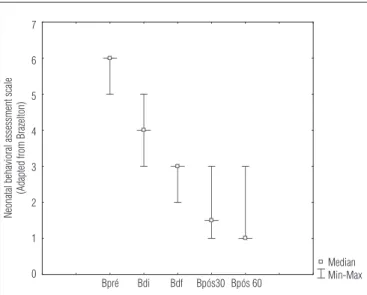
Figure 1 describes the changes observed in median NBAS scores at the different time-points. Before the physi-cal therapy procedure, the newborns’ behavior varied from fully awake with vigorous body movements to crying (scores ranging from 5 to 6 points). During the procedure, the me-dian NBAS score were reduced, with the most prevalent behaviors being a wakefulness state with eyes open and minimum body movements, followed by a state of sleep with eyes opening and closing (scores of 3 and 4). At the end of the procedure, the sleep states varied between light sleep with eyes closed and some body movement and deep sleep with no movement and regular breathing (scores of 1 and 2). These differences were statistically significant (p<0.001).
Neonatal facial coding system (NFCS)
h e mean score on the NFCS was 5.38±0.916 before the
physical therapy procedure. During the i rst minutes of physi-cal therapy, the mean NFCS score decreased to 4±1.85. At the end of the procedure, the mean score was reduced to 1.38±1.18 (p<0.001) when compared to the mean pre-intervention score. Further reductions were observed 30 minutes (0.38±0.74; p<0.001) and 60 minutes (0.25±0.463; p<0.001) after the proce-dure (Table 3 and Figure 2).
Discussion
During the physical therapy procedure, the newborns’ behavior varied from a crying state to a wakefulness state with open eyes and organized body movements. This result
is consistent with that found in Sweeney’s study5, which
ob-served the maintenance of the alert and quiet state during hydrotherapy, as opposed to the sleep state demonstrated during immersion baths without body movements. After several procedures performed in newborns presenting changes in tonus, the same author observed an improve-ment in spasticity when the subjects underwent aquatic physical therapy. The newborns obtained, in a shorter period of time and with less effort, semi-flexed postures and im-provements in the performance of spontaneous movements
Figure 1. Neonatal behavioral assessment scale (adapted from brazelton)4 during the study.
Neonatal behavioral assessment scale
(Adapted from Brazelton)
Bpré Bdi Bdf Bpós30 Bpós 60
Median Min-Max 7
6
5
4
3
2
1
0
1Scale rating from 1 to 6 (Appendix B); Bpré=scale rating before the protocol; Bdi=Scale
rating during 5 minutes of the protocol; Bdf=Scale rating in the final of the protocol; Bpós-30=Scale rating after 30 minutes of the protocol; Bpós-60=Scale rating after 60 minutes of the protocol; Friedman’s test: Qui-square: 46.3; p<0.001; Kendall’s coeffi-cient of concordance=0.96.
Table 3. Comparisons between the average scores of the scale of pain (NFCS) during the protocol
Mean (sd) p Diference of the Means
NFCS Pré 5.25±0.87 -
-NFCS Di 3.83±1.59 0.012 1.41±0.47
NFCS Df 1.33±1.07 <0.001 4±0.26 NFCS Pós-30’ 0.42±0.79 <0.001 4.83±0.34 NFCS Pós-60’ 0.33±0.65 <0.001 4.91±0.31 sd=Standard Deviation; NFCS Pré=Scale rating before the protocol; NFCS di=Scale rating during 5 minutes of the protocol; NFCS DF=Scale rating in the final of the protocol; NFCS Pós-30=Scale rating after 30 minutes of the protocol; NFCS Pós-60=Scale rating after 60 minutes of the protocol. Between the groups only the NFCS Pós 30’ x NFCS 60’ the difference (0.08±0.08) wasn’t significant (p=0.34).
NFCS
1
8
7
6
5
4
3
2
1
0
-1
5,25
1,42 3,83
0,42 0,33
NFCSpré NFCSdi NFCSdf NFCSpós30 NFCSpós60
1NFCS scale rating from 0 to 8; *Multivariate Tests Wilks’ lambda (p<0,001); *Verticals
Bars indicated 95% Confidence Interval. NFCSpré=Scale rating before the protocol; NFCSdi=Scale rating during 5 minutes of the protocol; NFCSdf=Scale rating in the final of the protocol; NFCSpós30=Scale rating after 30 minutes of the protocol; NFCSpós60=Scale rating after 60 minutes of the protocol.
Figure 2. Comparison between the average scores of the scale of pain (NFCS) during the study.
in a liquid environment5. Other studies investigating
bath-ing techniques in newborns found reductions in crybath-ing
and anguish and improvements in behavior6. According to
Béziers and Hunsinger7, the water environment facilitates
the movement and also allows infants to recover the feeling of their fundamental movements and continue to develop their “motor coordination”.
When it comes to sleep and wakefulness cycles, the REM and non-REM cycles are considered essential to the subject’s neurodevelopment, learning skills, memory and
preservation of brain plasticity8. Nedive9 states that the
facilitation and protection of sleep and sleep cycles are essential, in the long term, to learning skills and to cere-bral development by the preservation of brain plasticity. In the present study, newborns’ sleep and wakefulness cycles changed to a light sleep state with eyes closed and some body movement immediately after the aquatic physical therapy, and after some time, the newborns acquired a deep sleep state with regular breathing.
According to the NFCS scores, there was a significant decrease in pain after the aquatic physical therapy. The physiological effects of water cause pain relief and general muscle relaxation by the reduction of sensibility in nerve endings and the increase of peripheral circulation, which
provides more blood to the muscles10. According to
So-brinho, Kreulish e Habib11, as pain receptors are located in
the skin, physical approaches to reduce pain are basically related to the spinal dorsal horn. The stimulation of larger afferents that deliver less harmful messages can reduce the impact of smaller afferents that deliver pain messages. Therefore, painless stimulus such as touch can be used to ease pain.
Aquatic physical therapy has shown to be safe when it
comes to vital signs. In 1983, Sweeney5 compared exercises
in water with immersion only and found normal vital signs values during both procedures. However, the authors ob-served a decrease in mean blood pressure during the im-mersion procedure. The temperature was kept at normal values, without variations. This finding might be related to the water temperature, which was closer to the infants’
body temperature. According to Masi12, if the water is at
the same temperature as the subject’s body, the convec-tion and conducconvec-tion mechanisms are not operating in heat loss. These mechanisms, however, are very important for heat dissipation during aquatic exercises due to the great body surface in contact with water and the conduction capacity of the environment. According to Cloherty and
Stark13, loosely wrapping the infant in a warm wet cloth, as
performed in this study, assists the child’s relaxation and temperature stability.
Before the procedure, the infants demonstrated
tachy-cardia, with CF of 172.13±12.11, probably due to crying
and/or presence of pain. This finding matches the findings
of Clohery and Stark’s13 study, where newborns’ CF was
in-creased during crying. Studies suggest that pain and stress aggravate the clinical instability of newborns in intensive
care14. In the present study, after the physical therapy
in-tervention, the subjects’ CF decreased, especially 30 and 60 minutes after the intervention. This finding is in line
with those of Sweeney et al.5, who detected a decrease in
heartbeats after hydrotherapy. Caromano et al.10 observed
that exercises in warm water could modify physiological responses such as CF, however this did not occur in the present study. It is suggested that the decrease in physi-ological responses is associated to changes in behavior (i.e. crying to deep sleep).
The BF was significantly reduced after the aquatic physi-cal therapy, especially 60 minutes after the procedure. As previous studies demonstrate that tachypnoea can be a
con-sequence of anxiety or pain15, this finding might be related
to pain reduction and the change in neonatal behavior to a deep sleep state.
Before the aquatic physical therapy, the infants were
agitated and tearful, demonstrating a mean O2 SAT of
91%±3.66%. After the aquatic physical therapy, there was
a statistically significant increase in O2 SAT. It is believed
that this result is related to the decrease in the neonates’
crying and pain. Authors report that the O2 SAT decreases
due to the stressful environment of the NICU2. According
to Campion16, the therapeutic effects of either exercising
in warm water or simple immersion improve blood
circu-lation and respiratory muscle functioning. Beziers7, Getz,
Hutzler and Vermer17 also argue that the water
environ-ment increases vital capacity and reduces body weight, al-lowing the newborns to recover the movements performed during their fetal life.
he present study demonstrated that the aquatic physical therapy was safe for preterm newborns. However, the indication for this technique should be precise and follow well-established criteria in addition to the caution with water temperature, cot sterilization and observation of vital signs.
The present study has several limitations that need to be acknowledged. First, it is possible that the scores on the pain assessment scale may have been biased due to the difficulty in identifying and scoring the newborns’ facial movements (i.e. observer bias). Second, the limited sample size makes it difficult to generalize the results (i.e. low external validity). A total of 14 and 24 patients would be required to provide 80% power and 90% power to detect important differences, respectively; whereas the actual
sample size (n=12) provided only 77.3% power with an al-pha value of 0.05. The main limitation of this study was the absence of a control group. As such, the observed effects could have been due to factors other than the intervention provided (e.g. change in the environment conditions, effect of the time, oscillations of the circadian cycle, etc.). Based on the discussions that were raised and the limitations of this study, future controlled studies with larger sample sizes are needed to examine the presence of possible con-founding factors that could interfere with the results.
Conclusions
he aquatic physical therapy was shown to be safe and efective in reducing pain and improving sleep quality among premature infants hospitalized in NICUs. his intervention, when well performed, can be used as a non-pharmacological method for pain relief and improvement in deep sleep quality and duration. As such, this procedure can contribute to the multidisciplinary principles of humanization in NICUs.
Pain is a sensory experience and can be managed by phar-macological or non-pharphar-macological procedures, or by the simultaneous use of both. Non-pharmacological interventions, such as tactile approaches, massages, non-nutritive suck-ing and immersion baths aim to prevent the aggravation of a painful process, disorganization of the neonates, stress and agitation; in other words, to minimize the pain repercussions. In the present study, the improvement in physiological param-eters, pain and sleep quality after the intervention suggest that aquatic physical therapy can be beneicial to stable preterm newborns. his technique can contribute to the reduction of harmful efects among the infants, without depriving them of the tactile-kinesthetic stimulation necessary to their neurode-velopment. More controlled studies are necessary to prove these beneits.
Acknowledgements
Lidiane Zanelatto, Rafael Luiz Souza Do Amaral and Paulo Nader
References
1. Gaspardo CM, Linhares MBM, Martinez FE. A eficácia da sacarose no alívio de dor em neonatos: revisão sistemática da literatura. J Pediatr (Rio J). 2005;81:435-42.
2. Anand KJ. Effects of perinatal pain and stress. Prog Brain Res. 2000;122:117-29.
3. Grunau RE, Weinberg J, Whitfield MF. Neonatal procedural pain and preterm infant cortisol response to novelty at 8 months. Pediatrics. 2004;114(1):e77-84.
4. Brazelton TB. Neonatal Behavioral Assessment Scale. London: Clinics in Developmental Medicine; 1973.
5. Sweeney JK. Neonatal hydrotherapy: an adjunct to developmental intervention in an intensive care nursery setting. Phys Occup Ther Pediatr. 1983;3(1):39-52.
6. Santos PF, Cunha MCB, Franco RC. Estimulação e aquisição do controle cervical e do rolar por meio do método Halliwick associado ao conceito Bobath, em crianças com atraso motor. Fisioter Bras. 2006;7(3):224-8.
7. Béziers M, Hunsinger Y. O bebê e a coordenação motora:os gestos apropriados para lidar com a criança. São Paulo: Summus; 1994.
8. Graven S. Sleep and brain development. Clin Perinatol. 2006;33:693-706.
9. Nedive E. Molecular analysis of developmental plasticity in neocortex. J Neurobiol. 1999;41(1):135-47.
10. Caromano FA, Themudo-Filho MRF, Candeloro JM. Efeitos fisiológicos da imersão e do exercício na água. Fisioter Bras. 2003;4(1):1-5.
11. Sobrinho GM, Kreulich LS, Habib AL. O efeito do toque na dor do bebê. Fisioter Bras. 2004;65:26-35.
12. Di Masi F. Hidro: propriedades físicas e aspectos fisiológicos. Rio de Janeiro: Sprint; 2000.
13. Cloherty J, Stark AR. Manual de neonatologia.Minas Gerais: MEDSI; 2000.
14. Calasans MTA, Kraychette DC. Dolor de recién-nacido. Revista Recrearte. 2005;4:01-11.
15. Scalan GD, Stoller J, Wilkins R. Fundamentos da terapia respiratória de Egan. São Paulo: Manole; 2000.
16. Campion MR. Hidroterapia: princípios e prática. São Paulo: Manole; 2000.
17. Getz M, Hutzler Y, Vermeer A. Effects of aquatic interventions in children with neuromotor impairments: a systematic review of the literature. Clin Rehabil. 2006;20(11):927-36.
Appendix 1
Neonatal Facial Coding System (NFCS).
The Neonatal Facial Coding System (NFCS) is a scale based only in the evaluation of neonate facial expression and it is adapted to those born at term and also preterm.
Facial movement 0 Point 1 Point
Wrinkled foreheads Absent Present
Compressed palpebral fissures Absent Present
Deep nasolabial groove Absent Present
Half open lips Absent Present
Mouth vertical or horizontal outstretched Absent Present
Tense tongue Absent Present
Tongue protrusion Absent Present
Quivering of the chin Absent Present
Maximum score: eight points. It is considered the presence of pain when three or more fa-cial movements appear in a consistent way during the evaluation of the presence of pain.
Appendix 2
Brazelton – Neonatal behavioral assessment scale.
State 1 Deep sleep, without movements, breathing regularly State 2 Light sleep, closed eyes, some corporal movement State 3 Sleepy, eyes opening and closing
State 4 Awake, opened eyes, minimum corporal movement State 5 Completely awake, strong corporal movement State 6 Cry