Lip reading role in the hearing
aid fitting process
Summary
Ana Helena Bannwart Dell´Aringa 1, Elisabeth
Satico Adachi 2, Alfredo Rafael Dell´Aringa 3
1 Specialization, Speech Therapist at the Speech Therapy Sector in Otorhinolaryngology at Marilia Medical School. 2 Specialization, Speech Therapist at the Speech Therapy Sector in Otorhinolaryngology at Marilia Medical School.
3 Doctor - Professor, Chief of Otorhinolaryngology at Marilia Medical School. Speech Therapy Sector in Otorhinolaryngology at Marilia Medical School (FAMEMA). Mail address: Ana Helena Bannwart Dell´Aringa - Rua Sperendio Cabrini 310 17.516-300 Marília SP.
Tel (0xx14) 3433-6631 - Fax: (0xx14) 3402-1704 - E-mail: [email protected]
Paper submitted to the ABORL-CCF SGP (Management Publications System) on February 3rd, 2006 and accepted for publication on July 6th, 2006. cod. 1705.
L
ip reading (LR) is unconsciously practiced as we communicate and has currently been widely used in the assessment of hearing impaired people. The hearing challenged individual is able “to read” lip position and thus interpret the speech sounds of the speaker; however, it is very likely that the best lip reader can only catch 50% of the words uttered. Methodology: 30 individuals of both gender, with age ranging from 27 to 89 years, carriers of moderate bilateral sensorineural hearing loss. The assessment encompassed speech recognition test of monosyllable words in four situations: without hearing aid (HA) and LR; without HA and with LR; with HA and without LR; and with HA and LR. Results: we noticed an improvement in the percentage of correct answers in 93.5% of the patients with HA and LR when compared to those patients in the other situations. Conclusion: Lip reading is an important communication strategy for those with hearing impairment, and it can support the hearing aid fitting process.Keywords: hearing aid, hearing loss, lip reading.
ORIGINAL ARTICLE
INTRODUCTION
Communication difficulty is considered the most important consequence of hearing impairment. Hearing impaired individuals try to minimize this difficulty by using some mechanisms in order to have a better understanding of what is being said. Thus, they send the message back to the person they are talking to, in a much easier way. These mechanisms are called by Speri (2000) “communi-cation strategies”1.
According to Boéchat (1992), communication stra-tegies are a set of given attitudes that work as facilitating agents for the message to be easily received, both in a visual and hearing way2.
The same author organized communication strate-gies in groups, according to their nature and she classified them into cognitive, interventional, mechanic, palliative, remedial, waiving and simulative ones.
Among the cognitive strategies, which aim to rescue the content of the message, there is lip reading (LR).
Besides using communication strategies as facilita-ting agents for communication effectiveness, the use of Lip Reading becomes essential for this purpose. According to Kozlowski (1997), the visual processing of speech is used even among listeners, as part of speech perception3. This process takes place mainly when the signal/noise re-lationship is unfavorable, since the phonemes are hidden by the noise, only being audible by the listener.
For Demorest, Bernstein (1992) lip reading is the most prevalent expression within the cognitive type of strategy, where individuals use several clues to understand speech, as for example, paying attention to facial expres-sions, recognition of gesture clues, paying attention to environmental clues and others4
The use of lip reading is unconsciously done when we communicate watching for facial expression, gestures, change of posture and clues that show us ways to deco-de the information, and it is being currently used when assessing hearing impaired individuals. 5.
The hearing challenged individual is able “to read” lip positions and thus interpret the speech sounds of the speaker; however, it is very likely that the best lip reader can only catch 50% of the words uttered, since many phonemes have an invisible articulation and others have the same articulation. 6
For Russo (1999), it is necessary to select, indicate and adapt hearing aids together with global audiologic rehabilitation programs, in order to minimize the psycho-social reactions of older people to the aspects mentioned above, helping this hearing impaired person and his/her relatives7.
Therefore, this study aimed to research lip reading benefits during the hearing aid fitting process in adults.
MATERIAL AND METHOD
This study was done at the Speech Therapy Sector at the Otorhinolaryngology Department at Marilia Medical School (FAMEMA), and approved by the Research Ethics Committee under protocol # 322/04. Thirty one patients were selected with ages ranging between 27 and 89 years (average= 65.6 median = 71), whose threshold tonal au-diometry indicated symmetric bilateral hearing impairment, both sensorineural and moderate, being these two the inclusion factors. All the patients were being submitted to hearing aid selection and indication process for the first time, and they have never had a hearing aid test previously, exclusion factors.
Data collection was done through the analysis of medical records. We selected medical records from patients meeting the inclusion and exclusion factors described above.
We collected data relative to a speech perception test of monosyllable words (Lacerda et al., 1976) in 4 si-tuations, which were presented as follows8:
- Without HA and without LR (1st situation); - Without HA with LR (2nd situation); - With HA without LR (3rd situation); - With HA with LR (4th situation);
This specific procedure is used as routine for hea-ring aid selection on this institution.
The different tests were applied orally by the same investigator, with an intensity of around 70/75 dB, in a well-lit room and with minimum noise. The distance be-tween the subject and the investigator was 1 meter.
Davis, Silvermann’s classification (1970) was used to determine the degree of hearing impairment9.
RESULTS
Results were analyzed in a descriptive manner, according to statistical orientation.
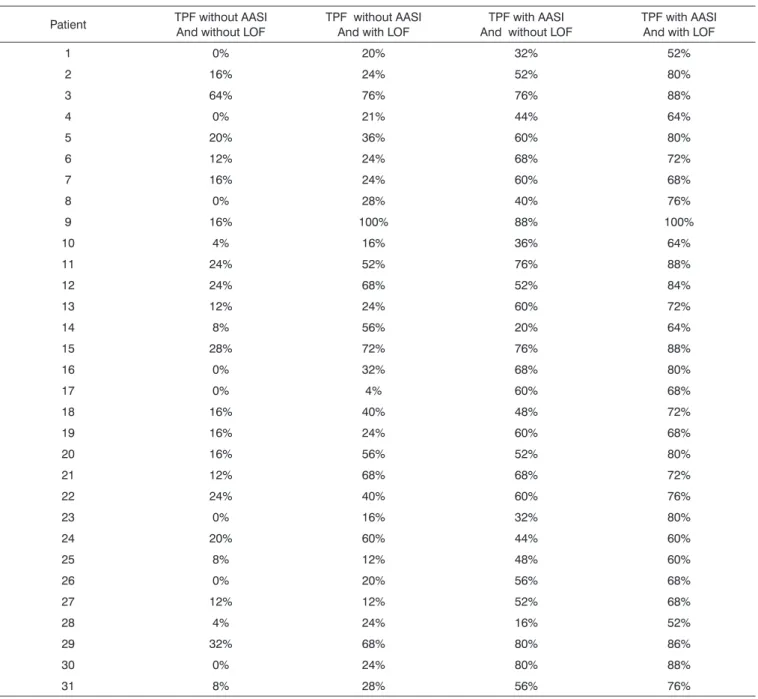
On Table 1, it is possible to observe the correct answer percentage obtained by each patient, in all 4 situ-ations of the speech perception test.
Situation number 1 presented a higher degree of difficulty for the hearing impaired individual, since the patient was without HA and without LR.
When comparing situations 1 and 2, without HA, without and with LR, it can be noticed that 100% of the patients (31 patients) scored higher using LR. The same happened when we compare the two following situations, 3 and 4, with HA, with and without LR, since 100% scored better using HA.
Results such as these, are also similar between si-tuations 1 and 3, without LR, with and without HA, it was confirmed that 100% of patients scored better using HA.
Table 1. Depicts the percentage of right answers per patient in the speech perception test in each assessment situation. ( n=31) Patient TPF without AASIAnd without LOF TPF without AASI And with LOF And without LOFTPF with AASI TPF with AASI And with LOF
1 0% 20% 32% 52%
2 16% 24% 52% 80%
3 64% 76% 76% 88%
4 0% 21% 44% 64%
5 20% 36% 60% 80%
6 12% 24% 68% 72%
7 16% 24% 60% 68%
8 0% 28% 40% 76%
9 16% 100% 88% 100%
10 4% 16% 36% 64%
11 24% 52% 76% 88%
12 24% 68% 52% 84%
13 12% 24% 60% 72%
14 8% 56% 20% 64%
15 28% 72% 76% 88%
16 0% 32% 68% 80%
17 0% 4% 60% 68%
18 16% 40% 48% 72%
19 16% 24% 60% 68%
20 16% 56% 52% 80%
21 12% 68% 68% 72%
22 24% 40% 60% 76%
23 0% 16% 32% 80%
24 20% 60% 44% 60%
25 8% 12% 48% 60%
26 0% 20% 56% 68%
27 12% 12% 52% 68%
28 4% 24% 16% 52%
29 32% 68% 80% 86%
30 0% 24% 80% 88%
31 8% 28% 56% 76%
obtained the same score in both situations.
And comparing the last situation with the rest, 93.5% improved using HA and LR.
DISCUSSION
We will now establish comparison relationships between the different situations.
When we compare the first two situations, whe-re almost all individuals did not have HA, 97% of them
obtained an improved rate on speech recognition when they did LR.
Therefore, we can observe that using LR only, most hearing impaired patients can benefit from this com-munication strategy.
This type of data is similar to those reported by Schartz et al. (2004), who stated that watching a speaker’s lips helps the listener to hear better, and as a consequence,
to understand better10.
Between situations 1 and 3, where they did not have the help of LR, we can notice a better score on 100% of individuals assessed, when they used HA.
Silva et al. (2002) described that the use of hearing aids, is important to improve the cognitive functions in older hearing impaired patients 11.
The same thing did not happen between situations 2 and 4, where almost every individual did LR, situation 2 was without HA and situation 4 with HA, since 6.5% obtained the same result, both with and without HA.
Situations 2 and 3 called our attention, since betwe-en them 16% of individuals scored higher on the second one, where they did not have HA but did LR.
It is likely that this fact happened because the test with HA was done with hearing impaired patients who had never used or tested HA previously, but knew how to do LR as a communication strategy, being the hearing stimulus on a second level.
This could also be justified by the conclusion rea-ched by the study done by Boéchat (1992), where it is said that those individuals dealing better with hearing impair-ment, used the communication strategies more often 2.
Blamey et al. (1989) described that when hearing does not offer proper sensorial information on speech, the visual and tactile aspects can be used as additional or alternative sensorial channels, and therefore, they should be used with the aim of increasing the communication potential of those with hearing loss 12.
Hull (1992) talked about the importance of intro-ducing older patients to hearing difficulties on a hearing rehabilitation program, where LR training would be em-phasized, making up for the communicative difficulties found when they only use HA 13.
In a similar study, authors concluded that HA and LR together, offer a significant improvement in recognizing consonants. Whereas LR offers information regarding the point of articulation, HA helps with its point and manner, and with information on vowels14.
Other studies such as this one, were not found on compulsory literature, however, on a paper done by Mello et al. (2004), the authors reported that 100% of assessed individuals used the cognitive strategies, LR among them, both with HA and without HA15. And they concluded that this was the most used fact, due to its spontaneity and its easy application, since it is widely used, even among normal listeners.
Marques et al. (2004) showed on their study, that after a hearing rehabilitation program, aiming to assess the capability to integrate visual and hearing clues, through phoneme training, only one subject did not improve the
speech perception of monosyllable words.
With this study, we can state the importance of LR as a mechanism to facilitate speech understanding and keeping a successful conversation. From a general point of view, LR brings benefits to patient’s well-being with more self-esteem and, therefore, a better social life.
An important factor we should highlight is the fact that this study was carried out in a quiet and lit setting, which makes easier the use of these strategies. When the patient is in a noisy place where noise is louder than spe-ech, the HA system may not be effective and the strategies play a significant role for communication.
CONCLUSION
From the results obtained with this study one can conclude that:
Most individuals obtained a better score in the speech perception test when they used lip reading, both with and without HA.
The most beneficial situation for hearing impaired individuals was situation number 4, where they had HA and LR.
Lip reading is an important communication strategy for hearing impaired individuals and its recommendation helps the HA fitting process.
REFERENCES
1. Speri MRB. Estratégias de comunicação usadas nas interações de crianças deficientes auditivas e seus interlocutores. [Dissertação - Mes-trado] Distúrbios da Comunicação Humana: Pontifícia Universidade Católica de São Paulo; 2000.
2. Boéchat EM. Ouvir sob o prisma da estratégia. [Dissertação -Mestrado]. Distúrbios da Comunicação Humana: Pontifícia Universidade Católica de São Paulo; 1992.
3. Kozlowski L. A percepção Auditiva e Visual da Fala. São Paulo: Ed. Revinter; 1997.
4. Demorest ME, Bernstein LE. Sources of variability in speech rea-ding sentences: a generalizability analysis. J Speech Lang Hear Res 1992;35(4):876-91.
5. Bevilacqua MC, Piccino MTRF, Pinto MDB. Rastreamento de fala em indivíduos com audição normal. Pró-fono: Revista da Atualização Científica 1999;11(1):73-7.
6. 3.1.5. Leitura Orofacial. Disponível em http://www.ines.org.br/ ines_livros/18/18_006.HTM. Acessado em 10 de junho de 2006. 7. Russo ICP. Distúrbios da Audição: A Presbiacusia. In: Russo ICP.
Intervenção Fonoaudiológica na Terceira Idade. Rio de Janeiro: Ed. Revinter; 1999. p. 51-92.
8. Lacerda AP. Audiologia Clínica. Rio de Janeiro: Ed. Guanabara Koo-gan; 1976.
9. Davis H, Silverman RS. Hearing and Deafness. 4 ed. New York, Holt: 1978.
10. Schartz JL, Berthommier F, Savariaux C. Seeing to hear better: evidence for early audio visual interactions in speech identification. Cognition 2004;93(2):69-78.
perception using combinations of auditory visual and tactile infor-mation. J Rehabil Res Dev 1989;26:15-24.
13. Hull RH. Techniques of Aural Rehabilitation Treatment For Older Adults. In:___. Aural Rehabilitation. San Diego: 2a. Ed. Singular Publishing Group Inc.; 1992. p. 278-92.
14. Walden BE, Grant KW, Cord MT. Effects of amplification and speech reading on consonant recognition by persons with impaired hearing.
Ear Hear 2001; 22(4):333-41.
15. Mello JM, Dell’Aringa AHB, Zacare CC, Oliveira JRM, Oliveira VV. Estratégias de comunicação utilizadas por portadores de deficiência auditiva neurossensorial moderada. Pro-Fono2004;16(1):111-8. 16. Marques ACO, Kozlowski L, Marques JM. Reabilitação auditiva no