Printed in Brazil - ©2007 Sociedade Brasileira de Química 0103 - 5053 $6.00+0.00
Article
*e-mail: [email protected], [email protected]
Chemoselective Oxidation of Benzophenazines by
m
-CPBA:
N
-Oxidation
vs.
Oxidative Cleavage
Raphael S. F. Silva,a Mauro B. de Amorim,a Maria do Carmo F. R. Pinto,a Flávio S. Emery,a Marília O. F. Goulart*,b and Antonio V. Pinto*,a
a
Núcleo de Pesquisas de Produtos Naturais, Universidade Federal do Rio de Janeiro, Centro de Ciências da Saúde, 21944-970 Rio de Janeiro- RJ, Brazil
b
Instituto de Química e Biotecnologia, Universidade Federal de Alagoas, Campus A.C. Simões, Tabuleiro dos Martins, 57072-970 Maceió-AL, Brazil
Quimiosseletividade é observada, após reação de oxidação, utilizando-se m-CPBA, a partir da piranobenzo[a]fenazina e da furanobenzo[a]fenazina, derivadas, respectivamente da
β-lapachona e da nor-β-lapachona. A fenazina pirânica forneceu macrolactonas, principalmente, enquanto a fenazina furânica conduziu a um único produto: o N-8 óxido da fenazina. Objetivando entender essa diferença de reatividade, uma nova fenazina furânica foi sintetizada, tendo como característica principal, a presença da ligação dupla em um sítio menos encoberto estericamente do que aquele presente no derivado nor-beta-lapachônico. Essa furanofenazina, após oxidação com m-CPBA, forneceu, principalmente, a macrolactona esperada. Esses resultados experimentais, aliados a cálculos mecânico-moleculares do estado fundamental dos substratos, permitiram sugerir que a quimiosseletividade observada pode ter controle estérico, relacionado à presença dos grupos substituintes metila geminados, que dificultam a aproximação do oxidante. Muitos dos compostos sintetizados são relatados, pela primeira vez, no presente artigo.
Chemoselectivity is observed when a pyran-benzo[a]phenazine and a furan-benzo[a]phenazine from β-lapachone and nor-β-lapachone, respectively, were submitted to oxidation by m-CPBA. The pyran phenazine furnished mainly macrolactones, while the furan one led exclusively to a phenazine N-8 oxide. To understand this difference in reactivity, we synthesized a new furan phenazine, with the reactive double bond site less hindered than that of the derivative from nor-beta-lapachone. This furan phenazine, upon oxidation with m-CPBA, furnished mainly the expected macrolactone. These experimental results, along with preliminary analysis based on mechanical molecular calculations of the ground state of the substrates, allowed us to suggest that the observed chemoselectivity has a steric oxidant approach control origin, related to the presence of the geminal methyl groups in the phenazine structure. Several of the synthesized compounds are, herein, reported for the first time.
Keywords: m-CPBA oxidation, phenazines, chemoselectivity, N-oxides, macrolactones, oxidative cleavage
Introduction
In previous communication,1 we reported the
unexpected reactivity of β-lapachone phenazine 1 upon oxidation by m-CPBA. The oxidative cleavage of the aromatic double bond at the site of ring junction was observed, leading to the formation of a 10-membered
macrolactone 2 (27%) and its N-oxide 3 (13%), together with an α-hydroxy-dihydrobenzophenazinone derivative 4 (35%), resultant from the pyranic ring cleavage (Figure 1).1 Hydroxy and bromo derivatives of 1, respectively, 5
and 6, were also submitted to oxidation in the same conditions and furnished substituted 10 membered macrolactones: 7 from 5 and 8 from 6.2
Based on that initial study,1 some papers dealing with
of the synthetic aspects have appeared in the literature, showing the large potential of this macrolide synthetic approach.3,4
Macrolides are an attractive class of compounds that have shown a wide variety of bioactivities,5 especially
recognized as antibiotics.6 The presence of diaza
heterocyclic groups close to the ion-binding macrolactone moiety constitutes attractive molecular features.3 On the
other hand, N-oxides were also designed and synthesized to behave as bioreducible drugs, being the anticancer hypoxic agent tirapazamine, one of the most successful example.7
These results and the relevance of the synthesized compounds led us to perform a more detailed study of this reaction. Two furan phenazines, 9 (Figure 2) and 10 (Figure 3), were synthesized and submitted to m-CPBA oxidation in an attempt to obtain 9-membered macrolactones.
It is worth mentioning that medium-sized heterocycles (with 8 to 10-membered rings) are often pharmaceutically important compounds and the production of such rings remains challenging.1,8
Results and Discussion
The new compound 9 (2-methyl-1,2-dihydro-benzo[a]furo[2,3-c]phenazine) is derived from
o-naphthoquinone 9a9 (Figure 2) which was recently
evaluated against T. cruzi with good results.10 Its
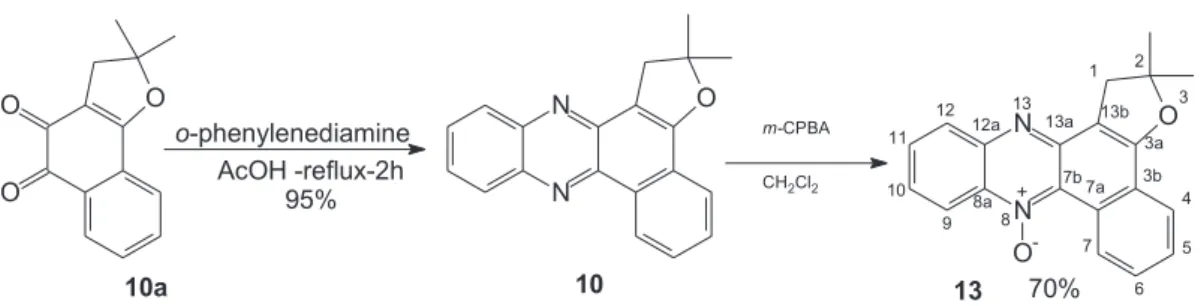
homologue, 1,2-dihydro-2,2-dimethylbenzo[a]furo[2,3-c]phenazine, compound 10, is obtained from nor-β -lapachone 10a which was synthesized following the methods described in the literature (Figure 3).12-13
The new monomethyl derived-phenazine 9 (Figure 2), submitted to m-CPBA oxidation has furnished two compounds: the 9-membered macrolactone N-oxide 11 and the α-hydroxy-ketone 12 (Figure 2).However, for 10, analysis of the reactional mixture pointed to the almost exclusive formation of the mono-N-oxide product (13), without any evidence of the formation of the corresponding 9-membered macrolactone (Figure 3).
The product characterization was based on data from spectroscopic methods, mainly IR, 1H NMR and 13C NMR
and by comparison with spectra of similar compounds.1-4, 10, 14
Figure 1. m-CPBA oxidation of selected pyran phenazines. N
N O
R
N
N O O
O R' R + N N O HO OH m-CPBA
CH2Cl2
1 R = H 4
R = OH R = Br
5 6
2 R = H, R' = 2e
-3 R = H,R'= O (27%) (13%)
7 R = OH, R'= O(52%)
8 R = Br, R'= O (10%)
(35%) 4a
14b
Figure 2. Preparation and reactivity of a furan phenazine toward m-CPBA. 6 7 8 o-phenylenediamine 5 5a 9 9a 1 2 3 3a 12 13 13a 13b 95% 56% 26% N N O O O O
AcOH, reflux, 2h
N
N O O
O
O
-+
m-CPBA
CH2Cl2
rt, 24h
9a 9
11
N
NHO O OH
12
1 2 3
3a 4 3b
The differences in reactivity of these phenazines toward m-CPBA oxidation (1, 5, 6, and 9, Figures 1 and 2, which produced the corresponding macrolactones,
versus10, Figure 3, which led only to N-8 oxide product) has prompted us to perform some preliminary theoretical calculations on these substrates.
Firstly, considering that the different reactivity might have an electronic origin, we performed electronic structure calculations at B3LYP/6-31G(d,p) level of theory,15-17 on compounds 1, 9, and 10. At this level, no
appreciable differences were detected between the values of these compounds, either in charge distribution around the reactive double bond site or in HOMO and/or LUMO energy levels (Table 1)18 which could have been
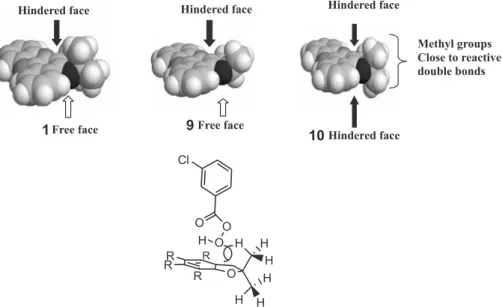
responsible for such a dramatic difference in reactivity. Nevertheless, during the theoretical conformational analysis of these compounds, we observed that while one of methyl groups in the half-chair pyranic ring of 1 occupied a pseudo-equatorial position, leaving a relatively accessible surface for m-CPBA approach, both faces of the planar furanic ring of phenazine 10 were sterically hindered by its methyl groups (Figure 4). On the other hand, phenazine 9 assumed a envelop conformation with one of its dihydrofurane faces relatively free for m-CPBA approach (Figure 4). So, it seems reasonable to suppose that a steric approach control based on the proposed spiro transition structure for epoxidation of double bonds with m-CPBA19-21
could be responsible for the dramatic effect observed on reactivity. The two methyl groups in 10 would preclude the attack of m-CPBA on the enol double bond shared by aromatic and heterocyclic rings, leading exclusively to the N-8 oxidation and the production of 13.
As a conclusion, both experimental results and theoretical evidences seem to indicate that the steric approach control would explain the different reactivities, especially if we consider that the attack of m-CPBA tends to be perpendicular to the plane of the rings (spiro-transition-structure). Additional theoretical study is currently being performed in order to find transition structures and barrier heights for these oxidations and to corroborate this initial guess.
This rationale could now be extended to reactions with other phenazines, with the goal of preparing 9- or 10-membered macrolactones or N-oxides. The phenazine 9, the N-oxide 13 and the oxidized products from 10 are reported, herein, for the first time.
Experimental
NMR experiments were performed in deuteriochloroform with TMS as the internal standard with Gemini-200 MHz instrument: chemical shifts are given in δ (ppm), and J values are given in Hz. For elemental analysis, IR spectra and mass spectra we used Perkin-Elmer CHN 2400, Perkin-Elmer 783 and a Shimadzu GCMS-QP 5050-A, respectively.
Preparation of 2-methyl-1,2-dihydrobenzo[a]furo [2,3-c]phenazine (9)
A solution of glacial acetic acid (50 mL) containing quinone 9a (2-methyl-2,3-dihydronaphtho[1,2-b]furan-4,5-dione), synthesized by the procedure described by Fieser9 and adapted by Pinto and coworkers10 (214 mg,
1.00 mmol), o-phenylenediamine (119 mg, 1.10 mmol) and sodium acetate (107 mg, 1.30 mmol) were kept under reflux for 2 h, and monitored by TLC. After
Figure 3. Preparation and reactivity of a sterically hindered furan phenazine toward m-CPBA.
2 3
4
5
6 3a 3b 13b
O O
O
o-phenylenediamine
AcOH -reflux-2h 95%
1
N
N O
CH2Cl2
m-CPBA
7 8 11
12
12a 13a
7a 7b 13
8a 9 10
70%
10a 10
N
N O
O
-13
Table 1. Calculated HOMO/LUMO energies, HOMO-LUMO, energy gap (hartrees) and reactive double bond atomic charges (electrons)
Compound HOMO LUMO GAP CHARGE CHARGE
1 -0.20247 -0.07454 0.12793 -0.26 C-14b 0.15 C-4a
9 -0.19963 -0.07683 0.12280 -0.20 C-13b 0.14 C-3a
reaction, the mixture was added into ice and allowed to stay overnight. The formed yellow precipitate was filtered off in Buchner funnel and washed with cold water (3 × 100 mL) and the phenazine 9 (273 mg, 0.95 mmol) was isolated with 95% yield.
Physical data, mp 134 °C, 1H NMR 200 MHz (CDCl 3) δ 9.3 (m, H-7) 8.25 (m, H-4) 8.15 (m, H-12 or H-9), 8.0 (m, H-9 or H-12) 7.75 (m, H-6, H-5, H-11, H-10) 5.35 (m, H-2), 3.8 (dd, J 14.3 Hz, 7.5 Hz H-1a or H-1b) 3.3 (dd, J 14.3 Hz, 7.5 H-1a or H-1b) 1.65 (d, J 4 Hz, C-2-Me), 13C NMR 50 MHz(CDCl
3) δ 158.01 (s, C-3a) 142.7
(s, 13a) 142.4 (s, 8a) 140.9 (s, 7b), 139.7 (s, C-12a), 131.5 (s, C-7a) 129.65 (d, C-5), 129.62 (d, C-12), 129.4 (d, C-10), 129.4 (s, C-3b) 128.2 (d, C-11), 127.8 (d, C-9), 125.6 (d, C-6), 124.4 (d, C-7), 121.9 (d, C-4), 112.7 (s, 13b), 81.9 (d, 2), 35.6 (t, 1), 22.2 (q, C-2-Me). Anal. Calc: C19H14N2O,C 79.70, H 4.93, N 9.78, O 5.59; Found: C 79.62, H 5.03, N 9.75.
Oxidation of phenazine 9
Phenazine 9 (286 mg, 1.00 mmol) in a solution of dichloromethane (7 mL) was treated at room temperature with m-CPBA (860 mg, 5 mmol) added dropwise. After 24 h of contact under stirring and the usual work up, the reaction product residue was submitted to column chromatography over silica gel and eluted with mixtures of hexane/ethyl acetate of increasing gradient of ethyl acetate. The macrolactone N-oxide 11,colourless solid, was eluted with a mixture of hexane/ethyl acetate (85:15), yielding 188 mg (56%, 0.56 mmol). The α-hydroxy-ketone, colourless solid 12 was eluted with a mixture of hexane/ethyl acetate (60:40) yielding 84 mg (0.26 mmol) with 26% yield.
7-Methyl-7,8-dihydro-benzo[3,4]oxonino[6,7-b]quinoxalin-5,9-dione 15-N-oxide (11)
Colourless solid, mp 145 °C, 1H NMR 200 MHz
(CDCl3) δ 8.6 (dd, J 7.8 Hz, J 1.6 Hz, H-14), 8.2 (dd, J
7.8 Hz, J 1.6 Hz, H-11), 8.1 (dd, J 7.8 Hz, J 1.6 Hz, H-4), 7.9 (m, H-3 + H-13), 7.7 (dd, J 7.6 Hz, J 1.6 Hz, H-2), 7.6 (dd, J 7.6 Hz, 1.6 Hz, H-1), 5.6 (m, H-7), 3.7 (dd, J 14.8 Hz, J 7.6 Hz, H-8a or H-8b), 3.3 (dd, J 14.8 Hz, J 7.6 Hz, H-8a or H-8b), 1.3 (d, J 3,9 Hz, C-7-Me),
13C NMR 50MHz(CDCl
3) δ 194.67 (s, C-9), 166.67 (s,
C-5), 153.7 (s, C-9a), 143.9 (s, C-11a + C-15a), 133.80 (d, 2), 133.7 (d, 3), 133.45 (d, 8), 132.55 (d, C-10), 131.1 (d, C-9), 130.8 (d, C-4) 130.2 (d, C-1) 129.6 (s, C-14a), 128.0 (s, C-15b), 127.6 (s, C-4a), 118.2 (d, C-14), 70.2 (d, C-7), 29.3 (t, C-8), 21.49 (q, C-7-Me), IR (KBr) νmax/cm-1:3063, 2985, 2933, 1721, 1709, 1597,
1286, 1264, 1198, 760, 701.MS [70 eV, m/z (%)]:319 (15), 318 (65), 291 (4), 290 (20), 274 (4), 249 (72), 248 (47), 234 (52), 220 (100), 204 (44), 177 (20), 102 (21), 76 (57), 50 (30). Anal. Calc: C19H14N2O3,C 68.26, H 4.22, N 8.38, O 19.14; Found: C 68.11. H 4.35, N 8.30.
6-Hydroxy-6-(2-hydroxypropyl)-5,6-dihydrobenzo [a]phenazin-5-one (12)
Colorless crystals, mp 155 °C. 1H NMR, 200 MHz
(CDCl3) δ 8.1 (m, 1, 4, 9, 10), 7.8 (m, 2, H-11, H-5), 7.6 (dd, J 7.5 Hz, 1,4 Hz, H-3), 5.6 (bs, H-2’), 3.8 (dd, 14.1 Hz, 4.6 Hz, H-1’a or H-1’b, 1H), 3.3 (dd, 14.1 Hz, 4.6 Hz H-1’a or H-1’b, 1H), 1.2 (bs, H-3’), 13C NMR,
50 MHz (CDCl3) δ 200.5 (s, C-5), 153.7(s, C-6a), 143.9 (s,
Figure 4. Proposed spiro transition structure for epoxidation of double bonds with m-CPBA.
Hindered face
Free face 1
Hindered face
Free face 9
Hindered face
Hindered face
Methyl groups Close to reactive double bonds
10
Cl
O H O
O
O
R R
R R
H H H
H H
C-12a), 139.1 (s, C-7a), 133.8 (s, C-11a), 133.6 (d, C-2), 133.5 (d, C-3), 131.2 (d, C-11), 131.0 (d, C-8), 130.6 (d, C-10), 129.8 (d, C-9), 129.5 (d, C-4), 128.7 (d, C-1), 126.6 (s, C-12b), 123.0 (s, C-4a), 85.6 (s, C-6), 69.4 (s, C-2’), 29.3 (t, C-1’), 21.6 (q, C-3’). IR (KBr) νmax/cm-1:3063,
2985, 2933, 1721, 1597, 1286, 1264, 1198, 760, 701. MS [70 eV, m/z (%)]:320(3) 319 (11), 318 (6), 301 (3), 291 (4), 290 (20), 274 (4), 263 (27), 249 (59), 233 (53), 220 (100), 204 (15), 192 (13), 177 (9), 164 (6) 102 (25), 76 (30), 50 (16). Anal. calcd: C19H16N2O3, C 71.24, H 5.03, N 8.74, O 14.98; Found: C 71.05, H 5.12, N 8.60.
Preparation of 2,2-dimethyl-1,2-dihydrobenzo[a]furo[2,3-c]phenazine-8-N-oxide (13)
Phenazine 10 (300 mg, 1.00 mmol), in a solution of dichloromethane (7 mL), was treated at room temperature with a solution of m-CPBA (860 mg, 5.00 mmol) added dropwise. After 24 h of contact and the usual work up, the reaction product residue was submitted to column chromatography over silica gel and eluted with mixtures of hexane/ethyl acetate of increasing gradient of ethyl acetate up to 100% of ethyl acetate, followed by mixtures of ethyl acetate / methanol of increasing polarity. The N-8 oxide 13 was eluted with mixture of ethyl acetate/methanol (90:10) and isolated as a fluorescent yellow solid (221 mg, 0.70 mmol), with a yield of 70%. Yellow solid, mp 173 °C,
1H NMR 200 MHz (CDCl
3) δ 9.3 (m, 7) 8.7 (m,
4) 8.3 (m, 12), 8.1 (m, 9) 7.8 (m, 11, 10, H-6, H-5) 4.1 (s, 2H, H-1), 1.7 (s, 6H, 2 x C-2 Me), 13C
NMR 50 MHz (CDCl3) δ 157.2 (s), 143.4 (s), 141.6 (s), 135.4 (s), 133.6 (s), 131.8 (s), 131.4 (d) 129.5 (s), 129.4 (d) 129.2 (d), 128.3 (d), 125.8 (d), 124.3 (d), 122.2 (d), 117.9 (d), 107.6 (s), 89.8 (s), 45.5 (t), 29.3 (s), MS [70 eV, m/z (%)]: 316 (6.97), 300 (11.31), 299 (32.45), 283 (11.21), 257 (28.18), 233 (24.85), 142 (24.50), 102 (25.85), 77 (37.41), 43 (100.00). Anal. Calc: C20H16N2O2,C 75.93, H 5.10, N 8.86, O 10.11; Found: C 75.88, H 5.21, N 8.78.
Computational methods
Electronic calculations were performed with the Gaussian 98 package.15 Geometries were fully
optimized at the B3LYP/6-31G(d,p) level (Becke three parameter hybrid functional, combined with the Lee, Yang, and Parr (LYP) correlation functional),16,17 and
all of them were characterized as genuine local minima (no imaginary frequencies) by calculation of vibrational frequencies at the same level of theory. In order to
search for additional local minima, rough confor-mational analysis of the furan and pyran rings were performed through small changes in ring torsion angles (from planar to twisted conformations and vice versa), followed by geometry re-optimization. Calculated charges are those that fit the electrostatic potential at points selected according to CHelpG scheme.22
Acknowledgments
The authors wish to thank CNPq/Edital Universal, CAPES, FAPEAL, CNPq/PADCT/ CTINFRA, Banco do Nordeste do Brasil (BNB), Instituto do Milênio-Inovação em Fármacos (CNPq) and FAPERJ for grants and fellowships.
References
1. Goulart, M.O.F.; Cioletti, A.G.; Filho, J.D.S.; De Simone, C.A.; Castellano, E.E.; Emery, F.S.; De Moura, K.C.G.; Pinto, M.C.F.R.; Pinto, A.V.; Tetrahedron Lett. 2003, 44, 3581. 2. Silva, R.S.F.; Guimarães, T.T.; Teixeira, D.V.; Lobato, A.P.G.;
Pinto, M.C.F.R.; De Simone, C.A.; Soares, J.G.; Cioletti, A.G.; Goulart, M.O.F.; Pinto, A.V.; J. Braz. Chem. Soc. 2005, 16, 1074.
3. Pérez-Sacau, E.; Soto-Delgado, J.; Estévez-Braun, A.; Ravelo, A.G.; Tetrahedron 2005, 61, 437.
4. De Simone, C.A.; Silva R.P.; Goulart M.O.F., Silva, R.S.F.; Lobato, A.P.G.; Pinto, M.C.F.R.; Pinto, A. V.; J. Chem. Crystal. 2006, 36, 551.
5. Mutzer, J.; Ohler, E.; Chem. Rev. 2003, 103, 3753.
6. Labro, M. In Macrolide Antibiotics; Schoenfeld, W.; Kirst, H. eds., Birkhaeuser Verlag: Basel, Switzerland. 2002, p.37. 7. Brown, J. M.; Mol. Med. Today 2000, 6, 157.
8. Nubbemeyer, U.; Eur. J. Org. Chem. 2001, 1801. 9. Fieser, L.F.; J. Am. Chem. Soc. 1926, 48, 3201.
10. Silva, R.S.F.; Costa, E.M.; Trindade, U.L.T.; Teixeira, D.V.; Pinto, M.C.F.R.; Santos, G.L.; Malta, V.R.S.; De Simone, C.A.; Pinto, A.V.; de Castro, S.L.; Eur. J. Med. Chem. 2006, 41, 526.
11. Carvalho, C.E.M.; Brinn, I.M.; Pinto, M.C.F.R.; Pinto, A.V.; J. Photochem. Photobiol., A: Chem. 2000, 136, 25.
12. Hooker, S. C.; J. Am. Chem. Soc. 1936, 58, 1168.
13. Andrade-Neto V.F.; Goulart, M.O.F.; Da Silva Fo, J.F.; Da
Silva, M.J.; Pinto, M.C.F.R.; Pinto, A.V.; Zalis, M. G.; Carvalho, L. H.; Krettli, A.U.; Bioorg. Med. Chem. Lett. 2004, 14, 1145.
14. Goulart, M.O.F.; Reys, J.R.M.; Emery, F.S.; Pinto, A.V.; de Souza Fo, J.D; Magn. Reson. Chem. 2004, 42, 663.
16. Becke, A.D.; Phys. Rev. 1988, 38, 3098; Becke, A.D.; J. Chem. Phys. 1993, 98, 5648.
17. Lee, C.; Yang, W.; Parr, R. G.; Phys. Rev. B 1988, 37, 785. 18. Recently, Zhan et al. (Zhan, C.-G.; Nichols, J. A.; Dixon, D.
A.; J. Phys. Chem.A 2003, 107, 4184) have shown that, if calculated LUMO energies are negative, as in our case, there are satisfactory linear correlation relationships between the (B3LYP) calculated HOMO and LUMO Kohn-Sham orbitals energy gaps and hardness values.
19. Bach, R. D.; Dimitrenko, O.; J.Phys. Chem. A 2003, 107, 4300. 20. Deubel, D.V.; J. Org. Chem. 2001, 66, 3790.
21. Freccero, M.; Gandolfi, R.; Sarzi-Amadè, M.; Rasteli, A.; J. Org. Chem. 2002, 67, 8519.
22. Breneman, C. M.; Wiberg, K. B.; J. Comp. Chem.1990, 11, 361.
Received: August 1, 2006