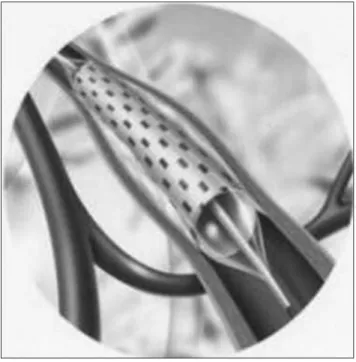
Cryoplasty for the treatment of femoropopliteal arterial disease
Crioplastia para tratamento da doença arterial femoro-poplítea
Marco Antonio Lourenço1, Gustavo Ioshio Handa1
Abstract
Background: Endovascular treatment of peripheral arterial disease (PAD) presents low morbidity and mortality rates; however, mid and long-term patency rates remain controversial. Cryoplasty was developed as an attempt to resolve the main problems related to angioplasty: dissection, recoil and restenosis.
Objective: To evaluate clinical results and mid-term patency in patients treated with cryoplasty of femoropopliteal arterial disease.
Methods: Patients with indication for endovascular lower limb revascularization according to Fontaine and Rutherford clinical classiications and to TASC II anatomical classiication underwent cryoplasty using the PolarCath® peripheral dilatation balloon catheter. Clinical results and anatomical patency were analyzed by duplex ultrasound scan at follow-up.
Results: Ten patients with femoropopliteal arterial disease were treated with cryoplasty. Nine patients presented with intermittent claudication and one patient had an ischemic ulcer. hree patients had class B lesions and seven patients had class A lesions according to the TASC II. Initial technical success was achieved in all patients, and one patient needed stenting during the procedure due to dissection. One patient died due to complications in the postoperative period. Nine patients were followed up for 31.6 months on average (18–35), with primary patency rate of 77.7% and secondary patency rate of 100%. All patients were asymptomatic at the end of this period (Fontaine stage I).
Conclusion: Cryoplasty is a safe technique for the treatment of femoropopliteal arterial disease that presents low morbidity rates, short-term and mid-term results comparable to conventional angioplasty, as well as potential advantages of lower dissection, recoil and mid-mid-term restenosis rates.
Keywords: cryotherapy; angioplasty, balloon; femoral artery.
Resumo
Contexto: O tratamento endovascular da doença arterial obstrutiva periférica apresenta baixa morbidade e mortalidade, no entanto, a perviedade dos
stents a médio e longo prazo ainda é controversa. A crioplastia foi desenvolvida para reduzir os grandes desaios da angioplastia: dissecção, retração e reestenose.
Objetivo: Avaliar os resultados clínicos e a perviedade a médio prazo em pacientes submetidos à técnica de crioplastia da doença arterial do território femoro-poplíteo.
Métodos: Pacientes com indicação de revascularização de membro inferior por técnica endovascular do território femoro-poplíteo, segundo as classiicações clínicas de Fontaine e Rutherford e classiicações anatômicas do TASC II, foram submetidos à crioplastia com cateter balão PolarCath®. No seguimento, foram avaliadas as manifestações clínicas e perviedade anatômica pelo duplex scan.
Resultados: Dez pacientes foram submetidos à angioplastia do território femoro-poplíteo utilizando a técnica de crioplastia. Nove pacientes apresentavam quadro clínico de claudicação limitante do membro inferior e um paciente apresentava úlcera isquêmica, três pacientes apresentavam lesão classe B pelo TASC II e sete pacientes, classe A. Sucesso técnico angiográico inicial foi obtido em todos os casos, sendo que um caso necessitou do implante de stent devido à dissecção. Seguimento foi realizado em 9 pacientes, por período médio de 31,6 meses (28–35), com perviedade primária de 77,7% e perviedade secundária de 100%. Todos os pacientes apresentam-se assintomáticos no inal do seguimento (Fontaine I).
Conclusão: A crioplastia do território femoro-poplíteo é um método seguro, de baixa morbidade, com resultados a curto e médio prazo comparáveis à angioplastia convencional e com potencial de reduzir as taxas de dissecção e retração durante o procedimento, e redução do grau de reestenose a médio e longo prazo.
Palavras-chave: crioterapia; angioplastia com balão; artéria femoral.
Study carried out at Santa Casa de Misericórdia de Curitiba – Curitiba (PR), Brazil.
1 Service of Vascular and Endovascular Surgery of Irmandade da Santa Casa de Misericórdia de Curitiba – Curitiba (PR), Brazil. Conlict of interest: nothing to declare.
Introduction
Endovascular treatment for infrainguinal arterial occlusive disease is well established in literature, pre-sents low morbidity and mortality rates and technical success rate higher than 95%. Indication for treatment is based on clinical manifestations, according to Fontaine and Rutherford classifications, and the option for the endovascular technique is based on TASC II anatomical classification (Transatlantic intersociety consensus for the management of peripheral arterial disease)1.
Angioplasty with stent placement in the femoropo-pliteal artery remains controversial. Its use is only indi-cated in cases of dissection and recoil. The results of pri-mary stenting as to the prevention of mid and long-term restenosis are unfavorable in some studies2, but favorable
in others3.
Cryoplasty was developed as an attempt to reduce the usual problems related to angioplasty, such as dissection, recoil and restenosis, for it combines the force of balloon dilatation with the cold thermal energy at the vascular wall. Liquid nitrous oxide is used to fill the balloon, whi-ch expands and absorbs energy when it turns into gas, thus reducing the temperature of the balloon surface to -10o C.
The effects of cryoplasty involve: 1) changes in pla-que response (effect of cooling that freezes the interstitial fluid, forming ice and creating microfractures that break the plaque and contribute to a uniform dilation and less injuries); 2) reduction of elastic recoil (cooling lead to alterations on collagen and elastic fibers, reducing vas-cular wall elasticity and preventing recoil); 3) apoptosis induction (cooling makes smooth muscle cells to rele-ase water, and the dehydration followed by rehydration induces an apoptotic response). This programmed cell death is a non-inflammatory response that may theoreti-cally reduce neointima formation4.
Objective
To assess clinical results and mid-term patency in patients subjected to cryoplasty for the treatment of fe-moropopliteal arterial disease.
Patients and methods
The study was designed as a case series. Consecutive patients who met the inclusion criteria were followed prospectively, and the outcomes were compared with data from the literature and with other treatment techniques.
Control group and randomization techniques were not used.
Patients with indication for lower limb revasculari-zation by an endovascular approach at the femoropopli-teal segment — based on the Fontaine and Rutherford clinical classifications and TASC II anatomical classifi-cation — underwent cryoplasty with PolarCart® catheter balloon (Boston Scientific). Patients who had been pre-viously treated or had arterial restenosis were excluded from the study.
The cryoplasty technique requires a catheter, a gas-insufflation device with microprocessor and a nitrous oxide storage cylinder (Figures 1 and 2). The traditio-nal technique is performed with the passage of a 0.035 hydrophilic guide wire through a 7Fr sheath and positio-ning of the cryoplasty balloon at the level of the lesion, followed by release of pressurized liquid nitrous oxide. As it flows into the balloon, the nitrous oxide turns into gas, causing the balloon to expand up to 8 atm of pressu-re. The temperature at the balloon surface is reduced to -10oC. Each cycle lasts 20 seconds and then the balloon
is passively heated and deflated in order to be withdrawn or repositioned (Figure 3). Technical success was defined as less than 30% stenosis at completion angiography. All patients with no contraindications were given acetylsa-licylic acid and clopidogrel for 90 days.
Outpatient clinical assessment according to Fontaine and Rutherford classifications was performed one month after the procedure and every six months thereafter after recovery. Anatomical patency was evaluated by duplex scan every six months after the procedure; narrowing exceeding 50% characterized restenosis. Data on mor-bidity (hemorrhage, local hematoma, pseudoaneurysm formation, arteriovenous fistula, major and minor am-putations) and mortality were collected.
All patients signed the informed consent form and agreed to participate in the study and to authorize fur-ther data inclusion in clinical trials.
Results
From December 2006 to July 2007, ten patients un-derwent cryoplasty for femoropopliteal arterial occlusi-ve disease at the Service of Endovascular Surgery, Santa Casa de Misericórdia de Curitiba, Curitiba (PR). Nine
Figure 1. Balloon catheter PolarCath® (Boston Scientiic).
Figure 2. Gas-insulation device with microprocessor and nitrous ox-ide cylinder.
Figure 4. Femoropopliteal arterial occlusion in patient with limiting in-termitent claudication (Fontaine IIb, TASC IIa).
ulcers (Fontaine IV and Rutherford 6). Based on TASC II classification, seven patients were categorized as A, and three patients as B. All had good run-off and at least one patent distal artery at preoperative angiography.
Initial technical success rate was achieved in all ca-ses, but one patient needed stenting during the procedu-re due to dissection after balloon insufflation (Figuprocedu-res 4, 5 and 6). Follow-up ended on December 2009 and lasted 31.6 months on average (28 to 35 months). One patient died due to complications and was therefore excluded from the patency assessment. Two patients presen-ted restenosis at the follow-up duplex scan and needed
reintervention. Primary patency rate was 77.77%, and secondary patency was 100%. All patients were asympto-matic (Fontaine I, Rutherford 0) at the end of the follow-up (Figure 7).
No patient had major or minor amputations, and there were no morbidities related to the procedure.
Discussion
Endovascular treatment for femoropopliteal arterial disease by balloon angioplasty presents suboptimal re-sults. Despite the initial technical success rate of more
Source: http://www.bostonscientiic.com/cryoplasty
Figure 3. Balloon inlated with nitrous oxide gas reaches pressure at 8 atm and the surface is cooled at -10°C.
than 95%, restenosis rates range from 40 to 60% after 6 to 12 months5, which is much higher compared to other
vascular beds, such as the coronary and renal arteries. Stenting was initially chosen to be performed, but the high rate of restenosis and stent fracture limited its indication to patients with failing simple angioplasties. Stent fractures are associated with a significant reduc-tion in primary patency, and occur as a result of the
compression, torsion and flexion forces to which the ar-teries are subjected. Besides that, the treatment of reste-nosis is difficult, and the placement of stents may com-promise a future surgical revascularization2,6,7.
A number of strategies have been developed to crea-te a minimally invasive and long-lasting approach to treat femoropopliteal artery occlusive disease. However, many techniques that were initially promising have not presen-ted satisfactory mid- and long-term results. he use of Sirolimus-coated stents in supericial femoral artery an-gioplasty (the SIROCCO study) has shown no beneit over non-coated stents7. Paclitaxel-coated balloon angioplasty
reduced the rate of luminal loss and resulted in better re-vascularization of the target lesion at six-months in one study, but long-term beneits have not been conirmed8.
Cryoplasty combines the time-tested mechanisms of transluminal angioplasty with the biologically favorable effects of cryotherapy. This technique seems to have ex-cellent short and mid-term results, but further long-term studies are needed to determine its actual benefits.
Mechanical-biological effects lead to an altered pla-que response to dilation, with reduction of post-dilation recoil and induction of smooth muscle cells apoptosis. Freezing of the plaque and vascular wall causes micro-fractures, which weakens the plaque and promotes a more uniform dilation, thus reducing the frequency and severity of dissection during the procedure9.
Ice formation on the arterial wall produces acute changes in elastin ibers, which are histologically described as frag-mentation of elastin ibers and uncoiling of elastic layers that
Figure 5. Cryoplasty therapy in the arterial lesion.
Figure 6. Postoperative angiography showing recanalized artery.
reduce elastic recoil ater cryoplasty2. By reducing the rates of
dissection and recoil, cryoplasty diminishes the need for fe-moropopliteal stenting, thereby reducing costs and prolonging patency. Smooth muscle cells apoptosis promoted by cryoplas-ty results from their exposure to freeze-induced dehydration followed by rehydration and the creation of a hypertonic envi-ronment. High apoptotic activity in smooth muscle cells may reduce neointima formation and restenosis10,11.
Laird et al.2 conducted a prospective multicenter study
to assess the eicacy of cryoplasty for femoropopliteal dise-ase in 102 patients presenting with claudication and lesions less than 10 cm. Technical success was obtained in 85.3% of the patients, with mean residual restenosis of 11.2±11.2% and clinical patency of 82.2% at 9 months (absence of target lesion revascularization), and primary patency of 70.1% at duplex ultrasound scan. he authors followed 70 patients for an average of 31 months and noted a patency rate of 83.2%, patency rate in three years (36 months) estimated in 75%.
A Cochrane database review did not retrieve any rando-mized controlled trials on cryoplasty. he authors conclude there are no data to support the beneits of the technique over conventional angioplasty, but the rates of technical success and primary patency in prospective studies are encoura-ging and may suggest a future important role for cryoplas-ty in the treatment of peripheral arterial obstructive disease (PAOD)12.
Krajcer et al.13 performed 35 successful cryoplasties,
including cases of restenosis, anastomotic stenosis and infrapopliteal stenosis, but one patient needed stenting to improve a suboptimal result. Kasper et al.14 performed 81
cryoplasties in 77 patients. Ater a mean follow-up of 10.8 months, primary patency was 85% and secondary patency was 89%. Stent was necessary in 12% of the original proce-dures. A total of 18% of the patients presented restenosis in the follow-up period and needed reintervention.
According to TASC II data, based on randomized trials and meta-analyses, conventional angioplasty presents pa-tency one-year and three-year papa-tency rates of 77 and 61% for stenosis, and 65 and 48% for occlusion, respectively. Stent angioplasty has similar patency rates: 75 and 66% for ste-nosis, and 73 and 64% for occlusion in one and three years, respectively1,15,16. Cryoplasty presents similar or better
pa-tency results than conventional or stent angioplasty, as sho-wn in this series and other studies found in the literature.
Conclusion
Cryoplasty is a safe method for the treatment of fe-moropopliteal occlusive lesions. his technique presents low morbidity rates, and short- and mid-term results
comparable to conventional angioplasty. It has the poten-tial to reduce dissection, recoil, and the mid and long-term rates of restenosis. However, further randomized controlled trials with longer follow-up are necessary to determine the actual role of cryoplasty in the treatment of peripheral arte-rial obstructive disease.
References
1. Norgren L, Hiatt WR, Dormandy JA, et al. Inter-society consensus for the management of peripheral arterial disease (TASC II). J Vasc Surg. 2007;45(Suppl S):S5-67.
2. Laird JR, Biamino G, McNamara T, et al. Cryoplast for the treat-ment of femoropopliteal arterial disease: extended follow-up re-sults. J Endovasc her. 2006;13(Suppl 2):II52-9.
3. Schillinger M, Sabeti S, Loewe C, et al. Balloon angioplasty versus implantation of nitinol stents in the supericial femoral artery. N Engl J Med. 2006;354(18):1879-88.
4. Laird JR, Jaf MR, Biamino G. et al. Cryoplasty for the treatment of femoropopliteal arterial disease: results of a prospective multi-center registry. J Vasc Interv Radiol. 2005;16(8):1067-73.
5. Minar E, Pokrajac B, Maca T, et al. Endovascular brachythera-py for prophylaxis of restenosis after femoropopliteal angio-plasty: results of a prospective randomized study. Circulation. 2000;102(22):2694-9.
6. Schneinert D, Scheinert S, Sac J, et al. Prevalence and clinical im-Prevalence and clinical im-plact of stent fractures after femoropopliteal stenting. J Am Coll Cardiol. 2005;45(2):312-5.
7. Duda SH, Bosiers M, Lammer J, et al. Sirolimus-eluting versus bare nitinol stent for obstructive supericial femoral artery disease: the SIROCCO II trial. J Vasc Interv Radiol. 2005;16(3):331-8.
8. Tepe G, Zeller T, Albrecht T, et al. Local delivery of paclitaxel to inhibit restenosis during angioplasty of the leg. N Engl J Med. 2008;358(7):689-99.
9. Zhang A, Cheng S, Lei D, et al. An experimental study of the me-chanical behavior of frozen arteries at low temperatures. Cryo Letter. 2002;23(6):389-96.
10. Tatsutani KN, Joye JD, Virmani R, et al. In Vitro evaluation of vascular endotelial and smooth muscle cell survival and apoptosis in responde to hypothermia and freezing. Cryo Letters. 2005;26(1):55-64.
11. Isner JM, Kearney M, Bortman S, et al. Apoptosis in human athero-sclerosis and restenosis. Circulation. 1995;91(11):2703-11.
12. McCaslin JE, Macdonald S, Stansby GP. Cryoplasty for peripheral vascular disease. Cochrane Database of Systematic Reviews. 2007; Issue 4. Art. No.: CD005507. DOI: 10.1002/14651858.CD005507. pub2.
13. Krajcer Z, Strickman N, Mortazavi A, Achari A, Dougherty K. Could cryoplasty be a simple solution to ibrointimal hyperplasia en endovascular restenosis? J Endovas her. 2005;12 Suppl 1:I-21.
14. Kasper G, Clark PM. Cryoplasty therapy for critical limb ischemia and claudication. J Endovasc her. 2006;13 Suppl I:I-13-4.
16. Cejna M, Thurnher S, Illiasch H, et al. PTA versus Palmaz stent placement in femoropopliteal artery obstructions: a multi-center prospective randomized study. J Vasc Interv Radiol. 2001;12(1):23-31.
Correspondence
Gustavo Ioshio Handa Rua Chichorro Júnior, 364, apto 1.104 – Cabral CEP 80035-040 – Curitiba (PR), Brasil. E-mail: [email protected]
Author’s contribution
Conception and design: MAL Analysis and interpretation: GIH Data collection: GIH Writing the article: GIH Critical revision of the article: MAL Final approval of the article*: MAL, GIH Statistical analysis: GIH Overall responsibility: MAL