www.jped.com.br
ORIGINAL
ARTICLE
Effects
of
soy
beverage
and
soy-based
formula
on
growth,
weight,
and
fecal
moisture:
experimental
study
in
rats
夽
,
夽夽
Maisa
de
Lima
Correia
Silva
a,b,
Patrícia
da
Grac
¸a
Leite
Speridião
a,b,
Renata
Marciano
a,b,
Olga
Maria
S.
Amâncio
c,d,
Tânia
Beninga
de
Morais
a,e,
Mauro
Batista
de
Morais
b,f,∗aPostgraduatePrograminNutrition,EscolaPaulistadeMedicina(EPM),UniversidadeFederaldeSãoPaulo(UNIFESP),SãoPaulo,
SP,Brazil
bDivisionofPediatricGastroenterology,DepartmentofPediatrics,EscolaPaulistadeMedicina(EPM),UniversidadeFederalde
SãoPaulo(UNIFESP),SãoPaulo,SP,Brazil
cPostgraduateTeachingCommitteeinPediatricsandSciencesAppliedtoPediatrics,EscolaPaulistadeMedicina(EPM),
UniversidadeFederaldeSãoPaulo(UNIFESP),SãoPaulo,SP,Brazil
dDivisionofNutrology,DepartmentofPediatrics,LaboratoryofResearchinPediatrics,EscolaPaulistadeMedicina(EPM),
UniversidadeFederaldeSãoPaulo(UNIFESP),SãoPaulo,SP,Brazil
eLaboratoryofFoodScienceandFoodMicrobiology,EscolaPaulistadeMedicina(EPM),UniversidadeFederaldeSãoPaulo
(UNIFESP),SãoPaulo,SP,Brazil
fDepartmentofPediatrics,SchoolofMedicine,UniversidadeFederaldeSãoPaulo(UNIFESP),SãoPaulo,SP,Brazil
Received28April2014;accepted4September2014 Availableonline22January2015
KEYWORDS
Soymilk; Infantformula; Soyproteins; Milkproteins; Experimentaldesign
Abstract
Objective: Tocomparebodygrowth,weight,andfecalmoistureinrecentlyweanedratsfed exclusivelyoninfantsoyformulaandsoy-basedbeverage.
Methods: Threesimilargroupswereformed(n=10/group)consistingofweanlingWistarrats, maintainedinmetaboliccages.Onegroupwasfedsoyprotein-basedbeverage,anotherwith soy-basedinfantformula,andanotherwithcow’smilkinfantformula(controlgroup).Water anddietwereofferedadlibitum.Bodyweightandlengthweremeasured.Stoolwascollected forthreeconsecutivedays.
夽 Pleasecitethisarticleas:SilvaMdL,SperidiãoPdG,MarcianoR,AmâncioOM,deMoraisTB,deMoraisMB.Effectsofsoybeverageand soy-basedformulaongrowth,weight,andfecalmoisture:experimentalstudyinrats.JPediatr(RioJ).2015;91:306---12.
夽夽
StudyconductedatResearchLaboratoryoftheDepartmentofPediatrics,UniversidadeFederaldeSãoPaulo(UNIFESP),SãoPaulo,SP, Brazil.
∗Correspondingauthor.
E-mails:[email protected],[email protected](M.B.deMorais). http://dx.doi.org/10.1016/j.jped.2014.09.003
Results: Weightandlengthwerelower(p=0.001;p=0.001)inthegroupsreceivingsoy protein-based beverage (73.16±5.74g; 23.94±1.04cm) and soy-based formula (71.11±5.84g; 24.74±0.60cm) in relation to the group receiving cow’s milk formula (84.88±9.75g; 26.01±0.91cm). Fresh fecal weight was greater (p<0.001) in the soy-based beverage (3.44±0.48g) than inthe soy-based formula (0.79±0.20g) and cow’s milk-based formula (0.42±0.17g).Fecalmoisturewashigher(p<0.001)inthegroupreceivingsoyprotein-based beverage(47.28±9.02%)andsoy-basedformula(37.21±13.20%)thaninthegroupreceiving cow’smilkformula(22.71±10.86%).
Conclusion: The growthofrats fedsoy protein-based beverageand soy-basedformula was lowerthanthosefedcow’smilk-basedformula.The soyprotein-basedbeverageresultedin significantincreaseinfecalweightandmoisture.
©2015SociedadeBrasileiradePediatria.PublishedbyElsevierEditoraLtda.Allrightsreserved.
PALAVRAS-CHAVE
Leitedesoja; Fórmulasinfantis; Proteínasdesoja; Proteínasdoleite; Desenho
experimental
Efeitosdebebidaedefórmuladesojanocrescimento,pesoeumidadefecal:estudo experimentalemratos
Resumo
Objetivo: Comparar ocrescimento corporal,opesoeaumidadedasfezesderatos recém-desmamadosalimentadosexclusivamentecomfórmulainfantildesojaecombebidadeextrato desoja.
Métodos: Constituíram-setrêsgrupossimilares(n=10/grupo)deratosmachosWistar recém-desmamados,mantidosemgaiolasmetabólicas.Umgrupofoialimentadocombebidadeextrato desoja,outrocomfórmulainfantildesojaeooutrocomfórmulainfantildeleitedevaca(grupo controle).Águaedietaforamoferecidasadlibitum.Forammensuradosopesoeocomprimento corporal.Fezesforamcoletadasdurante3diasconsecutivos.
Resultados: Pesoecomprimentoforammenores(p=0,001;p=0,001)nosgruposcombebida deextratodesoja(73,16±5,74g;23,94±1,04cm)efórmulainfantildesoja(71,11±5,84g; 24,74±0,60cm) em relac¸ãoao grupo de fórmula infantil deleite de vaca(84,88±9,75g; 26,01±0,91cm). O peso fresco fecal foi maior (p<0,001) na bebida de extrato de soja (3,44±0,48g) do que com as fórmulas infantis de soja (0,79±0,20g) e de leite de vaca (0,42±0,17g). A umidade fecal foi maior (p<0,001) na bebida de extrato de soja (47,28±9,02%)efórmulainfantildesoja(37,21±13,20%)doquenafórmulainfantildeleite devaca(22,71±10,86%).
Conclusão: Ocrescimentoderatosalimentadoscombebidadesojaefórmulainfantildesoja foimenordoqueosalimentadoscomfórmulacomproteínadoleitedevaca.Abebidaàbase deextratodesojaproporcionouaumentoexpressivodopesoedaumidadefecal.
©2015SociedadeBrasileiradePediatria.PublicadoporElsevierEditoraLtda.Todososdireitos reservados.
Introduction
Soy formulas arecurrentlyindicated for the treatmentof infants inthe second semesteroflife withsuspected IgE-mediatedallergytocow’smilk.1,2However,somestudieson
pharmacoeconomicsevaluatingthe impactoffood allergy onthe health systemsof many countries3---6 demonstrated
that soy formulas are also used, in practice, in patients withnon-IgE-mediatedallergytocow’smilk.Although inad-equate,fromthenutritionalviewpoint, tofeedinfants, a studyperformedinBrazil7showedthatasignificantnumber
ofhealthprofessionalsconsideredthatsoy-basedbeverages couldbeusedin thealternativedietof infantsallergicto cow’smilk.
Soy-based formulas have been used in infant nutrition eitherduetotheirrelativelylowcostortheiracceptanceby infants.8Despitetheverylimitedindications,theyareused
bya large number of infants aroundthe world,9,10
repre-sentingoneofthemostoften-usedalternativestosubstitute cow’smilk-basedinfantformula,frequentlyintroducedata veryearly ageor intheneonatalperiod.Thecomposition ofsoyproteinsisverycomplex,anddiffersfromcow’smilk proteinsusedininfantformula.11
Themarketalsooffersothersoy-basedbeverages.These productsshouldnotbecalledformula,butrathersoy-based beverages,asalthoughsomearefortified,theydonotmeet the legal standards for child nutrition related to protein qualityorlevelsofmineralsandtheirproportions.12
Initially, their consumption in the West was restricted mainlytopeoplewithlactoseintoleranceasasubstitutefor cow’smilk,inadditiontovegetarians andthosewithfood restrictions.13,14Currently,thisproductisverywellaccepted
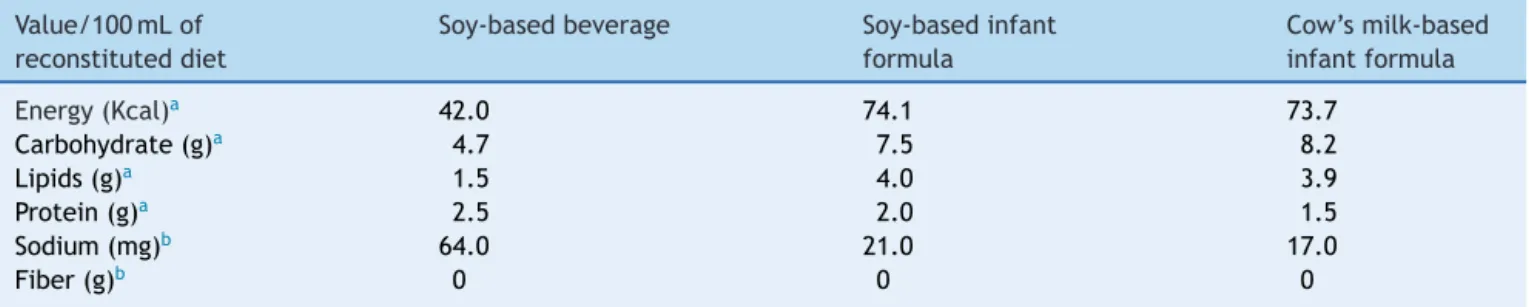
Table1 Nutritionalcompositionofthedietsofferedduringtheexperimentaccordingtotheinformationoneachproductlabel.
Value/100mLof reconstituteddiet
Soy-basedbeverage Soy-basedinfant
formula
Cow’smilk-based infantformula
Energy(Kcal)a 42.0 74.1 73.7
Carbohydrate(g)a 4.7 7.5 8.2
Lipids(g)a 1.5 4.0 3.9
Protein(g)a 2.5 2.0 1.5
Sodium(mg)b 64.0 21.0 17.0
Fiber(g)b 0 0 0
aValuesdeclaredbymanufacturers. b Valuesobtainedthroughchemicalanalysis.
It is noteworthy that the characteristics of soy formu-lasdifferfromthoseofsoy-basedbeverages,commonlyand erroneouslymarketedas‘‘soymilk,’’asthelatterdonot meetthenutritionalneedsofinfants.16
Consideringthenutritionalinadequacyofsoy-based bev-eragesinrelationtosoyinfantformulaandthatthepresent laboratorydevelopedanexperimentalmodelinrats17 that
allowsmeasuringnotonly foodintakebutalsogrowth,as wellastheeliminationofstoolandurine,thisprojectwas planned.Theobjectiveofthe studywastocomparebody growth,weight,andfecesmoistureofweanlingrats exclu-sively fed soy-based formula and soy-based beverage. As reference,an additional groupfed standard formula with cow’smilkproteinwasusedascontrol.
This experimental model was usedin order toprovide knowledge and possible benefits for humans; however, it does notaccurately reflect whatoccursin human beings. Consideringtheobjectiveofthisproject,itshouldbenoted thatitcouldnotbeperformedinhumaninfants,asitis unac-ceptabletofeed soy-basedbeveragetothisagerange.In turn,theinterpretationofresultsmusttakeintoaccountthe differencesbetweenthespecies;however,certaincommon characteristics justify the use of experimental models to increasetheunderstandingofmattersofinteresttohuman health.
Methods
A total of 30 male Wistar rats, aged 21 days (the first day of weaning) were used in the study. Throughout the studyperiod(tenconsecutivedays),theyreceiveddeionized waterthroughtheMilliQPlussystem (MilliporeIndústriae ComércioLtda.,Barueri,SP,Brazil)andliquiddiet(infant formula or soy-protein based beverage) ad libitum. All animalsweremaintainedinindividualmetaboliccages (Nal-gene Metabolic Cages 650-0100, Tecniplast, Buguggiate, Italy)underalightcycleof12hoursandatemperatureof 23±1◦C.Eachcagewasfittedwithtwodrinkingfountains
previouslytreatedwithnitricacidandrinsedindeionized water.
ThestudyprotocolwasapprovedbytheResearchEthics CommitteeofUniversidadeFederal deSãoPaulo --- Escola PaulistadeMedicina(CEP0659/10).
Threegroupswereformedwithtenanimalseach,which started receivingone of thefollowing diets: 1) soy-based
beverage;2)soy-basedinfantformula;3)cow’smilk-based infantformula.Thevolumesconsumedweremeasuredand thefeedingsystemswerecleanedateach changeofmeal (150mL/day,dividedintothreetimesperday).Group3 rep-resentedthecontrolgroupandreceivedformulabasedon lactose-freecow’smilkprotein.
All diets were reconstituted as recommended by the
manufacturerandtheirnutritionalcompositionisdescribed in Table 1. Regarding the nutritional content, the values declaredbythe manufacturersonthelabels were consid-ered. Sodium and fiber content shown in the table were obtainedbychemicalanalysisconductedintheLaboratory ofFoodScienceandFoodMicrobiologyofUniversidade Fed-eraldeSãoPaulo---EscolaPaulistadeMedicina,SãoPaulo, SP,Brazil,usingstandardizedtechniques.
Theexperimentwasperformedintwophases,eachwith 15 animals. On the first day of the study, three similar groupswereformedandtheanimalswereweighedand mea-sured.Weightmeasurement wasperformed usinga digital CG-LibrorL-600electronicscale(CGScientificInstruments Ltda.,SãoPaulo, SP, Brazil),witha maximumcapacity of 600g and 0.1g sensitivity. The length was expressed in centimeters, considering the measurements of body and tail.Thesesameprocedureswererepeatedonthefifthand tenthdays(31daysoflifeoftheanimals).
Dietaryintakewasdeterminedbythe volumeingested during the ten daysof the experiment. Evaluation of the dailyfoodintakeallowedthecalculationoffeeding conver-sion efficiency, which wasexpressed in twoways: weight gainingramspermLoffoodintakeandweightgainingrams perkilocalorieofintake.
Onthefifthdayof theexperiment,stoolcollectionfor fecalbalancewasperformed.Forthispurpose,0.1gofpink carminedye wasadded toeach animal’sdiet,and during threeconsecutivedays,thestooleliminatedfromthetime ofoccurrenceofthischangeincolor(reddish)wascollected. After72hoursofthe additionof pinkcarmine,Evansblue dyewasaddedtothediet(Inlab;SãoLuís,MA,Brazil, water-soluble).The collectionwasstoppedwhenthebluishstool startedtobeeliminated.
Thestoolcollectedduringthethreedayswereweighed onan analyticalelectronicscale(MettlerToledo-AB204-S model),withasensitivityof0.0001,andstoredinafreezer (-20◦C).Subsequently,thestool samplesweredried inan
oven at 105◦C and,after 22hours, theywere weighedat
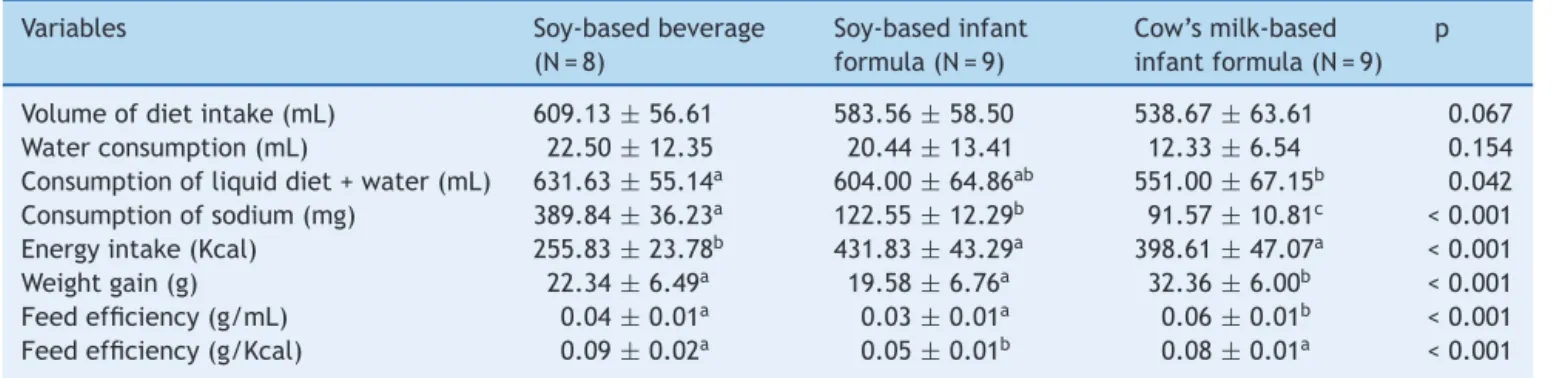
Table2 Foodintake,weightgain,andfeedefficiencyduringthetendaysoftheexperiment.
Variables Soy-basedbeverage
(N=8)
Soy-basedinfant formula(N=9)
Cow’smilk-based infantformula(N=9)
p
Volumeofdietintake(mL) 609.13±56.61 583.56±58.50 538.67±63.61 0.067
Waterconsumption(mL) 22.50±12.35 20.44±13.41 12.33±6.54 0.154
Consumptionofliquiddiet+water(mL) 631.63±55.14a 604.00±64.86ab 551.00±67.15b 0.042
Consumptionofsodium(mg) 389.84±36.23a 122.55±12.29b 91.57±10.81c <0.001
Energyintake(Kcal) 255.83±23.78b 431.83±43.29a 398.61±47.07a <0.001
Weightgain(g) 22.34±6.49a 19.58
±6.76a 32.36
±6.00b <0.001
Feedefficiency(g/mL) 0.04±0.01a 0.03±0.01a 0.06±0.01b <0.001
Feedefficiency(g/Kcal) 0.09±0.02a 0.05±0.01b 0.08±0.01a <0.001
Valuesexpressedasmeanandstandarddeviation,analysisofvariancecomplementedbyTukey’stest.
a,b,cDifferentlettersinthesamelinerepresentstatisticallysignificantdifferencesinthecomparisonbetweengroups(p<0.05).
obtained witha differenceof less than 1.0mg. The stool moisturecontentwascalculatedusingtheformula[(fresh fecalweight-dryfecalweight/freshfecalweight)x100].18
At31daysoflife(tenthdayoftheexperiment),the ani-malswereeuthanized,afterbeingpreviouslyanesthetized withketamineandxylazine,byexsanguinationofthevena cava.
Results were expressed as mean±standard deviation when the numerical variables were normally distributed. Analysis of variance (ANOVA) was used to compare the groups. When a statistically significant difference was observed,theanalysiswascomplementedbyTukey’stest. TheJandel-SigmaStat®softwareprogram,release3.5
(Sys-tat SoftwareInc., SanJose, California,USA) was usedto performthe statistical testsandcharts, withthe levelof rejectionofthenullhypothesissetat5%.
Results
Before initiating the experimental diets, there was no statistically significant difference between the groups in terms of weight and length, demonstrating the similarity between them (data notshown). The similarity remained afterexclusion of fouranimalsthat didnot complete the entirestudy period.Twoanimalswerefromthegroupfed soy-basedbeverage,onefromthegroupfedsoy-based for-mula, andthe otherfromthe groupfedcow’s milk-based formula.
Attheendoftheexperiment(tenthday)thegroupsfed soy-basedbeverage(73.16±5.74g)andsoy-basedformula (71.11±5.84g)hadlowerweightthanthegroupfedcow’s milk-basedformula(84.88±9.75g),withastatistically sig-nificantdifference(p=0.001).Bodylengthattheendofthe interventionwaslowerinthegroupsfedsoy-basedbeverage (24.74±0.60cm) andsoy-based formula(22.63±0.52cm) incomparisonwiththegroupfedcow’smilk-basedformula (26.01±0.91cm,p=0.001).
Table 2 shows that, regarding the volume consumed, therewasnostatisticallysignificantdifferenceamongthe threegroups (p=0.067). Sodiumintakewas higher in the groupfed soy-basedbeverage. The animalsfed soy-based formulaconsumed moresodiumthan thegroup fedcow’s
milk-basedformula.Energy intakewaslowerinthegroup fedsoy-basedbeverage.
At the end of the experiment, the animals from the groupsfedsoy-basedbeverageandsoy-basedformulahad significantlylowerweightgainwhencomparedtoanimals fedcow’smilk-basedformula.Thefeedefficiency(g/kcal) ofsoyformulawaslowerthantheothertwogroups.Feed efficiency(g/mL)washighest inthecow’smilk-based for-mulagroup.
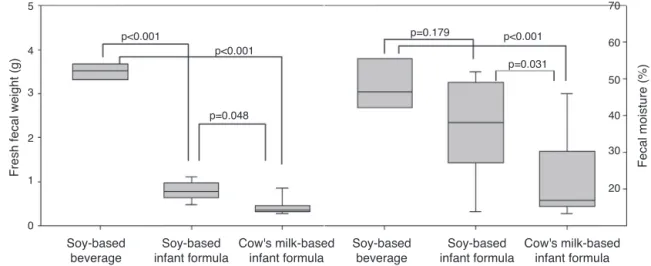
Fig.1showsfecalweightandfecalmoisture.Thefecal weightofanimalsfedsoy-basedbeverage(3.44±0.48g)and soy-basedformula(0.79±0.20g)werehigherthanthatin thegroupfedcow’smilk-basedformula(0.42±0.17g).The fecalweightwithsoy-basedbeveragewashigherthanwith soy-basedformula(p=<0.001).Regarding fecalmoisture, thegroupsfedsoy-basedbeverage(47.28±9.02%)and soy-basedformula(37.21±13.20%)hadhighermoisturecontent inthe stool than the groupfed cow’s milk-based formula (22.71±10.86%),witha statisticallysignificant difference (p<0.001;Fig.1).
Discussion
Thepresentstudyshowedthatanimalsfedsoyproteingrew lessthanthosefedcow’smilk-basedformula.Highsodium contentwasalsofoundinthesoy-basedbeverage.Animals fedsoyproteinalsohadhigherfecalweightandmoisture, especiallythosefedsoy-basedbeverage.
Theexperimentalmodel usedallowsfortheevaluation oftheeffectsofasingleliquidfood,similarlytowhatoccurs ininfantfeedingbeforetheintroductionofcomplementary foods.Inthisstudy,thecontrolgroupwasfedlactose-free cow’smilk-based formula, considering that previous stud-ies showed that weanling rats fed formula with lactose had a greater number of loose stools, suggesting lactose intolerance.17,19 Thus, a productthatdid notcontain
lac-tosewasusedasreference,aswiththesoy-basedbeverage andsoy-basedformula.
Soy-based beverage
Cow's milk-based infant formula Soy-based
infant formula Soy-based
beverage
Soy-based infant formula Cow's milk-based
infant formula
p<0.001 p<0.001
5 70
60
50
40
30
Fecal moisture (%)
20 4
3
2
Fresh fecal weight (g)
1
0
p<0.001
p=0.048
p=0.179
p=0.031
Figure1 Freshweight(g)andfecalmoisture(%)duringthe72-hourcollectionperiodbeginningonthefifthdayoftheexperiment.
Statisticalanalysis:analysisofvariance,complementedbyTukey’stest.
fromthethreegroups didnotreceivefoodotherthanthe liquiddiet.
The differenceinthevoluntaryfoodintakeof therats maybeattributedtothedifferentcompositionofthediets, probably the characteristic taste of soy extract and soy proteinor the smell of the milk,thereby makingit more acceptable.
Attentionshouldbepaidtothesignificantdifferencein weight gain and length, with lower values in the groups receiving the soy-based beverage and soy-based formula. This result could be explained by the nutritional compo-sitionof the soy-basedbeverage, which haslower energy contentwhencomparedtotheothertwodietsused.Other differencesregardingthecompositionofthesoy-based for-mulasuchascarbohydrates(lowercontent),protein(higher content),andaminoacids (e.g.,relatively lowcontentof methionine,lysine,andproline,andhighercontentof argi-nine,cysteine,glycine,andasparagine)whencomparedto cow’smilk-basedformulacouldalsohavecontributedtothis finding.Soy-basedformulacontainsanti-nutritionalfactors thatcouldaffectnutrientavailability.11
A surprising result was that the soy-based beverage, althoughithaslowerenergydensitywhencomparedto soy-basedformula,resultedin similargrowth,which couldbe explainedbythehigherfeedefficiencyintermsofgramsof weightgainperkilocalorieconsumed.Thisstudyfound no clearexplanationintheliteratureforthisresult, consider-ingthecompositionofthetwofoods.Itisworthmentioning thatalthoughdifferences wereobservedin growthamong thethreegroups, theanimalsin thisstudyshowedweight gainandbody lengthsimilartothat shown byrats ofthe sameagefedaconventional diet,demonstratingthatthe experimental model didnot affect growthin the animals fedaliquiddiet.20
The higher sodium intake (p<0.001) by the rats that receivedthesoy-basedbeverageshouldbeattributed exclu-sively to the higher sodium content in this group’s diet. Itshouldbeemphasizedthatthe sodiumcontentfoundin soy-basedbeverageswashigher thanthatspecified inthe productlabeling.With regard tothe formula,the sodium
contentwasclosetotheexpectedvalue.Itshouldbenoted thatthe sodiumcontentin thedietcan contributetothe development of eating habitswith a preference for salty foods,andalsoisassociatedwithhigherbloodpressure lev-elsinchildhoodandadulthood.21,22Thisstudydemonstrated
that,although therewasnostatisticallysignificant differ-ence,thegroup fedsoy-basedbeverageconsumed almost twice the amount of water when compared to the group fedcow’smilk-basedformula.Similarresultswereobtained with the soy-based formula. This fact may be related to the highersodiumcontentin the soy-basedbeverage and soy-basedformula.
Itmustberecalledthatthesoy-basedformulawas devel-opedtomeetthenutritionalneedsofthefull-termnewborn, andseveralstudiesinhumanshaveshownthatitpromotes growthanddevelopmentsimilartothoseofinfantsfedcow’s milk-based formula,butitshowsnoadvantageovercow’s milk-basednutritionalformulasandcontainshighlevelsof phytate,aluminum,andphytoestrogens(isoflavones),which canresultinundesirableeffects.Amongtheindicationsfor soy-based formula use are persistent lactose intolerance, galactosemia,and ethicalconsiderations(e.g.,vegetarian diet).8---10 It is noteworthy thatsoy-based formulas do not
havearoleinthepreventionofallergicdiseasesandshould notbeusedinchildrenwithfoodallergyduringthefirstsix monthsoflife.8
In turn, based on their composition and the results observed inthis study,includingthe sodiumcontent, soy-based beverages should not be used in infant feeding. However,according toa study7 evaluating the knowledge
ofpediatriciansandnutritionistsonadietexcludingcow’s milk and dairy products, withemphasis on issues related tochild nutrition, it wasshown that soy-basedbeverages orjuiceswereconsideredbymanyprofessionalsaspossible substitutesforcow’smilkprotein.
be noted that most of these products are not fortified and/orspecificallyformulatedfortheagegroupofinfants, whichmaycauseinsufficientintakeofnutrients,especially calcium.23,24
Another interesting result wasthe higher fecal weight andmoistureobservedinanimalsfedsoy-basedbeverage. Aspreviouslyobserved,itwasfoundthatfecalweightand moisturedependonthefibercontentinfeed.25Inthisstudy,
the threegroups were feddiets that,according to infor-mationfromthemanufacturerandtheresultsobtainedin laboratorytests,donotcontaindietaryfiber.Thus,itwas notpossibletoidentifywhatcomponentinthesoyextract wouldberesponsibleforhigherfecalweightandmoisture. Noexplanationwasfoundintheliteratureforthisfinding. Consideringthepotentialuseofsoyextractinthe preven-tionand treatment of constipation, thisaspect should be investigatedinfurtherstudies.
Finally,it shouldbeemphasizedthatthereareno pub-lications similar to this study in the literature, which prevents direct comparison of results. Another limita-tion refers to the difficulty in extrapolating the results obtained to humans. However, the importance of exper-imental models with animals, despite their limitations, cannot be disregarded in situations where experiments with humans are impermissible from an ethical stand-point.
Insummary,thepresentstudyobservedlessbodygrowth (weightand length) in mice fedsoy protein-based bever-agesandsoyprotein-basedinfantformulawhencompared to cow’s milk protein infant formula without lactose, results that corroborate the recommendation not to use soy protein-basedbeverages in infantfeeding. There was alsoasignificant increase infecal weightandmoisturein rats fed soy protein-basedbeverages, when compared to thosefedsoyprotein-basedformulaandcow’smilk-based formula.
Funding
ThisstudyreceivedfinancialsupportfromCoordenac¸ãode Aperfeic¸oamento de Pessoal de Nível Superior - CAPES. CAPES had no role in the study design, data analysis, or draftingofthismanuscript.
Conflicts
of
interest
Theauthorsdeclarenoconflictsofinterest.
References
1.Sociedade Brasileira de Pediatria e Associac¸ão Brasileira de Alergia e Imunopatologia, Alergia alimentar. Rev Med Minas Gerais.2008;18:S1---44.
2.Koletzko S, Niggemann B, Arato A, Dias JA, Heuschkel R, HusbyS,etal.Diagnosticapproachandmanagementof cow’s-milk protein allergy in infants and children: ESPGHAN GI Committeepracticalguidelines.JPediatrGastroenterolNutr. 2012;55:221---9.
3.SladkeviciusE,GuestJF.Modellingthehealtheconomicimpact of managing cow milk allergy in South Africa. J MedEcon. 2010;13:257---72.
4.GuestJF,NagyE.Modellingtheresourceimplicationsand bud-getimpactofmanagingcowmilkallergyinAustralia.CurrMed ResOpin.2009;25:339---49.
5.GuestJF,ValovirtaE.Modellingtheresourceimplicationsand budgetimpactofnewreimbursementguidelinesforthe man-agement ofcow milkallergy inFinland.Curr MedResOpin. 2008;24:1167---77.
6.SladkeviciusE,NagyE,LackG,GuestJF.Resourceimplications andbudgetimpactofmanagingcowmilkallergyintheUK.J MedEcon.2010;13:119---28.
7.Cortez AP, Medeiros LC, Speridião PG, Mattar RH, Neto UF, MoraisMB.Conhecimentodepediatrasenutricionistassobre otratamentodaalergiaaoleitedevacanolactente.RevPaul Pediatria.2007;25:106---13.
8.Agostoni C,AxelssonI,GouletO,KoletzkoB, MichaelsenKF, PuntsJ,etal.Soyproteininfantformulaeandfollow-on formu-lae:acommentarybytheESPGHANCommitteeonNutrition.J PediatrGastroenterolNutr.2006;42:352---61.
9.Bhatia J, Greer F,American Academy of Pediatrics Commit-teeonNutrition.Useofsoyprotein-basedformulasininfant feeding.Pediatrics.2008;121:1062---8.
10.BadgerTM,GilchristJM,PivikRT,AndresA,ShankarK,ChenJR, etal.Thehealthimplicationsofsoyinfantformula.AmJClin Nutr.2009;89:1668S---72S.
11.LönnerdalB.Nutritionalaspectsofsoyformula.ActaPaediatr Suppl.1994;402:105---8.
12.Fenollosa T, Dalmau J. Fórmulas de soja. Acta Pediatr Esp. 2001;59:85---7.
13.FAO. Soymilk and related products. In: FAO Agricultural Services Bulletin n.97. Technology of production of edi-ble flours and protein products from soybeans. Rome: FAO; 1992.
14.RosenthalA, Deliza R, CabralLC,FariasCA,Domingues AM. Effectofenzymatictreatmentandfiltrationonsensory charac-teristicsandphysicalstabilityofsoymilk.FoodControlJournal. 2002;14:187---92.
15.Behrens JH,da SilvaMA.Atitudedo consumidor em relac¸ão à soja e produtos derivados. Ciênc Tecnol Alim. 2004;24: 431---9.
16.YonamineGH,CastroAP,PastorinoAC,JacobCM.Usode fór-mulasàbasedesojanaalergiaàproteínadoleitedevaca.Rev BrasAlergImunopatol.2011;34:187---92.
17.CostaML,FreitasKC,AmâncioOM,PaesAT,daSilvaSM,Luz J,etal.Ironabsorptionfrominfantformulaandiron-fortified cow’smilk:experimentalmodelinweanlingrats.JPediatr(Rio J).2009;85:449---54.
18.MarksGE,MooreCE,KanarockiEL,OesterYT,KaplanE. Deter-minationoftraceelementsinhumantissue.I,Cd,Fe,Zn,Mg andCa.ApplSpectrosc.1972;26:523---7.
19.FarjallaLB. Absorc¸ãointestinaldoferrodefórmulasinfantis anti-regurgitac¸ãoespessadas com fibraalimentar gomajataí eamidode milhoemratos recém-desmamados[thesis]. São Paulo:UniversidadeFederaldeSãoPaulo;2011.
20.Lopes LA. Efeitos da restric¸ão de macronutrientes sobre o crescimentocorporaleahistopatologiadosistemanervoso cen-tralderatosjovensdesnutridosintra-útero[thesis].SãoPaulo: UniversidadeFederaldeSãoPaulo;1999.
21.Geleijnse JM, Hofman A, Witteman JC, Hazebroek AA, Valkenburg HA, Grobbee DE. Long-term effects of neonatal sodiumrestrictiononbloodpressure.Hypertension.1997;29: 913---7.
23.Medeiros LC, SperidiãoPG, SdepanianVL, Fagundes-Neto U, Morais MB. Ingestão de nutrientes e estado nutricional de crianc¸asemdietaisentadeleitedevacaederivados.JPediatr (RioJ).2004;80:363---70.
24.CastroAP,JacobCM,CorradiGA,AbdallaD,Golc¸alvesRF,Rocha FT,etal.Evoluc¸ãoclínicaelaboratorialdecrianc¸ascomalergia
aleitedevacaeingestãodebebidaàbasedesoja.RevPaul Pediatr.2005;23:27---34.