Key words:
Prostatic Neoplasms; Validation Studies [Publica-tion Type]; Prostatectomy; Quality of Life; Questionnaires; Translations
Int Braz J Urol. 2013; 39: 344-52 __________________
Submitted for publication: February 02, 2012 __________________
Accepted after revision: May 29, 2013
Objectives: Validation of the Expanded Prostate Cancer Index Composite (EPIC) questio-nnaire translated to Portuguese. This is an evaluation tool of the effects of treatment on quality of life of patients with prostate cancer.
Materials and Methods: In order to translate and validate, several recommended me-thodological techniques in the literature were included: initial translation, synthesis of translation, board committee review and back translation. Sample included 40 patients with localized prostate cancer submitted to surgical retropubic radical prostatectomy from 2008 to 2010.
Results: The internal consistency analysis of the scales of the questionnaire resulted in al-pha Cronbach coefficients “very good” (> 0.9) and “good” (> 0.8) to 8 of 14 domains. The higher coefficients (0.94) were assigned to sexual score, subscales incontinence and sexu-al function. Post-operatory follow-up ranged from 3 to 35 months, median 18.7 months. Conclusions: The Brazilian version of EPIC is reliable and valid, and is a useful tool to evaluate the impact of retropubic radical prostatectomy on quality of life of Brazilian patients with localized prostate cancer, in national and internationals studies.
INTRODUCTION
Prostate cancer is the sixth most common cancer in the World, representing 10% of all tu-mors. In Brazil, it is the second most common cancer among men (behind non-melanoma skin cancer), and it is 52.350 new cases are estimated in 2010, or an estimated risk of 54 new cases per 100.000 men. The rise of incidence is due to the diagnosis of asymptomatic patients, the rise of life expectancy and the improvement of the information systems of the country. The inciden-ce raised mainly in areas of the country
whe-re surveillance is common (1). The diagnosis of prostate cancer is made through rectal exam and prostate specific antigen essay (PSA) and confir-mation with ultrasound-guided prostate biopsy. According to the recommendations of the Bra-zilian Society of Urology, the preventive exam must be done after 45 years of age, and for those with family history of prostate cancer after 40 years of age (2,3).
Prostate cancer treatment depends of the staging of the disease, histological grade, patient age and general status of the patient. To locali-zed tumors, surgery is an option (radical
pros-Validation of the Brazilian version of the Expanded
Prostate Cancer Index Composite (EPIC) for patients
submitted to radical prostatectomy
_______________________________________________
Enaury Alves, Rebecca Medina, Cássio Andreoni
Department of Urology, Escola Paulista de Medicina da Universidade Federal de São Paulo, EPM/ UNIFESP - Sao Paulo, SP, Brazil
ABSTRACT
ARTICLE
INFO
IBJU |VALIDATION OF THE BRAZILIAN VERSION OF THE EXPANDED PROSTATE CANCER INDEX
345
tatectomy), as well as external radiotherapy or brachytherapy. To localized advanced tumors, it has been used surgery or radiotherapy combined with hormone therapy, and to metastatic disease, the treatment of choice is hormone therapy (4).
However, all therapeutic options have collateral effects (radical prostatectomy, bra-chytherapy and external radiotherapy), such as urinary incontinence, erectile dysfunction and intestinal alterations. The evaluation of the treat-ment must address not only the survival but the negative impact on quality of life of patients (5,6).
Quality of life evaluation related to health includes all aspects of patient evaluation and can verify the impact of the disease, health and treat-ment (7). The used questionnaires to evaluate qua-lity of life are useful to transform subjective mea-sures in objectives evaluations in order to quantify and analyze specific and global aspects (8,9).
World Health Organization (WHO) defines quality of life as the individual perception of his role in life, in relation to his (her) objectives, expec-tations, patterns and worries, in culture and values contexts. It is a broad and complex concept that encompass physical health, psychological status, independence level, social relations, personal belie-fs, and relation to environment (10,11).
MATERIALS AND METHODS
EPIC questionnaire is a self-administered tool and is intended to evaluate the impact of tre-atment on quality of life of patients with prostate cancer. It includes 50 questions, of four domains: urinary, intestinal, sexual and hormonal; it evalu-ates the last four weeks and includes a Likert scale of answers of 5 options. Each domain contains two subscales (function and nuisance). The urinary do-main still has two additional subscales: incontinen-ce and irritative/obstructive symptoms (12).
Procedures for translation and validation
The translation and validation of the questionnaire was performed in four steps: ini-tial translation, translation synthesis, board committee of specialists review and back trans-lation, according to the criteria described by Guillemin et al (13).
Initial translation
Question translation was performed by two independent translators, fluent in English and aware of the study objectives.
Translation Synthesis
Production of a synthesis of the two transla-ted versions carried out by the researcher and leader, maintaining the same fundamental characteristics of the original questionnaire.
Review by a Board of Specialists Committee
A committee of specialists included five urologists fluent in English that evaluated for each question the semantic, idiomatic, cultural and conceptual equivalents between the original and the translated version.
Semantic equivalence refers to the me-aning of the words (grammar and vocabulary), while idiomatic equivalence refers to colloquial expressions that are equivalent to the original idiom. Cultural equivalence refers to the lived ex-periences in the cultural context of society. The conceptual equivalence refers to the words with different cultural meaning (14).
A first final version in Portuguese was proposed during the meeting of the panel of spe-cialists, the leader and the researcher, after joint evaluation of instructions, questions and format.
Back Translation
During back translation, the questionnaire was translated again, but this time from Portugue-se to English, by two native English translators with domain of the Portuguese language, who did not know the objectives of the study or the origi-nal questionnaire. Afterwards, they compared the translation with the original and did not find any discrepancy.
Population and Sampling
Ethical Aspects
Initially, an e-mail authorization was refer-red to the authors of EPIC in order to translate and validate the original to Portuguese. After that autho-rization, the research was approved by the Ethical Committee of Research of the Federal University of São Paulo. All patients signed an Informed Consent.
Statistical analysis
In this phase, the same procedure adopted by the original EPIC study was performed, allowing the evaluation of a total sample of heterogeneous patients regarding the impact of treatment on the domains: urinary, intestinal, sexual and hormonal. The tests were performed using the quality of life scores obtained after treatment.
To internal consistency analysis, in order to verify the reliability of the instrument (15), it was used the statistical alpha test of Cronbach (16). This index varies from 0 to 1. The closest to 1, the higher the reliability of the instrument. Intern consistency was considered: very good, if superior to 0.9; good, between 0.8 and 0.9; reasonable, between 0.7 and 0.8; weak, between 0.7 and 0.8; and poor, between 0.6 and 0.7; it was considered inadmissible if inferior to 0.6. It there is no variance between the individual items, the alpha score is 1: all items of the instru-ment are totally homogeneous, producing exactly the same variance (17,18).
The significance level for the statistical tests was 5%, or p < 0.05. Data analysis was made using the software SPSS - Statistical Package for Social Science.
RESULTS
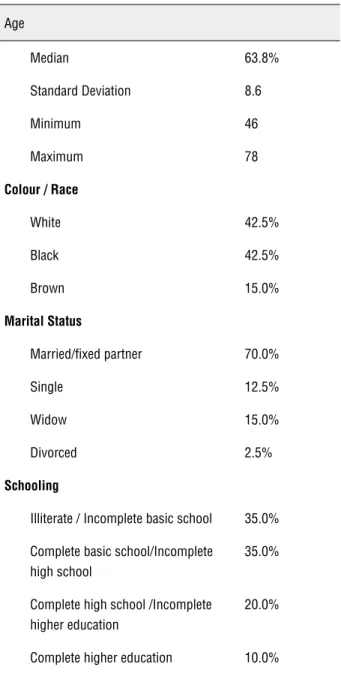
Socio-demographic characteristics of the 40 patients are described in Table-1. Median age was 63.8 ± 8.6 years, varying from 46 to 78 years, and 70% of patients were married or had a fixed partner.
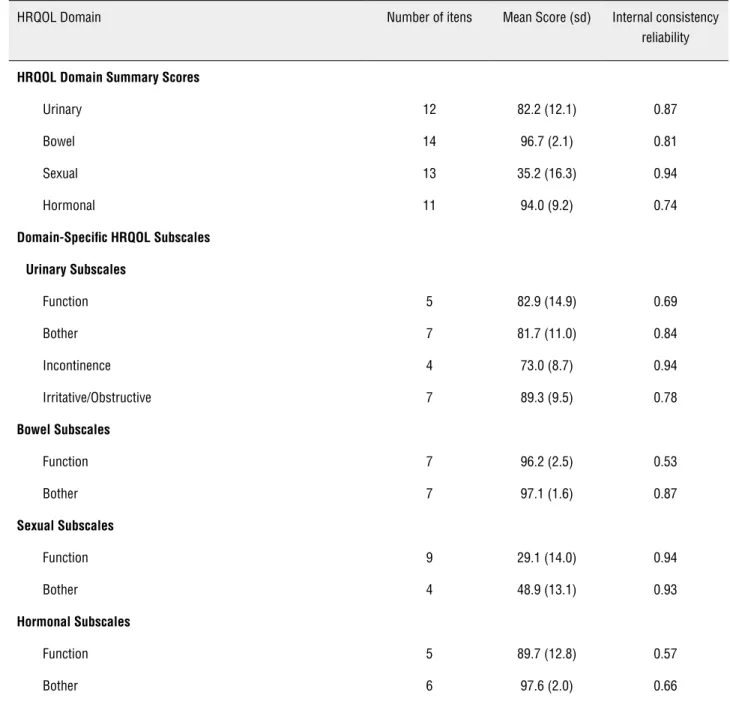
Table-2 depicts the results of intern con-sistency, median and standard deviation for the 14 domains (4 summaries and 10 subscales) of the Brazilian version of EPIC. The internal consistency analysis of the scales of the questionnaire resulted in Cronbach alpha coefficients “very good” above 0.9 and “good” above 0.8 to 8 of them, and the higher
scores were obtained for the sexual score, subscales incontinence and sexual function. When we com-pared these data with the original version and the Spanish version (Table-3), it is observed that they are similar, without significant differences.
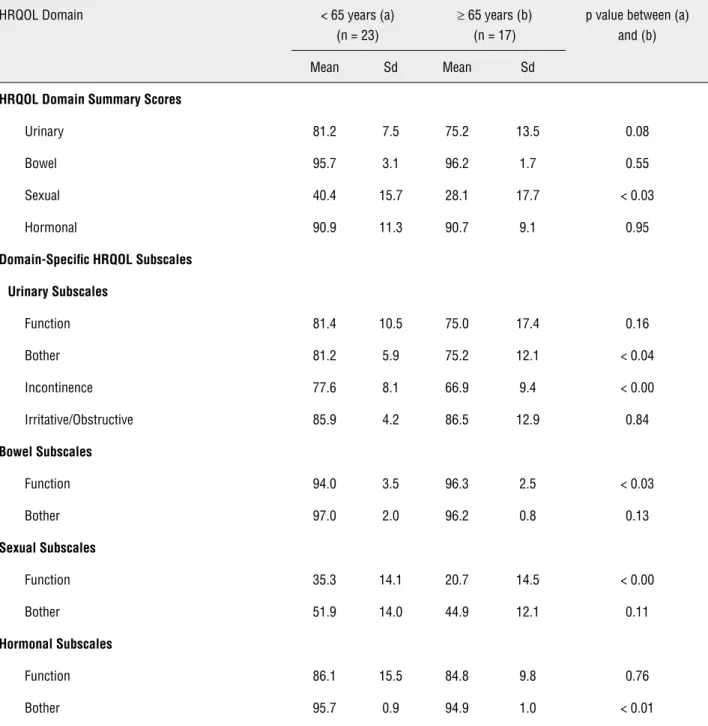
Table-4 shows the data for patients older than 65 or with less than 65 years and EPIC scores. It is observed that as the age rises, there is a decline of the scores “sexual domain”, ‘sexual function”, “in-continence” and “urinary distress”.
Table 1 - Socio-demographic profile.
Age
Median 63.8%
Standard Deviation 8.6
Minimum 46
Maximum 78
Colour / Race
White 42.5%
Black 42.5%
Brown 15.0%
Marital Status
Married/fixed partner 70.0%
Single 12.5%
Widow 15.0%
Divorced 2.5%
Schooling
Illiterate / Incomplete basic school 35.0%
Complete basic school/Incomplete high school
35.0%
Complete high school /Incomplete higher education
20.0%
IBJU |VALIDATION OF THE BRAZILIAN VERSION OF THE EXPANDED PROSTATE CANCER INDEX
347
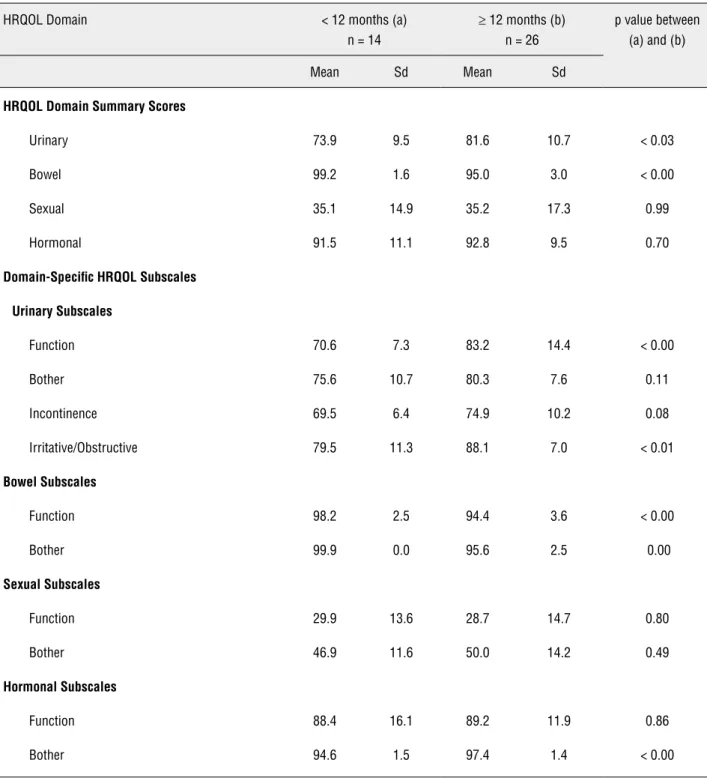
Post-operatory follow-up varied from 3 to 35 months, median 18.7 months, with mi-nimal significant correlations of the following EPIC scores: “domain and urinary function”, “ir-ritative/obstructive”, “domain, function and in-testinal distress” and “hormonal distress”). It is observed that as the time passes, the scores tend to decrease (Table-5).
DISCUSSION
The literature highly recommends the adaptation of scales and questionnaires previous-ly validated, due to reduction of costs, a standar-dization of measure for investigation in different cultures, allowing international studies to compa-re the same phenomena in several cultucompa-res (19).
Table 2 - Descriptive measures of EPIC.
HRQOL Domain Number of itens Mean Score (sd) Internal consistency
reliability
HRQOL Domain Summary Scores
Urinary 12 82.2 (12.1) 0.87
Bowel 14 96.7 (2.1) 0.81
Sexual 13 35.2 (16.3) 0.94
Hormonal 11 94.0 (9.2) 0.74
Domain-Specific HRQOL Subscales
Urinary Subscales
Function 5 82.9 (14.9) 0.69
Bother 7 81.7 (11.0) 0.84
Incontinence 4 73.0 (8.7) 0.94
Irritative/Obstructive 7 89.3 (9.5) 0.78
Bowel Subscales
Function 7 96.2 (2.5) 0.53
Bother 7 97.1 (1.6) 0.87
Sexual Subscales
Function 9 29.1 (14.0) 0.94
Bother 4 48.9 (13.1) 0.93
Hormonal Subscales
Function 5 89.7 (12.8) 0.57
IBJU
|
V
ALID
A
TION OF THE BRAZILIAN VERSION OF THE EXP
ANDED PROST
A
TE CANCER INDEX
348
of items
Mean Score (sd)
Internal consistency reliability
Mean Score (sd)
Internal consis-tency reliability
Mean Score (sd)
Internal consis-tency reliability
HRQOL Domain Summary Scores
Urinary 12 80.2 (17.5) 0.88 74.8 (21.1) 0.73 82.2 (12.1) 0.87
Bowel 14 86.6 (15.7) 0.92 92.2 (9.7) 0.75 96.7 (2.1) 0.81
Sexual 13 33.1 (23.6) 0.93 36.5 (22.0) 0.89 35.2 (16.3) 0.94
Hormonal 11 86.6 (13.8) 0.82 90.0 (11.4) 0.66 94.0 (9.2) 0.74
Domain-Specific HRQOL Subscales
Urinary Subscales
Function 5 86.5 (16.7) 0.69 72.3(24.5) 0.68 82.9 (14.9) 0.69
Bother 7 75.8 (20.4) 0.85 76.5 (22.7) 0.74 81.7 (11.0) 0.84
Incontinence 4 83.2 (22.9) 0.89 72.2 (35.7) 0.85 73.0 (8.7) 0.94
Irritative/Obstructive 7 79.7 (18.5) 0.81 77.5 (19.2) 0.64 89.3 (9.5) 0.78
Bowel Subscales
Function 7 87.9 (13.6) 0.75 89.2 (10.7) 0.43 96.2 (2.5) 0.53
Bother 7 85.3 (18.8) 0.9 95.2 (10.7) 0.75 97.1 (1.6) 0.87
Sexual Subscales
Function 9 29.5 (24.0) 0.92 24.2 (19.4) 0.88 29.1 (14.0) 0.94
Bother 4 41.1 (30.1) 0.84 64.0 (43.0) 0.98 48.9 (13.1) 0.93
Hormonal Subscales
Function 5 84.0 (15.3) 0.51 84.9 (14.2) 0.25 89.7 (12.8) 0.57
IBJU |VALIDATION OF THE BRAZILIAN VERSION OF THE EXPANDED PROSTATE CANCER INDEX
349
After careful review of literature, in order to identify all available instruments for the evalua-tion of the impact of treatment of prostate cancer in quality of life, EPIC questionnaire was chosen, since it was the one that best approached our goals and was highly accepted in the international scientific community, and easy to use. Since EPIC was
develo-ped to the American population, it was necessary to translate it and adapt it to Brazilian context and to test its measure proprieties.
Final version of translated EPIC (Appendix) maintained the English original title, since it is inter-nationally recognized. It was added “Brazilian Ver-sion” to the title to facilitate the search in data bases.
Table 4 - Correlation of EPIC score and age.
HRQOL Domain < 65 years (a)
(n = 23)
≥ 65 years (b) (n = 17)
p value between (a) and (b)
Mean Sd Mean Sd
HRQOL Domain Summary Scores
Urinary 81.2 7.5 75.2 13.5 0.08
Bowel 95.7 3.1 96.2 1.7 0.55
Sexual 40.4 15.7 28.1 17.7 < 0.03
Hormonal 90.9 11.3 90.7 9.1 0.95
Domain-Specific HRQOL Subscales
Urinary Subscales
Function 81.4 10.5 75.0 17.4 0.16
Bother 81.2 5.9 75.2 12.1 < 0.04
Incontinence 77.6 8.1 66.9 9.4 < 0.00
Irritative/Obstructive 85.9 4.2 86.5 12.9 0.84
Bowel Subscales
Function 94.0 3.5 96.3 2.5 < 0.03
Bother 97.0 2.0 96.2 0.8 0.13
Sexual Subscales
Function 35.3 14.1 20.7 14.5 < 0.00
Bother 51.9 14.0 44.9 12.1 0.11
Hormonal Subscales
Function 86.1 15.5 84.8 9.8 0.76
Tabela 5 - Correlation between the score and the EPIC segment postoperatively.
HRQOL Domain < 12 months (a)
n = 14
≥ 12 months (b) n = 26
p value between (a) and (b)
Mean Sd Mean Sd
HRQOL Domain Summary Scores
Urinary 73.9 9.5 81.6 10.7 < 0.03
Bowel 99.2 1.6 95.0 3.0 < 0.00
Sexual 35.1 14.9 35.2 17.3 0.99
Hormonal 91.5 11.1 92.8 9.5 0.70
Domain-Specific HRQOL Subscales
Urinary Subscales
Function 70.6 7.3 83.2 14.4 < 0.00
Bother 75.6 10.7 80.3 7.6 0.11
Incontinence 69.5 6.4 74.9 10.2 0.08
Irritative/Obstructive 79.5 11.3 88.1 7.0 < 0.01
Bowel Subscales
Function 98.2 2.5 94.4 3.6 < 0.00
Bother 99.9 0.0 95.6 2.5 0.00
Sexual Subscales
Function 29.9 13.6 28.7 14.7 0.80
Bother 46.9 11.6 50.0 14.2 0.49
Hormonal Subscales
Function 88.4 16.1 89.2 11.9 0.86
Bother 94.6 1.5 97.4 1.4 < 0.00
The patients that answered the questio-nnaire were invited to answer open question re-garding each item in order to identify questions with difficult understanding. In general, the
ins-trument was easy to apply and well accepted by the patients, with good efficacy.
indica-IBJU |VALIDATION OF THE BRAZILIAN VERSION OF THE EXPANDED PROSTATE CANCER INDEX
351
te equivalency with the Brazilian version, with adequate reliability, high sensitivity to altera-tions. However, it is important to state that the questionnaire was used only for patients sub-mitted to retropubic radical prostatectomy. In the present, another study comparing “open” to robotic-assisted laparoscopic radical prostatec-tomy is been carried out.
This questionnaire, after comparision of treatments, will be a resourceful tool for clini-cals and researchers, to evaluate the impact of different treatmens on quality of life of pacients with prostate cancer.
CONCLUSIONS
Brazilian version of EPIC is valid and re-liable as a new tool for the evaluation of the impact of retropubic radical prostatectomy in quality of life of Brazilian patients with locali-zed prostate cancer, for national and internatio-nal studies.
APPENDIX
The Expanded Prostate Cancer Index Composite (EPIC) – Brazilian version – Availa-ble at:
http://www.uroepm.com.br/setores/robotica.html
CONFLICT OF INTEREST
None declared.
REFERENCES
1. Ministério da Saúde. Instituto Nacional do Câncer - INCA. Incidência de Câncer no Brasil. Estimativa 2010. 2009. [cited ago 19, 2011]. Available at: http://www.inca.gov. br/estimativa/2010/index.asp?link=conteudo_view. asp&ID=5.
2. Sociedade Brasileira de Urologia - SBU. Manual de Boas Práticas Urológicas. 2009. [cited ago 19, 2011]. Available at: http://www.sbu.org.br/pdf/manual_de_praticas_uro-logicas.pdf.
3. Ministério da Saúde. Instituto Nacional do Câncer - INCA. Câncer de próstata. 2009. [cited ago 19, 2011]. Available at:http://www.inca.gov.br/conteudo_view.asp?id=339. 4. Presti JC. Neoplasias da próstata. In: Tanagho EA,
McAninch JW. Urologia geral de Smith. 16a ed. Barueri: Manole; 2007; pp. 406-28.
5. Litwin MS, Hays RD, Fink A, Ganz PA, Leake B, Leach GE, et al.: Quality-of-life outcomes in men treated for localized prostate cancer. JAMA. 1995; 273: 129-35.
6. Miller DC, Sanda MG, Dunn RL, Montie JE, Pimentel H, Sandler HM,et al.: Long-term outcomes among localized prostate cancer survivors: health-related quality-of-life changes after radicalprostatectomy, external radiation, and brachytherapy. J Clin Oncol. 2005; 23: 2772-8. 7. Thiel Rdo R, Dambros M, Palma PC, Thiel M, Riccetto CL,
Ramos M de F: Translation into Portuguese, cross-nation-al adaptation and vcross-nation-alidation of the Femcross-nation-ale Sexucross-nation-al Function Index. Rev Bras Ginecol Obstet. 2008; 30: 504-10. 8. Farias N, Buchalla CM: A classificação internacional de
funcionalidade, incapacidade e Saúde da Organização Mundial da Saúde: conceitos, usos e perspectivas. Rev Bras Epidemiol. 2005; 8: 187-93.
9. Michener LA, Snyder AR: Evaluation of health-related quality of life in patients with shoulder pain: are we doing the best we can? Clin Sports Med. 2008; 27: 491-505. 10. The WHOQOL Group. The Development of the World
Health Organization quality of life assessment instrument (the WHOQOL). In: Orley J, Kuyken W, editors. Quality of Life Assessment: international perspectives. Heidelberg: Springer-Verlag. 1994: pp. 41-60.
11. Moreno AB, Lopes CS: Quality of life assessment in lar-yngectomized patients: a systematic review. Cad Saude Publica. 2002; 18: 81-92.
12. Wei JT, Dunn RL, Litwin MS, Sandler HM, Sanda MG: De-velopment and validation of the expanded prostate cancer index composite (EPIC) for comprehensive assessment ofhealth-related quality of life in men with prostate can-cer. Urology. 2000; 56: 899-905.
13. Guillemin F, Bombardier C, Beaton D: Cross-cultural adaptation of health-related quality of life measures: literature review and proposed guidelines. J Clin Epidemiol. 1993; 46: 1417-32. 14. Beaton DE, Bombardier C, Guillemin F, Ferraz MB:
Guide-lines for the process of cross-cultural adaptation of self-re-port measures. Spine (Phila Pa 1976). 2000; 25: 3186-91. 15. Duarte YAO. Família: Rede de suporte ou fator estressor. A ótica
de idosos e cuidadores familiares. São Paulo, 2001. Tese (Dou-torado) - Escola de Enfermagem, Universidade de São Paulo. 16. Lobiondo-Wood G, Harber J. Confiabilidade e validade. In:
17. Pestana MH, Gagueiro JN: Análise de Dados para Ciências Sociais. 4. ed. Lisboa: Editora Sibalo. 2005.
18. George D, Mallery P. SPSS for Windows Step by Step. A Simple Guide and Reference. 11.0 Update. Boston: Allyn and Bacon. 2003.
19. Alexandre NM, Guirardello Ede B: Cultural adaptation of instruments utilized in occupational health. Rev Panam Salud Publica. 2002; 11: 109-11.