Fisioter. Mov., Curitiba, v. , n. , p. - , jul./set. Licenciado sob uma Licença Creative Commons DO): http://dx.doi.org. . / - . . .AR
[T]
The Pilates
®Method in the treatment of lower back pain
[)]
Método Pilates® no tratamento da dor lombar
[A]
Marcelo Henrique Oliveira de Vasconcellos[a], Ramon Diego Santana da Silva[b],
Sheila Maria Bispo dos Santos[c], José Reynaldo de Carvalho Merlo[d], Tatiana Maíta Alves Conceição[e]
[a] Undergraduate student, Centro Universitário Jorge Amado, Salvador, Bahia - Brazil, e-mail: [email protected] [b] Undergraduate student, Centro Universitário Jorge Amado, Salvador, Bahia - Brazil, e-mail: [email protected] [c] Undergraduate student, Centro Universitário Jorge Amado, Salvador, Bahia - Brazil, e-mail: sheila.bispo @hotmail.com [d] Specialist, professor, Centro Universitário Jorge Amado, Salvador, Bahia - Brazil, e-mail: [email protected] [e] MSc, professor, Centro Universitário Jorge Amado, Salvador, Bahia - Brazil, e-mail: [email protected]
[R]
Abstract
Introduction: The Pilates® method incorporates a number of the guidelines recommended for therapeutic
ex-ercises considered to be effective in the treatment of chronic lower back pain, such as the contraction of the transversus abdominis and multifidus muscles, associated with breathing, while taking into account the indi-vidual characteristics of patients. Objective: To assess the effects of the Pilates® method on the treatment of
lower back pain. Method: This systematic review includes papers published from to in the B)REME,
L)LACS, MEDL)NE and SciELO databases. The keywords used were spinal stabilization, Pilates®, and back pain
and their equivalents in Portuguese. Results: )mbalance among the trunk’s agonist-antagonist muscles and the
ineffective activation of the transversus abdominis are risk factors for the onset of lower back pain that can be mitigated with the practice of Pilates®-based exercises. Conclusion: The method has clinical effects similar to
those obtained with traditional stabilization exercises and Back School exercises in the treatment of chronic lower back pain and are considered more satisfactory than conservative treatments.
[P]
Keywords: Lower back pain. Spinal stabilization. Pilates. [B]
Resumo
abdominal associado à respiração, além da progressão de acordo com as características do paciente. Objetivo:
Averiguar os efeitos do método Pilates® no tratamento da lombalgia. Método: O artigo constitui uma
revi-são sistemática de artigos publicados entre 2000 a 2010 nas bases de dados do BIREME, LILACS, MEDLINE e SciELO, utilizando as palavras-chave: estabilização vertebral, método Pilates e lombalgia, e seus correlatos em
inglês. Resultados: O desequilíbrio entre a musculatura agonista-antagonista do tronco e a ativação inefetiva
do transverso abdominal são fatores de risco para o desencadeamento da dor lombar e que podem ser
atenua-dos mediante a realização atenua-dos exercícios do Pilates®. Considerações finais: O Método tem efeitos clínicos
se-melhantes aos dos exercícios de estabilização tradicionais e da Escola de Coluna no tratamento da dor lombar
crônica e mais satisfatórios que os do tratamento conservador. [K]
Palavras-chave: Lombalgia. Estabilização vertebral. Pilates.
Introduction
Lower back pain is the most common pain dis-order in modern society, affecting about % of the population, with prevalence among women aged be-tween and years old , . )n the United States, lower back pain is the leading cause of physical dis-ability in the context of work. Yearly expenditures in terms of medical costs and indemnity was estimated around billion dollars in the s, with an in-crease of % for the next decade .
As for any pain condition, back pain can be defined as pain with or without stiffness, located in the lower regions of the back between the last coastal arc and the gluteal fold . )t is classified as acute pain when symptoms last less than weeks, chronic when they last more than weeks, and specific when there is a well-defined etiology, or nonspecific or mechanical/ postural, which indicates musculoskeletal disorders
. Lower back pain is triggered by various etiologi-cal factors, such as: inflammatory, degenerative or neoplastic disorders; congenital malformations; mus-cle weakness; rheumatic predisposition; and signs of degeneration in the spine or intervertebral discs .
The spine forms the axial skeleton of the human body and is frequently subject to postural changes and the support of different loads, requiring the proper functioning of the elements that compose it . The spinal framework is inherently unstable and interaction among three subsystems is neces-sary to provide it stability: the passive subsystem consisting of vertebral bodies, joints, spinal ligaments and intervertebral discs; the active subsystem that is composed of spinal muscles and tendons; and the neural subsystem that receives information from the
other two subsystems through receptors, capturing changes of balance and promoting specific adjust-ments through the muscles , . The importance of good muscular function is highlighted because it is the component that contributes the most to joint stability, as it operates through the entire range of motion ROM . Unlike the ligaments that perform their roles only at the end of the ROM, the active sys-tem may even compensate for weakness in ligament function .
Many resources have been used to treat lower back pain, such as laser, massage, spinal manipula-tion, TENS transcutaneous electrical nerve stimula-tion , hydrotherapy, acupuncture, and ultrasound, however few of these show significant improvement and/or have sound scientific evidence at their ba-sis. An exception is therapeutic exercise, which has shown good results . Therapeutic exercise is one of the most efficient resources to treat chronic lower back pain, with significant statistical evidence and very relevant clinical repercussions, though the most appropriate configuration of such a program of exercises is yet unknown , . The model of exercises considered efficient in enabling vertebral stability involves the contraction of the transversus abdominis and multifidus muscles , .
The treatment of lower back pain using the Pilates® method has been of special interest for study
461
their equivalents in Portuguese. )nclusion criteria were: papers written either in Portuguese or English published from to , addressing the mecha-nisms of spinal stabilization, chronic lower back pain, the Pilates® method, or treatment of chronic lower
back pain. Older papers referred to multiple times and having undeniable historical value were included. Papers addressing disorders different from those un-der study, reporting only the treatment of acute lower back pain, or mentioning surgical or pharmacological treatments, were excluded.
Results
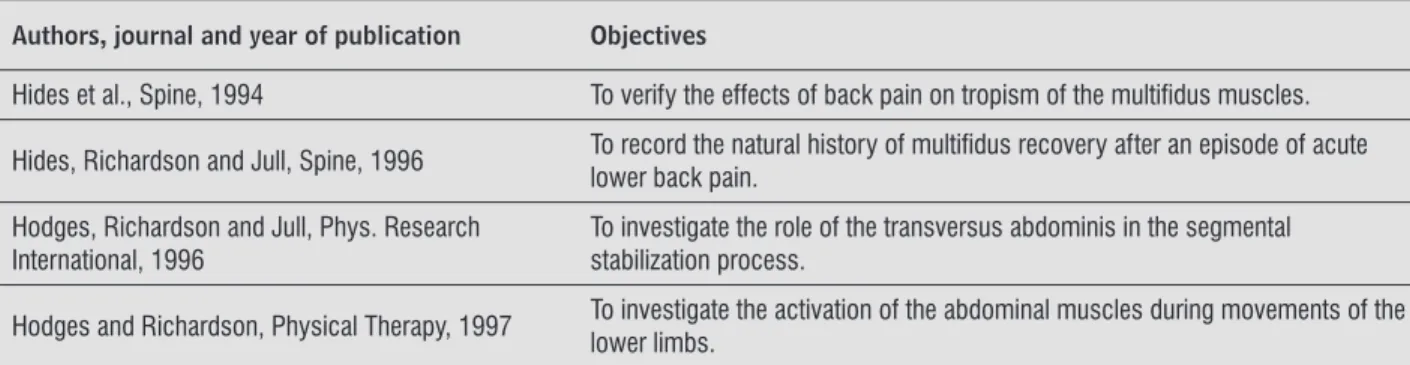
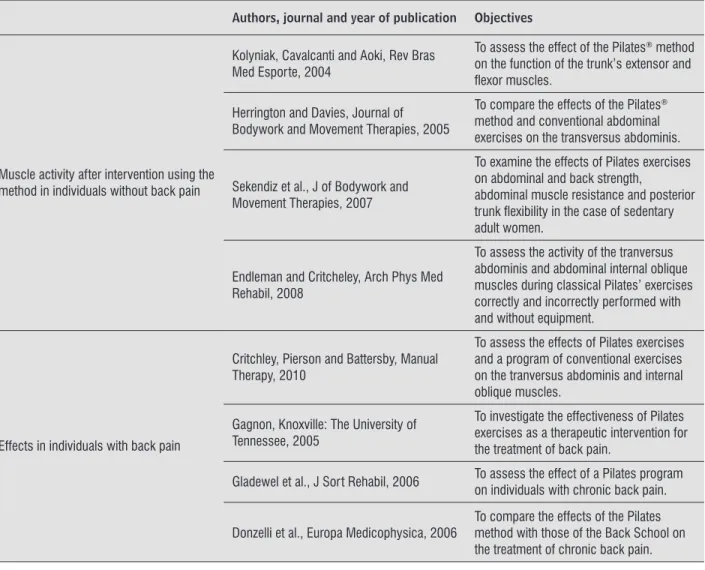
A total of papers were found, of which were excluded for not meeting the inclusion criteria. Of the papers selected, are special papers, are liter-ature reviews, and are original papers. Thirty-one papers address lower back pain and most indicate joint instability as the pathological-mechanical factor that leads to lower back disorders; discuss the seg-mental stabilization process; are field papers; four address muscle activities in individuals with lower back pain Table ; six address traditional stabiliza-tion exercises Table ; and discuss stabilizastabiliza-tion exercises based on the Pilates® method Table .
field. This technique requires the performance of movements in the most deliberate manner based on six basic principles: balance, concentration, control, precision, breathing, and flow .
The Pilates method® incorporates various
thera-peutic exercise guidelines considered efficient for the treatment of chronic lower back pain, such as the contraction of the multifidus and transversus abdominis associated with breathing, while its de-velopment takes into account the patient’s individual characteristics . The general goal of this study was to investigate the effects of the Pilates® method
on the treatment of chronic lower back pain through a bibliographic review.
Method
This systematic review was conducted using the following databases: L)LACS Latin American and Caribbean Literature on (ealth Sciences , B)REME Latin American and Caribbean Center on (ealth Sciences )nformation , SciELO Scientific Electronic Library Online , and MEDL)NE Medical Literature Analysis and Retrieval System Online . The follow-ing keywords were used in the search for papers: spinal stabilization, Pilates®, and lower back pain and
Table 1 - Muscle activity in individuals with back pain
Authors, journal and year of publication Objectives
Hides et al., Spine, 1994 To verify the effects of back pain on tropism of the multifi dus muscles.
Hides, Richardson and Jull, Spine, 1996 To record the natural history of multifi dus recovery after an episode of acute lower back pain.
Hodges, Richardson and Jull, Phys. Research International, 1996
To investigate the role of the transversus abdominis in the segmental stabilization process.
Hodges and Richardson, Physical Therapy, 1997 To investigate the activation of the abdominal muscles during movements of the lower limbs.
Source: Research data.
Table 2 - Traditional stabilization exercises
Authors, journal and year of publication Objectives O’Sullivan, Twomey and Allison, J Orthop Sports
Phys Ther, 1998
To investigate the effectiveness of interventions using specifi c exercises that advocate the co-contraction of deep abdominal muscles with the lumbar multifi dus muscle to treat chronic lower back pain.
Table 2 - Traditional stabilization exercises
Authors, journal and year of publication Objectives
Goldby et al., Spine, 2006
To determine the effectiveness of two components of the musculoskeletal physical therapy, i.e., manual therapy and segmental stabilization, on chronic lower back disorders.
Koumantakis, Watson and Oldham, Physical Therapy, 2005
To analyze the inclusion of spinal stabilization exercises in general exercises for the abdominal muscles among patients with sub-acute or nonspecifi c chronic lower back pain compared to a group performing general exercises only.
Norris and Matthews, Complementary Therapies in Clinical Practice, 2008
To assess the effects of an integrated spinal stabilization program on chronic back pain.
Pereira, Ferreira and Pereira, Physical Therapy in Movement, 2010
To assess the effectiveness of segmental stabilization exercises on the pain and functional ability of individuals with chronic back pain.
Sakamoto et al., Conscientiae Saúde, 2009
To assess the effects of a four-week program of lumbar stabilization exercises on the intensity of pain and level of functionally among 13 individuals with nonspecifi c chronic back pain.
Source: Research data.
(Conclusion)
Table 3 - Stabilization exercises based on the Pilates® method
Authors, journal and year of publication Objectives
Muscle activity after intervention using the method in individuals without back pain
Kolyniak, Cavalcanti and Aoki, Rev Bras Med Esporte, 2004
To assess the effect of the Pilates® method
on the function of the trunk’s extensor and
fl exor muscles.
Herrington and Davies, Journal of Bodywork and Movement Therapies, 2005
To compare the effects of the Pilates®
method and conventional abdominal exercises on the transversus abdominis.
Sekendiz et al., J of Bodywork and Movement Therapies, 2007
To examine the effects of Pilates exercises on abdominal and back strength,
abdominal muscle resistance and posterior trunk fl exibility in the case of sedentary adult women.
Endleman and Critcheley, Arch Phys Med Rehabil, 2008
To assess the activity of the tranversus abdominis and abdominal internal oblique muscles during classical Pilates’ exercises correctly and incorrectly performed with and without equipment.
Effects in individuals with back pain
Critchley, Pierson and Battersby, Manual Therapy, 2010
To assess the effects of Pilates exercises and a program of conventional exercises on the tranversus abdominis and internal oblique muscles.
Gagnon, Knoxville: The University of Tennessee, 2005
To investigate the effectiveness of Pilates exercises as a therapeutic intervention for the treatment of back pain.
Gladewel et al., J Sort Rehabil, 2006 To assess the effect of a Pilates program on individuals with chronic back pain.
Donzelli et al., Europa Medicophysica, 2006
To compare the effects of the Pilates method with those of the Back School on the treatment of chronic back pain.
463 Table 3 - Stabilization exercises based on the Pilates® method
Authors, journal and year of publication Objectives
Effects in individuals with back pain
Rydeard, Leger and Smith, J Orthop Sports Phys Ther, 2006
To compare the effects achieved with the Pilates method to those obtained with a conservative treatment for chronic back pain.
Fonseca, Magni and Freitas, Journal of Sport Rehabilitation, 2009
To assess the infl uence of pain on the vertical ground-reaction force in patients with back problems and the effect of the Pilates method on the gait of these patients.
Source: Research data.
(Conclusion)
Discussion
Strong evidence indicates that joint instability triggers lower back pain , , . Joint stability can be defined as a joint’s ability to recover its origi-nal state after being disturbed . Spine stability mainly depends on the contraction of specific groups of muscles, among which the multifidus, transversus abdominis, internal oblique muscles and quadratus lumborum stand out , , , .
The coordinated contraction of these muscles pro-motes increased joint rigidity making it less suscepti-ble to disturbance, preventing the occurrence of joint stress and lesions , , , . Electromyographic studies show that individuals with chronic lower back pain experience little activation of the transversus abdominis and that after an episode of acute lower back pain, the multifidus are inhibited and weakened, unable to return to their physiological standards without therapeutic interventions , , .
Sensorial experiences of the proprioceptive system go to the Central Nervous System CNS that promotes muscle contraction responses to control stability. When an individual goes through already experienced situations, the CNS performs an anticipatory muscle adjustment, i.e. feed-forward, even before the move-ment occurs. )n the case of new situations, the CNS responds afterwards, i.e., feedback, based on sensorial afferents captured by muscle spindles, Golgi tendon organ GTO and intra-articular receptors , . Activation of the transversus abdominis is a clear example of anticipatory adjustment: it is recruited before any movement of the limbs .
The muscles operating in the trunk can be clas-sified as local or global. The multifidus, transversus
abdominis and internal oblique muscles are local because they operate directly on the vertebrae, con-trolling rigidity and intervertebral relationships. The latissimus dorsi and rectus abdominal muscles are global muscles that generate the torque necessary to move the spine and do not directly operate on the vertebrae; they are mobilizer muscles . The trans-versus abdominis and the multifidus muscles are pri-mary stabilizers because they do not have important functions regarding the orientation of the vertebrae. They are specifically configured to control interseg-mental motion, while internal oblique muscles and the quadratus lumborum are secondary stabilizers. They have excellent stabilizing ability but can also generate movement . Segmental stabilization ex-ercises are for the maintenance and restoration of physiological patterns of local muscle groups , .
Exercises for lumbopelvic stabilization are widely used to treat chronic lower back pain , , , , . Research shows that individuals who take part in segmental stabilization programs experience sig-nificant improvement in pain and functional perfor-mance, even more expressive than improvement and performance obtained with manual therapy, lasting over the long run , , , .
The Pilates® method is also applied
therapeuti-cally to achieve lumbopelvic stabilization , , . The powerhouse or core strength is the meth-od’s focus of intervention. The powerhouse com-prises a region that extends from the pelvic floor to the chest, formed by local and global muscles closely related to the stabilization of the spine and internal organs , , , . )n general, Pilates®
The abdominopelvic region is bounded by ab-dominal, back and pelvic muscles. The stronger they are, the more stable the body is. )ncreased intra-ab-dominal pressure resulting from strengthening these muscles makes the trunk more stable and optimizes movement motor control .
(errington and Davies’ findings show the effectiveness of Pilates® in recruiting the transversus
abdominis and the stabilization process in compari-son with conventional abdominal exercises. (ealthy individuals were distributed into three groups: individuals exercised with the Pilates® method;
ex-ercised with traditional abdominal exercises; and individuals did not exercise. A total of % individu-als who exercised with Pilates®, % of those who
exercised with conventional abdominal exercises, and % of those who did not exercise presented effective ability to contract the transversus abdominis after the period of interventions. Lumbopelvic stability was also assessed in the Pilates group, in which % of the individuals were successful, while all the individuals in the other groups failed.
This greater effectiveness in contracting the trans-versus abdominis is explained by the Endleman and Critcheley study . They showed that, statistically, there is significant recruiting of the transversus ab-dominis and internal oblique muscles during the performance of Pilates-based exercises. This was observed using ultrasound. Muscle activation only happened when the exercise was correctly performed and the studied muscles did not contract in isolation, but activated simultaneously.
Critchley, Pierson and Battersby also ob-served greater activity of the transversus abdomi-nis and the internal oblique muscles during certain Pilates-based exercises. There were, however, no changes in muscle thickness during rest or functional activities. The population under study was composed of individuals without a history of back pain, among whom, theoretically, the activation of muscle groups were within physiological standards. A group of indi-viduals with back pain would be projected to be more favored because these standards would be restored during rest and functional activities.
Gagnon conducted a study to investigate the effectiveness of Pilates-based exercises as a therapeu-tic intervention for back pain. Twelve individuals with back pain were randomly assigned to two groups. Six performed conventional stabilization exercises and six performed Pilates-based exercises. )ndexes for changes in the spine. Secondly, it promotes
stretch-ing and strengthenstretch-ing of the axial muscles, and fi-nally, optimization of the abdominopelvic tone of the rib cage .
Pelvic posture largely determines spinal posture due to the sacroiliac joint. )n the sagittal plane, the pelvis performs anteversion and retroversion move-ments so that lumbar lordosis increases when there is anteversion motion and when retroversion occurs lordosis is corrected , . Therefore, Pilates®
works to ensure the pelvis is properly positioned, i.e., a neutral pelvis, due to its implications for the spine. A well-positioned pelvis depends on balance among four large muscle groups, namely: the anterior abdominal wall and hip extensor muscles, respon-sible for retroversion; the spine extensors and hip flexors, responsible for anteversion .
Kolyniak, Cavalcanti and Aoki investigated the effects of the Pilates method on the trunk’s extensor and flexor muscles. Twenty people were selected for sessions of Pilates-based exercises distributed over weeks. An isokinetic assessment was performed on these individuals’ flexor and ex-tensor muscles of the trunk before and after the sessions. The variables concerning the extensor muscles significantly improved when compared to those of the flexor muscles. Additionally, the agonist-antagonist relationship also improved in regard to all the parameters investigated. The authors assert that extensor muscles are more susceptible to sedentari-ness and emphasize a need for exercises intended to strengthen these muscles in order to prevent back pain, since imbalance between the trunk’s agonistic and antagonistic muscles is a risk factor for the de-velopment of spinal disorders.
Sekendiz et al. used an isokinetic dynamom-eter to investigate the effects of Pilates® mat exercises
465
relevant improvement in functionality and minimi-zation of pain compared to the Pilates group . )t is important to note that, in addition to being sig-nificant, the results obtained by the Pilates group re-mained similar in the long run to what was observed in the study by Donzelli et al. .
Fonseca, Magni and Freitas investigated the deleterious effects of pain on the gait of individuals with back pain and the influence of sessions of Pilates-based exercises on their gait. The group af-fected by back pain experienced changes in aspects of gait and satisfactory reduction of these disorders was observed after the Pilates-based interventions.
Final considerations
The Pilates method improves the relationship between the trunk’s agonistic-antagonistic muscles, increases activity of the transversus abdominis and internal oblique muscles during the performance of exercises and makes contractions of the transversus abdominis more effective, effects that may minimize the incidence of back pain of a mechanical/postural nature. Statistically significant results are found in the treatment of chronic back pain: even better than results obtained with conservative therapies and sim-ilar to those obtained with conventional stabilization exercises or with the Back School treatment.
Therefore, there is evidence that the Pilates method promotes positive effects in the treatment of chronic back pain. There are, however, questions concerning the mechanisms that lead to such re-sponses because studies do not demonstrate changes in the electromyographic activity of the stabilizing muscles nor changes that concern the relationship of the agonistic-antagonistic muscles of individuals with back pain after being part of interventions with the different methods.
References
. Andrade SC, Araújo AGR, Vilar MJP. Escola de coluna : revisão histórica e sua aplicação na lombalgia crônica. Rev Bras Reumatol. ; : - .
. Pires RA, Dumas FL. Lombalgia: revisão de concei-tos e métodos de tratamenconcei-tos. Univ Ci Saúde. ;
: - .
pain, functionality and lumbopelvic stability were collected, respectively using the Visual Analog Scale VAS , the Oswestry Disability )ndex OD) and a Stability Platform Lafayette )nstrument Co before and after the interventions. Both groups presented significant improvement and in the same proportion.
)n the study by Gladwel et al. , individuals with chronic back pain participated in a Pilates-based exercises program for six weeks. A one-hour train-ing session was linked with two -minute sessions of individual activity performed at home per week. Post-treatment analysis showed positive responses P < . in general health, performance in sports, flexibility, proprioception and in pain symptoms. Functionality, assessed before and after the treat-ment using the Oswestry Lower-Back Pain Disability Questionnaire – OSWDQ did not show a significant decrease that would indicate positive progress, prob-ably because few sessions were supervised by a quali-fied professional and also because the participants were already active individuals.
Donzelli et al. investigated the effects of the Pilates method on the treatment of chronic back pain. Forty-three individuals with chronic back pain were randomly assigned to two groups: individu-als in a Pilates group and in a group receiving the Back School treatment. The interventions were implemented in the respective groups for a period of seven consecutive days in groups of up to seven individuals. Questionnaires were applied to measure pain Visual Analog Scale and dysfunction Oswestry Lower Back Pain Disability Scale before the interven-tions and one, three and six months after the inter-ventions. Both groups experienced similar clinical improvement. The Pilates method was as effective as the Back School treatment, however, the group treated with Pilates reported greater satisfaction with their treatment.
. O’Sullivan P, Twomey L, Allison GT. Altered abdominal muscle recruitment in patients with chronic back pain following a specific exercise intervention. J Orthop Sports Phys Ther. ; : - .
. Oliveira VCO, Bicalho L), Soares TB, Dornellas RS. Estabilidade articular da coluna vertebral: teorias contemporâneas e novos paradigmas. Fisioter Bras.
; : - .
. França FJR, Burke TN, Claret DC, Marques AP. Estabi-lização segmentar da coluna lombar nas lombalgias: uma revisão bibliográfica e um programa de exercí-cios. Fisioter Pesqui. ; : - .
. Gouveia KMC, Gouveia EC. O músculo transverso abdominal e sua função de estabilização da coluna lombar. Fisioter Mov. ; : - .
. (ides JA, Stokes MJ, Saide M, Jull GA, Cooper D(. Evidence of lumbar multifidus muscle wasting ipsi-lateral to symptoms in patients with acute/subacute low back pain. Spine. ; : - .
. (ides JA, Richardson CA, Jull GA. Multifidus muscle recovery is not automatic following resolution of acute first-episode low back pain. Spine. ; :
- .
. Aquino CF, Viana SO, Fonseca ST, Bricio RS, Vaz DV. Mecanismos neuromusculares de controle da esta-bilidade articular. R Bras Ci e Mov. ; : - . . (odges PW, Richardson CA, Jull GA. Evaluation of the
relationship between laboratory and clinical tests of transversus abdominis function. Physiother Res )nt.
; : - .
. Bergmark A. Stability of the lumbar spine. A study in mechanical engineering. Acta Orthop Scand Suppl.
; : - .
. Norris CM. Functional load abdominal training: part . Phys Ther Sport. ; : - .
. O'Sullivan PB. Lumbar segmental instability : clinical presentation and specific stabilizing exercise manage-ment. Man Ther. ; : - .
. Goldby L, Moore A, Doust J, Trew M. A randomized controlled trial investigating the effi ciency of mus-culoskeletal physiotherapy on chronic low back dis-order. Spine. ; : - .
. Kolyniak )E, Cavalcanti SMB, Aoki MS. Avaliação isoci-nética da musculatura envolvida na flexão e extensão do tronco: efeito do método Pilates®. Rev Bras Med
Esporte. ; : - .
. Brazil AV, Ximenes AC, Radu AS, Fernades AR, Appel C, Maçaneiro C(, et al. Diagnóstico e tratamento das lombalgias e lombociatalgias. Rev Bras Reumatol.
; : - .
. Woolf AD, Pfleger B. Burden of major musculoskel-etal conditions. Bull World (ealth Organ. ; :
- .
. Ferreira MS, Navega MT. Efeitos de um programa de orientação para adultos com lombalgia. Acta Ortop Bras. ; : - .
. Panjabi MM. The stabilizing system of the spine. Part ). Function, dysfunction, adaptation, and enhance-ment. J Spinal Disord. ; : - .
. Panjabi MM. The stabilizing system of the spine. Part )). Neutral zone and instability hypotesis. J Spinal Disord.
; : - .
. Panjabi MM. Clinical spinal instability and low back pain. J Electromyogr Kinesiol. ; : - . . Maher CG. Effective physical treatment for chronic low
back pain. Orthop Clin North Am. ; : - . . Lewis A, Morris M, Walsh C. Are physiotherapy
exercises effective in reducing chronic low back pain? Phys Ther Rev. ; : - .
. Richardson CA, Jull GA. Muscle control-pain control. What exercises would you prescribe? Man Ther. ;
: - .
. Silva ACL, Mannrich G. Pilates na reabilitação: uma revisão sistemática. Fisioter Mov. ; : - . . Bertolla F, Baroni BM, Leal Junior ECP, Oltramari JD.
Efeitos de um programa de treinamento utilizando o método Pilates® na flexibilidade de atletas juvenis
de futsal. Rev Bras Med Esporte. ; : - . . Muscolino JE, Cipriani S. Pilates and the
power-house — ). J Bodyw Mov Ther. ; : - . . (odges PW. )s there a role for transverses abdominis
467
. Alvim FC, Peixoto JG, Vicente EJD, Chagas PSC, Fonseca DS. )nfluência da porção extensora do mús-culo glúteo máximo sobre a inclinação da pelve antes e depois da realização de um protocolo de fadiga. Rev Bras Fisioter. ; : - .
. (errington L, Davies R. The influence of Pilates train-ing on the ability to contract the transversus abdominis muscle in asymptomatic individuals. J Bodyw Mov Ther. ; : - .
. Endleman ), Critchley DJ. Transversus abdominis and obliquus internus activity during pilates exercises: measurement with ultrasound scanning. Arch Phys Med Rehabil. ; : - .
. Critchley DJ, Pierson Z, Battersby G. Effect of pilates mat exercises and conventional exercise programmes on transversus abdominis and obliquus internus ab-dominis activity: pilot randomised trial. Man Ther.
; : - .
. Gagnon L(. Efficacy of Pilates exercises as therapeu-tic intervention in treating patients withLow Back Pain doctorate thesis . Knoxville: The University of Tennessee; .
. Gladwell V, (ead S, (aggar M, Beneke R. Does a pro-gram of Pilates improve chronic non-specific low back pain? J Sport Rehabil. ; : - .
. Fonseca JL, Magini M, Freitas T(. Laboratory gait analysis in patients with low back pain before and after a pilates intervention. J Sport Rehabil. ;
: - .
Received: / /
Recebido: / /
Approved: / /
Aprovado: / /
. Koumantakis GA, Watson PJ, Oldham JA. Trunk muscle stabilization training plus general exercise versus general exercise only: randomized controlled trial of patients with recurrent low back pain. Phys Ther.
; : - .
. Norris C, Matthews M. The role of an integrated back stability program in patients with chronic low back pain. Complement Ther Clin Pract. ; : - . . Pereira NT, Ferreira LAB, Pereira WM. Efetividade
de exercícios de estabilização segmentar sobre a dor lombar crônica mecânico-postural. Fisioter Mov.
; : - .
. Sakomoto ACL, Nicácio AS, Silva LA, Victória Júnior RC, Andrade )LL, Nascimento LR. Efeito dos exercícios de estabilização na intensidade da dor e no desempenho funcional de indivíduos com lombalgia crônica. Con-scientiae Saúde. ; - .
. Anderson BD, Spector A. )ntroductions to pilates-based rehabilitation. Orthop Phys Ther Clin N Am.
; : - .
. Donzelli S, Domenica E, Cova AM, Galleti R, Giunta N. Two different techniques in the rehabilitation treat-ment of low back pain: a randomized controlled trial. Eura Medicophys. ; : - .
. Rydeard R, Leger A, Smith D. Pilates-based thera-peutic exercise: effect on subjects with nonspecific chronic low back pain and functional disability: a ran-domized controlled trial. J Orthop Sports Phys Ther.
; : - .
. Gonçalves MBK, Ângelo RDCO, Costa PP. Aspectos clínicos e morfofuncionais da casa de força no método Pilates. Fisioter Bras. ; : - .
. Sekendiz B, Altun O, Korkuzos F, Akin S. Effects of Pi-lates exercise on trunk strength, endurance and flex-ibility in sedentary adult females. J Bodyw Mov Ther.
; : - .
. Segal NA, (ein J, Basford JR. The effects of Pilates training on flexibility and body composition: an observational study. Arch Phys Med Rehabil. ;
: - .
. Souza MS, Vieira CB. Who are the people looking for the Pilates method? J Bodyw Mov Ther. ; :