A.V. Vasilakos et al. (Eds.): AUTONOMICS 2009, LNICST 23, pp. 144–159, 2010.
© Institute for Computer Sciences, Social-Informatics and Telecommunications Engineering 2010
Context-Aware Self-optimization in Multiparty
Converged Mobile Environments
Josephine Antoniou1, Christophoros Christophorou1, Augusto Neto2,3, Susana Sargento2, Filipe Cabral Pinto4, Nuno Filipe Carapeto4, Telma Mota4,
Jose Simoes5, and Andreas Pitsillides1
1
University of Cyprus, 75 Kallipoleos Str., 1678 Nicosia Cyprus
{josephin,christophoros.andreas.pitsillides}@cs.ucy.ac.cy
2 Instituto de Telecomunicações, Univerity of Aveiro,
Campus Universitario Santiago, Aveiro, Portugal [email protected], [email protected]
3
Universidade Federal de Goiás, Instituto de Informatica Bloco IMF I, sala 239, Campus II – Samambaia, Goiânia, Brazil
4 PT Inovação, Rua Engenheiro José Ferreira Pinto Basto, 3830 Aveiro, Portugal
{filipe-c-pinto,nuno-f-carapeto,telma}@ptinovacao.pt
5 Fraunhofer FOKUS, Kaiserin-Augusta-Allee, 31, 10589 Berlin, Germany
Abstract. The increase of networking complexity requires the design of new performance optimization schemes for delivering different types of sessions to users under different conditions. In this scope, special attention is given to multi-homed environments, where mobile devices cross areas with overlapping access technologies (Wi-Fi, 3G, WiMax). In such scenario, efficient multiparty delivery depends upon the grouping operation (creation of a set of users to re-ceive a given session), which must be done based on several parameters. We propose sub-grouping of content-based service groups, so that the same service session can be delivered using different codings of the same content, to adapt to the current network, users, session and environment context. The context-aware information is used to improve the sub-grouping process. This paper aims to de-scribe these sub-grouping techniques, in particular how they improve network performance and user experience in the future Internet, in the scope of cognitive autonomic networks.
Keywords: Context-awareness, self-optimization, multiparty, sub-grouping, convergence, session & network management.
1 Introduction
increasing revenues, network/service providers must optimize costs and provide new sessions operating in a mixture of access technologies, which is not trivial and de-mands complex control. Attention must be given to group-based multimedia sessions, since the strong requirements on Quality of Service (QoS) must be fulfilled simulta-neously for all group users and be kept during the entire session lifetime.
These requirements increased interest of the research community in cognitive and autonomic/self-managed networks. Main functional components of such networks in-clude self-configuration and context-awareness, deploying auto-learning implemented by means of network-aware middleware distributed across network components. Bene-fits of cognitive autonomic networks include, but are not limited to, network perform-ance optimization, automatic and seamless reconfiguration, fast and efficient resilience, etc. Applications and devices are able to exploit such adaptations while being agnostic of underlying reconfigurations, in accordance with the seamless service provision para-digm. The proposed architecture plans to support automatic and seamless session recon-figuration, through self-management, recognizing context and acting on it to sub-group users. Context refers to information collected dynamically over time, describing the user, its environment and the network’s current state.
In terms of group-based sessions, efficiency of session setup requires a correct definition of user groups. Nowadays, most mobile devices are produced with multi-homed capabilities, and it is common to cross areas where there exists overlapping of different network access technologies, such as Wi-Fi, 3G and WiMax. The efficiency of the grouping operation (creation of a set of users to receive a given session) may depend on parameters, such as access technology, since for instance, 3G networks have lower bandwidth capabilities than Wi-Fi and WiMax networks. Thus, sub-grouping could be performed and the same service session could be delivered with different throughput (e.g., using different codings of the same content) to adapt to the current network capabilities. In addition to network traffic, other types of context should also be used to improve sub-grouping, such as noise, terminal location and speed, user’s priority and network preferences, user’s terminal capabilities, quality of received signal etc. Moreover, history context can also be used for the improving sub-grouping. For example, previously received context can be compared with current context for patterns to be located. Using some intelligence, forecasts of undesirable events are possible and sub-groups may be created so that such events are avoided.
The FP7 Context Casting (C-CAST) project [1] proposes such innovative sub-grouping process to enable context-awareness and consequently self-optimization in multiparty, converged mobile environments. This paper describes these sub-grouping techniques, in particular how they improve network performance in the future Internet, in the scope of cognitive autonomic networks. Related work is presented in Section 1.1. Section 2 overviews context-aware multicasting (C-CAST), introducing sub-grouping. Sections 3 and 4 diverge into self-management through sub-grouping as designed at the session and network layers. Section 5 presents how context is used by the content, and finally Section 6 offers conclusions and directions for future work.
1.1 Related Work
networks, multiple access networks coexist, thus, access selection using context-based algorithms is necessary to enable the optimization of both terminal and network [3]. Although many proposals base the decision process on radio signal properties (e.g. [4]), this is only one of the many criteria in such selection schemes. Some proposals suggest context-aware decisions [3]. Moreover, the majority of related work focuses entirely on network selection algorithms, not concerning other important mechanisms crucial to support the decisions e.g. QoS management, to enable the complete network re-configuration triggered by context. This lack of high-level perspective is addressed in more recent proposals, [5]. We consider the support of context-aware selection, in a multicast environment, where the group membership is a main issue, but being flexible enough to support any parameter envisioned.
The integration of class-based QoS and IP multicast is promising, since the former allows a scalable QoS approach while the latter saves bandwidth [6]. However, this is not trivial [7], e.g. while QoS achieves scalability by pushing unavoidable complexity to edges routers, IP multicast operates on a per-flow basis throughout the network. Also, dynamic addition of new group members may affect existing traffic [8].
On the session layer, most of the solutions proposed use the Session Initiation Proto-col (SIP) as the main signalling protoProto-col, e.g. in MPLS-based next generation networks [9], or as an enabler for session mobility in converged networks [10], integrating QoS management and mobility management as the basis for overall session management. Enabling session management mechanisms with context-aware information, the ap-proach of [11] exploits strategies involving the use of contextual information, strong process migration, context-sensitive binding, and location agnostic communication protocols for “follow-me” sessions. Although interesting, these do not cover QoS and efficient multiparty delivery systems.
Finally, much effort has been put recently on the autonomic network concepts [12], where autonomic processes can perceive network conditions, plan, decide, and act on these conditions. They can learn from the impact of former adaptations and accord-ingly make future decisions, while considering end-to-end goals. Autonomic networks are promising for wireless networks, which are highly dynamic and complex to man-age. Our approach is towards the autonomic concept by enabling the dynamic optimi-zation of the use of the network taking into account also the history and instantaneous context of the users, network, sessions and environment.
2 Context-Aware Multiparty Service Provision
This section presents the overall context-aware multiparty architecture, able to sup-port context from the user, network, sessions and surrounding environment in future multiparty mobile communications. We also show how the context can influence grouping and sub-grouping of users at different levels from the environment and user-levels, to the session and network-layers.
2.1 System Architecture
multicast/broadcast services. The three main parts comprise: the context and group management service enablers, with reasoning and grouping users based on context; content adaptation and delivery based on context; and context information collection through sensors, context distribution and context aware multiparty transport.
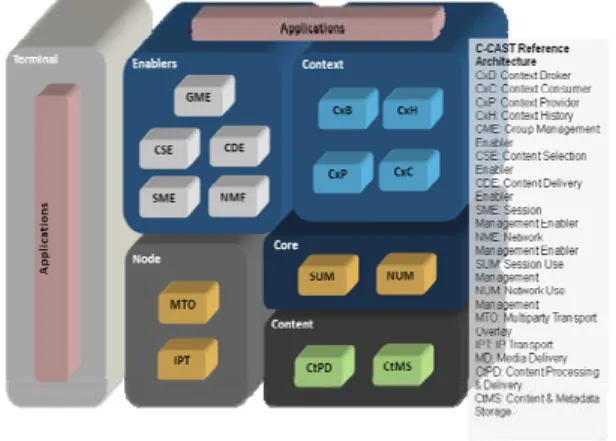
Fig. 1. Context-Aware Multicasting Reference Architecture
In this paper we focus on the multiparty delivery layers and how they support ses-sion delivery through efficient network mechanisms, both supporting context infor-mation and grouping/sub-grouping of users based on the different sources of context information. In the following paragraphs we briefly describe the main entities of the multiparty delivery process.
Context Providers (CxP) – They obtain contexts from sensors and networks, map them to information in an interpretable manner and deliver this information to the several components.
IP Transport (IPT) – It controls the integrated QoS and IP multicast enforcement in the nodes along a communication path for the efficient delivery of multiparty sessions to groups of users, with QoS-guaranteed over the time, able to build delivery trees in heterogeneous environments. The performance limitations of existing proposals moti-vated the design of IPT with support to distributed per-class resource control. For scalability, network edges coordinate resource allocations, and interior routers remain simple by reacting only upon both signalling and network events (e.g., link failures, re-routing or mobility), where these events can be local or triggered by context changes.
Network Management (NM) – It performs context-aware decision of the best con-nection of multimode terminals in heterogeneous networks. It makes use of user, environment, network and session context, to drive intelligent network selection, in terms of communication path, terminal interface and access technologies (Network Use Management – NUM). Moreover, it is expected to achieve more efficient re-source utilization, as well as more uniform distribution of data load, while fulfilling the QoS required by sessions and experienced by the users (Network Management Enabler – NME). For instance, the Wi-Fi incoming interface of a terminal should be changed to the WiMax during congestion periods, or after terminal mobility to an area without Wi-Fi coverage area. Associated with MTO, Network Management (NM) allows generalized transport by assigning MTO trees and controlling packet transport along them. Thus, end-to-end multiparty content transport over network segments with different transport technologies (i.e., unicast and multicast) is deployed with context-driven self-organization and seamless resilience support.
Session Management (SM) – It manages user-to-content and content-to-user rela-tionships, through session control. It is intelligently designed to enable the use of context information for session control, using the SIP, in terms of network-specific, environment-specific and user-specific contexts, without in fact knowing the actual network, environment or service details (through Session Management Enabler – SME - and Session Use Management – SUM).
Mobility Controller – It applies the decisions issued by the NUM related to the net-work interface to be used in the terminal, for vertical handover decisions.
2.2 Context-Based Sub-grouping
In this context-aware architecture, grouping and sub-grouping of users in the same session does not only depend on the desired content (performed at higher layers, such as the service and application ones), but also, due to the variety of context informa-tion, it is also performed at Session and Network levels, supported by the session-related and network-session-related context. As an example of session-session-related context, due to session context on availability of codecs support in the terminals, users may need to be sub-grouped in different sessions with different codecs but with the same content. As an example of network-context, due to the context information, the best access technologies for the users in the same group may be different, since user context and environment is also taken into account. The different networks may have different guarantees, which may require the content to be delivered with different quality and codecs, hence requiring users sub-grouping.
The Session Management is the element that accepts context information through requests or triggers and answers by creating/modifying/terminating the sub-group sessions. Once it determines the matching between available content formats and user capabilities in terms of supported content formats, resulting in candidate files per user in the service group, it is responsible of first inviting the users to a session and to invite the content provider to deliver the content to these users.
accordingly (move a user to a different group, or eventually create or delete sub-groups). The trigger can have different sources (network conditions change, device change, handovers, etc).
The Session Management should be able to notify the Network Management to modify sub-groups/sessions based on the above notifications. This might make the Session Management terminate the SIP and Media session both with the client and the content provider. It should also be able to modify sessions based on notifications coming from other components, through changes in context. According to the trigger, when only sub-groups are affected, it is important to modify the multiparty session as well. Therefore, it will communicate all changes to the Network Management to adapt the trees (and the correspondent overlays) accordingly, and possibly change the net-work and technology to the new sub-groups.
On the network side, each of the created sub-groups represents a multicast delivery tree or, in case of a single user, a unicast connection, that requires network resources. The network Context Provider improves the network operator view about network resource usage, to optimize network resource management and QoS. It is then possi-ble for the network to provide different QoS levels to the members of a group that consume identical content, but experience various network contexts. This is the proc-ess of network level sub-grouping.
The Network Management is triggered through network level context, or by the Session Management to adapt the network and users in the network. It performs an optimization process whose output is the decision of the networks/technologies to be used by the several users. If the users in the same group change the attached network, and the levels of QoS cannot be fulfilled in the networks of a group, sub-grouping is performed at network level, and different QoS, and possibly different codecs, will be assigned to the different sub-groups. For some cases, where not all the users or links have the required multicast capabilities, overlay nodes are enabled to abstract the grouping decision of these considerations. Moreover the sub-grouping flexibility allows, for instance, in the same session, two users to receive the same audio, but different video streams with different codecs or rates, just depending on the available resources or preferences. In this case both would be in the same audio sub-group, but in different video sub-groups.
Sections 3 and 4 will deeply describe the context-aware sub-grouping processes, both from the session and network sides.
3 Enabling Context-Awareness at the Session Level
3.1 Session Management Overview
the appropriate content for a given user (or group of users) and act as an intermediary platform between the content provider and the content consumer.
This work extends the session management functionality to consider context trig-gers in the creation, modification and teardown of sessions. Context-aware Session Management is a key functionality of the converged system. Specifically, the session management deals with context that is relevant in order to select the right content for its consumers. Therefore, the first step for enabling context-awareness in the multi-cast-enabled, converged network is to recognize and use content-related context such as user capabilities and preferences regarding content support (content for-mats/codings). Such context may be categorized as Device Context (e.g. supported coding options) and User Context (e.g. user preferences). Thus, the Session Manage-ment entity will eventually be able to:
• Recognize a context trigger for session setup • Recognize a context trigger for session renegotiation • Recognize a context trigger for session termination • Recognize a context trigger for session mobility
• Make additional requests for context when necessary to the appropriate func-tional entity within the system architecture.
3.2 Context-Aware Session Management
The context-awareness in the Session Management entity comes from the recognition of context as triggers or the capability to receive any context requested, e.g. for initiat-ing a context-aware session. Therefore, the Session Management entity has the func-tionalities described in the subsequent paragraphs (based on interfaces with other system functional entities), necessary to enable this awareness of context information: Primarily, the Session Management needs to interact with the entity responsible for identifying the service groups, i.e. the groups of users that will receive the same con-tent. Through this interface the Session Management must receive identification for the service group, together with separate identifications for the individual users that comprise the particular group.
Consequently, the Session Management must be able to interact with the entity re-sponsible for Content Processing and Delivery. The Session Management sends the group identification received in the step described above, to the Content Processing and Delivery entity, and the identification is used by this entity to collect some gen-eral content information for the group e.g. whether the content that will be received by the particular group is video or audio, as well as some more specific information, e.g. the coding(s) and bitrate(s) in which the particular content is available. Thus, the Session Management entity acquires descriptive information on the content that will be transmitted to the group.
service group its capabilities and preferences, including coding options sup-ported/preferred by the user device (e.g. resolution, coding options supported).
Once this particular context information is obtained per user, the Session Manage-ment entity can match the content codings/formats in which the content is available, i.e. received from the Content Processing and Delivery (CtPD) entity, to the content codings/formats that each of the group users is capable or willing to support. This matching will results in a list of particular content codings per each user, which may be viewed as an initial refinement of the original service group to sub-groups of users according to the supported content. This is the first step of the sub-grouping process. The sub-grouping will continue in the network where further refinements will addi-tionally consider network and environment context (e.g. current QoS capabilities based on user location and current network load).
The sub-grouping is initiated in the Session Management entity but is further re-fined and concluded in the Network Management entity, since network and environ-ment context are more appropriately collected at that system level. Consequently, the Session Management entity must support interface functionality to exchange informa-tion with the Network Management entity. Over this interface the Session Manage-ment entity will send the list of users and their supported content codings (once the matching of content availabilities and content capabilities is performed), and will receive the finalized context-based sub-grouping of the original service group by which only one content coding will be selected for each user in the original service group. This will enable a context-aware session for each multicast sub-group to be setup. Furthermore, in the case that context changes at any level, the session is modi-fied accordingly, since the system allows the context information to be propagated through to the content. However, we focus on the session setup procedure and provide in the next session details on the signal flows.
3.3 Initiating a Context-Aware Session
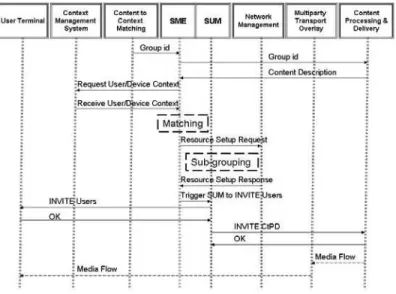
Fig. 2. Session Management related messages in session initiation
Figure 2 illustrates the messages exchanged during session initiation that are rele-vant to Session Management (both the SME and SUM). SME receives group identifi-cation and immediately requests group content information from the CtPD. For each group user the terminal capabilities and user preferences are collected from the Con-text Management System and particularly from the ConCon-text Broker entity. The match-ing between this information results in a list of users and correspondmatch-ing available content codings, which is sent to the Network Management to proceed with more refined sub-grouping. The returned user list has one coding per user, with all users that support the same content coding to form a subgroup. Then, the SME interacts with the SUM to open a new session for each subgroup by inviting the users that belong to that sub-group to join the session, and by inviting the Media Delivery func-tion (part of the CtPD) to deliver the particular content coding for that sub-group.
4 Enabling Context Awareness at the Network Level
4.1 Network Management Overview
4.2 Context-Aware Network Management
This section describes the Network Management element in detail, which is divided in Network Management Enabler (NME) and Network Use Management (NUM), with different functionalities and roles in terms of context usage and sub-grouping.
The NME is the module responsible for the group management at network level. It splits the service groups into several network-based sub-groups according to user, network, operator policies, and a large set of context information. It receives requests from the Session Management, for resource setup, modification and teardown for session groups, i.e. service groups refined according to content availabilities matched with user capabilities. Once the NME receives a request, it triggers the network selec-tion process for an intelligent access technology selecselec-tion (using network, user and environment context dynamically obtained). Following, it is requested to NUM the selection of the best available communication paths, be them multicast or unicast which can provide sufficient resources throughout the network and support some of the network interfaces. With the possible end-to-end paths, the best network inter-faces, the user and operator preferences and a set of context NME disposes the users in different sub-groups. This process is extendable to cope with new sets of context information that can refine the sub-groups. Each subgroup will reflect a specific uni-cast/multicast with a unique (to that content) quality of service. Furthermore these mechanisms were defined to cope and deal with updates and modification due to network problems or context changes. Once the sub-groups are created and provi-sioned by the underlaying modules, this information is returned to the Session Man-agement entity with the respective addresses and ports and selected coding for each sub-group.
resources, also informing each terminal about the selected interface from which mul-tiparty content will be provided (i.e. Wi-Fi, WiMAX, UMTS, LTE, DVB, etc.). The network selection process will also provide support during the multiparty sessions transport, i.e. users of on-going sessions can receive multiparty content from a differ-ent network interface, due to changing network conditions or even handovers (with the support of the mobility controller).
NUM is also responsible for selecting the best communication path within the net-work. It receives requests from the NME to decide on the best path for the multiparty connection. To do that, NUM maps the QoS requirement of the multiparty session into an available class of service, also taking into account all the network status when selecting the path (NetworkQoSCxP). In this sense, it deploys admission control op-erations along the network communication path. Afterwards, it returns them to the NME which finally takes the decision of enforcing the reservation. Consequently, NUM receives the enforcement order and commits the resource reservation by trig-gering each router to enforce both QoS and multicast. QoS enforcement consists in indicating amount of bandwidth and class of service for resource reservation, and Multicast enforcement comprises populating the Multicast Routing Information Base (MRIB) with the information about nodes of the selected communication path. At the end, NME is informed about the success of the operation.
4.3 Grouping as a Part of Network Management
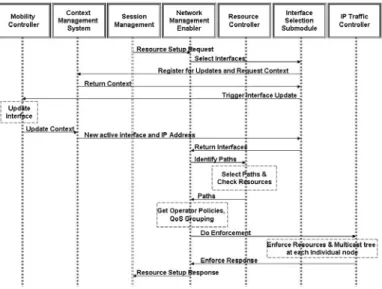
Whenever SME triggers NME with a new request, it contains the users that were selected to receive the same content and the codings in which it is available. SME matches these to the user terminal capabilities and sends to NME. This starts the sub-grouping process in NME that is composed by three different steps. Firstly, network selection is performed to determine, based on the instantaneous context of the net-work (i.e. RATs’ current load, RATs’ available capacity, RATs’ QoS cababilities etc.) and of the users (RATs within reach, signal quality received, speed, etc.) and by considering the constrains set by NUM, the interfaces and the content codings that are more appropriate. This event takes into consideration all the access network context and might trigger an interface and IP address update.
Fig. 3. Network Management related messages in session initiation
4.3.1 Network Role in Context-Aware Group Modification
The group modification capabilities are one of the strengths of this architecture since it is able to adapt to various environment changes. Network conditions can change rapidly and is virtually impossible to predict those changes. Thus the architecture must be prepared to adapt quickly. It is able to fast detect changes, and evaluate their impact on the architecture, by usually enforcing a modification of the group or sub-group of users receiving the same content. Actually three major triggering points were considered, updates to the group constitution, modifications on the network elements which may influence the experienced QoS and the mobility of users.
By assuming these different triggering possibilities, two levels of group modifica-tion must be considered. Group Session Modificamodifica-tion, which represents the ability of users to join or leave the group session. This is initiated at SME and propagates through to the Network Management and other modules similarly to session initiation. The removal of users can reduce size or even terminate an existing sub-group. The addition of users has to take into consideration that the stream is already progressing and the content will only be viewed from that point forward. This is only considered when the new user viewing experience is not compromised by joining an already streaming context.
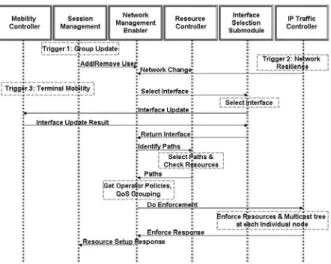
Fig. 4. Network Management in session modification
may become overloaded, or the terminal may be forced to move into a different net-work with different conditions. Eventually, session mobility between terminals with different characteristics and updates of operator policies will also trigger sub-group modifications. The process is depicted in Figure 4.
5 Propagating Context to Content
In the previous sections we presented how context-awareness was enabled at the session and network levels, describing the proceedings on how sub-groups are formed, the us-age of context information in this process and further describing mechanisms activated in order to assure QoS across the whole transport and network layers. In this section we describe the mechanisms involved in delivering the correct media types to the right users and explain the importance of this process in the overall value chain of the content to context management and distribution. In order to better understand the relevant flows, Section 5.1 presents a use case that motivates this work, where one user is capable of receiving different media types (audio, video, text, etc.) and consequently is inserted into different sub-groups according to a myriad of context information. Section 5.2 explains the importance of this behavior and the impact on the Quality of Experience (QoE) for the end user.
5.1 Motivation: Same User, Different Media Types, Different Sub-groups
termination and mobility becomes quite straightforward. After receiving the notifica-tion from Network Management, Session Management needs to parse the message in order to initiate its back-to-back user agent (B2BUA) function.
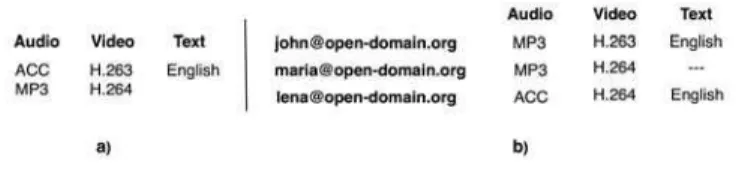
Although all users will be receiving the same content, the media types may vary according to their preferences, needs or current conditions, allowing each user to receive its own personalized stream. Moreover, note that a subset of the users might belong to the same sub-group concerning one media type and different sub-groups in others. Assume the example depicted in Figure 5: i.e. that while doing the parsing, it is possible to identify two videos, three text and two audio sub-groups.
Fig. 5. Example of different media per user for the same content
After identifying the required sub-groups for a specific content (group with similar context) the Session Management entity initiates the session establishment process with the CtPD. On the other hand, Figure 6 shows a sequence flow from the messages between the Session Management entity and the CtPD concerning all sub-groups session initiation and corresponding session establishment. Simultaneously, Session Management triggers the session initiation towards the end user.
When this message reaches the user terminal, according to the network capabilities, the behavior may vary. If the terminal/network is multicast capable, the device will send a JOIN message towards the multicast addresses included in the initial INVITE message. If the device only supports unicast connections, it will answer the request
with a 200 OK message containing the ports it will be expecting media from. Conse-quently the Session Management entity will forward this information towards the Network Management entity, which will have the responsibility of updating the over-lay leaf node with this information.
After the session is established towards the end user, Session Management acti-vates the CtPD delivery process, which consists in creating unicast sessions with the overlay source nodes on the overlay trees. This step activates the media transmission across the entire multicast overlay trees. Consequently, the media flows are estab-lished, finalizing the process of context to content propagation.
5.2 The Importance of Sub-grouping
The importance of personalization in multiparty multimedia services strongly moti-vates content providers, operators and other players to adapt the user experience of these services. Often, adaptation raises scalability and performance concerns, which need to be addressed efficiently. Creating different sub-groups for different media types, allows users to receive the multimedia content that is most suitable to them, not only according to their personal, device and environmental contexts but also consider-ing the current network context information. This compromise allows both users and operators to achieve an optimal point in what concerns personalization vs. scalability. Furthermore, this will boost the user perceived QoE as the sub-grouping mechanisms allow personalization, contextualization and adaptation of content/services, facilitat-ing further interactivity and mobility tasks. By simultaneously allowfacilitat-ing, the operators to optimize and save network resources, services become cheaper and consequently more attractive to the end user.
6 Conclusions and Future Work
In this paper we present an innovative way to achieve self-optimization through con-text-awareness in multiparty converged mobile system. This is achieved through the dynamic re-definition of service groups (sub-grouping) in a converged architecture. A general overview of the sub-grouping process was given with reference to the C-CAST system architecture, in order to place the proposed innovation within a system scope. Subsequently, the focus shifted to particular aspects of the sub-grouping proc-ess and the use of the reference architecture in this procproc-ess; in particular, we have shown how the process begins at the session level, is refined at the network level, and is finally propagated at the service level to the content. As a result, the content re-ceived by each defined sub-group has been adapted to the users’ preferences, situa-tions and contexts on the one hand, and on their network capabilities on the other hand, improving both network resource usage and user experience.
Future work aims, within the scope of the C-CAST project, to finish implementa-tion of the sub-grouping mechanism in order to collect relevant performance meas-ures. Furthermore, specific sub-modules participating in this self-optimization process will be individually enhanced and evaluated.
References
1. ICT-2007-216462 C-CAST (Context Casting) project, http://www.ict-ccast.eu 2. Sigrid, B., Poi, M., Tore, U.: A simple architecture for delivering context information to
mobile users. In: Workshop on Infrastructure for Smart Devices - How to Make Ubiquity an Actuality, Bristol (2000)
3. Jesus, V., Sargento, S., Aguiar, R.L.: Any-constraint personalized network selection. In: Personal, Indoor and Mobile Radio Communications Symposium, pp. 1–6. IEEE Press, Cannes (2008)
4. Pahlavan, K., Krishnamurthy, P., Hatami, A., Ylianttila, M., Makela, J.P., Pichna, R., Vallstron, J.: Handoff in hybrid mobile data networks. Personal Communications 7, 34– 47 (2000)
5. Chen, Y., Yang, Y.: A new 4G architecture providing multimode terminals always best connected services. Wireless Communications 14, 36–41 (2007)
6. Yang, B., Mohapatra, P.: DiffServ-aware multicasting Source. Transactions of the High Speed Networks Journal 13, 37–57 (2004)
7. Bless, R., Wehrle, K.: IP Multicast in Differentiated Services (DS) Networks. IETF RFC 3754 (April 2004)
8. Bless, R., Nichols, K., Wehrle, K.: A Lower Effort Per-Domain Behavior (PDB) for Dif-ferentiated Services. IETF RFC 3662 (December 2003)
9. Kwon, Y., Park, H.J., Choi, S.G., Lee, H.S.: P2MP Session Management Scheme using SIP in MPLS-based Next Generation Network. Opt. Internet and Next Gen. Net., Jeju, 3– 185 (2006)
10. Oberle, K., Wahl, S., Sitek, A.: Enhanced Methods for SIP based Session Mobility in a Converged Network. In: 16th IST Mobile and Wireless Communications Summit, Buda-pest (2007)
11. Handorean, R., Sen, R., Hackmann, G., Roman, G.C.: Context Aware Session Manage-ment for Services in Ad Hoc Networks. In: Intl. Conf. on Services Computing, Orlando, pp. 113–120 (2005)