Context-Aware Multiparty Networking
Christophe JANNETEAU1, Jose SIMOES2, Josephine ANTONIOU3, Christophoros CHRISTOPHOROU4, Mounir KELLIL5, Andreas KLEIN6, Augusto NETO7, Filipe
Cabral PINTO8, Pierre ROUX9, Susana SARGENTO10, Hans D. SCHOTTEN11, Jörg SCHNEIDER12
1
CEA LIST, DTSI/SOL/LSC, Boîte courrier 94, Gif-sur-Yvette, F-91191, France Tel: +33 169089182, Fax: +33 169088395, Email: [email protected]
2
Fraunhofer FOKUS, Kaiserin-Augusta-Allee 31, 10589 Berlin, Germany Tel: +493034637218, Fax: +493034638218, Email:
3
University of Cyprus, 75 Kallipoleos Str., 1678 Nicosia, P.O.Box 20537, Cyprus Tel: +35722892686, Fax: + 35722892701, Email: [email protected]
4
University of Cyprus, 75 Kallipoleos Str., 1678 Nicosia, P.O.Box 20537, Cyprus Tel: +35722892687, Fax: + 35722892701, Email: [email protected]
5 CEA LIST, DTSI/SOL/LSC, Boîte courrier 94, Gif-sur-Yvette, F-91191, France
Tel: +33 169089233, Fax: +33 169088395, Email: [email protected]
6
University of Kaiserslautern, Paul-Ehrlich-Straße, 67663 Kaiserslautern, Germany Tel: +49 631 205 3680, Fax: +49 631 205 4151, Email: [email protected]
7
IT Aveiro, Campus Universitário de Santiago, 3810 -193, Aveiro, Portugal Tel: +351 234377900, Fax: +351 234377901, Email: [email protected]
8
PT Inovação, SA, Rua Eng. José Ferreira Pinto Basto, 3810 -106 Aveiro, Portugal
Tel: +351 234 377 900, Fax: +351 234 377 900, Email: [email protected]
9
CEA LIST, DTSI/SOL/LSC, Boîte courrier 94, Gif-sur-Yvette, F-91191, France Tel: +33 169089137, Fax: +33 169088395, Email: [email protected]
10
IT Aveiro, Campus Universitário de Santiago, 3810 -193, Aveiro, Portugal Tel: +351 234377900, Fax: +351 234377901, Email: [email protected]
11
University of Kaiserslautern, Paul-Ehrlich-Straße, 67663 Kaiserslautern, Germany
Tel: +49 631 205 3595, Fax: +49 631 205 4151, Email: [email protected]
12
University of Kaiserslautern, Paul-Ehrlich-Straße, 67663 Kaiserslautern, Germany
Tel: +49 631 205 3680, Fax: +49 631 205 4151, Email: [email protected]
Abstract: Efficient network support of real-time group communications
multiparty networking stack (i.e. session, transport, and network layers) based not only on the user networking context but also on its environmental context.
Keywords: Context detection; context-aware multiparty delivery, transport,
session.
1. Introduction
With the increasing popularity of online community applications allowing users to form groups and exchange information in real-time, multiparty communications are becoming widespread. One such application is group-based real-time video streaming, like the TVperso service [1] by Free, a French Internet Service Provider. This service is supported by IP Multicast and allows users to stream in real-time, their own media content publicly or to a limited group of receivers. Moreover, context-awareness has been identified as a key enabler for enriching/optimizing group applications, allowing various forms of dynamic adaptation of the service based on the group members’ context [2]. Typical enhancements proposed include the dynamic formation of a group based on users’ context (e.g. location), or the dynamic, preference-based selection of the (same) content received by group members using group preference arbitration systems like MusixFX [3].
This paper aims at progressing further and investigate the dynamic optimization of content delivery to a group based on the group’s context; i.e. context-aware multiparty delivery. Specifically, the current paper aims to address the following objectives:
• Investigate ways to maximize user satisfaction in group communications. • Address heterogeneity of access networks, devices, environments & physical
mobility by dynamic content adaptation.
• Achieve optimized context-aware multiparty delivery, by defining a novel functional delivery architecture.
Given the above objectives, optimizations are considered at all levels of the TCP/IP protocol stack, including session, transport and network layers. Furthermore, the context considered to drive the dynamic adaptation of the multiparty delivery encompasses not only the networking context of each group members (e.g. link quality and characteristics) but also its environmental context (device capabilities, physical location, speed, etc.). Naturally, different adaptations can be applied simultaneously for different members of a group receiving the same content, with adaptations for each user being driven by its own networking and environmental contexts.
Section 2, presents the motivation for this work and the associated research challenges, by illustrating achievable optimizations through example use cases. In Section 3, a functional architecture is proposed to enable context-aware multiparty delivery. Sections 4-6 focus on the detailed technical realisation of each of its components and on the way interactions allow optimizing multiparty delivery for heterogeneous groups.
2. Use Cases & Research Challenges
mobile and might frequently switch between access networks. The content for the group is available in different codings to accommodate such a variety of contexts. Networking context (e.g. available networks, cell/access point loads, etc) is used to select the currently most appropriate network. Whenever a handover is triggered between networks, there might be an adaptation of the codec characteristics to accommodate new QoS conditions. Specific networking features like improved transport reliability might also be activated on the stream. Environmental context can also influence the ongoing group communication. For example, always selecting the most appropriate network requires frequent scannings for each radio access technology. Environmental context may be used to decrease this burden, e.g. for battery saving. For instance, it may be considered that WiFi scanning makes sense only in indoor environment. In outdoor environment, WiFi scanning can be considered as a useless waste of battery resource. Then temperature measurement may be combined to location information in order to elaborate a reliable indoor indication flag, which in turn will trigger WiFi discovery scanning. Thus, the content to a user group is adapted to optimize delivery for each user in the group, achieving an enhanced environment where a user may expect to have access to “personalized” group communications anywhere, anytime and anyhow.
Implementation of such context-aware multiparty delivery, as illustrated in the above scenario, poses some important research challenges: (1) define an open context detection and distribution architecture that can integrate a wide range of sensors and make this context information available to applications and network services; (2) define scalable, generic, and adaptive multiparty transport and multiparty session services to allow efficient support of group communications despite heterogeneities in group members’ contexts; and (3) enable context-aware network selection to best serve ongoing multiparty sessions.
3. Functional Architecture for Context-Aware Multiparty
Networking
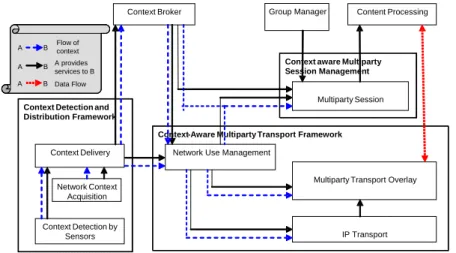
Figure 1 introduces the proposed architecture for context-aware multiparty networking.
Context Detection by Sensors Network Context
Acquisition
Network Use Management Context Delivery
Multiparty Transport Overlay
IP Transport Multiparty Session
Context Detection and Distribution Framework
Context-Aware Multiparty Transport Framework Context aware Multiparty Session Management
Context Broker Content Processing
A B Flow of context
Group Manager
A provides services to B Data Flow A B A B
Figure 1: Context-aware Multiparty Networking Architecture
networks, and covers both environmental context and networking context (e.g. available networks). This framework generally feeds a context broker. However it may also directly feed the context-aware multiparty transport framework (cf. section 5) whenever very fast adaptation is needed. A context-aware multiparty session management (cf. section 6) is triggered by a group manager entity for initiating or updating group communications sessions. Multiparty session management takes care of managing subgroups of users that share similar contexts. The context-aware multiparty transport framework exploits context context-awareness in order to select e.g. the optimum access technology and dynamically adapt the multiparty delivery at transport and network layers for each group member based on his current context; e.g. in terms of networks’ supported QoS or multicast capabilities.
4. Context Detection and Distribution Framework
Adaptation in content delivery, e.g. to allow the option that a video stream can be sent as different coding to different subsets of the group members, is affected by network and environmental characteristics for the participating users, i.e. the users’ context. The acquisition, processing as well as the dissemination of such context is the focus of the first framework that is addressed, the Context Detection and Distribution Framework.
The concept of acquisition, processing and dissemination of context is not new and has been studied within the “MobiLife” project[4]. However, implementing such systems that exploit user-related context inevitably leads to privacy issues. Although privacy issues are not a major research topic of the C-CAST project [24], the authors are aware of the respective measures that have to be taken when commercially deploying and exploiting such systems. Other research initiatives and projects such as SWIFT [23] develop solutions addressing privacy concerns within the federated telecommunications area.
In contrast to existing mobile-centric, wireless sensing approaches, such as NORS [5], which usually either are defined for specialized hardware platforms only, or do not have open interfaces, or are only intended to support one or a limited set of applications they were optimized for, a more generic approach is introduced to make environmental context available. Most of the projects working on context-aware systems are limited to available sensors, whereas the proposed framework will provide open and standardized interfaces. Furthermore, it will be capable of integrating newly developed sensors and future context-aware applications.
4.1 Context Detection by Sensors
Figure 2: Generic Model of “Context Detection by Sensors” Module
Figure 3: Generic Model of “Context Delivery”
The requirements for the capabilities of the sensors in terms of resolution, accuracy and response time depend on the various kinds of context information and may be influenced via the “Context Delivery” module, user profiles, settings and terminal parameters. A generic model of the “Context Detection by Sensor” module is shown in Figure 2. It is divided into a “Sensor Data Plane” and a “Sensor Control Plane”. On the sensor data plane, raw sensor data is converted into the required data. Filtering and mapping of sensor data is performed according to the settings given by the sensor control. The processed sensor data is forwarded to the “Context Delivery” module. The sensor control entity is responsible for providing information about the capabilities, availability and status of the sensors to the “Context Delivery” module. In addition, the sensor control manages the sensor activity depending on terminal needs (e.g. power consumption) or policies provided by the user or the “Context Delivery” module.
4.2 Network Context Acquisition
Network Context is already used by some organisations and research projects, which work on concepts for inter system handover, e.g. IEEE 802.21, and for heterogeneous access management, such as the ScaleNet project [6]. The functional module “Network Context Acquisition” collects information about the transport networks and makes them available to the “Network Use Management” and the “Context Broker” via the “Context Delivery”. Network information such as capabilities and Radio Resource Management (RRM) information may be directly retrieved from the network nodes, whereas information about availability of specific networks has to be reported by terminals, implying that the terminals being used are multi-mode terminals. The “Context Delivery” controls the necessary measurements of network context in terminals as well as in network nodes.
4.3 Context Delivery
humidity Æ weather) and low level reasoning (use of logical rules to derive conclusions about user situation from fusioned sensor data and network context).
5. Context-Aware Multiparty Transport Framework
The proposed approach for context-aware multiparty transport, which is the framework that has the knowledge of the network resources and may use this knowledge to enable through network adaptations the awareness of context for individual users and user groups, encompasses context-aware adaptations at multiple levels including the multiparty transport overlay, the IP transport, and the network use management; which are detailed below.
5.1 Multiparty Transport Overlay
The goal behind using a multiparty transport overlay (MTO) is to provide a generic transport service for multiparty applications, i.e. supporting a variety of existing and future multiparty applications in a heterogeneous networking environment (e.g., WiFi, 3G, etc.) with changing networking and environmental contexts (e.g., network multicast capability, packet loss ratio, etc.). The MTO is a new concept in that it applies the overlay paradigm at the transport layer, while most of the existing multiparty overlay solutions, whether in the conceptual stage or deployed in today’s networks, either use some form of IP tunnelling (e.g. MBMS [7] or AMT [8]) or specify application layer protocols [9]. The study of the prior art raised the lack of generic MTO (some multiparty technologies are application-dependent while others do not support IP multicast) as well as the lack of dynamic transport group management functionalities that consider the changing networking and environmental contexts.
In essence, the MTO to be developed should be generic (vis-à-vis the communication layers below and above the transport layer), scalable and reliable. Also this overlay should provide a dynamic multiparty transport group management service, adaptable to the networking and environmental contexts. This context-aware transport group management paradigm is a key feature of the MTO. The transport group management per se represents a set of operations performed at the transport layer on the whole multiparty group or individual groups of users. This is a new concept, and no substantial work exists in the technical literature1. In the present work, this concept is tightly related to the management of multiparty transport connections (i.e., creation, update, and deletion operations) according to the changing networking and environmental contexts. A multiparty transport connection is the set of all unicast and multicast connections of a given multiparty group.
Conceptually, an MTO is a transport tree made up of overlay nodes (ONs). The root of the tree represents the multiparty source (e.g. application server). The leaf of the tree is the closest node to the receiver (e.g. user terminal). To properly deliver multiparty packets from the source to the receivers over the overlay tree, each overlay node has to maintain mapping information between the multiparty transport connection ID2 and the IDs of associated multicast and unicast transport connections forming the branches of the MTO tree. Multiparty data routing (unicast or multicast routing) from the source to ON, between ONs, and from ON to
1
Group management is a quite generic term, which was defined from different perspectives (e.g., Group membership, mobility, media selection, group partitioning, etc) such as in [10].
2
receivers is handled by IPT module (cf. section 5.2). Figure 4 shows an example of an MTO maintaining a multiparty transport connection made up of 3 multicast connections and 3 unicast connections.
S
ON1
ON3
R1
ON2
mca
st@
1
mcast @2
mcast @3
S: Source ONi: ithoverlay node
Ri: ithreceiver
Logical link
Unicast transport connection Multicast transport connection
Legend
R2 R3 R4 R5 R6 R7
Figure 4: Concept of Multiparty Tran-sport Overlay.
Considering the definition of a MTO tree, it is clear that any management operation performed on a multiparty transport connection (i.e., creation, update, and deletion) impacts the MTO tree (i.e. addition/removal of ONs and/or tree branches). Although performed by the MTO component, the transport management operations along with the related MTO tree updates are triggered by networking and environmental contexts, captured by the NUM component (cf. section 5.3), and translated by IPT (cf. section 5.2) for MTO in terms of commands via the IPT-MTO interface. MTO also provides an efficient transport framework able to optimize use of network resources (e.g. by maximizing the use of IP multicast when possible) while adapting to the specific context of each group member (e.g. by using IP unicast where multicast is not available). In terms of context-awareness networking, the MTO component also maintains adaptive transport reliability (e.g., adaptive FEC) based on the link quality.
5.2 IP Transport
The IP Transport (IPT) component aims at selecting a communication path (unicast or multicast) to connect ONs, as well as further allocating network resources in the nodes between the ONs to allow the propagation of multiparty content sessions, with QoS guaranteed over the time, to group of users. The main requirements of IPT in heterogeneous networks include the support of: (a) scalable QoS control; (b) efficient IP multicast control; (c) fast resilience operations; (d) setup of network resources; (e) QoS mapping. IPT handles network resources aggregately to overcome the performance shortcomings of existing per-flow approaches like (RSVP) [11] which introduces excessive signalling/state to configure and maintain resources for each micro flow. Also, IPT aims at avoiding too much centralized control, such as in [11], to achieve scalability and fault tolerance. In addition, current IP multicast routing protocols lack support for QoS and admission control.
trees are assigned at system bootstrap. In case of QoS, per-class over-reservations allow establishing multiple flows without per-flow signalling, and multicast aggregation can be used to reduce multicast state overhead. In order to correctly deploy resource allocation and build IP multicast trees in heterogeneous environments, IPT must support different technologies and network elements. Interactions with session management (SM - section 6) enable to determine the QoS required by the multiparty content session. Additionally, SM can be triggered for resilience, where adaptation and/or re-mapping can be deployed to adjust multiparty content session quality to the current network conditions.
5.3 Network Use Management
The Network Use Management (NUM) component provides intelligent context-aware network selection to select IP routing paths (e.g., between two ONs), as well as access networks, since the environment is assumed to be composed by several Radio Access Technologies (RATs). Hence, the aim of NUM is to keep multimode terminals always “best” connected and to profit from the best QoS offered by the heterogeneous system, while at the same time achieve enhanced network capacity and performance. In addition, context-based reactions of NUM allow mobile terminals to switch between interfaces, to prevent quality degradation according to user context, current network conditions, transport modes or devices.
NUM is being designed based on the limitations of existing multihomed mobility solutions. For instance, the SCTP protocol [14] is not able to provide information on how to select the best path; while the HIP protocol [15] does not provide information about technologies and QoS attributes of local network interface, which is crucial to take efficient decisions. For the network selection functionality, Objective [16] and Profit functions [17] are not transparent to the users since users are asked for data in order to make a decision. Consumer surplus [18] uses a user-centric approach, which may not be good for load balancing. Stochastic programming [19] is designed for supporting a single common service with a fixed bandwidth, which is not flexible.
The context-aware network selection of NUM is being designed to overcome the limitations of the aforementioned solutions, by considering user’s, environment’s, session’s and network’s contexts. Thus, it is expected to achieve a more efficient use of the available heterogeneous radio resources, as well as more uniform distribution of the load between the different RATs while fulfilling the requested QoS to the users. In addition, the network selection algorithm aims at anticipating and preventing undesirable situations like overloading or underutilizing of RATs. The heterogeneous aspect of future Internet requires routing decisions to take into account all the relevant information of the users and sessions, as well as the environmental information, such as location, velocity, noise, etc.
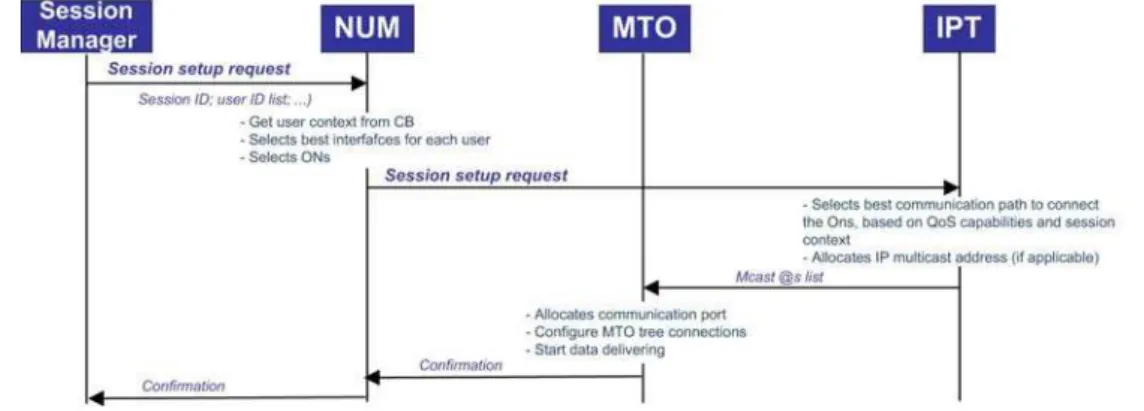
Afterwards, NUM matches in a local database (carrying overall network topology) the best ONs to create an MTO Tree for each sub-group, and triggers IPT to select the best communication path3 (multicast or unicast) between ONs and further enforces both QoS (per-class bandwidth reservations) and, if applicable, IP multicast (IP multicast address allocation, MRIB population and multicast routing protocol triggering at the egress ONs). After succeeding, IPT triggers MTO with the IP multicast addresses of multicast MTO branches to MTO component, allowing MTO to create multiparty transport connections and start multiparty data delivery.
Figure 5: High-Level Message Sequence Chart for Multiparty Session Setup
6. Context-Aware Multiparty Session Management
Since group members receiving the same content may experience different delivery requirements, imposed by the Context Detection and Distribution framework and the Context-aware Multiparty Transport framework, there must exist an entity to subgroup these users in order to optimize delivery; the delivery must be based on user context, without losing the advantage of multicast delivery, i.e. not having to duplicate each packet for each user in the group separately. Session Management (SM) manages all user-to-content, content-to-user relationships, and handles session control events, specifically: session establishment, session renegotiation (upon a given trigger or change) and session termination. Thus, it is the appropriate entity to be responsible for sub-grouping and providing the signalling to deliver a specific content to its consumers. There are currently a few initial solutions touching the SM issues we are facing. EU FP6 C-MOBILE, presented a converged architecture enabling multimedia content to be distributed to user groups preserving network resources. The authors of [20] propose a Point-to-Multipoint SM scheme using SIP protocol in MPLS-based Next Generation Network service stratum. Thesis [21] forms a view on a group and SM system for collaborative applications. Paper [3] describes a framework for managing connections to mobile hosts in the Internet, which integrates the notions of QoS and mobility management and forms a base for overall SM. The approach of [22] is quite interesting as it exploits strategies involving the use of contextual information, strong process migration, context-sensitive binding, and location agnostic communication protocols for “follow-me” sessions.
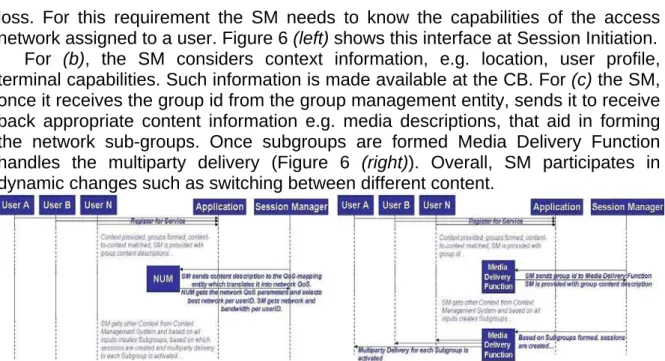
SM requirements may be defined in terms of key SM functionalities, focusing mainly on: (a) The interface to the Network Use Management (NUM), (b) the interface to the Context Broker (CB), (c) the interface to the Media Delivery Function. For (a), requirements involve transmission quality, ensuring that the network has enough resources to make the transmission effective without quality
3
loss. For this requirement the SM needs to know the capabilities of the access network assigned to a user. Figure 6 (left) shows this interface at Session Initiation. For (b), the SM considers context information, e.g. location, user profile,
terminal capabilities. Such information is made available at the CB. For (c) the SM, once it receives the group id from the group management entity, sends it to receive back appropriate content information e.g. media descriptions, that aid in forming the network sub-groups. Once subgroups are formed Media Delivery Function handles the multiparty delivery (Figure 6 (right)). Overall, SM participates in dynamic changes such as switching between different content.
Figure 6: (left)The interface between the NUM and the SM at Session Initiation. (right)The interface between the Media Delivery Function and the SM at Session Initiation
7. Conclusions
This paper proposed a functional architecture for context-aware multiparty delivery that allows optimizing real-time multiparty communications by dynamically adapting content delivery to each individual group member’s networking and environmental contexts, while also optimizing use of network resources. Furthermore, key research challenges have been addressed in a detailed technical manner, showing how the proposed context-aware multiparty delivery could be enabled; especially through definitions of: open context detection and distribution architecture; a scalable, generic and adaptive multiparty transport layer; and an intelligent multiparty session manager with sub grouping capabilities. Each technical definition included considerations for the overall initial objectives, i.e. user satisfaction, dynamic content adaptation and optimized context-aware delivery.
Allowing optimizations to be enabled at all levels of the multiparty networking stack, i.e. in the session, the transport and network layers, makes this architecture flexible and efficient. Nevertheless, achieving such optimizations is not simple. Indeed, latencies upon system adaptation (at session, transport, and network layers) when the context changes represent a critical performance parameter that should be considered. Furthermore, the scalability of the overall context-aware multiparty networking architecture is yet another feature that should be fulfilled and demonstrated.
One key objective behind the proposed functional architecture is to finalize the detailed specification of the system architecture for context-aware multiparty delivery by June 2009. This will be followed by its implementation, validation, and evaluation in a proof-of-concept tested by February 2010. The enablers developed in this paper are expected to facilitate the emergence of new types of multiparty applications by optimizing their delivery to the users.
in the vicinity of a stadium. Another, could be for a group of users that subscribed for a ringtone service (very popular inside telecom operators premises), where these should be made available to users anytime a content provider publishes a new content (in this case, a ringtone). Moreover, by exploiting the optimization of network resources, operators will be able to provide the same service, with the same equipment to a bigger number of users, which represents substantial savings and consequently providing a significant economical impact.
Acknowledgments
This work has been supported by the European FP7 ICT project C-CAST [24] which aims at evolving mobile multimedia multicasting to exploit the increasing integration of mobile devices with our everyday physical world and environment.
References
[1] TVperso service by Free, http://www.freenews.fr/nat/4991-services-tvperso-comment-ca-marche.html. [2] O. Coutand et al., “Context-aware Group Management in Mobile Environments”, IST Mobile Summit 2005,
Germany.
[3] B. Landfeldt et al, “SLM, A Framework for Session Layer Mobility Management“, IEEE CCN 1999, pp 452-456. [4] Mobilife project, http://www.ist-mobilife.org.
[5] NOKIA Remote Sensing Platform (NORS) project, http://opensource.nokia.com/projects/nors/index.html. [6] ScaleNet project, http://www.scalenet.de.
[7] 3GPP TS 23.246: 3rd Generation Partnership Project; MBMS; Architecture and functional description.
[8] D. Thaler et al., “Automatic IP Multicast Without Explicit Tunnels (AMT)”, IETF, draft-ietf-mboned-auto-multicast-09.txt, June 2008.
[9] D. M. Moen, “Overview of Overlay Multicast Protocols”,
http://bacon.gmu.edu/XOM/pdfs/Multicast%20Overview.pdf.
[10] C. Gine et al., “Concepts for Mobile Multicast in Hybrid Networks”, IST-2001-35125 (OverDRiVE), 2003. [11] R. Braden et al., "The Design of the RSVP Protocol", ISI Final Technical Report, July 1996.
[12] A. Kurokawa et al., “Standardization Trends of the Next Generation Network in ETSI TISPAN”, NTT Review, 2006. [13] Neto et al., “Scalable Resource Provisioning for Multi-user Communications in Next Generation Networks”, IEEE
Globecom 2008, New Orleans, LA, USA, November 2008
[14] R. Stewart, “Stream Control Transmission Protocol”, IETF, RFC 4960, September 2007.
[15] R. Moskowitz, P. Nikander, “Host Identity Protocol (HIP) Architecture”, IETF, RFC 4423, May 2006. [16] G. Koundourakis et al., “Network-based access selection in composite radio environments”, IEEE Wireless
Communications and Networking Conference 2007, (WCNC 2007), Pages 3877–3883, 11-15 March 2007. [17] X. Liu et al., “NXG04-4: Joint radio resource management through vertical handoffs in 4G networks”, GLOBECOM
2006.
[18] O. Ormond et al., “Network selection decision in wireless heterogeneous networks”, IEEE PIMRC 2005, Sept. 2005.
[19] A.-E.M. Taha et al., “On robust allocation policies in wireless heterogeneous networks”, QSHINE 2004, Oct. 2004. [20] YoungHwan Kwon et al.,"P2MP Session Management Scheme using SIP in MPLS-based Next Generation
Network", COIN-NGNCON 2006, pp.183-185, 9-13 July 2006.
[21] Erik Wilde, “Group and Session Management for Collaborative Applications”, Ph.D. Thesis, ETH Zürich, 1997. [22] R. Handorean et al., “Context Aware Session Management for Services in Ad Hoc Networks”, Services Computing,
IEEE International Conference on Services Computing, 2005. [23] SWIFT project, http://www.ist-swift.org.