Context‐aware Control for Personalized Multiparty Sessions
in Mobile Multihomed Systems
Jose Simoes
Fraunhofer FOKUS Kaiserin‐Augusta‐Allee, 31
10589 Berlin, Germany +493034637218
[email protected]
Christophe Janneteau
CEA LIST, Laboratoire des Systèmes Communicants, Point Courrier 94,
Gif sur Yvette, F91191 France +33169089182
[email protected]
Susana Sargento
Universidade de Aveiro, Instituto de Telecomunicações Campus Universitário de Santiago
3810‐193 Aveiro, Portugal +351234377900
[email protected]
Nuno Carapeto
Portugal Telecom Inovação, SA Rua Eng José Ferreira Pinto Basto
3810‐106, Aveiro ‐ Portugal +35169089182
nuno
‐
f
‐
[email protected]
Josephina Antoniou
Christophoros Christophorou
University of Cyprus 75 Kallipoleos Street CY‐1678, Nicosia, Cyprus
+35722892686
{Josephin,christophoros}@cs.ucy.ac.cy
Augusto Neto
Universidade de Aveiro Campus Universitário de Santiago
3810‐193 Aveiro, Portugal +351234377900
[email protected]
ABSTRACT
Telecommunication and Internet services are constantly subject to changes, seeking customer’s satisfaction. Enriching services with innovative approaches such as context‐aware, mobile, adaptable and interactive mechanisms, enables users to experience personalized services seamlessly across different technologies. Aiming at evolving mobile multimedia multicasting to exploit the increasing integration of mobile devices with our everyday physical world, a context‐aware multiparty delivery needs to research into two important frameworks: context detection and distribution and context‐aware multiparty networking, encompassing adaptations at the session, transport, and network layers. The paper diverges into the second by focusing on the user perceived Quality of Experience and efficient network support of real‐time group communications, allowing dynamic adaptation of the multiparty delivery, group communications optimization and maximization of group member’s overall satisfaction.
Keywords
Context‐awareness, Mobility, Multicasting, Multiparty, Personalization, QoE, Session
1.
INTRODUCTION
The current technological trend towards context‐aware, adaptive systems has brought new requirements in the
telecommunication industry for effective usage of context and support of adaptive, context‐aware content casting. Context (e.g. network condition, environmental/user information) can be used intelligently to achieve satisfactory user experience and economical use of resources. Context‐aware applications and networks should react to context changes to take more efficient decisions according to the environment, session, user and network characteristics. For instance, on the session side, mobile terminals may automatically switch from ringing to vibrating mode inside noisy environments (e.g., mass events) or places requiring silence (e.g., theatres); on the mobility side, the co‐existence of multiple Radio Access Technologies (RATs), could be utilized to enhance user experience by recognizing changing context (e.g. a deterioration of network condition) and seamlessly transferring an ongoing session between RATs; on the QoS side, efficient re‐routing can be deployed when changes in network/user context is detected, such as increasing on losses and delays or terminal handovers.
multiparty session content delivery, re‐negotiation, and seamless context‐aware mobility. These reactions need to be efficiently handled by the architecture, in order to increase scalability in such a constant changing environment. We propose an architecture composed by well‐defined components that support context‐aware multiparty session and networking, which is able to perform the required adaptations at the session, transport, and network levels, triggered by context changes.
The paper is organized as follows. Section 2 describes related work and how it relates to the proposed approach. Section 3 presents the architecture, its components and functionalities and important implementation decisions. Section 4 depicts the most important use cases that illustrate how the architecture works. Finally, section 5 concludes the paper and addresses future work.
2.
RELATED
WORK
Personalized sessions can be influenced by varying context, thus, allowing users access to sessions based on their indoor location, preferences, profile and capabilities [2]. Today, different communication behaviours such as user‐initiated communication mediated by the network, situation‐ oriented and network‐initiated communication mediated by the environment, will be possible, requiring the concept of smart spaces to become an integral part of global group communications. In this sense, we aim at extending the smart space concept in the heterogeneous networking environment to provide ubiquitous computing, and support of dynamic group management and personalization.
In next generation networks, multiple access networks will coexist on a common service platform. Consequently, an access selection process, using any‐constraint algorithm based on context, preferences and capabilities, should be in place to enable the optimization of both terminal and network [3]. Although many proposals base the decision process on radio signal properties (e.g. [4]), this is only one of the many criteria in a network selection scheme. Thus, some proposals suggest that selection decisions should be context‐aware [3]. Moreover, the majority of related work focuses entirely on network selection algorithms, not concerning other important mechanisms crucial to support the decisions made by mobility protocols and QoS management, to enable the complete network re‐ configuration triggered by context. This lack of high‐level perspective is addressed in more recent proposals, [5]. We consider the support of context‐aware selection, in a multicast environment, where the group membership is a main issue, but which flexible enough to support any parameter envisioned.
In fact, literature review shows the lack of current standard solutions to deal with multihomed scenarios. The Stream Control Transmission Protocol (SCTP) [6] has limitations in supporting simultaneous communication on different interfaces, reordering and load balancing, as well as it is not able to provide information on best path selection. The Host Identity Protocol (HIP) [7] evolves towards mobility management without support about technologies and QoS attributes of local network interface. Objective [8] and Profit [9] function mechanisms are not transparent to the users, since they ask data user for decisions. Consumer surplus [10] on the other hand uses a user‐centric approach, which may not be good for load balancing of the whole network. Stochastic programming approach [11] is designed for supporting a single common service with fixed required bandwidth, which is not appropriate to a variety of services along with various bandwidth requirements.
Concerning QoS, the integrated deployment of class‐based QoS and IP multicast is promising, since the former allows a scalable QoS approach while the latter saves bandwidth [12]. However, this integration is not trivial [13], for instance while QoS achieves scalability by pushing unavoidable complexity to edges routers, IP multicast operates on a per‐flow basis throughout the network. Furthermore, the dynamic addition of new group members may affect existing traffic [14]. To overcome these issues, the solution in [15] deploys a coupled control of QoS and multicast resources.
In order to support a variety of multiparty applications in a heterogeneous networking environment with changing networking and environmental contexts, a generic multiparty transport overlay (MTO) needs to be considered. Indeed, mechanisms available in today’s networks are using some form of IP tunnelling (e.g. MBMS [16] or AMT [17]) or specify application layer protocols [18] [19] to provide partial solutions targeted at specific deployment scenarios. As there is no generic multiparty transport overlay able to support hybrid delivery (IP unicast and IP multicast) of multiparty application data, with dynamic management of multiparty transport connections, (i.e., dynamic unicast/multicast switching support, creation/update/ removal of multiparty transport connections), being application‐layer independent, the proposed multiparty delivery system will address these issues.
connections to mobile hosts in the Internet. The framework integrates quality of service management and mobility management as the basis for overall session management. Enabling session management mechanisms with context‐ aware information, the approach of [23] exploits strategies involving the use of contextual information, strong process migration, context‐sensitive binding, and location agnostic communication protocols for “follow‐me” sessions. Although interesting, these do not cover QoS and efficient multiparty delivery systems.
Finally, much effort has been done recently on the cognitive network concepts [24][25], where cognitive processes can perceive network conditions, and plan, decide, and act on these conditions. It can learn from the impact of former adaptations and accordingly make future decisions, while considering end‐to‐end goals. Cognitive networks are promising for wireless networks, which are highly dynamic and complex to manage. Our approach is towards the cognitive concept by enabling the dynamic optimization of the use of the network taking into account also the context of the users, sessions and environment.
Concerning standardization, there are several initiatives in the area of multimedia, multicast and broadcast, such as TISPAN architecture and the IP Multimedia Subsystem (IMS) [26], Multimedia Broadcast Multicast Services (MBMS) [27] and Digital Video Broadcasting (DVB) [28]. Our architecture will take into account these developments and will be built upon them, e.g. IMS, enhancing them with context‐aware optimized multi‐party delivery.
3.
CONCEPT
AND
ARCHITECTURE
3.1
Architectural
Overview
In order to understand the real purpose of our paper, it is necessary to contextualize our work into what is being done in parallel to achieve the goals of the C‐CAST [1] (context casting) project. In this sense, figure 1 depicts the reference architecture of C‐CAST, whose main strategic objective is to evolve mobile multicasting to exploit the increasing integration of mobile devices with our everyday physical world and environments.
Providing an end‐to‐end context‐aware communication framework specifically for intelligent multicast‐broadcast services, it addresses three key issues:
• Development of context and group management service enablers for context representation, context assisted group management and context reasoning. • Definition of a framework to collect sensor data,
distribute context information and manage efficiently context aware multiparty and multicast transport.
• Development of mechanisms for autonomous context driven content creation, adaptation and media delivery.
Figure 1. C‐CAST Reference Architecture.
3.2
Functional
Overview
In the previous section we introduced the main entities involved in the overall content to context architecture; however, it is important to know how each one of them work and how they communicate with each other. Figure 2 details the functional architecture of C‐CAST, focusing only on the multiparty delivery layers, where our contributions are most notable. To simplify, in this section we abstract the content to context mechanisms as well as initial grouping and application algorithms, as they are out of the scope of this paper.
Figure 2. Context‐aware Multiparty Delivery Architecture.
3.2.1
Context
Providers
information in an interpretable manner and deliver this information, making it available to other components. Such entities are called Context Providers (CxP) and they are capable to adapt or report sensed and network information according to control mechanisms, triggering events on other components (using notify/subscription mechanisms).
3.2.2
IP
Transport
The IP Transport (IPT) is responsible to control the integrated QoS and IP multicast enforcement in the nodes along a communication path for the efficient delivery of multiparty sessions to groups of users, with QoS‐ guaranteed over the time. The performance limitations of existing/standard proposals (mainly based on per‐flow control) motivated the design of IPT’s operations to take into account performance and efficiency. QoS control is dynamically done, in different QoS models, by means of per‐class resource reservations from source to destinations (requested per‐flow). For multiparty transport, Source Specific Multicast (SSM) [29] is adopted, being IPT the responsible to correctly populate the Multicast Routing Information Base (MRIB), to allow QoS‐aware IP multicast over asymmetric environments (legacy IP multicast lacks QoS support and access control, which is essential in multimedia environments). IPT must support seamless resilience, aiming at attempting to reconfigure multicast trees without changing the current IP multicast address and preventing additional user re‐subscriptions. The benefits of such process include reduction in terminal energy consumption, in signalling overhead, and in session disruption during handovers due to processing, as well as improvement of user satisfaction.
In order to achieve scalability, resource allocations are coordinated by network edges, thus interior routers remain simple by reacting upon signalling, network events (e.g., link failures, re‐routing or mobility) or context changes. As input, IPT takes session context and collects network context directly from devices or QoS‐CPs (CPs with QoS information about nodes, paths, etc.) via a well‐defined API. IPT is prepared to interact with elements (packet scheduling mechanisms, QoS approaches for mapping, unicast/multicast routing protocols, etc.) of different network technologies to deploy resource allocations and build delivery trees in heterogeneous environments.
3.2.3
Multiparty
Transport
Overlay
The Multiparty Transport Overlay (MTO) is in charge of providing a generic, scalable, and efficient transport service for group communications by applying the overlay paradigm at the transport layer. MTO allows hiding the heterogeneity of underlying networks in terms of IP multicast capabilities or IPv4/v6 support, thus allowing any
user to participate in a multiparty delivery session irrespective of the network he/she is attached to and in a transparent manner to the application. MTO enables the dynamic creation of an overlay tree, composed of Overlay Nodes (ON), between the source and the group members. The branches of the MTO tree are made of transport connections (identified by a unicast source address and port, and a unicast or multicast destination address and port) over which ON forwards the content to be delivered towards the group members. MTO also provides an adaptive FEC‐based reliable transport option designed for streaming services with stringent latency constraints.
3.2.4
Network
Use
Management
Network Use Management (NUM) has as main objective to use different context information to keep multimode terminals always “best” connected. Network selection is essential since it is assumed that terminals will contain different, simultaneously available access technologies (e.g., Wi‐Fi, WiMax, UMTS, GPRS, etc) with overlapping coverage areas. Therefore, NUM makes use of: user, environment, network and session context, to drive intelligent network selection, in terms of communication path, terminal interface and access technologies. Whereas user, environment and network context can be retrieved in the Context Providers (CPs) by means of the Context Broker (CB), session context is derived from the SME/SUM. Moreover, it is expected to achieve more efficient resource utilization, as well as more uniform distribution of data load, while fulfilling the QoS required by sessions and experienced by the users. For instance, the Wi‐Fi incoming interface of a terminal should be changed to the WiMax during congestion periods, or after terminal mobility to an area without Wi‐Fi coverage area.
capabilities of each path and supported technologies. In the MTO tree scope, ingress ON is viewed as a session source, egress ONs as leaf nodes, and core nodes remain simple by mainly deploying IP forwarding operations.
3.2.5
Session
Management
The Session Management Enabler/Session Use Management (SME/SUM) is an entity found in the Core Network, whose main task is to manage user‐to‐content and content‐to‐user relationships. SME/SUM is responsible for session control, more specifically initiation, modification/renegotiation and termination of the session. It is intelligently designed to enable the use of context information for session control (using SIP), in terms of network‐specific, environment‐ specific and user‐specific contexts, without in fact knowing the actual network, environment or service details. The main challenge of this component is to enable the support of multiparty sessions that can effectively adapt to context changes, improving the overall user experience.
3.2.6
Mobility
Controller
The Mobility Controller (MoC) sits in the mobile terminal and is in charge of applying the decision issued by the Network Interface Selection (NIS) module of the NUM related to the network interface to be used in the terminal. Therefore, the MoC is involved in any vertical handover decision. The interface between MoC and NUM leverages the so‐called Command Service provided by the IEEE 802.21 Media Independent Handover (MIH) standard [x]. SIP‐based mobility is used to handle continuity of ongoing multimedia sessions despite change of interface. Therefore, upon receiving a handover command from NUM, the MoC will configure the new interface and will trigger the SIP User Agent on the terminal to perform SIP re‐registration with the new IP address, and to send a SIP re‐invite for ongoing session(s).
3.3
Implementation
Decisions
The implementation of the context‐aware multiparty delivery presented here has been driven by the following design principles:
• Minimize changes in the user terminal.
• Place intelligence in the network; where most of the networking and environmental context information, needed to drive adaptations in multiparty delivery, is available.
• Maximize reuse of existing standards when applicable.
• Distinguish between context‐aware decision making & enforcement.
• Enable fast adaptation to a context change.
The SME/SUM is the entity that receives the user capabilities from the Context Broker and accordingly matches them with the available content formats received by the content processor. The SME/SUM promotes this matching (a form of preliminary sub‐grouping) to the NUM, which will further refine the users into QoS‐specific sub‐groups, based on the paths selected for each user. The decision from the NUM will be received by the SME, which will invoke Session Use Management (SUM) state, responsible for activating a different session per each sub‐ group. In fact, SUM is the sub‐module responsible for handling the SIP‐specific tasks of the Session Manager, such as inviting the users and the media delivery function to sessions.
The NUM is the entity that performs best path selection according to the network, user and environment context, optimizing both user QoE and network performance in a heterogeneous technology environment. NUM takes as inputs the context information coded in measurable parameters, and performs a decision of the best network to support the users and its flows. It then selects the ONs and the transport mode (unicast or multicast, IPv4 or IPv6) that best fits the users, sessions and network needs. Note that NUM is able to perform a second level of sub‐grouping since, depending on the network ability to serve the several users, it may be required to distribute them through different technologies able to support the services with different bitrates and QoS. This may require the users to receive the content with different codecs, through different flows, and therefore, different groups may be created.
access networks requiring a change in the transport connection supporting the multiparty delivery.
4.
USE
CASES
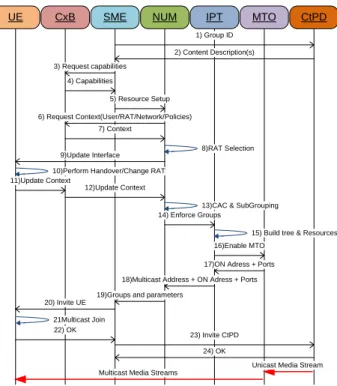
The following section shows the use cases that describe the main interactions between the several architecture elements in different situations and scenarios. Figure 4 depicts a simplified process for session setup. Session Initiation is achieved in the following manner: the SME receives the identification of a service group and interacts with the CtPD to get the content description that corresponds to that particular service group. In parallel, the codecs supported by each user in the group are obtained and the content description is mapped to network QoS parameters and these are used by the NUM to create, sub‐groups based on quality constraints, which are returned to the SME in terms of supported codecs. In the network side, after interface selection, trees are built, resource reservation is performed, and sub‐grouping is performed based on QoS context and the user capabilities and preferences. The resources are reserved in the network, and the overlay nodes are chosen and enforced for unicast and multicast communications. For each sub‐group a session must be setup and the SME requests session setup parameters, obtained from the NUM by interacting with the MTO and the IPT. The SME is then triggered to setup the user and media connections by opening the appropriate session and, once this is achieved, the media flow is sent to the users multicast or unicast addresses.
4.1
Triggers
/
Contexts
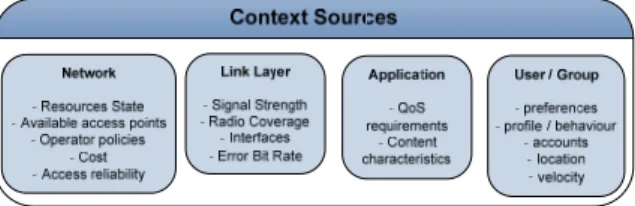
To endow networks with the ability to rapidly and correctly adapt to any type of event or change, it is crucial to be aware of the context surrounding the different network elements. The type of information that may be used to select the best access network can be found on different entities and within each at different levels. Given the large variety of possible information sources, a complex and possibly “heavy” context acquisition mechanism is required. Moreover, as a large amount of information may be relevant to the decision procedure, an efficient model and organization scheme must be developed in order to make critical context constantly updated.
Figure 3. Context Sources.
All this context‐awareness encompasses a wide variety of sources and obviously they do not have all equal urgency when any kind of change occurs. Critical context is related with low level constrains such as signal strength, high packet loss rate or delays and lack of resources. High level constraints, as user profile or preferences, may be taken into account in a future access selection decision, as far as the current state of the entity is updated so that when processing the changes noticed they are not outdated. Thus, it is crucial to wisely select which context sources are crucial and deserve immediate attention, and those that do not affect directly connectivity and minimum quality of service. Due to processing time concerns of the selection algorithm, critical context changes are attended on real‐time, providing solutions to the network that avoid and prevent service disruption.
4.2
Grouping
/
Sub
‐
grouping
MTO
SME IPT
UE CxB NUM CtPD
1) Group ID 2) Content Description(s) 3) Request capabilities
4) Capabilities
5) Resource Setup
8)RAT Selection
13)CAC & SubGrouping 6) Request Context(User/RAT/Network/Policies)
7) Context 9)Update Interface 10)Perform Handover/Change RAT 11)Update Context
12)Update Context
14) Enforce Groups 16)Enable MTO 17)ON Adress + Ports
15) Build tree & Resources
18)Multicast Address + ON Adress + Ports 19)Groups and parameters
20) Invite UE 21Multicast Join 22) OK
23) Invite CtPD 24) OK Multicast Media Streams
Unicast Media Stream
Figure 4. Overview of Session Initiation MSC.
Each of the created sub‐groups represents a multicast delivery tree or, in case of a single user, a unicast connection, that requires network resources. For some cases, where not all the users or links have the required multicast capabilities, MTO nodes are enabled to abstract the grouping decision of these considerations. Moreover the sub‐grouping flexibility allows, for instance, in the same session, two users to receive the same audio, but different video streams with different codecs or rates, just depending on the available resources or preferences. In this case both would be in the same audio sub‐group, but in different video sub‐groups. To be able to achieve an efficient sub‐ grouping dynamism, we considered several use cases:
• Session Initiation ‐ Arrives at SME and is usually associated with a new group creation. This triggers NUM to segment the group in smaller ones considering the operator policies (may prefer the fewer the possible), the characteristics of each terminal, the terminal associated RAT, multicast and QoS capabilities, end to end available resources, etc. Each sub‐group represents a multicast group that is enabled and maintained by IPT and MTO. In the end NME pushes the SME to invite all the users and the context provider.
• Group Session Modification ‐ Comprises the cases where users join and/or leave the group session. This is initiated at SME and propagates through NUM and
other modules similarly to session initiation. The removal of users can reduce size or even terminate an existing sub‐group. The addition of users is complex and is only considered when the user experience of the new user is not compromised by joining an already streaming context.
• Sub‐Group Modification ‐ Performed in NUM, refers to those cases where the users are switched between sub‐groups. The session group previously created is not modified and only the concerned sub‐groups are updated. Whenever this happens, some users get “promoted” (or “demoted”) to a group with different quality of service. This can be triggered by the implemented IPT resilience mechanisms, where the network conditions are significantly altered: a link or a router may go offline or back online, the QoS conditions may be altered, the access network may become overloaded, or the terminal may be forced to move into a different network with different conditions. Eventually, session mobility between terminals with different characteristics and updates of operator policies will also trigger sub‐group modifications.
• Session Termination ‐ In this case all the users leave the group, or the context that triggered the session changes significantly. NUM frees the resources at IPT and MTO.
4.3
Mobility
To actually guarantee QoS and service continuity during node mobility, the architecture is prepared to select the best RAT and trigger handover mechanisms. This can be done by two ways: one is having the context providers monitoring if the individual parameters from the network instant context go below defined thresholds; other is by similarly monitoring different weighted subsets of these parameters plus additional environmental and situational context by the NIS module.
Both cases of terminal mobility, Terminal Triggered Handover and Network Triggered Handover were considered. Still, independently of the stimulus provenience, the process is assisted by the network. NIS takes the decision of selecting the best RAT from the candidates provided by the CxP and triggers the handover process at the MoC. After the traditional handover mechanisms, the terminal updates its addresses and the providers which through the context framework notify the NUM. Finally the NME checks if is necessary to update the multicast tree, notifies IPT, MTO and sends a session update to the terminal through the SME.
context, capabilities, user information and content requirements. Such actions will trigger the SIP registration for the new equipment and a NUM update on the multicast tree. These cases have usually a high impact in QoS, given the different terminal capabilities. NUM performs the sub‐ groups update selecting a different codec and transmission stream. Done with this process, SME moves the session to the new terminal, which joins the multicast group.
4.4
Scalability
The presented architecture was originally designed with strong concerns for performance. This was addressed in each individual module. The inherent separation of tasks, mechanisms and decision algorithms allow the system to process each update of context independently, consequently only affecting the necessary modules. Events such as the ones described in the following paragraphs do not propagate throughout the system triggering non‐essential modifications.
Grouping and sub‐grouping is performed mostly to reduce the resources necessary to deliver content and also to reduce the signaling in initiation and update of groups. It allows resources to be managed as a whole and not individually per user. Furthermore the content source does not need to be aware of the quantity, location or network parameters of its clients.
Whenever the RAT is changed, if it is possible and advantageous to maintain the same QoS, the user is kept in the same multicast group. Only the IPT multicast routing tables are affected without even requiring the user to trigger multicast leave/join. If the new RAT implies QoS changes, this will switch the user between multicast sub‐groups and force a session update towards the user. Even so, the global session is kept unchanged and the content source does not receive any update. In the eventuality of a network element malfunction or the deterioration of a link QoS level, the IPT implements fast resilience mechanisms. These allow the re‐ routing of multicast traffic with minimal impact on the end‐ to‐end session. This is done by updating the path in‐ between overlay nodes and keeping the overlay tree. Upper modules do not need to be involved and NUM is only notified of updates to keep database consistency.
5.
CONCLUSIONS
AND
FUTURE
WORK
The use of context allows the definition of mobile communities that are characterized by requiring the same content. The users in similar situations should receive the same data. The mobile network, as well as the multicasting service, should be enhanced to create multiparty sessions that allow content delivery to such groups of users. The context‐aware multiparty delivery system proposed in this paper, allows on one hand making networking and
environmental contexts available, and on the other hand leveraging this context information to drive adaptations in multiparty delivery. This is achieved through the support of a dynamic session considering and making use of context‐ based adaptations including user device selection, access network selection, routing path selection, media coding selection (by sub‐grouping), transport connection type selection (e.g. unicast/multicast or IPv4/v6), dynamic control of transport reliability, and dynamic QoS enforcement along the multiparty delivery tree. In fact, splitting the content into different media types and delivering it using different sub‐groups, allows the architecture to improve the rationale between personalization and efficiency, which is one of the biggest dilemmas operators are nowadays facing.
By early 2010, this architecture will be completely implemented in the C‐CAST experimental platform, allowing its validation and demonstration of the value‐ added capabilities and usages envisaged. In parallel, simulations are also contemplated as a means to assess the scalability and performance (e.g. in terms of adaptation to change in context) of the proposed scheme for context‐ aware multiparty networking.
Moreover, the solutions presented in this paper are expected to facilitate the emergence of new types of context‐ aware multiparty applications, which may respond to context changes in order to adapt and satisfy the users of a group through adaptive content delivery. This is enabled by proposed network enhancements resulting in a novel framework that promises to best meet user needs and optimize user experience while enabling efficient use of network resources.
6.
ACKNOWLEDGMENTS
This work was supported by the European ICT project “C‐ CAST” – Content Casting – (Contract‐No. ICT‐216462). The authors would also like to thank the contributions from their colleagues Mounir Kellil (CEA LIST), Pierre Roux (CEA LIST), and all other C‐CAST partners for their insightful comments.
7.
REFERENCES
[1] C‐CAST project, web site: http://www.ict‐ccast.eu
[2] B. Sigrid, M. Poi, U. Tore, U, “A simple architecture for
delivering context information to mobile users”, Proc. Work. Infrastructure for Smart Devices ‐ How to Make Ubiquity an Actuality, 2003.
[3] V. Jesus, S. Sargento, and R. L. Aguiar, ʺAny‐constraint
personalized network selectionʺ, in Personal, Indoor and Mobile
Radio Communications, 2008. PIMRC 2008. IEEE 19th
[4] K. Pahlavan, P. Krishnamurthy, A. Hatami, M. Ylianttila, J. P. Makela, R. Pichna, and J. Vallstron, ʺHandoff in hybrid mobile data networks,ʺ Personal Communications, IEEE, vol. 7,
pp. 34‐47, 2000.
[5] Y. Chen and Y. Yang, ʺA new 4G architecture providing
multimode terminals always best connected services,ʺ Wireless Communications, IEEE, vol. 14, pp. 36‐41, 2007.
[6] P. Chiron, E. Njedjou, P. Seite, K. Gosse, E. Melin, and P. Roux,
ʺArchitectures for IP‐based network‐assisted mobility management across heterogeneous networks ʺ Wireless Communications, IEEE, vol. 15, pp. 18‐25, 2008.
[7] Moskowitz, R., Nikander, P.: Host Identity Protocol (HIP) Architecture. IETF, RFC 4423 (2006).
[8] Koundourakis, G., Axiotis, D.I., and Theologou, M.: Network‐
based access selection in composite radio environments. In: IEEE Wireless Communications and Networking Conference 2007, Hong Kong (2007).
[9] Liu, X., Li, V. O. K., and Zhang, P.: NXG04‐4: Joint radio
resource management through vertical handoffs in 4G networks. In: IEEE Global Telecommunications Conference 2006, San Francisco (2006).
[10] Ormond, O., Perry, P., and Murphy, J.: Network selection
decision in wireless heterogeneous networks. In: IEEE 16th International Symposium on Personal, Indoor and Mobile Radio Communications, Berlin (2005).
[11] Taha, A.‐E.M., Hassanein, H.S. and Mouftah, H.T.: On robust
allocation policies in wireless heterogeneous networks. In: First International Conference on Quality of Service in Heterogeneous Wired/Wireless Networks, Dallas (2004).
[12] B. Yang and P. Mohapatra, “DiffServ‐aware multicasting
Source”, Transactions of the High Speed Networks Journal, Vol. 13 , pp. 37‐57, January 2004.
[13] R. Bless, K. Wehrle, “IP Multicast in Differentiated Services
(DS) Networks”, IETF RFC 3754, April 2004.
[14] R. Bless, K. Nichols and K. Wehrle, “A Lower Effort Per‐
Domain Behavior (PDB) for Differentiated Services”, IETF RFC 3662, December 2003.
[15] A. Neto, E. Cerqueira, A. Rissato, E. Monteiro and P. Mendes,
“A Resource Reservation Protocol Supporting QoS‐aware Multicast Trees for Next Generation Networks”, In Proc. of
the 12th IEEE Symposium on Computers and
Communications, Aveiro, Portugal, July 2007.
[16] 3GPP TS 23.246: 3rd Generation Partnership Project; MBMS;
Architecture and functional description.
[17] D. Thaler et al., 2008. Automatic IP Multicast Without Explicit Tunnels (AMT), IETF, draft‐ietf‐mboned‐auto‐multicast‐ 09.txt, June 2008.
[18] D. M. Moen, “Overview of Overlay Multicast Protocols”, http://bacon.gmu.edu/XOM/pdfs/Multicast%20Overview.pdf
[19] J. Jannotti et al., “Overcast: Reliable Multicasting with an Overlay Network”, Proceedings of the Fourth Symposium on Operating Systems Design and Implementation, San Diego, October 2000, pp 197‐212.
[20] Know, Y., 2006. P2MP Session Management Scheme using
SIP in MPLS‐based Next Generation Networkʺ, COIN‐ NGNCON 2006, pp.183‐185, 9‐13 July (2006).
[21] Oberle, K. Wahl, S. Sitek, A., 2007. Enhanced Methods for
SIP based Session Mobility in a Converged Network, 16th IST Mobile and Wireless Communications Summit, (2007).
[22] B. Landfeldt, T. Larsson, Y. Ismailov, A. Seneviratne, “SLM, A
Framework for Session Layer Mobility Management“, in Proc. IEEE International Conference on Computer Communications and Networks, pages 452–456, Natick, Massachusetts, Oct 1999.
[23] R. Handorean et al., 2005. Context Aware Session
Management for Services in Ad Hoc Networks, Services Computing, IEEE International Conference on Services Computing, (2005).
[24] R. Thomas, D. Friend, L. Dasilva, A. Mackenzie: Cognitive networks: adaptation and learning to achieve end‐to‐end performance objectives, IEEE Communications Magazine, December 2006.
[25] R. Thomas, L. DaSilva, and A. B. MacKenzie, “Cognitive
networks.” IEEE Intl. Symposium on New Frontiers in Dynamic Spectrum Access Networks, 2005.
[26] TISPAN ‐ Telecoms & Internet converged Services &
Protocols for Advanced Networks,
http://www.etsi.org/tispan/
[27] MBMS ‐ 3GPP TS 23.246: ʺMultimedia Broadcast/Multicast
Service (MBMS): Architecture and functional descriptionʺ
[28] DVB ‐ Digital Video Broadcasting, http://www.dvb.org/ [29] H. Holbrook, B. Cain, “Source‐Specific Multicast for IP”, IETF
RFC 4607, Aug 2006.
[30] IEEE P802.21/D14, Draft Standard for Local and Metropolitan
Area Networks: Media Independent Handover Services, September 2008.