Risk factors for infant mortality in a municipality
in southern Brazil: a comparison of two cohorts
using hierarchical analysis
Fatores de risco para mortalidade infantil em
município do Sul do Brasil: comparação de
duas coortes em análise hierarquizada
1 Programa de Pós-graduação em Saúde Coletiva, Universidade Estadual de Londrina, Londrina, Brasil.
Correspondence S. M. Andrade
Programa de Pós-graduação em Saúde Coletiva, Universidade Estadual de Londrina.
Rua Sergipe 1639, apto. 201, Londrina, PR
86038-350, Brasil. [email protected]
Hellen Geremias dos Santos 1 Selma Maffei de Andrade 1 Ana Maria Rigo Silva 1 Wladithe Organ de Carvalho 1 Arthur Eumann Mesas 1
Abstract
This study compared risk factors for infant mor-tality in 2000-2001 and 2007-2008 in Londrina, Paraná State, Brazil. Data on live births and in-fant deaths were linked in a single database, and a hierarchical regression model was used. Distal risk factors for infant mortality in 2000-2001 were maternal age < 20 or ≥ 35 years and lower mater-nal schooling. In 2007-2008, matermater-nal age ≥ 35 or < 20 years were risk factors, while low schooling appeared as a protective factor. The following in-termediate factors were associated with increased infant mortality in 2000-2001: multiple preg-nancy, history of stillbirth, and insufficient num-ber of prenatal visits, while cesarean delivery was a protective factor. Multiple pregnancy was the only intermediate risk factor in 2007-2008. All of the proximal factors were associated with higher infant mortality in 2000-2001, but only gesta-tional age and 5-minute Apgar in 2007-2008. The risk factors for infant mortality changed from the first to the second cohort, which may be related to the expansion of social policies and primary care and changes in the reproductive and social pat-terns of Brazilian women.
Infant Mortality; Risk Factors; Information Sys-tems
Introduction
The reduction of infant mortality has been one of the key priorities of Brazilian health and social policies for several decades. The creation of the Brazilian Unified National Health System (SUS) was followed by an important improvement in access to health services and quality of health-care in Brazil. Further strides occurred in the first decade of the 21st century, especially with
invest-ments in human resources, science and technol-ogy, and primary care, with relevant implications for neonatal care and the organization of care for pregnant women and newborn infants 1. Thus,
1990 to 2007 witnessed an important decline in infant mortality in all regions of Brazil, especially among the poorer population, due to improve-ments in socioeconomic conditions, urban infra-structure, and healthcare 2,3.
Nevertheless, a large proportion of infant deaths are still avoidable through adequate pre-natal, childbirth, and neonatal care 4. The
iden-tification of factors involved in the causal chain of infant death is crucial for understanding the health conditions of the maternal and child pop-ulation and for defining priority actions.
systems by health services to monitor risk fac-tors over time and support epidemiological sur-veillance services using only limited additional resources.
The use of a hierarchical conceptual model to study determinants of infant mortality allows considering determinants that occur prior to the outcome and the possible relationship between these factors, avoiding analyses that treat all the variables at the same level of determination and which reduce or eliminate the effect of factors that act indirectly on the occurrence of infant death 7.
The current study thus sought to identify and compare risk factors for infant mortality in Londrina, Paraná State, Brazil, in 2000-2001 and 2007-2008, through hierarchical analysis, using data sources routinely collected by health services.
Methods
The study was conducted in Londrina, a mu-nicipality (county) with a population of 506,701 according to the 2010 Population Census (Insti-tuto Brasileiro de Geografia e Estatística. http:// www.ibge.gov.br/home/estatistica/populacao/ censo2010/primeiros_resultados/populacao_ por_municipio.shtm, accessed on 31/Mar/2012). The study compares two non-concurrent cohorts consisting of live born infants of mothers living in the municipality. The first two-year period (2000-2001) was selected because it immediately fol-lowed the creation of the Municipal Committee for the Prevention of Maternal and Child Mortal-ity (CMPMMI) in 1999 and preceded the imple-mentation of the Family Health Program (FHP) in the municipality in late 2001. The second period (2007-2008) was the most recent one with avail-able data on live births and infant deaths at the time the data were collected for the study. The data were grouped in two-year periods in order to increase the rates’ stability and allow more de-tailed analyses.
The study drew on databases from the Infor-mation System on Live Births (SINASC) and the Mortality Information System (SIM) and reports on investigation of infant deaths completed by the CMPMMI. The SINASC data, corresponding to the study’s two-year periods, were obtained from the website of the Information Technology Department of the SUS (DATASUS. http://tabnet. datasus.gov.br/cgi/deftohtm.exe?sinasc/cnv/ nvPR.def, accessed on 23/Aug/2010). The live birth records for mothers living in Londrina and who had given birth in the State of Paraná, which represented more than 99% of the live births in
the Municipality of Londrina, were selected and disaggregated using the Tabwin software (DATA-SUS. http://portal.saude.gov.br/portal/se/data-sus/area.cfm?id_area=732). Next, Microsoft Ex-cel (Microsoft Corp., USA) was used for the data organization and tabulation.
Infant deaths (under one year of age) were identified in the SIM and CMPMMI for the years 2000 to 2002 and 2007 to 2009. The CMPMMI re-cords were examined manually and allowed ob-taining the recording number from the Live Birth Certificate (LBC) for 2000-2001, a field which was not available at the time in the SIM database. These records were preferred over those from the SIM in cases of discordant data.
Infant deaths were correlated with the live birth database using deterministic linkage 8,
us-ing the LBC number as key information. In only five cases there was no information available on the LBC number, but it was possible to perform linkage between the deaths and live births based on identical information in both databases for date of birth and maternal, gestational, and neo-natal characteristics.
The dependent variable was infant death, and the independent variables were those available in the SINASC database in both two-year periods: maternal age, schooling, and marital status, new-born’s race/skin color, obstetric history, number of prenatal visits, type of pregnancy, type of deliv-ery, gestational age, birth weight, 5-minute Apgar score, and newborn’s gender. The analysis did not include presence of congenital malformations because of the low reliability of this informa-tion in the SINASC database based on analysis of matching three data sources, or the 1-minute Ap-gar score, since 5-minute ApAp-gar provides a better indication of the newborn’s status 9.
“Number of prenatal visits” was reclassified as sufficient or insufficient according to gesta-tional age, based on the prenatal care protocol of the Londrina Municipal Health Secretariat (Secretaria Municipal de Saúde de Londrina), Clinical Health Protocols: http://www1.londri na.pr.gov.br/index.php?option=com_content& view=article&id=569&Itemid=615 (accessed on 23/Aug/2011). Sufficient was defined as at least one prenatal visit for pregnancies up to 27 weeks, at least four visits for pregnancies from 28 to 36 weeks, and at least seven for pregnancies 37 weeks or more. Both variables (prenatal visits and gestational age), from the SINASC database, had been previously grouped.
The variable “obstetric history” was defined by cross-analyzing the variables “number of live births” and “number of stillbirths”. The follow-ing categories were considered: with or without stillbirths, where the latter was subdivided into primiparous, 1 or 2 live births and no stillbirths, and mulitparous (3 or more live births) with no stillbirths.
In addition to these groupings, the categories for the variable “newborn’s race/skin color” were grouped into White/Asian versus Black/Brown/ Indigenous, and the categories for the variable “marital status” were grouped as with versus without spouse/companion, both of which were indicative of socioeconomic differences.
Statistical analyses used SPSS 19.0 (SPSS Inc., Chicago, USA). Measure of association was odds ratio (OR) for both the bivariate analysis and the binary logistic regression conducted by the hier-archical conceptual model, using the backward stepwise method (likelihood ratio). For definition of the hierarchical conceptual model, the vari-ables were grouped as distal (socio-demographic characteristics), intermediate (gestational and healthcare characteristics), and proximal (char-acteristics of the newborn), considering the de-terminant factors as temporally positioned prior to the outcome (infant death) as shown in Figure 1. All the selected variables were included in the regression model based on their clinical and epi-demiological importance. Statistical significance was set at 5% (Wald test), and for all the variables a reference category was established (OR = 1), considered the lowest risk for occurrence of the outcome. Logistic regression excluded live born infants with some field in the SINASC database that was either missing or coded as unknown.
The study was approved by the Institutional Review Board of the Londrina State University (Universidade Estadual de Londrina; case CEP/ UEL 240/10).
Results
The study population consisted of 15,385 and 13,208 live born infants in 2000-2001 and 2007-2008, respectively. The SIM and CMPMMI da-tabases showed 185 and 148 deaths of live born infants, respectively. For the first period, it was possible to link 97.3% of the infant deaths to their respective LBCs in the live birth database, while in the second period 100% of the deaths were linked to their LBCs.
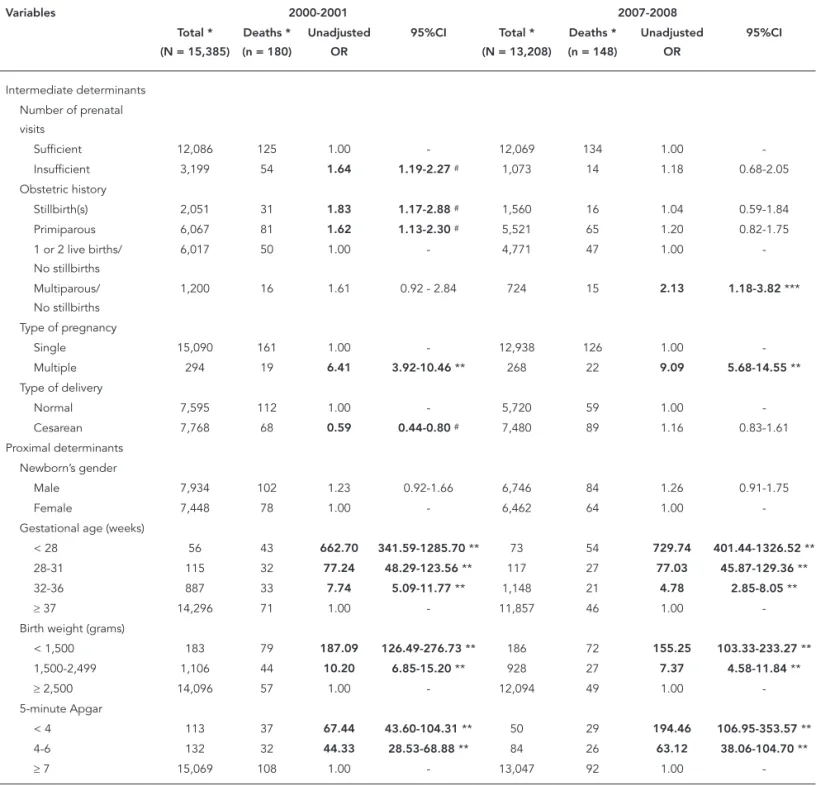
Bivariate analysis of the 2000-2001 cohort (Table 1) showed higher odds of death (p < 0.05) among infants of mothers < 20 years or ≥ 35 years of age, with low schooling, without a spouse/ companion at the time of the child’s birth, among Black/Brown/Indigenous newborns, and among those of mothers with insufficient number of prenatal visits, primiparous mothers, or moth-ers with a history of stillbirth, and infants born of multiple pregnancies. Cesarean delivery ap-peared as a protective factor. All proximal vari-ables except the newborn’s sex were statistically associated with infant death.
In 2007-2008 (Table 1), the following were statistically associated with infant death: mater-nal age < 20 or ≥ 35 years, multiparity with no stillbirths, multiple pregnancy, and all proximal variables except the newborn’s sex. Low maternal schooling appeared as a protective factor.
In 2000-2001, adjustment of distal variables in the hierarchical analysis showed the following as risk factors for infant mortality: maternal age < 20 or ≥ 35 years and low maternal schooling (Table 2).
All the intermediate variables remained in the model after adjusting for variables at the same level and at the distal level. The subgroups of live born infants whose mothers reported insufficient number of prenatal visits, history of stillbirth, or newborns from multiple pregnancies showed higher odds of death. Meanwhile, cesarean deliv-ery showed less than half the odds of infant death as compared to vaginal delivery (Table 2).
Proximal variables, especially birth weight, showed the greatest impact on infant mortality in 2000-2001. For gestational age, the only cat-egory that remained as a risk factor was extreme prematurity (< 28 weeks). Five-minute Apgar < 4 and 4 to 6 were also statistically significant risk factors as compared to Apgar ≥ 7. Male newborns showed 52% higher odds of dying as compared to females (Table 2).
Figure 1
Hierarchical conceptual model for determinant factors of infant mortality based on variables available in the database of the Information System on Live Births (SINASC).
Infant death Distal level
Socio-demographic sphere
Maternal schooling, marital status, and age
Newborn's race/skin color
Obstetric history Number of prenatal visits Type of pregnancy
Type of delivery Obstetric characteristics
and pregnancy care Intermediate level
Gestational age Birth weight 5-minute Apgar
Gender Newborn's characteristics Proximal level
Table 1
Unadjusted risk factors for infant mortality. Londrina, Paraná State, Brazil, 2000-2001 and 2007-2008.
Variables 2000-2001 2007-2008
Total * (N = 15,385)
Deaths * (n = 180)
Unadjusted OR
95%CI Total *
(N = 13,208)
Deaths * (n = 148)
Unadjusted OR
95%CI
Distal determinants
Maternal age (years)
< 20 2,832 57 2.29 1.64-3.18 ** 2,141 31 1.52 1.01-2.29 ***
20-34 10,887 97 1.00 - 9,394 90 1.00
-≥ 35 1,664 25 1.70 1.09-2.64 *** 1,673 27 1.70 1.10-2.62 *** Maternal schooling
Low 12,767 160 1.67 1.04-2.69 *** 10,375 105 0.66 0.46-0.94 ***
High 2,518 19 1.00 - 2,800 43 1.00
-Race/skin color Black/Brown/ Indigenous
801 26 1.73 1.14-2.65 *** 1,207 18 1.38 0.84-2.27
White/Asian 8,063 153 1.00 - 11,966 130 1.00
-Marital status With spouse/ companion
12,205 131 1.00 - 7,102 77 1.00
-Without spouse/ companion
3,123 48 1.44 1.03-2.01 *** 6,067 71 1.08 0.78-1.49
Table 1 (continued)
Variables 2000-2001 2007-2008
Total * (N = 15,385)
Deaths * (n = 180)
Unadjusted OR
95%CI Total *
(N = 13,208)
Deaths * (n = 148)
Unadjusted OR
95%CI
Intermediate determinants
Number of prenatal visits
Sufficient 12,086 125 1.00 - 12,069 134 1.00
-Insufficient 3,199 54 1.64 1.19-2.27 # 1,073 14 1.18 0.68-2.05
Obstetric history
Stillbirth(s) 2,051 31 1.83 1.17-2.88 # 1,560 16 1.04 0.59-1.84
Primiparous 6,067 81 1.62 1.13-2.30 # 5,521 65 1.20 0.82-1.75
1 or 2 live births/ No stillbirths
6,017 50 1.00 - 4,771 47 1.00
-Multiparous/ No stillbirths
1,200 16 1.61 0.92 - 2.84 724 15 2.13 1.18-3.82 ***
Type of pregnancy
Single 15,090 161 1.00 - 12,938 126 1.00
-Multiple 294 19 6.41 3.92-10.46 ** 268 22 9.09 5.68-14.55 **
Type of delivery
Normal 7,595 112 1.00 - 5,720 59 1.00
-Cesarean 7,768 68 0.59 0.44-0.80 # 7,480 89 1.16 0.83-1.61
Proximal determinants Newborn’s gender
Male 7,934 102 1.23 0.92-1.66 6,746 84 1.26 0.91-1.75
Female 7,448 78 1.00 - 6,462 64 1.00
-Gestational age (weeks)
< 28 56 43 662.70 341.59-1285.70 ** 73 54 729.74 401.44-1326.52 ** 28-31 115 32 77.24 48.29-123.56 ** 117 27 77.03 45.87-129.36 **
32-36 887 33 7.74 5.09-11.77 ** 1,148 21 4.78 2.85-8.05 **
≥ 37 14,296 71 1.00 - 11,857 46 1.00
-Birth weight (grams)
< 1,500 183 79 187.09 126.49-276.73 ** 186 72 155.25 103.33-233.27 ** 1,500-2,499 1,106 44 10.20 6.85-15.20 ** 928 27 7.37 4.58-11.84 **
≥ 2,500 14,096 57 1.00 - 12,094 49 1.00
-5-minute Apgar
< 4 113 37 67.44 43.60-104.31 ** 50 29 194.46 106.95-353.57 **
4-6 132 32 44.33 28.53-68.88 ** 84 26 63.12 38.06-104.70 **
≥ 7 15,069 108 1.00 - 13,047 92 1.00
-OR: odds ratio; 95%CI: 95% confi dence interval.
* The total number of live births and infant deaths varied according to the number of missing values for each characteristic; ** p < 0.001;
Table 2
Hierarchical logistic regression for determinant factors of infant mortality. Londrina, Paraná State, Brazil, 2000-2001.
Variables Total * (N = 8,587) Deaths * (n = 175) Adjusted OR ** 95%CI
Distal determinants Maternal age (years)
< 20 1,192 97 2.79 1.98-3.93 ***
20-34 6,260 53 1.00
-≥ 35 1,135 25 1.58 1.01-2.47 #
Maternal schooling
Low 6,304 155 2.34 1.45-3.79##
High 2,283 20 1.00
-Intermediate determinants
Number of prenatal visits
Sufficient 7,129 123 1.00
-Insufficient 1,458 52 1.48 1.04-2.09 #
Obstetric history
Stillbirths 971 31 2.03 1.28-3.24##
Primiparous 3,578 80 1.35 0.91-2.00
1 or 2 live births, no stillbirths 3,457 49 1.00
-Multiparous, no stillbirths 581 15 1.22 0.66-2.25
Type of pregnancy
Single 8,349 156 1.00
-Multiple 238 19 5.60 3.34-9.38 ***
Type of delivery
Normal 2,983 107 1.00
-Cesarean 5,604 68 0.42 0.30-0.58 ***
Proximal determinants Newborn’s gender
Male 4,433 100 1.52 1.04-2.21 #
Female 4,154 75 1.00
-Gestational age (weeks)
< 28 54 42 6.63 1.85-23.81##
28-31 112 32 2.12 0.75-5.97
32-36 702 33 1.08 0.58-2.02
≥ 37 7,719 68 1.00
-Birth weight (grams)
< 1,500 177 78 22.50 8.02-63.09 ***
1,500-2499 798 43 5.95 3.40-10.41 ***
≥ 2,500 7,612 54 1.00
-5-minute Apgar
< 4 83 36 11.89 5.88-24.07 ***
4-6 93 32 11.52 6.12-21.69 ***
≥ 7 8,411 107 1.00
-OR: odds ratio; 95%CI: 95% confi dence interval.
* Live births and infant deaths related to complete data in the Information System on Live Births (SINASC); ** OR adjusted for variables at the same level and higher levels;
***p < 0.001;
years, with an OR identical to that in the previous period. Low maternal schooling, unlike the first period, appeared as a protective factor against infant death. Among the obstetric and healthcare characteristics, type of pregnancy was the only variable that remained in the model (Table 3).
As in the first period, proximal variables had the greatest impact on the outcome, but the new-born’s sex and birth weight lost significance. All the categories related to prematurity and low Ap-gar score (< 4 and 4 to 6) were statistically signifi-cant (Table 3).
Discussion
The study showed changes in the risk profile for infant mortality from the first to the second co-hort. In 2000-2001, markers of social inequality such as low schooling and maternal age less than
20 years played a more important role in this out-come, although newborns of mothers 35 years of age or older already showed increased odds of in-fant death. The changes detected in the risk fac-tors in the more recent period, like a reduction in the odds of death among newborns of adolescent mothers and an increase among mothers with more schooling, in addition to the persistence of maternal age ≥ 35 years as a risk factor, suggest a reduction in these inequalities and changes in the women’s childbearing and social profile.
Among the socio-demographic variables, in 2000-2001, maternal age < 20 years was the most important determinant of infant mortality. The association between infant death and teen-age pregnancy has been discussed from both the biological and social point of view. The im-maturity of the female reproductive system and maintenance of the adolescent’s growth and development during pregnancy are examples
Table 3
Hierarchical logistic regression for determinant factors of infant mortality. Londrina, Paraná State, Brazil, 2007-2008.
Variables Total * (N = 12,326) Deaths * (n = 142) Adjusted OR ** 95%CI
Distal determinants Maternal age (years)
< 20 2,055 29 1.59 1.03-2.46 ***
20-34 8,771 88 1.00
-≥ 35 1,500 25 1.58 1.01-2.48 ***
Maternal schooling
Low 9,867 103 0.60 0.40-0.88 #
High 2,459 39 1.00
-Intermediate determinants Type of pregnancy
Single 12,090 120 1.00
-Multiple 236 22 10.17 6.31-16.40 ##
Proximal determinants
Gestational age (weeks)
< 28 68 52 304.84 144.12-644.78 ##
28-31 109 27 48.74 26.34-90.19 ##
32-36 1,042 20 3.86 2.19-6.78 ##
≥ 37 11,107 43 1.00
-5-minute Apgar
< 4 49 29 46.99 17.94-123.13 ##
4-6 79 24 14.76 6.71-32.47 ##
≥ 7 12,198 89 1.00
-OR: odds ratio; 95%CI: 95% confi dence interval.
* Live births and infant deaths related to complete data in the Information System on Live Births (SINASC); ** OR adjusted for variables at the same level and higher levels;
*** p < 0.05;
of predisposing biological factors for adverse perinatal outcomes such as intrauterine growth restriction, prematurity, and low birth weight 10. Teenage pregnancy has also been highlighted as one of the results of worse socioeconomic condi-tions for the adolescent and her family 11, a situa-tion that precedes and determines difficulties in access to (and use of) health services and adverse perinatal outcomes 12.
Low maternal schooling also affects the in-terdependence between socioeconomic status, access to health services, and vulnerability of the pregnant woman and newborn. In 2000-2001, this factor appeared as a risk for infant mortality, corroborating a study by Geib et al. 13 in Passo Fundo, Rio Grande do Sul State, from February 2003 to January 2004, in which low maternal schooling contributed to the perpetuation of in-iquities in infant survival. Women’s low schooling is also associated with lower access to adequate prenatal care 14.
In 2007-2008, newborns of mothers ≥ 35 years of age showed odds of death similar to infants of teenage mothers. The association between this outcome and advanced maternal age may reflect the increase in the proportion of Brazilian moth-ers in this age bracket and may represent the bio-logical disadvantages of late pregnancy, gener-ally accompanied by more schooling and higher socioeconomic status, stable marital status, and planned/desired pregnancy 15. Studies have shown higher odds of gestational diabetes and hypertension with increasing maternal age 16,17,
both of which have direct implications for in-fant survival. In addition, a review of the effects of maternal age on infant mortality emphasizes the increased likelihood of assisted reproduction techniques among women that choose to post-pone motherhood 15, potentially associated with more multiple pregnancies and maternal com-plications that predispose to premature labor 18.
Statistically, low maternal schooling ap-peared as a protective factor against infant death in 2007-2008, unlike the previous period. Recent studies in Brazil have highlighted a decrease in inequalities in infant mortality according to ma-ternal schooling 19. This characteristic is associat-ed with the rassociat-eduction in the infant mortality rate among mothers with less schooling and the rate’s stabilization or increase among mothers with more schooling, who are mostly older, more like-ly to have cesareans, and have a higher propor-tion of premature and low birth weight infants 19.
This scenario illustrates the changes in Brazilian women’s social and reproductive characteristics and healthcare in recent years 3.
The explanations attributed to socio-demo-graphic factors are strengthened by obstetric and
healthcare variables that remained in the model for determination of infant mortality after the hi-erarchical logistic regression analysis.
Although the data source restricted the in-terpretation of prenatal care to the number of prenatal visits, and although previously catego-rized, a study in Salvador, Bahia State, Brazil, us-ing a criterion similar to that of the current study, also identified inadequate number of prenatal visits as a predictor of infant death, a finding at-tributed to possible difficulties in access to such care 6. Access to health services involves socio-economic, cultural, and geographic factors that transcend the availability of healthcare resources and can act singly or jointly to hinder the use of such services 20. In this context, factors related to quality of prenatal care are important, but were not covered in this study, such as early uptake of pregnant women into prenatal care, the es-tablishment of a bond between the health team and the patient that ensures case resolution in care, linkage to other health services for continu-ity of care, ordering of tests for the investigation of maternal diseases and conditions, adequate communication of protocols and procedures 3,
and other actions that have been the focus of ini-tiatives for the humanization and qualification of prenatal care.
In 2007-2008, insufficient number of prenatal visits was no longer a predictor of infant mortal-ity. Improvements in the field of social policies and primary care are possible explanations for this finding 1. Between the first and second
pe-riods, the Bolsa Família (Family Grant) Program was created in 2003 in Brazil, conditioned (among other requirements) on mandatory prenatal care attendance by pregnant women 21. Expansion of
primary care by the FHP may have contributed to the increased coverage and improvement in pre-natal care, by favoring decentralization of primary health services and uptake, follow-up, and refer-ral of pregnant women to other levels of care 22. In the municipality studied here the number of family health teams (initially only four) was ex-panded in late 2001 and 2002 to 93 teams, cover-ing 70% and 100% of the urban and rural popula-tions, respectively 23.
According to the current study, the associa-tion between history of stillbirth and infant mor-tality was statistically significant in 2000-2001 but not in 2007-2008, suggesting the importance of the socioeconomic context in the determina-tion of this obstetric antecedent. Almeida et al. 12,
In the current study, cesarean delivery was a protective factor in 2000-2001 but was not statis-tically associated with infant mortality in 2007-2008. Although no analysis was performed on the relationship between type of delivery, maternal age, and schooling, one can hypothesize that the association observed in the earlier two-year pe-riod was due more to that birth cohort’s socio-economic characteristics than to the procedure itself. Studies have called attention to socioeco-nomic differences according to type of delivery: white and older women and those with more schooling and better socioeconomic status (who mainly give birth in private hospitals) are the group that usually undergoes cesarean delivery 24. The fact that type of delivery did not remain in the explanatory model for infant death in the more recent period may be explained by changes in the socio-demographic and reproductive pro-file of Brazilian women, as discussed above.
Multiple pregnancies were a risk factor for infant mortality in both periods, and unlike the other intermediate variables, they showed an in-crease in the odds of infant death in the more re-cent cohort. A study in Salvador, showed a similar result for early neonatal mortality, also consider-ing type of pregnancy at the intermediate level in the hierarchical model 25. The authors emphasize the importance of special care for women with multiple pregnancies, due to the increased rate of adverse perinatal outcomes such as prematurity and low birth weight in twin pregnancies.
Completing the causal chain for infant death, among the proximal factors, female gender in the newborn only acted as a protective factor in 2000-2001. Studies on infant mortality 25,26 have also shown this association, which has been attrib-uted to earlier fetal lung maturation in girls and a resulting decrease in the incidence of neonatal respiratory problems 27. However, more recently, similar to the current study’s findings in the latest two-year period, some researchers have detected a reduction in excess male infant mortality in 15 developed countries, attributing this fact to im-proved obstetric and neonatal care 28. The loss
of this variable’s effect in the current context of Londrina may have resulted from expansion of perinatal care, with the hierarchical organization and regionalization of health services and greater access to neonatal technologies such as intensive care and the use of corticosteroids and surfactant in prematurity 28.
In 2000-2001, very low birth weight (< 1,500g) appeared as an important category in the de-termination of infant death, possibly reflecting pregnant women’s social and healthcare charac-teristics during this same period. Very low birth weight, in addition to acting as a marker for worse
socioeconomic conditions and worse access to prenatal care 5, signals the importance of quality of obstetric and neonatal care for very low birth weight infants, who are more vulnerable to vari-ous complications and thus depend more heavily for their survival on technology (equipment and highly trained professionals) 12. A study in a pub-lic maternity hospital in the State of Minas Gerais emphasized the relevance of birth weight below 1,000g and extreme prematurity (up to 27 weeks gestational age) for early neonatal mortality (up to seven days of life); these two characteristics were the most prevalent among early neonatal deaths and are considered difficult to prevent by the authors 29.
The current study showed an increase in odds of death for premature newborns, but also a loss of significance for the birth weight variable be-tween the first and second cohort. One possible explanation is the increase in premature births in recent years 30 and the decrease in infants with
intrauterine growth restriction, due to the im-provement in socioeconomic conditions in Bra-zil 31, which may have eliminated the statistical significance of birth weight. It is further plausible to assume that this finding is associated with a reduction in the underreporting of live births in-volving worse prognosis and an improvement in the quality of data on gestational age.
The Apgar score is a simple and useful indica-tor for estimating neonatal vitality and evaluat-ing responses to resuscitation maneuvers 9. The increase in the odds of death for newborns with low 5-minute Apgar is consistent with the change in the risk profile for infant mortality between the first and second cohorts.
The more recent infant mortality risk fac-tor profile, in which the proximal determinants gained importance, especially prematurity, high-lights the relevance of improving care for women not only during pregnancy, as already discussed, but also during childbirth, guaranteeing the con-tinuity of prenatal care through immediate up-take of women in labor and adequate monitoring, in order for the necessary medical interventions to occur in timely fashion 3. Neonatal care also needs to be improved. Given the increase in the number of premature live newborns with chanc-es of survival, training human rchanc-esourcchanc-es in the proper utilization of available technologies and management of adverse situations that require neonatal reanimation 32 are strategic measures to avoid deaths and sequelae and to guarantee survival with quality of life.
event, the completeness and detail of the vari-ables in these systems, and their data’s validity 33. In Londrina, studies have identified good qual-ity of data in the SINASC database and a gradual decrease in the rates of missing or unknown data since the system has been implemented 34. In ad-dition, the application of data linkage and the use of CMPMMI records as an alternative data source on infant death allow improving the data record-ed in the SINASC and SIM databases, in relation to both their completeness and plausibility 33.
Another limitation to the data source used here involves the variables available in SINASC, which fail to include important risk factors for in-fant death described in the literature, such as do-mestic violence and maternal illness during preg-nancy 35, low maternal height, pre-gestational
weight, maternal smoking, and birth spacing 30. Still, studies based on secondary data have iden-tified various maternal, healthcare, and neonatal risk factors for infant death and have thus helped raise hypotheses for planning studies based on primary data and for monitoring these charac-teristics by health services 5,12. In addition, the analysis and interpretation of independent
vari-Resumo
Compararam-se fatores de risco para mortalidade in-fantil nos anos 2000/2001 e 2007/2008 em Londrina, Paraná, Brasil. Dados sobre nascidos vivos e óbitos infantis foram vinculados em base de dados única, e usou-se análise de regressão em modelo hierárquico. No nível distal, foram de risco para mortalidade in-fantil, em 2000/2001, idade materna < 20 e ≥ 35 anos e escolaridade materna baixa. Em 2007/2008, idades maternas ≥ 35 e < 20 anos foram de risco, enquanto escolaridade baixa, protetora. Associaram-se à maior mortalidade infantil, no nível intermediário, em 2000/2001: gestação múltipla, filhos mortos e número insuficiente de consultas pré-natal, enquanto
cesaria-na foi fator protetor. Em 2007/2008, apecesaria-nas gestação múltipla foi de risco. Todos os fatores proximais asso-ciaram-se à maior mortalidade infantil em 2000/2001 e, em 2007/2008, apenas idade gestacional e Apgar no quinto minuto. Houve mudanças nos fatores de risco para a mortalidade infantil nos biênios analisados, o que pode estar relacionado à ampliação de políticas sociais e de ações básicas de saúde, e a modificações no padrão reprodutivo e social das mulheres.
Mortalidade Infantil; Fatores de Risco; Sistemas de In-formação
ables from the logic of a hierarchical conceptual model enhanced the understanding of the role of socio-demographic, healthcare, and neonatal variables in the determination of infant death, thereby reinforcing the importance of this proce-dure as an alternative to analyses based only on statistical associations 7.
Contributors
H. G. Santos, S. M. Andrade, A. M. R. Silva, and W. O. Carvalho participated in the research project design, data tabulation and analysis, and writing and critical revision of the article. A. E. Mesas contributed to the data tabulation and analysis, and writing and critical revision of the article.
Acknowledgments
The authors wish to thank DECIT/SCTIE/Ministry of Health, CNPq, and Araucária Foundation for the re-search funding (Call for Projects PPSUS, Agreement 200/2010, case 19.516) and CNPq and CAPES for the scholarships.
References
1. Paim J, Travassos C, Almeida C, Bahia L, Macinko J. The Brazilian health system: history, advances, and challenges. Lancet 2011; 377:1778-97. 2. Barros FC, Matijasevich A, Requejo JH, Giugliani
E, Maranhão AG, Monteiro CA, et al. Recent trends in maternal, newborn, and child health in Brazil: progress toward Millennium Development Goals 4 and 5. Am J Public Health 2010; 100:1877-89. 3. Victora CG, Aquino EM, Leal MC, Monteiro CA,
Barros FC, Szwarcwald CL. Maternal and child health in Brazil: progress and challenges. Lancet 2011; 377:1863-76.
4. Malta DC, Duarte EC, Escalante JJC, Almeida MF, Sardinha LMV, Macario EM, et al. Mortes evitá-veis em menores de um ano, Brasil, 1997 a 2006: contribuições para a avaliação de desempenho do Sistema Único de Saúde. Cad Saúde Pública 2010; 26:481-91.
5. Morais Neto OL, Barros MBA. Fatores de risco pa-ra mortalidade neonatal e pós-neonatal na Região Centro-Oeste do Brasil: linkage entre bancos de dados de nascidos vivos e óbitos infantis. Cad Saú-de Pública 2000; 16:477-85.
6. Nascimento EMR, Costa MCN, Mota ELA, Paim JS. Estudo de fatores de risco para óbitos de menores de um ano mediante compartilhamento de bancos de dados. Cad Saúde Pública 2008; 24:2593-602. 7. Victora CG, Huttly SR, Fuchs SC, Olinto MT. The
role of conceptual frameworks in epidemiological analysis: a hierarchical approach. Int J Epidemiol 1997; 26:224-7.
8. Machado CJ. A literature review of record linkage procedures focusing on infant health outcomes. Cad Saúde Pública 2004; 20:362-71.
9. American Academy of Pediatrics, Committee on Fetus and Newborn; American College of Obste-tricians and Gynecologists; Committee on Ob-stetric Practice. The Apgar score. Pediatrics 2006; 117:1444-7.
11. Matijasevich A, Victora CG, Barros AJ, Santos IS, Marco PL, Albernaz EP, et al. Widening ethnic disparities in infant mortality in southern Brazil: comparison of 3 birth cohorts. Am J Public Health 2008; 98:692-8.
12. Almeida MF, Novaes HMD, Alencar GP, Rodrigues LC. Mortalidade neonatal no Município de São Paulo: influência do peso ao nascer e de fatores sócio-demográficos e assistenciais Rev Bras Epide-miol 2002; 5:93-107.
13. Geib LT, Freu CM, Brandão M, Nunes ML. Deter-minantes sociais e biológicos da mortalidade in-fantil em coorte de base populacional em Passo Fundo, Rio Grande do Sul. Ciênc Saúde Coletiva 2010; 15:363-70.
14. Coimbra LC, Silva AA, Mochel EG, Alves MT, Ribei-ro VS, Aragão VM, et al. Fatores associados à inade-quação do uso da assistência pré-natal. Rev Saúde Pública 2003; 37:456-62.
15. Lima LC. Idade materna e mortalidade infantil: efeitos nulos, biológicos ou socioeconômicos? Rev Bras Estud Popul 2010; 27:211-26.
16. Luke B, Brown MB. Elevated risks of pregnancy complications and adverse outcomes with increas-ing maternal age. Hum Reprod 2007; 22:1264-72. 17. Chan BC, Lao TT. Effect of parity and advanced
maternal age on obstetric outcome. Int J Gynaecol Obstet 2008; 102:237-41.
18. Graner VR, Barros SM. Complicações maternas e ocorrências neonatais associadas às gestações múltiplas resultantes de técnicas de reprodução assistida. Rev Esc Enferm USP 2009; 43:103-9. 19. Hernandez AR, Silva CH, Agranonik M, Quadros
FM, Goldani MZ. Análise de tendências das taxas de mortalidade infantil e de seus fatores de risco na cidade de Porto Alegre, Rio Grande do Sul, Bra-sil, no período de 1996 a 2008. Cad Saúde Pública 2011; 27:2188-96.
20. Travassos C, Martins M. Uma revisão sobre os con-ceitos de acesso e utilização de serviços de saúde. Cad Saúde Pública 2004; 20 Suppl 2:S190-8. 21. Estrella J, Ribeiro LM. Qualidade da gestão das
condicionalidades do Programa Bolsa Família: uma discussão sobre o índice de gestão descentra-lizada. Rev Adm Pública 2008; 43:625-41.
22. Costa GD, Cotta RMM, Reis JR, Siqueira-Batista R, Gomes AP, Franceschini SCC. Avaliação do cuida-do à saúde da gestante no contexto cuida-do Programa Saúde da Família. Ciênc Saúde Coletiva 2009; 14 Suppl 1:1347-57.
23. Secretaria Municipal de Saúde de Londrina, Autar-quia Municipal de Saúde, Prefeitura de Londrina. Relatório de gestão 2002. http://www1.londrina. pr.gov.br/dados/images/stories/Storage/sec_sau de/relatorios_gestao/relatorio_gestao_2002.pdf (accessed on 23/Aug/2011).
24. Barros AJ, Santos IS, Matijasevich A, Domingues MR, Silveira M, Barros FC, et al. Patterns of deliv-eries in a Brazilian birth cohort: almost universal cesarean sections for the better-off. Rev Saúde Pública 2011; 45:635-43.
25. Soares ES, Menezes GMS. Fatores associados à mortalidade neonatal precoce: análise de situa-ção no nível local. Epidemiol Serv Saúde 2010; 19: 51-60.
26. Menezes AM, Hallal PC, Santos IS, Victora CG, Bar-ros FC. Infant mortality in Pelotas, Brazil: a com-parison of risk factors in two birth cohorts. Rev Panam Salud Pública 2005; 18:439-46.
27. Araújo BF, Bozzetti MC, Tanaka AC. Mortalida-de neonatal precoce no município Mortalida-de Caxias do Sul: um estudo de coorte. J Pediatr (Rio J.) 2000; 76:200-6.
28. Drevenstedt GL, Crimmins EM, Vasunilashorn S, Finch CE. The rise and fall of excess male infant mortality. Proc Natl Acad Sci USA 2008; 105:5016-21.
29. Assis HM, Machado CJ, Rodrigues RN. Perfis de mortalidade neonatal precoce: um estudo em uma maternidade pública de Belo Horizonte (MG), 2001-2006. Rev Bras Epidemiol 2008; 11:675-86. 30. Barros FC, Victora CG, Barros AJ, Santos IS,
Alber-naz E, Matijasevich A, et al. The challenge of reduc-ing neonatal mortality in middle-income coun-tries: findings from three Brazilian birth cohorts in 1982, 1993, and 2004. Lancet 2005; 365:847-54. 31. Romo A, Carceller R, Tobajas J. Intrauterine growth
retardation (IUGR): epidemiology and etiology. Pediatr Endocrinol Rev 2009; 6 Suppl 3:332-6. 32. Lansky S, França E, Leal MC. Mortalidade
perina-tal e evitabilidade: revisão da literatura. Rev Saúde Pública 2002; 36:759-72.
33. Almeida MF, Alencar GP, França Jr. I, Novaes HMD, Siqueira AAF, Schoeps D, et al. Validade das infor-mações das declarações de nascidos vivos com ba-se em estudo de caso-controle. Cad Saúde Pública 2006; 22:643-52.
34. Gabani FL, Sant’Anna FHM, Andrade SM. Carac-terização dos nascimentos vivos no município de Londrina (PR) a partir dos dados do Sinasc, 1994-2007. Ciênc Cuid Saúde 2010; 9:205-13.
35. Schoeps D, Almeida MF, Alencar GP, França Jr. I, Novaes HM, Siqueira AAF, et al. Fatores de risco para mortalidade neonatal precoce. Rev Saúde Pú-blica 2007; 41:1013-22.
Submitted on 11/Jan/2012