Mariella Vieira Pereira Leão(a) Ricardo Coelho Cassia(a) Silvana Soléo Ferreira dos Santos(a)
Célia Regina Gonçalves e Silva(a) Antônio Olavo Cardoso Jorge(b)
(a)Bioscience Basic Institute, University of
Taubaté, Taubaté, SP, Brazil.
(b)Department of Bioscience and Oral
Diagnosis, School of Dentistry of São José dos Campos, Unesp - São Paulo State University, São José dos Campos, SP, Brazil.
Corresponding author: Mariella Vieira Pereira Leão E-mail: [email protected]
Received for publication on Jun 02, 2011 Accepted for publication on Aug 12, 2011
Influence of consumption of probiotics
on presence of enterobacteria in the
oral cavity
Abstract: Clinical beneits of probiotics have been clearly reported in different gastrointestinal disorders, many of them caused by enterobacte-ria. The oral cavity is a port of entry and can be an important reservoir of these microorganisms. This work evaluated whether consumption of probiotics was able to inluence the presence of enterobacteria in the oral cavity and the speciic secretory response against these microorganisms. Saliva samples of healthy individuals were collected and plated in Mac-Conkey agar. Carriers of Gram-negative, rod-shaped microorganisms in the oral cavity were selected and instructed to use the probiotic Yakult LB for 20 days. Saliva was then collected and enterobacteria species were identiied using the API 20 E system and by ELISA using anti-bacteria IgA. The results showed reduction in the prevalence of entero-bacteria, but no signiicant changes in enterobacterial counts (log CFU/ mL; p = 0.3457). The species most frequently isolated were Enterobac-ter cloacae and Klebsiella oxytoca, both before and after probiotic con-sumption. No signiicant changes were observed in anti-enterobacteria IgA levels. In conclusion, probiotic consumption had some inluence on enterobacterial presence in the oral cavity, but did not affect enterobacte-rial counts or the speciic immune secretory response against them.
Descriptors:Lactobacillus casei; Biidobacterium;Enterobacteriaceae; Probiotics.
Introduction
Probiotics are food supplements containing live microorganisms or microbial cell components that promote host health.1 Clinical beneits
of probiotics have been clearly documented for different gastrointestinal disorders (e.g., lactose intolerance, viral and bacterial gastroenteritis, and inlammatory bowel disease2) and in immunotherapy against cancer and
allergies.3 The presence of probiotic microorganisms in intestinal mucosa
can prevent the colonization of pathogens, probably via competitive ef-fects, production of antimicrobial substances, and/or modulation of mu-cosal immunity.4-6
Shu et al.7 observed that the consumption of probiotic bacteria
in-duced a reduction in diarrhea caused by Escherichia coli toxin in pigs.
The authors also observed an increase in phagocyte activity and in levels of IgA antibodies, reducing the mortality caused by E. coli 0157:H7 in mice.8 Jespersen9 observed an inhibitory effect of probiotics in pathoge-Declaration of Interests: The authors
nicity of Salmonella typhimurium, Shigella lexneri, and Clostridium dificile in infant acute gastroen-teritis.
The oral cavity is a port of entry for many mi-croorganisms and can be an important reservoir of enterobacteria. These microorganisms are po-tential agents in gastrointestinal disorders, hospital infections, and aggravation of oral disease.10 An
in-creased knowledge about products that may inhibit the adherence or growth of these bacteria is impor-tant and essential. Thus, the objective of the present study was to analyze whether consumption of the probiotic Yakult LB inluences the presence of en-terobacteria in oral cavity and the speciic immune secretory response against these microorganisms.
Methodology
The study was based on Santos et al.11 and was
approved by the Local Research Ethics Committee according to the Declaration of Helsinki. Healthy young individuals were selected, excluding those who had used antibiotics for a period of 3 months, who were smokers, or who wore oral prosthesis or orthodontic devices. All participants were fully in-formed concerning the objectives and methodology of the study and provided written free and informed consent.
Initially, 112 individuals were analyzed and sa-liva samples were collected without stimulation. Carriers of Gram-negative, rod-shaped microor-ganisms in the oral cavity were selected for a sec-ond collection 1 month later. Individuals who tested positive both times were instructed to use the probi-otic Yakult LB (Yakult S/A Indústria e Comércio, Lorena, Brazil) (Lactobacillus casei at 2 × 10⁷ to 109
and Biidobacterium breve at 5 × 10⁷ to 109 CFU/
mL) daily for 20 days. After this period, another sa-liva sample was collected from each subject.
All samples were plated in duplicate in MacCon-key agar (Oxoid, Lawrence, USA) and incubated at 37 °C for 24-48 h. The number of colony forming units per milliliter of saliva (CFU/mL) was deter-mined. Suggestive colonies from each plate were con-irmed by smear tests stained by the Gram technique. Enterobacteria species were identiied using the API 20 E system (BioMérieux, Craponne, France).
Levels of anti-enterobacterial IgA were also ana-lyzed by ELISA. Sensitization of ELISA plates was performed using a pool of enterobacteria cells iso-lated from the oral cavity of participants, which was killed with formaldehyde and then diluted in 0.1 M carbonate-bicarbonate buffer, pH 9.6, at a inal con-centration of 109 cells/mL. The ELISA plates were
then incubated with diluted saliva (1:10), followed by anti-human IgA labeled with horseradish peroxi-dase. The reaction was developed with orthophenyl-enediamine and H2O2 as substrate. Absorbance was measured at 496 nm.
CFU/mL counts and anti-enterobacteriaIgA lev-els before and after use of probiotics were compared by analysis of variance (ANOVA) for paired samples with a 5% level of signiicance (p < 0.05).
Results
From 112 initial saliva samples, 42 (37.5%) were carriers of Gram-negative rod-shaped microorgan-isms. Of these, 38 (90.5%) tested positive again 1 month after the irst collection. Of these, 20 indi-viduals were included in this study after losses due to voluntary withdrawal, lack of compliance, and use of antibiotics.
After taking probiotic for 20 days, 5/20 indi-viduals no longer tested positive for enterobacte-ria, indicating a 25% reduction in the prevalence of enterobacteria in the oral cavity. A reduction in enterobacterial countswas also observed in most of the subjects (Figure 1). However, there was no sig-niicant difference between the mean log CFU/mL before and after probiotic consumption (p = 0.3457) (Figure 2).
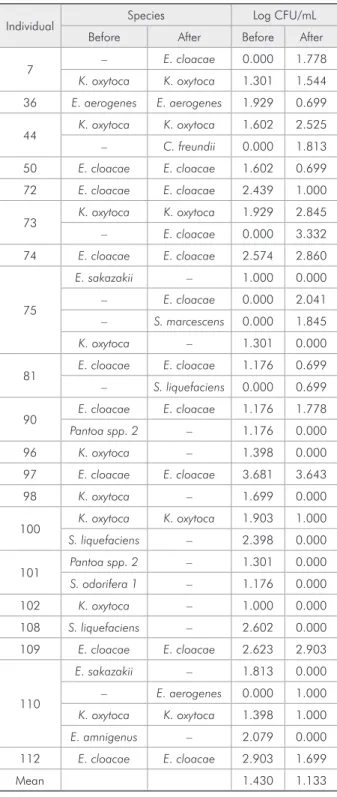
Eight species of enterobacteria were identiied before probiotic consumption, whereas six were identiied after. The most frequently isolated species, both before and after consumption, was Enterobac-ter cloacae, followed by Klebsiella oxytoca (Table 1). The use of probiotic did not signiicantly change the amounts of either species. The species isolated from each individual before and after probiotic consump-tion are shown in Table 2. E. sakazaki, Pantoa spp.,
Immunological analysis showed no signiicant changes in the level of anti-enterobacteria IgA (p = 0.1215) (Figure 3) and there was no correlation between IgA levels and CFU/mL counts (data not shown).
Discussion
Enterobacteria are considered part of the tran-sient microbiota of the oral cavity, but colonization can persist for years and may favor transmission of
these microorganisms.10 Buehlmann et al.10 studied
a decolonization regimen of antibiotics or mouth rinse with 0.2% chlorhexidine for eradication of ex-tended-spectrum β-lactamase-producing Enterobac-teriaceae (ESBL) in infected or colonized patients. They observed that 76% of patients became negative for ESBL at follow-up, suggesting that the program could be beneicial in a select group of patients, po-tentially shortening duration of ESBL colonization and subsequently reducing the risk for transmission. Some in vitro studies have demonstrated that pro-biotics present antimicrobial activity against some bacteria of the Enterobacteriaceae family and can prevent their adhesion to epithelial cells.12,13
Figure 1 - Comparison between mean log CFU/mL in saliva before and after probiotic consumption for each individual subject.
Figure 2 - Mean log CFU/mL of enterobacteria isolated from the oral cavity before and after probiotics (p = 0.3457).
The present work showed that probiotic con-sumption was able to reduce the number of people carrying enterobacteria in the oral cavity by 25%, suggesting a possible role for the product in decolo-nization. This phenomenon could be useful in hos-pital environments to reduce the prevalence of these microorganisms among medical professionals and consequently reduce transmission, since the infec-tions caused by enterobacteria are usually dificult to treat.10
Although 25% of tested subjects no longer car-ried enterobacteria, others showed an increase in counts, so that no signiicant change was seen in the mean enterobacteria counts before and after probiotics. Brown et al.14 also observed no
signii-cant changes in E. coli, Klebsiella, and Enterobac-ter counts in feces of healthy adults who consumed food containing probiotic bacteria on a daily basis. Thus, a mutually beneicial relationship between the probiotic species and some enterobacteria species cannot be ruled out. Moreover, there is a possibility that probiotic consumption favors the adherence of enterobacteria in the oral cavity of non-carrier indi-viduals, who were not studied, possibly resulting in no net change in prevalence.
Probiotic consumption also had no inluence on the amount of each species or the proile of species identiied in individuals. The most frequently isolat-ed species before and after probiotics was E.
cloa-Table 2 - Species and abundance of enterobacteria iso-lated from the oral cavity of each healthy individual before and after probiotic consumption.
Individual Species Log CFU/mL
Before After Before After
7 – E. cloacae 0.000 1.778
K. oxytoca K. oxytoca 1.301 1.544 36 E. aerogenes E. aerogenes 1.929 0.699 44 K. oxytoca K. oxytoca 1.602 2.525 – C. freundii 0.000 1.813 50 E. cloacae E. cloacae 1.602 0.699 72 E. cloacae E. cloacae 2.439 1.000
73 K. oxytoca K. oxytoca 1.929 2.845 – E. cloacae 0.000 3.332 74 E. cloacae E. cloacae 2.574 2.860
75
E. sakazakii – 1.000 0.000 – E. cloacae 0.000 2.041 – S. marcescens 0.000 1.845
K. oxytoca – 1.301 0.000
81 E. cloacae E. cloacae 1.176 0.699 – S. liquefaciens 0.000 0.699
90 E. cloacae E. cloacae 1.176 1.778
Pantoa spp. 2 – 1.176 0.000 96 K. oxytoca – 1.398 0.000 97 E. cloacae E. cloacae 3.681 3.643 98 K. oxytoca – 1.699 0.000
100 K. oxytoca K. oxytoca 1.903 1.000
S. liquefaciens – 2.398 0.000
101 Pantoa spp. 2 – 1.301 0.000
S. odorifera 1 – 1.176 0.000 102 K. oxytoca – 1.000 0.000 108 S. liquefaciens – 2.602 0.000 109 E. cloacae E. cloacae 2.623 2.903
110
E. sakazakii – 1.813 0.000 – E. aerogenes 0.000 1.000
K. oxytoca K. oxytoca 1.398 1.000
E. amnigenus – 2.079 0.000 112 E. cloacae E. cloacae 2.903 1.699
Mean 1.430 1.133
Table 1 - Log CFU/mL of E. cloacae and K. oxytoca before and after probiotic consumption
E. cloacae K. oxytoca
Before After Before After
0.0000 1.7782 1.3010 1.5441
1.6021 0.6990 1.6021 2.5250
2.4393 1.0000 1.9294 2.8451
2.5740 2.8603 1.3010 0.0000
0.0000 3.3324 1.3979 0.0000
0.0000 2.0414 1.6990 0.0000
1.1761 0.6990 1.9031 1.0000
1.1761 1.7782 1.0000 0.0000
3.6812 3.6435 1.3979 1.0000
2.6233 2.9031
2.9031 1.6990
Mean 1.6523 2.0395 1.5035 0.9905
St dev 1.2938 1.0291 0.3055 1.1195
cae, followed by K. oxytoca. The predominance of these species in the oral cavity has already been re-lated,15 and some authors suggest that the imbria is
an important virulence factor, being responsible for bacterial adherence and persistence.16
Although many studies have shown that probi-otics can improve cellular and humoral immune re-sponses,17,18 signiicant effects of probiotics on the
level of secretory antibodies against enterobacteria have not been demonstrated. Previously, only to-tal IgA levels have been shown to be inluenced by probiotic consumption. Revolledo et al.17 observed
an increase in total IgA levels in serum and intesti-nal luid of chickens that received probiotic supple-ments, and Lara-Villoslada et al.18 observed an
in-crease in total IgA in feces and saliva of children who used products with Lactobacillus coryniformis
CECT5711 and L. gasseri CECT5714.
The presence of antigens in the mucosa induces production of immunoglobulins that interfere with adhesion and facilitate the elimination of patho-gens. Thus, immunoglobulin levels increase with antigenic stimulation and decrease after elimination of microorganisms. Although enterobacteria are considered part of the transient microbiota of the
oral cavity, these microorganisms are persistent in the intestinal mucosa, promoting an uninterrupted stimulus. It was therefore expected that the speciic secretory response could not have changed.
In summary, probiotic consumption may be ca-pable of inluencing the prevalence of enterobacteria in the oral cavity. It is possible that probiotics have no effect when there is a balance between entero-bacteria and the resident microbiota and the host; however, when the balance is disrupted and the en-terobacteria become pathogenic, the consumption of probiotics may induce evident beneicial effects, as other works have shown.7,9
Conclusion
Probiotic consumption reduced the prevalence of enterobacteria in the oral cavity, but did not inter-fere with their amounts or with the speciic secre-tory immune response against them.
Acknowledgements
We thank Yakult S/A Industria e Comércio (Ca-çapava, São Paulo, Brazil) for the donation of Yakult LB samples, and Ivan da Silva de Faria and Jane Rose Dionísio Rodrigues for technical assistance.
References
1. Fuller R. Probiotics in man and animals. J Appl Bacteriol. 1989 May;66(5):365-78.
2. Saavedra JM. Clinical applications of probiotic agents. Am J Clin Nutr. 2001 Jun;73(6):1147S-51S.
3. Cross ML. Microbes versus microbes: Imune signals generated by probiotic lactobacilli and their role in protection against microbial pathogens. FEMS Immunol Med Microbiol. 2002 Dec 13;34(4):245-53.
4. Isolauri E, Sütas Y, Kankaanpää P, Arvilommi H, Salminen S. Probiotics: Effects on immunity. Am J Clin Nutr. 2001 Feb;73(2 Suppl):444S-50S.
5. Shteyer E, Wilschanski M. Novel therapeutic modalities in pediatric inflammatory bowel disease. Isr Med Assoc J. 2008 Nov;10(11):816-20.
6. Gupta V, Garg R. Probiotics. Indian J Med Microbiol. 2009 Jul-Sep;27(3):2002-9.
7. Shu Q, Qu F, Gill HS. Probiotic treatment using
Bifidobac-terium lactis HN019 reduces weanling diarrhoea associated
with rotavirus and Escherichia coli in infection in a piglet model. J Pediatr Gastroenterol Nutr. 2001 Aug;33(2):171-7.
8. Shu Q, Gill HS. Immune protection mediated by the pro-biotic Lactobacillus rhammosus HN001 (DR20ã) against
Escheichia coli 0157: h7 infection in mice. FEMS Immunol
Med Microbiol. 2002 Sep 6;34(1):59-64.
9. Jerpesen L. Occurrence and taxonomic characteristics of strains of Saccharomyces cerevisiae predominant in African indigenous fermented foods and beverages. FEMS Yeast Res. 2003 Apr;3(2):191-200.
10. Buehlmann M, Bruderer T, Frei R, Widmer AF. Effectiveness of a new decolonisation regimen for eradication of extended-spectrum β-lactamase-producing Enterobacteriaceae. J Hosp Infect. 2011 Feb;77(2):113-7.
11. Santos AL, Jorge AOC, Santos SSF, Silva CRG, Leão MVP. Influence of probiotics on Candida presence and IgA
anti-Candida in the oral cavity. Braz J Microbiol. 2009 Oct-Dec;40(4):960-4.
12. Collado MC, Grzes´kowiak Ł, Salminen S. Probiotic strains and their combination inhibit in vitro adhesion of pathogens to pig intestinal mucosa. Curr Microbiol. 2007 Sep;55(3):260-5. 13. Barrantes X, Railey D, Arias ML, Chaves C. [Evaluation of the
known population of Listeria monocytogenes and Escherichia coli O157:H7]. Arch Latinoam Nutr. 2004 Sep;54(3):293-7. Spanish.
14. Brown AT, Sims RE, Raybould TP, Lillich TT, Henslee PJ, Ferretti GA. Oral gram-negative bacilli in bone marrow transplant patients given chlorhexidine rinses. J Dent Res. 1989 Jul;68(7):1199-204.
15. Sedgley CM, Samaranayake LP. The oral prevalence of aerobic and facultatively anaerobic gram-negative rods and yeasts in Hong Kong Chinese. Arch Oral Biol. 1994 Jun;39(6):459-66. 16. Livrelli V, De Champs C, Di Martino P, Darfeuille-Michaud
A, Forestier C, Joly B. Adhesive properties and antibiotic
resistance of Klebsiella, Enterobacter, and Serratia clinical isolates involved in nosocomial infections. J Clin Microbiol. 1996 Aug;34(8):1963-9.
17. Revolledo L, Ferreira CS, Ferreira AJ. Prevention of
Sal-monella typhimurium colonization and organ invasion by
combination treatment in broiler chicks. Poult Sci. 2009 Apr;88(4):734-43.
18. Lara-Villoslada F, Sierra S, Boza J, Xaus J, Olivares M. [Ben-eficial effects of consumption of a dairy product containing two probiotic strains, Lactobacillus coryniformis CECT5711
and Lactobacillus gasseri CECT5714 in healthy children].