PREVALENCE OF ATTENTION-DEFICIT
HYPERACTIVITY DISORDERS IN STUDENTS
COMPARISON BETWEEN DSM-IV AND NEUROPSYCHOLOGICAL CRITERIA
ANA GUARDIOLA*, FLAVIO D. FUCHS** NEWRA T. ROTTA***
ABSTRACT - Attention-deficit hyperactivity disorder (ADHD) is a common childhood condition, recognized as an important social-medical problem. The syndrome is characterized by motor system, perception, cognition and behavioral disturbances, compromising the learning of children with adequate intellectual potential. To investigate its prevalence in first grade pupils 484 children with DSM-IV diagnostic criteria and neuropsychological criteria were examined. The prevalence of ADHD was 18% when the diagnosis was made using DSM-IV criteria; 3.5% when neuropsychological criteria was used, including, in addition to behavioral and psychometric aspects, a discrepancy in the evolutionary neurological examination, and 3.9% when motor persistence was taken into account. The prevalence of ADHD was higher among older children (92.4 months) only when DSM-IV criteria were used. We conclude that the use of DSM-IV criteria probably overestimates the prevalence of ADHD, since it detects another behavioral disorders. In this context, they may be useful as screening, since they have adequate pre-testing performance.
KEY WORDS: attention-deficit hyperactivity disorder, diagnostic efficiency.
Distúrbio de hiperatividade com déficit de atenção em estudantes: comparação entre os critérios do DSM-IV e neuropsicológicos
RESUMO - O distúrbio de hiperatividade com déficit de atenção é uma condição frequente em crianças, sendo considerado importante problema médico-social. Caracteriza-se por distúrbios motores, perceptivos, cognitivos e comportamentais, que comprometem o aprendizado de crianças intelectualmente normais. Investigamos a prevalência do distúrbio em 484 estudantes de primeiro grau utilizando os critérios do DSM-IV e neuropsicológicos. A prevalência do distúrbio é 18% considerando-se os critérios do DSM-IV; 3,5%, considerando-se os critérios neuropsicológicos, incluindo, em adição aos aspectos psicométricos e comportamentais, a discrepância no exame neurológico evolutivo, e 3,9% considerando-se a persistência motora. A prevalência da síndrome foi maior nas crianças com mais idade (92,4 meses)com os critérios do DSM-IV e provavelmente foi superestimada, já que podem detectar outros distúrbios do comportamento. Neste contexto, o DSM-IV pode ser usado como rastreamento, desde que apresente adequada performance pré-teste.
PALAVRAS-CHAVE: distúrbio de hiperatividade com déficit de atenção, eficiência diagnóstica.
Attention-deficit hyperactivity disorder (ADHD) is a common condition in childhood. It is recognized as an important social-medical problem, being subject of vast investigation as to its determinants, diagnostic approaches, treatment and prevention strategy1. The syndrome is
characterized by motor system deficit, low perception, and cognition and behavioral disturbance, compromising the learning of children with adequate intellectual potential2-4.
*MD, PRD, Child Neurologist, Associate Professor of Neurology of Medicine School of Porto Alegre (FFFCMPA). **MD, PRD, Associate Professor of Pharmacology of Medicine School of Porto Alegre (FFFCMPA and UFRGS). ***MD, PRD, Child Neurologist, Associate Professor of Neurology of Federal University of Rio Grande do Sul (UFRGS).
This disorder has had different designations over time. Strauss and Lehtinen (1947) called it “minimal cerebral lesion”. In a symposium held in Oxford (1962), the expression “minimal cerebral dysfuntion” was officialized. It was coined with the expression “attention disorder” with or without hyperactivity (DSM-III, 1980), changing to “attention-deficit hyperactivity disorder” (DSM-III-R, 1987), designation that has been maintained in DSM-IV (1994)5-7. However the recent revision of
DSM-IV(1994)7 mention three subtypes of ADHD: prevailing inattention; prevailing hyperactivity
and combination of both. New diagnostics are proposed such as the “children’s global assessment scale”8 and the “ADHD knowledge and opinion scale”9. August and Garfinkel in a epidemiologic
study with 1490 students observed that patients with ADHD diagnosis, according to DSM-III-R, could fit well in other diagnosis, such as behavioral disorder, challengeable oppositional disturbs and anxiety disorder, concluding that this criteria is not enough to make a precise diagnostic10.
Baumgaertel et al. (1995) compared the different criteria of DSM-III, DSM-III-R and DSM-IV to conclude that many children diagnosed by these criteria need further evaluation, aimed at confirming ADHD and warranting an appropriate management.11
In the absence of homogeneous diagnostic criteria, and defective Brazilian epidemiological data related to prevalence of ADHD syndrome, we carried out this study, proposing a new diagnostic criteria, which considers neuropsychological aspects, in addition to DSM-IV criteria (1994) including findings of the evolutionary neurological examination (ENE)12, psychometric aspects of behavior
and difficulty in learning (Table 1).
METHOD
An observation study was performed based on a total number of 35,521 first grade students in elementary school, 64.7% of them registered in state-owned public schools, 11.9% in municipal schools and 23.4% in private
Table 1. Diagnostics criteria of ADHD, in the scholar period, according to neuropsychological aspects.
1. Hyperactivity
2. Poor motor coordination
3. Difficulty in concentration
4. Difficulty to maintain attention
5. Kept seat, mixing in small objects
6. Interferes on the activities of other children
7. Explosive temper
8. Fear not be accepted by school mates
9. Disturbs other children
10. Difficulty in learning
11. Evolutionary neurological examination without asymmetry
12. Altered tone: hypotonia or paratonia
13. Discrepant evolutionary neurologic examination, development, below the expected, at static equilibrium, appendicular coordination, sensibility and gnosis, motor persistence
14. Alteration at the subtest numbers, complete figures and the scale code WISC
From the items 1 until 10, at least, five may be present
The items 11, 13 and 14, may be always present
schools; a proportional random sample of 484 children was selected. This provided a 3% measurement precision (for 95% confidence) for an estimated prevalence of 10%.
The children were submitted to individual assessment performed at school: gender, age, color, weight, nutritional status, characteristics of the parents, neurological examination, ENE, performance in the numbers, completing figures and codes subtests from the WISC scale.
Neurological examination was perfomed in every child, considering psychism, language, facies, attitude, equilibrium, tonus, voluntary motricity, reflex and passive motricity, sensibility and cranial nerves. Children who did net fit normal neurological examination, were excluded.
ENE evaluates developmental neurological functions, and consists of: static (at rest) equilibrium, dynamic equilibrium, limb coordination, integrated brain sensory and motor activity, motor persistence, impulse control, gnosias, and body-limbs coordination, body-limbs synergy. ENE was considered normal when all tests for the seven year old children (middle age of first grade students in elementary school) were normal.
Behavior was evaluated by DSM-IV criteria (1994) and a quiz, answered by the teacher.
Three diagnostic criteria were used: the first one was called ADHD 1, and was based on the suggestion of the DSM-IV (1994); the second one ADHD 2, was based on the neuropsychologic criteria showed at Table 1, considering the ENE, psychometric behavioral changes and learning disorders. ADHD 3 followed the same criteria as ADHD 2, except for item 13 that considers motor persistence.
Consents were obtained from the State Education Bureau, Municipality and Private Schools Administration, and parents.
Children were tested individually in their own school and the evaluations took around 60 minutes. Examination were performed by a group of 10 medical doctors. Chi-square testing was used to determine the significance of associations among different variables. ANOVA was used for continuous variable. A two tailed p-alpha of 0.05 was considered significant.
Associations between gender, age, color and parental education with ADHD 1, ADHD 2 and ADHD 3 were tested.
RESULTS
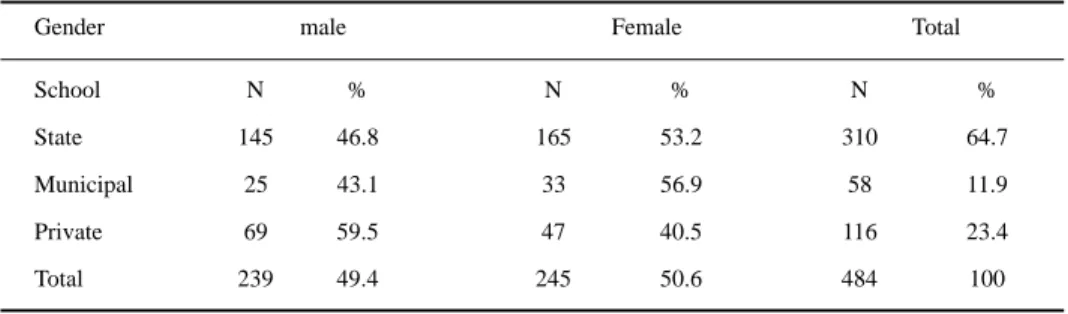
Four hundred eighty four children were studied, 310 (64.7%) in state schools, 58 (11.9%) in municipal schools and 116 (23.4%) in private schools; 239 (49.4%) were male and 245 (50.6%) were female (Table 2). The mean age was 89.5 months, the oldest children being in municipal schools (mean age = 105.1 months) and the youngest in private schools (mean age = 83.5 months).
Weight and height were similar for boys and girls, but the first group was older. Four hundred (82.6%) children were white and 84 (17.4%) were not white (Table 3), this being the same proportion observed in Porto Alegre’s population.
All children had normal neurological examination except for muscle tone, 35 children (7.2%) presented paratonias and 4 (0.8%) hypotonia, and language disturbance, 20 (8.4%) boys and 10 (4.1%) girls had dyslalia.
Table 2. Distribution of 484 Children by school and gender.
Gender male Female Total
School N % N % N %
State 145 46.8 165 53.2 310 64.7
Municipal 25 43.1 33 56.9 58 11.9
Private 69 59.5 47 40.5 116 23.4
Total 239 49.4 245 50.6 484 100
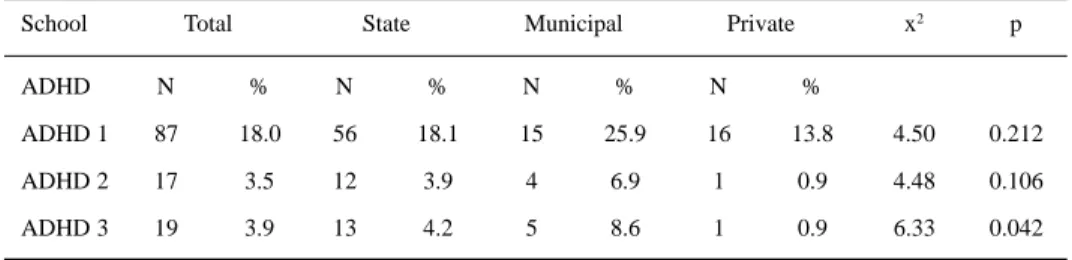
Table 4 shows the prevalence of ADHD according to the diagnostic criteria. Table 5 shows the prevalence of ADHD-1, ADHD-2, ADHD-3 by school type, showing that in municipal schools there were more children ADHD-3. Table 6 shows the distribution of ADHD by gender, showing predominance of ADHD- 1 among boys. Table 7 shows that children with ADHD 1, according to the DSM-IV, were older.
Table 3. Color of children by school.
Color White Not White Total
School N % N % N %
State 258 83.2 52 16.8 310 100
Municipal 37 63.8 21 36.2 58 100
Private 105 90,5 11 9.5 116 100
Total 400 82,6 84 17.4 484 100
x2 = 19.46; p = <0.001
Table 4. Prevalence of ADHD according to the different diagnostic criteria in 484 children.
Criteria N % CI
ADHD 1 87 18,0 14.7-21.7
ADHD 2 17 3,5 2.1-5.6
ADHD 3 19 3,9 2.4-6.1
Table 5. Prevalence of ADHD according to the different diagnostic criteria by school.
School Total State Municipal Private x2 p
ADHD N % N % N % N %
ADHD 1 87 18.0 56 18.1 15 25.9 16 13.8 4.50 0.212
ADHD 2 17 3.5 12 3.9 4 6.9 1 0.9 4.48 0.106
ADHD 3 19 3.9 13 4.2 5 8.6 1 0.9 6.33 0.042
Table 6. Prevalence of ADHD according to the different diagnostic criteria by gender.
Gender Total Male* Female** x2 p
ADHD N % N % N %
ADHD 1 87 18.0 60 25.1 27 11.0 15.33 <0.001
ADHD 2 17 3.5 8 3.3 9 3.7 0.00 1.000
ADHD 3 19 3.9 10 4.2 9 3.7 0.00 0.956
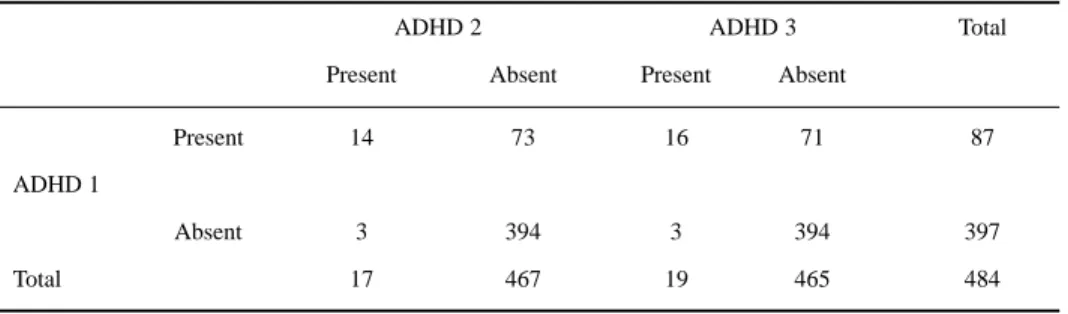
On Tables 8, 9 and 10, DSM-IV diagnostic performance was analysed using the neuropsychological criteria as gold standard.
DISCUSSION
Paine13 pointed out that minimal brain dysfunction is the most common neurologic illness of
childhood, presenting a 5% to 10% incidence, being more frequent than cerebral palsy (0.5%), epilepsy (0.5%), and mental retardation. Attention disorder has a prevalence of approximately 3% to 10% in children and is 10 times more common in boys14-17.
Table 7. Mean age, in months, of children with ADHD.
ADHD Condition (n) Age F p
ADHD 1 Yes (87) 92.4 (10.7) 8.62 0.003
No (397) 88.6 (10.9)
ADHD 2 Yes (17) 87.5 (3.9) 0.48 0.488
No (467) 89.4 (11.11)
ADHD 3 Yes (19) 88.7 (5.2) 0.06 0.808
No (465) 89.3 (11.1)
Table 8. Table of contingency used to guess diagnostic performance of DSM-IV criteria
ADHD 2 ADHD 3 Total
Present Absent Present Absent
Present 14 73 16 71 87
ADHD 1
Absent 3 394 3 394 397
Total 17 467 19 465 484
Table 10. Predictive values for ADHD 2 and ADHD 3 diagnosis by DSM-IV ADHD diagnosis.
Gold-Standard Positive predictive value Negative predictive value
ADHD 2 16 99
ADHD 3 17 99
Table 9. Sensitivity and specificity (%) of ADHD DSM-IV dignosis, taking neuropsychological criteria as gold-standard.
Gold-Standard Sensitivity % Specificity %
ADHD 2 82 84
Bird at al.8, in an epidemiological study of 386 children in Puerto Rico, found that 49.5% of
them met some of the DSM-III-R diagnostic criteria for ADHD. Stanford at al.18, found a prevalence
of 1% to 18% of psychiatric disease, school and social impairment in children from Ontario between ages 6 and 16 years old. However the studied population was not homogeneous, since it had children with attention disorder and either psychiatric problems or not. Faraine et al.]9, using different evaluation
criteria for ADHD report more accurate diagnoses. August and Garfinkel10 reinforced that is very
important to include other diagnostic criteria for ADHD in addition to the ones listed by DSM-III-R. They pointed that other disturbances, most frequently conduct disorder, oppositional defiant disorder, and anxiety disorder, may be included.
Several different approaches were used in our study or ADHD diagnosis, being the neurological aspects the most important12,20-24.
A significant difference in the prevalence of ADHD was found in firstgrade children of Porto Alegre when DSM-IV and neuropsychological criteria were used. It was felt that the ADHD diagnosis is overestimated by DSM-IV. This interpretation agrees with August and Garfinkel 10 . They
recommend to use DSM-III-R criteria only as screening for ADHD.
In this study the DSM-IV criteria were compared with neuropsychological criteria, and it was found that DSM-IV would be more useful as a screening tool, based on its sensitivity and specificity. However its positive predictive value is low, meaning that many children diagnosed by DSM-IV criteria would be excluded by neuropsychological tests. The prevalence of ADHD diagnosis, using DSM-IV, was 18% (CI= 14.7-21.7) and 3,5 % using the neuropsychological criteria. This shows that DSM-IV criteria overestimate the prevalence, probably by including other behavioral disorders. ADHD is more prevalent in boys when DSM-IV criteria are used.This difference was not seen in our study when children were evaluated using neuropsychological criteria. Although boys probably respond more with hyperactivity and inattention to psychological and environmental stresses than girls, they actually do not present more ADHD.
The study measured with significant acuity the prevalence of ADHD in first. grade scholars
in Porto Alegre, concluding: the prevalence of ADHD measured by neuropsychological criteria is smaller than measured by behavioral criteria (DSM-IV); in combination with the neuropsychological diagnostic criteria, the altered motor persistency always detect children with ADHD; the increased prevalence of ADHD in boys is seen only when DSM-IV criteria are used; children age is higher when DSM-IV criteria are used.
Acknowledgment - We are grateful to Dr. Francisco T. Rotta for his review in English.
REFERENCES
1. Spencer T, Biederman J, Wilens T, Harding M, O’Donnell D, Griffins S. Pharmacotherapy of attention-deficit hyperactivity disorder across the life cycle. J Am Acad Child Adolesc Psychiatry 1996;35:409-432
2. Rebollo MA. Etiologia de la disfunción cerebral mínima. Neuropediatria Latinoamericana, 1972;1:61-68. 3. Lefèvre AB. Disfunção cerebral mínima: estudo multidisciplinar. São Paulo: Sarvier, 1975.
4. Fischer W, Burd L, Kuna D, Berg D. Attention deficit disorders and the hyperactivities in multiply disable children. Rehabilitation Literature 1985;46:250-254.
5. American Psychiatric Association. Diagnostic and statistical manual of mental disorders Ed3 (DSM-III). Washington DC, American Psychiatric Association, 1980.
6. American Psychiatric Association. Diagnostic and statistical manual of mental disorders (DSM-III-R). Washington DC, American Psychiatric Association, 1987.
7. American Psychiatric Association. Diagnostic and statistical manual of mental disorders Ed 4(DSM-IV). Washington DC, American Psychiatric Association 1994.
8. Bird HR, Yager TJ, Staguezza B, Gould MS, Canino G, Rubio-Stipec M. Impairment in the community. J Am Acad Child Adolesc Psychiatry 1990;29:796-803.
9. Rostain AL, Power TJ, Atkins MS. Assessing parents willingness to pursue treatment for children with attention-deficit hyperactivity disorder. J Am Acad Child Adolesc Psychiatry 1993;32:175-181.
10. August GJ, Garfinkel BD. The nosology of attention - deficit hyperactivity disorder. J Am Acad Child Adolesc Psychiatry 1993;32:155-165.
12. Lefèvre AB. Exame neurológico evolutivo do pré-escolar normal. São Paulo: Sarvier, 1972. 13. Paine RS. A study of “minimal cerebral disfunction”. Dev Med Child Neurol 1968;10:505-520.
14. Fischer W, Burd, L, Kuna D, Berg, D. Attention deficit disorders and the hyperactivities in multiply disable children. Rehabilitation Literature 1985;46:250-254.
15. Werry JS. Developmental hyperactivity. Ped Clin N Am, 1968;15:581-599. 16. Wender PH. Disfunção cerebral mínima na criança. São Paulo: Manole, 1974.
17. Rebollo MA, Cardús S, Delfino AG. Disfunção cerebral mínima. Buenos Aires: Inter-Médica, 1980.
18. Stanford MN, Offord DR, Boyle MH, Peace, Racine YA. Ontario child health study: social and school impairments in children aged 6 to 16 years. J Am Acad Child Adolesc Psychiatry 1992;31:60-67.
19. Faraone SV, Biederman J, Sprich-Buckminster, Chen Wei, Tsuang MT. Efficiency of diagnostic criteria for attention deficit disorder: toward an empirical approach to disigning and validating diagnostic algorithms. J Am Acad Child Adolesc Psychiatry, 1993;32:166-174.
20. Rebollo MA. Concepto de la disfunción cerebral mínima. Rev Bras Defic Mental 1971;6:12-16.
21. Rotta NT. Aspectos neurológicos das adaptações escolares. Bol Soc Sul-Riograndense Neurol Psiquiatria Infantil 1971;1:12-16.
22. Guardiola A. Uso da imipramina no estudo da hiperatividade com déficit de atenção. Tese, Fundação Faculdade Federal de Ciências Médicas de Porto Alegre. Porto Alegre, 1990.
23. Rotta NT, Guardiola A, Barros HT, Hibig A. Use of imipramine in attention deficit hyperactivity disorder. Internat Pediatrics 1991;6:343-346.