ORIGINAL ARTICLE
By the book: ADHD prevalence in medical students varies
with analogous methods of addressing DSM items
Paulo Mattos,
1,2Bruno P. Nazar,
2Rosemary Tannock
31Instituto D’Or de Pesquisae Ensino (IDOR), Rio de Janeiro, RJ, Brazil.2Instituto de Psiquiatria (IPUB), Universidade Federal do Rio de Janeiro
(UFRJ), Rio de Janeiro, RJ, Brazil.3The Hospital for Sick Children (SickKids), Toronto, ON, Canada.
Objective:The marked increase in the prevalence of attention-deficit/hyperactivity disorder (ADHD) among university students gives rise to questions about how best to diagnose in this setting. The aim of the present study was to calculate ADHD prevalence in a large non-clinical sample of medical students using a stepwise design and to determine whether ADHD diagnosis varies if interviewees use additional probing procedures to obtain examples of positive DSM items.
Methods:A total of 726 students were screened with the Adult Self-Report Scale (ASRS) and invited for an interview with the Kiddie Schedule for Affective Disorders and Schizophrenia (K-SADS) adapted for adults.
Results:The ASRS was positive for 247 students (37%), although only 83 (7.9%) received an ADHD diagnosis. ASRS sensitivity and specificity rates were 0.97 and 0.40, respectively. Probing procedures were used with a subgroup of 226 students, which decreased the number of ADHD diagnoses to 12 (4.5%).
Conclusion:Probing for an individual’s real-life examples during the K-SADS interview almost halved ADHD prevalence rate based on the ASRS and K-SADS, which rendered the rate consistent with that typically reported for young adults. In reclassified cases, although examples of inattention did not match the corresponding DSM item, they often referred to another DSM inattention item.
Keywords: ADHD; university services; student; diagnostic interviews; prevalence
Introduction
Objective criteria for psychiatric diagnosis, such as listed symptoms grouped in clusters, were introduced in 1980 in the third edition of the American Psychiatric Association’s DSM and have been considered an achievement in the field.1 However, psychiatric disorders manifest mainly with symptoms and not observable signs, thus demand-ing a further ‘‘interpretive understanddemand-ing’’ of the patient’s report, which is thereby translated into diagnostic terms. Individuals may also have problems with self-reflection and self-evaluation, and this may well lead to either over-or underrepover-orting. Finally, psychiatric symptoms, over-or even clusters of symptoms, are often not specific to a disorder. Different strategies in patient assessment (i.e., open, structured or semi-structured) can highly influence inter-view results, and even small changes in question wording may affect the responses.2 Although standardized inter-views are considered the gold standard for psychiatric diagnosis, efforts to minimize the above-mentioned short-comings can involve additional patient-related data, which often increases diagnostic accuracy.3
Attention-deficit/hyperactivity disorder (ADHD) is better understood as a dimensional disorder which often persists
into adulthood. The first study investigating ADHD symp-toms in the general population was published in the 1990s,4 demonstrating that up to 9% of college students reported clinically significant levels of symptoms, which led inves-tigators to conclude that ‘‘ADHD symptoms may be relati-vely common.’’ Shortly after, another study5reported that more than two-thirds of its participants presented six or more DSM-IV symptoms at the ‘‘sometimes’’ level or higher. Given recent reports that adult ADHD rates have been increasing, which have been exaggerated in the lay media,6 there is a need to emphasize the importance of stringency in ADHD diagnosis.7
The aims of this study were: 1) to investigate the ADHD prevalence rate in a sample of young adults enrolled at a university using a stepwise design from self-screening to semi-structured DSM-based interview; 2) to deter-mine whether ADHD diagnosis varied if the interviewees were further questioned about real-life examples. For these purposes, we screened 662 students, of which 344 were assessed using a semi-structured interview, with additional probing in a subsample. Our aim was not to investigate the construct validity of the DSM, previously suggested non-DSM ADHD symptoms or feigned ADHD.
Methods
The study was approved by the ethics committee of Instituto de Psiquiatria (IPUB), Universidade Federal do Rio de Janeiro (UFRJ), Brazil, and all subjects signed an
Correspondence: Bruno Palazzo Nazar, Rua Visconde de Piraja´, 547, sala 610, CEP 22415-900, Rio de Janeiro, RJ, Brazil.
E-mail: [email protected]
Submitted Jul 27 2017, accepted Oct 22 2017, Epub Feb 15 2018.
Brazilian Journal of Psychiatry Brazilian Psychiatric Association
informed consent form prior to participation. Our sample consisted of regularly enrolled university students from eight consecutive classes (eight waves of enrollment) over four years (n=726).
All eligible subjects completed the Adult Self-Report Scale (ASRS-18) in Portuguese,8 an 18-item question-naire on current ADHD symptoms. Students completed the ASRS individually in a classroom at the beginning of a regular day. Since there is no psychometric data on the ASRS in Brazil, we used the 18-item ASRS instead of the six-item screening version9; for the same reason, we ignored the shaded boxes in the ASRS, instead interpret-ing the checklist in a binary fashion: symptoms reported as often or very often were considered as positive and all other frequencies were considered as negative, as pre-viously suggested by others.10Students reporting at least five positive symptoms in the inattention and/or hyper-activity/impulsivity domain were considered ‘‘ASRS positive’’ and were invited to participate in a second stage, which con-sisted of a semi-structured interview from the ADHD module of the Kiddie Schedule for Affective Disorders and Schizo-phrenia (K-SADS), in Portuguese, adapted for adults.11
In the second stage, occurring on another day and on an individual basis, a final ADHD diagnosis was warranted if the subject met DSM-5 criteria for at least five current inattention and/or hyperactivity/impulsivity symptoms, as well as childhood onset inattention and/or hyperactivity/ impulsivity symptoms occurring in at least two life domains. We extensively investigated childhood symptoms during the interview, choosing to use a conservative criterion of at least five past symptoms in any domain for a positive child-hood diagnosis. Impairment was assessed by clinical investi-gation of different areas of functioning previously shown to be impaired in similar Brazilian samples12,13‘‘immediately after’’ investigating ADHD symptoms and before investi-gating for comorbidities. This procedure aimed to minimize the difficult distinction between ADHD-associated impairments and those associated with highly frequent comorbid conditions; if impairment is addressed at the end of a long investigation of ADHD and comorbid disorders, patients often have difficulties in ascertaining its causes.14 The Mini International Neuropsychiatric Interview (MINI-Plus) was used to investigate comorbidities and formulate a differential diagnosis.15 Due to time con-straints, all modules were used except antisocial behavior and premenstrual mood disorder. Decisions about ADHD DSM-IV criterion E were made at the interviewer’s discretion
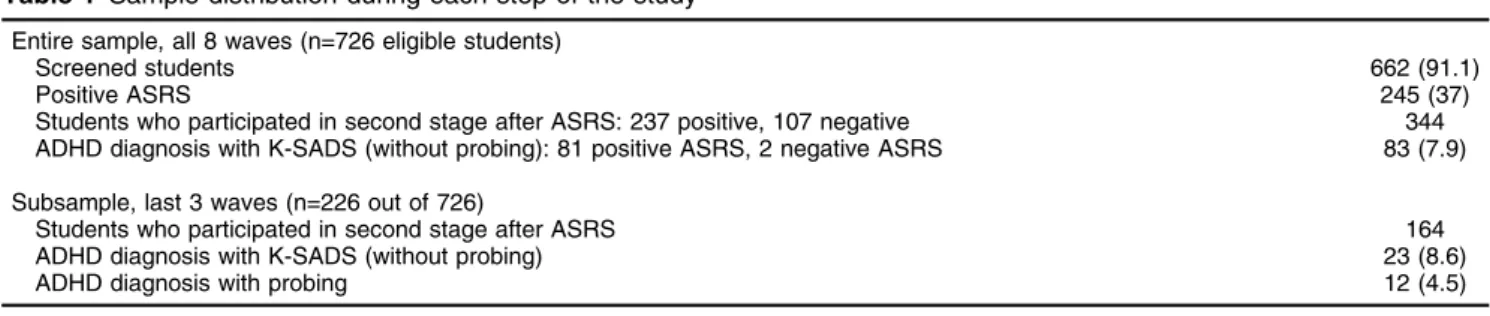
using the following guidelines: 1) this criterion was con-sidered ‘‘negative’’ if ADHD symptoms occurred exclusi-vely or almost exclusiexclusi-vely in periods (approximate periods were allowed) when the individual was reportedly suffering from another disorder; 2) for more chronic disorders, such as generalized anxiety disorders and dysthymia, we tried to investigate levels of attention or hyperactivity in periods when the disorders had abated; 3) we also considered this criterion to be negative when the examples provided by the interviewee (see below) occurred during periods of another disorder. The rationale behind this is that ADHD is better understood as a dimensional disorder, and lower-level symptoms can be found in otherwise normal individuals. Nevertheless, such symptoms may be magnified by a dif-ferent disorder (particularly anxiety and depression) and only then reach clinical significance. All cases were dis-cussed among the examiners, a senior psychiatrist (PM), and two psychiatrists with more than five years of clinical practice. The probing procedure consisted of asking for an indivi-dual’s own real-life examples to illustrate the DSM symptom they had just been asked about. Since this procedure nearly doubled the duration of an already long interview, it was only administered in the last three waves of students. As in previous waves, all ASRS-positive students and a randomized number of ASRS-negative ones were invited to the second stage, in which ADHD was diagnosed accord-ing to the same steps, usaccord-ing the K-SADS and MINI-Plus (Table 1). The interviewer then returned to the K-SADS again, but this time asking for real-life examples occurring in the last six months, as suggested in the DSM. Each symptom was considered ‘‘negative’’ if the individual could not provide examples considered associated to that item; individuals were not corrected during the interview. If a subject was reclassified after the probing procedure with either a positive or a negative ADHD diagnosis, the case was discussed among the interviewers and all procedures were reviewed in order to reach a clinical consensus.
Results
The total sample (all eight waves) included 726 eligible students; 662 (91.1%) completed the ASRS (47% male, 53% female; mean age 23.662 years). The subsample from the last three waves included 226 students (31.1%) who underwent the additional probing procedure (Table 1). Sixty-four students (8.81%) who were absent on the screening day were excluded. There were no age or
Table 1 Sample distribution during each step of the study
Entire sample, all 8 waves (n=726 eligible students)
Screened students 662 (91.1)
Positive ASRS 245 (37)
Students who participated in second stage after ASRS: 237 positive, 107 negative 344 ADHD diagnosis with K-SADS (without probing): 81 positive ASRS, 2 negative ASRS 83 (7.9)
Subsample, last 3 waves (n=226 out of 726)
Students who participated in second stage after ASRS 164
ADHD diagnosis with K-SADS (without probing) 23 (8.6)
ADHD diagnosis with probing 12 (4.5)
Data presented as n (%).
gender differences in students who did not participate in the screening. Of the entire sample, 344 students partici-pated in the second stage (i.e., K-SADS and MINI-Plus). No individual refused to participate in the first stage. Nine students (2.54%) who were invited for the second stage but missed their appointment were contacted a second time, although we opted not to inquire about the reason; only two of them were ASRS positive. There were no gender or age differences between screened students who completed the study and those who did not (p 4
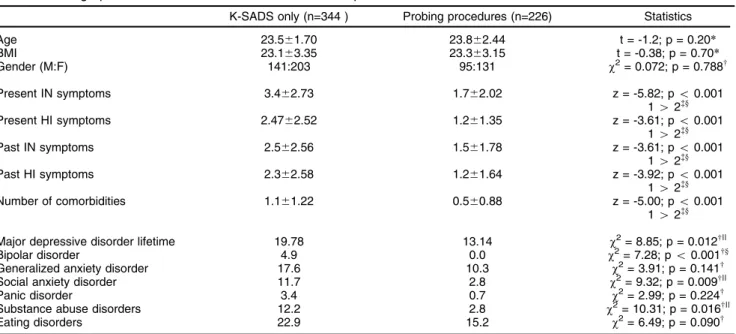
0.05). There were no significant gender, age, or body mass index differences between students who were interviewed with K-SADS and those who underwent the probing procedure. There was a significant difference in ADHD symptoms between groups, since the K-SADS group presented greater inattention and hyperactivity/ impulsivity symptoms. The K-SADS group presented a significantly higher percentage of current major depres-sive episodes, bipolar disorder, social anxiety disorder, and substance abuse disorders (Table 2).
A total of 247 students, 37% of the entire sample, were ASRS positive, but only 83 (7.9%) were diagnosed with ADHD with the K-SADS. Of the subgroup of 226 students from the last three waves, 67 (25.1%) were ASRS positive and 23 (8.6%) were diagnosed with ADHD in the second stage before the probing procedure. The diagnosis was upheld for only 12 (4.51%) after probing. This stepwise approach provided a correction factor of 0.52.
The projected prevalence of ADHD diagnosis in the entire sample was 4.1%. In the subsample, reclassification from cases to non-cases occurred when symptom counts fell below the cutoff after the probing procedure. It is important to point out that examples unrelated to the allegedly corre-sponding DSM symptom (which made that specific symptom negative) often pointed to another DSM symptom (Table 3).
Discussion
This is the first study to investigate the ADHD prevalence rate in a large non-clinical sample of university students in
Table 2 Demographic and clinical characteristics of the sample
K-SADS only (n=344 ) Probing procedures (n=226) Statistics
Age 23.561.70 23.862.44 t = -1.2; p = 0.20*
BMI 23.163.35 23.363.15 t = -0.38; p = 0.70*
Gender (M:F) 141:203 95:131 w2= 0.072; p = 0.788w
Present IN symptoms 3.462.73 1.762.02 z = -5.82; po0.001
142=y
Present HI symptoms 2.4762.52 1.261.35 z = -3.61; po0.001
142=y
Past IN symptoms 2.562.56 1.561.78 z = -3.61; po0.001
142=y
Past HI symptoms 2.362.58 1.261.64 z = -3.92; po0.001
142=y
Number of comorbidities 1.161.22 0.560.88 z = -5.00; po0.001
142=y
Major depressive disorder lifetime 19.78 13.14 w2= 8.85; p = 0.012w||
Bipolar disorder 4.9 0.0 w2= 7.28; po0.001wy
Generalized anxiety disorder 17.6 10.3 w2= 3.91; p = 0.141w
Social anxiety disorder 11.7 2.8 w2= 9.32; p = 0.009w||
Panic disorder 3.4 0.7 w2= 2.99; p = 0.224w
Substance abuse disorders 12.2 2.8 w2= 10.31; p = 0.016w||
Eating disorders 22.9 15.2 w2= 6.49; p = 0.090w
Data presented as mean6standard deviation or %.
142 = K-SADS only4probing procedures; BMI = body mass index; HI = hyperactivity/impulsivity; IN = inattention; K-SADS = Kiddie Schedule for Affective Disorders and Schizophrenia; M:F = male:female.
*t-test;wchi-square test;=Mann-WhitneyUtest.
ySignificant at 0.001;||significant at 0.05.
Table 3 Main examples reported by individuals in the probing procedure which did not correspond to the item addressed by the K-SADS question
DSM criterion addressed by K-SADS (DSM item in parenthesis)
Examples given during probing
(correct DSM corresponding item in parenthesis)
Making careless mistakes (I1) Misplacing or losing things (I7)
Difficulty sustaining attention (I2) Does not seem to listen during the conversation (I3) Easily distracted by extraneous stimuli (I8)
Difficulty organizing tasks and activities (I5) Can’t find things necessary for the task (I7) Avoids or dislikes tasks that require sustained mental effort (I6) Difficulty in lengthy reading (I2)
Brazil using a semi-structured interview, which is considered the gold standard in clinical research. This study also investigated whether an additional probing procedure might reveal incorrect understandings by the interviewee and thus provide different prevalence rates without alter-ing the overall structure of the DSM symptom list.
In our study, the semi-structured interview diagnosed only a fraction (35%) of individuals rated as positive in the screening procedure with the ASRS, which demonstrated sensitivity and specificity rates of 0.97 and 0.40, respecti-vely. A previous study16 found that the ASRS can dis-criminate between previously diagnosed ADHD patients recruited from disability services and college student controls, but there is a paucity of data regarding its sensitivity and specificity in other contexts. In our sample, one-third of the students self-reported symptoms at a clinically significant level (i.e., the DSM-5 cutoff); these results are highly divergent from an older study that found only a modest prevalence of ADHD symptoms in post-secondary students and suggested an even lower cutoff of four symptoms for diagnosis.17 Others have demon-strated that young adults without ADHD tend to over-report symptoms.18Our results agree with a recent study in which self-reported ADHD symptoms showed limited agreement with objective markers of persistence and remittance of the disorder.19
In the present study, we did not collect corroborating information from collateral reports. Because of the some-what conflicting results of self-reports, collateral reports are often recommended for adult ADHD diagnosis.20 However, besides the difficulty in obtaining informant reports for this population (adult ADHD diagnosis without collateral reports abound in the literature, unlike child or adolescent ADHD), many factors influence significant others’ or relatives’ ratings on behavioral questionnaires. Among these difficulties, we highlight observer expecta-tions, the frequency of targeted behaviors during the time shared by the observer and the individual (and its context), and the observer’s capacity to determine behavioral impair-ment in comparison to others of the same age or group. For college students, who often do not live with their parents or significant others, this aspect should be considered as a very important limitation. Moreover, parents of adult patients are necessarily older individuals who may find it difficult to remember behaviors from decades ago; in our unit agreement rates between adults and their parents were only moderate in similar samples.21 Finally, adult patients diagnosed with ADHD by self-report whose informants did not report ADHD symptoms in childhood have similar clinical profiles and treatment response as those whose informants described ADHD symptoms in childhood.22 In our study, ASRS clearly overestimated the ADHD prevalence rate; this result confirms previous findings in another study with a similar design.23 We relied on the students’ self-reports rather than on standardized measures of achievement to investigate ADHD-associated impairment because there is still scarce evidence that post-secondary students with ADHD show deficits on such instruments, despite self-reported difficulties attaining good academic performance.16 The subsample prevalence rate with K-SADS (without probing) in the last three waves was similar to that of the
entire sample (7.9 vs. 8.6%, p o0.05), although ADHD diagnosis in the subsample decreased from 8.6 to 4.5% with the probing procedure. This prevalence rate is within the broad range (from 2 to 12%) obtained from other studies with university students.24 Although our preva-lence rate is similar to that found in a previous epidemio-logical study with adults,25it is higher than the 2.5% found in a more recent meta-analysis.26 The reasons for the discrepancy between university students and the general population are beyond the scope of this study, but many different factors might come into play. Enrollment in a university is often associated with increased demand for behavioral self-regulation and attentional skills and a simultaneous decrease in the external structure and support previously provided by parents and teachers.27 Some individuals may have a biased self-perception of their attentional capacity in a very competitive environ-ment28; potential social and cultural biases in ADHD diagnosis have been a focus of debate for some time.29 Finally, feigning ADHD to receive stimulants or accom-modations might also contribute to higher prevalence rates.
Our results sharply contrast with an epidemiological study in our country, where exact wording from DSM-IV and a dichotomous answer (instead of the frequencies proposed in the K-SADS) resulted in a 2.9% prevalence rate in individuals aged 18 to 19 years old.30Besides not investigating a sample of university students, one major methodological difference is that study used a follow-up sample, i.e., participants who had been previously exposed to the assessment protocol and, typically, informants’ scores on rating scales and interviews are lower in a second administration.31
The use of objective criteria, such as those in the DSM, clearly represents an important strategy for improving scientific communication, minimizing variations in the under-standing of behaviors, which are often displayed and combined in a myriad of ways. Its use, however, has the limitations inherent in any diagnosis based on the assess-ment of behavioral symptoms without laboratory tests; in ADHD this is exacerbated by the fact that ADHD symptoms may be difficult to distinguish from normal behaviors. The contribution of the probing procedure was that a number of individuals diagnosed with ADHD through a semi-structured interview were reclassified because the symptom count fell below the cutoff point.
In our study, examples in reclassified cases were unrelated to the symptom addressed, although they almost invariably related to ‘‘another’’ ADHD symptom. In all cases, such wrongful examples referred to the inatten-tion domain. Unlike the vast majority of disorders, where symptoms lists include a single item for each different behavior or aspect (for example, mood disorder items include appetite, libido, sleep, mood, etc.), DSM module A for ADHD lists nine symptoms for inattention. We could tentatively hypothesize a ‘‘halo effect,’’ in which different items addressing a single cognitive domain contributed to our findings.
value to a semi-structured interview, we opted to investigate potential correlations between comorbidities and types of response in a separate study.
A recent study of students previously diagnosed with ADHD demonstrated that nuances could be offered to the meanings of some DSM items, as well as similar responses to different probing questions that address DSM symptoms16; nevertheless, most students’ res-ponses were consistent with the intended meaning of the corresponding DSM symptom in that study. Findings from our non-clinical sample suggest higher levels of misinterpretation of DSM items; however, our sample profile differed from the above-mentioned study of pre-viously diagnosed ADHD students on disability services (who are potentially more acquainted with ADHD DSM items).
Finally, it should be pointed out that a previous ‘‘official’’ English version of the K-SADS Present and Lifetime version, which was based on the DSM-IV, had errors in several items, providing questions that were in fact related to other items.32
Although probing procedures are time-consuming (approximately doubling the duration of an interview), our results suggest their use in at least some research protocols has the potential to decrease the number of false-positive ADHD diagnoses. Interestingly, probing with previously defined examples is a procedure in the more recent Diagnostic Interview for ADHD in Adults (DIVA).33 In conclusion, our study suggests that self-reporting may overestimate ADHD prevalence rates in a sample of uni-versity students, and that probing the DSM items by asking for real-life examples lowers the total number of symptoms considered as positive and, as a result, the ADHD pre-valence rate.
Disclosure
PM and RT have received funding from Novartis, Shire, and Apopharma in the form of personal fees and have acted as a consultant in panels and scientific talks. The other author reports no conflicts of interest.
References
1 American Psychiatric Association. Diagnostic and Statistical Manual of Mental Disorders, Third Edition (DSM-III). Washington: American Psychiatric Publishing; 1980.
2 Csordas TJ, Dole C, Tran A, Strickland M, Storck MG. Ways of asking, ways of telling: a methodological comparison of ethnographic and research diagnostic interviews. Cult Med Psychiatry. 2010;34: 29-55.
3 Ramirez Basco M, Bostic JQ, Davies D, Rush AJ, Witte B, Hendrickse W, et al. Methods to improve diagnostic accuracy in a community mental health setting. Am J Psychiatry. 2000;157:1599-605. 4 DuPaul GJ, Weyandt LL, O’Dell SM, Varejao M. College students with ADHD: current status and future directions. J Atten Disord. 2009; 13:234-50.
5 Murphy K, Barkley RA. Prevalence of DSM-IV symptoms of ADHD in adult licensed drivers: Implications for clinical diagnosis. J Atten Disord. 1996;1:147-61.
6 Hinshaw SP, Scheffler RM. The ADHD explosion. myths, medication, money and today’s push for performance. Introduction. Oxford: Oxford University; 2014.
7 Mohr Jensen C, Steinhausen HC. Time trends in incidence rates of diagnosed attention-deficit/hyperactivity disorder across 16 years in a nationwide Danish registry study. J Clin Psychiatry. 2015;76:e334-41. 8 Mattos P, Segenreich D, Saboya E, Louza˜ M, Dias G, Romano M. Adaptac¸a˜o transcultural para o portugueˆs da escala Adult Self-Report
Scale para avaliac¸a˜o do transtorno de de´ficit de atenc¸a˜o/hiperatividade
(TDAH) em adultos. Rev Psiquiatr Clin. 2006;33:188-94.
9 Kessler RC, Adler LA, Gruber MJ, Sarawate CA, Spencer T, Van Brunt DL. Validity of the World Health Organization adult ADHD self-report scale (ASRS) screener in a representative sample of health plan members. Int J Methods Psychiatr Res. 2007;16:52-65. 10 Faraone SV, Biederman J. What is the prevalence of adult ADHD?
Results of a population screen of 966 adults. J Atten Disord. 2005; 9:384-91.
11 Grevet EH, Henrique C, Bau D, Alberto C, Salgado I, Ficher A, et al. Concordaˆncia entre observadores para o diagno´stico em adultos do trantorno de de´ficit de atenc¸a˜o/hiperatividade e transtorno de
opo-sic¸a˜o desafiante utilizando o K-SADS-E. Arq Neuropsiquiatr. 2005;
63:307-10.
12 Mattos P, Louza˜ MR, Palmini AL, de Oliveira IR, Rocha FL. A multicenter, open-label trial to evaluate the quality of life in adults with ADHD treated with long-acting methylphenidate (OROS MPH): concerta quality of life (CONQoL) study. J Atten Disord. 2013;17:444-8. 13 Mattos P, Dias GM, Segenreich D, Malloy-Diniz L. Self-evaluated
burden in adults with attention-deficit hyperactivity disorder (ADHD): a pilot study. J Bras Psiquiatr. 2010;59:322-5.
14 Fortes D, Serra-Pinheiro MA, Coutinho G, Bernardes C, Regalla MA, Sergeant J, et al. Quantitative measurement of impairment in ADHD: perspectives for research and clinical practice. Arch Clin Psychiatry. 2014;41:124-30.
15 Amorim P. Mini International Neuropsychiatric Interview (MINI): validac¸a˜o de entrevista breve para diagno´stico de transtornos mentais.
Rev Bras Psiquiatr. 2000;22:106-15.
16 Gray S, Woltering S, Mawjee K, Tannock R. The adult ADHD self-report scale (ASRS): utility in college students with attention-deficit/ hyperactivity disorder. PeerJ. 2014;2:e324.
17 Heiligenstein E, Conyers LM, Berns AR, Miller MA. Preliminary normative data on DSM-IV attention deficit hyperactivity disorder in college students. J Am Coll Health. 1998;46:185-8.
18 Sibley MH, Pelham WE, Molina BS, Gnagy EM, Waxmonsky JG, Waschbusch DA, et al. When diagnosing ADHD in young adults emphasize informant reports, DSM items, and impairment. J Consult Clin Psychol. 2012;80:1052-61.
19 Du Rietz E, Cheung CH, McLoughlin G, Brandeis D, Banaschewski T, Asherson P, et al. Self-report of ADHD shows limited agreement with objective markers of persistence and remittance. J Psychiatr Res. 2016;82:91-9.
20 Dvorsky MR, Langberg JM, Molitor SJ, Bourchtein E. Clinical utility and predictive validity of parent and college student symptom ratings in predicting an ADHD diagnosis. J Clin Psychol. 2016;72:401-18. 21 Dias G, Mattos P, Coutinho G, Segenreich D, Saboya E, Ayra˜o V.
Agreement rates between parent and self-report on past ADHD symptoms in an adult clinical sample. J Atten Disord. 2008;12:70-5. 22 Breda V, Rovaris DL, Vitola ES, Mota NR, Blaya-Rocha P, Salgado CA, et al. Does collateral retrospective information about childhood attention-deficit/hyperactivity disorder symptoms assist in the diag-nosis of attention-deficit/hyperactivity disorder in adults? Findings from a large clinical sample. Aust N Z J Psychiatry. 2016;50:557-65. 23 Garnier-Dykstra LM, Pinchevsky GM, Caldeira KM, Vincent KB, Arria AM. Self-reported adult attention-deficit/hyperactivity disorder symp-toms among college students. J Am Coll Health. 2010;59:133-6. 24 Nugent K, Smart W. Attention-deficit/hyperactivity disorder in
post-secondary students. Neuropsychiatr Dis Treat. 2014;10:1781-91. 25 Kessler RC, Adler L, Barkley R, Biederman J, Conners CK, Demler
O, et al. The prevalence and correlates of adult ADHD in the United States: results from the national comorbidity survey replication. Am J Psychiatry. 2006;163:716-23.
26 Simon V, Czobor P, Ba´lint S, Me´sza´ros A, Bitter I. Prevalence and correlates of adult attention-deficit hyperactivity disorder: meta-analysis. Br J Psychiatry. 2009;194:204-11.
28 Amaral OB. Psychiatric disorders as social constructs: ADHD as a case in point. Am J Psychiatry.2007;164:1612; author reply 1612-3. 29 Singh I. Beyond polemics: science and ethics of ADHD. Nat Rev
Neurosci. 2008;9:957-64.
30 Matte B, Anselmi L, Salum GA, Kieling C, Gonc¸alves H, Menezes A,
et al. ADHD in DSM-5: a field trial in a large, representative sample of 18- to 19-year-old adults. Psychol Med. 2015;45:361-73.
31 Solanto MV, Conners CK. A dose-response and time-action analysis of autonomic and behavioral effects of methylphenidate in attention deficit disorder with hyperactivity. Psychophysiology. 1982;19:658-67. 32 Mattos P, Rohde LA. The Kiddie-SADS-Present and Lifetime Version.
J Atten Disord. 2007;11:100.