216
RENAL HEMANGIOMA Case Report
International Braz J Urol
Official Journal of the Brazilian Society of Urology
Vol. 30 (3): 216-218, May - June, 2004
RENAL HEMANGIOMA
THEODORICO F. DA COSTA NETO, JUAN M. RENTERIA, G. DI BIASE FILHO
Section of Urology, Ipanema General Hospital, Rio de Janeiro, RJ, Brazil
ABSTRACT
Introduction: Renal hemangioma is a relatively rare benign tumor, seldom diagnosed as a cause of hematuria.
Case report: A female 40-year old patient presented with continuous gross hematuria, anemia and episodic right lumbar pain, with onset about 3 months previously. The patient underwent multiple blood transfusions during her hospital stay and extensive imaging propedeutics was performed. Semi-rigid ureterorenoscopy evidenced a bleeding focus in the upper calix of the right kidney, with endo-scopic treatment being unfeasible.
The patient underwent right upper pole nephrectomy and presented a favorable outcome. Histopathological analysis of the surgical specimen showed that it was a renal hemangioma.
Comments: Imaging methods usually employed for diagnostic investigation of hematuria do not have good sensitivity for renal hemangioma. However, they are important to exclude the most fre-quent differential diagnoses. The ureterorenoscopy is the diagnostic method of choice and endoscopic treatment can be feasible when the lesion is accessible and electrocautery or laser are available. We emphasize the open surgical treatment as a therapeutic option upon failure of less invasive methods.
Key words: kidney; hemangioma; hematuria
Int Braz J Urol. 2004; 30: 216-8
INTRODUCTION
Renal hemangioma is a relatively rare benign tumor, seldom diagnosed as a cause of hematuria. Approximately 200 cases were reported since this condition was first described by Virchow in 1867 (1). This tumor can be classified as cavernous or capil-lary and the majority of lesions have a diameter of less than 1 cm. It affects most frequently young adults and there is no preference for gender.
Clinical presentation is characterized by he-maturia ranging from intermittent microscopic hem-orrhage to abundant, continuous bleeding, with he-modynamic repercussion.
We report one case of gross hematuria due to renal hemangioma emphasizing clinical presentation, imaging diagnosis and the treatment prescribed.
CASE REPORT
re-217
RENAL HEMANGIOMA
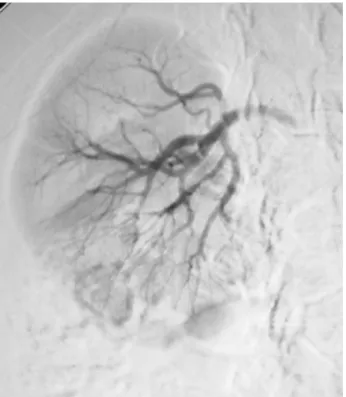
quiring multiple blood transfusions during hospital-ization. Renal arteriography was unable to evidence the bleeding focus. However, considering its previ-ous location on semi-rigid ureterorenoscopy, an op-tion was made towards selective embolizaop-tion of the right kidney upper pole (Figure-2).
Since there was no hematuria remission fol-lowing arterial embolization, the patient underwent a right upper pole nephrectomy (Figure-3), presenting a favorable outcome, without hematuria within a 6-month follow-up. Histopathological analysis revealed renal hemangioma.
COMMENTS
Renal hemangioma is seldom diagnosed as a cause of hematuria. Imaging examinations usually are not helpful for diagnosing hemangioma, though they are important in order to exclude more frequent causes of hematuria.
The differential diagnosis of renal heman-gioma must include papillary necrosis, ectopic
pa-Figure 1 – Right selective renal arteriography, without identify-ing the bleedidentify-ing focus.
Figure 2 – Right renal arteriography following selective embo-lization of the upper pole (arrow).
218
RENAL HEMANGIOMA
pilla, hemorrhagic papillitis and urothelial carcinoma, among others (2).
Currently, the flexible ureterorenoscopy is the method of choice for diagnosing this kind of lesion (3). When available, the electrocautery or laser con-stitutes also the treatment of choice, if the lesion is accessible. However, in the absence of such facili-ties, open surgery is indicated in cases of persistent bleeding.
REFERENCES
1. Daneshmand S, Huffman JL: Endoscopic management of renal hemangioma. J Urol. 2002; 167: 488-9. 2. Viguier JL, Abbar M, Gelet A, Bouvier R, Martin X,
Marechal JM, et al.: The contribution of endoscopy in the diagnosis of unilateral hematuria of renal origin and pseudotumors of the upper urinary tract. Prog Urol. 1994; 4: 219-27.
3. Tawfiek ER, Bagley DH: Ureteroscopic evaluation and treatment of chronic unilateral hematuria. J Urol. 1998; 160: 700-2.
Received: November 25, 2003 Accepted after revision: January 28, 2004
Correspondence address:
Dr. Juan Miguel Renteria Hospital Geral de Ipanema Rua Antônio Parreiras, 67 / 69 Rio de Janeiro, RJ, 22411–020, Brazil Fax: + 55 21 3111-2362