Petroianu a etal.
568
Rev Assoc Med Bras 2010; 56(5): 568-71I
ntroductIonSubstance use – including alcohol and tobacco consumption and psychotropic drug use – is a public health issue that requires analysis of its prevalence and consumption patterns. Due to their knowledge of and ease of access to various drugs, physicians and medical students have been assessed as a possible target of substance abuse1-11. The high rate of psychotropic drug use
among physicians is a well established fact2. This is a worrisome
scenario in light of its professional consequences and possible social impacts.
It is therefore important to ascertain the prevalence and patterns of substance use among medical students7,11-17.
Newbury-Birch et al. (2001) investigated the prevalence of drug use in a group of students at Newcastle University Medical School (England) during their undergraduate studies and after their irst year as house oficers, and found that mean alcohol
and illicit drug consumption increased signiicantly over this period11. Conard et al. (1998) showed that tranquilizer use was
highly prevalent among medical students; on the other hand, cannabis, cocaine, or tobacco consumption were infrequent in the study sample7. In a 2000 study, Petroianu et al. reported that
anxiolytics and stimulants were the drugs most often consumed by medical students13. According to Passos et al. (2006), rates of
alcohol and cannabis use by medical students in Rio de Janeiro were lower than those found in developed countries14.
The objective of this study was to estimate the prevalence of alcohol and tobacco consumption and psychotropic drug use among medical students and ascertain which factors are asso-ciated with substance use in this population.
M
ethodsThis study was conducted at the Universidade Federal de Minas Gerais (UFMG) School of Medicine after approval had
*Correspondence: Avenida Afonso Pena, 1626 - apto. 1901 Funcionários
Belo Horizonte - MG, Brazil CEP: 30130-005 Phone/Fax: (31) 3274-7744
ABSTRACT
objectIve. The purpose of this study was to assess the prevalence of alcohol, tobacco and psycho-tropic drug consumption by students of the Universidade Federal de Minas Gerais (UFMG) School of Medicine, Brazil, and to ascertain aspects related to substance use in this population.
Methods. This study was carried out with students of all years of the UFMG Medicine course, who were invited to participate anonymously by answering a self-administered questionnaire that has previously been validated and adapted to the Brazilian reality. The instrument was based on World Health Organization methods for development of student drug use surveys and included 25 questions on substance use. The Student t test and chi-square testing were performed for comparison of means and proportions.
results. Alcohol and tobacco were the most commonly used substances, consumed by 85.2% and 16.3% of students respectively. Among the psychotropic drugs, use of cannabis was reported by 16.5% of students, LSD by 6.9%, sedatives by 12%, amphetamines by 7.5% and inhalant substances by 16.8%. Use of cocaine, crack, opiates, anticholinergics and anabolic steroids was rarely mentioned.
conclusIon. Alcohol was the most widely used substance, and its consumption was associated with other drug addictions. Drugs were used most frequently by single, male students who live alone and need not work to support themselves.
Key words: Students. Public health. Medicine. Alcohol drinking. Consumption of tobacco-derived products. Psychotropic drugs.
prevalence
of
alcohol
,
tobacco
and
psychotropIc
drug
use
aMong
MedIcal
students
at
the
unIversIdade
federal
de
MInas
geraIs
andy petroIanu1*, danIel cruz ferreIrados reIs2, breno dayrell sIlva cunha3, davI Machadode souza3
Study conducted at Departamento de Cirurgia da Faculdade de Medicina da Universidade Federal de Minas Gerais – UFMG, Belo Horizonte, MG, Brazil
1- Professor Titular do Departamento de Cirurgia da Faculdade de Medicina da Universidade Federal de Minas Gerais – UFMG; Livre-Docente em Cirurgia da Faculdade de Medicina de Ribeirão Preto – USP; Livre-Docente em Cirurgia da Escola Paulista de Medicina – UNIFESP; Doutor em Fisiologia e Farmacologia- Instituto de
Ciências Biológicas – ICB na UFMG e Pesquisador IA do Conselho Nacional de Desenvolvimento Cientíico e Tecnológico – CNPq, Belo Horizonte, MG
2- Acadêmico da Faculdade de Medicina da Universidade Federal de Minas Gerais – UFMG e Bolsista de Iniciação Cientíica do Conselho Nacional de Desenvolvimento Cientíico e Tecnológico – CNPq, Belo Horizonte, MG
Prevalenceofalcohol, tobaccoandPsychotroPicdruguseamongmedicalstudentsatthe universidade federalde minas gerais
569
Rev Assoc Med Bras 2010; 56(5): 568-71been granted by the UFMG Human Subjects Research Ethics Committee (request no. CAAE ETIC/0295.0.203.000-08; ruling no. ETIC/295/08). Medical students of all years were notiied of the purpose of this study and invited to take part on a volunteer, anonymous basis, with safeguards to ensure that responses would not be identiiable. Students who chose not to answer the questionnaire were allowed to refuse it altogether or turn it in blank.
After expressing consent, students received a self-admi-nistered structured questionnaire based on the World Health Organization’s guidelines for student drug-use surveys18 and
validated for the Brazilian reality. The instrument comprised 25 questions on social characteristics and occupational and extracurricular activities. Data on substance use, frequency of substance, use, irst contact with drugs, and any relationships between substance use, exams, and holidays or vacationing were also assessed.Data were collected between December 2007 and March 2008. At the end of the collection period, 360 students from the irst through sixth years of medical school had been interviewed.
Statistical analyses were conducted with the Epi Info 3.4.3 software package. Comparison of means was performed by the Student t test and proportions were compared with the chi-square test. The signiicance level was set at P<0.05.
r
esultsOf the 360 questionnaires handed out, 353 were returned, 332 of which were considered valid; 172 respondents (51.8%) were female and 160 (48.2%) were male. Age ranged between 18 and 41 years, with a predominance of the 21–24 year range (mean, 23 years).
Over half of respondents (195, 58.9%) took part in study-related activities, such as undergraduate research, extended and continuing education courses, or internships in the healthcare ield. Most students (247, 74.3%) had no employment, 65 (19.6%) worked to pay for their medical studies, 19 (5.7%) worked to support themselves and one (0.3%) to support his family. Students with jobs were found to engage in signiicantly less consumption of cannabis (P = 0.033).
Concerning living conditions, 205 respondents (61.7%) lived with their parents, 50 (15.1%) with siblings, 50 (15.1%) at student cooperatives/fraternity housing, 23 (6.9%) alone and 4 (1.2%) at boarding houses. Consumption of hallucinogenic drugs was signiicantly lower among students living with their parents or guardians (P = 0.019), whereas solvents were most often used by students who lived alone (P = 0.01).
Most students (297, 89.7%) engaged in sports activities occasionally, whereas 217 (65.3%) were considered sedentary and only 115 (34.7%) engaged in sporting activities three or more times a week. Although there was no statistically valid association between sporting practices and substance use, sedentary students were found to consume alcoholic beverages more often (OR=1.8; p=0.06).
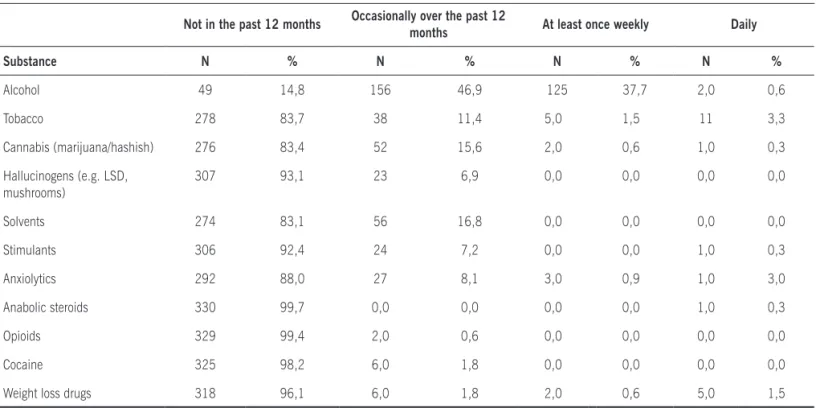
Alcohol consumption was reported by 283 students (85.2%), 156 of whom (46.9%) consumed alcohol only occasionally over the 12 months prior to administration of the survey, 125 (37.7%) consumed alcohol at least once a week and 2 (0.6%) drank on a daily basis (Table 1). There were no gender differences in alcohol
consumption. Students who lived with their parents or guardians consumed less alcohol than other respondents (P = 0.021).
Alcohol consumption was associated with increased odds of stimulant use (1.09, P = 0.015), smoking (1.23, P = 0.00007), ethyl chloride inhalation (1.24, P = 0.00004), hallucinogen use (1.08, P= 0.02), and cannabis consumption (1.24, P = 0.00003).
Tobacco smoking was reported by 54 students (16.3%), 38 of whom (11.5%) had smoked only occasionally over the 12 months prior to administration of the survey, 5 (1.5%) smoked at least once a week and 11 (3.3%) did so on a daily basis (Table 1). Smoking was signiicantly more prevalent among men (23.1% of male vs. 9.9% of female students, P = 0.0008) (Table 2) and those who did not live with their parents or guardians (P = 0.03). Smoking was also less prevalent among students with jobs (P = 0.013).
Cannabis consumption (marijuana or hashish) was reported by 55 students (16.5%) (Tables 1 and 2). Again, cannabis use was less prevalent among students with jobs (P=0.033).
Hallucinogens such as LSD or psychedelic mushroom tea were occasionally consumed by 23 students (6.9%) (Table 1). Consumption of hallucinogenic substances was less prevalent among students who lived with their parents or guardians (P = 0.019).
On rare occasions, 56 students inhaled ethyl chloride (lança-perfume), paint thinner, glue, petroleum ether, or gasoline (16.8%) (Table 1).
Anxiolytics were used by 40 students (12%) (Tables 1 and 2), most of whom were women (P=0.038). Stimulants were taken by 25 respondents (7.5%) to promote wakefulness (Tables 1 and 2), particularly during the inal years of medical school (P=0.02) and by male students (P<0.001).
There was no association between substance use and age, study-related activities, or religion.
d
IscussIonAlcohol, tobacco, and psychotropic drug use is a worldwide health problem, which has prompted a wealth of studies on the issue. University students19,20, including medical students, are affected by
substance use6-16,21. In researching the issue, one must take
parti-cular care to avoid generalizing data analyzed from a preconceived standpoint, particularly in light of cultural, political, and social stances towards psychotropic substance use22-24. Differences may be detected
even between similar populations. Studies performed in various Brazilian states have revealed distinct results on several aspects25,26.
Most students consume alcoholic beverages, even if only occasionally. Overall, studies have shown that alcohol is the most widely consumed drug worldwide6-17. Country-speciic and
international results are similar in terms of alcohol consump-tion, differing mostly with respect to length of use and amount of alcoholic beverages consumed22. In this study, alcoholism
rates were not high and there were no differences in intensity of alcohol consumption over the course of respondents’ medical studies, corroborating previous research indings11,27. Although
there were no gender differences in alcohol consumption in this study, others have shown that men drink alcohol more frequently and in higher quantity than women14,28.
Petroianu a etal.
570
Rev Assoc Med Bras 2010; 56(5): 568-71psychoactive substances, as well as smoking, was also detected in this study. According to Webb et al. (1996) and Newbury-Birch et al. (2000), cannabis is consumed more often by alcoholics15,19.
These results corroborate the hypothesis that alcoholism predis-poses to other addictions. Furthermore, alcoholism acquired during medical studies persists throughout physicians’ careers11.
Cannabis (marijuana or hashish) was the third most commonly used drug in this study sample. A similar study conducted in Rio de Janeiro found cannabis to be the fourth most-consumed drug by medical students (20.9%)14. In both studies, this was
a lower preference than that reported in other countries9,11,15.
Newbury-Birch et al. (2001) reported that marijuana was the most commonly used illicit drug in a sample of medical students and physicians in Newcastle, England, and regular consumption of cannabis was considered trivial by the majority of users. On the other hand, cannabis was not often consumed by medical students in a U.S. study7.
Stimulants and anxiolytics were used less often by respondents in the present study than in a sample of U.S. medical students reported by Conard et al. (1998). In a previous study by Petroianu et al. (2000), anxiolytics and stimulants were used by 29.3% and 67.7% of medical students respectively. Use of anxiolytics became more common from the second half of the course onwards13,14,
whereas stimulant use decreased over this same period13. Female
students consume anxiolytics more often, whereas stimulant use is more prevalent among male students14,17. These indings are in
agreement with the results of the present study.
In this study, smoking was less common than in other countries11,20. In prior studies of Brazilian student populations,
Petroianu et al. (2000) found a 35% rate of tobacco smoking, and Passoset et al. (2006), 54.3%. Conversely, Makanjuola et al. (2007) found that only 3.2% of Nigerian medical students smoked. Antismoking campaigns carried out over the past ive years may account for this change in behavior. According to
Table 1 – Frequency of substance use by medical students
Not in the past 12 months Occasionally over the past 12
months At least once weekly Daily
Substance N % N % N % N %
Alcohol 49 14,8 156 46,9 125 37,7 2,0 0,6
Tobacco 278 83,7 38 11,4 5,0 1,5 11 3,3
Cannabis (marijuana/hashish) 276 83,4 52 15,6 2,0 0,6 1,0 0,3
Hallucinogens (e.g. LSD, mushrooms)
307 93,1 23 6,9 0,0 0,0 0,0 0,0
Solvents 274 83,1 56 16,8 0,0 0,0 0,0 0,0
Stimulants 306 92,4 24 7,2 0,0 0,0 1,0 0,3
Anxiolytics 292 88,0 27 8,1 3,0 0,9 1,0 3,0
Anabolic steroids 330 99,7 0,0 0,0 0,0 0,0 1,0 0,3
Opioids 329 99,4 2,0 0,6 0,0 0,0 0,0 0,0
Cocaine 325 98,2 6,0 1,8 0,0 0,0 0,0 0,0
Weight loss drugs 318 96,1 6,0 1,8 2,0 0,6 5,0 1,5
Table 2 – Gender differences in substance use by medical students
Substance Male Female Signiicance
Tobacco 23,1% 9,9% P < 0,001
Cannabis (marijuana/ hashish)
23,8% 9,9% P < 0,001
Hallucinogens (e.g. LSD, mushrooms)
11,3% 2,9% P = 0,002
Anxiolytics 8,8% 15,1% P = 0,038
Stimulants 13,1% 2,3% P < 0,001
Anabolic steroids 0,3% 0% P = 0,430
Opioids 0,6% 0% P = 0,260
Cocaine 1,8% 0% P = 0,001
Prevalenceofalcohol, tobaccoandPsychotroPicdruguseamongmedicalstudentsatthe universidade federalde minas gerais
571
Rev Assoc Med Bras 2010; 56(5): 568-71Newbury-Birch et al. (2001), smoking decreases over time among women.
The inluence of lifestyle on substance use is a topic of frequent debate. Remarkably, and contrary to what might be expected, sporting practices have no inluence on drug use. This was found in the present study and has previously been reported in the literature27-31.
c
onclusIonSubstance use is common among medical students, with alcohol consumption being most prevalent. Drug use was most common among single male students who do not live with family members and do not depend on employment to support them-selves or their families. The use of one substance predisposes to further dependence.
No conlicts of interest declared concerning the publication of this article.
r
eferences1. Vaillant GE, Brighton JR, McArthur C. Physicians’ use of mood-altering drugs. N Engl J Med. 1970;282:365-70.
2. McAuliffe WE, Rohman M, Santangelo S, Feldman B, Magnuson E, Sobol A, et al. Psychoactive drug use among practicingphysicians and medical students. N EnglJ Med. 1986;315:805-10.
3. Hughes PH, Brandenburg N, Baldwin DC Jr, Storr CL, Williams KM, Anthony JC, et al. Prevalence of substance use among US physicians. JAMA. 1992;267:2333-9.
4. Hughes PH, Storr C, Baldwin DC Jr, Williams KM, Conard S, Sheehan D. Patterns of substance use in the medical profession. Md Med J. 1992;41:311-14. 5. O’Connor PG, Spickard A Jr. Physician impairment by substance abuse. Med
Clin North Am. 1997;81:1037-52.
6. Singh G, Singh RP. Drugs on a medical campus I. Drug use among medical undergraduates. Drug Alcohol Depend. 1979;4:391-98.
7. Conard S, Hughes P, Baldwin DC Jr, Achenbach KE, Sheehan DV. Substance use by fourth-year students at 13 U.S. medical schools. J Med Educ. 1998;63:747-58.
8. Forney MA, Ripley WK, Forney PD. A proile and prediction study of problem drinking among irst-year medical students. Int J Addict. 1988;23:767-79.
9. Baldwin DC Jr, Hughes PH, Conard SE, Storr CL, Sheehan DV. Substance use among senior medical students. JAMA. 1991;265:2074-8.
10. Pickard M, Bates L, Dorian M, Greig H, Saint D..Alcohol and drug use in second-year medical students at the University of Leeds. Med Educ. 2000;34:148-50. 11. Newbury-Birch D, Walshaw D, Kamali F. Drink and drugs: from medical
students to doctors. Drug Alcohol Depend. 2001;64:265-70.
12. Clark DC. Alcohol and drug use and mood disorders among medical students: implications for physician impairment. Qual Rev Bull. 1988;14:50-54. 13. Petroianu A, Pereyra W, Brito A, Oliveira C, Silva F, Canela G, et al. Avaliação
do uso de drogas por estudantes de Medicina. Rev Med Minas Gerais. 2000;10:8-12.
14. Passos S, Brasil P, Santos MA, Aquino MT. Prevalence of psychoactive drug use among medical students in Rio de Janeiro. Soc Psychiatr Epidemiol. 2006;41:989-96.
15. Newbury-Birch D, White M, Kamali F. Factors inluencing alcohol and illicit
drug use amongst medical students. Drug Alcohol Depend. 2000;59:125-30. 16. Mesquita AM, Bucaretti HA, Castel S, Andrade AG. Estudantes da Faculdade
de Medicina da Universidade de São Paulo: uso de substâncias psicoativas em 1991. Rev ABP-APAL. 1995;17:47-54.
17. Oliveira LG, Barroso LP, Wagner GA, Ponce JC, Malbergier A, Stempliuk VA, et al. Drug consumption among medical students. Rev Bras Psiquiatr. 2009;31:227-39.
18. Smart RG, Hughes PH, Johnston LD, Anumonye A, Khant U, Mora MEM, et al. World Health Organization´s guide-lines for student substance use survey. Geneve: WHO; 1980
19. Webb E, Ashton C, Kelly P, Kamali F. Alcohol and drug use in UK university students. Lancet. 1996;348:922-25.
20. Webb E, Ashton H, Kelly P, Kamali F. Patterns of alcohol consumption, smoking and illicit drug use in British university students: interfaculty comparisons. Drug Alcohol Depend. 1997;47:145-53.
21. West R, Drummond C, Eames K. Alcohol consumption, problem drinking and anti-social behavior in a sample of college students. Br J Addict. 1990;85:479-86.
22. Mesquita AM, Laranjeira R, Dunn J. Psychoactive drug use by medical students: a review of the national and international literature. Rev Paul Med. 1997;115:1356-65.
23. Helwick SA. Substance abuse education in medical school: past, present and future. J Med Educ. 1985;60:707-11.
24. Negrete JC. The role of medical schools in the prevention of alcohol-related problems. Can Med Assc J. 1990;143:1048-53.
25. TeixeiraAF, Aliane PP, Ribeiro LC, Ronzani TM. Uso de substâncias psicoativa-sentre estudantes de Goiana, MG. Estud Psicol (Natal). 2009;14(1):51-7. Disponível em: http://www.scielo.br/epsic.
26. Ribeiro MS, Ronzani FAT, Alves MJM. Consumo de substâncias psicoativas entre estudantes de Medicina da UFJF. J Bras Psiquiatr. 1997;46:631-8. 27. Silva LVER, Malbergier A, Stempliuk VA, Andrade AG. Factors associated
with drug and alcohol use among university student. Rev Saúde Pública. 2006;40:280-8.
28. Makanjuola AB, Daramola TO, Obembe AO. Psychoactive substance use among medical students in a Nigerian university. Psychiatry. 2007;6:48-50. 29. Dunn MS, Wang MQ. Effects of physical activity on substance use among
College students. Am J Health Studies. 2003;18:126-32.
30. Wechsler H, Davenport AE, Dowdall GW, Grossman SJ, Zanakos SI. Binge drinking, tobacco, and illicit drug use and involvement in college athle-tics: A study of students at 140American colleges. J Am College Health. 1997;45:195-200.
31. Pate RR, Heath GW, Dowda M, Trost SG. Association between physical activity andother health behaviors in a representative sample of US adolescents. Am J Public Health. 1996;86:1577-81.
32. Kokkevi A, Stefanis C. The Epidemiology of licit and illicit substance use amonghigh school students in Greece. Am J Public Health. 1991;81:48-52. 33. O´Malley PM, Bachman JG, Johnston LD. Relibility and consistency in self -
reports of drugs use. Int J Addict. 1983;18:805-24.
34. Alcohol and the young. J Roy Coll Phys Lond. 1995;29:470-74.