he knowledge of intensive care professionals
about diarrhea
INTRODUCTION
Gastrointestinal motility disorders are common in critically ill patients,(1) occurring mainly because of physiological responses to the severe disease itself, enteral nutrition intolerance, use of medications (particularly antibiotics and prokinetics), infection, and immunosuppression.(2,3)
Diarrhea is the most frequent complication among the changes observed in intensive care unit (ICU) patients receiving enteral nutrition.(4) Among other factors, diarrhea can be caused by alterations in the colonic response, microbial contamination of enteral nutrition formulas, low-iber diet, hypoalbuminemia, disturbances of the intestinal lora, increased use of antibiotics and concurrent drug therapy, and Clostridium difficile infection.(5-8) Furthermore, etiology, Cláudia Regina Felicetti Lordani1, Raquel Goreti
Eckert2, Altevir Garcia Tozetto3, Tarcísio Vitor
Augusto Lordani4, Péricles Almeida Delfino
Duarte5,6,7
1. Nutrition Service, Hospital Universitário do Oeste do Paraná - Cascavel, Paraná (PR), Brazil. 2. Nutrition Service, União Oeste Paranaense de Estudos e Combate ao Câncer - Cascavel, Paraná (PR), Brazil.
3. Nutrition Service, Hospital São Lucas, Faculdade Assis Gurgacz - Cascavel, Paraná (PR), Brazil. 4. Nursing Service, Hospital São Lucas, Faculdade Assis Gurgacz - Cascavel, Paraná (PR), Brazil. 5. Intensive Care Unit, Hospital Universitário do Oeste do Paraná - Cascavel, Paraná (PR), Brazil. 6. Intensive Care Unit, Hospital São Lucas, Faculdade Assis Gurgacz - Cascavel, Paraná (PR), Brazil. 7. Intensive Care Unit, Hospital do Câncer, União Oeste Paranaense de Estudos e Combate ao Câncer - Cascavel, Paraná (PR), Brazil.
Objective: To assess the opinions and practices of intensive care professionals with regard to diarrhea in critically ill patients.
Methods: A multicenter
cross-sectional study was conducted among health care professionals working at three adult intensive care units. Participants responded individually to a self-administered questionnaire about their length of work experience in intensive care; the deinition, characterization, and causes of diarrhea; types of records in the patient’s medical record; and training received.
Results: A total of 78 professionals participated in this study, of whom 59.0% were nurse technicians, 25.7% were nurses, and 15.3% were physicians; 77.0% of them had worked in intensive care for over 1 year. Only 37.2% had received training on this topic. Half of the interviewees deined diarrhea as
Conflicts of interest: None.
Submitted on December 16, 2013 Accepted on May 26, 2014
Corresponding author:
Cláudia Regina Felicetti Lordani
Serviço de Nutrição do Hospital Universitário do Oeste do Paraná
Avenida Tancredo Neves, 3.224 - Santo Onofre Zip code: 85806-470 - Cascavel (PR), Brazil E-mail: [email protected]
Responsible editor: Gilberto Friedman
Conhecimento de profissionais de unidade de terapia intensiva
sobre diarreia
ABSTRACT
Keywords: Diarrhea; Nutritional
therapy; Questionnaires; Intensive care units
“liquid and/or pasty stools” regardless of frequency, while the other 50.0% deined diarrhea based on the increased number of daily bowel movements. he majority of them mentioned diet as the main cause of diarrhea, followed by “use of medications” (p<0.001). Distinct nutritional practices were observed among the analyzed professionals regarding episodes of diarrhea, such as discontinuing, maintaining, or reducing the volume of enteral nutrition; physicians reported that they do not routinely communicate the problem to other professionals (for example, to a nutritionist) and do not routinely record and quantify diarrhea events in patients’ medical records.
Conclusion: Diferent opinions and
practices were observed in intensive care professionals with regard to diarrhea.
disease severity, and comorbidities may contribute to the onset of diarrhea in critically ill patients.(9)
he complications of diarrhea can be severe and include infection and skin problems (such as pressure ulcers), loss of electrolytes, dehydration, malnutrition, and hypoalbuminemia, which prolong hospitalization and thus contribute to higher rates of morbidity and mortality in addition to increased hospital costs.(7,10)
he reported incidence of diarrhea in ICU patients varies widely in the literature, ranging from 2 to 95% depending on the criteria used to deine and quantify bowel movements.(7,8,11-13) he World Health Organization(14) deines diarrhea as the passage of three or more episodes of liquid or loose stools per day. Usually, this deinition is easier to apply in practice and compatible with the daily routine of the health care professional team in the ICU.(15,16) Nevertheless, neither a consensus on the deinition of diarrhea among the services nor care standards for patients with this condition are available.(17,18) he literature itself does not present a single deinition of diarrhea, which also makes its identiication for the actual quantiication of this problem in critically ill patients more diicult. For example, diferent criteria are used by researchers to deine diarrhea, such as the stool density, description of the frequency, consistency and quantity of bowel movements, or the daily elimination of feces weighing >250g or volume >300mL.(15) his lack of consensus can have serious efects for the patient, especially related to nutritional deicits, inappropriate metabolic response, and delay in the clinical rehabilitation process.(11)
he analysis of the knowledge of health care professionals on this topic is important to develop strategies for the multidisciplinary management of hospitalized patients. herefore, this study aimed to assess the opinions and practices of professionals in the ICU with regard to diarrhea in critically ill patients.
METHODS
A multicenter cross-sectional study was conducted among physicians, nurses and nurse technicians working in three adult ICU of hospitals located in the city of Cascavel in western Paraná State-Brazil. One of the hospitals was a public teaching hospital with 15 ICU beds; the second was a voluntary hospital for cancer care with 8 beds; and the third was a private teaching hospital with 20 beds, with a total of 127 professionals (82 nurse technicians, 25 nurses and 20 physicians). Physicians, nurses, and nurse technicians who were working in the ICU in August 2012 and who agreed to participate in the study were included. Professionals on vacation or on sick leave
during that month and cases where the questionnaires were incomplete and/or not returned within the deadline were excluded from the study. he study was approved by the Human Research Ethics Committee of the Faculdade Assis Gurgacz (FAG), opinion 231/2013 REC/FAG, with the signing of an Informed Consent Form being required to include any professional in the study.
he participants answered a questionnaire (self-administered) that was delivered during the work shift and were allotted 30 minutes to complete it. he questionnaires were answered individually and without interference from the researchers, who collected them immediately after their completion. Data were collected during the morning, afternoon, and night shifts. he participation in the study was voluntary. he survey questionnaires did not contain personally identiiable information from the participants.
he variables of the questionnaire were related to the work identiication (position held and length of work experience in ICU); deinition, characterization, and causes of diarrhea in the ICU; documentation of diarrhea in the clinical record; and practices and training on diarrhea.
here was no sample size calculation because the goal was the participation of all professionals. Statistical analysis was performed using the Stata 9.1 software. After a general description of the population, diferences were analyzed using a chi-square test, with signiicance level of 5% (p=0.05).
RESULTS
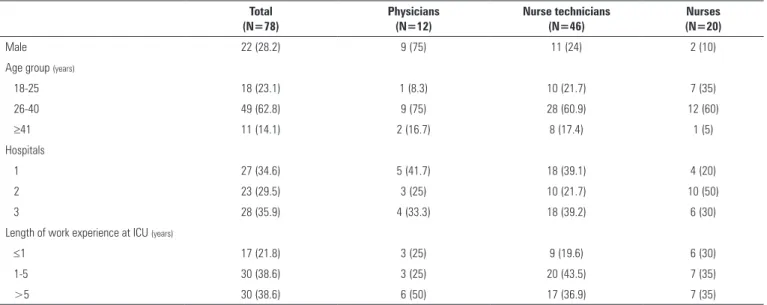
A total of 78 professionals participated in the study (61.4% of the total professionals), of whom 59.0% were nurse technicians (N=46), 25.7% nurses (N=20), and 15.3% physicians (N=12). Eight professionals on vacation, 5 professionals on sick leave, and 36 who either did not return or did not properly answer the survey questionnaire were excluded from the study. Table 1 shows the demographic proile of the participants.
Among the professionals, 37.2% (N=29) had received some training on this subject (characterization of diarrhea), and of this group, 27.0% (N=21) reported that they received this training during college, 8.9% (N=7) in the work institution, and only 1.3% (N=1) in courses or meetings.
When the professionals were asked about the deinition of diarrhea (single-answer question), 39 (50.0%) responded that diarrhea is “liquid or pasty stools” regardless of frequency, while the other 39 (50.0%) responded that diarrhea was characterized by an increased number of daily bowel movements, with large variability observed for the frequency (Figure 1).
Regarding the most common causes of diarrhea among ICU patients, the two most common responses were “diet”
Table 1 - Interviewees’ demographic characteristics (N=78)
Total (N=78)
Physicians (N=12)
Nurse technicians (N=46)
Nurses (N=20)
Male 22 (28.2) 9 (75) 11 (24) 2 (10)
Age group (years)
18-25 18 (23.1) 1 (8.3) 10 (21.7) 7 (35)
26-40 49 (62.8) 9 (75) 28 (60.9) 12 (60)
≥41 11 (14.1) 2 (16.7) 8 (17.4) 1 (5)
Hospitals
1 27 (34.6) 5 (41.7) 18 (39.1) 4 (20)
2 23 (29.5) 3 (25) 10 (21.7) 10 (50)
3 28 (35.9) 4 (33.3) 18 (39.2) 6 (30)
Length of work experience at ICU (years)
≤1 17 (21.8) 3 (25) 9 (19.6) 6 (30)
1-5 30 (38.6) 3 (25) 20 (43.5) 7 (35)
>5 30 (38.6) 6 (50) 17 (36.9) 7 (35)
ICU - intensive care unit. Results expressed in number (%).
Figure 1 - Definition of diarrhea according to the interviewees (single-answer questions).
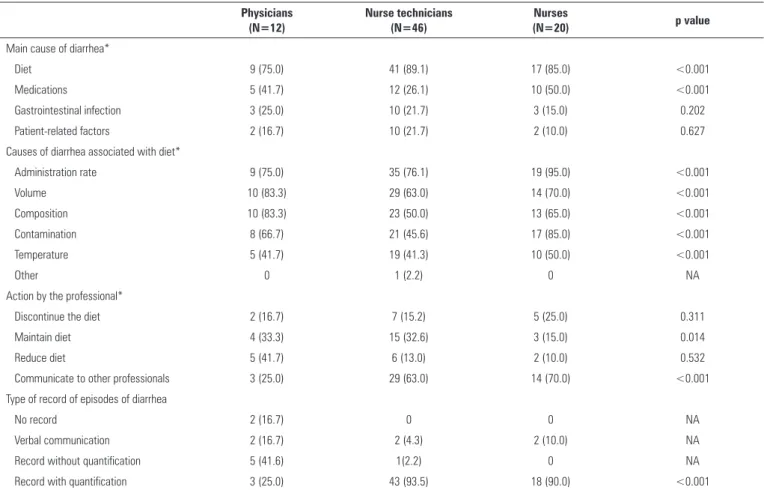
and “use of medications”, with a statistically signiicant diference among the professionals (p<0.001) (Table 2). he percentage of professionals who indicated diet as the main cause of diarrhea ranged from 75% (physicians) to 89.1% (nurse technicians). Among the factors associated with diet (volume, infusion rate, temperature, composition, and contamination of enteral nutrition formula), diferences were observed for all items among the interviewed health care professionals (<0.001) (Table 2).
Table 2 - Results from questionnaires
Physicians (N=12)
Nurse technicians (N=46)
Nurses
(N=20) p value
Main cause of diarrhea*
Diet 9 (75.0) 41 (89.1) 17 (85.0) <0.001
Medications 5 (41.7) 12 (26.1) 10 (50.0) <0.001
Gastrointestinal infection 3 (25.0) 10 (21.7) 3 (15.0) 0.202
Patient-related factors 2 (16.7) 10 (21.7) 2 (10.0) 0.627
Causes of diarrhea associated with diet*
Administration rate 9 (75.0) 35 (76.1) 19 (95.0) <0.001
Volume 10 (83.3) 29 (63.0) 14 (70.0) <0.001
Composition 10 (83.3) 23 (50.0) 13 (65.0) <0.001
Contamination 8 (66.7) 21 (45.6) 17 (85.0) <0.001
Temperature 5 (41.7) 19 (41.3) 10 (50.0) <0.001
Other 0 1 (2.2) 0 NA
Action by the professional*
Discontinue the diet 2 (16.7) 7 (15.2) 5 (25.0) 0.311
Maintain diet 4 (33.3) 15 (32.6) 3 (15.0) 0.014
Reduce diet 5 (41.7) 6 (13.0) 2 (10.0) 0.532
Communicate to other professionals 3 (25.0) 29 (63.0) 14 (70.0) <0.001
Type of record of episodes of diarrhea
No record 2 (16.7) 0 0 NA
Verbal communication 2 (16.7) 2 (4.3) 2 (10.0) NA
Record without quantification 5 (41.6) 1(2.2) 0 NA
Record with quantification 3 (25.0) 43 (93.5) 18 (90.0) <0.001
* Multiple-answer questions. Results expressed in number (%). Chi-square test.
Respondents were asked about how the diarrhea episodes were recorded, with options for a single daily record in the patient diary (checklist); a record in the shift report, mentioning the consistency, frequency, or volume of diarrhea; or verbal communication without any entry in the patient’s medical record. In this question, some of the physicians reported not routinely recording and quantifying events of diarrhea in the patient’s medical record (Table 2).
DISCUSSION
he majority of the professionals who participated in this study were from the nursing department, and a great disparity was observed regarding nutritional practices during an episode of diarrhea.
It is known that a proper nutritional procedure can inluence most of the items mentioned above, and therefore, knowledge regarding appropriate strategies of care is critical in the management of these patients. he same is true for complications, especially gastrointestinal ones (diarrhea and constipation), which can cause,
result from, or occur associated with disorders linked to malnutrition.
herefore, questionnaires designed to assess the level of knowledge of the health care professionals specialized in nutrition therapy are important tools to map practices and identify performance in internal continuing education programs.
In this study, the opinions and practices of the professionals who work directly with ICU patients showed great variability in the approach and management of diarrhea, including the deinition of the condition. Variations were observed among professionals working at the same hospital and among professionals of the same category, which makes the standardization of practices more diicult.
observed in the literature, which shows great variability in the deinition of diarrhea.(12,16,19) In a questionnaire administered to professionals working at hospitals, ICU nurses considered the frequency of bowel movements to deine diarrhea, while nurses in a neurological unit considered the liquid consistency of stools to be the more important factor for the diagnosis of diarrhea.(12)
Regarding the opinions of the causes of diarrhea assessed in this study, more than half of the respondents in each group indicated enteral nutrition as a primary factor. his inding can be partially explained by the fact that the interviews were conducted by the nutritionists of the institutions, which could inluence these responses. he concept of diarrhea itself could inluence these responses in the group of respondents who consider stool volume to be a criterion in the deinition of diarrhea because infectious diarrhea tends to be more severe and voluminous.(15) Another factor that could inluence the results is that the diagnosis of infectious diarrhea, particularly caused by Clostridium difficile, is unusual and diicult,(20) which could contribute to its underdiagnosis. Among 141 patients with diarrhea in Spanish ICU, only 5% of cases were associated with Clostridium difficile.(21)
Regarding the etiology of diarrhea associated with enteral nutrition, there was no consensus within the group or among the groups, and all variables were signiicantly diferent. Intensivist nurses who were interviewed about practices and opinions in regard to enteral nutrition reported that the most common causes of diarrhea were associated with the use of antibiotics or the composition of enteral nutrition.(22) he infusion method of enteral nutrition is also indicated as a risk factor for developing diarrhea. In a comparative study, a signiicant diference was observed in the incidence of diarrhea in a group of patients who used enteral nutrition in a closed enteral feeding system with tighter control of the drip rate.(23)
he most common response of the nursing team about their practice in regard to diarrhea in patients with enteral nutrition was to notify other professionals (p<0.001); in contrast, among the physicians, almost half decided to reduce or maintain the diet. Even more worrying was the fact that when the decision was to communicate the problem to other professionals, only in 38.8% of the cases was this professional the nutritionist. It is important to emphasize that the performance of a multidisciplinary team improves the eiciency of
nutrition therapy in hospitalized patients, in addition to reducing complications, hospital costs,(24) and unnecessary procedures such as discontinuing the enteral feeding.(11,25)
A study with Brazilian nurses(12) and physicians working in intensive care(26) (54% were certiied intensivists) demonstrated a great discrepancy in both the deinition of diarrheal stools in ICU patients and the practices in a illustrative case of diarrhea in the ICU. In this study,(26) the majority of the interviewees reported diiculty in organizing an enteral nutrition program for critically ill patients.
he number of misdiagnoses was reduced after the implementation of a training program for nursing professionals about the deinition of diarrhea.(27) herefore, this study can help to identify the actual approach and practices of health care professionals within a hospital in regard to the gastrointestinal management of patients, aiming to establish clinical protocols based on evidence and experience.(28)
his study had certain limitations. he researcher delivered the questionnaires to the participant and collected them after approximately 30 minutes, without any conidentiality criterion. Despite the absence of validation (pre-test), the time and the nature of the questions were apparently not limitations to completing the questionnaire. However, the researchers were the nutritionists of the hospitals that participated in the study, which could have inluenced the answers, given that the participants might be embarrassed to describe what they know and/or what they do. he number of analyzed professionals and the number of institutions (three institutions) limit the generalizability of these data.
CONCLUSIONS
he analysis of the responses of a questionnaire administered to health care professionals working in adult intensive care units showed that opinions on and knowledge about diarrhea in hospitalized patients were discrepant, varying among the studied groups. Likewise, the practices of the health professionals were also divergent.
Objetivo: Avaliar opiniões e condutas de proissionais atu-antes em unidades de terapia intensiva relacionadas à diarreia do paciente grave.
Métodos: Estudo transversal, multicêntrico realizado com proissionais de saúde de três unidades de terapia intensiva de adultos. Os participantes responderam individualmente a um questionário autoaplicável sobre tempo de atuação proissional em terapia intensiva; deinição, caracterização e causas da diar-reia; formas de registro no prontuário; e treinamentos recebidos.
Resultados: Participaram 78 proissionais, sendo 59,0%
técnicos em enfermagem, 25,7% enfermeiros e 15,3% médicos; 77,0% trabalham em terapia intensiva há mais de 1 ano. Apenas 37,2% tinham realizado previamente algum treinamento rela-cionado. Metade dos entrevistados caracterizou diarreia como
“evacuações líquidas e/ou pastosas” independentemente da frequência, enquanto os outros 50,0% caracterizaram pelo au-mento do número de episódios diários de evacuações. A maioria referiu a dieta como principal fator causal da diarreia, seguida de “uso de medicamentos” (p<0,001). Foram detectadas condutas nutricionais distintas entre os proissionais pesquisados frente a um episódio de diarreia, no tocante a suspender, manter ou reduzir a dieta; os médicos referiram não ter o hábito de comu-nicar a outro proissional (por exemplo, o nutricionista), assim como não referiram o hábito de registrar e quantiicar os eventos de diarreia no prontuário.
Conclusão: Detectou-se pluralidade de opiniões e atitudes dos proissionais de terapia intensiva relacionadas à diarreia. RESUMO
Descritores: Diarreia; Terapia nutricional; Questionários; Unidades de terapia intensiva
REFERENCES
1. Agudelo GM, Giraldo NA, Aguilar N, Barbosa J, Castaño E, Gamboa S, et al. Incidencia de complicaciones del soporte nutricional en pacientes críticos: estudio multicéntrico. Nutr Hosp. 2011;26(3):537-45.
2. Ukleja A. Altered GI motility in critically ill patients: current understanding of pathophysiology, clinical impact, and diagnostic approach. Nutr Clin Pract. 2010;25(1):16-25.
3. Btaiche IF, Chan LN, Pleva M, Kraft MD. Critical illness, gastrointestinal complications, and medication therapy during enteral feeding in critically ill adult patients. Nutr Clin Pract. 2010;25(1):32-49. Review.
4. McClave SA, Martindale RG, Vanek VW, McCarthy M, Roberts P, Taylor B, Ochoa JB, Napolitano L, Cresci G; A.S.P.E.N. Board of Directors; American College of Critical Care Medicine; Society of Critical Care Medicine. Guidelines for the Provision and Assessment of Nutrition Support Therapy in the Adult Critically Ill Patient: Society of Critical Care Medicine (SCCM) and American Society for Parenteral and Enteral Nutrition (A.S.P.E.N.). JPEN J Parenter Enteral Nutr. 2009;33(3):277-316.
5. Sabol VK, Carlson KK. Diarrhea: applying research to bedside practice. AACN Adv Crit Care. 2007;18(1):32-44.
6. Whelan K. Enteral-tube-feeding diarrhoea: manipulating the colonic microbiota with probiotics and prebiotics. Proc Nutr Soc. 2007;66(3):299-306. 7. López-Herce J. Gastrointestinal complications in critically ill patients: what
differs between adults and children? Curr Opin Clin Nutr Metab Care. 2009;12(2):180-5.
8. Luft VC, Beghetto MG, de Mello EZ, Polanczyk CA. Role of enteral nutrition in the incidence of diarrhoea among hospitalized adult patients. Nutrition. 2008;24(6):528-35.
9. Thorson MA, Bliss DZ, Savik K. Re-examination of risk factors for non-Clostridium difficile-associated diarrhoea in hospitalized patients. J Adv Nurs. 2008;62(3):354-64.
10. Cresci GA. Clinical research: The use of probiotics with the treatment of diarrhea. Nutr Clin Pract. 2001;16(1):30-4.
11. Wiesen P, Van Gossum A, Preiser JC. Diarrhoea in the critically ill. Curr Opin Crit Care. 2006;12(2):149-54. Review.
12. Whelan K, Judd PA, Tuohy KM, Gibson GR, Preedy VR, Taylor MA. Fecal microbiota in patients receiving enteral feeding are highly variable and may be altered in those who develop diarrhea. A J Clin Nutr. 2009;89(1):240-7. 13. Oliveira SM, Burgos MG, Santos EM, Prado LV, Petribú MM, Bomfim
FM. Complicações gastrointestinais e adequação calórico-protéica de pacientes em uso de nutrição enteral em uma unidade de terapia intensiva. Rev Bras Ter Intensiva. 2010;22(3):270-3.
14. World Health Organization. The treatment of diarrhoea. A manual for physicians and other senior health workers [internet]. 4th rev. Geneva:
World Health Organization; 2005. p. 1-44. [acesso 2012 out 13]. Disponível em: <http://whqlibdoc.who.int/publications/2005/9241593180.pdf>. 15. Ferrie S, East V. Managing diarrhoea in intensive care. Aust Crit Care.
2007;20(1):7-13.
16. Williams MS, Harper R, Magnuson B, Loan T, Kearney P. Diarrhea management in enterally fed patients. Nutr Clin Pract. 1998;13(5):225-9. 17. McKenna S, Wallis M, Brannelly A, Cawood J. The nursing management of
diarrhoea and constipation before and after the implementation of a bowel management protocol. Aust Crit Care. 2001;14(1):10-6.
18. Dorman BP, Hill C, McGrath M, Mansour A, Dobson D, Pearse T, et al. Bowel management in the intensive care unit. Intensive Crit Care Nurs. 2004;20(6):320-9.
19. Mobarhan S, DeMeo M. Diarrhea induced by enteral feeding. Nutr Rev. 1995;53(3):67-70.
20. Bobo LD, Dubberke ER. Recognition and prevention of hospital-associated enteric infections in the intensive care unit. Crit Care Med. 2010;38(8 Suppl):S324-34.
21. Izaguirre Guerricagoitia L, Truchelo Aragón A. Prevalencia de diarrea en las unidades de pacientes en estado crítico de España: estudio multicéntrico. Enferm Intensiva. 2011;22(2):65-73.
22. Marshall AP, West SH. Enteral feeding in the critically ill: are nursing practices contributing to hypocaloric feeding? Intensive Crit Care Nurs. 2006;22(2):95-105.
23. Watanabe S, Cukier C, Civelli S, Catalani LA, Muroya C. Impacto do sistema de infusão de dieta enteral sobre infecção respiratória e diarreia. Rev Bras Nutr Clín. 2008;23(1):46-50.
24. Leite HP, Carvalho WB, Santana e Meneses JF. Atuação da equipe multidisciplinar na terapia nutricional de pacientes sob cuidados intensivos. Rev Nutr. 2005;18(6):777-84.
25. Bellomo R. Nosocomial scatology in the intensive care unit. Crit Care Resusc. 2009;11(3):228-30.
26. Cunha HF, Salluh JI, França MF. Atitudes e percepções em terapia nutricional entre médicos intensivistas: um inquérito via internet. Rev Bras Ter Intensiva. 2010;22(1):53-63.
27. Kumbier M, Costa C, Barreto AL, Abreu AR, Gonzáles D, Spolidoro JV. Análise dos registros de evacuações pela equipe de enfermagem em pacientes com nutrição enteral (NE): redução de registro de diarréias após treinamento. Rev Bras Nutr Clín. 2009;24(3):155-8.