Intensity of climacteric symptoms in postmenopausal women
Intensidade da sintomatologia climatérica em mulheres pós-menopausa
Thaiene Rodrigues dos Santos1, Sandra Valéria Martins Pereira1, Renato Lopes Santos1
Objective: to evaluate the characteristics and intensity of climacteric symptoms in postmenopausal women.
Methods: a cross-sectional, descriptive study with systematic sampling, consisting of 247 women in post menopause, who answered the Questionnaire of Women’s Health. To evaluate the intensity of climacteric symptoms the Menopausal Index of Blatt and Kupperman was used. Statistical analysis was performed using
the Statistical Package for Social Sciences software version 17, a significance level of 5% and 95% confidence
intervals for all analyzes were adopted. Results: 36.8% of women had mild climacteric symptoms, 56.3%
moderate and 6.9% severe. In descending order hot flushes, irritability and sleep disorders reached the highest
intensity ratios. Conclusion: the Menopausal index of Blatt and Kupperman (25.34) showed symptoms of
moderate intensity. Hot flushes showed to be the symptom of highest intensity of discomfort.
Descriptors: Climacteric; Postmenopause; Signs and Symptoms.
Objetivo: avaliar as características e a intensidade da sintomatologia climatérica em mulheres pós-menopausa.
Métodos: estudo transversal, descritivo. Amostra sistemática, composta de 247 mulheres em pós-menopausa, que responderam ao Questionário de Saúde da Mulher. Para avaliação da intensidade da sintomatologia climatérica, utilizou-se o Índice Menopausalde Blatt e Kupperman. Aanálise estatística foi realizada no software Statistical Package for the Social Sciences versão 17. Adotou-se nível de significância de 5% e intervalo de confiança 95% para todas as análises. Resultados: 36,8% das mulheres apresentaram sintomatologia climatérica leve, 56,3%
moderada e 6,9% severa. Em ordem decrescente fogachos, irritabilidade e distúrbios do sono alcançaram os
maiores índices de intensidade. Conclusão: o índice global Menopausalde Blatt e Kupperman (25,34) indicou
sintomatologia de intensidade moderada. Fogacho mostrou-se o sintoma de maior intensidade de desconforto.
Descritores: Climatério; Pós-menopausa; Sinais e Sintomas.
Introduction
The increase in life expectancy in all regions
of the world except in sub-Saharan Africa, implies in
the increase of female longevity and time of life after
menopause. The estimate for 2030 is that about 1200
million women will be in menopause transition(1).
The climacteric comprises the passing of the female reproductive stage to the non-reproductive
one, before and after the last period, usually between 40-65 years of age. In this phase multidimensional clinical manifestations are perceived subjectively by
women from different parts of the world(1-2).
In most cases, vasomotor symptoms are the
first to affect women. There are reports that hot flushes and night sweats cause intense discomfort. In
the medium and long term range, neuropsychiatric, urinary, sleep and sexuality disorders, if not controlled, can jeopardize the quality of life(3).
In Latin America, in general, menopause occurs
between 43.8 to 53 years of age, which is below to
the one found in developed countries. The effects of
menopause for women in this region have been of
special concern to international health organizations due to the accelerated process of population aging and
social vulnerability experienced there(2).
In Brazil, the age structure of the last decade shows the same tendency to the intense population aging registered in other countries of Latin America.
The estimated life expectancy is 78.5 years, with emphasis on the increase of the 45-year-old segment
or more, as well as the female population(4). Thus, there is expected gradual increase in the demand for
health services by women with problems related to
menopause(5).
In this context, due to the disparity in the
distribution of health services in the country, many women, due to lack of knowledge, attribute, solely and exclusively, to menopause the burden of symptoms,
making this period the most feared stage of their
lives. One has to note that these symptoms may be associated to clinical co-morbidities, as well as to
demographic, socioeconomic, ethnic and cultural factors and the distortion of their real causes hinders
the ability of coping with those and consequent self-care by part of that population(6).
Facing the above problems, it is worth recalling
that the approach of women in menopausal condition
follows the global consensus, which recommends, in any field of health sector, overcoming the mechanistic
and reductionist issues through a holistic approach. The new integrative and not exclusionary paradigm is
guided by the concept of health promotion, focusing
on raising the quality of life. However, in Brazil, similar to Latin America, this process has faced many
obstacles, making its implementation a challenge to
managers and health professionals(5).
The evaluation of the intensity of symptoms, related factors and the multiple effects of Climacteric Syndrome in health and quality of life of population
groups of interest, has been the objective of scientific
studies worldwide(3,5-10).
This study aimed at evaluating the characteristics and intensity of climacteric symptoms in postmenopausal women.
Methods
It is a cross-sectional study. The sampling consisted of climacteric women in the postmenopausal
period, 45-60 years old, living in the county of Anapolis,
GO. This county is located in the central highlands of
Brazil, with an area of 917.011 km2 and urbanization of 97.3%. The female population in 2010 was 177,410, of which 28,786 were in the age group of 45-60 years,
considered at risk of menopause(11).
20.0% for possible losses was calculated.
There was a research with high flow of women
in the age group of interest was made in the following
venues: basic health units, associations, street markets, squares and public parks and malls.
The time measured in months of the last
menstrual period based the classification of
menopausal status. It was considered menopausal women in permanent cessation state of menstruation for at least 12 consecutive months of amenorrhea
without obvious pathological or physiological cause(1). For inclusion in the study, the following criteria
were used: women with 45-60 years of age who reported being in post-menopausal period and the
ones who were alone at the time of data collection to
avoid embarrassment and information bias.
A systematic sampling was adopted, and the
street markets, squares, parks and malls became a starting point for selection of the sample the first
woman included in the study, and from then on the
interval of 1:3 was adopted. At first, In the basic health
units and associations, the researchers made a list of
women who were eligible for the study from medical records or their own records. In each list of 50 women, the first woman was chosen at random and from then
on the interval 1: 3 was adopted.
Data collection occurred in September 2015, when 279 women were approached and from those 247 were interviewed, with a proportion of 11.0%
non-response. The participants answered a written
interview by data collection instrument adapted from the Women’s Health Questionnaire (WHQ),
Portuguese version, which was supplemented with questions to research socioeconomic, cultural and gynecological factors. In addition, the menopausal
index of Blatt and Kupperman (MIBK) was attached to the instrument for analysis and classification of the
intensity of climacteric symptoms.
The Women’s Health Questionnaire is an instrument for the evaluation of physical and mental
37 questions, divided into nine areas, which evaluate: depressed mood, somatic symptoms, cognitive impairment, vasomotor symptoms, anxiety, sexual
function, sleep problems, menstrual problems and
self-esteem. It offers a structured format, with options of response in the scales of Likert of four-points: yes,
definitely yes, sometimes, not much and no in all
areas(10).
The MIBK allows the analysis and classification
of the intensity of climacteric symptoms in menopausal
obtained by the evaluation rating scales. It includes 11
symptoms or complaints: vasomotor, paraesthesia, insomnia, nervousness, melancholia, vertigo, fatigue, arthralgia/myalgia, headache, palpitations and
tingling, classified in mild, moderate and severe,
corresponding to the numerical values 1, 2 and 3,
respectively. Subsequently different weights should be assigned to the symptoms: vasomotor, weight 4, paresthesia, sleep disorders and irritability, weight 2
and the others weight 1. In the end, the overall index
is obtained by summing the scores achieved in each symptom, which leads to the following classification: mild intensity ≤19, moderate intensity ≥ 20 and ≤35 and severe intensity> 35. WHQ highest score in the
domains corresponds to the highest score in this index(12).
Fellows and assistants of properly trained researchers applied the questionnaires presented
above.
The descriptive statistical analysis used the Statistical Package for the Social Sciences version 17®. significance level adopted was 5.0% and 95.0% confidence interval for the entire
analysis. Demographic, socioeconomic, cultural and gynecological factors were dichotomized and coded in
0 and 1 for identification of absolute and percentage distributions. The average and standard deviation for
BKMI scores were found.
Results
The age of participants ranged from 45-60 years on average 52 years (± 5.07). According to their
information, the age of occurrence of menopause
ranged from 28-59 years on average 47.43 (± 4.70).
All were postmenopausal women, the amenorrhea
time ranged from 1-32 years on average of 5 years. More than 70.0% had a husband or stable mate, the rest were single or widowed, 80.2% reported they
were sexually active.
The demographic and socioeconomic profile
shows low levels of education, employment and
household income, 48.2% less than eight years of study, 37.7% between 8 and 12 years, 9.7% over 12 years and 4.5% reported to be illiterate, 58.7% were housewives, 59.5% reported family income of 1-5 minimum wages, 24.7% less than a minimum wages and 15.8% more than six.
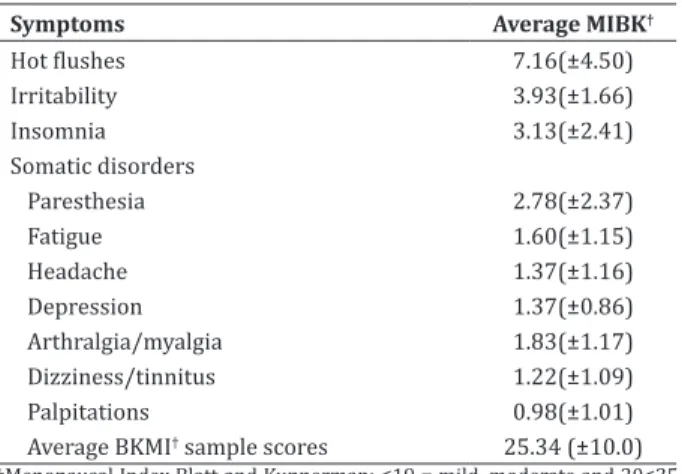
Tables 1 and 2 show the distribution of
climacteric symptoms according to the intensity and MIBK in postmenopausal women in the county of the research.
It can be seen from Table 1 that the frequency of symptoms found in descending order was: irritability (92.0%), depression (80.2%), hot flushes (79.8%), arthralgia / myalgia (77.7%) fatigue (73.3%), sleep disorders (70.9%), headache (65.9%), numbness or tingling (64.0%), dizziness and / or tinnitus (62.4%) and palpitations (55.9%). It is observed
that palpitation appeared less frequently. In contrast,
irritability had the highest prevalence and was considered as severe intensity (31.6%) and moderate intensity (48.2%) were considered by the majority. Depression, reported by 80.2% of women had the
second most frequently occurrence. However, only
6.9% considered it with severe intensity. Myalgia
was highlighted as the symptom with the highest
proportion of severe intensity (39.3%).
Table 1 - Distribution of postmenopausal women
with 40-65 years of age, the frequency and intensity
of climacteric symptoms and to the Menopausal Index of Blatt and Kupperman
Climacteric symptoms Absent Mild Moderate Severe n(%) n(%) n(%) n(%) Irritability 20(8.10) 30(12.1) 119(48.2) 78(31.6)
Depression 49(19.8) 87(35.2) 94(38.1) 17(6.90)
Hot flushes 50(20.2) 41(16.6) 67(27.1) 89(36.0)
Arthralgia/myalgia 55(22.3) 28(11.3) 67(27.1) 97(39.3)
Tiredness/fatigue 66(26.7) 34(13.8) 80(32.4) 67(27.1)
Sleep disorders 72(29.1) 39(15.8) 60(24.3) 76(30.8)
Headache 84(34.1) 39(15.9) 74(30.1) 49(19.9)
Paresthesia/tingling 89(36.0) 27(10.9) 78(31.6) 53(21.5)
Vertigo/dizziness/tinnitus 93(37.6) 40(16.2) 81(32.8) 33(13.4)
Palpitations 109(44.1) 55(22.3) 63(25.5) 20(8.10)
MIBK† - 91(36.8) 139(56.3) 17(6.90) †Menopausal Index of Blatt and Kupperman: ≤19 = mild, moderate and 20≤35
=> 35 = severe intensity
Tables 1 and 2 shows that according to the
MIBK, there was a predominance of climacteric
symptoms of moderate intensity (56.3%), followed by mild symptoms of 36.8% and 6.9% severe symptoms. The hot flushes appear as a symptom of more severe intensity. The MIBK (25.34) reveals moderate
symptoms.
Table 2 - Average Distribution of intensity of
climacteric symptoms in postmenopausal women according to the Menopausal Index of Blatt and Kupperman
Symptoms Average MIBK†
Hot flushes 7.16(±4.50)
Irritability 3.93(±1.66)
Insomnia 3.13(±2.41)
Somatic disorders
Paresthesia 2.78(±2.37)
Fatigue 1.60(±1.15)
Headache 1.37(±1.16)
Depression 1.37(±0.86) Arthralgia/myalgia 1.83(±1.17) Dizziness/tinnitus 1.22(±1.09) Palpitations 0.98(±1.01) Average BKMI† sample scores 25.34 (±10.0)
Discussion
Latin American women experience menopause earlier than the ones in developed countries(2). It
is observed the same pattern in Annapolis, where menopause occurred with an average of five years before the average age found in Europe and North
America(3) and a little before Latin America(2). This
information is relevant by scientific evidence that
early menopause increases the risk of osteoporosis, cardiovascular disease and discomfort due mainly
to hot flushes and night sweats, pain and emotional
limitations(2-3).
Another aggravating factor in the condition of climacteric women in Annapolis is the social
vulnerability expressed by low levels of education, employment and income. Unfavorable social
framework similar to that found in Latin America(2). It is important to consider that the lack of access to health
services and programs exacerbates the situation,
making the enhancement of services of health care
important, aiming at better levels of quality of life for
this population.
Somatic symptoms were found among women in the sampling, such as fatigue, headache, dizziness and tinnitus, paresthesia. Similar results were found for all of these symptoms in women from Maceio, AL, Brazil(13).
Hot flushes were found in 79.8% of women, 36.0% considered them of severe intensity. This
symptom achieved the highest intensity score MIBK.
Hot flushes are sudden heat waves, which cause
severe discomfort, along with night sweats are the most common complaints from climacteric women. Vasomotor symptoms cause severe discomfort in many women during the menopause transition, with a
negative impact on quality of life and ability to work(3). Similar results were found in climacteric
women in counties of the Northeastern region of
the country(13-14). In Latin American countries, the
of vasomotor symptoms(2).
The prevalence and degree of intensity of
hot flushes in menopausal women may be related
to menopausal status and age(9). Women of a metropolitan region of southeastern Brazil showed
greater intensity of symptoms before and after two
years of menopause, so the more advanced the age, the less severe the symptoms were(8).
Most women (92.0%) complained of irritability, only 12.0% considered mild and other moderate
or severe intensity. The MIBK average found for
this symptom was the second highest, behind hot flushes. Similar prevalences were found in studies
with climacteric women living in other parts of the country(13-15). In the county of Passo Fundo in southern
Brazil, irritability, low education level and memory
loss were considered risk factors for mild psychiatric disorders in women in menopause transition who
underwent an outpatient screening followed by home
care(16).
Mild depression was present in 80.2% of women. Episodes of depression may be associated to hormonal fluctuations, characteristic of
perimenopause and often other extrinsic factors such as socioeconomic conditions, changes in the pace of life and/or family structure(3).
During the menopause transition, vasomotor
and psychological symptoms can cause significant
discomfort for most women, having an impact on their
quality of life and ability to work. Perimenopause has been described as a gateway to vulnerability to depression. However, there is debate about the
extent that the mood disorder and depression are related to menopause. In clinical practice, there
are many women who report to be depressed due
to menopause, and many of them receive medical diagnosis of depression(3,16).
A study made in a metropolitan area of
the southeast found an association between the
presence of anxiety and/or depression and the
Systematic revision of the literature found an
association between vasomotor symptoms and
depressive symptoms(17).
Fatigue was reported as a complaint by 73.3% of women. It was observed that this symptom appeared
in greater proportion in the county of Passo Fundo where women had complaints of fatigue at all stages of menopause transition(16). A multicentered study in the United States of America has found an association
between early menopause and the occurrence of
fatigue and lack of energy(3).
Myalgia was found in 77.7% of women, 39.3% presented severe intensity and 27.1% moderate.
Similar results were found in household survey in the county of Maceió, Alagoas, with climacteric women
in the same age group, where 81% of them reported myalgia and arthralgia, 43.5% of severe intensity and 33.0% moderate (13). In the state of Acre, 74.8% of postmenopausal women had this symptom(15).
Sleep disorders were referred by 71.0% of women, more 55.0% presented moderate or severe
intensity of insomnia, the MIBK average was the third
highest of the identified symptoms. It is interesting to observe that hot flushes are considered as a common cause of insomnia during menopause. Night Heat waves may be responsible for the increase of episodes
of nocturnal awakening and the reduction of sleep(18).
Palpitations were found in 55.9% of women in Anapolis, where only 8.1% presented severe intensity.
Similar frequency of this symptom was present in climacteric women assisted in a Health Family Unit of
Recife, Pernambuco(14).
Over 80.0% of women reported to have active
sex life. It is interesting to consider that the age at which women experience the postmenopause period coincides with a reduction in professional duties and household chores, providing more time for sexual activities. In a study of the population
developed in a Basic Health Unit in Natal, Rio Grande do Norte, a proportionally inverse relationship was found, with a level of statistical significance between
climacteric symptoms and sexual function. Women
with climacteric symptoms showed greater chance of sexual dysfunction(19).
In the same study, symptoms of psychological
domain, such as depressed mood, irritability, anxiety,
and physical and mental exhaustion presented
statistically significant association with sexual
dysfunction(19). However, it is important to take into
account that other biopsychosocial factors may influence sexual function.
According to the MIBK scores 56.3% of women
in Annapolis had moderate symptoms. Similar data were found in a study of women in post-menopausal
period in Rio Grande do Norte(20). A study conducted
in China, with women with similar characteristics also predominated symptoms of moderate intensity(12).
This study identified the characteristics and distribution of climacteric symptoms, and also to know
their intensity among women in post menopause period in the county of research. This information is important to estimate the impact of menopause on the welfare and quality of life of this population.
However, considering the subjectivity that the menopause transition is experienced by the woman,
a more precise interpretation should consider the
importance of the influence of socioeconomic, ethnic
and cultural factors in symptoms.
However, this study showed the characteristic limitations of the cross-work design, not allowing the elucidation of factors related to the intensity of climacteric symptoms. Thus, the results found provoke deeper questioning on the event, pointing to the need to develop studies with designs that allow the inference of these factors.
Conclusion
The results of this study show that post-menopausal women showed climacteric symptoms predominantly of moderate intensity. The proportion
of severe symptoms intensity was low. Hot flushes, irritability and sleep disorders had higher intensity
It is known that the higher the MIBK is, the more intense the climacteric symptoms and
their negative influence on quality of life will be. Therefore, it is concluded that the global intensity of symptoms points to moderate disturbance of quality of life, highlighting hot flushes as the most intense and uncomfortable symptoms.
Knowing the intensity and climacteric symptoms characteristic in the county of research
may guide the selection of efficient strategies and actions aiming at a whole approach, clarifying doubts
and motivation of the population of interest to health promotion and raising the quality of life.
Acknowledgement
The Conselho Nacional de Desenvolvimento
Científico e Tecnológico for the financial support to the research. Process No. 144963/2014-0.
Collaborations
Santos TR contributed in the writing of the
article and relevant critical revision of the intellectual
content. Pereira SVM contributed to the conception, design and final approval of the version to be published. Santos RL contributed to the analysis and
interpretation of data.
References
1. World Health Organization. Research on the
menopause in the 1990s: report of a WHO scientific group. WHO technical report series.
[Internet]. Geneva: World Health Organization;
1996 [cited 2015 Oct 11]. Available from: http:// apps.who.int/iris/bitstream/10665/41841/1/
WHO_TRS_866.pdf
2. Palacios S, Henderson VW, Siseles N, Tan D,
Villaseca P. Age of menopause and impact of
climacteric symptoms by geographical region. Climacteric. 2010; 13(5):419-28.
3. Hess R, Thurston RC, Hays RD, Chang CC, Dillon
SN, Ness RB, et al. The impact of menopause on
health-related quality of life: results from the stride longitudinal study. Qual Life Res On line
[Internet]. 2012 [cited 2014 Nov 10]; 21(3):535-44. Available from: http://doi.org/10.1007/ s11136-011-9959-7
4. Instituto Brasileiro de Geografia e Estatística.
Ministério do Planejamento, Orçamento e Gestão. Síntese de indicadores sociais: uma análise das
condições de vida da população brasileira - 2014. Rio de Janeiro: IBGE; 2014.
5. Lorenzi DRS, Catan LB, Moreira K, Ártico
GR. Assistência à mulher climatérica: novos
paradigmas. Rev Bras Enferm. 2009; 62(2):287-93.
6. Valença CN, Germano RM. Concepções de mulheres sobre menopausa e climatério. Rev Rene. 2012; 11(1):161-71.
7. De Lorenzi DRS, Catan LB, Cusin T, Felini R, Bassani F, Arpini AC. Caracterização da qualidade de vida segundo o estado menopausal entre mulheres da Região Sul do Brasil. Rev Bras Saúde Mater Infant.
2009; 9(4):459-66.
8. Lui Filho JF, Baccaro LFC, Fernandes T, Conde
DM, Costa-Paiva L, Pinto NAM. Epidemiologia
da menopausa e dos sintomas climatéricos em mulheres de uma região metropolitana no sudeste do Brasil: inquérito populacional domiciliar. Rev
Bras Ginecol Obstet. 2015; 37(4):152-8.
9. Blümel JE, Chedraui P, Baron G, Belzares E,
Bencosme A, Calle A, et al. A large multinational study of vasomotor symptom prevalence, duration, and impact on quality of life in
middle-aged women. Menopause. 2011; 18(7):778-85. 10. Silva Filho CR, Baracat EC, Conterno LO, Haidar
MA, Ferraz MB. Climacteric symptoms and quality of life: validity of women’s health questionnaire.
Rev Saúde Pública. 2005; 39(3):333-9.
11. Ministério da Saúde (BR). Sala de apoio à gestão estratégica (SAGE). [Internet]. 2015 [citado 2014
maio 30]. Disponível em: http://189.28.128.178/
sage/
13. Araújo JBS, Santos GC, Nascimento MA, Dantas JGS, Ribeiro ASC. Avaliação da intensidade da
sintomatologia do climatério em mulheres: Inquérito populacional na cidade de Maceió,
Alagoas. Ciênc Biol Saúde. 2015; 2(3):101-11. 14. Paiva ER, Silva MM, Oliveira CDB, Leal IHS, Araújo
VS, Dias MD. Manifestações climatéricas mais frequentes entre mulheres de uma unidade
de saúde da família. Rev Enferm UFPE On line [Internet]. 2013 [citado 2015 fev 22]; 7(11):6430-7. Disponível em: http://www.revista.ufpe.br/
revistaenfermagem/index.php/revista/article/
view/3793/pdf_3902.
15. Silva AR, Tanaka ACA. Factors associated with
menopausal symptoms severity in middle-aged Brazilian women from the Brazilian Western
Amazon. Maturitas 2013; 76(1):64-9.
16. Oppermann K, Fuchs SC, Donato G, Bastos CA, Spritzer PM. Physical, psychological, and meno-pause-related symptoms and minor psychia-
tric disorders in a community-based sample of
Brazilian premenopausal, perimenopausal, and
postmenopausal women. Menopause. 2012; 19(3):355-60.
17. Worsley R, Bell R, Kulkarni J, Davis SR. The
association between vasomotor symptoms and
depression during perimenopause: a systematic
review. Maturitas. 2014; 77(2):111-7.
18. Hachul H, Bittencourt LRA, Soares Jr JM, Tufik S, Baracat EC. Sleep in post-menopausal women: Differences between early and late post-menopause. Eur J Obstet Gynecol Reprod Biol. 2009; 145(1):81-4.
19. Cabral PUL, Canário ACG, Spyrides MHC, Uchôa SAC, Eleutério JJ, Amaral RLG, et al. Influência dos sintomas climatéricos sobre a função sexual
de mulheres de meia-idade. Rev Bras Ginecol
Obstet. 2012; 34(7): 329-34.
20. Silveira IL, Petronilo PA, Souza MO, Silva TDNC,
Duarte JMBP, Maranhão TMO, et al. Prevalência de sintomas do climatério em mulheres dos meios