using hydrochemistry and stable isotopes in the Subei Lake basin,
Ordos energy base, Northwestern China
F. Liu1,2, X. Song1, L. Yang1, Y. Zhang1, D. Han1, Y. Ma1, and H. Bu1
1Key Laboratory of Water Cycle and Related Land Surface Processes, Institute of Geographic Sciences and Natural
Resources Research, Chinese Academy of Sciences, 11 A, Datun Road, Chaoyang District, Beijing, 100101, China
2University of Chinese Academy of Sciences, Beijing, 100049, China Correspondence to:X. Song ([email protected])
Received: 12 March 2014 – Published in Hydrol. Earth Syst. Sci. Discuss.: 28 May 2014 Revised: 17 October 2014 – Accepted: 17 December 2014 – Published: 28 January 2015
Abstract. A series of changes in groundwater systems caused by groundwater exploitation in energy base have been of great concern to hydrogeologists. The research aims to identify the origin and geochemical evolution of groundwa-ter in the Subei Lake basin under the influence of human ac-tivities. Water samples were collected, and major ions and stable isotopes (δ18O,δD) were analyzed. In terms of hy-drogeological conditions and the analytical results of hydro-chemical data, groundwater can be classified into three types: the Quaternary groundwater, the shallow Cretaceous ground-water and the deep Cretaceous groundground-water. Piper diagram and correlation analysis were used to reveal the hydrochem-ical characteristics of water resources. The dominant water type of the lake water was Cl-Na type, which was in accor-dance with hydrochemical characteristics of inland salt lakes; the predominant hydrochemical types for groundwater were HCO3–Ca, HCO3–Na and mixed HCO3–Ca–Na–Mg types.
The groundwater chemistry is mainly controlled by disso-lution/precipitation of anhydrite, gypsum, halite and calcite. The dedolomitization and cation exchange are also important factors. Rock weathering is confirmed to play a leading role in the mechanisms responsible for the chemical composition of groundwater. The stable isotopic values of oxygen and hy-drogen in groundwater are close to the local meteoric water line, indicating that groundwater is of modern local meteoric origin. Unlike significant differences in isotopic values be-tween shallow groundwater and deep groundwater in the Ha-bor Lake basin, shallow Cretaceous groundwater and deep Cretaceous groundwater have similar isotopic characteristics
in the Subei Lake basin. Due to the evaporation effect and dry climatic conditions, heavy isotopes are more enriched in lake water than in groundwater. The low slope of the regres-sion line ofδ18O andδD in lake water could be ascribed to a combination of mixing and evaporation under conditions of low humidity. Comparison of the regression line forδ18O andδD showed that lake water in the Subei Lake basin con-tains more heavily isotopic composition than that in the Ha-bor Lake basin, indicating that lake water in the discharge area has undergone stronger evaporation than lake water in the recharge area. Hydrochemical and isotopic information of utmost importance has been provided to decision makers by the present study so that a sustainable groundwater man-agement strategy can be designed for the Ordos energy base.
1 Introduction
ex-tracted from Jurassic strata and subsurface mining is com-mon. Local residents there mostly depend on groundwater on account of the serious shortage of surface water. Water re-sources support the exploitation of coal and development of related industries. In China, since 2011, all new construction projects must carry out an environment evaluation of ground-water consistent with the technical guidelines of the PRC Ministry of Environmental Protection (2011). It is of great-est significance in mining areas, because water resources are an essential component of the mining process (Agartan and Yazicigil, 2012). Over the past several decades, the quantity and quality of groundwater resources have been affected by the rapid development of coal mining. Haolebaoji well field of Subei Lake basin is a typical, large well field and acts as an important water source for this coalfield. However, large-scale and intensive groundwater exploitation could remark-ably influence the hydrochemical field of groundwater sys-tems in the study area. In recent years, with the fast develop-ment of Ordos energy base, more and more well fields have been built in some lake basins (including Haolebaoji well field newly built in the Subei Lake basin) in order to meet the increasing demand on water resources. However, due to a lack of adequate hydrogeological knowledge about these spe-cific lake basins and reasonable groundwater management strategies, water resources in these specific lake basins are currently subject to increasing pressure from altered hydrol-ogy associated with water extraction for regional develop-ment and groundwater over-exploitation has taken place. If it continues, it may cause a series of negative impacts on the groundwater-dependent ecosystem around these lakes. Thus, studies about the lake basins are urgently needed so as to obtain comprehensive knowledge of the hydrochemi-cal and isotopic characteristics, and geochemihydrochemi-cal evolution of groundwater under the background of intensive ground-water exploitation.
Research of groundwater and hydrogeology in the Ordos Basin has been conducted by numerous Chinese scholars and institutes because the Ordos Basin plays a vital role in nat-ural resources exploitation and national economic develop-ment. Most importantly, China Geological Survey Bureau has conducted some regional-scale research on groundwa-ter resources of Ordos Basin beginning in 1980s (Zhang et al., 1986; Hou et al., 2008). The previous research has clari-fied geology and hydrogeology and has provided a compre-hensive overview of quantity and quality of groundwater in this region, laying a solid foundation for the present study. However, regional-scale groundwater investigations may not provide much accurate information on the groundwater flow characteristics in small basins (Toth, 1963). Hence, it is also significant to implement local groundwater resource investi-gations. As Winter (1999) concluded that lakes in different part of groundwater flow systems have different flow char-acteristics. Data on hydrochemistry and stable isotopes of water were used to study the origin and geochemical evo-lution of groundwater in the Habor Lake basin (Yin et al.,
2009), which is located in the recharge zone. But other lakes in the runoff and discharge area still have not been studied so far. Due to the particularity of the discharge area, a vari-ety of hydrochemical effects such as evaporation, decarbon-ation, strong mixing action, etc., take place and result in ex-tremely complicated hydrochemical and isotopic characteris-tics. In addition, intensive groundwater withdrawal has dra-matically changed the local hydrologic cycle in these specific lake basins, groundwater flow field and hydrochemistry have been changed significantly, and a series of ecological envi-ronment problems have taken place. Therefore, given that these potential problems originate from human activity, it is essential to conduct hydrochemical and isotopic study of Subei Lake basin located in the discharge area.
Isotopic and geochemical indicators often serve as effec-tive methods for solving multiple problems in hydrology and hydrogeology, especially in semi-arid and arid regions (Clark and Fritz, 1997; Cook and Herczeg, 1999). These techniques have been widely used to obtain groundwater in-formation such as its source, recharge and the interaction be-tween groundwater and surface water (De Vries and Sim-mers, 2002; Yuko et al., 2002; Yang et al., 2012a). The tech-nique of stable isotopes as excellent tracers has been widely used by many scholars in the study of hydrological cycle (Chen et al., 2011; Cervi et al., 2012; Garvelmann et al., 2012; Yang et al., 2012a; Hamed and Dhahri, 2013; Kamdee et al., 2013). Greater knowledge on the origin and behavior of major ions in groundwater can enhance the understanding of the geochemical evolution of groundwater. Measurement of the relative concentration of major ions in groundwater from different aquifers can provide information on the geochemi-cal reactions within the aquifer and the possible evolutionary pathways of groundwater (Cook and Herczeg, 1999).
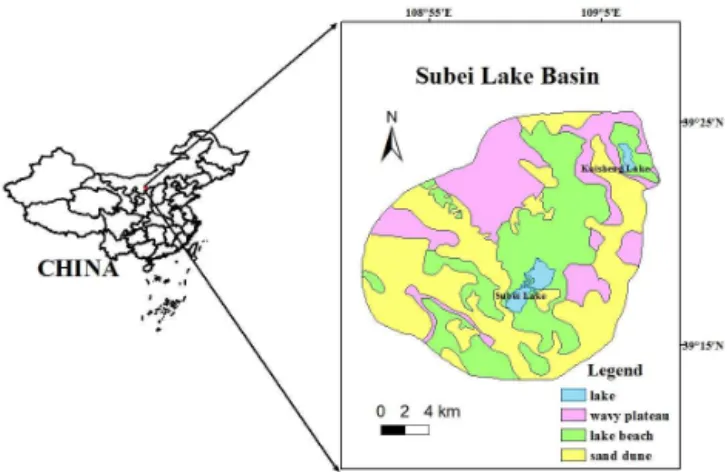
Figure 1.Location of the study area and geomorphic map.
2 Study area 2.1 Physiography
The study area is situated in the northern part of the Or-dos Basin, which is located at the junction of Uxin Ban-ner, Hanggin Banner and Ejin Horo Banner in Ordos City and is mainly administratively governed by Uxin Banner of Ordos City. It covers an area of almost 400 km2 within
39◦13′30′′–39◦25′40′′N and 108◦51′24′′–109◦08′40′′E. Its length is 23 km from east to west and its width is 22 km from north to south (Fig. 1).
The continental semi-arid to arid climate controls the whole study area, which is characterized by long, cold win-ters and short, hot summers (Li et al., 2010, 2011). Accord-ing to the data of the Wushenzhao meteorological station, the average monthly temperature ranges from−11.5◦C in
Jan-uary to 21.9◦C in July. The mean annual precipitation in the study area was 324.3 mm yr−1from 1985 to 2008. The total annual precipitation varied greatly from year to year with a minimum of 150.2 mm in 2000 and a maximum of 432.3 mm in 1985. The majority of the precipitation falls in the form of rain during the 3-month period from June to August, with more than 63.6 % of annual precipitation (Fig. 2). The mean annual evaporation is 2349.1 mm yr−1 (from 1985 to 2008)
at Wushenzhao station (Fig. 2), which far exceeds rainfall for the area. The average value of monthly evaporation is lowest in January (42.4 mm month−1)and highest from May to July,
with maximum evaporation in May (377.4 mm month−1).
As a small-scale lake basin, the general geomorphic types of Subei Lake basin are wavy plateau, lake beach and sand dunes (Fig. 1). The terrain of Subei Lake’s west, east and north sides is relatively higher with altitudes between 1370 and 1415 m; the terrain of its south side is slightly lower with elevations between 1290 and 1300 m. The topography of the center area of Subei Lake basin is flat and low-lying. There are no perennial or ephemeral rivers within the study area; the main surface water bodies are Subei and Kuisheng
Figure 2.Average monthly precipitation and evaporation in the study area.
lakes, and they are situated in the same watershed consider-ing actual hydrogeological conditions and groundwater flow field. In response to precipitation, diffuse overland flow and groundwater recharge the Subei and Kuisheng lakes (Hou et al., 2006; Wang et al., 2010). Subei Lake is located in the low-lying center of the study area (Fig. 1), which is an inland lake characterized by high alkalinity; Kuisheng Lake is also a perennial water body and it is located in northeastern corner of the study area, only covering 2 km2(Fig. 1).
2.2 Geologic and hydrogeologic setting
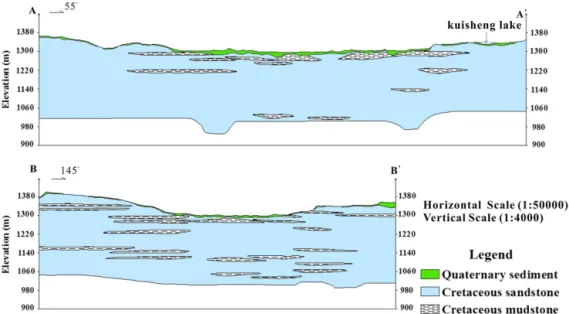
Subei Lake basin is a relatively closed hydrogeological unit given that a small quantity of lateral outflow occurs in a small part of southern boundary (Wang et al., 2010). The Quater-nary sediments and Cretaceous formation can be observed in the study area. The Quaternary sediments are mainly dis-tributed around the Subei Lake with relatively smaller thick-ness. Generally the thickness of Quaternary sediments is be-low 20 m. The Quaternary layer is chiefly composed of the interlaced layers of sand and mud. The Cretaceous forma-tions mainly consist of sedimentary sandstones and gener-ally outcrop in the regions with relatively higher elevation. The maximum thickness of Cretaceous rocks could be nearly 1000 m in the Ordos Plateau (Yin et al., 2009), so the Creta-ceous formation composed of mainly sandstone is the ma-jor water-supplying aquifer of the investigated area. Calcite, dolomite, anhydrite, aragonite, gypsum, halite and feldspar are major minerals in the Quaternary and Cretaceous strata (Hou et al., 2006).
hy-Figure 3. Hydrogeological map of the study area. Data were re-vised from original source (Inner Mongolia Second Hydrogeology Engineering Geological Prospecting Institute, 2010).
draulic connection between the Quaternary layer and Cre-taceous phreatic aquifer, which could be viewed as an inte-grated unconfined aquifer in the area. The depth to water ta-ble in unconfined aquifer is influenced by the terrain change, of which the minimum value is below 1 m in the low-lying region, and the maximum value could be up to 13.24 m. The hydraulic conductivity of the aquifer changes between 0.16 and 17.86 m day−1. The specific yield of unconfined aquifer
varies from 0.058 to 0.155. The recharge source of ground-water in the unconfined aquifer is mainly the infiltration recharge of precipitation; it can be also recharged by lateral inflow from groundwater outside the study area. Besides the above recharge terms, leakage recharge from the underlying confined aquifer and infiltration recharge of irrigation water can also provide a small percentage of groundwater recharge. Evaporation is the main discharge way of the unconfined groundwater. In addition, lateral outflow, artificial exploita-tion and leakage discharge are also included in the main dis-charge patterns. Unconfined groundwater levels were con-toured to illustrate the general flow field in the area (Fig. 3). Groundwater levels were monitored during September 2003.
As is shown in Fig. 3, lateral outflow occurs in a small part of southern boundary determined by analyzing the contours and flow direction of groundwater. The groundwater flows pre-dominantly from surrounding uplands to low lands, which is under the control of topography. On the whole, groundwater in phreatic aquifer flows toward Subei Lake and recharges lake water (Fig. 3).
The unconfined and confined aquifers are separated by an uncontinuous aquitard. Generally speaking, permeable layers and aquitards intervein in the vertical profile of the aquifer system. Nevertheless, aquitards may pinch out in many places, so the aquifer system acts as a single hydrogeo-logic unit. In the present study, the covering aquitard is com-posed of the mudstone layer, which is mainly distributed in the second sand layer, and discontinued mudstone lens could also be observed in Cretaceous strata (Fig. 4). The phreatic aquifer is underlain by a confined aquifer composed of Cre-taceous rocks. Due to huge thickness and high permeabil-ity of confined aquifer, it is regarded as the most promising water-supplying aquifer for domestic and industrial uses. The hydraulic conductivity of confined aquifer changes between 0.14 and 27.04 m day−1. The hydraulic gradient varies from 0.0010 to 0.0045 and the storage coefficient changes between 2.17×10⁻⁵and 1.98×10⁻³. The confined aquifer primarily
receives leakage recharge from the unconfined groundwater. The flow direction of confined groundwater is similar to that of unconfined groundwater (Fig. 3). Artificial exploitation is the major way in which confined groundwater is drained.
Figure 4.Geologic sections of the study area. Data were revised from original source (Inner Mongolia Second Hydrogeology Engineering Geological Prospecting Institute, 2010).
3 Methods
3.1 Water sampling
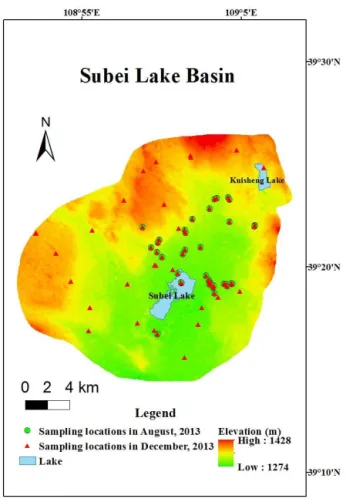
Two important sampling actions were conducted in the study area during August and December 2013, respectively. A to-tal of 95 groundwater samples and seven lake water samples were collected. The first sampling action was during the rainy season and the other was during the dry season. The sampling locations are shown in Fig. 5. The water samples were taken from wells for domestic and agricultural purposes, ranging in depth from 2 to 300 m. The length of screen pipes in all sam-pling wells ranges from 1 to 10 m and every samsam-pling well has only one screen pipe rather than multiple screens. The distance between the bottom of the screen pipe and the total well depth ranges from 0 to 3 m in the study area, and the bot-tom depth of screen pipe was assigned to the water samples. The samples from the wells were mostly taken using pumps installed in these wells and after removing several well vol-umes prior to sampling. The 100 and 50 mL polyethylene bottles were pre-rinsed with water sample three times before the final water sample was collected. Lake water samples were collected at Subei Lake, Kuisheng Lake and Shahaizi Lake. Cellulose membrane filters (0.45 µm) were used to fil-ter samples for cation and anion analysis. All samples were sealed with adhesive tape so as to prevent evaporation. GPS was applied to locate the sampling locations.
3.2 Analytical techniques
Electrical conductivity (EC), pH value and water tempera-ture of each sample were measured in situ using an EC/pH meter (WM-22EP, DKK-TOA, Japan), which was previously
calibrated. Dissolved oxygen concentration and oxidation– reduction potential were also determined using a HACH HQ30d Single-Input Multi-Parameter Digital Meter. In situ hydrochemical parameters were monitored until these values reached a steady state.
The hydrochemical parameters were analyzed at the Cen-ter for Physical and Chemical Analysis of Institute of Geo-graphic Sciences and Natural Resources Research, Chinese Academy of Sciences (IGSNRR, CAS). Major ion compo-sitions were measured for each sample including K+, Na+, Ca2+, Mg2+, Cl−, SO2−
4 and NO
−
3. An inductively coupled
plasma optical emission spectrometer (ICP-OES) (Perkin-Elmer Optima 5300DV, USA) was applied to analyze ma-jor cations. Mama-jor anions were measured by ion chromatog-raphy (ICS-2100, Dionex, USA). HCO−3 concentrations in all groundwater samples were determined by the titration method using 0.0048 M H2SO4 on the day of sampling;
methyl orange endpoint titration was adopted with the fi-nal pH of 4.2–4.4. Due to the extremely high alkalinity of lake water samples, HCO−3 concentrations in all lake water samples were analyzed by titration using 0.1667 M H2SO4.
CO23− concentrations were also analyzed by titration; phe-nolphthalein was used as an indicator of endpoint titration.
Figure 5.Sampling locations in August and December 2013.
4 Results
4.1 Hydrochemical characteristics
In situ water quality parameters such as pH, electrical con-ductivity (EC), temperature, dissolved oxygen concentration (DO), oxidation–reduction potential (ORP) and total dis-solved solids (TDS) as well as analytical data of the major ions composition in groundwater and lake water samples are shown in Table 1 and Table S1 in the Supplement. Based on the chemical data, hydrochemical characteristics of ground-water and lake ground-water are discussed.
The chemical composition for lake water showed that Na+ accounted for, on average, 93 % of total cations and Cl− ac-counted for, on average, 58 % of total anions. Thus, Na+and Cl−were the dominant elements (Fig. 6), which was in ac-cordance with hydrochemical characteristics of inland salt lakes. This was also observed in lake water of Habor Lake basin located in the recharge area (Yin et al., 2009). The pH of lake water varied from 8.86 to 10.25 with an average of 9.74 in August and from 8.49 to 10.47 with an average of 9.23 in December; it can be seen that the pH was relatively stable and was always more than 8.4 without obvious sea-sonal variation, which indicated that the dissolved
Figure 6.Piper diagram of groundwater and lake water in August and December 2013.
ates were in the HCO−3 and CO23−forms simultaneously. The temperatures of lake water ranged from 1.1 to 24.3◦C with large seasonal variations, implying that the surface water body was mainly influenced by hydrometeorological factors. The dissolved oxygen concentration of lake water showed an upward tendency from August (mean value: 11.50 mg L−1)
to December (mean value: 14.27 mg L−1) because the
rela-tionship between water temperature and DO is inverse when oxygen content in the air stays relatively stable. With the de-creasing water temperature, the dissolved oxygen value rises. The average value of ORP ranged from 15.1 mV in August to 26.8 mV in December, which was in accordance with the up-ward tendency of DO. It showed that lake water had stronger oxidation in December than that in August and there is a close relationship between DO and ORP. The average val-ues of major ions concentrations showed a downward trend except for Ca2+, Mg2+ from August to December. Specifi-cally, the average values of Ca2+and Mg2+increased from 6.50 to 15.30 mg L−1 and 25.15 to 102.20 mg L−1,
respec-tively; other ions concentrations were reduced to different degrees. The same variation trend of major ions from Au-gust to December could be found in the Habor Lake basin (Yin et al., 2009) as well. Before August, the strong evap-oration capacity of lake water exceeded the finite recharge amount, which caused lake water to be enriched. After Au-gust, lake water was recharged and diluted by groundwater and a large amount of fresh overland flow from precipitation. The EC values varied between 1017 and 229 000 µS cm−1. This relatively large range of variation was closely related to the oscillation of the TDS values, which ranged from 0.56 to 302.5 g L−1. The results showed that lake water chemistry was controlled by strong evaporation and recharge from over-land flow and groundwater.
HCO3–Ca–Na–Mg types. Figure 6 also indicates that there
are three groups of groundwater in the Subei Lake basin: the Quaternary groundwater, shallow Cretaceous groundwater and deep Cretaceous groundwater. The shallow Cretaceous groundwater refers to groundwater in the local groundwa-ter system, and the deep Cretaceous groundwagroundwa-ter refers to groundwater in the intermediate groundwater system of Or-dos Basin. The hydrochemical characteristics of the three groups of groundwater indicate that they have undergone dif-ferent degrees of mineralization.
With respect to the Quaternary groundwater, the pH var-ied from 7.64 to 9.04 with an average of 8.09 in August and changed from 7.49 to 9.26 with an average of 8.08 in Decem-ber, indicating an alkaline nature. The TDS varied from 396 to 1202 mg L−1, 314 to 1108 mg L−1 with averages of 677
and 625 mg L−1, respectively, in August and December. The
major cations were Na+, Ca2+and Mg2+, while the major anions were HCO−3 and SO24−.
As for the shallow Cretaceous groundwater (<120 m), the pH varied from 7.37 to 8.3 with an average of 7.77 in Au-gust and oscillated from 7.49 to 9.37 with an average of 8.14 in December. The TDS varied from 249 to 1383 mg L−1
and from 217 to 1239 mg L−1, with averages of 506 and 400 mg L−1, respectively, in August and December.
For the deep Cretaceous groundwater (>120 m), the pH varied from 7.75 to 8.09 with an average of 7.85 in August and fluctuated from 7.99 to 8.82 with an average of 8.23 in December. The TDS varied from 266 to 727 mg L−1, 215 to 464 mg L−1 with averages of 377 and 296 mg L−1, respec-tively, in August and December.
4.2 Stable isotopic composition in groundwater and surface water
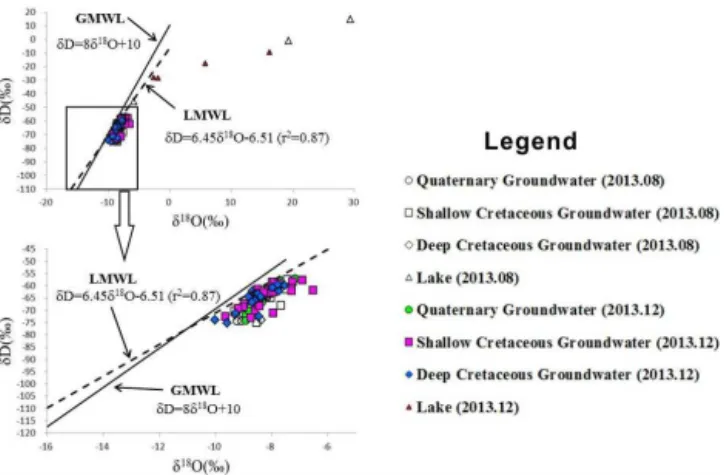
In the present study, the results of the stable isotope anal-ysis for groundwater and lake water are plotted in Fig. 7. In a previous study, the local meteoric water line (LMWL) in the northern Ordos Basin had been developed by Yin et al. (2010). The LMWL isδD=6.45δ18O−6.51 (r2=0.87), which is similar to that developed by Hou et al. (2007) (δD=6.35 δ18O−4.69). In addition, it is very clear in
the plot that the LMWL is located below the global mete-oric water line (GMWL) defined by Craig (1961) (δD=8
Figure 7. Relationship between hydrogen and oxygen isotopes in groundwater and lake water in August and December 2013.
evaporation during rainfall. The LMWL is controlled by lo-cal hydrometeorologilo-cal factors, including the origin of the vapor mass, re-evaporation during rainfall and the seasonal-ity of precipitation (Clark and Fritz, 1997).
The linear regression curve equation of δ18O and δD in groundwater can be defined as δD=6.3δ18O−13.0 (r2=
0.62). Groundwater follows the LMWL in the study area, in-dicating that it is of modern local meteoric origin rather than the recharge from precipitation in paleoclimate conditions. In August, the stable isotope values in the Quaternary ground-water were found to range from−9.2 to−8.0 ‰ in18O with an average of−8.8 ‰ and from−74 to−62 ‰ in2H with an average of−71 ‰; the shallow Cretaceous groundwater had
δ18O ranging from −9.3 to −7.5 ‰ and δD varying from
−75 to−57 ‰. The average values ofδ18O andδD of the shallow Cretaceous groundwater were−8.3 and−66 ‰,
re-spectively.δ18O andδD of the deep Cretaceous groundwater ranged from−9.3 to−7.8 ‰ and from −74 to −61 ‰,
re-spectively. The average values ofδ18O andδD were−8.4 and −67 ‰, respectively. In December, the stable isotope values
in the Quaternary groundwater ranged from−8.9 to−7.2 ‰
in18O with an average of−8.2 ‰ and from−74 to−57 ‰
in2H with an average of−65 ‰;δ18O andδD of the
shal-low Cretaceous groundwater ranged from −9.7 to−6.5 ‰ and from −73 to−58 ‰, respectively. The average values of δ18O andδD were−8.2 and−64 ‰, respectively.δ18O of the deep Cretaceous groundwater varied from −10.0 to
−7.5 ‰ and δD ranged from −75 to −60 ‰. The average values ofδ18O andδD of the deep Cretaceous groundwater were−8.5 and−66 ‰, respectively.
The regression curve equation ofδ18O andδD in lake wa-ter could be defined asδD=1.47δ18O−29.09 (r2=0.95), whereδ18O ranged from−5.8 to 29.4 ‰ andδD ranged from
−46 to 15 ‰ with averages of 14.3 and−10 ‰ in August,
while in December,δ18O andδD of lake water ranged from
−2.6 to 16.2 ‰ and from −28 to−9 ‰, respectively. The
average values ofδ18O andδD were 4.4 and−21 ‰,
respec-tively, in December. The low slope of the regression line of
δ18O andδD in lake water could be ascribed to a combination of mixing and evaporation under conditions of low humidity. 4.3 Linkage among geochemical parameters of
groundwater
Correlations among groundwater-quality parameters are shown in Table 2 and Fig. 8. All of the major cations and an-ions are significantly correlated with TDS (Table 2), which shows that these ions have been dissolved into groundwater continuously and resulted in the rise of TDS.
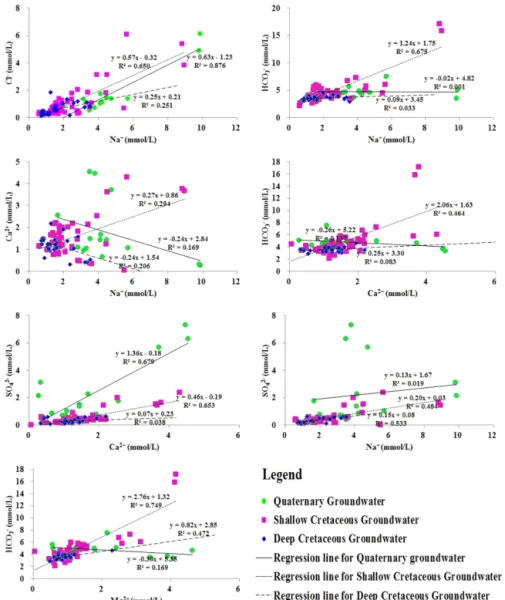
As is shown in Table 2, the concentration of Mg2+is cor-related with HCO−3 and SO24−, with correlation coefficients of 0.582 and 0.819, respectively. The concentration of Ca2+ is well correlated with SO24−with a correlation coefficient of 0.665. Cl−has good correlation with Na+with a large cor-relation coefficient of 0.824.
The results of linear regression analysis of some pairs of ions are displayed in Fig. 8. There is good correlation be-tween Cl−and Na+in Quaternary groundwater and shallow Cretaceous groundwater; Ca2+and SO2−
4 have a good
posi-tive correlation in Quaternary groundwater and shallow Cre-taceous groundwater. Mg2+is well correlated with HCO−
3 in
shallow Cretaceous groundwater.
5 Discussion
Generally speaking, water–rock interactions are the most im-portant factors influencing the observed geochemical com-position of groundwater (Appelo and Willemsen, 1987); the geochemical and isotopic results of this work are no ex-ception. In terms of dissolved minerals and the correlation of geochemical parameters, the dominant geochemical pro-cesses and formation mechanisms could be found (Su et al., 2009). The weathering and dissolution of minerals in the host rocks and ion exchange are generally the main source of ions in groundwater based on available research. The stable iso-topes signatures in lake water can reveal the predominant mechanism controlling the chemical composition of lake wa-ter.
5.1 Geochemical processes of groundwater
As displayed in the correlation analysis of geochemical pa-rameters, a good correlation between Mg2+ and HCO−
3
in-dicates that the weathering of dolomite releases ions to the groundwater, as expressed in Reaction (R1). The fact that Mg2+ is well correlated with HCO−
3 could be found in the
gyp-Figure 8.Relationship between some pairs of ions in groundwater.
sum and anhydrite are present in these strata, so it is reason-able to consider that gypsum and anhydrite are the source of the SO24−. However, in Yin’s study, there is poor correla-tion between Ca2+and SO24−in the Habor Lake basin (Yin et al., 2009). It can be explained by geochemical evolution of groundwater along flow path from the recharge area to the discharge area. There is poor correlation between Na+ and SO24−, suggesting that the weathering of Glauber’s salt (Na2SO4q10H
2O) may not be the major sources of such ions
in groundwater. On the contrary, a good correlation between Na+and SO2−
4 can be found in the Habor Lake basin (Yin
et al., 2009). It indicates that Glauber’s salt may be more abundant in the recharge area (Habor Lake basin) than in the discharge area (Subei Lake basin). Although there is no ob-vious correlation between Ca2+and HCO−3, it is reasonable to regard the dissolution of carbonate minerals as a source of Ca2+ and HCO−3 due to the widespread occurrence of car-bonate rocks in the study area, as conveyed in Reaction (R3).
The concentration of Mg2+ is well correlated with SO2−
4 ,
suggesting the possible dissolution of gypsum, followed by cation exchange. The pH is negatively correlated with Ca2+; it is likely that the dissolution of carbonate minerals is con-strained due to the reduction of the hydrogen ion concentra-tion in water at higher pH. It can be judged from the above analysis that during groundwater flow, the following reac-tions are very likely to take place in the study area:
CaMg(CO3)2+2CO2+2H2O⇔Ca2++Mg2++4HCO−3, (R1)
CaSO4⇔Ca2++SO24−, (R2)
CaCO3+CO2+H2O⇔Ca2++2HCO−3. (R3)
Figure 9. Geochemical relationship of pH vs. log (pCO2) in groundwater.
al., 1981; Dixon and Chiswell, 1992; Sami, 1992). The con-centration of Cl−is well correlated with Na+, suggesting that the dissolution of halite may be the major source of Na+and Cl−. Theoretically, the dissolution of halite will release equal amounts of Na+and Cl−into the solution. Nevertheless, the results deviate from the anticipated 1 : 1 relationship. Almost all samples have more Na+than Cl−. The molar Na/Cl ra-tio varies from 0.68 to 16.00 with an average value of 3.48. A greater Na/Cl ratio may be ascribed to the feldspar weather-ing and the dissolution of other Na-containweather-ing minerals. The relatively high Na+concentration in the groundwater could also be illustrated by cation exchange between Ca2+or Mg2+ and Na+, as is discussed later.
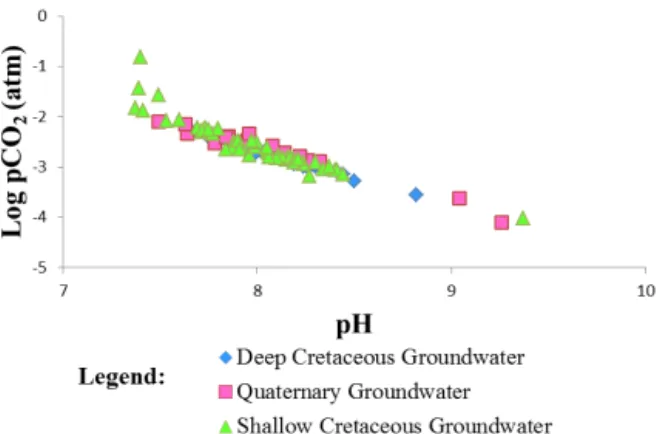
The partial pressure of carbon dioxide (pCO2)values were
calculated by the geochemical computer code PHREEQC (Parkhurst and Appelo, 2004). ThepCO2values of
ground-water range from 10−0.82 to 10−4.1atm. The vast
ma-jority of groundwater samples (about 96 %) have higher
pCO2values than the atmosphericpCO2, which is equal to
10−3.5atm (Van der Weijden and Pacheco, 2003), indicating that groundwater has received CO2from root respiration and
the decomposition of soil organic matter. Figure 9 indicates that thepCO2values are negatively correlated with pH
val-ues; the partial pressure values of CO2decrease as pH values
increase (Rightmire, 1978; Adams et al., 2001). It likely has a connection with relatively longer aquifer residence time, more physical, chemical reactions with aquifer minerals and biological reactions of microorganism that produce CO2
tak-ing place. Accordtak-ing to Hou et al. (2008), feldspars can be observed in the Cretaceous formations and it is possible that the following reaction occurs:
Na2Al2Si6O16+2H2O+CO2→Na2CO3 (R4)
+H2Al2Si2O8+H2O+4 SiO2.
This reaction will consume CO2and give rise to the increase
of the concentration of Na+and HCO−3. As a result, the par-tial pressure of CO2will decrease and the pH will increase.
In terms of a statistical analysis, the average pH values of the
Quaternary groundwater and the shallow Cretaceous ground-water are 8.08 and 7.99, respectively, lower than that of the deep Cretaceous groundwater (8.11). However, the average
pCO2 values of the Quaternary groundwater and the
shal-low Cretaceous groundwater are 10−2.67and 10−2.58atm, re-spectively, higher than that of the deep Cretaceous ground-water (about 10−2.79atm). The negative correlation charac-teristic betweenpCO2and pH shows that the dissolution of
feldspar takes place along groundwater flow path. The phe-nomenon also occurs in the Habor Lake basin according to Yin et al. (2009).
Cation exchange is an important process of water–rock in-teractions that obviously influences the major ion composi-tion of groundwater (Xiao et al., 2012). Although the cacomposi-tion exchange is widespread in the geochemical evolution of all groundwater, it is essential to know and identify the various changes undergone by water during their traveling processes in the groundwater system under the influence of anthro-pogenic activities. In the present study, the molar Na/Ca ra-tio changes between 0.5 and 106.09 with an average of 3.80, suggesting the presence of Na+and Ca2+exchange. It can be conveyed in the following reaction:
Ca2++Na2−X=2Na++Ca−X, (R5) whereXis sites of cation exchange.
Schoeller proposed that chloro-alkaline indices could be used to study the cation exchange between the ground-water and its host environment during residence or travel (Schoeller, 1965; Marghade et al., 2012; Li et al., 2013). The Schoeller indices, such as CAI-I and CAI-II, are calculated by the following equations, where all ions are expressed in mEq L−1:
CAI−I=Cl
−− Na++K+
Cl− , (1)
CAI−II= Cl
−−
Na++K+ HCO−3 +SO2−
4 +CO
2−
3 +NO
−
3
. (2)
TDS 1.000 −0.378
pH 1.000
Figure 10.Plots of saturation indices with respect to some minerals in groundwater.
a common form of cation exchange in the study area. This also further confirms that the cation exchange is one of the major contributors to higher concentrations of Na+ in the groundwater, and it is still an important geochemical process of groundwater in the Subei Lake basin under the influence of human activities.
5.2 The formation mechanisms of groundwater and surface water
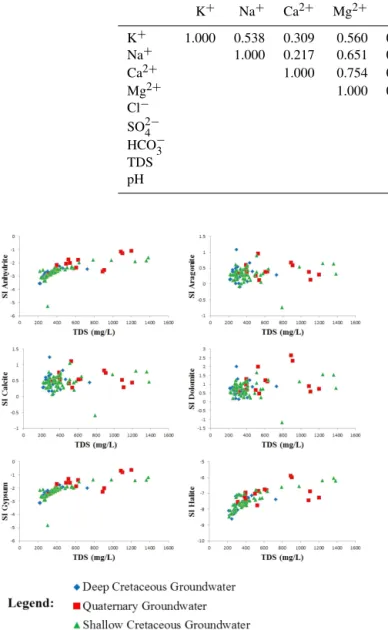
The saturation index is a vital geochemical parameter in the fields of hydrogeology and geochemistry, often useful for identifying the existence of some common minerals in the groundwater system (Deutsch, 1997). In this present study,
saturation indices (SIs) with respect to gypsum, anhydrite, calcite, dolomite, aragonite and halite were calculated in terms of the following equation (Lloyd and Heathcote, 1985): SI=log
IAP
ks(T )
(3) where IAP is the relevant ion activity product, which can be calculated by multiplying the ion activity coefficientγi and
the composition concentration mi, and ks (T) is the
equi-librium constant of the reaction considered at the sample temperature. The geochemical computer model PHREEQC (Parkhurst and Appelo, 2004) was used to calculate the satu-ration indices. When the groundwater is saturated with some minerals, SI equals zero; positive values of SI represent over-saturation, and negative values show undersaturation (Ap-pelo and Postma, 1994; Drever, 1997).
Figure 10 indicates the plots of SI versus the total dis-solved solids (TDS) for all the groundwater samples. The calculated values of SI for anhydrite, gypsum and halite os-cillate between−5.27 and−1.11, between−4.8 and−0.65
and between−8.61 and−5.9, with averages of−2.62,−2.16
and−7.49, respectively. It shows that the groundwater in the
study area was below the equilibrium with anhydrite, gypsum and halite, indicating that these minerals are anticipated to dissolve. However, the SIs of aragonite, calcite, and dolomite range from−0.74 to 1.09,−0.59 to 1.25 and−1.16 to 2.64, with averages of 0.32, 0.48 and 0.81, respectively. On the whole, the groundwater samples were dynamically saturated to oversaturated with aragonite, calcite and dolomite, imply-ing that the three major carbonate minerals may have affected the chemical composition of groundwater in the Subei Lake basin. The results show that the groundwater may well pro-duce the precipitation of aragonite, calcite and dolomite. Sat-uration of aragonite, calcite and dolomite could be attained quickly due to the existence of abundant carbonate minerals in the groundwater system.
Figure 11. Gibbs diagram of groundwater samples in the Subei Lake basin: (a) TDS vs. Na+/(Na++Ca2+), (b) TDS vs. Cl−/(Cl−+HCO−
3).
Gibbs diagrams have been widely used in hydrogeochem-ical studies (Feth and Gibbs, 1971; Naseem et al., 2010; Marghade et al., 2012; Yang et al., 2012b; Xing et al., 2013). Gibbs (1970) recommended two diagrams to assess the dom-inant effects of precipitation, rock weathering and evapora-tion on geochemical evoluevapora-tion of groundwater in semi-arid and arid regions. The diagrams show the weight ratios of Na+/(Na++Ca2+)and Cl−/(Cl−+HCO−
3)against TDS,
and precipitation dominance, rock dominance, and evapora-tion dominance are included in the controlling mechanisms (Gibbs, 1970). The distributed characteristic of samples in Fig. 11 shows that rock weathering is the dominant mecha-nism in the geochemical evolution of the groundwater in the study area. The ratio of Na+/(Na++Ca2+)was mostly less than 0.5 in shallow and deep Cretaceous groundwater, with low TDS values (Fig. 11). It shows that rock weathering was the main mechanism controlling the chemical compositions of shallow and deep Cretaceous groundwater. In the Quater-nary groundwater, about two-thirds of samples had a ratio of Na+/(Na++Ca2+)greater than 0.5 and higher TDS be-tween 314 and 1202 mg/L, which indicated that the Quater-nary groundwater was not only controlled by rock weather-ing, but also by the process of evaporation–crystallization. It is obvious that the weight ratio of Na+/(Na++Ca2+) spreads from low to high without a great variation of TDS, which indicated that cation exchange also played a role by increasing Na+and decreasing Ca2+ under the background of rock dominance. During the cation exchange process, the TDS values do not change obviously because 2 mmol L−1 of Na+ is released by 1 mmol L−1Ca2+exchange, and the weight of 1 mmol L−1of Ca2+(40 mg L−1) is nearly equal to that of 2 mmol L−1of Na+(46 mg L−1).
In August, the average isotopic values of deep Cretaceous groundwater (δ18O: −8.4 ‰, δD: −67 ‰) were enriched
compared with the Quaternary groundwater (δ18O:−8.8 ‰,
δD:−71 ‰), but in December, the average isotopic values of deep Cretaceous groundwater (δ18O:−8.5 ‰,δD:−66 ‰) were depleted compared with the Quaternary groundwater (δ18O:−8.2 ‰,δD:−65 ‰); the stable isotopic values of
Quaternary groundwater had a wider range from August to December than those of deep Cretaceous groundwater. This may be explained by heavy isotope enrichment in the Qua-ternary groundwater caused by evaporation given that there was effectively no precipitation in the study area during the period from August to December; meanwhile, the deep Cre-taceous groundwater may have been mainly recharged by lat-eral inflow from groundwater outside the study area, result-ing in smaller seasonal fluctuations in the isotopic values.
Furthermore, the average values ofδ18O and δD of the shallow Cretaceous groundwater are−8.3 and−66 ‰ and
−8.2 and −64 ‰, respectively, in August and December; meanwhile, the average values ofδ18O and δD of the deep Cretaceous groundwater are−8.4 and−67 ‰ and−8.5 and −66 ‰, respectively, in August and December. Thus, given
the precision of the analysis, shallow Cretaceous ground-water and deep Cretaceous groundground-water have similar iso-topic characteristics in the Subei Lake basin, which indicates that they may be replenished by the similar water source due to the similar geological setting. This also validates the existence of leakage. The similar isotopic characteristic of groundwater from the Cretaceous aquifer may be ascribed to the increasingly close relationship between shallow Cre-taceous groundwater and deep CreCre-taceous groundwater due to changes in the hydrodynamic field caused by intensive groundwater exploitation. Conversely, the phenomenon of deep groundwater depleted in heavy isotopes compared with shallow groundwater was found in the Habor Lake basin lo-cated in the recharge area (Yin et al., 2009).
show that three groups of groundwater are present in the Subei Lake basin: the Quaternary groundwater, shallow Cre-taceous groundwater and deep CreCre-taceous groundwater. The analysis of groundwater chemistry clarifies that the chem-istry of lake water was controlled by strong evaporation and recharge from overland flow and groundwater; mean-while the major geochemical processes responsible for the observed chemical composition in groundwater are the dis-solution/precipitation of anhydrite, gypsum, halite and cal-cite and the weathering of feldspar and dolomite. Further-more, the cation exchange has also played an extremely vi-tal role in the groundwater evolution. The absolute predom-inance of rock weathering in the geochemical evolution of groundwater in the study area is confirmed by the analyti-cal results of Gibbs diagrams. The stable isotopic data in-dicate that groundwater is of modern local meteoric origin rather than the recharge from precipitation in paleoclimate conditions. Unlike significant differences in isotopic values between shallow groundwater and deep groundwater in the Habor Lake basin, shallow Cretaceous groundwater and deep Cretaceous groundwater have similar isotopic characteristics in the Subei Lake basin. Due to the evaporation effect and dry climatic conditions, heavy isotopes are more enriched in lake water than groundwater. The low slope of the regres-sion line ofδ18O andδD in lake water could be ascribed to a combination of mixing and evaporation under conditions of low humidity. A comparison of the regression line forδ18O andδD shows that lake water in the Subei Lake basin con-tains more heavily isotopic composition than that in the Ha-bor Lake basin, indicating that lake water in the discharge area has undergone stronger evaporation than lake water in the recharge area.
Much more accurate groundwater information has been obtained by conducting this study on Subei Lake basin, which will further enhance the knowledge of geochemical evolution of the groundwater system in the whole Ordos Basin and provide comprehensive understanding of Subei Lake basin, typical of lake basins in the discharge area where significant changes in the groundwater system have taken place under the influence of human activity. More impor-tantly, it could provide valuable groundwater information for decision makers and researchers to formulate scientifically reasonable groundwater resource management strategies in these lake basins of Ordos Basin so as to minimize the
nega-Acknowledgements. This research was supported by the State Basic Research Development Program (973 Program) of China (grant no. 2010CB428805) and Greenpeace International. The authors are grateful for our colleagues for their assistance in sample collection and analysis. Special thanks go to the editor and the two anonymous reviewers for their critical reviews and valuable suggestions.
Edited by: S. Uhlenbrook
References
Adams, S., Titus, R., Pietersen, K., Tredoux, G., and Harris, C.: Hydrochemical characteristics of aquifers near Sutherland in the Western Karoo, South Africa, J. Hydrol., 241, 91–103, doi:10.1016/S0022-1694(00)00370-X, 2001.
Agartan, E. and Yazicigil, H.: Assessment of water supply impacts for a mine site in western Turkey, Mine Water Environ., 31, 112– 128, doi:10.1007/s10230-011-0167-z, 2012.
Appelo, C. A. J. and Postma, D.: Geochemistry, groundwater and pollution, AA Balkema, Rotterdam, 1994.
Appelo, C. A. J. and Willemsen, A.: Geochemical calculations and observations on salt water intrusions, I. A combined geochemi-cal/mixing cell model, J. Hydrol., 94, 313–330, 1987.
Cervi, F., Ronchetti, F., Martinelli, G., Bogaard, T. A., and Corsini, A.: Origin and assessment of deep groundwater inflow in the Ca’ Lita landslide using hydrochemistry and in situ monitoring, Hy-drol. Earth Syst. Sci., 16, 4205–4221, doi:10.5194/hess-16-4205-2012, 2012.
Chen, J., Liu, X., Wang, C., Rao, W., Tan, H., Dong, H., Sun, X., Wang, Y., and Su, Z.: Isotopic constraints on the origin of groundwater in the Ordos Basin of northern China, Environ. Earth Sci., 66, 505–517, doi:10.1007/s12665-011-1259-6, 2011. Clark, I. D. and Fritz, P.: Environmental isotopes in hydrogeology,
CRC press, Boca Raton, Florida, 1997.
Cook, P. G. and Herczeg, A. L.: Environmental tracers in subsurface hydrology, Kluwer, Dordrecht, 1999.
Craig, H.: Isotopic variations in meteoric waters, Science, 133, 1702–1703, doi:10.1126/science.133.3465.1702, 1961. Dai, S. F., Ren, D. Y., Chou, C. L., Li, S. S., and Jiang, Y. F.:
Min-eralogy and geochemistry of the No. 6 coal (Pennsylvanian) in the Junger Coalfield, Ordos Basin, China, Int. J. Coal Geol., 66, 253–270, doi:10.1016/j.coal.2005.08.003, 2006.
De Vries, J. J. and Simmers, I.: Groundwater recharge: an overview of processes and challenges, Hydrogeol. J., 10, 5–17, doi:10.1007/s10040-001-0171-7, 2002.
Dixon, W. and Chiswell, B.: The use of hydrochemical sec-tions to identify recharge areas and saline intrusions in alluvial aquifers, southeast Queensland, Australia, J. Hydrol., 135, 259– 274, doi:10.1016/0022-1694(92)90091-9, 1992.
Drever, J. I.: The geochemistry of natural waters: surface and groundwater environments, Prentice Hall, New Jersey, 1997. Feth, J. H. and Gibbs, R. J.: Mechanisms controlling world
wa-ter chemistry: evaporation-crystallization process, Science, 172, 871–872, 1971.
Garvelmann, J., Külls, C., and Weiler, M.: A porewater-based sta-ble isotope approach for the investigation of subsurface hy-drological processes, Hydrol. Earth Syst. Sci., 16, 631–640, doi:10.5194/hess-16-631-2012, 2012.
Gibbs, R. J.: Mechanisms controlling world water chemistry, Science, 170, 1088–1090, doi:10.1126/science.170.3962.1088, 1970.
Hamed, Y. and Dhahri, F.: Hydro-geochemical and isotopic com-position of groundwater, with emphasis on sources of salinity, in the aquifer system in Northwestern Tunisia, J. Afr. Earth Sci., 83, 10–24, doi:10.1016/j.jafrearsci.2013.02.004, 2013.
Hou, G., Zhao, M., and Wang, Y.: Groundwater investigation in the Ordos Basin, China Geological Survey, Beijing, 2006 (in Chi-nese).
Hou, G., Su, X., Lin, X., Liu, F., Yi, S., Dong, W., Yu, F., Yang, Y., and Wang, D.: Environmental isotopic composition of natural water in Ordos Cretaceous Groundwater Basin and its signifi-cance for hydrological cycle, J. Jilin Univ. (Earth Science Edi-tion), 37, 255–260, 2007.
Hou, G., Liang, Y., Su, X., Zhao, Z., Tao, Z., Yin, L., Yang, Y., and Wang, X.: Groundwater systems and resources in the Ordos Basin, China, Acta Geol. Sin., 82, 1061–1069, 2008.
Kamdee, K., Srisuk, K., Lorphensri, O., Chitradon, R., Noipow, N., Laoharojanaphand, S., and Chantarachot, W.: Use of iso-tope hydrology for groundwater resources study in Upper Chi river basin, J. Radioanal. Nuclear Chem., 297, 405–418, doi:10.1007/s10967-012-2401-y, 2013.
Lasaga, A. C., Soler, J. M., Ganor, J., Burch, T. E., and Nagy, K. L.: Chemical-weathering rate laws and global geochemical cycles, Geochim. Cosmochim. Ac., 58, 2361–2386, doi:10.1016/0016-7037(94)90016-7, 1994.
Li, P., Wu, J., and Qian, H.: Groundwater quality assessment and the forming mechanism of the hydrochemistry in Dongsheng Coal-field of Inner Mongolia, J. Water Resour. Water Eng., 21, 38–41, 2010 (in Chinese).
Li, P., Qian, H., and Wu, J. H.: Application of set pair analysis method based on entropy weight in groundwater quality assess-ment – a case study in Dongsheng City, Northwest China, E-J Chem., 8, 851–858, 2011.
Li, P., Qian, H., Wu, J., Zhang, Y., and Zhang, H.: Major ion chemistry of shallow groundwater in the Dongsheng Coal-field, Ordos Basin, China, Mine Water Environ., 32, 195–206, doi:10.1007/s10230-013-0234-8, 2013.
Lloyd, J. W. and Heathcote, J.: Natural inorganic hydrochemistry in relation to groundwater, Oxford University Press, New York, 1985.
Magaritz, M., Nadler, A., Koyumdjisky, H., and Dan, J.: The use of Na-Cl ratios to trace solute sources in a semi-arid zone, Wa-ter Resour. Res., 17, 602–608, doi:10.1029/Wr017i003p00602, 1981.
Marghade, D., Malpe, D. B., and Zade, A. B.: Major ion chemistry of shallow groundwater of a fast growing city of Central India, Environ. Monit. Assess., 184, 2405–2418, doi:10.1007/s10661-011-2126-3, 2012.
Naseem, S., Rafique, T., Bashir, E., Bhanger, M. I., Laghari, A., and Usmani, T. H.: Lithological influences on oc-currence of high-fluoride groundwater in Nagar Parkar area, Thar Desert, Pakistan, Chemosphere, 78, 1313–1321, doi:10.1016/j.chemosphere.2010.01.010, 2010.
Parkhurst, D. L. and Appelo, C.: PHREEQC2 user’s manual and program, Water-Resources Investigations Report, US Geological Survey, Denver, Colorado, 2004.
Piper, A. M.: A graphic procedure in the geochemical interpreta-tion of water analysis, US Department of the Interior, Geological Survey, Water Resources Division, Ground Water Branch, Wash-ington, 1953.
PRC Ministry of Environmental Protection: Technical guidelines for environment impact assessment-groundwater environment, China Environmental Science Press,Beijing, 2011.
Rightmire, C. T.: Seasonal-variation in pCO2 and 13C con-tent of soil atmosphere, Water Resour. Res., 14, 691–692, doi:10.1029/Wr014i004p00691, 1978.
Sami, K.: Recharge mechanisms and geochemical processes in a semiarid sedimentary basin, Eastern Cape, South-Africa, J. Hy-drol., 139, 27–48, doi:10.1016/0022-1694(92)90193-Y, 1992. Schoeller, H.: Qualitative evaluation of groundwater resources, In:
Methods and techniques of groundwater investigations and de-velopment, UNESCO, Paris, 54–83, 1965.
Su, Y., Zhu, G., Feng, Q., Li, Z., and Zhang, F.: Environmen-tal isotopic and hydrochemical study of groundwater in the Ejina Basin, northwest China, Environ. Geol., 58, 601–614, doi:10.1007/s00254-008-1534-3, 2009.
Toth, J.: A theoretical analysis of groundwater flow in small drainage basins, J. Geophys. Res., 68, 4795–4812, doi:10.1029/Jz068i008p02354, 1963.
Van der Weijden, C. H., and Pacheco, F. A. L.: Hydrochemistry, weathering and weathering rates on Madeira island, J. Hydrol., 283, 122–145, doi:10.1016/S0022-1694(03)00245-2, 2003. Wang, W., Yang, G., and Wang, G.: Groundwater numerical model
of Haolebaoji well field and evaluation of the environmental problems caused by exploitation, South-to-North Water Trans. Water Sci. Technol., 8, 36–41, 2010 (in Chinese).
Winter, T. C.: Relation of streams, lakes, and wetlands to groundwater flow systems, Hydrogeol. J., 7, 28–45, doi:10.1007/s100400050178, 1999.
Xiao, J., Jin, Z., Zhang, F., and Wang, J.: Solute geochem-istry and its sources of the groundwaters in the Qinghai Lake catchment, NW China, J. Asian Earth Sci., 52, 21–30, doi:10.1016/j.jseaes.2012.02.006, 2012.