Influence of thermomechanical processing on shear bands formation and
magnetic properties of a 3% Si non-oriented electrical steel
Sara Silva Ferreira de Dafe´
a,n, Sebasti
ao da Costa Paolinelli
~
b, Andre´ Barros Cota
a aPhysics Department, Federal University of Ouro Preto, Campus Universita´rio, Ouro Preto, MG 35400000, BrazilbResearch Department, ArcelorMittal Inox Brasil, Prac
-a Primeiro de Maio, 9 Timo´teo, MG 35180018, Brazil
a r t i c l e
i n f o
Article history:
Received 1 February 2011 Received in revised form 11 July 2011
Available online 26 July 2011
Keywords:
Non-oriented silicon steel Shear band
Texture
Hot band grain size Cold strain Magnetic property
a b s t r a c t
The effect of thermomechanical processing on the formation of shear bands and on the magnetic properties of a 3.0 wt% silicon non-oriented steel was investigated by hot rolling samples with different thicknesses at different temperatures, in order to obtain a variation in hot band grain size and cold strain. All the samples were processed in a single-stage cold rolling and finally annealed at 10201C. It was found that the increase of the hot band grain size decreases thegfiber volume fraction and increases theZfiber volume fraction after the final annealing. The increase of the cold strain strongly contributed to this result. A good combination of intense generation of shear bands, and proper crystallographic texture, due to higher nucleation of grains with favorable orientations to magnetiza-tion in these bands, can be obtained for the samples hot rolled at 1000 and 11201C and submitted to cold strain of 64.3% and 72.2% respectively. However the best combination ofB50,W15/60andmrcan be obtained by hot rolling the samples at 10001C to the thickness of 1.4 mm, corresponding to 64.3% of cold strain.
&2011 Elsevier B.V. All rights reserved.
1. Introduction
Optimizing the motors and generators performance depends on the use of grain non-oriented silicon steels with high perme-ability and low core loss. These properties are achieved by controlling the chemical composition and thermomechanical processing conditions, which influence the microstructure and the crystallographic texture[1–3].
At the final annealing stage the nucleation of grains with Goss (1 1 0) [0 0 1] and Cube (1 0 0) [0 0 1] orientations at shear bands present in the deformed structure benefit the magnetization process [4–6]. These bands correspond to narrow regions of intense shear, formed by very thin and elongated cells. They are independent of the grain structure and its crystallography, but are more frequent in highly cold deformed metals and coarse grains. In cold rolled materials, the shear bands typically occur at 351 from the rolling direction and can exceed several grains through the sample[6,7].
The cold rolling process enhances
a
{h k l}/1 1 0S andg
{1 1 1}/u v wSfibers. However, the recrystallization crystal-lographic texture will arise from rolling crystalcrystal-lographic texture heterogeneities. The strengthening of thea
fiber is harmful because this crystallographic texture stores little energy duringcold rolling and provides
g
fiber grain nucleation in the interfaces with grains that have orientations belonging tog
fiber [2,3]. On the other hand, theg
fiber volume fraction increase during cold rolling is beneficial because these grains result in the Goss texture after the final annealing[4].The addition of large amounts of solute, the presence of large grains in the structure before cold rolling, high strain and low temperatures promote the occurrence of shear bands in the deformed material[8,9]. The development of shear bands has a strong effect not only on the work hardening and the evolution of deformation texture, but also on the nucleation and grain growth during subsequent recrystallization. Therefore, to obtain a better understanding of deformation and recrystallization phenomena and correlation between them is essential to have a better understanding about the formation of these bands.
This work evaluates the influence of thermomechanical pro-cessing, by which were obtained hot rolled samples with different grain sizes and thicknesses, on the formation of shear bands and magnetic properties of non-oriented grain steel with 3% Si.
2. Material and methods
Samples of a non-oriented grain steel of 28 mm thickness with 3.0% Si, 0.004% C and 0.55% Mn were produced in ArcelorMittal Inox Brazil and taken after roughing, reheated at 11501C for 120 s and rolled with seven passes to 2.2, 1.8, 1.4 and 1.1 mm thicknesses in a Contents lists available atScienceDirect
journal homepage:www.elsevier.com/locate/jmmm
Journal of Magnetism and Magnetic Materials
0304-8853/$ - see front matter&2011 Elsevier B.V. All rights reserved. doi:10.1016/j.jmmm.2011.07.015
n
Corresponding author. Tel.:þ55 31 34091772.
Fenn pilot reversing mill at temperatures of 920, 960, 1000, 1040, 1080 and 11201C, with heating interpasses. After rolling of all the samples, they remained at 5501C for 2 h and were then cooled in air
to simulate the coiling conditions. Following this, the samples were cold rolled to 0.50 mm by a single-stage process and finally annealed at 10201C for 30 s. To evaluate the recrystallization
Fig. 1.Grain size as a function of hot rolling temperature for the samples rolled to different thicknesses.
Fig. 2.g (a) and a (b) fiber volume fractions as a function of hot rolling temperature, for samples hot rolled to different thicknesses.
Fig. 3.g (a) and a (b) fiber volume fractions as functions of hot rolling
temperature and strain degree for cold rolled samples.
evolution and the intensity of the shear bands formed in each sample, annealing with partial recrystallization was carried out at the temperatures 620, 660, 700, 740 and 7801C for 30 s.
The grain size was determined by optical metallography. The crystallographic orientation and volume fractions of fiber and texture components were obtained by X-ray diffraction and Electron Back-Scattering diffraction (EBSD). The presence of shear bands was evaluated by light microscopy of samples submitted to annealing at intermediate temperatures. Magnetic induction at 5000 A/m (B50), core losses at 1.5 T and 60 Hz (W1.5) and magnetic permeability at 1.5 T/60 Hz were measured in the rolling direc-tion using a single-sheet tester of a Brockhaus MPG100D.
3. Results and discussion
The microstructural evolution of hot rolled samples shows that a higher hot rolling temperature resulted in a larger grain size for all thicknesses, due to static recrystallization and grain growth between the passes favored by the use of the reversible rolling process with heating between the passes (Fig. 1). The influence of the hot rolling temperature on the values of
g
fiber volume fraction was not significant (Fig. 2a) and a tendency was observed for thea
fiber volume fraction to decrease when the hot rolling temperature increases (Fig. 2b).Fig. 5.Intensity of shear band formation as functions of grain size of hot rolled steel and the cold strain degree.
The effect of hot rolling temperature and cold strain for the samples as cold rolled on the volume fraction of fibers
g
anda
is shown inFig. 3. It suggests that rolling temperature practically does not influence the volume fractions of grains with orienta-tions belonging to these fibers. There is an increasing trend of volume fractiong
anda
with increasing cold strain, when compared with the fractions of these fibers in the samples after hot rolling (Fig. 2). A higherg
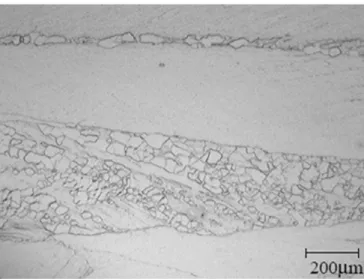
fiber fraction on work hardened state is interesting because the grains with this orientation store more energy during cold work and increase the tendency to generate shear bands, favoring the nucleation of grains with Goss and Cube orientations during the final annealing[10–12].The evolution and the recrystallization behavior due to nuclea-tion in shear bands were evaluated by annealing at intermediate temperatures. For the samples submitted to higher cold strain it was observed that the nucleation starts at a lower annealing temperature, because these samples stored more energy during cold deformation. It was also found that the nucleation starts preferentially at shear bands, as shown inFig. 4.
The semi-quantitative diagram (Fig. 5) was plotted from the microstructures of the samples hot rolled at different tempera-tures (different grain sizes, Fig. 1) and different cold strains, submitted to five annealings at intermediate temperatures. For each sample, the regions containing shear bands were counted and according to the number and size of these regions, measures of intensity were assigned. This diagram shows an increase in the tendency to form shear bands when the sample has large grain size and was submitted to higher cold strain. It can also be observed that the formation of shear bands has a greater influ-ence of the cold strain than the grain size of samples after hot rolling. Furthermore, it is essential for nucleation of grains with Goss and Cube orientations at the final annealing. A high intensity of shear bands formed in cold rolling improves the magnetic induction and reduces the core losses.
After the final annealing, it is observed that the grain size decreases when the cold strain and the grain size after hot rolling increase. This effect can be explained by the larger work hard-ening and larger generation of potential sites for nucleation like shear bands, resulting in a smaller final grain size, suggesting a greater difficulty to obtain simultaneously the highest possible magnetic induction and the lowest possible core loss values.
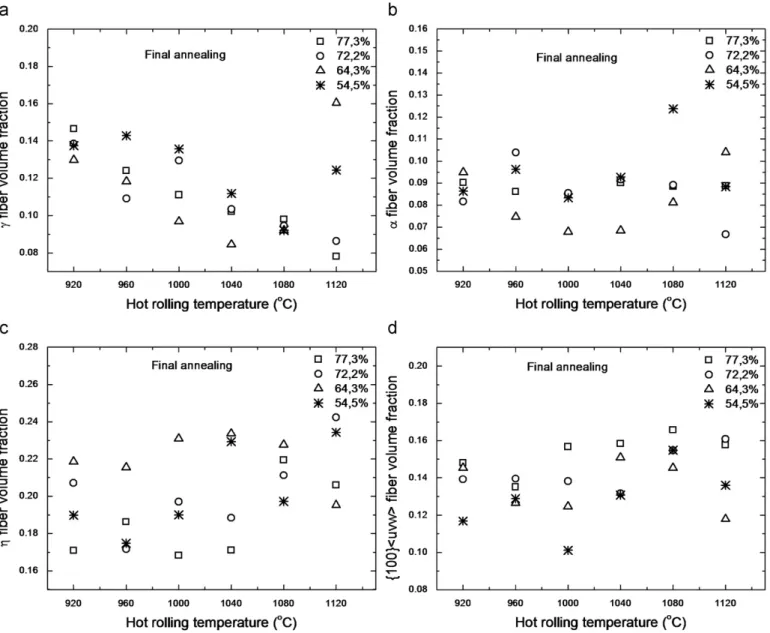
After the final annealing the
g
fiber volume fraction decreases with increase in the hot rolling temperature (Fig. 6a). The nucleation of grains with orientations belonging to theg
fiber takes place preferentially at the grain boundaries[10–12] and an increase in grain size of samples before cold rolling results in a smaller surface area of boundary per unit volume, hindering theg
fiber nucleation in annealing. This figure shows that highg
volume fraction can be obtained with low cold strain and large grains after hot rolling. This result shows that the cold strain strongly influences the crystallographic texture, as predicted by the semi-quantitative diagram of Fig. 5. The values ofg
fiber volume fractions in the samples annealed are smaller than those of cold rolled samples, as expected. Samples hot rolled between 1040 and 11201C with cold strains greater than 64.3% have the lowest fraction values of this fiber.It was observed for annealed samples that the hot rolling temperature and the cold strain have no significant effect on the volume fraction of grains with
a
fiber orientations. The highest values ofZ
fiber volume fraction were obtained in samples hot rolled from 1000 to 10801C with a 64.3% of cold strain and hot rolled at 11201C with 72.2% of cold strain (Fig. 6c). The increase inZ
fiber volume fraction is due to the fact that the samples with large grain sizes and submitted to high cold strain resulted in a greater generation of shear bands, in which grains with orienta-tions belonging to this fiber nucleate preferentially. This result isalso consistent with the diagram shown inFig. 5. The effect of hot rolling temperature and cold strain on the {1 0 0}/u v wSfiber volume fraction was not significant (Fig. 6d).
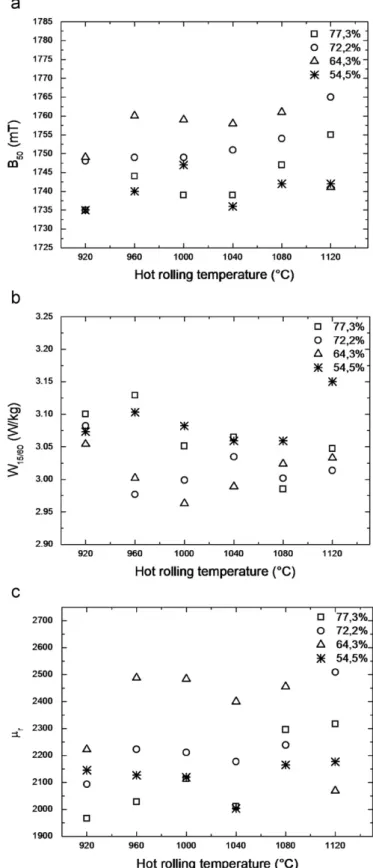
As shown in Fig. 7a the increase in hot rolling temperature (or hot rolled grain size), for all the cold strains, improves
the magnetic induction B50 values. This behavior of magnetic induction is according to the literature [9]. In this work the highest magnetic induction value of hot rolled sample was observed at 11201C, 1.8 mm thickness and submitted to a cold strain of 72.2%. This result can be predicted by structural analysis
(Fig. 5) and is induced by the increase in
Z
fiber volume fractionafter the final annealing (Fig. 6c), confirming the strong depen-dence of this property in relation to crystallographic texture. Samples rolled from 1000 to 10801C to 1.4 mm thickness and 64.3% of cold strain also showed satisfactoryB50values.
The behavior of core loss values at 1.5T/60 Hz (W15/60) as a function of hot rolling temperature and cold strain is according to the literature [9] (Fig. 7b). It can be observed that there is a minimum core loss for each hot rolling temperature and this property has a greater dependence on grain size. The sample hot rolled at 10001C to 1.4 mm thickness and submitted to 64.3% cold strain showed the lowest core loss value.
Taking into account the results presented for magnetic induc-tion and core losses it can be suggested that the increase in the grain size of the hot rolled samples was beneficial toB50, but from a given value this increase leads to a reduction in the final grain size, inducing an undesirable increasingW15/60.
A tendency of increase in the magnetic permeability
m
rwith increasing hot rolling temperature and the grain size, for all the cold strains is shown inFig. 7c. It can be observed that the value of magnetic permeability was higher for the sample rolled at 11201C to 1.8 mm thickness, with 72.2% cold strain and is induced by the increase inZ
fiber volume fraction after the final annealing (Fig. 6c). However, the samples rolled between 1000 and 10801C to 1.4 mm thickness and 64.3% of cold strain also showed satisfactory magnetic permeability values.4. Conclusions
It was found that to obtain the best magnetic properties it is necessary to nucleate grains with favorable texture to the mag-netization process, and the high intensity of shear bands genera-tion during the cold rolling is essential. This result can be achieved when getting a large grain size in hot rolled samples
at 1000 and 11201C temperatures and submitting them to 64.3% and 72.2% cold strain, respectively. However, the best combina-tion of B50, W15/60 and
m
r can be obtained by hot rolling the samples at 10001C to 1.4 mm thickness, with 64.3% of cold strain.Acknowledgement
The authors acknowledge the laboratory support and samples provided for this project by ArcelorMittal Inox Brasil and the financial support by CNPq.
References
[1] F. Bohn, A. G ¨undel, F.J.G. Landgraf, A.M. Severino, R.L. Sommer, Magnetostric-tion in non-oriented electrical steels, Physica B 384 (2006) 294–296. [2] S.C. Paolinelli, M.A. Cunha, Effect of the annealing temperature on the
structure and magnetic properties of 2% Si steel, Materials Research 5 (2002) 373–378.
[3] S.C. Paolinelli, M.A. Cunha, Development of a new generation of high permeability non-oriented silicon steels, Journal of Magnetism and Magnetic Materials 304 (2006) 596–598.
[4] R. Takanohashi, F.J.G. Landgraf, Effect of hot-band grain size and intermediate annealing on magnetic properties and texture of non-oriented silicon steels, Journal of Magnetism and Magnetic Materials 304 (2006) 608–610. [5] T. Haratani, W.B. Hutchinson, I.L. Dillamore, P. Bate, Contribution of shear
banding to origin of Goss texture in silicon steel, Metal Science 18 (1984) 57–65.
[6] J.T. Park, J.A. Szpunar, Evolution of recrystallization texture in nonoriented electrical steels, Acta Materialia 51 (2003) 3037–3051.
[7] F.J. Humphreys, M. Hatherly, Recrystallization and Related Annealing Phe-nomena, second ed., Elsevier, UK, 2004.
[8] M. Koizumi, H. Inagaki, Role of shear band in texture control of Al–Mg alloys, Metals and Materials 5 (1999) 511–517.
[9] S.C. Paolinelli, M.A. Cunha, A.B. Cota, The influence of shear bands on final structure and magnetic properties of 3% Si non-oriented silicon steel, Journal of Magnetism and Magnetic Materials 320 (2008) 641–644.
[10] K. Ushioda, W.B. Hutchinson, Role of shear bands in annealing texture formation in 3%Si–Fe (1 1 1)[1 1 -2] single crystals, ISIJ International 29 (1989) 862–867.
[11] S.C. Paolinelli, M.A. Cunha, Effect of the annealing temperature on the structure magnetic properties of 3% silicon non-Oriented steel, Journal of Magnetism and Magnetic Materials 254–255 (2003) 379–381.