http://dx.doi.org/10.1590/S1984-46702013005000009
Collembola are abundant representatives of the pedofau-na (CASSAGNEet al. 2003) and have important roles in soil for-mation and decomposition of organic material (making it more easily degraded by fungi and bacteria) (HOPKINS 1997, ZEPPELINI
& BELLINI 2004). The abundance and richness of Collembola
species are influenced by various biotic and abiotic factors (CULIK
& ZEPPELINI 2003, ZEPPELINIet al. 2009), and the abundances of individuals in numerous insect orders are known to be related to temporal variations in climatic conditions in both temper-ate and tropical ecosystems (WOLDA 1988).
Seasonal variations in insect abundances are a common phenomenon, with accentuated reductions in abundance be-ing common durbe-ing the dry seasons in tropical regions or dur-ing the winter in temperate regions (WOLDA 1988, PINHEIROet al. 2002, VASCONCELLOSet al. 2010). Climatic variables such as
rainfall, humidity, and temperature are known to be good dicators of the activity (and/or reproductive activities) of in-sect populations in environments where there are clear distinctions between rainy and dry seasons (JANZEN 1973, WOLDA
1978). Other factors, however, may influence the seasonal ac-tivities of insect species inhabiting tropical regions, such as variations in the availability of food resources, interspecific competition, and habitat variations (WOLDA 1988).
The Caatinga (Seasonal Dry Forest) biome comprises an area of approximately 740,000 km2 in Northeastern Brazil, about 10% of the surface area of the country (TABARELLI & SILVA
2003). From 50% to 70% of the annual precipitation in almost all Caatinga region is concentrated into three consecutive months – characterizing an extremely seasonal climate with a long dry season varying from six to nine months but extend-ing to 10 or even 11 months in some of the driest regions (NIMER
1972). As such, the concentration of rainfall into short peri-ods of time (intercalated by long dry seasons) exercises more accentuated effects on living organisms than the actual total amount of precipitation. The Caatinga biome comprises a sur-prising diversity of environments, constituting a mosaic of vegetation types ranging from dry forests to open formations dominated by cacti and bromeliads that all demonstrate ac-centuated leaf fall during the dry season (TABARELLI & SILVA 2003).
Studies of the effects of temporal variations of climatic factors on the Caatinga fauna, especially in terms of its inver-tebrates, have been scarce in light of the wide diversity of this group of organisms (AGUIAR & MARTINS 1997, ZANELLA & MARTINS
2003, GUSMÃO & CREÃO-DUARTE 2004, IANNUZZI et al. 2006,
HERNÁNDEZ 2007, ARAÚJOet al. 2010, VASCONCELLOS et al. 2010, MEDEIROSet al. 2012)
Temporal variations of Collembola (Arthropoda: Hexapoda)
in the semiarid Caatinga in northeastern Brazil
Aila Soares Ferreira
1, Bruno Cavalcante Bellini
1& Alexandre Vasconcellos
2,31 Programa de Pós-graduação em Sistemática e Evolução, Departamento de Botânica, Ecologia e Zoologia, Centro de
Biociências, Universidade Federal do Rio Grande do Norte. Lagoa Nova, Campus Universitário, 59072-970 Natal, RN, Brazil. 2 Laboratório de Termitologia, Departamento Sistemática e Ecologia, Universidade Federal da Paraíba. 58051-900 João
Pessoa, PB, Brazil.
3 Corresponding author: [email protected]
ABSTRACT. The richness and abundance of Collembola species can be influenced by many biotic and abiotic factors, mainly humidity. The semiarid region of Brazil is dominated by Caatinga dryland vegetation which experiences distinct seasonal alterations of its physiognomy linked to regional rainfall regimes. The present study evaluated the environ-mental factors affecting populations of Collembola in an area of Caatinga vegetation in Northeastern Brazil during a 12-months period. Specimens were collected by active searching in ten 20 x 20 m plots, with a sampling effort of 1 hour/ person/plot. A total of 1231 specimens were collected, comprising 15 morphospecies, 12 genera, and nine families. Both species richness and individual abundances demonstrated oscillations during the year, with the highest values occurring during the rainy season; rainfall was the principal predictive variable for the observed temporal oscillations. Minimum temperatures and precipitation influenced the structural composition of the Collembola. Populations of Collembola demonstrated clustered distribution during the year. The direct and indirect effects of precipitation on the quality of microhabitats and resource availability were apparently responsible for the numerical and compositional alterations of the Collembola fauna observed in the Caatinga site.
The present study sought to evaluate the Collembola fauna in a semiarid area of Caatinga vegetation in northeast-ern Brazil and identify the climatic variables that influence species richness, individual abundances, and the structural composition of that guild. This represents one of the few stud-ies undertaken in the Caatinga biome that has evaluated the effects of temporal variations in climatic elements on inverte-brates at the species level.
MATERIAL AND METHODS
Collections were undertaken in a preserved area of Caatinga vegetation (approximately 100 years without the re-moval of any woody material) at the Fazenda Cauaçu farm (05°32’15"S, 35°49’11"W) in the municipality of João Câmara, state of Rio Grande do Norte, Brazil. The regional climate is semiarid, with an average and a rainfall of 648.6 mm. The rainy season normally lasts from March to June. The average annual temperature is 24.7°C, with a minimum of 21°C and maxi-mum of 32°C. The caatinga vegetation there includes shrub and arboreal physiognomies (IDEMA 2011).
Collections were made on a monthly basis for a full year (August/2011 to July/2012) in ten 20 x 20 m plots that were established at random in an area of 25 ha (500 x 500 m). The Collembola were harvested with a collection effort of 1 hour/ person/plot in diverse microhabitats (such as the leaf litter, soil, and on tree bark) using a white tray and an entomological aspi-rator; the specimens were subsequently fixed in 70% ethanol.
The specimens collected were examined and counted under a stereomicroscope, cleared in 5% KOH and lactophenol, and mounted on semi-permanent slides for microscopic ob-servation in Hoyer’s medium (CHRISTIANSEN & BELLINGER 1998). We also employed the clearing methodology described by ARLÉ
& MENDONÇA (1982), using hydrochloric acid (HCL) and
potas-sium dichromate. Species identifications were made through morphological and chaetotaxic studies of the specimens using an optical microscope with the aid of specialized keys for iden-tifying families, genera, and species.
Multiple regression analyses were performed using spe-cies richnesses and individual abundances (dependent vari-ables), with four independent variables: rainfall, maximum and minimum temperatures, and relative humidity of the air. Cli-matic data was provided by EMPARN (Empresa de Pesquisa Agropecuária do Rio Grande do Norte). The Durbin-Watson test was used to verify the temporal independence of the samples by examining the existence (or not) of autocorrelations among the residual values (DURBIN & WATSON 1950). Regression analyses at species level were only performed with species en-countered in at least five monthly samples.
Based on the distance matrix, obtained from the Bray-Curtis coefficient, non-metric multidimensional scaling was undertaken (NMDS) to calculate the distortion (or stress) be-tween the similarity matrix and the ordination, producing a graph whose axes could be used to evaluate the spatial
disposi-tion of the guild in two dimensions for each month (MANLY 2008).
Pearson’s correlation analyses were subsequently undertaken using the environmental variables and the values of the two principal NMDS axes to determine which variables most influ-enced the compositional structure of the Collembola guild.
Rayleigh’s test was used to determine if the distributions of the annual abundances of the Collembola guild, and of the most frequent species, were random (ZAR 1999). All of the analy-ses were performed using R program software (R Core Team, 2012), including the Car (FOX & WEISBERG 2011), Circular
(AGOSTINELLI & LUND 2011), Vegan (OKSANENet al. 2012) and MASS
(VENABLES & RIPLEY 2002) packages.
RESULTS
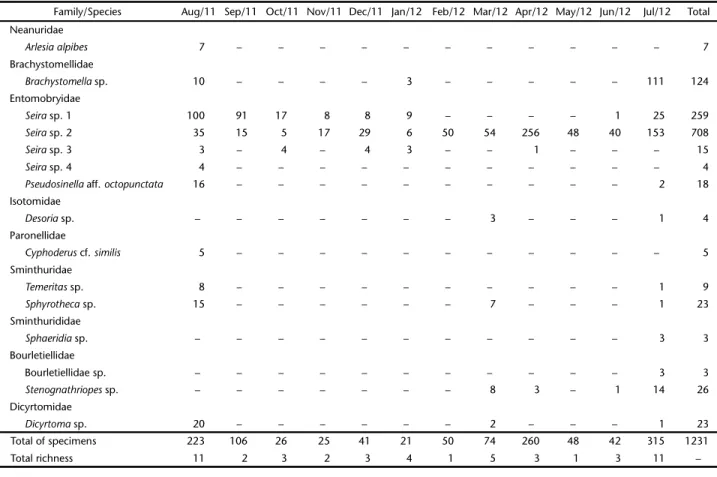
During the 12 study months a total of 1,231 Collembola specimens were collected, comprising 15 morphospecies in 12 genera, and nine families (Table I). Of the 12 genera identified, only Seira Lubbock, 1869 was represented by more than a single species (four species); it was also the most abundant genus, with 986 specimens (80% of the total abundance). Seira sp. 2 was the most abundant species (708 specimens; 57.5% of the total abundance), followed by Seira sp. 1 (259 specimens; 21% of the total abundance), and Brachystomella sp. (124 specimens; 10% of the total abundance). The other species demonstrated abundance values of >10% of the total (Table I). The species Seira sp. 1, Seira sp. 2, and Seira sp. 3 were the most frequent, while the remaining species were encountered in fewer than five collection months (Table I).
The climatic variable rainfall explained 59% of the tem-poral variations of species richness and 58% of the variations of abundance of Collembola (Table II). There was no temporal autocorrelation between the regression residuals (DWrichness = 1.87, p = 0.22; DWabundance = 2.64, p = 0.91). The temporal varia-tions of the species Seira sp. 1, Seira sp. 2, and Seira sp. 3 were explained by temperature variations.
The structural composition of the Collembola assemblage was also influenced by temporal variations of climatic elements (Fig. 1 and Table III). Axis 1 of the NMDS was related to the minimum temperature, while axis 2 was principally related to rainfall.
The distributions of the abundances of Collembola indi-viduals during the 12 months were different from random dis-tributions (z = 0.618, p = 0.007), being concentrated during the rainy period. Clustered distributions were also observed for Seira sp. 1 (z = 0.513, p = 0.038), Seira sp. 2 (z = 0.695, p = 0.001), and Seira sp. 3 (z = 0.857, p = 0.000)
DISCUSSION
Figure 1. NMDS analysis generated by Bray-Curtis similarity matri-ces of the Collembolan fauna at João Câmara, Rio Grande do Norte, Brazil.
Table I. The diversity of Collembola captured between August/2011 and July/2012 at the Fazenda Cauaçu farm, João Câmara, Rio Grande do Norte, Brazil.
Family/Species Aug/11 Sep/11 Oct/11 Nov/11 Dec/11 Jan/12 Feb/12 Mar/12 Apr/12 May/12 Jun/12 Jul/12 Total Neanuridae
Arlesiaalpibes 7 – – – – – – – – – – – 7
Brachystomellidae
Brachystomellasp. 10 – – – – 3 – – – – – 111 124
Entomobryidae
Seirasp. 1 100 91 17 8 8 9 – – – – 1 25 259
Seirasp. 2 35 15 5 17 29 6 50 54 256 48 40 153 708
Seirasp. 3 3 – 4 – 4 3 – – 1 – – – 15
Seirasp. 4 4 – – – – – – – – – – – 4
Pseudosinella aff. octopunctata 16 – – – – – – – – – – 2 18
Isotomidae
Desoriasp. – – – – – – – 3 – – – 1 4
Paronellidae
Cyphoderus cf. similis 5 – – – – – – – – – – – 5
Sminthuridae
Temeritassp. 8 – – – – – – – – – – 1 9
Sphyrothecasp. 15 – – – – – – 7 – – – 1 23
Sminthurididae
Sphaeridiasp. – – – – – – – – – – – 3 3
Bourletiellidae
Bourletiellidae sp. – – – – – – – – – – – 3 3
Stenognathriopessp. – – – – – – – 8 3 – 1 14 26
Dicyrtomidae
Dicyrtomasp. 20 – – – – – – 2 – – – 1 23
Total of specimens 223 106 26 25 41 21 50 74 260 48 42 315 1231
Total richness 11 2 3 2 3 4 1 5 3 1 3 11 –
Table II. Multiple regression analysis of the richnesses and abundances of Collembola species captured in João Câmara, RN, with climatic variables. Regressions at the species level were only performed for species encountered during at least five months.
Collembola R2
adj F-value
Climatic Variables
P-value Precipitation T. max T. min Richness 0.59 19.03 2.24 0.003 Abundance 0.58 12.62 1.52 0.009
Seira sp. 1 0.73 12.70 -1.56 0.009
Seira sp. 2 0.36 5.58 0.81 0.050
Seira sp. 3 0.21 6.60 1.23 0.037
Table III. Pearson’s Correlation between environmental variables and the NMDS scores of the Collembola guild in João Câmara, Rio Grande do Norte, Brazil. * p < 0.05
Climatic Variables Axis 1 (NMDS) Axis 2 (NMDS) Precipitation -0.22 0.85* Relative humidity -0.47 -0.82* Minimum temperature 0.68* 0.43 Maximum temperature -0.17 0.81*
The Collembola species identified in the present study demonstrated seasonal patterns of abundance, with their distri-butions being grouped during the rainy season. According to WOLDA (1978), areas with well-defined rainfall cycles tend to have
less abundant insect populations during the dry season, as has been reported for various groups of Caatinga insects (IANNUZZIet al. 2006, VASCONCELLOSet al. 2010). The structural composition of the entire Collembola assemblage (and not just the individual species and their individual abundances) was found to be greatly influenced by direct and indirect effects of climatic variables.
Insect assemblages in Neotropical ecosystems are strongly influenced by rainfall (WOLDA 1978, DEVELEY & PERES 2000, HERNÁNDEZ 2007), and the patterns of abundance and richness observed in the present study among Collembola species were explained principally by this same phenomenon. VASCONCELLOS etal. (2010) investigated the effects of seasonal change on vari-ous insect orders in the Caatinga region and observed that their abundance patterns were principally related to rainfall patterns. Temperature, on the other hand, appears to be the environ-mental variable that most affects insect guilds in the Cerrado (Brazilian savanna) biome (SILVA 2011).
The responses of the Collembola assemblage to rainfall in the Caatinga region are probably related to corresponding responses by the vegetation, as the plants there renew their growth activities rapidly after the first rains – resulting in greater food resource availability (and a more amenable climate) (MACHADOet al. 1995). According to CASTAÑO-MENESESetal. (2004), decomposing organic plant material is the principal dietary resource of Collembolans, followed by fungi (conidia and spores) and, occasionally, other animals (possibly already dead) such as dust mites and even other Collembola. Resource avail-ability plays an important role in determining the seasonal abundance patterns of insects, as food resources vary with the seasonal climate (WOLDA 1978, 1988).
Collembola have low natural resistance to desiccation (BUTCHERet al. 1971) and reductions in substrate humidity
cons-titute a determinant factor in their population densities during the dry season. Reduced mite activity is not necessarily linked to mortality, however, as population decreases may be related to other behavioral survival mechanisms such as reductions in re-production rates or the migration of individuals to more humid localities (BUTCHERet al. 1971). It is possible that certain micro-habitats can serve as refuges for these mites during the dry sea-son. Leaf litter, fallen trunks, and rocky soils provide important microhabitats for the pedofauna due to their ability to maintain acceptable levels of soil humidity during the dry season (GOLDSBROUGHet al. 2003), allowing these hexapods to survive
and subsequently increase their horizontal distributions in the soil and occupy additional microhabitats at the beginning of the rainy season, where they can mate, lay their eggs, and find food and protection against predators (CORNELISSEN & BOECHAT 2001).
Seira was the most abundant genus and the only one represented by more than a single species. The species of this
genus are predominately tropical and are covered by abundant hairs and scales that can trap layers of air above their bodies, diminishing water losses and allowing these animals to inhabit dry environments (CHRISTIANSEN & BELLINGER 2000, ZEPPELINI &
BELLINI 2004). BELLINI & ZEPPELINI (2009) noted that northeastern
Brazil has one of the highest species richnesses of this genus in the world. Twenty-five species of Seira have been reported from Brazil, with 14 recorded in the Caatinga region (BELLINI & ZEPPELINI 2009, SANTOS-ROCHAet al. 2011).
The numerical variations in the populations of Seira sp. 1, Seira sp. 2, and Seira sp. 3 were explained by temperature varia-tions. Environmental factors, especially temperature, directly affect development among Collembolans, with their growth rates being suppressed during unfavorable seasons; there are many examples of the eggs and immatures of this guild surviv-ing unfavorable periods through latency or diapause (CHRISTIANSEN
& BELLINGER 1988, HOPKINS 1997, BELLINGERet al. 1996-2012). Seira sp. 2 was the most frequent and abundant species during the dry season, with a seasonal pattern similar to that reported for Seira purpurea Schött, 1891 in Mexico (PALACIOS
-VARGASet al. 2003). S. purpurea has been observed varying its
diet between the dry and rainy seasons, with fragments of Collembola and other nematode parasites being found in their intestines during the dry season (CASTAÑO-MENESESet al. 2004). Collembola are considered generalist consumers and can use many food resources, depending on their habitats. The high abundance and frequency of Seira sp. 2 during the dry season may also be related to reductions in some groups of insect predators. Collembola have many natural enemies, including Coleoptera (such as carabid beetles and their larva), Diptera, and Hymenoptera (RUSEK 1988). VASCONCELLOSet al. (2010)
re-ported that the abundances of these predator groups were greatly reduced during the dry season.
The present study demonstrated that the return of rain-fall to the Caatinga region was directly related to increases in the richness and abundance of Collembolans, although other factors such as interspecific competition, predation, and the distribution of food resources during the year act in tandem with climatic factors to influence the distributions of Collembola. The effects of climatic variables on Collembola suggest that future climate changes (principally in terms of rainfall patterns and temperature regimes) will affect ecosystems ser-vices directly or indirectly associated with these organisms. Collembola are one of the least known groups among the hexa-pods that compose the Caatinga pedofauna, principally in terms of their spatial-temporal distributions and diversity.
ACKNOWLEDGEMENTS
LITERATURE CITED
AGOSTINELLI, C. & U. LUND. 2011. R package ‘circular’: Circular Statistics. Avalable online at: https://r-forge.r-project.org/ projects/circular [Accessed: 03/VI/2012].
AGUIAR, C.M.L. & C.F. MARTINS. 1997. Abundância relativa,
di-versidade e fenologia de abelhas (Hymenoptera, Apoidea) na Caatinga, São João do Cariri, Paraíba, Brasil. Iheringia, Série Zoologia, 83: 151-163.
ARAÚJO, C.S.; D.M. CANDIDO; H.F.P. ARAÚJO; S.C. DIAS & A.
VASCONCELLOS. 2010. Seasonal variations in scorpion activities
(Arachnida: Scorpiones) in an area of Caatinga vegetation in northeastern Brazil. Zoologia 27: 372-376. doi: 10.1590/ S1984-46702010000300008.
ARLÉ, R. & C. MENDONÇA. 1982. Estudo preliminar das espécies
de Dicranocentrus Schött, 1893, ocorrentes no Parque Naci-onal da Tijuca, Rio de Janeiro (Collembola). Revista Brasi-leira de Biologia 42 (1): 41-49.
BELLINGER, P. F.; K. A. CHRISTIANSEN & F. JANSSENS. 1996-2012.
Checklist of the Collembola of the World. Available online at: http://www.collembola.org. [Accessed: 03/VI/2012]. BELLINI, B. C. & D. ZEPPELINI. 2009. Registros da fauna de
Collembola (Arthropoda, Hexapoda) no Estado da Paraíba, Brasil. Revista Brasileira de Entomologia 53 (3): 386-390. BUTCHERJ, W.; R. SNIDER & R.J. SNIDER. 1971. Bioecology of edaphic
Collembola and Acarina. Annual Review of Entomology 3: 249-288.
CASSAGNE, N.; C. GERS & T. GAUQUELIN. 2003. Relationships between Collembola, soil chemistry and humus types in forest stands (France). Biology and Fertility of Soils37: 355-361. doi: 10.1007/s00374-003-0610-9.
CASTAÑO-MENESES, G.; J.G. PALACIOS-VARGAS & L.Q. CUTZ-POOL. 2004.
Feeding habits of Collembola and their ecological niche.
Anales del Instituto de Biologia, Universidad Nacional Autónoma de México, Serie Zoologia75 (1): 135-142. CHRISTIANSEN, K. & P. BELLINGER. 1998. The Collembola of North
America. Northof Rio Grande, an analysis taxonomic. Iowa: Grinnel College: 1322-1980.
CHRISTIANSEN, K.A. & P. BELLINGER. 2000. A Survey of the Genus Seira (Hexapoda: Collembola: Entomobryidae). Sciences-New York36 (1): 39-75.
CORNELISSEN, T.G. & I.G. BOECHAT. 2001. Seleção de hábitats por Porrimosa lagotis (Mello-Leitão, 1941) (Araneae, Lycosidae) em área de cerrado em Minas Gerais, Brasil. Revista Brasi-leira de Zoociências3 (2): 147-1548.
CULIK, M.P. & D. ZEPPELINI. 2003. Diversity and distribution of
Collembola (Arthropoda: Hexapoda) of Brazil. Biodiversity and Conservation 12: 1119-1143.
DEVELEY, P.F. & C.A. PERES. 2000. Resource seasonality and the structure of mixed species bird flocks in a coastal Atlantic forest of southeastern Brazil. Journal of Tropical Ecology16: 33-53. DURBIN, J. & G.S. WATSON. 1950. Testing for serial correlation in
least squares regression. Biometrika37: 409-428.
FOX, J. & S.WEISBERG. 2011. An R Companion to Applied Regression. Thousand Oaks, Sage. Available online at: http:/ /socser v.socsci.mcmaster.ca/jfox/Books/Companion [Accessed: 03/VI/2012].
GOLDSBROUGH, C.L.; D.F. HOCHULI & R. SHINE. 2003. Invertebrate
biodiversity under hot rocks: habitat use by the fauna of sandstone outcrops in the Sydney region. Biological Conservation109: 85-93.
GUSMÃO, M.A.B. & A.J. CREÃO-DUARTE. 2004. Diversidade e
análi-se faunística de Sphingidae (Lepidoptera) em área de brejo e caatinga no Estado da Paraíba, Brasil. Revista Brasileira de Zoologia 21: 491-498.
HERNANDEZ, M.I.M. 2007. Besouros escarabeineos (Coleóptera: Scarabaeidae) da caatinga paraibana, Brasil. Oecologia Brasiliensis11: 356-364.
HOPKIN, S.P. 1997. Biology of Springtails (Insecta: Collembola).
New York, Oxford University Press, 344p.
IANNUZZI, L.; A.C.D. MAIA & S.D. VASCONCELOS. 2006. Ocorrência e sazonalidade de coleópteros buprestídeos em uma região de caatinga nordestina. Biociências 14: 174-179.
IDEMA. Informativo municipal, João Câmara. Instituto de Desenvolvimento Sustentável e Meio Ambiente do Rio Gran-de do Norte. Available online at:http://200.149.240.140:8080/ i3geo/aplicmap/geral.htm?109e26d9b378612b42a08fd 20675547d#> [Accessed: 08/03/2011].
JANZEN, D.H. 1973. Sweep samples of tropical foliage insects:
effects of seasons, vegetation types, elevation, time of day, and insularity. Ecology 54: 667-701.
MACHADO, I.C.S.; L.M. BARROS & E.V.S.B. SAMPAIO. 1995. Phenology
of Caatinga Species at Serra Talhada, PE, Northeastern Brazil.
Biotropica29: 57-68.
MANLY, B.J.F. 2008. Métodos estatísticos multivariados: uma introdução. Porto Alegre, Bookman, 3rd ed., 229p. MEDEIROS, J.; A. ARAUJO; H.P.F. ARAUJO; J.P.C. QUEIROZ & A. VASCONCELLOS.
2012. Seasonal activity of Dinoponera quadriceps (Formicidae, Ponerinae) in the semi-arid Caatinga of northeastern Brazil.
Revista Brasileira de Entomologia56: 81-85.
NIMER, E. 1972. Climatologia da região Nordeste do Brasil. In-trodução à climatologia dinâmica. Revestia Brasileira Ge-ografia34: 3-51.
OKSANEN, F.J.; B. GUILLAUME; K. ROELAND; L. PIERRE; R.M. PETER; R.B.
O’HARA; L.S. GAVIN; S. PETER; M.H.H. STEVENS & H. WAGNER. 2012.
Vegan: Community Ecology Package. R package version
2.0-5. Available online at: http://CRAN.R-project.org/package = vegan [Accessed: Accessed: 03/VI/2012].
PALACIOS-VARGAS, J.G. & G. CASTAÑO-MENESES. 2003. Seasonality
and community composition of springtails in Mexican forests, p. 159-169. In: Y. BASSET; R. KITCHING, S. MILLER & N. NOVOTNY (Eds). Arthropods of tropical forests. Cambridge,
Cambridge University Press.
PINHEIRO, F.; I.R. DINIZ; D. COELHO & M.P.S. BANDEIRA. 2002.
R CORE TEAM. 2012. R: A language and environment for statistical computing. R Foundation for Statistical Computing, Vienna, Austria. ISBN 3-900051-07-0, available online at: http://www.R-project.org.
RUSEK, J.1998. Biodiversity of Collembola and their functional
role in the ecosystem. Biodiversity and Conservation 7: 1207-1219
SANTOS-ROCHA, I.M.; R. ANDREAZZE & B.C. BELLINI. 2011. Registros de Collembola (Arthropoda, Hexapoda) no Estado do Rio Grande do Norte, Brasil. Biota Neotropica 11 (3): 167-170. SILVA, N.A.P.; M.R. FRIZZAS & C.M. OLIVEIRA. 2011. Seasonality in
insect abundance in the “Cerrado” of Goiás State, Brazil. Revista Brasileira de Entomologia 55 (1): 79-87. TABARELLI, M & J.M.C. SILVA. 2003. Áreas e ações prioritárias para a
conservação da biodiversidade da Caatinga, p. 777-796. In: I.R. LEAL; M. TABARELLI & J.M. C SILVA (Eds). Ecologia e Conservação da Caatinga. Recife, Universidade Federal de Pernambuco. VASCONCELLOS, A.; R. ANDREAZZE; A.M. ALMEIDA; H.F.P.ARAUJO; E. S.
OLIVEIRA & U. OLIVEIRA. 2010. Seasonality of insects in the
semi-arid Caatinga of northeastern Brazil. Revista Brasilei-ra de Entomologia 54: 471-476.
VELLOSO, A.L.; E.V.S.B. SAMPAIO & F.G.C.PAREYN. 2002. Ecorregiões propostas para o Bioma Caatinga. Resultados do
Semi-nário de Planejamento Ecorregional da Caatinga. Reci-fe, Associação Plantas do Nordeste, The Nature Conservancy do Brasil.
VENABLES, W.N. & B.D. RIPLEY. 2002. Modern Applied Statistics with S. New York, Springer, 4th ed.
WOLDA, H. 1978. Seasonal fluctuations in rainfall, food and
abundance of tropical insects. Journal Animal Ecology47: 369-381.
WOLDA, H. 1988. Why Insect seasonality? Annual Review of Ecology and Systematics PaloAlto19: 1-18.
ZANELLA, F.C.V. & C.F. MARTINS. 2003. Abelhas da Caatinga:
Biogeografia, Ecologia e Conservação, p. 75-134. In: I. LEAL; M. TABARELLI & J. M. C. SILVA (Eds). Ecologia e conservação da Caatinga. Recife, Universidade Federal de Pernambuco, 804p. ZAR, J. H. 1999. Biostatistical Analysis. New Jersey, Prentice Hall,
663p.
ZEPPELINI, D.F. & B.C. BELLINI. 2004. Introdução ao estudo dos Collembola. João Pessoa, Editora Universitária, Universi-dade Federal da Paraíba, 82p.
ZEPPELINI, D.; B.C. BELLINI; A.J. CREÃO-DUARTE & M.I.M. HERNÁNDEZ.
2009. Collembola as bioindicators of restoration in mined sand dunes of Northeastern Brazil. Biodiversity and Conservation 18: 1161-1170. doi: 10.1007/s10531-008-9505-2.