Major Article
Corresponding author: Profa. Gílcia Aparecida de Carvalho.
e-mail: [email protected]; [email protected]
Received 27 April 2016
Accepted 22 November 2016
Sandfl ies (Diptera: Psychodidae) in an urban area
of Northeastern Brazil
Maria Claudia Ribeiro Agra
[1],[2], Pietra Lemos Costa
[2], Anderson Enio Silva Duque
[2],
Efraim Naftali Lopes Soares
[3], Leucio Câmara Alves
[4],
Rafael Antonio Nascimento Ramos
[5]and Gílcia Aparecida de Carvalho
[5][1]. Programa de Pós-Graduação Stricto Sensu em Ciência Animal Tropical, Universidade Federal Rural de Pernambuco, Recife, Pernambuco, Brasil. [2]. Gerência de Vigilância em Saúde, Secretaria Municipal de Saúde de Caruaru, Caruaru,
Pernambuco, Brasil. [3]. IV Gerência Regional de Saúde, Secretaria Estadual de Saúde, Recife, Pernambuco, Brasil. [4]. Departamento de Medicina Veterinária, Universidade Federal Rural de Pernambuco, Recife, Pernambuco, Brasil. [5]. Unidade Acadêmica de Garanhuns, Universidade Federal Rural de Pernambuco, Garanhuns, Pernambuco, Brasil.
Abstract
Introduction: The sandfl y fauna is well studied globally. In Brazil, sandfl y fauna is very diverse in the Northeast region,
especially in states such as Maranhão, Ceará, and Bahia. However, in the State of Pernambuco, the distribution of these insects is still not well known. Therefore, the objective of this study was to identify the different species that constitute the sandfl y fauna in an urban area in the Northeast region of Brazil, where an outbreak of visceral leishmaniasis (VL) was recently reported.
Methods: The sandfl ies were collected from an urban area endemic for VL, at fi ve collection points. The collection of samples
was carried out from November 2014 to December 2015, using CDC light traps installed in intradomiciliary and peridomiciliary
fashion. Results: The collected sandfl ies (n = 297) belonged to eight species: Lutzomyia lenti, Lutzomyia longipalpis, Lutzomyia sallesi, Lutzomyia migonei, Lutzomyia walkeri, Lutzomyia capixaba, Lutzomyia carmelinoi, and Lutzomyia whitmani. Most
of the specimens collected were peridomiciliary (247/297, 83%). L. lenti (154/297, 52%) was the most frequently sampled species, followed by L. longipalpis (88/297, 29.6%), and L. sallesi (42/297, 14.1%), which together accounted for over 90% of the collected sandfl y specimens. Conclusions: The continued presence of L. longipalpis in urban areas, including that in
intradomiciliary areas, with a predominance of females, is crucial because of the high possibility of them causing VL outbreaks,
since this species is the main vector of Leishmania infantum in Brazil.
Keywords:Lutzomyia longipalpis. Leishmania infantum. Urbanization.
INTRODUCTION
Sandfl ies (Diptera: Psychodidae) are important insects that are widespread globally, with approximately 800 species; there are approximately 243 known sandfl y species in Brazil(1) (2). It is known that several species of sandfl ies are vectors of pathogens, including the Leishmania protozoan (Kinetoplastida: Trypanosomatidae), which is an etiologic
agent of leishmaniasis(3). In Brazil, two species are involved in
transmission of visceral leishmaniasis (VL), namely Lutzomyia longipalpis and Lutzomyia cruzi(4). Lutzomyia migonei specimens were found to be naturally infected with Leishmania infantum, in São Vicente Ferrer, Pernambuco(5) and Rio de Janeiro(6) (7). An experimental infection with L. infantum was reported in a previous study(8). However, further studies are
needed to elucidate the role of this species in the epidemiology
of VL in Brazil.
The occurrence of VL and American cutaneous leishmaniasis (ACL) in the Americas involves complex ecology and
epidemiology, because it is directly related to the distribution of
the species of sandfl ies(9) (10). Because of environmental changes
resulting from the deforestation and urbanization processes observed in various regions of Brazil, some species of wild sandfl ies settled around human dwellings and animal shelters, demonstrating their adaptation to the environments modifi ed by
humans. This phenomenon contributed to the gradual spread of
VL in all the regions of the State of Pernambuco over the last two decades(5). For example, from 2005 to 2010 16.9% of canine
visceral leishmaniasis (CVL) was observed in the municipality
of Caruaru(11). More recently, in 2015, an outbreak of VL was
reported in the same study area, with six human cases(12). Despite recent progress in mapping the geographical
distribution of vector-borne diseases, the occurrence and expansion of VL vectors have not been systematically monitored or
AgraMCR et al. - Sandfl y in an urban area
Males Females Intradomicile Peridomicile Species
Total n (%) n (%) n (%) n (%)
L. lenti (Mangabeira, 1938) 154 55 (35.7)
40 (45.4) 21 (50.0) 4 (100.0)
-1 (33.3)
-1 (-100.0)
99 (64.3) 48 (54.5) 21 (50.0)
-3 (100.0) 2 (66.7) 2 (100.0)
-21 (13.6) 15 (17.0) 10 (24.0)
-3 (100.0)
-1 (-100.0)
133 (86.4) 73 (83.0) 32 (76.0) 4 (100.0) 3 (100.0)
-2 (100.0)
-L. longipalpis (Lutz & Neiva, 1912) 88
L. sallesi (Galvão e Coutinho, 1939) 42
L. migonei (França, 1920) 4
L. walkeri (Newstead, 1914) 3
L. capixaba (Dias, Falcão, Silva & Martins, 1987) 3
L. carmelinoi (Ryan, Fraihab & Brazil, 2001) 2
L. whitmani (Antunes & Coutinho, 1939) 1
Total 297 122 (41.0) 175 (59.0) 50 (17.0) 247 (83.0)
TABLE 1
Sandfl y species collected in an urban area of Caruaru, State of Pernambuco, from November 2014 to December 2015.
L.: Lutzomyia.
and insuffi cient knowledge about the various elements involved in the transmission chain of VL in some areas where control
strategies are still ineffective. Therefore, for performing surveys
on sandfl ies, an increased familiarity with the areas of occurrence and an understanding of the population dynamics of VL vectors are important factors that can help expand the epidemiological control policies. The aim of the present study was to identify different species that constitute the sandfl y fauna in a specifi c urban area in northeastern Brazil where VL cases have been reported.
METHODS
Study area
The study was conducted in the municipality of Caruaru (08°16'58" South and 35°58'33" West), which has an estimated population of 351,686 people and is considered an urban VL endemic area in the State of Pernambuco, Northeastern Brazil. Over the recent years, the municipality has grown inordinately, presenting a close interface between the urban and rural areas. The main economic activity of the area is textile production, followed by subsistence agriculture(13). It has a semi-arid climate
with winter rainfall. Its pluviometric index is approximately
662mm, unevenly distributed throughout the year. The average
annual temperature is 22.5°C, and the annual average of relative humidity (RH) is 75%. The predominant vegetation is Caatinga, with the presence of some remnant Atlantic Rainforest. The climatic data on temperature, RH, and rainfall were recorded by
the Agronomic Institute of Pernambuco [Instituto Agronômico de Pernambuco (IPA)] and the Pernambuco Agency for Water and
Climate [Agência Pernambucana de Águas e Clima (APAC)].
Collection and identifi cation of sandfl ies
From November 2014 to December 2015, samples were collected from fi ve districts in the municipality of Caruaru:
Morada Nova, Rendeiras, Campo Novo, Nova Caruaru, and Alto
do Moura. The criteria for selection of the capture sites were
based on the occurrence of human and/or canine VL cases(12),
as well as on the presence of dogs and/or other pets in homes. The capture of insects was performed monthly for three consecutive nights. Twelve Centers for Disease Control (CDC)
light traps(14) were placed in each of the districts, 1.5m above the
ground level, in the evening (at 5:00pm) and gathered at dawn (at 6:00am). The traps were placed in different intradomicile and peridomicile ecotypes: sheepfold, pen, kennel, barn, chicken coop, and pigsty. Households with traps were georeferenced; each trap was numbered and mapped using satellite remote sensing global positioning system (GPS).
The collected insects were fixed in 70% alcohol and identifi ed using taxonomic keys(15).
Data analysis
The data were submitted for descriptive statistical analysis. The Lilliefors test was used to verify the normality of the data. The relationship between the number of collected sandfl ies and climatic variables was measured using cross correlation coeffi cient
and t-test(16). The Friedman test was used to compare the monthly
variation in species among the collected sandfl ies. The Chi-square test (χ2) with Yates correction was used to compare the presence
of males and females in the environment (intradomiciliary or peridomiciliary), as well as the occurrence of various sandfl y species in the different ecotypes. A 5% signifi cance level was considered. The BioEstat software version 5.3 was used for statistical calculations(17).
RESULTS
A total of 297 sandfl ies were collected during the study, of which 122 (41%) were males and 175 (59%) were females; i.e., a sex ratio (M:F) of 1:1.43. No monthly statistical difference between the number of collected females and males was observed (Fr = 0.0714; p = 0.7893).
Eight species were identifi ed (Table 1), and Lutzomyia lenti
Nov Dec Jan Feb Mar Apr Mai Jun Jul Aug Sep Oct Nov Dec 0
20 40 60 80 100
Sandflies Relative Humidity Temperature Rainfall
N
u
m
b
e
r
of Sand
flies
0 20 40 60 80 100 120
R
H
/T
e
m
p
/R
a
in
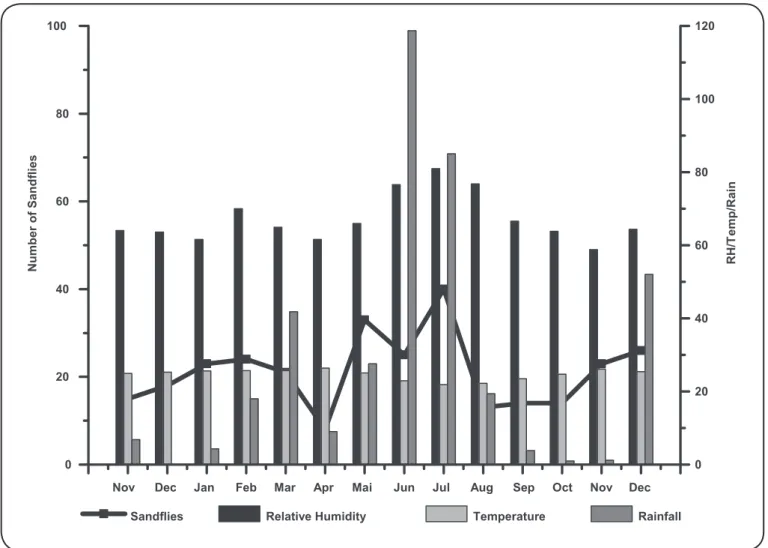
FIGURE 1. Number of sandfl ies collected and climatic variations in Caruaru, State of Pernambuco, from November 2014 to December 2015. RH: relative humidity.
followed by L. longipalpis (88/297, 29.6%) and Lutzomyia sallesi (42/297, 14.1%), which together accounted for more than 90% of the collected sandfl ies. L. lenti, L. longipalpis, and L. sallesi were
the most commonly occurring species throughout the study, with monthly variations (Friedman test, p = 0.0429). It is important to
note that L. longipalpis was more predominant in June (n = 16) and L. lenti was more frequently found in July 2015 (n = 36).
These three species were found in all the surveyed neighborhoods. The sandflies showed preference for peridomicile environments (247/297, 83%), followed by dwellings (50/297, 17%). Both males and females were abundant in animal sheds (105/247, 42.5%; 142/247, 57.5%, respectively), and no statistical difference between them was observed (χ2 = 0.917;
p = 0.3381).
Lutzomyia longipalpis (73/247, 29.6%) and L. lenti (133/247, 54%) were captured mainly in animal sheds and no statistical difference was observed between them (χ2 = 0.514;
p = 0.5967). It is important to note that L. longipalpis females
(9/48, 18.7%) were collected from bedrooms of the houses. When observing the preference of sandflies to the
peridomicile ecotypes, the study found a high prevalence in
chicken coops, followed by kennels, sheepfolds, pigsties,
barns, and stalls. L. longipalpis was mainly detected in chicken
breeding sites (34/73, 46.6%) and L. lenti was detected in sheepfold (51/132, 38.6%).
The species were more abundant in May and July 2015, at average temperatures 25.1 and 21.9ºC and RH 66 and 81%, respectively. However, in the present study any infl uence of temperature on the number of sandfl ies was observed through the analysis of cross correlation coeffi cient (cross correlation coeffi cient = - 0.21; Figure 1). Moreover, RH directly infl uenced
the number of specimens collected (cross correlation coeffi cient = - 0.53). The rainfall ranged from 0.0 (December 2014) to 118.7mm (June 2015). No signifi cant (p > 0.05) correlation between the number of samples collected per month and precipitation was observed (cross correlation coeffi cient = 0.21).
DISCUSSION
difference from their natural habitats(18). Three sandfl y species,
L. lenti, L. longipalpis, and L. sallesi were found in all the surveyed neighborhoods. From an epidemiological perspective,
this fi nding is very important because of the spread of insects
in the city, especially L. longipalpis, which is considered the main vector of L. infantum in Brazil.
Most (247; 83%) sandfl ies collected during the study period were peridomiciliary. An increase in the abundance and diversity of peridomiciliary sandfl ies has been observed in several areas of Brazil in recent years(5). It is important to correlate the vector
density with favorable environmental aspects for peridomiciliary sandfl ies, such as the presence of vegetation, roots, tree trunks, and organic matter, which are the possible shelters and breeding
grounds for the vector(19). In locations, from where the samples
were collected, there were mostly poor households, with defi cient basic sanitation and high pet population, resulting in
the accumulation of organic matter. The families maintained diverse types of animal breeding outside their houses as means
of subsistence. These conditions were more pronounced in places like Alto do Moura and Nova Caruaru, where a higher frequency of sandfl ies was found. These environmental factors associated with low economic status of residents have been reported to contribute considerably to the transmission of VL(20).
Lutzomyia lenti represented 51.8% of the captured sandfl ies. This fi nding is notable, given the fact that this species feeds on the blood of humans, horses, and dogs. It has wide distribution
in the country and although it is not presumably a vector of
Leishmania, it is found in ACL and VL transmission areas(21).
L. lenti was found naturally infected with promastigotes
in the City of Jacobina, Bahia(22). Therefore, the possible epidemiological role of L. lenti needs to be further clarifi ed.
Lutzomyia longipalpis is the main vector of L. infantum in the New World. This species represented 29.6% of the
specimens captured in this study. It is possible that this species is more adaptive to the environmental changes than the other
Lutzomyia spp., as it is perpetuated in different ecotypes and is most synanthropic(23) (24). This species was collected in large
numbers from chicken coops, pigsties, and corrals. In fact, it is known that chickens are among the preferred hosts for the
blood meal of L. longipalpis(20) (26).
Lutzomyia sallesi represented 14.1% of the sandfl ies collected
during the study period. This species commonly spread in the
State of Minas Gerais and has been found naturally infected with L. infantum(27). There are no records to date suggesting that this
species uses humans as hosts. However, it may be involved in a wild or rural cycle of Leishmania transmission(28).
The species L. migonei, L. walkeri, L. capixaba, L. whitmani, and L. carmelinoi together amounted to 4.37% of the collected sandflies. L. migonei, although not as anthropophilic as
L. intermedia, can reach man and domestic animals by adapting to their home environment. Its presence inside the homes and outdoors indicates its adaptation to human environments(5) (29).
L. migonei was found naturally infected in the municipality of
São Vicente Ferrer, Pernambuco(5) and in the State of Rio de Janeiro(6) (7). However, its role in the epidemiology of VL in
Brazil needs to be elucidated.
Lutzomyia walkeri, Lutzomyia capixaba, and Lutzomyia carmelinoi are usually found in forest environments, probably
because of more abundant resources. However, in this study they were also observed in locations showing effects of human
intervention, suggesting some adaptation to the changing environments(5).
Lutzomyia whitmani is well known for its anthropophilic
action and involvement in the transmission of leishmaniasis in
Brazil and Paraguay(25) (30) (31). The data on the ecology of this
species is still incipient, especially in Northeastern Brazil(32).
However, even at low density, it may be contributing to the transmission of ACL in the urban area of Caruaru.
The seasonal dynamics of sandfl ies can vary greatly from
region to region, and the varying climatic factors, over time, might cause species to have different patterns in the same geographical area(5) (26). The specimens collected in this study
showed abundance in the months of May and July 2015, corresponding to the months before and after the wettest period of the year. The greatest abundance of sandfl ies occurred in June 2015, the month with the highest rainfall of the year; this pattern was also observed in several other regions of Brazil(18). The
present study showed a moderate positive correlation between the number of sandfl ies and rainfall, but no signifi cant correlation could be deduced. On the other hand, a negative correlation was observed, with direct infl uence between the number of insects and humidity. Finally, a negative, albeit non-signifi cant, correlation between the number of sandfl ies and temperature was observed.
This study provides additional data on the ecology of the
sandfl y, L. longipalpis, which is the main vector of L. infantum in South America. Moreover, the study demonstrated the ability of
this species to adapt to anthropic environments. This species was consistently present in the studied locations and showed general intradomicile adaptation in the urban areas, which suggest a high possibility of VL outbreaks in these environments. The rainy season presented the highest risk, since it was the period showing the highest occurrence of the vector. The role of other sandfl y species in the epidemiology of VL in Brazil needs to
be elucidated in future studies.
Acknowledgments
The authors would like to thank the Secretaria Municipal de Saúde de Caruaru, IV Gerência Regional de Saúde, Secretaria Estadual de Saúde and Fundação Nacional de Saúde for supporting this study.
Confl ict of interest
The authors declare that there is no confl ict of interest.
REFERENCES
1. Galati EAB. Classifi cação de Phlebotominae. In: Rangel ER, Lainson R, editors. Flebotomíneos do Brasil. Rio de Janeiro: Fiocruz; 2003. p. 23-51.
2. Aguiar GM, Medeiros WM. Distribuição regional e habitats das espécies de fl ebotomíneos do Brasil. In: Flebotomíneos do Brasil. Rio de Janeiro: Fiocruz; 2003. p. 207-255.
3. Maroli M, Feliciangeli MD, Bichaud L, Charrel RN, Gradoni L. Phlebotomine sandfl ies and the spreading of leishmaniases and other diseases of public health concern. Med Vet Entomol 2013; 27: 123-147.
4. Ministério da Saúde. Secretaria de Vigilância em Saúde. Departamento de Vigilância Epidemiológica. Manual de Vigilância e Controle da Leishmaniose Visceral. (Série A. Normas e Manuais Técnicos); Brasília: Editora do Ministério da Saúde; 2003. 120p. 5. Guimarães VCFV, Costa PL, Silva FJ, Silva KT, Silva KG, Araújo
AIF, et al. Phlebotomine sandfl ies (Diptera: Psychodidae) in São Vicente Férrer, a sympatric area to cutaneous and visceral leishmaniasis in the State of Pernambuco, Brazil. Rev Soc Bras Med Trop 2012; 45:66-70.
6. Pita-Pereira D, Alves CR, Souza MB, Brazil RP, Bertho AL, Barbosa FA, et. al. Identifi cation of naturally infected Lutzomyia intermedia and Lutzomyia migonei with Leishmania (Viannia) braziliensis in Rio de Janeiro (Brazil) revealed by a PCR multiplex non-isotopic hybridisation assay. Trans R Soc Trop Med Hyg 2005; 99:905-913. 7. Carvalho BM, Maximo M, Costa WA, Santana ALF, Costa SM,
Rego TANC, et. al. Leishmaniasis transmission in an ecotourism area: potential vectors in Ilha Grande, Rio de Janeiro State, Brazil. Parasit Vectors 2013; 6:325.
8. Guimarães VCFV, Pruzinova K, Sadlova J, Volfova V, Myskova J, Brandão-Filho SP, et al. Lutzomyia migonei is a permissive vector competent for Leishmania infantum. Parasit Vectors 2016; 9:159. 9. Sharma U, Singh S. Insect vectors of Leishmania: distribution,
physiology and their control. J Vector Borne Dis 2008; 45:255-272. 10. Carvalho SMS, Santos PRB, Lanza H, Brandão-Filho SP.
Diversidade de fl ebotomíneos no Município de Ilhéus, Bahia. Epidemiol Serv Saúde 2010; 19:239-244.
11. Souza ZC, Brandespim DF, Agra MCR, Simões-Mattos L. Leishmaniose visceral canina e humana em Caruaru, Pernambuco, no período de 2005 a 2010. Rev Patol Trop 2014; 43:57-68.
12. Secretaria Municipal de Saúde de Caruaru. 2015. Boletim da Saúde 2013. Acessado: 13/12/2015. Disponível em: http://www. saudecaruaru.pe.gov.br/smscaruaru2013/index.php/
13. Instituto Brasileiro de Geografi a e Estatística (IBGE). Cidades@. 2016. Acessado: 02/02/2016. Disponível em: http://cidades. ibge.gov.br/xtras/perfi l.php?lang=&codmun= 260410&search= pernambuco|caruaru
14. Sudia WD, Chamberlain RW. Battery operated light trap, an improved model. Mosquito News 1962; 22:126-129.
15. Young DG, Duncan MA. Guide to the identifi cation and geographic distribution of Lutzomyia sand fl ies in Mexico, the West Indies, Central and South America (Diptera: Psychodidae). Mem American Entomol Inst 1994; 54:1-881.
16. Box GEP, Jenkins GM, Reinsel GC. Time Series Analysis: Forecasting and Control. 4th edition. New Jersey: Wiley; 2008; 784p.
17. Ayres M, Ayres Jr M, Ayres DL, Santos AL. BioEstat 2.0: Aplicações estatísticas nas áreas das ciências biológicas e médicas. Belém, Sociedade Civil Mamirauá. Brasília: CNPq; 2000. 272p. 18. Almeida PS, Minzão ER, Minzão LD, Silva SR, Ferreira AD,
Faccenda O, et al. Aspectos ecológicos de fl ebotomíneos (Diptera: Psychodidae) em área urbana do município de Ponta Porã, Estado de Mato Grosso do Sul. Rev Soc Bras Med Trop 2010; 43:723-727.
19. Camargo-Neves VLF, Katz G, Rodas LAC, Poletto DW, Lage LC, Spínola RMF, et al. Utilização de ferramentas de análise espacial na vigilância epidemiológica de leishmaniose visceral americana - Araçatuba, São Paulo, Brasil, 1998-1999. Cad Saude Publica 2001; 17:1263-1267.
20. Barata RA, França-Silva JC, Mayrink W, Silva JC, Prata A, Lorosa ES, et. al. Aspectos da ecologia e do comportamento de fl ebotomíneos em área endêmica de leishmaniose visceral, Minas Gerais. Rev Soc Bras Med Trop 2005; 38:421-425.
21. Brazil RP, Carneiro VL, Andrade Filho JD, Alves JCM, Falcão AL. Biology of Lutzomyia lenti (Mangabeira) (Diptera: Psychodidae). An Soc Entomol Bras 1997; 26:191-193.
22. Sherlock IA. Ecological interactions of visceral leishmaniasis in the State of Bahia, Brazil. Mem Inst Oswaldo Cruz 1996; 91:671-683. 23. Scandar SAS, Silva RAD, Cardoso-Júnior RP, Oliveira FH.
Ocorrência de leishmaniose visceral americana na região de São José do Rio Preto, estado de São Paulo, Brasil. BEPA. Bolet Epid Paul (Online) 2011; 8:13-22.
24. Dantas-Torres F, Solano-Gallego L, Baneth G, Ribeiro VM, de Paiva-Cavalcanti M, Otranto D. Canine leshmaniosis in the Old and New Worlds: unveiled similarities and diferences. Trends Parasitol 2012; 28:531-538.
25. Nunes VLB, Galati EAB, Cardozo C, Rocca MEG, Andrade ARO, Santos MFC, et. al. Estudo de fl ebotomíneos (Diptera, Psychodidae) em área urbana do município de Bonito, Mato Grosso do Sul, Brasil. Rev Bras Entomol 2008; 52:446-451.
26. Costa PL, Dantas-Torres F, da Silva FJ, Guimarães VCFV, Gaudêncio K, Brandão-Filho SP. Ecology of Lutzomyia longipalpis in an area of visceral leishmaniasis transmission in north-eastern Brazil. Acta Tropica 2013; 126:99-102.
27. Nascimento BWL, Saraiva L, Teixeira Neto RG, Serra e Meira PCL, Sanguinette CC, Tonelli GB, et al. Study of sand fl ies (Diptera: Psychodidade) in visceral and cutaneous leishmaniasis areas in central western of Minas Gerais state – Brazil. Acta Tropica 2013; 125:262-268.
28. Saraiva L, Carvalho GM, Gontijo CM, Quaresma PF, Lima AC, Falcão AL, et. al. Natural infection of Lutzomyia neivai and Lutzomyia sallesi (Diptera: Psychodidae) by Leishmania infantum chagasi in Brazil. J Med Entomol 2009; 46:1159-1163.
29. Aguiar GM, Medeiros WM, Marco TS, Santos SC, Gambardella S. Ecologia dos fl ebotomíneos da Serra do Mar, Itaguaí, Estado do Rio de Janeiro, Brasil. I - A fauna fl ebotomínica e prevalência pelo local e tipo de captura (Diptera, Psychodidae, Phlebotominae). Cad Saude Publica 1996; 12:195-206.
30. Galati EAB, Nunes VLB, Dorval MEC, Oshiro ET, Cristaldo G, Espíndola MA, et. al. Estudo dos fl ebotomíneos (Diptera, Pychodidae), em área de leishmaniose tegumentar, no Estado de Mato Grosso do Sul, Brasil. Rev Saúde Pública 1996; 30: 115-128. 31. Lainson R, Shaw JJ. New world leishmaniasis. In: Topley and
Wilson's Microbiology and Microbial Infections. Boston: Hodder Arnold; 2005.