Original Article
Artigo Original
Rafaeli Higa Scarmagnani1
Daniela Aparecida Barbosa2
Ana Paula Fukushiro1,3
Manoel Henrique Salgado4
Inge Elly Kiemle Trindade1,3
Renata Paciello Yamashita1
Keywords
Cleft Palate Velopharyngeal Insuficiency Speech Rhinomanometry Evaluation
Descritores
Fissura Palatina Insuiciência Velofaríngea Fala Rinomanometria Avaliação
Correspondence address:
Rafaeli Higa Scarmagnani Rua Silvio Marchione, 3-20, Bauru (SP), Brasil, CEP: 17012-900. E-mail: [email protected]
Received: 08/15/2014
Study carried out at the Laboratory of Physiology, Hospital for the Rehabilitation of Craniofacial Analysis, University of São Paulo – USP – Bauru (SP), Brazil.
(1) Hospital for the Rehabilitation of Craniofacial Anomalies, Universidade de São Paulo – USP – Bauru (SP), Brazil. (2) Support and Rehabilitation Center of Patients with Cleft Palate – Londrina (PR), Brazil.
(3) Bauru School of Dentistry, Universidade de São Paulo – USP – Bauru (SP), Brazil. (4) Universidade Estadual Paulista “Júlio de Mesquita Filho” – UNESP – Bauru (SP), Brazil.
Financial support: Coordenação de Aperfeiçoamento de Pessoal de Nível Superior – CAPES.
Relationship between velopharyngeal closure,
hypernasality, nasal air emission and nasal rustle
in subjects with repaired cleft palate
Correlação entre o fechamento velofaríngeo,
hipernasalidade, emissão de ar nasal e ronco nasal
em indivíduos com issura de palato reparada
ABSTRACT
Purpose: To investigate the correlation among velopharyngeal closure, hypernasality, audible nasal air emission (NAE) and nasal rustle (NR), in individuals with repaired cleft palate. Methods: One hundred patients with repaired cleft palate and lip, submitted to pressure-flow study for measurement of velopharyngeal orifice area (velopharyngeal area) and speech sample recordings. Velopharyngeal area was estimated during the production of the sound /p/ inserted in a sentence, and the velopharyngeal closure was classified as adequate, borderline or inadequate. Hypernasality was rated using a 4-point scale, NAE and NR were rated as absent or present, by three speech language pathologists, using recorded speech samples. Inter and intra-judge agreements were established. Statistical analysis was performed using the Spearman correlation coefficient considering p<0.05. An ordinal logistic regression model was developed to investigate whether the characteristics of speech can predict velopharyngeal closure. For this, the speech samples included in this analysis were those that obtained 100% agreement among raters as to the degree of hypernasality (43 out of 100). Results: Significant correlation was found between hypernasality and velopharyngeal area; audible NAE and velopharyngeal area. A negative correlation was observed between the NR and velopharyngeal area. The regression analysis showed that the perceptual speech characteristics contributed significantly to predict the velopharyngeal closure.
Conclusion: There is significant correlation between velopharyngeal closure and hypernasality, NAE and NR. It suggests that the perceptual speech characteristics can predict velopharyngeal closure, favoring the diagnosis and the definition of treatment conduct of velopharyngeal dysfunction.
RESUMO
Objetivo: Investigar a correlação entre as dimensões do orifício velofaríngeo, hipernasalidade, emissão de ar nasal (EAN) audível e ronco nasal (RN), em indivíduos com fissura palatina reparada. Métodos:
INTRODUCTION
Most speech disorders observed in individuals with repaired cleft palate are directly or indirectly related to velopharyngeal dysfunction (VPD). Symptoms such as hypernasality, nasal air emission (NAE) (audible or not), and weak intraoral pressure are direct consequences of the failure of velopharyngeal closure. VPD is diagnosed by the auditory-perceptual assessment of speech(1-5) and by instrumental evaluations(5-7).
Generally, the velopharyngeal function is classiied based on the quality of resonance, assessed by the auditory-perceptual assessment and by the direct observation of velopharyngeal structures using methods such as nasendoscopy and video-luoroscopy(8). Besides these, indirect methods, such as aero-dynamic evaluations, provide quantitative data and, therefore, objective information about the velopharyngeal function. The pressure-low technique in particular allows to determine the velopharyngeal closure by measuring the area of the velo-pharyngeal oriice.
The perceptual characteristics of the velopharyngeal function are used to make inferences on the adequacy of the velopharyngeal mechanism. Studies suggest, for example, that there is a correlation between the degree of hypernasality, the presence of audible NAE and nasal rustle (NR), and velopha-ryngeal gap size(3-10).
Once more and more the subjectivity and the reliability of the auditory-perceptual assessment of speech have been investigated in literature, this study analyzed the following question: can the perceptual judgment of speech parameters predict the velopharyngeal gap size? Therefore, this study was carried out with the objective of investigating the correlation between the velopharyngeal gap size, the degree of hypernasal-ity, and the presence of NAE and NR.
METHODS
Subjects
This study was approved by the Research Ethics Committee of the Hospital for the Rehabilitation of Craniofacial Anomalies, Universidade de São Paulo, and all of the participants signed the informed consent. One hundred patients with repaired cleft palate were assessed, being 37 with isolated cleft palate and 67 with lip and cleft palate; 36 male and 68 female participants, aged between 6 and 47 years
old. Participants were selected consecutively, for 1 year and 3 months. Have not been included in the study individuals who presented syndromes; neurological problems; physical and/or mental incapacity to undergo the tests; acute or chronic allergic respiratory symptoms that could lead to nasal conges-tion during the examinaconges-tion; subnormal values of nasal area, according to the result of the rhinomanometry performed on the same day; residual palatal istulae dificult to sealing dur-ing the evaluation; pharyngeal lap; compensatory articulation in the production of the consonant “p”, since this sound is used to measure the velopharyngeal oriice area.
Procedures
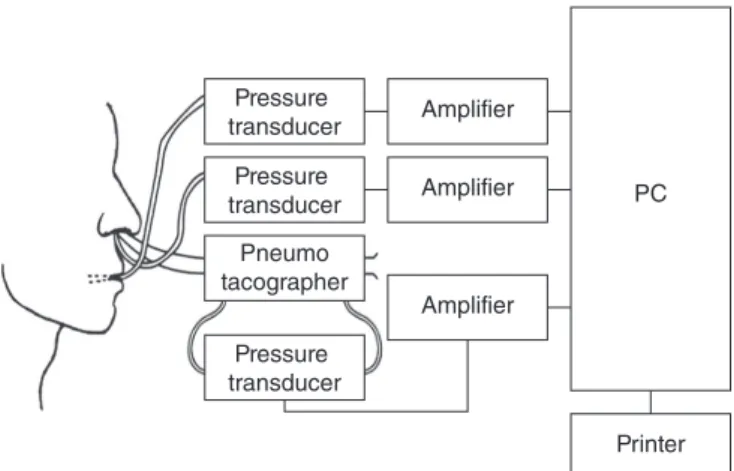
Aerodynamic Assessment of Speech (pressure‑low technique) The area of the velopharyngeal oriice was assessed by the pressure-low technique, using the PERCI-SARS system (ver-sion 3.50, Microtronics, Chapel Hill, NC, USA). The method is based on the aerodynamic principle that the area of an oriice can be estimated by simultaneously measuring the differential pressure between the two sides of the oriice and the airlow that passes through it (Figure 1).
The equation A=V/k(2ΔP/d)1/2,where A is the area of the oriice in cm2; V is the nasal low in cm3/s; k is 0.65; ΔP is the oral-nasal pressure in dynes/cm2; and d is the air density (0.001 g/cm3) is used to measure the minimum cross-sectional area of the velopharynx during the production of the consonant fechamento velofaríngeo. Para tanto, foram incluídas somente 43 amostras de fala que obtiveram 100% de concordância quanto ao grau de hipernasalidade entre as avaliadoras. Resultados: Correlação significativa entre hipernasalidade e área velofaríngea; EAN audível e área velofaríngea. Correlação negativa foi verificada entre RN e área velofaríngea. O modelo logístico mostrou que as características da fala contribuíram significativamente para a previsão do fechamento velofaríngeo. Conclusão: Existe correlação entre dimensões do orifício velofaríngeo e hipernasalidade, EAN e RN, sugerindo que as características perceptivas da fala podem predizer o fechamento velofaríngeo, favorecendo o diagnóstico e a definição de conduta de tratamento da disfunção velofaríngea.
Figure 1. Instrumentation to determine the area of the velopharyngeal orifice(11) (PERCI-SARS System, Microtronics, Chapel Hill, NC, USA)
! ! ! !
Pressure transducer
Pressure transducer
Pressure transducer
Amplifier
Amplifier
Amplifier
PC
Printer Pneumo
/p/ inserted in the word “rampa”, in the sentence “Papai pintou a rampa”, as aforementioned(11,12). The velopharyngeal closure was classiied according to the velopharyngeal oriice area based on criterion adapted from literature(13): 0–4.9 mm2 = adequate velopharyngeal closure; 5.0–19.9 mm2 = borderline; and ≥20 mm2 = inadequate.
Speech sample recording
All of the audio-digital recordings were recorded in a soundproof booth with the software Wave Studio (Creative Labs) and a headset microphone PRA-30 XLR (Superlux) laterally placed 5 cm away from the patient’s mouth. The speech sample was comprised of a 10-sentence set mostly containing words with the consonant /p/ because this is the target sound used in the aerodynamic evaluation. The patient was oriented to read the sentences. Those who were incapable of reading repeated the sentences after the evaluator. Speech sample record-ing and aerodynamic evaluation were performed on the same day.
Analysis of the perceptual parameters of speech
The speech samples were analyzed by three speech lan-guage pathologists experienced in the diagnosis of VPD, who individually classiied hypernasality in a 4-point scale: 1=absent hypernasality (normal resonance); 2=mild; 3=moderate; and 4=severe. Audible NAE and NR were classiied as follows: 1=absent or 2=present. The samples were recorded in three CDs and 20% of the sample was duplicated for the intra-rater analysis. The CDs also had speech samples representative of the four degrees of hypernasality, in order to be used as reference in the resonance classiication. In total, each rater analyzed 120 speech samples.
Data analysis
The inal score of hypernasality was established as score with more occurrences among the three raters. The percentage of inter- and intra-rater agreement was established using the Kappa coeficient(14). The correlation between the perceptual aspects of speech (absent, mild, moderate, and severe degree of hypernasality, audible NAE, and present or absent NR) and the velopharyngeal closure was analyzed using the Spearman cor-relation coeficient. The Fisher’s exact test and the χ2-test were used to verify the association between these same variables, when expressed qualitatively. An ordinal logistic regression model was established to predict the scoring of velopharyngeal closure according to these same speech parameters. For all these tests, a 5% signiicance level was considered (p<0.05).
RESULTS
Perceptual analysis of speech characteristics
The agreement between the raters in the analysis of the 100 speech samples was moderate for hypernasality (0.41) and audible NAE (0.59), and substantial for NR (0.72). In 43 speech samples, there was total agreement between the evaluators,
with Kappa index of 1.0, therefore being interpreted as almost perfect. The intra-rater agreement was almost perfect for the three analyzed speech characteristics.
Correlation between velopharyngeal oriice area and speech parameters
Hypernasality
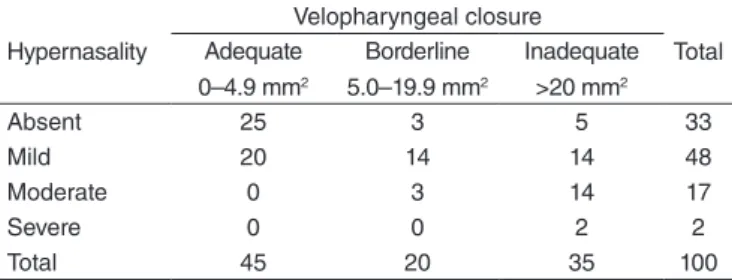
The Spearman correlation coeficient showed signiicant correlation (p<0.000; r=0.581) between hypernasality and ve-lopharyngeal area. Likewise, the Fisher’s exact test indicated signiicant association (p<0.000) between the level of hyper-nasality and the velopharyngeal closure, as shown in Table 1.
Audible nasal air emission
The Spearman correlation coeficient showed signiicant correlation (p<0.000; r=0.547) between audible NAE and the measurement of velopharyngeal area. The χ2-test results showed signiicant association (p<0.000) between the variables (Table 2).
Nasal rustle
The Spearman correlation coeficient showed signiicant correlation and the χ2-test showed signiicant association between the presence of NR and velopharyngeal closure (p=0.005). However, in this case, the Spearman correlation was negative (p=0.004; r=-0.287), as shown in Table 3.
Table 1. Distribution of patients according to degree of hypernasality, perceptually assessed, and velopharyngeal closure, measured by velopharyngeal area
Hypernasality
Velopharyngeal closure
Total Adequate
0–4.9 mm2
Borderline 5.0–19.9 mm2
Inadequate >20 mm2
Absent 25 3 5 33
Mild 20 14 14 48
Moderate 0 3 14 17
Severe 0 0 2 2
Total 45 20 35 100
Fisher’s exact test (p<0.000)
Table 2. Distribution of patients according to the presence and the absence of audible nasal air emission, perceptually measured, and velopharyngeal closure, measured by the velopharyngeal measurement
Nasal air emission (audible)
Velopharyngeal closure
Total Adequate
0–4.9 mm2
Borderline 5.0–19.9 mm2
Inadequate >20 mm2
Absent 42 13 12 61
Present 3 7 23 39
Total 45 20 35 100
Ordinal logistic regression model
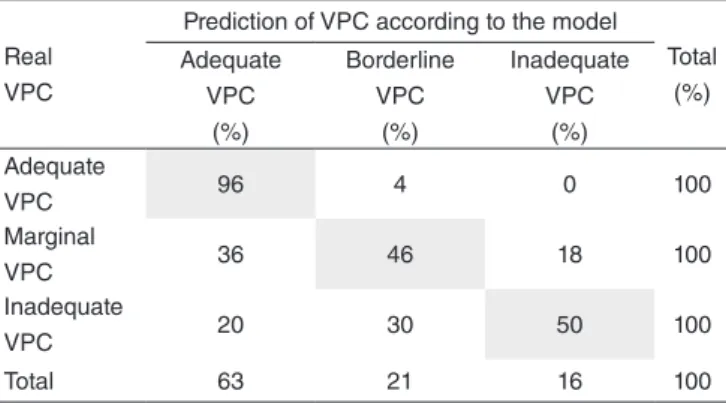
The χ2-test showed that the model presented a statistically signiicant adjustment (p=0.000). Considering the reduced number of participants classiied with severe hypernasality (2/100), it was decided to group the scores moderate and severe in this analysis. Besides, considering that the inter-rater regard-ing the degree of hypernasality was moderate, it was also chosen to use only the samples that obtained 100% agreement to im-prove the reliability of the results of this analysis. Table 4 shows the percentage of predicted patients according to the logistic model related to the real classiication obtained in the sample. According to this model, of the 43 (100%) assessed individuals, 72% (31) were predicted in the correct category.
The individual analysis of hypernasality results showed a stronger association between the degree of hypernasality and velopharyngeal closure in the two extremes of both modalities of evaluation. These results corroborate the indings of authors who veriied that the characteristics of hypernasality can pre-dict the velopharyngeal gap size in cases of small and large gaps assessed by nasendoscopy(3). According to literature, the categories of hypernasality between both extremes (normal and severe) are usually associated with borderline VPD(15-18). Therefore, the results in this study lead to the agreement that the attempt to explore the mild degree of hypernasality is probably the key to understand borderline velopharyngeal insuficiency(18).
Data analysis showed a signiicant correlation between these two measurements, hypernasality and velopharyngeal gap, thus indicating that the velopharyngeal area increased when the degree of hypernasality increased. These results corroborate previous studies(3,7,10,19) that also showed a signii-cant correlation between hypernasality and velopharyngeal gap. However, most of these studies used direct instrumental methods; however, they also kept their subjective aspect to analyze the correlation between different aspects of the ve-lopharyngeal function. Studies comparing the performance of nasendoscopy and videoluoroscopy in the judgment of velopharyngeal closure showed that nasendoscopy tends to underestimate the size of velopharyngeal opening in com-parison with videoluoroscopy(20,21). However, better results in the nasendoscopy concerning the agreement between the perceptual judgment of the velopharyngeal function and the function of the velopharyngeal mechanism assessed by im-ages were found in another study(22). These indings show the limitations of this type of evaluation and reinforce the impor-tance of studies that use objective and quantitative methods of the velopharyngeal functioning to investigate the correlation with speech features.
In a single study that correlated hypernasality with the ve-lopharyngeal gap size using the pressure-low technique(19), the authors observed moderate correlation between the de-gree of hypernasality and velopharyngeal closure. These au-thors pointed out as a limitation of this study the fact that the velopharyngeal area was measured based on the emission of a single word (hamper). However, according to international parameters of perceptual analysis of speech(23,24), it is also possible to consider as a limitation of this study the fact that hypernasality was only judged by a single rater. In the present study, it was important to make the perceptual judg-ment as reliable as possible, submitting the speech samples to the analysis of three experienced raters. Besides, the aforementioned authors included individuals with reduced nasal area (subnormal values) to verify if the values of nasal area could inluence the speech resonance. This study only included individuals with good nasal permeability conirmed by posterior rhinomanometry, that is, with nasal area values within the limits of normality. This is because a decrease in nasal airway patency resulting from the temporary nasal Table 4. Distribution of 43 samples that presented total agreement
between raters as to the degree of hypernasality and the prediction of velopharyngeal closure related to hypernasality, audible nasal air emission, and nasal rustle
Real VPC
Prediction of VPC according to the model
Total (%) Adequate
VPC (%)
Borderline VPC
(%)
Inadequate VPC
(%) Adequate
VPC 96 4 0 100
Marginal
VPC 36 46 18 100
Inadequate
VPC 20 30 50 100
Total 63 21 16 100
Caption: VPC = velopharyngeal closure
Table 3. Distribution of patients according to the presence and the absence of nasal rustle, perceptually measured, and velopharyngeal closure, measured by velopharyngeal area
Nasal rustle
Velopharyngeal closure
Total Adequate
0–4.9 mm2
Borderline 5.0–19.9 mm2
Inadequate >20 mm2
Absent 22 14 29 65
Present 23 6 6 35
Total 45 20 35 100
χ2-test (p=0.005)
DISCUSSION
congestion, for example, could NR and interfere with the perceptual judgment of audible NAE and NR, besides hy-pernasality itself(5).
Concerning audible NAE, the results also showed signii-cant correlation with the velopharyngeal area, thus indicating that, at the presence of the symptom, the velopharyngeal gap tends to be larger. Studies using nasendoscopy and vid-eoluoroscopy also showed correlation between these two variables(3,10). However, other authors did not ind a signiicant correlation between NAE and the velopharyngeal gap size(7). However, these authors used a speciic scale in the perceptual analysis of speech, called Pittsburgh Weighted Speech Scale, in which velopharyngeal insuficiency is rated based on the combination of nasality, NAE, facial grimacing, vocal charac-teristics, and compensatory articulation(25). One can speculate that that the use of a scale containing more levels can increase the possibilities of variations, so it is more dificult to corre-late the analyzed variables.
The presence of NR also revealed a statistically signiicant correlation with velopharyngeal closure. However, in this case, it is curious fact that the correlation was negative, which means that the presence of NR is related to smaller values of velopharyngeal area. These results conirm what can be seen by using nasendoscopic evaluations: NR occurs in the presence of a small velopharyngeal opening(26) as a consequence of the increasing oriice resistance to airlow, and is a speech aspect that signiicantly contributes with the prediction of a small velopharyngeal gap(5).
Considering that the correlation between the speech parameters and the velopharyngeal closure was statistically signiicant, a logistic regression model was used to analyze if the degree of hypernasality and the presence of audible nasal air emission or nasal rustle could estimate the scoring of velopharyngeal closure. It is worth mentioning that the fact that the correlation has been more evident among the extreme categories, both in the classiication of hypernasality and in velopharyngeal closure, led us to consider the reli-ability of the results obtained from the moderate agreement between the different raters as to the degree of hypernasality in the 100 speech samples. Therefore, to obtain more reliable results, the logistic regression model was elaborated using the speech samples that obtained 100% agreement between raters in the judgment of hypernasality, that is, 43 samples whose classiication of the degree of hypernasality was unanimous among the three raters. This model classiied 72% samples in the correct category of velopharyngeal closure, so it was possible to predict the intermediate category, the borderline velopharyngeal closure.
So, this study showed that even though the correlation between the perceptual aspects of speech and the objec-tive measurement of velopharyngeal closure is not total, this correlation is significant and, according to the ordi-nal logistic regression, the model strongly suggests that the speech features can help and predict velopharyngeal closure. One can speculate that these results might have
been even better if we had selected only the samples with 100% agreement between the raters for the other speech categories, NAE and NR.
In the future, the intention is to propose a protocol of velo-pharyngeal closure based on the most representative perceptual parameters of speech of individuals with cleft palate and on the results obtained by the objective assessment of velopha-ryngeal functioning. It is suggested that the development of a protocol that establishes the correspondence between the perceptual aspects of speech and the possible results obtained in the objective evaluation may provide more reliable data and, therefore, assist the diagnosis and the deinition of treatment for patients with VPD.
CONCLUSION
There is a signiicant correlation between the velopharyn-geal gap size and the degree of hypernasality, and the presence of audible NAE and NR. These results reinforce the importance of using pressure-low technique as a complementary objec-tive method in the diagnosis of velopharyngeal dysfunction, and suggest that perceptual aspects of speech can predict ve-lopharyngeal closure, therefore assisting the speech-language pathologists to deine a more effective diagnosis and treatment for velopharyngeal dysfunction.
*RHS, the main author of the study, was in charge of data collection, data analysis, and the manuscript writing; DAB collaborated with the tabulation of data; APF collaborated with data analysis and the manuscript writing; MHS participated in the statistical data analysis and the manuscript writing; IEKT participated in the writing of the article; RPY, leader of the research group, was in charge of the project and study design, as well as the general orientation of the stages of execution and elaboration of the manuscript.
REFERENCES
1. Dotevall H, Lohmander-Agerskov A, Ejnell H, Bake B. Perceptual evaluation of speech and velopharyngeal function in children with and without cleft palate and the relationship to nasal airlow patterns. Cleft Palate Craniofac J. 2002;39(4):409-24.
2. Konst EM, Rietveld T, Peters HF, Weersink-Braks H. Use of a perceptual evaluation instrument to assess the effects of infant orthopedics on the speech of toddlers with cleft lip and palate. Cleft Palate Craniofac J. 2003;40(6):597-605.
3. Kummer AW, Briggs M, Lee L. The relationship between the characteristics of speech and velopharyngeal gap size. Cleft Palate Craniofac J. 2003;40(6):590-6.
4. Smith BE, Kuehn DP. Speech evaluation of velopharyngeal dysfunction. J Craniofac Surg. 2007;18(2):251-61.
5. Kummer AW. Resonance disorders and velopharyngeal dysfunction (VPD). In: Kummer AW. Cleft palate and craniofacial anomalies: the effects on speech and resonance. San Diego: Singular; 2008. p.176-213. 6. Shprintzen RJ, Lewin ML, Croft CB, Daniller AI, Argamaso RV, Ship
AG, et al. A comprehensive study of pharyngeal lap surgery: tailor made laps. Cleft Palate J. 1979;16:46-55.
and assessment of velopharyngeal inadequacy. Am J Otolaryngol. 1997;18(1):38-46.
9. Kummer AW, Clark SL, Redle EE, Thomsen L, Billmire DA. Current practice in assessing and reporting speech outcomes of cleft palate and velopharyngeal surgery: a survey of cleft palate/craniofacial professionals. Cleft Palate Craniofac J. 2012;49(2):146-52.
10. Kummer AW, Curtis C, Wiggs M, Strife JL. Comparison of velopharyngeal gap size in patients with hypernasality, hypernasality and nasal emission, or nasal turbulence (rustle) as the primary speech characteristic. Cleft Palate Craniofac J. 1992;29(2):152-6.
11. Trindade IEK, Yamashita RP, Bento Gonçalves CGA. Diagnóstico instrumental da disfunção velofaríngea. In: Trindade IEK, Silva-Filho OG, organizadores. Fissuras labiopalatinas: uma abordagem interdisciplinar. São Paulo: Editora Santos; 2007. p.123-44.
12. Warren DW, Dubois AB. A pressure-flow technique for measuring velopharyngeal oriice area during continuous speech. Cleft Palate J. 1964;16:52-71.
13. Warren DW. Aerodynamic assessments and procedures to determine extent of velopharynngeal inadequacy. In: Bzoch KR, editor. Communicative disorders related to cleft lip and palate. 4th ed. Austin: Pro-ed; 1997. p. 411-37.
14. Landis JR, Koch GG. The measurement of observer agreement for categorical data. Biometrics. 1977;33(11):159-74.
15. Krause CJ, Tharp RF, Morris HL. A comparative study of results of the von Langenbeck and the V-Y pushback palatoplasties. Cleft Palate J. 1976;13:11-9.
16. McWilliams BJ, Glaser ER, Philips BJ, Lawrence C, Lavarato AS, Beery QC, et al. A comparative study of four methods of evaluating velopharyngeal adequacy. Plast Reconstr Surg. 1981;68:1-9.
technique for qualifying temporal patterns of palatopharyngeal closure. Cleft Palate J. 1985;22(1):11-9.
18. Jones DL, Morris HL, Van Demark DR. A comparison of oral-nasal balance patters in speakers who are categorized as “almost but not quite” and “sometimes but not always”. Cleft Palate Craniofac J. 2004;41(5):526-34.
19. Wa r r e n DW, D a l s t o n R M , M a y o R . H y p e r n a s a l i t y a n d velopharyngeal impairment. Cleft Palate Craniofac J. 1994; 31(4):257-62.
20. Sinclair SW, Davies DM, Bracka A. Comparative reliability of nasal pharyngoscopy and videofluorography in the assessment o f ve l o p h a r y n g e a l i n c o m p e t e n c e . B r J P l a s t S u rg . 1 9 8 2 ; 35:113-7.
21. Henningsson G, Isberg A. Comparison between multiview videoluoroscopy and nasendoscopy of velopharyngeal movements. Cleft Palate Craniofac J. 1991;28(4):413-7.
22. Lam DJ, Starr JR, Perkins JA, Lewis CW, Eblen LE, Dunlap J, et al. A comparison of nasendoscopy and multiview videoluoroscopy in assessing velopharyngeal insuficiency. Otolaryngol Head Neck Surg. 2006;134:394-402.
23. Lohmander A, Olsson M. Methodology for perceptual assessment of speech in patients with cleft palate: a critical review of the literature. Cleft Palate Craniofac J. 2004;41(1):64-70.
24. Henningsson G, Kuehn DP, Sell D, Sweeney T, Trost-Cardamone JE, Whitehill TL. Speech parameters group. universal parameters for reporting speech outcomes in individuals with cleft palate. Cleft Palate Craniofac J. 2008;45(1):1-17.