862
DOI: 10.1590/0004-282X20130139 ARTICLE
The blink reflex test does not show abnormalities
in a large group of patients with chronic migraine
O teste do reflexo do piscamento não mostra alterações em um grande grupo de
pacientes com enxaqueca crônica
Joseph Bruno Bidin Brooks1,2, Yara Dadalti Fragoso1
1Department of Neurology, Universidade Metropolitana de Santos, São Paulo SP, Brazil; 2PhD student, Universidade Federal do Estado do Rio de Janeiro, Rio de Janeiro RJ, Brazil.
Correspondence: Joseph Bruno Bidin Brooks; Department of Neurology / Medical School, UNIMES; Rua da Constituição 374; 11015-470 Santos SP - Brasil; E-mail: [email protected]
Conflict of interest: There is no conflict of interest to declare.
Received 15 March 2013; Received in final form 02 May 2013; Accepted 09 May 2013. ABSTRACT
The blink reflex – a simple, non-invasive and inexpensive test – may be indicative of lesions or dysfunctions of the brainstem, and particularly assesses the trigeminal-facial arch. Results from alterations of the blink reflex in patients with headaches have provided controversial data.
Method: Registration of the waves R1 and R2 (ipsilateral to the stimulus) and R2c (contralateral to the stimulus) by electroneuromyogra-phy. Results: A large number of controls (n=160) and patients with chronic migraine (n=160) were studied. No significant differences were observed between the two groups. Conclusion: It is possible that this relatively simple and primitive reflex is not affected unless there is significant damage to the brainstem.
Keywords: blink reflex, headache, migraine, brainstem, trigeminal nucleus.
RESUMO
O reflexo do piscamento é um teste simples, não invasivo de baixo custo que pode direcionar o raciocínio para lesões ou disfunções do traonco cerebral, avaliando particularmente o arco trigêmeo-facial. Resultados de reflexo do piscamento em pacientes com cefaleias têm mostrado dados controversos. Método: Registro das ondas R1 e R2 (ipsilaterais ao estímulo) e R2c (contralateral ao estímulo) por eletro-neuromiografia. Resultados: Um grande número de controles (n=160) e pacientes com enxaqueca crônica (n=160) foi avaliado. Não foram
encontradas diferenças significativas no reflexo do piscamento entre os dois grupos. Conclusão: É possível que este reflexo, por ser relativa-mente simples e primitivo, não esteja alterado a menos que ocorram danos significativos no tronco cerebral.
Palavras-chave: reflexo do piscamento, cefaleia, enxaqueca, tronco cerebral, núcleo trigeminal.
INTRODUCTION
Activation of the trigeminovascular system and sensiti-zation of brainstem trigeminal nuclei are thought to play an important role in migraine and, possibly, in other chronic pri-mary headaches as well. However, studying brainstem func-tion and dysfuncfunc-tion is not an easy task1. A variety of nuclei, neuromodulators and pathways integrating at diferent le ve ls make the task of inding a marker of dysfunction virtually impossible. However, indirect signs of brainstem dysfunction can be obtained from assessment of certain facial relexes. In order to study the role of the pontine trigeminal nucleus and its interconnections, some electrophysiological relexes may be tested; one of these is the blink relex, described in 1896 by Overend2. he blink relex, also known as the orbicularis oculi relex test, may be indicative of lesions or dysfunctions
of the brainstem, and particularly assesses the trigeminal- fa-cial arch. his relex is elicited by stimulation of the supraor -bital nerve on one side of the face, leading to two ipsilateral responses (R1 and R2) and one contralateral response (R2c). R1 represents an oligosynaptic pathway involving the main sensory nucleus of the trigeminal nerve and the intermediate subnucleus of the facial nerve. he second response, R2, involves a pathway of descent to the spinal trigeminal tract. he contralateral response, R2c, relects the crossing of the brainstem in the medulla and progresses through the reticular formation to elicit a response at the contralateral facial nucleus.
he results obtained from testing the blink relex in pa tients with headaches have been very heterogeneous. A lack of habituation to pain stimulus can be observed in mi graneurs3,4 but not in patients with cluster headache5. In
863
Joseph Bruno Bidin Brooks et al. Blink reflex: chronic migraine
been able to identify alterations in these waves in patients with chronic headaches4,68, while other authors have failed to replicate these results5,912. Furthermore, some authors have only detected alterations in the blink relex waves during a migraine attack6, while others have noted alterations during the inter-attack period in migraineurs4,7,8. While some au-thors have drawn attention to the short latency of the R2c response7, others have highlighted enhanced latency for the
same R2c wave9. Several forms of headache have been studied by these authors, including episodic migraine4,7,8, cluster headache5, hypnic headache12, tension-type headache10,11,13
and cervicogenic headache11. he results have been contra
-dictory, and all studies published so far have only included a few dozen patients and controls, with typically less than 50 individuals in each group.
No previous study has assessed individuals with chronic daily headache evolving from episodic migraine14. hese pa
-tients might also present alterations in brainstem neuro-transmission and general function15 that may be detectable
using electrophysiological methods of investigation. On the other hand, these patients may have become “habituated” to the chronic pain condition, and brainstem alterations may not be detectable by electrophysiological methods. In addition, the usual pattern of high analgesic consumption by these patients may also afect the facial relex indings. he aims of the present study were to assess the blink relex wave patterns in a large group of chronic daily headache suferers who evolved from primary episodic migraine16 and to com-pare the results with matched control subjects.
METHOD
his study was approved by the Ethics Committee of the Universidade Metropolitana de Santos, number 020/2011, CAAE 0017.0.161.00011. he patient group consisted of 160 patients with chronic migraine. All patients frequently used analgesics and antiinlammatory drugs (but no opioids) and were attending medical consultations in the city of Santos, Brazil. During clinical investigation, the doctors in charge of these cases considered it worth requesting this test. he patients were then referred to our unit, where the test was performed and the results were noted for use in the present study. As an ethical requirement, the patients were given assurances that they could continue to make use of their medications. All of these patients agreed to participate in the study and took the inal results to the doctor who ordered the electrophysiological test. he control group consis ted of 160 subjects who were attending the EMG laboratory for nonspeciic complaints, as well as volunteers who were en -rolled in the project. All participants were aware of the expe rimental characteristics of the study. Control subjects who did not sign the test agreement statement, and those previously
diagnosed with central or peripheral nerve diseases, earlier cranial nerve lesions, autonomic disturbances or diabetes mellitus, and those using drugs with anti-cholinergic proper-ties, were excluded.
he blink relex was assessed using twochannel Nicolet Viking Quest EMG equipment (Nicolet Biomedical Inc, San Carlos, CA, USA). All tests were performed by the same medi cal doctor. he subjects were in a supine position, in a re -laxed state and with their eyes open. A ground electrode was placed on the patient’s chin. he active recording electrode was placed on the inferior orbital part of the orbicularis oculi, just laterally to the vertical line that can be drawn with the pupils in midposition. he reference recording electrode was placed laterally to the lateral canthus of each eye. Recording electrodes were placed on both sides. he machine settings were as follows: sweep speed 10 ms/division, sensitivity 100 μV/division, and motor ilter settings 10 Hz and 10 kHz. Facial nerve studies were initially performed on each subject to ensure that normal motor latency and amplitude could be obtained on each side and that there was no damage to the peripheral part of the eferent loop of the relex. he supra -orbital branches of the trigeminal nerve were stimulated on each side with a stimulus of 20–45 mA intensity and 0.1–0.3 ms duration. he stimulus intensity was increased in steps of 5 mA until a reliable and reproducible response was obtained. Bilateral recordings were made simultaneously.
In order to obtain the R1, R2, and R2c contralateral laten cies and an unambiguous response after each individual’s threshold stimulus intensity had been obtained, 10 responses were superimposed from each side and the median of these responses was chosen.
he results from the present study were essentially des criptive in nature. Statistical analyses were performed using a Pearson correlation test, Fisher’s exact test and Student’s t-test.
RESULTS
he demographic data for the group of 160 patients with chronic migraine and 160 control subjects are presented in Table 1. he patients and controls were, on average, 51 years old, and females represented slightly more than half of each group. Caucasian ethnic ancestry was observed in 48% of the patients and 56% of controls.
Table 1. Demographic characteristics of patients with chronic migraine and controls.
Controls Patients
Males 76 (47.5%) 71 (44.4%)
Females 84 (52.5%) 89 (55.6%)
Average age (years) 50.8±18.2 50.7±16.7
Caucasian 90 (56.2%) 77 (48.1%)
864 Arq Neuropsiquiatr 2013;71(11):862-865
DISCUSSION
he absence of biomarkers for a given disease is always frustrating. Several attempts have been, and continue to be, made to identify biomarkers that could conirm the diag nosis of a particular form of headache and also pro-vide indirect information on therapeutic success or failu-re. It is possible that patients with episodic migraine may present alterations in the blink relex, particularly regar ding habitua tion to the stimulus3,4, but the literature
di-verges with regard to every other aspect of the role of the blink relex for headaches. Episodic migraine with or without aura4,612, tension-type headache10,11,13, cluster headache5, cer
-vicogenic headache11 and hypnic headache12 all presented negative or controversial information on the blink relex res ponses. he present study adds to the previous reports of negative results when considering yet another hea dache type, i.e. chronic migraine16,17. For ethical reasons it was not possible to restrain patients from using pain medication, but severe neural dysfunction of the brainstem, if present, was not likely to have been afected by the analgesics and antiinlammatory drugs.
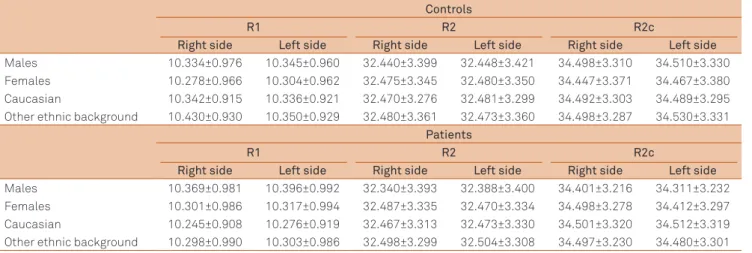
In this large series of patients and controls there were no signiicant diferences between the R1, R2, and R2c wave la -tencies. his suggests that the trigeminal nucleus in the pons may be fully functioning with regard to receiving, integra-ting and responding to the blink relex in the vast majority
Table 2. Average results (mm) for registry of latency and amplitude responses of the facial nerve in controls and patients with chronic migraine. These results show that there were no lesions of the facial nerve that could influence the results from the blink reflex.
Column1
Controls (n=160) Patients (n=160) Right side
Controls
Left side Column2
Right side Patients
Left side Column3
Average
latency 2.19±0.82 2.21±0.83 2.13±0.76 2.20±0.74 Average
amplitude
3.27±1.43 3.28±1.42 3.28±1.45 3.30±1.43
Table 3. Results from recordings (ms) of the blink reflex waves in controls and patients with chronic migraine. No significant
differences were observed between the two sides of the same individual or between patients and controls (p values were all
close to 1.0).
Controls (n=160) Patients (n=160)
Right side Left side Right side Left side
R1 10.245±0.908 10.276±0.919 10.297±0.970 10.290±0.934
R2 32.467±3.313 32.473±3.300 32.440±3.271 32.510±3.301
R2c 34.501±3.320 34.512±3.319 34.473±3.119 34.345±3.123
Table 4. Results from controls and patients with headache, according to gender and ethnicity. No differences were observed in recordings of waves (ms) from the blink reflex.
Controls
R1 R2 R2c
Right side Left side Right side Left side Right side Left side
Males 10.334±0.976 10.345±0.960 32.440±3.399 32.448±3.421 34.498±3.310 34.510±3.330
Females 10.278±0.966 10.304±0.962 32.475±3.345 32.480±3.350 34.447±3.371 34.467±3.380
Caucasian 10.342±0.915 10.336±0.921 32.470±3.276 32.481±3.299 34.492±3.303 34.489±3.295
Other ethnic background 10.430±0.930 10.350±0.929 32.480±3.361 32.473±3.360 34.498±3.287 34.530±3.331
Patients
R1 R2 R2c
Right side Left side Right side Left side Right side Left side
Males 10.369±0.981 10.396±0.992 32.340±3.393 32.388±3.400 34.401±3.216 34.311±3.232
Females 10.301±0.986 10.317±0.994 32.487±3.335 32.470±3.334 34.498±3.278 34.412±3.297
Caucasian 10.245±0.908 10.276±0.919 32.467±3.313 32.473±3.330 34.501±3.320 34.512±3.319
Other ethnic background 10.298±0.990 10.303±0.986 32.498±3.299 32.504±3.308 34.497±3.230 34.480±3.301
he facial nerve studies showed no diference between pa tients and controls, and normal values were obtained for all individuals (Table 2). his result conirmed that no cases of lesions of the facial nerve had been included among the subjects of either group.
865
Joseph Bruno Bidin Brooks et al. Blink reflex: chronic migraine
References
1. Tajti J, Szok D, Párdutz A, et al. Where does a migraine attack originate? In the brainstem. J Neural Transm 2012;119:557-568.
2. Overend W. Preliminary note on a new cranial reflex. Lancet 1986;1:619. 3. di Clementi L, Coppola G, Magis D, et al. Interictal habituation
deficit of the nociceptive blink reflex: an endophenotypic marker for presymptomatic migraine? Brain 2007;130:765-770.
4. de Marinis M, Pujia A, Collaizo E, Accornero N. The blink reflex in chronic migraine. Clin Neurophysiol 2007;118:457-463.
5. Holle D, Zillessen S, Gaul C, et al. Habituation of the nociceptive blink reflex in episodic and chronic cluster headache. Cephalalgia 2012;32:998-1004. 6. Avramidis TG, Podikoglou DG, Anastasopoulos IE, Koutroumanidis
MA, Papadimitriou AL. Blink reflex in migraine and tension-type headache. Headache 1998;38:691-696.
7. de Tommaso M, Guido M, Libro G, Sciruicchio V, Puca F. The three responses of the blink reflex in adult and juvenile migraine. Acta Neurol Belg 2000;100:96-102.
8. de Tommaso M, Murasecco D, Libro G, et al. Modulation of trigeminal reflex excitability in migraine: effects of attention and habituation on the blink reflex. Int J Psychophysiol 2002;44:239-249.
9. Yildirim G, Sayin R, Cogen EE, Odabas FO, Tombul T. Randomised, controlled blink reflex in patients with migraine and tension type headache. J Pak Med Assoc 2011;61:978-982.
10. Aktekin B, Yaltkaya K, Ozkaynak S, Oguz Y. Recovery cycle of the blink reflex and exteroceptive suppression of temporalis muscle activity in migraine and tension-type headache. Headache 2011;41:142-149.
11. Sand T, Moll-Nielsen B, Zwart JA. Blink reflex R2 amplitudes in cervicogenic headache, chronic tension-type headache and migraine. Cephalalgia 2006;26:1186-1191.
12. Holle D, Gaul C, Krebs S, et al. Nociceptive blink reflex and pain-related evoked potentials in hypnic headache. Cephalalgia 2011;31:1181-1188.
13. Peddireddy A, Wang K, Svensson P, Arendt-Nielsen L. Blink reflexes in chronic tension-type headache patients and healthy controls. Clin Neurophysiol 2009;120:1711-1716.
14. Lipton RB. Chronic migraine, classification, differential diagnosis, and epidemiology. Headache 2011;51(Suppl 2):S77-S83.
15. Aurora SK, Kulthia A, Barrodale PM. Mechanism of chronic migraine. Curr Pain Headache Rep 2011;15:57-63.
16. Manack A, Turkel C, Silberstein S. The evolution of chronic migraine: classification and nomenclature. Headache 2009;49:1206-1213. 17. Negro A, Rocchietti-March M, Fiorillo M, Martelletti P. Chronic
migraine: current concepts and ongoing treatments. Eur Rev Med Pharmacol Sci 2011;15:1401-1420.
of patients. his is a very primitive and relatively simple relex, and may remain unaltered even in patients who daily, or almost daily, sufer from headaches. It is possible that some patients