SUSPENSIONS WATER STATUS AND ITS RELATION WITH
VITRIFICATION RESISTANCE
GUILLERMO SEIJO
1Instituto de Botánica del Nordeste, Argentina
ABSTRACT – Changes in cell water relations during precultures were followed in an attempt to understand the mechanism of cell hardening for cryopreservation by vitrification. Medium containing 0.4 M sucrose (ψw=-1.45 MPa) and containing 5 mg L-1 of ABA (MT ψw=-0.73 MPa and MS ψw=-0.48 MPa)
were used to harden cell suspensions of orange and carrot. Preculture in these medium did not cause a significant decrease of cell viability, however, it improved the cell survival to PVS2 and liquid nitrogen expositions. When cells were inoculated into medium containing 0.4 M sucrose, the cell ψw decreased
rapidly until reach the medium ψw , and turgor was also severely reduced or disappeared. Subsequently,
cell ψs began to decrease and after 48 h of treatment in low water potential medium, turgor was recovered
by osmoregulation to almost the same values that cells had at the beginning of the experiment. Preculture in medium containing ABA also caused a decrease of cell ψs but in much less extent than the preculture
in low water potential medium. Since both precultures improved significantly the survival to PVS2 pretreatment and to LN exposure, this increment of survival to osmotic shock and vitrification can not be attribute solely to quantitative solute accumulation. The results suggest that qualitative accumulation of determined solutes would be the events which contributed for the improvement of tolerance to PVS2 exposure and thence tolerance to liquid nitrogen.
ADDITIONAL INDEX TERMS: Preculture, cell suspension, sucrose, ABA, cryopreservation
ABBREVIATION: ABA, absicic acid; PCV, packed cell volume; PVS2, plant vitrification solution 2;
ψs, osmotic potential; ψw , water potential; ; ψp , turgor.
EFEITOS DA PRECULTURA COM SACAROSE E ABA NO ESTADO
HÍDRICO DE SUSPENSÕES CELULARES E SUAS RELAÇÕES COM A
RESISTÊNCIA A VITRIFICAÇÃO
RESUMO - Foram realizadas mudanças nas relações hídricas celulares durante a fase de precultura afim de se entender os mecanismos de endurecimento celular pela vitrificação durante a criopreservação. Suspensões celulares de laranja e cenoura foram cultivadas em meio contendo 0,4 M sacarose (Ψw = -1,45
MPa) e 5 mgL-1 de ABA (MT Ψw = -0,73 MPa e MS Ψw = -0,48 MPa). A precultura nesse meio não
promoveu um significante decréscimo na viabilidade celular, entretanto, aumentou a sobrevivência das células a exposição a PVS2 e a nitrogênio líquido. Quando as células foram incubadas em meio contendo 0,4 M de sacarose, o Ψw celular decresceu rapidamente igualando-se ao Ψw do meio, enquanto o turgor
Recebido em 30/9/1999 – Aceito em 10/7/2000
foi também severamente reduzido ou desapareceu. Ao mesmo tempo o Ψs começou a decrescer e após
48h de tratamento em meio com baixo Ψw , o turgor foi recuperado pela osmoregulação até atingir o
mesmo valor que as células tinham no início do experimento. A precultura em meio contendo ABA também causou um decréscimo no Ψw celular em menor intensidade que aquela verificada quando a
precultura foi realizada em meio com baixo Ψw. O aumento na sobrevivência celular ao choque osmótico
e vitrificação não pode ser atribuído unicamente ao acúmulo quantitativo de solutos uma vez que a precultura aumentou significativamente a sobrevivência com o pré-tramento com PVS2 e exposição a nitrogênio líquido. Estes resultados sugerem que o acúmulo qualitativo de determinados solutos poderia ser o evento responsável pela aumento a tolerância a exposição ao PVS2 e ao nitrogênio líquido.
TERMOS ADICIONAIS PARA INDEXAÇÃO: Precultura, suspensão celular, sacarose, ABA, criopreservação.
INTRODUCTION
Successful cryopreservation of a considerable number of species has been reported (Uragami 1993, Withers and Engelman 1998) and many protocols have been proposed. Conventional cryopreservation procedures prevent internal ice formation inducing cell dehydration by slow and controlled freezing (Kobayashi et al., 1990, Find et al. 1998). Alternatively, a relative new strategy use cell dehydration by osmotic shock with high concentrated solutions and afterwards, they are dipped directly into liquid nitrogen inducing vitrification of the cell suspension (Sakai et al., 1991, Kobayashi et al. 1993, Fahy 1995, Wang et al., 1998). However, this vitrification method usually requires a preculture period in order to harden the cells to withstand the osmotic shock and achieve high survival rates after freezing. In many of these reports, protocols included preculture of cell suspensions in low water potential medium or the use of abscisic acid as the ways to harden the cells (Uragami 1991, 1993, Niino and Sakai 1992, Niino 1993, Wang et al., 1998, Withers and Engelman 1998).
Preculture in mediums of low water potential is found to enhance the freeze tolerance of cells suspension markedly. Sugars (sucrose, glucose) and sugar alcohol (mannitol and sorbitol) are the most used additives in preculture medium (Withers 1991, Yamada 1993, Dumet et al. 1994). Although the use of osmotically active additives in the preculture mediums is widespread, the responses to them are variable between species and the physiological events in relation to cell
hardening have not yet been investigated thoroughly.
Other way to harden the cells is the preculture with plant hormones. Abscisic acid has been shown to play an important role in plant water balance and in the adaptation of plants to environmental stresses. Moreover, preculture of cell suspensions with ABA has also shown in some cases an enhancement of freezing or desiccation tolerance, both properties desirable for cryopreservation (Shimonishi et al., 1991, Kahn et al., 1993, Gusta et al., 1996).
Studies on water relations of cell suspension after application of ABA or osmoticum in relation to freezing tolerance are rarely documented and not well understood. In order to comprehend more thoroughly the changes that the precultures elicit on cell suspensions, sucrose and ABA were used in this report as additives of the standard mediums. The aim of this study was to investigate the changes in water status of navel orange and carrot cell suspension during preculture in medium of low water potential or containing ABA, and relate them with cell survival after cryopreservation in liquid nitrogen by the vitrification technique.
MATERIAL AND METHODS
Plant Material
Navel orange (Citrus sinensis Osb. var.
brasiliensis Tanaka) cell cultures were induced
out by placing excised ovules of opening flowers on MT basal medium (Murashige and Tucker 1969) containing 50 gL-1 (0.15 M) of sucrose, supplemented with 10 mgL-1 kinetin and 3 g L-1 Gelrite. The cultures were kept at 25°C under illumination with cool fluorescent light (25 µmol m-2s-1). The embryogenic calluses were maintained by subculturing them every 15 days on the same medium. For cell suspension induction about 1 g of callus was cultured in 40 ml of MT liquid medium supplemented with 50 gL-1 (0.15 M) of sucrose and 20 mg/l kinetin (ψw=-0.73 MPa) in a 100 ml
Erlenmeyer flask. Cultures were maintained on rotary shaker at 110 rpm, under same conditions. Serial transfers of callus were done every two weeks for 2 to 3 months.
Daucus carota L. var. Shin-kurudagosum
embryogenic calluses were induced from hypocotyls segments cultured in MS medium (Murashige and Skoog 1962) containing 30 gL-1 (0.087 M) of sucrose, 8 gL-1 of agar and 0.2 mgL-1 of 2,4-D (ψw=-0.48 MPa). Cultures were kept in
dark at 25°C. For cell suspensions about 0.1 g of callus was cultured in liquid MS medium with 30 gL-1 (0.087 M) sucrose and 0.2 mgL-1 2,4-D subcultured every 15 days. Cultures were maintained in a rotary shaker at 110 rpm in dark and at 25°C.
Preculture
Preculture was carried out by increasing the concentration of sucrose or by adding ABA to the medium. Basal medium, MT for navel orange and MS for carrot, were supplemented with 0.4 M sucrose for low water potential preculture (ψw
=-1.45 MPa). Mediums were filtered with 0.45 µm disc filters (Schleiche and Schuell). Cultures were kept for 48 h under the same conditions mentioned for callus maintenance. Cell suspensions in exponential growth phase (6 to 8 days) were sieved with metallic mesh of 60 µm and about 3 mL PCV (packed cell volume) of cells were placed in a 100 mL Erlenmeyer containing the preculture medium.
ABA was added in concentrations of 5 mgL-1 to autoclaved MS medium containing 30 gL-1 sucrose and to MT medium containing 50 gL-1
sucrose by filtration. Preculture was carried out for 6 days in same conditions described for cell suspensions maintenance. Actively growing cell suspension was inoculated in a 300 mL Erlenmeyer containing 100 mL of medium in an inoculum density of 3 mL PCV.
Cryoprotection, Freezing and Thawing
Samples were cryopreserved using the vitrification technique. PVS2 solution (30% glycerol, 15% DMSO and 15 % EG in MT medium supplemented with 0.4 M sucrose) was used as cryoprotectant because it has shown low toxicity despite of being highly concentrated (Kobayashi et al. 1990). Two ml of cell suspension from 8 days old culture containing about 0.2 mL PCV was transferred to a 10 mL conical centrifuge tube and allowed to settle. After supernatant was discarded 4 mL of PVS2 was added at 25°C. The cell suspension was mixed and centrifuged for 30 sec at 100xg. The supernatant was again discarded and 2 ml of prechilled PVS2 (at 0°C) was added and kept for 5 minutes until equilibration. Then aliquots of 0.4 mL were placed in 1.8 mL plastic cryotubes and directly plunged into liquid nitrogen. The mean cooling rate was about 300°C min-1 in the range between -30°C and -150°C (Kobayashi and Sakai 1993).
Thawing was carried out rapidly in water bath at 40°C. The cell suspensions were transferred to standard mediums supplemented with 1.2 M sucrose (ψw=-4.8 MPa) and after few minutes cells
were collected on filter paper and cultured in solidified medium on a petri dish. After 6 h the cells were subcultured into fresh medium to avoid toxic effects of the cryoprotectants. Aliquots of cell suspensions were also used for viability test by vital staining
Water Status Measurements
sealed with parafilm and frozen at -70°C for a night. Once thawed the chambers were placed again into the psychrometer and osmotic potential was determined for the same sample. Data represented in the graphs and tables are the means of at least three replicates.
Cell Viability Determination
Viability after cryopreservation of precultured and control cells was determined by vital staining following Widholm’s technique (1972) using fluorescein diacetate and counterstained with phenosaphranine, under an epifluorescence microscope. Clusters with more than 75 % of cells with a clear green fluorescence were considered alive, others as dead. Viability is expressed as a percentage of alive clusters with respect to the total of counted clusters.
Statistical analysis
In Table 1 survival values correspond to the average of three replicates. A one-way analysis of variance (ANOVA) was applied to test the effects of preculture with high concentration of sucrose and ABA. Mean comparison was made by Tukey test. Values followed by the same letter are not significant different at the 0.05 probability level.
RESULTS
Effectiveness of Preculture with Respect to the Freezing Tolerance
Cell viability after preculture in low water potential medium or medium supplemented with ABA was almost the same as the viability
TABLE 1 - Size and survival rates of carrot and navel orange cells in suspension culture after each step of the freezing protocol. Values correspond to the mean of three repetitions.
Survival Material Treatmento Mean Cell
Size (µm) Preculture PVS2 LN
Control 24.9 x 18.7 99.00a± 1.0 87.33a± 3.1 81.33a ± 4.2
Suc. 0.4 M 24.2 x 19.9 96.67a± 1.5 95.00b± 3.0 94.00b± 1.7
Orange ABA 5 mg/l 25.4 x 20.1 98.00a± 2.0 90.33ab± 2.5 88.67b± 2.1
F α=0.05 1.68 5.45 15.12
p <0.2631 <0.0448 <0.0045
Control 24.2 x 18.4 98.67a± 1.2 78.67a± 4.5 55.00a± 4.6
Suc. 0.4 M 23.2 x 19.3 96.00a± 2.0 92.00b± 2.6 86.67b± 2.9
Carrot ABA 5 mg/l 24.0 x 19.4 98.00a± 2.6 90.67b± 1.2 79.33b± 4.0
F α=0.05 1.41 16 54.15
p <0.3158 <0.0034 <0.0001
observed for control cells, and no significant change in size could be appreciated (Table 1). The pretreatment with PVS2 caused a significant reduction of cell viability in control cell suspensions of both carrot and orange. However, when cells were precultured in 0.4 M sucrose or ABA the injurious effects of PVS2 were reduced in large extent and very few clusters lost the viability (Table 1). The most affected cells were the big ones containing large vacuoles.
After liquid nitrogen exposure, both navel orange and carrot cells demonstrated relatively high viability when pretreated directly with PVS2 without any preculture. However, these survival rates were significantly improved by preculturing the cells with low water potential medium or with medium containing ABA (Table 1).
In all cases, small cell clusters (10 - 30 cells) were the ones which showed higher rates of survival, while in isolated cells or big clusters the effect of freezing was most severe. In big clusters the most affected cells were the superficial ones, which usually were the most vacuolated and larger ones. These characteristics were also found in isolated cells of both species.
Water Status Measurements
The difference between the water potential of control medium and the medium supplemented with 0.4 M sucrose was 0.72 MPa for MT and 0.97 MPa for MS. On the other hand, addition of ABA to the medium did not change the water potential.
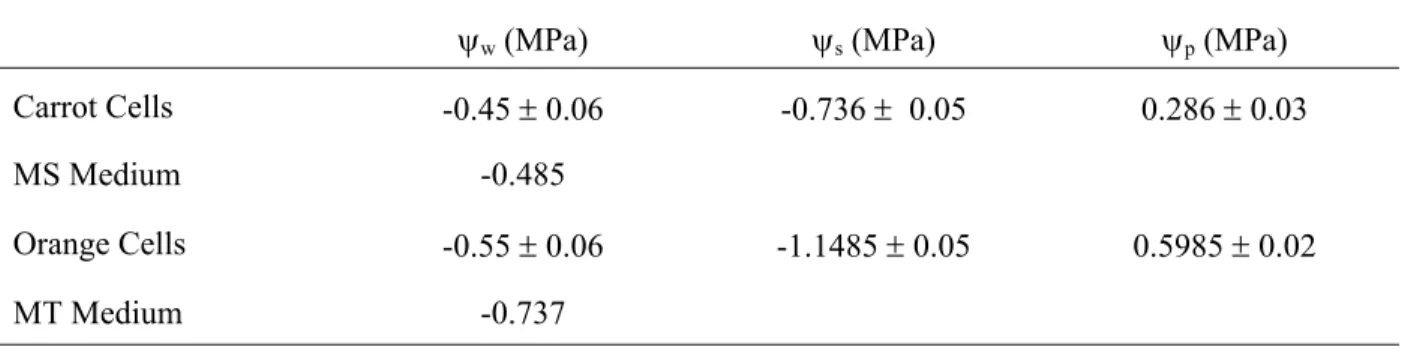
Carrot and navel orange cell ψw, ψs and
turgor before the preculture are shown in Table 2 and their ψw, ψs and turgor along several days of culture
in control medium are shown in Figure. 1 for navel orange and in Figure 2 for carrot cell suspensions.
When cells were inoculated into mediums containing 0.4 M sucrose a rapid decrease of the cell ψw took place. After 1 h the
cell and medium ψw were almost equal and turgor
was severely reduced or disappeared (Figure. 3 for navel orange and 4 for carrot). Carrot cells remained without turgor for more than 12 h, period which was followed by a slowly recovery of the turgor and a decrease of the ψs of the cells.
Orange cell ψw also decreased after being
subcultured to MT with 0.4 M sucrose, and their turgor was severely reduced as well. However, in orange cells the recovery of turgor was much rapid than for carrot cells, and by 12 h after treatment the turgor was close to the initial one. Similarly, the decrease of the cell ψs was more
intense in orange cells than in carrot cells at the same time. In both cases after 48 h of low water potential preculture, turgor was recovered to almost the same values that cells had at the beginning of the experiment.
When cells were pretreated with ABA (5 mg.L-1), turgor was kept almost constant during the whole treatment. However, a reduction in the cell ψw
and ψs in 0.2 to 0.3 MPa compared to the control was
observed by the 4th day. After this time, the cell ψs
remained almost constant. The same phenomenon was observed in both navel orange (Figure. 5) and carrot cell suspensions (Figure. 6).
TABLE 2 - Water, osmotic and pressure (turgor) potential of cell suspensions cultured in standard mediums in the dark and 25°C.
ψw (MPa) ψs (MPa) ψp (MPa)
Carrot Cells -0.45 ± 0.06 -0.736 ± 0.05 0.286 ± 0.03
MS Medium -0.485
Orange Cells -0.55 ± 0.06 -1.1485 ± 0.05 0.5985 ± 0.02
FIGURE 1 - Changes in ψw, ψs, and turgor of navel orange cells in suspension culture with MT basal medium
FIGURE 2 - Changes in ψw, ψs, and turgor of carrot cells in suspension culture with MS basal medium
FIGURE 3 - Changes in ψw, ψs, and turgor of navel orange cells in suspension culture with MT basal medium
FIGURE 4 - Changes in ψw, ψs, and turgor of carrot cells in suspension culture with MS basal medium
FIGURE 5 - Changes in ψw, ψs, and turgor of navel orange cells in suspension culture with MT basal medium
FIGURE 6 - Changes in ψw, ψs, and turgor of carrot cells in suspension culture with MS basal medium
DISCUSSION
The physiological changes caused by preculture in mediums of increased osmolality in relation to freezing tolerance is not yet well understood. Early reports (Withers and Street 1977, Sala et al. 1979, Withers and King 1980) attributed the enhancement of cell survival to a reduction in mean cell size after several subcultures in osmoticum. However, sycamore cells precultured for a single passage in 6 % mannitol presented no reduction in the mean cell size, yet increases of cell survival after cryopreservation have been observed (Pritchard et al. 1986a, b). Another sort of evidence shown that the critical fact induced by preculture is the increment of cytoplasm to vacuole ratio (Withers and King 1980, Wang et al. 1998). In the present experiment, cells were subjected only to a relatively short preculture in 0.4 M sucrose, and no significant variation in cell size was detected, however it was clear that the high vacuolated cells were the more susceptible to liquid nitrogen exposure. These data supports the cytoplasm to vacuole ratio hypothesis as important for survival after vitrification.
Preculture in medium containing 0.4 M sucrose caused a decrease of cells ψs in both carrot
and orange cells. These phenomenon may have been due, first, to cell dehydration because of sucrose non or very low permeability to the plasmamembrane, and latter due to solute accumulation in the cytoplasm. The recovery of turgor after some hours of culture at low water potential, indicates that cell osmoregulation occurred and therefore, they have been able to deplasmolyze. Osmoregulation could be achieved by incorporating solutes from the medium or by de
novo synthesis of osmotically active solutes.
External invertases are known to be produced by carrot cells (Stomell and Simon 1990) converting sucrose into fructose and glucose, thus facilitating the incorporation of these solutes. This mechanism was also found in citrus tissues (Echeverria 1990), thus its presence is also possible in orange cell cultures. The quicker recovery of turgor in orange can be attributed to the initial closer values of the
cell ψs to the ψw of the preculture medium,
compared with that of carrot cells, thus, smaller amounts of solutes were needed to accumulate inside the cell for turgor recovery.
Cell survival improvement elicited by preculturing cells in 0.4 M sucrose can be related at least partially to two phenomena. First, osmotic stress caused by the addition of 0.4 M sucrose to the preculture medium induced the intracellular accumulation of solutes, evidenced by a decrease of the cell ψs and recovery of turgor. Thus, in some
way the cells may have been predisposed to withstand the osmotic shock caused by the pretreatment with PVS2. This preadaptation to osmotic shock was also found by Fallon and Phillips (1989) in carrot cell suspensions and in sycamore as well (Pritchard et al. 1986c). Second, other mechanism of hardening could be elicited by this stress including the ones involved with a rise of endogeneous ABA and differential gen pattern expression with the consequent synthesis of stress related proteins (Misra et al. 1993, Kahn et al. 1993, Clements et al. 1999).
Inclusion of ABA into the preculture medium also caused a decrease of cell ψs, but in
much less extent than the preculture in low water potential medium. However, cell survival was considerably improved by this preculture. Thus, the solutes which caused the decrease of cell ψs
vitrification, and may have occurred in orange and carrot cell suspensions.
Even though there was a significant reduction of the ψs of cells precultured in 0.4 M
sucrose or ABA (5 mg L-l) containing mediums, the difference that exist between the cell ψs and the ψw
of the PVS2 was still very high. Thus, from the solute accumulation point of view it is difficult to explain quantitatively the increment of cell survival. The results presented in this work suggest that qualitative accumulation of determined solutes would be the event which contributed for the improvement of tolerance to PVS2 expositions and thence tolerance to liquid nitrogen temperatures.
AKNOWLEDGEMENTS
The author would like to thanks MOMBUSHO for the scholarship given to perform part of this research in the Department of Biomechanical Systems, Ehime University, Japan.
REFERENCES
BOYER, J. S. AND E. B. KNIPLING 1966. Isopiestic technique for measuring leaf water potentials with thermocouple psychrometer.
Proc. Natl. Acad. Sci. U.S.A. 54 : 1044 - 1051.
CLEMENTS, C. S. AND A. L. Plant 1999. Salt-induced protein synthesis in tomato roots: the role of ABA. Jour. Exp. Bot. 50: 667-687.
DUMET, D., F. ENGELMANN, N. CHABRILLANGE, S. DUSSERT AND Y. DUVAL 1994. Effects of various sugars and polyols on the tolerance to desiccation and freezing of oil palm polyembronic cultures.
Seed Sci. Research 4: 307-313.
ECHEVERRIA, E. 1990. Developmental transition from enzymatic to acid hydrolysis of sucrose in lima (Citrus aurantifolia). Plant Physiol. 92 : 168 - 171.
FAHY, G. M. 1995. The role of nucleation in cryopreservation. In R. Lee, G Warren and L.
Gusta Eds., Biological ice nucleation and its applications. APS Press, USA.
FALLON, K. M. AND R. PHILLIPS 1989. Responses to water stress in adapted and unadapted carrot cell suspension cultures. J. Exp. Bot. 40 (215) : 681 - 687.
FIND, J. I., M. M. H. KRISTENSEN, J. V. NOGAARD AND P. KROGSTRUP 1998. Effect of culture period and cell density on regrowth following cryopreservation of embryogenic suspension cultures of Norway Spruce and Sitka spruce. Plant cell Tiss and Org. Cult. 53: 27-33.
GLINKA, Z. AND L. REINHOLD, 1972. Induced changes in the permeability of plant cell to water. Plant Physiol. 49: 602-606.
GUSTA L. V., R. W. WILEN AND P. FU 1996. Low temperature stress tolerance: The role of abscisic acid, sugar, and heat-stable proteins.
Hortscience 31: 39-46.
KAHN, T. L., S. E. FENDER, E. A. BRAY AND M. A. O’CONNELL 1993. Characterization of expression of drought- and abscisic acid-regulated tomato genes in the drought-resistant species Lycopersicon pennelii. Plant Physiol. 103 : 597 - 605.
KOBAYASHI, S. AND A. SAKAI 1993. Cryopreservation of citrus. In: Cryopreservation of Plant Genetic Resources, Technical assistance activities for genetic resources projects N° 6, JICA, Japan.
KOBAYASHI, S., A. SAKAI AND I. OIYAMA 1990. Cryopreservation in liquid nitrogen of cultured navel orange (Citrus sinensis Osb.) nucellar cells and subsequent plant
MISRA, S., S. M. ATTREE, I. LEAL AND L.C. FOWKE 1993. Effects of Abscisic acid, osmoticum, and desiccation on synthesis of storage proteins during the development of white spruce somatic embryos. Ann. Bot. 71: 11-22.
tobacco tissue cultures. Physiol. Plant. 15 : 473 - 497.
MURASHIGE, T. AND D. P. H. TUCKER 1969. Growth factors requirements of citrus tissue culture, in: H. D. Chapman (Ed.) Proc. 1st Int. Citrus Symposium, Vol. 3. University of California, Riverside, California, pp. 1151 - 1161.
NIINO, T. 1993. Cryopreservation of deciduous fruits and mulberry trees In: Cryopreservation of plant genetic resources, Technical assistance activities for genetic resources projects N° 6,
JICA, Japan.
NIINO, T. AND A. SAKAI 1992. Cryopreservation of alginate-coated in vitro grown shoot tips of apple, pear, and mulberry.
Plant Science 87 : 199 - 206.
PRITCHARD, H. W., B. W. W. GROUT AND C. SHORT 1986a. Osmotic stress as a pregrowth procedure for cryopreservation 1. Growth and ultrastructure sycamore and soybean cell suspensions. Ann. Bot. 57 : 41 - 48.
PRITCHARD, H. W., B. W. W. GROUT AND C. SHORT 1986B. Osmotic stress as a pregrowth procedure for cryopreservation 2. Water relations and metabolic state of sycamore and soybean cell suspensions. Ann. Bot. 57 : 371 - 378.
PRITCHARD, H. W., B. W. W. GROUT AND C. SHORT 1986c. Osmotic stress as a pregrowth procedure for cryopreservation 3. Cryobiology of sycamore and soybean cell suspensions.
Ann. Bot. 57 : 378 - 387.
RICCARDI, F., P. GAZEAU, D. VIENNE, M. ZIVY 1998. Protein changes in response to progressive water deficit in maize. Quantitative variation and polypeptide identification. Plant Physiol. :1253-63.
SAKAI, A., S. KOBAYASHI AND I. OYAMA 1991. Survival by vitrification of nucellar cells of navel orange (Citrus sinensis Obs. var.
brasiliensis Tanaka) cooled to -196°C. J. of
Plant Physiol. 137 : 465 - 470.
Sala, F., R. Cella and F. Rollo 1979. Freeze-preservation of rice cells. Physiol. Plant. 45 : 170 -176.
SHIMINISHI, K., M. ISHIKAWA, S. SUZUKI AND K OOSAWA 1991. Cryopreservation of melon somatic embryos by desiccation method.
Japan. J. Breed. 41 : 347 - 351.
SINGH, N. K., D. E. NELSON, D. KUHN, P. M. HASEGAWA AND R. A. BRESSAN 1989. Molecular cloning of osmotin and regulation of its expression by ABA and adaptation to low water potential. Plant Physiol. 90:1096 - 1101.
SKRIVER, K. AND J. MUNDY 1990. Gene expression in response to abscisic acid and osmotic stress. Plant Cell 2 : 503 - 512.
STOMEL, J. R. AND P. W. SIMON 1990. Multiple forms of invertase from Daucus
carota cell cultures. Phytochemestry 29 :
2087 - 2089.
URAGAMI, A. 1991. Cryopreservation of Asparagus (Asparagus officinalis L.) cultured in vitro. Res. Bull. Hokkaido. Natl. Agric. Exp. Stn. 156:1 - 37.
URAGAMI, A. 1993. Cryopreservation of cultured cells and organs of vegetables. In: Cryopreservation of Plant Genetic Resources, Technical assistance activities for genetic resources projects N° 6, JICA, Japan.
WANG, J. J. GE, F. LIU AND C. HUANG 1998. Ultrastructural changes during Cryopreservation of rice (Oryza sativa L.) embryogenic suspension cells by vitification. Cryo-Letters
19: 49-54.
WIDHOLM, J. M. 1972. The use of fluorescein diacetate and phenosaphranin for determining viability of cultured plant cells. Stain Technol. 47 : 189 - 194.
WITHERS, L. A. 1991. In-vitro conservation.
Biol. J. Linn. Sci. 43 : 31 - 42.
WITHERS, L. A. AND F. ENGELMAN 1998. In vitro conservation of plant genetic resources.
In: A. Altman (Ed.), Agricultural
WITHERS, L. A. AND P. J. KING 1980. A simple freezing unit and routine cryopreservation method for plant cell cultures. Cryo-letters 1: 213 - 220.
WITHERS, L. A. AND H. E. STREET 1977. Freeze-preservation of cultured plant cells.
III. The pregrowth phase. Plant Physiol. 39: 171- 178.