
UNIVERSIDADE FEDERAL DE MINAS GERAIS FACULDADE DE LETRAS
PROGRAMA DE PÓS-GRADUAÇÃO EM ESTUDOS LINGUÍSTICOS
RUBENS SOUZA DA CUNHA
The Open Post-Tonic High Front Vowel in Trochaic Bisyllables A Study of Native Speaker and English Learner Corpora
RUBENS SOUZA DA CUNHA
The Open Post-Tonic High Front Vowel in Trochaic Bisyllables A Study of Native Speaker and English Learner Corpora
Dissertação apresentada ao Programa de Pós-Graduação em Estudos Linguísticos da Faculdade de Letras da Universidade Federal de Minas Gerais, como requisito parcial para a obtenção do título de Mestre em Línguística Teórica e Descritiva.
Área de concentração: Linguística Teórica e Descritiva
Linha de pesquisa: Estudos Linguísticos Baseados em Córpora
Orientadora: Profa. Dra. Heliana Ribeiro de Mello
Belo Horizonte
Acknowledgements
I thank my family, the ones who have shown me that many times the only thing that matters is sharing.
I would like to thank my colleagues from LEEL: Gabriel, for the support; Adriana, for the course you gave (twice); Lucia, for your generous instructions and help. I would also like to thank everybody else whom I didn't have the chance to meet as many times as I thought I would.
I thank Professor Tommaso Raso for his classes and advice. I also thank Professor Andrea Mattos for her tip.
I would like to very especially thank my advisor, Professor Heliana Ribeiro de Mello. Many times, after talking to Heliana or receiving some e-mail reply from her, I would think: 'She's only saying that to make me feel good. She wants to make it light on me. But later on I realized that it is much more than that: She really knows how to give her students the dimension of reality and the dimension of feasibility.
I would like to extend my recognition to three other professors under whose advice I could have written a thesis before:
I thank Professor Deise Dutra for all the incentive.
I also thank Professor Celia Magalhães for her support from the time when I was an undergraduate student.
Abstract
This is a phonetic study across three oral corpora: one with recordings of naturally spoken American English (the SBCSAE corpus), another with interviews with advanced Brazilian learners of English (the LINDSEI-BR corpus), and a third one, composed by recordings of spontaneous speech in Brazilian Portuguese (the C-ORAL-BRASIL corpus).
The main purpose was to investigate the realization and duration and second formant patterns of the phonologically lax high front vowel in free final position, [ɪ:]#, in English trochaic bisyllables, i.e., happy and study. The analysis of similar Portuguese [ɪ:]#-WORDS (such as gente and sabe), was also necessary for comparative purposes, since the project for this thesis originated from the impressionistic contention that native speakers of English consistently produce [ɪ:]#, even in their most casual speech. On the other hand, the English spoken by Brazilians and the Portuguese normally spoken in Brazil both often seem to exhibit [ɪ:]# -WORDS with an overly short or simply unrealized [ɪ:]#.
The results show that native speakers of English do produce [ɪ:]# consistently but that the vowel duration varies considerably (it varied between 33 ms and 124 ms in SBCSAE samples). In LINDSEI-BR the variation was even greater. Brazilian learners of English did not realize the [ɪ:]# in 10 words out of 32 analyzed. In all those cases of unrealized [ɪ:]#, there was phonetic similarity between the intervocalic consonant in the [ɪ:]#-WORD and the sound immediately following it (e.g. [p] and [b] in happ(y) because). The two sounds around [ɪ:]# may represent the same phoneme, e.g., (/r/ [ɪ:]# /r/), ver(y) rich;(/l/ [ɪ:]# /l/), reall(y) like. On the other hand, following pauses seem to have greatly favored the full realization of [ɪ:]# in the LINDSEI-BR, e.g., She was very...
The C-ORAL-BRASIL data indicate that, for Brazilian Portuguese, the expectations about [ɪ:]# should be readjusted for a different standard: The common behavior found in the corpus was the non-realization of the free vowel, e.g., the word gente was produced as [ t ] more fre uently than as [ .t ɪ:]. A further reduction was observed in some other samples analyzed, apparently caused by a considerable distance between two stressed syllables. In a segmentation of the phrase Sabe que que é? the canonical sequence of syllables Sa-be-que-que-é? was reduced to Sa-que-q'jé?
Resumo
Este é um estudo fonético baseado em três córpora orais, dois deles em língua inglesa, sendo um de norte-americanos, falantes nativos e outro de aprendizes brasileiros avançados (o SBCSAE e o LINDSEI-BR, respectivamente). O terceiro corpus é de português brasileiro espontâneo (o C-ORAL-BRASIL).
Pesquisa-se, especificamente, a realização ou não e os padrões de duração e segundo formante da vogal alta anterior final, [ɪ:]#, em inglês, em dissílabos trocaicos, como happy e study e comparam-se os resultados com os de palavras análogas portuguesas, e.g., gente, na fala de brasileiros.
O projeto para esta tese teve origem em uma persistente impressão de que falantes nativos da língua inglesa consistentemente produzem [ɪ:]#, mesmo na fala mais espontânea. Essa impressão contrasta com o que aparentemente ocorre na fala de brasileiros em inglês e também no português normalmente falado no Brasil. Em ambos os casos, o [ɪ:]# frequentemente parecia ser muito curto ou simplesmente não realizado.
Os resultados obtidos indicam que o SBCSAE realmente apresenta consistentemente a realização de [ɪ:]#, mas ue há grande variação na duração da vogal, tendo esta oscilado entre 33 e 124 ms nas análises feitas (a variação foi ainda maior no LINDSEI-BR). Os falantes do LINDSEI-BR não realizaram [ɪ:]# em 10 palavras entre 32 analisadas. Em todas essas 10 palavras há uma relação articulatória entre a consoante intervocálica ue precede o [ɪ:]# e o som que imediatamente segue essa vogal. Quando esses dois sons representam um mesmo fonema, o [ɪ:]# fre uentemente é eliminado, e.g., (/r/ [ɪ:]# /r/), em ver(y) rich;(/l/ [ɪ:]# /l/), em reall(y) like. Por outro lado, pausas seguintes parecem ter grandemente favorecido a realização da vogal livre no LINDSEI-BR. e.g.,She was very…
Em relação ao português brasileiro, os dados obtidos no C-ORAL-BRASIL sugerem que as expectativas sobre o [ɪ:]# devam ser reajustadas para um padrão específico: O comportamento mais observado no C-ORAL-BRASIL foi a não-realização do [ɪ:]#, e.g., a palavra gente foi produzida mais fre uentemente como [ t ] do que como [ .t ɪ:]. Uma redução ainda maior nas palavras pesquisadas foi observada em alguns casos, aparentemente provocada por grande distância entre duas sílabas tônicas. Em um dos exemplos (redução silábica), Sabe que que é? foi simplificado de Sa-be-que-que-é? para Sa-que-q'jé?
List of Tables
Table 2.1 - Distribution of word-boundary sounds and positions of stressed syllable in excerpt from thesis project introduction
32
Table 2.2 - Some word-final consonantal phonemes in English 35
Table 2.3 - Some words with checked and free vowels in English 38 Table 2.4 - Articulatory descriptions of speech sounds according to the literature 53
Table 3.1 - The three subdivisions of the [ɪ:]#-WORDS in SBC, LIN and C-ORAL-BRASIL
56
Table 3.2 - PRAAT adjustments 59
Table 3.3 - Most Frequent [ɪ:]#-WORDS in the SBCSAE, LINDSEI-BR and C-ORAL-BRASIL files analyzed
70
Table 3.4 - Exact morphological sequences within [ɪː]#-phrases in SBC and LIN (Word sequence matches in SBC and LIN phrases)
71
Table 3.5 - LIN 22 FULL-[ɪ:]#-WORDS,10 ZERO-[ɪ:]#-WORDS and all 32 [ɪ :]#-WORDS
74
Table 3.6 - Distribution of [ɪ:]#-WORDS analyzed from SBCSAE, LINDSEI-BR and C-ORAL-BRASIL
75
Table 3.7 - Proposed vowel and consonant contrasts for voice, sonority, transition speed and touch of articulators in [ɪː]#-WORDS analyzed: the INT consonants
81
Table 4.1 - SBC 32 and LIN 22 FULL-[ɪ:]#-phrases 88
Table 4.2 - Measurements of 54 FULL-[ɪ:]#-phrases by male and female speakers in SBC and LIN
90
Table 4.3 - Summarized measurements of happy, many and really in SBC and LIN 93 Table 4.4 - First and second formant values in American English vowels 99 Table 4.5 - Average formant values found for the SYL-1 vowels /i/ (in really)
and /æ/ (in happy) in SBC and LIN vs American English averages
99
Table 4.6 - Measurements of /i/ F1 and F2 and [ɪ:]# F2 in SBC really 102 Table 4.7 - Measurements of /i/ F1 and F2 and [ɪ:]# F2 in LIN really 103 Table 4.8 - Measurements of /æ / F1 and F2 and [ɪ:]# F2 in SBC happy 104 Table 4.9 - Measurements of /æ / F1 and F2 and [ɪ:]# F2 in LIN happy 105
Table 4.10 - 10 ZERO-[ɪ:]#-WORDS and 6 FULL-[ɪ:]#-WORDS by same LINDSEI-BR speakers
106
Table 4.11 - All 34 realizations of Really In LIN and in SBC 114 Table 4.11 B - FULL-[ɪ:]#-WORDS and ZERO-[ɪ:]#-WORDS realizations in LIN
according to speaker level of experience with English
116
Table 4.12 - SBC and LIN really [ɪ:]# measurements before voiced and voiceless sounds
119
Table 4.14 - SBC and LIN really [ɪ:]# measurements before laterals and pauses 121 Table 4.15 - [ɪ:]# durations (ms) in SBC and LIN really in relation to NXT-SGM 121 Table 4.16 - [ɪ:]# F2 values for really in SBC and LIN in relation to place of
articulation of NXT-SGM
123
Table 4.17 - Three different realizations of [ɪ:]#-WORDS in SBC, LIN and C-ORAL-BRASIL
125
Table 4.18 - Summarized measurements of [ɪ:]#-WORDS in C-ORAL-BRASIL word subdivisions and phrase spk rate averages
130
Table 4.19 - Measurements of 5 FULL-[ɪ:]#-WORDS in C-ORAL-BRASIL 131 Table 4.20 - Measurements of 9 ZERO-[ɪ:]#-WORDS in C-ORAL-BRASIL 132 Table 4.21 - Measurements of 4 ZERO-SYL-2-WORDS in C-ORAL-BRASIL 133
Table 4.22 - Measurements of parts of complete and incomplete [ɪ:]#-WORDS with phrase spk rates in SBC, LIN and C-ORAL-BRASIL
150
Table 4.23 - SBC (32) and LIN (22) [ɪ:]# durations with following pauses and words 151
Table 4.24 - 59 [ɪ:]# durations in SBCSAE (32 words), LINDSEI-BR (22 words) and C-ORAL-BRASIL (5 words) (in ms)-BRASIL (6 WORDS) (in ms)
155
List of Spectrograms and Pitch Contours
Spectrogram 2.1 - LIN - Gente! Mark'essa data! with focus on the word data 41 Spectrogram 3.1 - PRAAT menu options in SBC word segmentation 58 Spectrogram 3.2 - SBC - Some vowels and consonants in happy phrase 76 Spectrogram 3.3 - Offset of [ɪ:]# before pause in SBC word (many) 79 Spectrogram 3.4 - Offset of [ɪ:]# before pause in LIN word (many) 79 Spectrogram 3.5 - Onset of [ɪː]# after plosive sound in SBC word - She's totally happy now
83
Spectrogram 3.6 - LIN - We knew many people from Utah 84
Spectrogram 3.7 - LIN - It was really beautiful to hear them 85
Spectrogram 3.8 - C-ORAL-BRASIL - Gente véi... 86
Spectrogram 4.1 - SBC - Rise of F2 from [l] into [ɪ:]# in the phrase Maybe that's why she didn't really…
96
Spectrogram 4.2 - SBC - High F2 transition from [n] into [ɪ:]# and canonical initial F2 in post-pause [ɪ] in the word in of the phrase We have so many…
96
Spectrogram 4.3 - SBC - transition of onset [h] into vowel in the word happy 100 Spectrogram 4.4 - LIN - transition of onset [ɹ] into vowel in the word really 100
Spectrogram 4.6 - LIN - This rich girl was very… 109
Spectrogram 4.7 - LIN - I'm very happybecause… 110
Spectrogram 4.8 - LIN - (and) to study the Bible [ænd t u istʌd də baɪbəl] 112 Spectrogram 4.9 - SBC - (and) to studythe Bible [æn də stʌɾɪ: ðə baɪbəl] 112
Spectrogram 4.10 - C-ORAL-BRASIL - Example of ZERO-[ɪ:]#-WORD (Sabe como?)
127
Spectrogram 4.11 - C-ORAL-BRASIL - Example of FULL-[ɪ:]#-WORD (Sabe? Vendo assim...)
127
Spectrogram 4.12 - LIN - Chegou na sala e lamentou pra gente... 141
Spectrogram 4.12 - C-ORAL - Sabe que que é? 122
Pitch contour and textgrid 3.1 - Devoiced vowel in the word happy 61
Pitch contour and textgrid 3.2 - SBC - Really glad 64
Pitch contour and textgrid 4.1 - C-ORAL-BRASIL - Gente! Marca essa data! 135 Pitch contour and textgrid 4.2 - C-ORAL-BRASIL - Cê pensa que ele… (Do you
think that he...)
136
Pitch contour and textgrid 4.3 - C-ORAL-BRASIL - Gente controladim 137 Pitch contour and textgrid 4.4 - C-ORAL-BRASIL - A gente pode levar um também 138 Pitch contour and textgrid 4.5 - C-ORAL-BRASIL (...que a gente disseca) 140 Pitch contour and textgrid 4.6 - C-ORAL-BRASIL - (Sabe como?) 144 Pitch contour and textgrid 4.7 - LIN (I-real-love-my-job) 158 Pitch contour and textgrid 4.8 - LIN (I-for-got-men-things) 158 Pitch contour and textgrid 4.9 - LIN (She-was-a-ver-rich-girl) 159
Pitch contour and textgrid 4.10 - C-ORAL-BRASIL (E *-quer-sa-ber-a-ond-é-que-cê-quer-sal-var-o-flash-vi-deo*)
159
List of Figures
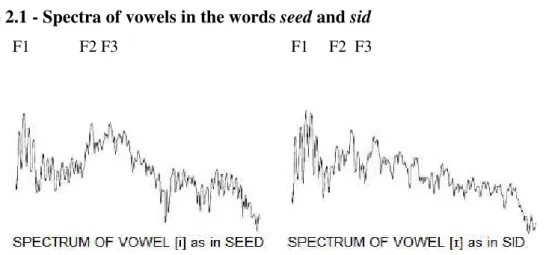
Figure 2.1 - Spectra of vowels in the words seed and sid 51
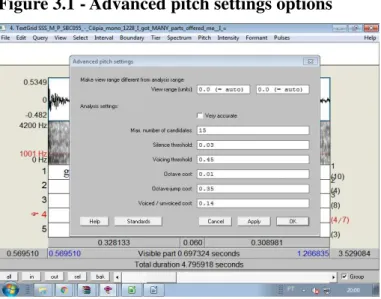
Figure 3.1 - Advanced pitch settings options 60
Figure 3.2 - Example of formant measurements given by PRAAT with a 0.025 s window length for [ɪ:]# in an SBC file
63
Figure 3.3 - Tongue positions for the tense and lax front vowels, [i], (ee) and [ɪ], (i).
Table of Contents
Acknowledgements 4
Abstract 6
Resumo 7
List of abbreviations and specific words and symbols List of Phonetic Symbols for English and BP
List of oral and nasal vowels in BP
16 20 21
Chapter 1 - Introduction 22
Research questions 25
Hypothesis 26
Chapter 2 - The syllable and word boundaries in English and in BP; the high front vowel [ɪ:]# and the difficulties inherent in speech segmentation 27 2.1 - Phoneme distribution in syllable and word boundaries in English and in BP; boundary sounds restrictions and preferences; stressed, strong and weak syllables; the bigger picture of morphology, syntax and etymology
27
2.1.1 - Do etymology and syntax differently influence syllabification and the realization of final sounds in English and in BP?
28
2.1.2 - The English preference for strong initial syllables and the apparent BP tendency for word-final stress
30
2.1.2.1 - A phoneme distribution test between a small excerpt in Portuguese and its adaptation into English
31
2.1.2.1.1 - A brief analysis of Table 2.1 33
2.1.3 - Some phonological particularities of word boundaries in English and BP 34 2.1.3.1 - Right-boundary phonemes in English and Portuguese words (in BP pronunciation)
35
2.1.3.1.1 - English right-boundary phonemes 35
2.1.3.1.2 - BP right-boundary phonemes 36
2.1.4 - Nasalization in English and in Portuguese 36
2.1.4.1 - Nasalization in English 36
2.1.4.2 - Nasalization in Portuguese (phonemic and allophonic) 36 2.1.5 - Free and checked vowels and open and closed syllables in English 38 2.1.6 - The pre- and post-tonic syllable in BP and in English; confirmation of the strength of final and initial stressless vowels in the two languages
2.1.6.1 - BP final vowel loss: external vocalic sandhi and the BP preference to preserve
word-initial vowels 40
2.1.6.2 - BP final syllable loss 42
2.1.6.3 - The English preference to preserve word-final vowels 42
2.1.6.4 - The English 'problem' with word-final consonants 43
2.1.7 - The Anglicization of foreign words; the adaptation of English and French words to BP phonology
43
2.1.7.1 - Anglicization 43
2.1.7.2 - The adaptation of foreign words to the BP syllable- and word-final sound inventory and Brazilians' suppositions about word stress in foreign languages
44
2.2 - Related works 45
2.2.1 - On high front vowels 45
2.2.2 - On English /l/ and /r/ (and /h/) transitions into vowels 46
2.2.3 - On vowels in word boundaries in BP 47
2.3 - The Literature: on the 'paradox' of speech segmentation, on how to best segment words, and on some articulatory and acoustic characteristics of speech sounds
49
2.3.1 - The 'paradox'2.3.1.1 - Phoneme vs segment 49
2.3.1.1 - Phoneme vs segment 50
2.3.2 - On manners to segment speech sounds 50
2.3.2.1 - Spectrograms, formants and waveforms 50
2.3.2.1.1 - Spectrograms 50
2.3.2.1.2 - Formants 51
2.3.2.1.3 - Waveforms 51
2.3.2.2 - Segmenting speech sounds 52
Chapter 3 - Methodology: the choice of words for segmentation in PRAAT, the measurements made and the symbols used
55
3.1 - The basic measurements made with [ɪ:]#, [ɪ:]#-WORDS and [ɪ:]#-phrases 55
3.2 - The PRAAT software and other useful tools 56
3.2.1 - Standard vs adjusted settings in PRAAT 57
3.2.2 - The PRAAT adjustments briefly explained 60
3.2.3 - The naming of the PRAAT files segmented 63
3.3 - The corpora 65
3.4 - The choice of the research words 67
3.4.1 - Some challenges in collecting phonetic data for analysis and the 'very' limitations
3.4.2 - Initial segmentation plans and results 68
3.4.3 - The importance of the INT consonant and NXT-SGM in the choices of phrases 69
3.4.4 - Seeking 'really intercomparable' words for segmentation 70
3.4.4.1 - Other normalization criteria 71
3.4.4.2 - The impossibilities of some normalization objectives 72
3.5 - The distribution of the analyzed words in the corpora 74
3.6 - The segmentation of the chosen words 76
3.6.1 - The segmentation of the onset and offset of [ɪ:]# 77
3.6.1.1 - The onset of [ɪ:]# 77
3.6.1.2 - The offset of [ɪ:]# 77
3.6.2 - Degrees of acoustic contrast between vowels and consonants 80 3.6.3 - Articulatory and acoustic differences in the segmentation of /p/, /n/, and /l/, as in happy, many and really; the segmentation of gente
82
3.6.3.1 - The segmentation of [p] - [ɪː]# in happy 83
3.6.3.2 - The segmentation of [n]-[ɪː]# in many 83
3.6.3.3 - The segmentation of [l]-[ɪː]# in really 84
3.6.3.4 - The segmentation of [t ]-[ɪː]# in gente 85
Chapter 4 - The data analysis: SBCSAE vs LINDSEI-BR; C-ORAL-BRASIL; the research questions
87
4.1 - The measurements of SBC and LIN [ɪ:]#-WORDS and phrases 87 4.1.1 - The 32 FULL-[ɪ:]#-WORDS from SBC and the 22 FULL-[ɪ:]#-WORDS from LIN
87
4.1.2 - Male and female speakers' measurements of all FULL-[ɪ:]#-phrases taken from SBC and LIN
89
4.1.3 - The measurements of happy, many and really 91
4.1.3.1 - A brief analysis of Table 4.3 93
4.1.3.2 - SYL-1, INT and [ɪ:]# measurements of happy, many and really 93 4.1.3.3 - The measurements of formants in the stressed vowel in happy and really: large differences between SBC and LIN
98
4.1.3.3.1 - /i/ in Really 100
4.1.3.3.2 - /æ/ in Happy 104
4.1.4 - What kinds of contexts exhibited ZERO-[ɪ:]-WORDS and FULL-[ɪ:]#-WORDS by the same speakers in LINDSEI-BR?
4.1.4.1 - Some comparative details of the ZERO-[ɪ:]#-WORDS in LIN 106 4.1.4.2 - FULL-[ɪ:]#s by speakers who also produced ZERO-[ɪ:]#s in LIN 108
4.1.4.3 - 'Skip' or 'stick'? 109
4.1.4.3.1 - The possible LIN speaker difficulty with [l]-[ɪ:]-[l] and [ɹ]-[ɪ:] se uences, as in really like and very
110
4.1.4.3.2 - 'Borrowed' BP phonemes to substitute for English labiodental consonants [θ] and [ð]
111
4.1.4.4 - A summary of really measurements in SBC and LIN 113
4.1.5 - The NXT-SGM influences on really [ɪ:]# durations and F2 values in SBC and LIN
116
4.1.5.1 - Voiced vs voiceless NXT-SGM 117
4.1.5.2 - Stop vs fricative NXT-SGM 119
4.1.5.3 - Lateral vs pause NXT-SGM 120
4.1.5.4 - Summary of really measurements data in relation to six types of NXT-SGM 121
4.1.5.5 - [ɪ:]# vs place of articulation of NXT-SGM 123
4.2 - The data from the C-ORAL-BRASIL 125
4.2.1 - The three realization types of [ɪ:]#-WORDS in C-ORAL-BRASIL 125 4.2.2 - Some more on BP haplology studies (Leal, 2006) vs the C-ORAL-BRASIL data 126 4.2.3 - Some visual examples of realization / non-realization of the research vowel in C-ORAL-BRASIL
127
4.2.4 - Durations, F2 and spk rate differences between C-ORAL-BRASIL [ɪ:]# -WORDS
128
4.2.5 - An analysis of C-ORAL-BRASIL [ɪ:]#-WORDS according to syllable sequences 130 4.2.6 - Durations of voiced vs voiceless NXT-SGM after ZERO-[ɪ:]#-WORDS in C-ORAL-BRASIL
133
4.2.7 - Some seemingly typical contexts favoring each of the three different realization types of [ɪ:]#-WORDS in C-ORAL-BRASIL
134
4.2.7.1 - A brief analysis of some FULL-[ɪ:]#-WORDS in C-ORAL-BRASIL 135
4.2.7.2 - A brief analysis of ZERO-[ɪ:]#-WORDS in C-ORAL-BRASIL 136
4.2.7.3 - A brief analysis of ZERO-SYL-2-WORDS in C-ORAL-BRASIL 140
4.2.8 - Natural vs non-natural speech and BP word codas 142
4.2.9 - One more Type B word 144
4.2.10 - Some qualities of coronal sounds /s/ and /i/ related to C-ORAL-BRASIL, LIN and some impressionistic data
4.2.11 - Differences in C-ORAL-BRASIL and LIN realizations of FULL-[ɪ:]# and ZERO-[ɪ:]#-WORDS
147
4.3 - The research questions and further analyses 148
4.3.1 - Answering the research questions 148
4.3.2 - An analysis of the initial hypothesis 156
4.3.3 - Some possible examples of lack of ambiguity in some contexts in English and in BP
161
Chapter 5 - Conclusions and suggestions for further research 162
List of abbreviations and specific words and symbols
Symbol/Name Description of use
Advanced A general label for the Brazilian learners of English (B-LNR-E) in the LINDSEI-BR corpus, although some subjects are more experienced than others.
Advanced (1)
LINDSEI-BR subjects with more years of English study than the intermediate group and fewer years than the experienced group
av average
Asterisk (*) used to indicate that a word was really produced in the way it is transcribed, as e.g., gente as [ ]*
BP Brazilian Portuguese, with the most examples from Belo Horizonte speakers B-LNR-E Brazilian learners of English who have BP as their mother tongue
CCC in PRAAT file names, indicates that the original file is from the C-ORAL-BRASIL corpus
C-ORAL-BRASIL Corpus de referência do Português brasileiro falado informal (the Brazilian Portuguese informal speech corpus used in this thesis) DH [ð], in PRAAT file names, a voiced labiodental fricative, as in, e.g., this English basically General American, but some RP examples are also used
Experienced LINDSEI-BR subjects with the most years of English study among the three groups of students in the corpus
F Female speaker(s). (used to identify speakers in figures and in Praat file names, e.g., LLL F HAPPY… meaning: LINDSEI-BR corpus; female speaker; research word: happy)
FULL-[ɪ :]#-WORD
A trochaic bisyllable of this thesis which presents all the canonical phonemes
I In PRAAT file names, the symbol used for the [ɪ:]# to indicate its duration within the research word. In the example below, [ɪ:]# measures 36 ms. SSS F REALLY_H HARD SBC001_mono 1008 I = 36, W = 346
INT The intervocalic consonant in the research words, e.g., [p] in happy and [b] in sabe
[ɪ:]#-phrase A phrase containing an [ɪ:]#-WORD [ɪ:]#-WORD A research word, such as happy or really
Intermediate LINDSEI-BR subjects with the least years of English study in comparison with advanced and experienced ones
LLL In PRAAT file names, indicates that the original file is from the LINDSEI-BR
M Male speaker(s)
nr Number
N-SPK-BP Native speaker(s) of Brazilian Portuguese N-SPK-E Native speaker(s) of English
n/a Not applicable. This was used to indicate that SYL-1 did not have F2 measured in words other than happy and really or when measurements were given for more words than just happy and really
NXT-SGM The segment that immediately follows an [ɪ:]#-WORD, e.g., in many parts, NXT-SGM is /p/
NXT-SYL The first syllable of the NXT-WORD
NXT-WORD
A word immediately following an [ɪ:]#-WORD
pct Percentage
PH A phrase, which may be a full utterance or just a phonological phrase
Phrase A whole utterance or, frequently, a shorter unit of speech (many times it was not possible to analyze the whole utterance due to, e.g., a very long pause after the [ɪ:]#-WORD)
ppp In PRAAT file names, this symbol indicates that the NXT-SGM is a pause and not actually a segment
PrP In PRAAT file names, a pre-pause (i.e., a pause that directly precedes the [ɪ:]#-WORD) that lasts more than 200 ms (when the pause is shorter than that, it is indicated by a comma)
PRAAT file names
The names given to PRAAT files, which have limitations on the use of letters and symbols, so that e.g., [θ] (as in 'think') had to be represented by TH PsP In PRAAT file names, a post-pause that lasts more than 200 ms
Research vowel
The [ɪ:]#
RP Received Pronunciation
SBC The SBCSAE
SBCSAE The Santa Barbara Corpus of spoken American English
spk rate This term is used in relation to the whole phrase in this thesis. The time taken for a speaker to realize one syllable, on average. If, in a phrase, a speaker takes 1500 ms to realize 10 syllables, then spk rate is of 150
SPKR Speaker
SSS In PRAAT file names, indicates that the original file is from the SBCSAE SYL-1 The two first segments of an [ɪ:]#-WORD, e.g. [hæ] in happy (exceptions are
stu.dy and e.le, in which SYL-1 has three and one segment, respectively). Secondarily, the term is also used to represent the first syllable in the specific phonology of a language.
SYL-2 The two final segments of an [ɪ:]#-WORD, e.g., [pɪ:] in happy. Secondarily, the term is also used to represent the second syllable in the specific phonology of a language.
Syllabifica -tion
The tentative combination of morphology and phonetics made for PRAAT file names, in order to better illustrate the way words were really spoken (in a direct relation with morphological form), and to count syllables in phrases and subsequently calculate spk rate. It was not possible to distinguish syllables between light and heavy, or reduced and not reduced, monomoraic and bimoraic
t In PRAAT file names, a tap (flap) as a NXT-SGM, e.g., happy to be doing it, when to was pronounced with a tap for /t/.
TH [θ], in PRAAT file names, a NXT-SGM which is a voiceless labiodental fricative, e.g. 'think'
Tier The name used for each line in the PRAAT textgrid, which follows the pitch contour images
Trochaic bisyllable
A bisyllabic word with stress on the first syllable. Differently from a trisyllable, for example, a bisyllable tends to have only one strong syllable (i.e., a trisyllable may have two strong syllables, usually the first and the third one. e.g., 'generate' (Sws) as exemplified by Cutler (ibid.)
tt Total or totals
UFMG Universidade Federal de Minas Gerais (The Federal University of Minas Gerais, located in Belo Horizonte)
V Vowel
W
A woman or women; a research word, mostly used to indicate word duration for comparisons with the [ɪ:]# and the whole phrase
W1 The first word in a word boundary. The elements of interest in this thesis are the two last or the last segment of the word
W1#W2 The boundary of two adjacent words, especially considering the last segment(s) in W1 and the first segment(s) in W2
ZERO-[ɪ
:]#-WORD A trochaic bisyllable which lacks the final vowel, [found in LINDSEI-BR and C-ORAL-BRASIL) ɪ:]# (such cases were
ZERO-SYL-2 -WORD
List of Phonetic Symbols for English and BP
Vowel and consonant chart for English (based on Pickett, 1999, p. 6) with analogous sounds in BP (most words are taken from phrases analyzed from SBCSAE and LINDSEI-BR)
Vowels English
examples BP examples Consonants English examples BP examples
[i] people participa [j] you folha [fo.ljɐ]
[ɪ] did [w] were
[ɪ:] happy [m] many come
[ɛ] * very é; quer [b] beautiful sabe
[e] ele; cê [v] very vou
[ɑ] job [p] people procurou
[ɔ] for (stressed) pode [f] for fazer
[oʊ] radio [ð] them
[ʊ] good [θ] things
[u] movies [n] now não
[ʌ] study [l] like levar
[ə] nervous [d] do desses
[ɜɹ] nervous [z] things fazer
[aɪ] hide [t] tired também
[aʊ] now [s] say sabe
[eɪ] native
[t ] rich gente (when
pronounced as [ .t ɪ:] or [ t ]
[a] hard (Boston
English)
sabe
[d ] job pode (when
pronounced as [pɔ.d ɪ:] or [pɔd ]
[ɐ] ** casa
[ɹ] really only occasionally
used in C-ORAL-BRASIL
[ɨ]*** really
Notes:
*
[ɛ] and [e] In BP [ɛ] and [e] ar[se.d ɪ:] (thirst) vs sede [sɛ.d ɪ:](head uarters)e often distinctive (in stressed position) in words such as sede
*
*
[ɐ] vs [ə] Some researchers consider that the final sound of BP words such as casa [ɐ], is the same as the schwa [ə]. But it seems that the possible segments represented, in BP, by [ɐ] can fre uently be uite long and very alike [a:]. It should be noted that, while [ə] can replace any morphological vowel in English, in BP, [ɐ] can only represent /a/, and this might favor a strong phonological identity between the phoneme /a/ and its possible physical manifestations in BP
***
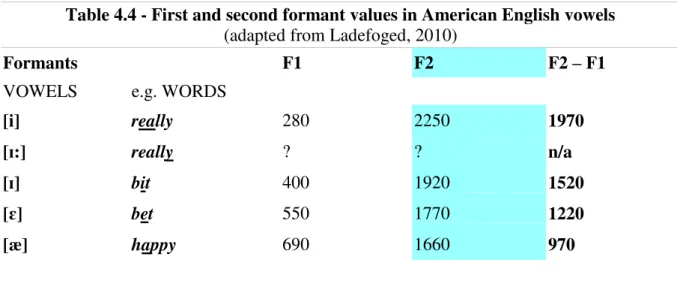
[ɨ] The symbol for IPA ‘barred /i/'. It was used when the F2 of the phonologically tense vowel /i/ averaged under 1700 Hz in the [ɪ:]#-WORD really (i.e., it was actually realized as a centralized vowel). Such an occurrence was registered nine times in the SBCSAE (i.e., the vowel in the initial, stressed syllable of the word and not the final vowel, [ɪ:]#)
****
[ᵻ:]# This is a barred [ɪ:], or a centralized high front used once for a final vowel in the word really by an SBC speaker who realized a vowel in a weak syllable. It was very low (centralized) F2 vowel in the final, post-tonic position.
Comment: From the point of view of a N-SPK-BP, for the stressed vowel in words such as happy it would make more sense to use a symbol like [aɛ] than the IPA symbol [æ], since [e] (the second part of the symbol in [æ]) is used, in isolation, to represent a much higher vowel than [a]
List of oral and nasal vowels in BP
Oral and nasal vowel contrasts in Brazilian Portuguese
Examples with translations
a/ã lá/lã (there/wool)
aɪ/ãɪ cais/cães (wharf/dogs)
aʊ/ãʊ nau/não (ship/no)
e/ leda/lenda (merry/legend)
ei/ ɪ sei/sem (I know/without)
i/ se/sim (if/yes)
o/õ ode/onde (ode/where)
22
Chapter 1 - Introduction
This is a phonetic study on vowel duration, which investigates patterns of realization of the phonologically lax high front vowel in final position of trochaic bisyllables, e.g., English happy and study and Brazilian Portuguese (BP) gente. All the data for the analysis originate from three oral corpora, two in English and one in BP. The first corpus contains recordings of American native speakers of English (N-SPK-E) and the second one, of advanced 1 Brazilian learners of English (B-LNR-E). The third one is a BP corpus containing spontaneous speech. The subjects recorded in this last corpus are native speakers of BP (N-SPK-BP) and live in the same area as the B-LNR-E (i.e., in and around the city of Belo Horizonte, State of Minas Gerais).
The chosen corpora are the Santa Barbara Corpus of Spoken American English, SBCSAE (SBC); the LINDSEI-BR (LIN); and the Corpus de referência do português falado informal, C-ORAL-BRASIL. While the two first corpora are directly comparable for realizations of words in English, the third one serves as a data bank for study of possible influences of BP on the B-LNR-E realizations of the high front vowel of interest and the words and phrases containing them.
The vowel analyzed is represented phonetically in this thesis as [ɪ:]#, following Harrington, 2005 (p. 441). The author uses the representation [ɪ:],2 for words such as
happy; [ɪ], for kit; and [i], for fleece. The symbol (#) is used, in the present thesis, to indicate word end (i.e., right word boundary). The English y-ending bisyllables containing the vowel of interest, as well as similar Poruguese words will, henceforth, be referred to as [ɪ:]#-WORDS or research words. Examples of similar English trochaic bisyllables (i.e., ending in the same phonological vowel) which do not end in y are coffee and posse.
Most of the reasoning in the proposal for this thesis and in the research questions was based
1 The term 'advanced' has two meanings in this thesis: it refers both to all the LIN speakers in general and also to the middle group within it, as the subjects in LIN were classified as experienced, advanced and intermediate.
23 on personal experiences as an English teacher and as a dilettante in a couple foreign languages rather than on actual experience with phonetic data analysis.3
To the ear of this Brazilian observer, one distinguishing feature of spoken English has long appeared to be the 'remarkable stability' with which N-SPK-E consistently seem to realize, even in very informal speech, the final high front vowel of words such as the above-mentioned happy and study.
The impression of '[ɪ:]#-stability' in N-SPK-E speech sharply contrasts with the one I have always had, as a teacher, from beginning learners of English, N-SPK-BP, because they fre uently seem to realize English [ɪ:]#-WORDSwith very short or faint [ɪ:]#s or simply with complete 'skipping' of the research vowel.
The [ɪ:]# is phonologically distinctive in English, mainly because it normally represents one additional syllable in otherwise monosyllabic words. It distinguishes many English words, a fact observable in the following noun -adjective pairs: ease > easy [iz], [iz.ɪ:]; sleep > sleepy [slip], [slip.ɪ:]; sun > sunny [sʌn], [sʌn.ɪ:], as well as in other similar pairs, such as red / ready [ɹɛd], [ɹɛd.ɪ:] and store / story [stɔɹ], [stɔɹ.ɪ:], or even earl / early [ɜɹl], [ɜɹl.ɪ:] and stud / study [stʌd], [stʌd.ɪ:] - [stʌɾ.ɪ:]4.
The apparent [ɪ:]#-keeping characteristic of English seems noticeably different from BP speech, probably due to the fact that similar Portuguese words do not seem to require consistent realizations of [ɪ:]# for prompt understanding by N-SPK-BP. In BP, the final vowel sound in [ɪ:]#-trochaic bisyllables seems to be in free variation with zero realization. Words such as gente do not have similar pairs in Portuguese (i.e., they have no other words contrasting with them for presence/absence of final high front vowel). Apparently because of this lack of 'word-boundary competition', [ɪ:]#-WORDS in BP do not seem to present,
3The author of this thesis is a native speaker of Brazilian Portuguese and is graduated in English and French, besides having basic knowledge of German and Latin.
24 phonetically, a 'standard' pronunciation for the final vowel, and very often that vowel appears to be left out. This notion that Brazilians, while speaking in Portuguese, tend not to regularly pronounce [ɪ:]# was supported in initial analyses of a few words from the C-ORAL-BRASIL which are analogous to English [ɪ:]#-WORDS: in some cases, the [ɪ:]# was realized and in others it was not, even in samples by single speakers.
Considering also that the reduction or deletion of English [ɪ:]# by B-LNR-E is generally observed to become less frequent after the initial stages of learning of the language, it would appear reasonable to deduce that the Brazilian '[ɪ:]#-instability' is probably an influence of BP-phonology. It seems to be a fact that those B-LNR-E who have studied English beyond the basic levels usually do realize a perceptible English [ɪ:]#. Still, their production does not always seem fully regular or smooth. During preliminary auditions of parts of the LINDSEI-BR, it sounded like many speakers resorted to pauses before saying [ɪ:]#-WORDS and when they did not pause, they frequently would fail to produce the research vowel. LIN subjects who spoke more slowly seemed to be able to realize the [ɪ:]# every time.
In BP, the word gente may be variously pronounced by different speakers, and influenced by context, as [ .t ɪ:], [ .tɪ:], [ t ], [ t] or even [ ], without causing any confusion or hesitation in the listener. It is a contention of this thesis, however, that, at the level of lexical representation, i.e., the association that speakers of a language make between the written and the spoken word (Mohanan, 1982, p. 29), N-SPK-BP would consider that Portuguese words such as gente, pode, etc., are, by all means, bisyllabic and should, when 'correctly pronounced', be realized as [ t.t( )ɪ:], [pɔ.d( )ɪ:] etc. In this sense, N-SPK-BP would not be fully conscious of when exactly they produce the research vowel and when they do not.
25 In order to start an objective investigation of the [ɪ:]#-WORDS, then, it was concluded that the basic comparison to be made between the SBC and the LIN had to be through measurements of [ɪ:]# duration. Those measurements should be compared with similar words taken from the C-ORAL-BRASIL. One of the first conclusions that could be taken from this would be to which corpus the LINDSEI-BR is closer in terms of [ɪ:]# realization patterns, whether the Brazilian or the American. For the analysis of those patterns, other measurements were also needed, such as of fundamental frequency (F0) variations, degrees of emphasis and, as an apparently favoring factor for [ɪ:]# realization in the LINDSEI-BR, the use of pre- and post-pauses. The impressionistic notion of a reduced or unclear [ɪ:]# in the speech of Brazilians might also be related with articulatory and acoustic features of the vowel. For this reason, measurements of the second formant, F2, should be systematically made for each research vowel analyzed in the comparative investigation among different speakers from SBC, LIN and C-ORAL-BRASIL.
"The average locations of F1 and F2 for an individual are also affected somewhat by language environment and training." Pickett (1999, p. 40).
Research questions
It was necessary to phonetically segment the [ɪ:]#-WORDS for the obtention of comparative measurements. For this purpose, the PRAAT software package was chosen (PRAAT. Doing Phonetics by Computer, by Paul Boersma and David Weenink). URL = http://www.fon.hum.uva.nl/praat/. The measurements obtained should indicate answers to the following questions:
1) What are the proportions of the LINDSEI-BR, the SBCSAE and C-ORAL-BRASIL [ɪ:]# -WORDS with full, reduced and null realizations of [ɪ:]#?;
2) What contextual elements, such as pre- and post-pauses, emphases, as well as features of voicing, place of articulation etc., of the segment immediately following the [ɪ:]#, (NXT-SGM), would favor or disfavor the full realization of the research word?;
3) How are sounds distributed in duration, e.g., in an occurrence of the word very, how long are, on average, [v], [ɛ], [ɹ] and [ɪ:]?;
26 'normal' realizations ? e.g., the word very realized with only the three initial segments ([v], [ɛ] and [ɹ]) in relation to a normally pronounced, four-segment word?;
4) What are the effects of pauses and emphases on the durations of [ɪ:]# samples studied in each corpus?;
5) How recurrent are pauses in LIN in comparison with the N-SPK-E corpus? 5.1) Are pauses and emphases also used purposefully in the C-ORAL-BRASIL?; 6) What are the average measurements of the second formant in the research vowel?
6.1) Is the [ɪ:]# F2 by B-LNR-E and N-SPK-BP similar to that of N-SPK-E? Does the Brazilian [ɪ:]# seem 'unclear ' because it is actually a different articulation?
7) Do the three corpora differ in the reasons why they exhibit suprasegmental features of pauses and emphases? How so?
8) How does the C-ORAL-BRASIL relate with the LINDSEI-BR in the production of [ɪ:]# -WORDS in English?
Hypothesis
In English, the types of words proposed for investigation are very often distinguishable from similar, monosyllabic ones, by the presence of [ɪ:]#, as in the comparison, store / story. Advanced B-LNR-E are expected to know the phonological differences. Considering, however, that the final vowels of similar BP trochaic bisyllables do not need to be distinctive in the same way (i.e., presence vs absence of a high front vowel after the intervocalic consonant), LINDSEI-BR speakers could be expected to frequently hesitate or pause before the English [ɪ:]#-WORDS, for considering them somehow 'marked'. Thus, B-LNR-E would tend to overemphasize the pronunciation of the [ɪ:]#-WORDS, but when they did not pay special attention or spoke fast, they would tend to produce BP-like, short [ɪ:]#s or no vowel at all. Therefore, very different [ɪ:]# realizations should be expected for the LINDSEI-BR [ɪ:]#, duration-like: sometimes overlong, sometimes unsuitably short or null.
27 Chapter 2 - The syllable and word boundaries in English and in BP; the high front vowel [ɪ:]# and the difficulties inherent in speech segmentation
This chapter initially considers several aspects that differentiate English from BP in what concerns variety in phoneme inventories (especially word-final) and syllabification rules, besides some other particularities of each language. Next, there is a brief analysis of other works related with this thesis and, finally, some conclusions and advice from experienced linguists on the difficulties of speech segmentation and on the best ways to cope with the task.
2.1 - Phoneme distribution in syllable and word boundaries in English and in BP; boundary sounds restrictions and preferences; stressed, strong and weak syllables; the bigger picture of morphology, syntax and etymology
This section examines the differences in phoneme inventories of syllable and word boundaries in English and in BP, especially right word boundaries. Syllabification rules and the loss of final vs initial sounds are focused. Syllables are classified as stressed, strong and weak and their typical positions in the two languages are studied. Possible influences of syntax on word order and semantic content are related with phonetic realizations. Etymological influences on syllabification are suggested. The questions of why English seems to always preserve post-tonic sounds while BP does not, and why BP tends to preserve pre-post-tonic sounds while English sometimes does not, are approached.
"Lexicon, morphology, and syntax are not abstractions; they are knowledge which speakers of the language possess, a knowledge which is largely unconscious for native speakers, who acquired the language in the earliest years of life". (Kreidler, 2004, p. 9).
28 2.1.1 - Do etymology and syntax differently influence syllabification and the realization of final sounds in English and in BP?
The random choice of the word Atlanta for a comparative illustrative syllabification in English and in Portuguese and the (also random) choice of the phrase as meninas pequenas (the small girls) for a comparative syntactic analysis in this section, led me to consider etymology and the way syntax differently organizes semantic information in the two languages as possible strong influences on today's Brazilian and English ordinary speech.
There are considerable syntactic differences between English and Portuguese at the level of the sentence and, apparently, different weights given to etymology at the level of the syllable. Portuguese tends to give essential information in the beginning of the sentence and to use a 'linking' consonant between morphemes to, supposedly, make pronunciation easier, which is also typical of French (liaison).
In what concerns syntactic ordering of information, let us compare the phrase the small girls with its Portuguese equivalent, as meninas pequenas. Several semantic differences promptly become apparent. In the small girls, there is no indication, in the two first words, of what is being talked about, except that it is small. Only in the final word of the phrase do we realize what is being described and only in the last phoneme do we get to know whether it is singular or plural. In as meninas pequenas, on the other hand, the initial word already tells that the subject of discussion is feminine and plural. When one gets to the last stressed syllable in the phrase, /que/ (as meninas pequenas), and hears the onset of SYL-3, ([n]), all the essential information has already been given. This could be a contributor to the weakening or elimination of final sounds in Portuguese or to the resyllabification of words, with syllable reduction. But if syllable reduction does occur in Portuguese (or in BP), the ensuing resyllabification may create unpredicted, closed syllables: (pe.que.nas) → (pe.quen*). According to Câmara Jr., 1977 (pp. 47-48), BP final post-tonic syllables are considerably weak, having "atonicidade máxima" (maximal stresslessness).
29 CV syllable prevails). Example words are Atlanta and attract, syllabified below. English does not reduce the initial vowel in Atlanta ([æt.læn.tə]) nor separates it from the following consonant, probably because of the word's relation with atlas and atlantis. Portuguese, for its part, reaffirms its typical preference by simply subdividing the word into open syllables, ([a.tlã.tɐ]), thus giving no indication as to the word's etymology at the syllabic level. It has appeared, during the present study, that a word root in English words has more of a tendency to be preserved in beginnings of words than have prefixes (e.g., At.lan.ta vs (re)mem.ber). If it ever was someone's intention to preserve morphemes as transparent as possible in words borrowed from other languages, that would necessarily require the permission, within the language's phonological system, for syllables to end in several different sounds. English seems very apt at that, considering its remarkable syllable-final reality, as partly illustrated in Table 2.2). The the small girls example seems also to be a good way of training the ear to listen carefully for the very last sound of a word or phrase.
30 2.1.2 - The English preference for strong initial syllables and the apparent BP tendency for word-final stress
"The most fundamental unit of speech seems to be the syllable. On the articulatory side, the syllable is produced by the alternation between open and constricted phases of the upper vocal tract". (Pickett, op. cit., p. 146).
This thesis uses Kreidler's identification of syllables by means of capital and small letters. An English stressed syllable is represented by S, a strong but not stressed syllable is represented by s and a reduced syllable (with schwa vowel) is represented by w. "Numerous English words contain one strong syllable (containing the stressed vowel) and one or more weak syllables." (Kreidler, op. cit., p. 74). e.g., salad (Sw). "In long words, there may be two strong syllables. Of course, only one of the strong syllables is the stressed syllable." (ibid.). e.g., engineer (swS). 5. This has been adapted to BP in the present thesis, by means of always attributing the strong, s, status to pre-tonic syllables and the status of weak, w, syllables to post-tonic ones. 6
According to Cutler (apud Tohkura et al., op. cit., pp. 419-422), laboratory tests have repeatedly shown that native English speaking listeners treat any strong syllable as if it were highly likely to be word-initial. The researcher adds that it is not fundamental whether an initial full vowel is the main stress of the word or not. As shown in the following examples, generous (Sww), generate (Sws) and generation (swSw) all have clearly strong initial syllables while e.g., generic has a weak initial syllable. "Weak syllables are those which contain central, or 'reduced' vowels" (ibid.). She relates that in tests when speakers had to produce words beginning with weak syllables, they frequently paused before those syllables, apparently to indicate to the listener that the following syllable, although weak, was
5 It seems that, while English tends to have a stressed syllable in the beginnings of bisyllables (e.g,
salad) it usually has a weak syllable in the middle of trisyllables (e.g., engineer). Because of that, this thesis considers a usually non-reduced syllable as a strong syllable in both English and BP. The word happy, for example, is considered to have Ss syllables (stressed - strong), while the word restaurant is considered to be Sws. In the case of words in BP, pre-tonic syllables are considered strong and post-tonic syllables are considered weak. e.g., gente (Sw), menino (sSw).
6 It does not seem simple, though, to make accurate and all-embracing generalizations in phonetics. It
31 initial.
2.1.2.1 - A phoneme distribution test between a small excerpt in Portuguese and its adaptation into English
This thesis presupposes that, due to the fact that English has a lot more words with distinctive right-boundary sounds than BP, English has more of a practical need to preserve those sounds. According to Ball & Rahilly, 1999 (p. 133), "speech economy" must be balanced with the need to maintain contrastivity for the listener. As an example given by the authors, the exact articulation of /s/ in Spanish may vary, in different contexts, much more than English /s/. They claim that it is probably because English needs the /s/ vs / / distinction, which Spanish does not. Because of this, Spanish /s/ can become quite [ ]-like without risk of misinterpretation.
The above example corroborates the supposition that the fre uent omission of an [ɪ:]# in BP trochaic bisyllables may be related with a lack of contrasting, similar words in the language (minimal pairs ending in a slightly different vowel or words contrasting with the [ɪ:]# -WORDS for presence/absence of the [ɪ:]# itself).
Following is an illustrative test of word-boundary phoneme distribution in English and in BP. Two small texts are transcribed. The first one, in Portuguese, is an excerpt from the introduction to the project for the present thesis; the second one is its adaptation into English.
Original text:
Para este trabalho, propõe-se a investigação das realizações orais do segmento
(1) frouxo [ɪ] em finais de palavras dissílabas paroxítonas em língua inglesa (aqui, LI), em corpus de estudantes brasileiros da LI em comparação a falantes nativos da mesma. O segmento pesquisado, que aqui terá a representação
formal [ɪ:]# em dissílabo paroxítono, é representado, ortograficamente, pela letra Y, na grande maioria dos casos, e.g., city, happy, story, coffee.
English version:
This is a project for the investigation of the phonetic realizations of the post-tonic segment [ɪ], (henceforth, [ɪ:]#) (Ns. 1 & 2) , in trochaic disyllables ending morphologically in y, e.g., city, happy and story, from an oral corpus of native speakers of the English language (EL) to be compared with a corpus with speech records of Brazilian learners of English. (Examples of [ɪ:]#
32 Table 2.1 - Distribution of word-boundary sounds and positions of stressed syllable in
excerpt from thesis project introduction (Portuguese and English versions)
Types of words BP vs
English
(total words)
Portuguese version
words English version words
A
With stress on final syllable(excepting monosyllables) 11 - 1
propõe, investigação, realizações, orais, finais, aqui, comparação, aqui, terá, representação, formal
compared
B
Ending in plosives 0 - 7 – project, phonetic, post-tonic, segment, trochaic, not, takeC
Ending in nasal vowels 9 - 0 propõe, investigação, realizações, em, em, em, comparação,representação, em
–
D
Ending in nasal consonants 0 - 5 – investigation, from, an, ending, BrazilianE
Ending in oral vowels (exceptingmonosyllables) 21 - 0 para, este, trabalho, segmento, frouxo, língua, inglesa, aqui, mesma, segmento, pesquisado, aqui, terá, dissílabo, paroxítono, representado,
ortograficamente, pela, letra, grande, maioria,
´ –
F
Beginning with vowels (exceptingmonosyllables) 8 - 5
este, investigação, orais, inglesa, aqui, estudantes, aqui, ortograficamente
ending, oral, English, English, examples
33 2.1.2.1.1 - A brief analysis of Table 2.1
While the first comparison proposed (A) refers to word stress position in the two languages analyzed, all the other comparisons (B through G) refer to word-boundary phoneme distribution, which are a result of language-specific syllabification restrictions.
A: Perhaps the most striking difference observable in Table 2.1 is that the Portuguese excerpt reveals 11 (non-monosyllabic) words with stress on the last syllable while the text in English has only one such word (compared).
According to Kreidler (op. cit., p. 208), English has frequently shown a preference for non-final word stress: "Ever since the eleventh century, English has been borrowing words from other languages, chiefly French, with stress on the last syllable. Often the stress has been moved forward." Examples given by the author include beauty < beauté [bo.te]; element < élément [e.le.mã]; and ticket < ticket (ti.kɛ]). 7
From the data in A, it is possible to suppose that English frequently seems to avoid word-final stress and that BP, on the other hand, may have a strong penchant for it, what would suggest that, when the final syllable of a word in BP is post-tonic, that final syllable may be reduced or fully deleted in several contexts. That 'penchant', if real, may be strongly influenced by the presence of 'redundant' information in the right boundaries of Portuguese words because of particularities of Portuguese syntax.
B: The fact that English very commonly has words ending in plosive codas differentiates it from BP;
C and D: (distribution of words ending in nasal vowels vs nasal consonants) The results found are exactly what is expected according to each language's phonology, as discussed in the nasalization analysis below, in subsection 2.1.4.
E: (in the studied excerpts, the Portuguese version had 21 non-monosyllabic words ending in
34 vowel sounds while English had none) These data tell a lot: BP has a massive amount of words ending in vowel sounds. English, for its part, has many words that end in a silent /e/, e.g. take (many English words ending in a silent /e/ once had that final vowel pronounced). English also has a lot of words which end in diphthongs and in [ɪ:]# (not present in the brief adaptation above).
F: (words beginning with vowels) The data here indicate that English also has quite a few words that begin with vowels. But the difference is that BP has a majority of words that end in vowels, which often encounter the considerable amount of words that begin with vowels, as in an example taken from the Portuguese excerpt: propõe-se a investigação. The word investigação, as can be seen, also ends in vowels [ãʊ].
G: the final /s/ was ignored in this analysis because plurals in Portuguese are indicated by an /s/. Incidentally, the only Portuguese word ending in /s/ in the excerpt above which is not a plural form is corpus. Similarly to the case of final plosives in B, English has many words that end in fricative consonants, while BP has none. 8
2.1.3 - Some phonological particularities of word boundaries in English and BP
There is an observable difference in the number of possible phonological contrasts in right boundaries of words in English and in BP. English has multiple distinctive final phonemes, which most likely act as efficient inhibitory instruments against the loss of canonical word-final sounds.9 BP, on the other hand, has relatively few distinctive sounds (i.e., minimal pairs) in right word-boundaries. BP speakers often fail to realize several canonical post-tonic phonemes (but somehow intelligibility is preserved) and frequently – as shown in studies on BP haplology, referred toby Leal (2006), Pavezi (2006) and Mendes (2009) 10– omit whole
8 i.e., canonical word endings. In this thesis, the word
gente, for example, was often found, in connected speech, to end phonetically in a fricative sound [ t ].
9 This thesis studies the differences between English and BP in what concerns syllable- and word-boundary phonemes, especially word-final phonemes.
35 final post-tonic syllables, especially when the initial syllable in W2 has onset similar to the one in the final syllable of W1 and when that first W2 syllable is not stressed (subsection 2.2.3, below).
2.1.3.1 - Right-boundary phonemes in English and Portuguese words (in BP pronunciation)
Below, the densely populated syllable- and word-boundary space of English is briefly compared with its counterpart in BP.
2.1.3.1.1 - English right-boundary phonemes
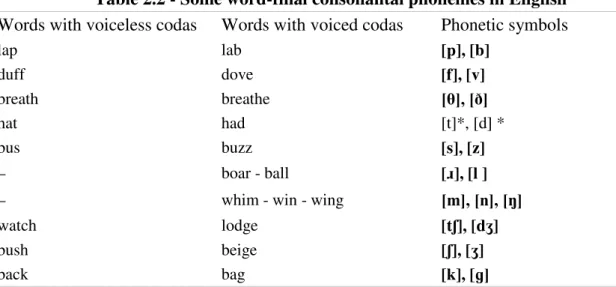
Table 2.2 shows some phonologically distinctive final sounds in English.
Table 2.2 - Some word-final consonantal phonemes in English Words with voiceless codas Words with voiced codas Phonetic symbols
lap lab [p], [b]
duff dove [f], [v]
breath breathe [θ], [ð]
hat had [t]*, [d] *
bus buzz [s], [z]
– boar - ball [ɹ], [l ]
– whim - win - wing [m], [n], [ŋ]
watch lodge [tʃ], [dʒ]
bush beige [ʃ], [ʒ]
back bag [k], [ɡ]
(*) /t/ and /d/ are typically realized as taps in General American English before a vowel sound in a following weak syllable. e.g., mad hatter [mæd hæɾəɹ]. (They can also be partly assimilated according to manner of articulation of the next sound. e.g., when followed by /w/, /t/ and /d/ tend to become bilabial). English /t/ and /d/ taps show a remarkable relation with BP haplology, because the sounds in BP found to be the onsets of the most easily eliminated W2 syllables are precisely the same alveolar (or coronal) sounds. e.g., faculda(de) de letras; lei(te) de coco. Pavezi (2006), subsection 2.2.3.
36 2.1.3.1.2 - BP right-boundary phonemes
It seems generally agreed among phonologists that syllable- and word-final phonemes in BP should only be vowels (with and without nasalization) and the consonants phonologically represented as /s/, /l/ and /r/. That consonantal inventory seems quite small and, according to Callou et al. (apud Abaurre et al., 2014, pp. 167-194), the codas in /s/, /l/ and /r/ can become highly variable in their phonetic realizations, depending on the following segment and/or on boundary prosodic features. i.e., they vary, but they usually do not have minimal pairs.
2.1.4 - Nasalization in English and in Portuguese
This subsection has analyses of the different ways in which English and Portuguese create nasal distinctions. Basically, the English nasalization is made with consonants, depending on place of articulation. In Portuguese, by contrast, nasal phonemes are all vowels, but allophonic nasalization caused by (onset) nasal consonants is fairly common (See Cristófaro-Silva below).
2.1.4.1 - Nasalization in English
Phonological nasalization in English is made with the consonantal phonemes /m/, /n/ and /ŋ/, as in Kim, kin and king. /m/, /n/ and /ŋ/ are distinctive, so that, e.g., a bilabial or alveolar closure will differentiate words such as team and teen, i.e.,[tim] vs [tin].
2.1.4.2 - Nasalization in Portuguese (phonemic and allophonic)
According to Abaurre et al. (op. cit, p. 85), among Indo-European languages, only French, Portuguese and Polish have phonological nasalization with the vowels (rather than with coda consonants, as is the case with English).
In Portuguese, a nasal vowel sound is contrasted only with its oral counterpart and not with consonant sounds. e.g.,
tato [ta.tʊ], (tact) vs tanto [tã.tʊ] (so much) se [si], (if) vs sim [s ] (yes)
37 According to Kreidler (op. cit., p. 48), a vowel has, among its characteristics, the following ones:
1) [+ syllabic], capable of carrying stress and pitch; 2) [– consonantal], made without impeding the air flow; 3) [+ continuant], articulated with air going continuously out.
Cristófaro-Silva, 2014 (pp. 91-94) classifies nasalization in Portuguese in two types: phonological nasalization (with 'nasal' vowels) and allophonic nasalization (with 'nasalized' vowels).
A nasal vowel distinguishes a nasal phoneme from an oral one, e.g., [u] vs [ũ]: o livro, [u li.vɾʊ:], (the book)vs umlivro, [ũ li.vɾʊ:], (a book, one book).
Nasal consonants in Portuguese do not occur (phonetically) in syllable codas, but only in syllable onsets.11 As such, they often cause the allophonic nasalization of preceding or following vowels. The following example brings an analysis of optional nasalization in the pre-tonic vowel in the word canela (shin; cinnamon), which is pronounced either as [a] or [ã] ([ka.nɛ.lɐ] vs [kã.nɛ.lɐ]), depending, usually, on regional differences.
According to Pickett (op. cit., p. 115), for the production of a nasal consonant, the movement downward of the velum to open the nasal passages happens well before the nasal consonant actually begins. Besides, the velopharyngeal port remains open for some time after the release of the nasal consonant. There is, therefore, a 'lead and lag' of nasal passages openings and closings in relation to the timing of the phonemes of the word being spoken (ibid.).
Notwithstanding Pickett's description, some BP speakers nasalize the phonologically oral pre-tonic /a/ of canela while others do not. The difference in pronunciation suggests that individual speakers are able to maximize or minimize anticipatory nasalization effects and it
11For example, the Portuguese equivalent for the English word consonantal, syllabified as
38 also suggests that the nasalized vowel in BP may be more the result of diachronic dialectal choice than purely the effect of articulatory constraints.
2.1.5 - Free and checked vowels and open and closed syllables in English
English vowels can be classified as 'free' and 'checked' (Kreidler, op. cit., p. 258), a system reflected in syllabifications given in dictionaries. Checked vowels (also known as 'short' vowels), e.g., æ, ɛ, ʌ are vowels which require a coda consonant, if they are in strong syllables (in weak syllables, any vowel [or vowels] becomes a schwa). Checked vowels can only occur, phonologically, in closed syllables [Kreidler, op. cit., p. 103], e.g., ad, bed, bud). On the other hand, free vowels (also known as 'long' vowels), among which diphthongs are included, e.g., i, a, u, aɪ, oʊ, can occur both in closed (VC or CVC) as well as in open (CV or V) syllables (e.g., bead, bee, spa, bar, show, shown).
Here follow examples of syllabification of vowels in some words, based on transcriptions from The American Heritage Dictionary
(https://www.ahdictionary.com/word/search.html?q=mayday&submit.x=35&submit.y=20) 12
Table 2.3 - Some words with checked and free vowels in English Checked vowels (closed syllables) Free vowels (open syllables) *
[ɛ] as in second [sɛk.ənd] [eɪ] as in nasal [neɪ.zəl] [æ] as in classified [klæs.ə.faɪd] [oʊ] as in coda [koʊ.də] ɑ as in follow [fɑl.oʊ] u as in durations [dju.ɹeɪ. ənz]
* as mentioned above, free or long vowels also occur in closed syllables (e.g., claim [kleɪm]; own [oʊn], classified [klæs.ə.faɪd]). The schwa happens in weak syllables, both open and closed. e.g., production [prə.dʌk. ən].
According to Stetson, 1945 (apud Pickett, op. cit., pp. 149-150), only languages with strongly marked syllable stresses, such as English, seem to make extensive use of syllable-final consonants and ample use of CVC syllables, as opposed to most other languages, e.g., French,
12
39 which have less variation in syllable duration and a preference for CV syllables. In weak syllables, all vowels become short (and the syllables themselves are also characteristically short), like the first and last syllables in the word production [prə.dʌk. ən].
The table above and Stetson's observations corroborate that, in English, a non-reduced (strong or stressed) syllable is usually a long one. Interpreting Cutler (subsection 2.1.1), when there is a 'short' vowel (e.g., æ, ɛ, ʌ) within a strong syllable, that syllable gets elongated by means of a coda consonant. e.g., the short vowel [ɛ], in the word second, cannot stand alone (a short vowel within a strong syllable is not allowed), so it is followed by [k] in the same syllable, [sɛk.ənd]. A strong open syllable is long due to the presence of a 'long' vowel, but there are long and longer strong syllables, i.e., depending on whether the long vowel is followed by a coda consonant or not , e.g., clay [kleɪ] and claim [kleɪm]. 13
As an example of the syllabification of checked vowels in English, let us look at the word Atlanta, which has a dictionary syllabification as [æt.læn.tə], with the unstressed initial vowel in the same syllable as the consonant that follows: [æt]. Nothwithstanding if the consonant /t/ is glottalized or silent, the initial vowel remains as [æ], i.e., it is not reduced to schwa. Note that English does not have syllables with onsets in /tl/ (Paradis & Prunet, op. cit., p. 53). If /tl/ onsets were permissible in English, the word-initial vowel /a/ in Atlanta would probably become an isolated schwa, as in about [ə.baʊt]. The similar word attract is pronounced as [ə.trækt], because /tr/ is a permissible, high-frequency syllable onset in English. This seems strongly related with etymological choices, as commented above, since the initial letters (at) in attract are just a prefix. Atlanta in English has, therefore, three syllables, being two closed and one open, [æt.læn.tə], i.e., VC-CVC-CV.
In accordance with BP phonology, Atlanta is syllabified as a.tlan.ta, phonetically [a.tlã.tɐ] or V-CCV-CV, i.e., three open syllables (in sharp contrast with English's two closed and one
13Some examples found with not too much difficulty, however, seem to mock or at least challenge
![Table 3.1 - The three subdivisions of the [ɪ:]#-WORDS in SBC, LIN and C-ORAL-](https://thumb-eu.123doks.com/thumbv2/123dok_br/15586724.607352/58.892.140.823.657.842/table-subdivisions-ɪ-words-sbc-lin-c-oral.webp)
![Table 4.4, below, shows expected F1 and F2 values for some American English vowels and Table 4.5 gives the formant values obtained for [ɪ:]# in the words happy and really in the SBC and LIN files analyzed](https://thumb-eu.123doks.com/thumbv2/123dok_br/15586724.607352/100.892.242.638.704.958/table-expected-values-american-english-formant-obtained-analyzed.webp)
![Table 4.11 B - FULL-[ɪ:]#-WORDS and ZERO-[ɪ:]#-WORDS realizations in LIN according to speaker level of experience with English](https://thumb-eu.123doks.com/thumbv2/123dok_br/15586724.607352/118.892.118.813.287.674/table-words-words-realizations-according-speaker-experience-english.webp)

![Table 4.16 - [ ɪ :]# F2 values for really in SBC and LIN in relation to place of articulation of NXT-SGM](https://thumb-eu.123doks.com/thumbv2/123dok_br/15586724.607352/125.892.138.811.282.896/table-values-really-sbc-lin-relation-place-articulation.webp)
![Table 4.19 - Measurements of 5 FULL-[ɪ:]#-WORDS in C-ORAL-BRASIL](https://thumb-eu.123doks.com/thumbv2/123dok_br/15586724.607352/133.892.130.809.697.1121/table-measurements-ɪ-words-c-oral-brasil.webp)
