Sequence characterization,
in silico
mapping and cytosine methylation
analysis of markers linked to apospory in
Paspalum notatum
Maricel Podio
1,2, María P. Rodríguez
1, Silvina Felitti
1, Juliana Stein
1, Eric J. Martínez
2, Lorena A. Siena
1,
Camilo L. Quarin
2, Silvina C. Pessino
1and Juan Pablo A. Ortiz
1,21
Laboratorio de Biología Molecular, Facultad de Ciencias Agrarias, Universidad Nacional de Rosario,
Zavalla, Santa Fe, Argentina.
2
Instituto de Botánica del Nordeste, Facultad de Ciencias Agrarias, Universidad Nacional del Nordeste,
Corrientes, Argentina.
Abstract
In previous studies we reported the identification of several AFLP, RAPD and RFLP molecular markers linked to apospory inPaspalum notatum. The objective of this work was to sequence these markers, obtain their flanking re-gions by chromosome walking and perform anin silico mapping analysis in rice and maize. The methylation status of two apospory-related sequences was also assessed using methylation-sensitive RFLP experiments. Fourteen mo-lecular markers were analyzed and several protein-coding sequences were identified. Copy number estimates and RFLP linkage analysis showed that the sequence PnMAI3 displayed 2-4 copies per genome and linkage to apospory. Extension of this marker by chromosome walking revealed an additional protein-coding sequence map-pingin silico in the apospory-syntenic regions of rice and maize. Approximately 5 kb corresponding to different mark-ers were characterized through the global sequencing procedure. A more refined analysis based on sequence information indicated synteny with segments of chromosomes 2 and 12 of rice and chromosomes 3 and 5 of maize. Two loci associated with apomixis locus were tested in methylation-sensitive RFLP experiments using genomic DNA extracted from leaves. Although both target sequences were methylated no methylation polymorphisms associated with the mode of reproduction were detected.
Keywords: apomixis, chromosome walking, gene mapping, molecular markers. Received: February 27, 2012; Accepted: July 1, 2012.
Introduction
Apomixis is a route of asexual reproduction through seeds (Nogler, 1984). This mode of reproduction has been described in about 400 genera from 40 plant families and seems to have arisen multiple times during evolution (Car-man, 1997). Apomixis avoids meiosis and fertilization of the egg cell to generate progeny that are clones of the mother plant (Savidan, 2000). In gametophytic apomixis, the type of apomixis found in the Poaceae, embryo sacs bearing non-reduced nuclei are formed from the megaspore mother cell itself (diplospory) or from nucellar cells (apos-pory), followed by development of the embryo through par-thenogenesis from unreduced (2n) egg cells. Depending on the species, the endosperm develops after fertilization of the polar nuclei (pseudogamy) or autonomously (Koltu-now, 1993). Gametophytic apomixis tends to occur in
poly-ploids, most often at the tetraploid stage or higher levels (Asker and Jerling, 1992). Despite the widespread occur-rence of apomixis in angiosperms, the trait is rare in crop gene pools, although apomictic wild relatives have been identified for important cereals, including maize and wheat (Spillaneet al., 2004).
Several studies have examined the inheritance of apomixis in tropical and subtropical forage grasses (reviewed by Ozias-Akins and van Dijk, 2007). These species are usually polyploid, highly heterozygous and genetically poorly-characterized. Transferring apomixis to sexually reproduc-ing crops could have an enormous impact in agriculture. The most important potential benefits derived from har-nessing apomixis would be the fixation and cloning of elite genotypes and hybrids through seeds, as well as the multi-plication of vegetatively-reproducing crops via seeds (Viel-le-Calzadaet al., 1996; Savidan, 2000; Toenniessen, 2001). Paspalum notatumFlügge (bahiagrass) is a polymor-phic forage grass native to South America. Tetraploid cytotypes (common bahiagrass) are important natural for-age resources in tropical and subtropical areas of southern
www.sbg.org.br
Send correspondence to Juan Pablo A. Ortiz. Laboratorio de Bio-logía Molecular, Facultad de Ciencias Agrarias, Universidad Nacional de Rosario, Campo Experimental Villarino s/n, CC 14
(S2125 ZAA), Zavalla, Santa Fe, Argentina. E-mail:
Brazil, Paraguay and northeastern Argentina; their repro-duction is by nearly-obligate aposporous apomixis (Gates et al., 2004). Completely sexual tetraploid plants have never been collected from nature, although several individ-uals have been artificially created by colchicine treatment of diploids or by crossing highly sexual facultative tetra-ploid genotypes (Quarin et al., 2003). Experimentally-generated tetraploid sexual plants have allowed the devel-opment of intraspecific populations that segregate accord-ing to their mode of reproduction; these populations have been used for genetic and molecular studies of apomixis in the species.
Inheritance analyses done on F1, F2and BC1families derived from sexual x apomictic crosses indicated that apospory in tetraploidP. notatumis controlled by a single locus with a distorted segregation ratio, probably due to a pleiotropic lethal effect with incomplete penetrance of the allele controlling apospory or, alternatively, to a partially lethal linked factor (Martínez et al., 2001). A group of RAPD, RFLP and AFLP molecular markers linked to the apospory locus has been identified (Martínezet al., 2003; Pupilliet al., 2004; Steinet al., 2004, 2007; Rebozzioet al., 2012). These markers define a chromosome block charac-terized by recombination restriction and preferential chro-mosome pairing (Martínezet al., 2003; Steinet al., 2004). Several AFLP and two SCAR markers (SPNA1 and SPNA2) linked to the trait are consistently present in a group of apomictic accessions from diverse geographic ori-gins (Rebozzioet al., 2012). These findings suggest that the structure of the chromosome segment carrying apospory is highly conserved in apomictic races of this species.
Based on the mapping data reported by Steinet al. (2007), the apospory region of tetraploidP. notatummay consist of a large chromosomal segment. A comparative analysis done with RFLP markers previously mapped in rice showed that clones C560 and C932 (rice chromosomes 2) and C545, C996A and C1069 (rice chromosome 12) mapped completely linked to apospory in this species (Pupilliet al., 2004). Synteny between the apospory locus and rice chromosome 12 was conserved in at least other threePaspalumspecies (P. mallacophyllum,P. simplexand P. procurrens) (Pupilliet al., 2004; Hojsgaardet al., 2011). Information derived from comparative mapping analyses in apomixis research is extremely valuable since this trait is currently considered to represent a reproductive deviation caused by mutations and/or epimutations involving canoni-cal sexual pathway genes, rather than the development of a new function. Consequently, gene order comparisons with sexual model grass species for which the genomes have been fully sequenced could allow rapid, exhaustive identi-fication of candidate genes whose structure and/or expres-sion may be affected in polyploid, highly heterozygous and poorly characterized apomictic species.
Although the structure of the chromosomal segment carrying apospory inP. notatumhas been partially
charac-terized by using molecular markers (Martínezet al., 2003; Pupilliet al., 2004; Steinet al., 2007) there is currently no sequence information for this region. The sequencing of markers fully linked to apospory would allow a detailed analysis of synteny involving model grasses such as rice and maize, and facilitate the identification of candidate genes physically associated with apospory. We are aware that characterizing the locus that controls apospory inP. notatumis a difficult task since polyploidy, heterozygosity, a lack of recombination and the presence of retrotrans-posons can complicate strategies used to recover specific sequence and provide unequivocal positional validation. However, since no sequence information is available for this species, data derived from markers linked to apospory would help to refine the study of synteny and accelerate the identification of candidate genes related to apospory.
The objective of this work was to analyze the se-quences of molecular markers linked to apospory in P. notatum, extend them by chromosome walking and per-form anin silicoanalysis of synteny in maize and rice. The cytosine methylation of markers linked to apospory were assessed by methylation-sensitive RFLP.
Materials and Methods
Plant material
The plant material used in this work consisted of the tetraploid (2n = 4x = 40) genotypes Q4188 and Q4117 and an F1mapping population derived from them. Q4188 is a completely sexual experimental hybrid derived from a cross between a highly sexual genotype (Q3664) and a nat-ural apomictic plant (Quarinet al., 2003) and Q4117 is an obligate apomictic tetraploid accession collected from southern Brazil (Ortizet al., 1997). Along with the parental genotypes, 65 F1individuals (55 sexual and 10 aposporous) were used to corroborate the linkage between molecular markers and apospory. The F1hybrids were the remaining part of a larger mapping population of 113 individuals that segregated according to the mode of reproduction devel-oped by Steinet al. (2004). This population was used to identify molecular markers linked to apospory, to deter-mine the type of inheritance in tetraploid races and to con-struct a genetic linkage map of the species (Stein et al., 2004, 2007). All of the hybrids were initially classified ac-cording to their mode of reproduction based on cytoem-bryological observations and molecular analysis (Steinet al., 2004).
Molecular markers linked to apospory
C454, C996A and C1069, from the New Landmarker set, Rice Genome Research Program, Japan), previously re-ported as completely linked to apospory in tetraploidP. notatum(Martínezet al., 2003; Pupilliet al., 2004) were analyzed. The RAPD and AFLP markers were re-amplified as described by Martínez et al. (2003) and Stein et al. (2007), respectively, from genomic DNA of Q4188, Q4117 and all F1progenies. Markers linked to apospory were iden-tified on agarose or polyacrylamide gels based on their mo-lecular weight and cosegregation with the mode of repro-duction. Target bands from Q4117 were excised from the gels and eluted in buffer containing 0.5 M ammonium ace-tate and 1 mM EDTA, pH 8. DNA fragments were precipi-tated with absolute ethanol, dried at room temperature, dis-solved in 20mL of distilled water, re-amplified using the
corresponding RAPD or AFLP primers and purified with the DNA Wizard SV Gel and PCR Clean-up system (Pro-mega). Clean fragments were cloned with the pGEM-T Easy Vector system (Promega). Inserts of recombinant plasmids were sequenced by Macrogen Inc. (Korea). The sequences of RFLP clones were retrieved from the GRAMENE web page (www.gramene.org).
Chromosome walking procedure
Genomic sequences flanking the AFLP-derived frag-ment PnMAI3 were recovered from genomic DNA of Q4117 by using the Genome WalkerTMuniversal kit proto-col (Clontech Laboratories, Inc.). The outer adaptor primer AP1 (see GenomeWalker universal kit user manual) and an outer sequence-specific primer were used (Table S1) for the first amplification. The PCR products were used as tem-plates for a second PCR with the nested adaptor primer AP2 (GenomeWalker) in combination with nested sequence-specific primers (Table S1). The PCR products were electrophoresed on 2% agarose gels and the bands of inter-est were cut out, cloned and sequenced as described above. The extended fragments were validated by searching for the corresponding upper and lower primers and aligning the overlapping segments with the originalPnMAI3sequence. Alignments were done with Sequencher 4.10.1 Demo Ver-sion (Gene Codes Corporation). Contigs betweenPnMAI3 and the flanking sequences were assembled with MegAlign v.4.03 (DNASTAR Inc.).
Amplification of apospory-specific contigs from genomic DNA
Apospory-specific contigs were amplified from Q4188 and Q4117 genomic DNA by PCR using internal primers designed within each extended sequence in combi-nation with anchored primers aligned with PnMAI3 (Table S2). The PCR mixtures used 100 ng of DNA, 30 ng of forward and reverse primers, 1XTaqbuffer (Promega), 200 mM of each dNTP, 1 mM MgCl2and 1 U ofTaq poly-merase (Promega). The amplification reactions included an initial step of 2 min at 94 °C followed by seven cycles of
1 min at 94 °C, 1 min at 62 °C and 1 min at 72 °C with decreases in the annealing temperature of 1 °C per cycle, followed by 35 cycles of 1 min at 94 °C, 1 min at 55 °C and 1 min at 72 °C with a final incubation at 72 °C for 5 min. The PCR products were separated by electrophoresis on 6% polyacrylamide gels at 60 W for 1 h and silver-stained. The linkage between amplicons and apospory was tested in 10 sexual and 10 aposporous F1individuals of the mapping population.
In silicomapping analysis ofPaspalum notatum
apospory-specific sequences
Sequences of molecular markers linked to apospory inP. notatumwere located in the rice and maize genomes by using the BLAST (Altschulet al., 1990) tool through the GRAMENE and MaizeSequence web pages, respectively. Putative orthologous sequences were determined based on the procedure described by Salseet al.(2004) by applying the criterion of at least 65% identity over at least 60% of the length of the sequences at E-values < 0.005.
RFLP analyses ofPaspalum notatum
apospory-specific sequences
Genomic DNA was extracted from leaf tissue as de-scribed by Martínezet al.(2003). Three clones (PnMAC5, PnMAI3andPnAM3) derived from AFLP markers linked to apospory were used as RFLP probes. Hybridizations were done using a non-radioactive procedure (Ortizet al., 2001) on Nylon Hybond N membranes (Amersham-Phar-macia) containing 20 mg of DNA alternatively digested
with three restriction enzymes (EcoRI,HindIII andBamHI or PstI). Putative genetic linkage between markers and apospory was assessed by bulk segregant analysis (BSA) (Michelmoreet al., 1991) in which 10 sexual (BS) and 10 aposporous (BA) F1progenies were used to construct each group.
Methylation-sensitive RFLP analysis of markers linked to apospory
Results
Sequence analysis of molecular markers completely linked to apospory
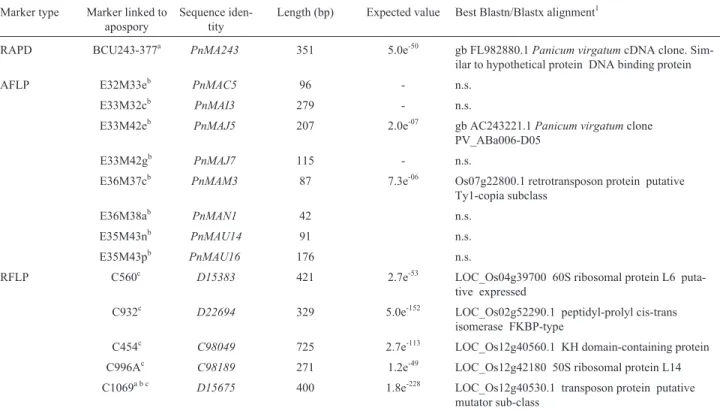
Two RAPD and 14 AFLP molecular markers previ-ously reported to be completely linked to apospory in tetraploid P. notatum were re-amplified using the corre-sponding primers from genotypes Q4188 (sexual), Q4117 (aposporous) and their F1hybrids (55 sexual and 10 apos-porous). The amplification products were electrophoresed and markers linked to apospory were identified based on their molecular weight and strict cosegregation with the mode of reproduction of the F1plants. The bands of interest were isolated from Q4117, cloned and sequenced. Of the 16 markers tested (two RAPDs and 14 AFLPs), only nine (one RAPD and eight AFLPs) were successfully recovered and cloned (Table 1). The rest of the PCR-based markers were lost during the cloning step or could not be confirmed be-cause they lacked specific primers. A consensus was built for each marker by assembling sequences from at least three clones of the same fragment, with a minimum homo-logy of 95%. The sequences of the cloned fragments ranged in length from 42 bp to 351 bp (Table 1). BLAST analysis revealed that only three of the sequences (33.3% of the total sequences characterized) shared significant homology with
sequences in the databases; the others probably represented poorly-conserved intergenic sequences. Fragment PnMA243 was similar to a cDNA clone of Panicum virgatumand sequencePnMAJ5aligned with aP. virgatum genomic clone. SequencePnMAM3shared similarity with rice locus LOC_Os07g22800.1 that encodes a putative Ty1-copia subclass retrotransposon protein (Table 1).
RFLP markers from rice cDNA clones that mapped at theP. notatumapospory locus encoded for L6 and L14 ri-bosomal proteins (C560 and C996, respectively), a pepti-dyl-prolyl cis-trans isomerase protein (C932), a KH do-main-containing protein (C454) and a mutator subclass transposon protein (C1069) (Table 1).
Copy number estimation of apospory-associated sequences
The AFLP-derived clones PnMAC5, PnMAI3 and PnMAM3 were used as probes in Southern blot experi-ments with genomic DNA from the Q4188 and Q4117 ge-notypes in order to determine the copy number of these clones in theP. notatumgenome. ClonePnMAM3was in-cluded as a high-copy number control since it showed simi-larity with retrotransposons in the BLAST searches (Ta-ble 1). Hybridization with the control sequence (PnMAM3) resulted in a smeared pattern with some discrete bands, a
Table 1- Sequences identified by RAPD, AFLP and RFLP molecular markers linked to apospory inP. notatum. Marker type Marker linked to
apospory
Sequence iden-tity
Length (bp) Expected value Best Blastn/Blastx alignment1
RAPD BCU243-377a PnMA243 351 5.0e-50 gb FL982880.1Panicum virgatumcDNA clone. Sim-ilar to hypothetical protein DNA binding protein AFLP E32M33eb PnMAC5 96 - n.s.
E33M32cb PnMAI3 279 - n.s.
E33M42eb PnMAJ5 207 2.0e-07 gb AC243221.1Panicum virgatumclone PV_ABa006-D05
E33M42gb PnMAJ7 115 - n.s.
E36M37cb PnMAM3 87 7.3e-06 Os07g22800.1 retrotransposon protein putative Ty1-copia subclass
E36M38ab PnMAN1 42 n.s. E35M43nb PnMAU14 91 n.s. E35M43pb PnMAU16 176 n.s.
RFLP C560c D15383 421 2.7e-53 LOC_Os04g39700 60S ribosomal protein L6 puta-tive expressed
C932c D22694 329 5.0e-152 LOC_Os02g52290.1 peptidyl-prolyl cis-trans isomerase FKBP-type
C454c C98049 725 2.7e-113 LOC_Os12g40560.1 KH domain-containing protein C996Ac C98189 271 1.2e-49 LOC_Os12g42180 50S ribosomal protein L14 C1069a b c D15675 400 1.8e-228 LOC_Os12g40530.1 transposon protein putative
mutator sub-class
characteristic of highly repetitive sequences (Table 1, Fig-ure 1A). Assays withPnMAC5showed only one hybridiza-tion band with the three restrichybridiza-tion enzymes tested and no polymorphisms between parental plants (Figure 1B). Clone PnMAI3showed 2-4 hybridization bands with polymorphic fragments between Q4188 and Q4117 for two restriction enzymes (Figure 1C). The polymorphism revealed by EcoRI consisted of bands with different migration rates in Q4188 and Q4117, while the polymorphism produced by PstI consisted of a band present in Q4117 and absent in Q4188 (Figure 1C). To determine the association between polymorphisms and the mode of reproduction, bulked se-gregant analysis (BSA) was done by hybridizingPnMAI3 on both sexual (BS) and apomictic (BA) bulks (Figure 1D). The hybridization pattern showed that the polymorphisms detected between parental plants were also observed be-tween sexual and apomictic bulks (Figure 1C and D), indi-cating genetic linkage between the target sequence and apospory.
Characterization ofPnMAI3-flanking sequences by
chromosome walking
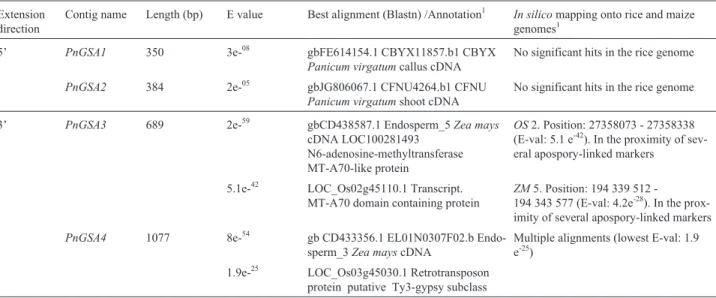
Based on results described above, we initiated chro-mosome walking around PnMAI3since this clone had a low-copy number and showed linkage to apospory. Succes-sive rounds of amplification yielded four consensus se-quences (%ID > 80), two of them extending towards the 5 flanking region and two towards the 3 flanking region, re-spectively (Table 2). Only fragments that could be vali-dated by identifying the primers used during the second round of amplification and by assembling the correspond-ing contig with the original sequence were considered for analysis. The length of the extended fragments ranged from 54 bp to 133 bp for the 5’ flanks and 102-826 bp for the 3’
flanks, respectively. These results agreed with the copy number (2-4) estimated for this marker, indicating that the
Figure 1- Southern blot of apospory-specific AFLP-derived sequences in DNA from sexual and apomicticPaspalum notatum.A, B and C: Hybrid-ization of DNA from genotypes Q4188 (SP) and Q4117 (AP) with clones PnMAM3,PnMAC5andPnMAI3, respectively, after digestion with three restriction enzymes. D: Hybridization ofPnMAI3against sexual (SB) and apomictic (AB) bulks obtained from ten F1sexual and apomictic proge-nies, respectively. Arrows indicate polymorphic bands between parental plants and sexual and apomictic bulks.
Table 2- Characterization ofP. notatumgenomic contigs derived from extension of the apospory-specific markerPnMAI3. Extension
direction
Contig name Length (bp) E value Best alignment (Blastn) /Annotation1 In silicomapping onto rice and maize genomes1
5’ PnGSA1 350 3e-08 gbFE614154.1 CBYX11857.b1 CBYX Panicum virgatumcallus cDNA
No significant hits in the rice genome PnGSA2 384 2e-05 gbJG806067.1 CFNU4264.b1 CFNU
Panicum virgatumshoot cDNA
No significant hits in the rice genome 3’ PnGSA3 689 2e-59 gbCD438587.1 Endosperm_5Zea mays
cDNA LOC100281493 N6-adenosine-methyltransferase MT-A70-like protein
OS2. Position: 27358073 - 27358338 (E-val: 5.1 e-42). In the proximity of sev-eral apospory-linked markers
5.1e-42 LOC_Os02g45110.1 Transcript. MT-A70 domain containing protein
ZM5. Position: 194 339 512
-194 343 577 (E-val: 4.2e-28). In the prox-imity of several apospory-linked markers PnGSA4 1077 8e-54 gb CD433356.1 EL01N0307F02.b
Endo-sperm_3Zea mayscDNA
Multiple alignments (lowest E-val: 1.9 e-25)
1.9e-25 LOC_Os03g45030.1 Retrotransposon protein putative Ty3-gypsy subclass 1
fragment was located in at least twoloci, probably sur-rounded by different flanking sequences. The sequences of contigsPnGSA1andPnGSA2(5’ amplifications) were si-milar to cDNA fromP. virgatumcalli and shoots, respec-tively, while the sequence ofPnGSA3was highly similar to maize endosperm cDNA (gb CD438587.1) that encodes a N6-adenosine-methyltransferase MT-A70-like protein. The PnGSA3 sequence also shared high similarity with LOC_Os02g45110.1 that encodes an MT-A70 domain-containing protein of rice. ContigPnGSA4was similar to a maize EST expressed in endosperm and to locus LOC_Os03g45030.1 of rice that encodes a putative retro-transposon protein (Table 2).
PCR amplifications based on primers that covered the four extended sequences and the original marker (Table S2) were used to amplify the whole contig in order to verify the presence of contigs derived from extension of the apos-pory-specific sequencePnMAI3in theP. notatumgenome (thereby excluding possible contamination or chimeric as-semblies) and to determine which of the two sequences iso-lated at each flank mapped to the apospory locus. Amplifi-cations done on genomic DNA from both parental plants showed fragments of the expected size, confirming correct assembly, in addition to other fragments. However, the ex-pected bands showed no polymorphisms between parental genotypes. This outcome prevented mapping the fragments using the F1hybrids. To overcome this difficulty, we under-took anin silicomapping analysis with the contig sequence on rice to distinguish which one was located in the region previously associated with apospory reported by Pupilliet al.(2004). Table 2 summarizes thein silico mapping re-sults. The two 5’-flanking regions showed no significant match with the rice genome in GRAMENE BLAST searches, even though they showed homology to two Panicum virgatumcDNAs. These sequences may represent novel sequences present only in a group of related grasses. Of the two 3’-flanking regions,PnGSA3mapped to rice chromosome 2, close to RFLP probes previously associated with apomixis (see below). The other 3’-flanking region (PnGSA4) showed multiple alignments and probably repre-sented a copy of a repetitive sequence located adjacent to a secondPnMAI3fragment but at a different genomic loca-tion.
Interestingly, during contig validation, several other fragments of unexpected size were amplified. Some of these were polymorphic between Q4188 and Q4117 (Fig-ure S1). Additional linkage analyses to determine the asso-ciation between polymorphic bands and the mode of reproduction were done using the corresponding primers for each contig on DNA from both parental plants and a sample of 20 (10 sexual and 10 aposporous) F1individuals. PCR amplifications showed that most fragments were un-linked to apospory. However, amplification of sequence PnGSA1 with primers VI3R and VI35BF1 generated a band of 764 bp (PnMA764) that was present in Q4117 and
in all aposporous individuals but was absent in Q4188 and in all sexual F1progenies (Figure S2). This fragment (Gen-Bank accession number: JN25001) showed sequence simi-larity to a maize transposable element (GRMZM5G800837_T01). Likewise, amplification of PnGSA4 with primers VI3F and VI3310AR2 showed a high molecular weight band (PnMA1200) that also cose-gregated with apospory (not shown). However, all attempts to clone this marker failed and their sequence could not be analyzed.
In silicomapping analysis of the whole set of apospory-associated sequences
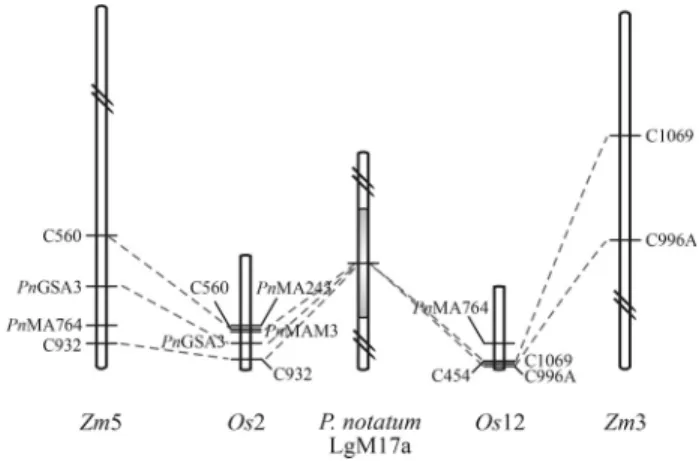
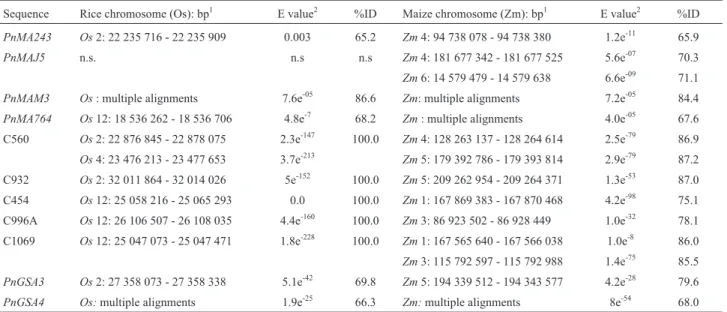
All sequences derived from the P. notatum apos-pory-specific markers were mappedin silicoonto the rice and maize genomes in order to determine the location of orthologous sequences in both model species. Rice RFLP clones previously associated with apospory were also in-cluded as reference points (Table 3). Putative orthologues to PnMA243 and PnMAM3 were found located on rice chromosome 2, close to the apospory-related markers C560 and C932.PnMA764aligned with a genomic sequence of rice chromosome 12 and maize chromosome 5, near to the apospory-related rice clones C1069 and C932, respec-tively. Apospory-related sequences mapping onto rice chromosomes 2 and 12 and maize chromosomes 3 and 5 covered approximately 10 Mbp and 30 Mbp, respectively (Figure 2). The rest of the sequences analyzed mapped on maize chromosomes 1 (C454), 4 (PnMA243,PnMAJ5and C560) and 6 (PnMAJ5) (Table 3).
Methylation-sensitive RFLP analysis of the apospory-related sequences
Since the activity of repetitive elements is known to be controlled through specific cytosine methylation
terns, methylation-sensitive RFLP experiments were done by using the apospory-associated clonesPnMAM3 (retro-transposon protein Ty1-copia subclass) and C1069 (trans-poson protein, mutator subclass) in combination with the restriction enzymesHpaII and MspI. The methylation in-sensitive enzymes EcoRI and HindIII were included as controls since they generate markers completely linked to apospory when clone C1069 is used as a probe (Martínezet al., 2003). Analyses were initially done on DNA from the sexual (Q4188) and apomictic (Q4117) parents of the map-ping cross. Hybridization withPnMAM3showed a smeared pattern with some individual bands for the four enzymes tested. Polymorphisms between genotypes were detected on samples digested with bothEcoRI andHindIII indicat-ing genetic differences among genotypes at the specific loci. Hybridization of samples digested with HpaII and MspI revealed differences between enzymes in both plants, indicating the existence of cytosine methylation, although a similar pattern was observed for the sexual and apomictic
genotypes (Figure S3). Assays with probe C1069 showed only discrete fragments. Samples digested withEcoRI and HindIII produced the expected polymorphic markers asso-ciated with apospory reported by Martínezet al.(2003) (not shown).
The hybridization patterns of samples digested with HpaII and MspI confirmed methylation of the target se-quence and also revealed differences between sexual and apomictic genotypes (Figure 3A). Genotype Q4188 showed three methylation-sensitive hybridization frag-ments (patterns 01 or 10); one of these (~ 0.9 kb) was spe-cific for the sexual plant while the other two (~3.5 kb and 0.5 kb) were also present in Q4117 (Figure 3A). Genotype Q4117 showed two methylation-insensitive hybridization bands (pattern 11) of ~2.0 kb and ~0.7 kb, respectively, that were absent in Q4188. Hybridization of probe C1069 on DNA from sexual (BS) and apomictic (BA) bulks showed that the three methylation-sensitive markers were mono-morphic between groups. The corresponding de-bulked
Table 3- In silicomapping ofP. notatumapospory-specific sequences in rice and maize genomes.
Sequence Rice chromosome (Os): bp1 E value2 %ID Maize chromosome (Zm): bp1 E value2 %ID PnMA243 Os2: 22 235 716 - 22 235 909 0.003 65.2 Zm4: 94 738 078 - 94 738 380 1.2e-11 65.9 PnMAJ5 n.s. n.s n.s Zm4: 181 677 342 - 181 677 525 5.6e-07 70.3 Zm6: 14 579 479 - 14 579 638 6.6e-09 71.1 PnMAM3 Os: multiple alignments 7.6e-05 86.6 Zm: multiple alignments 7.2e-05 84.4 PnMA764 Os12: 18 536 262 - 18 536 706 4.8e-7 68.2 Zm: multiple alignments 4.0e-05 67.6 C560 Os2: 22 876 845 - 22 878 075 2.3e-147 100.0 Zm4: 128 263 137 - 128 264 614 2.5e-79 86.9 Os4: 23 476 213 - 23 477 653 3.7e-213 Zm5: 179 392 786 - 179 393 814 2.9e-79 87.2 C932 Os2: 32 011 864 - 32 014 026 5e-152 100.0 Zm5: 209 262 954 - 209 264 371 1.3e-53 87.0 C454 Os12: 25 058 216 - 25 065 293 0.0 100.0 Zm1: 167 869 383 - 167 870 468 4.2e-98 75.1 C996A Os12: 26 106 507 - 26 108 035 4.4e-160 100.0 Zm3: 86 923 502 - 86 928 449 1.0e-32 78.1 C1069 Os12: 25 047 073 - 25 047 471 1.8e-228 100.0 Zm1: 167 565 640 - 167 566 038 1.0e-8 86.0 Zm3: 115 792 597 - 115 792 988 1.4e-75 85.5 PnGSA3 Os2: 27 358 073 - 27 358 338 5.1e-42 69.8 Zm5: 194 339 512 - 194 343 577 4.2e-28 79.6 PnGSA4 Os:multiple alignments 1.9e-25 66.3 Zm:multiple alignments 8e-54 68.0 1
Orthologous sequences were assigned based on the criteria of 65% identity over at least 60% of the length of the sequences at E-values < 0.005. This as-signment was done using the Blastn tool available from GRAMENE and MaizeSequence.2In cases of multiple alignments, the lowest E-value and the highest %ID are indicated (corresponding to the best match).
analysis confirmed that methylation-sensitive markers showed similar patterns in sexual and aposporous F1 hy-brids such that no association with the reproductive mode could be detected. On the other hand, methylation-insen-sitive markers were specific for aposporous plants and therefore linked to apospory (Figure 3B). These polymor-phisms could be attributed to: 1) an absence of the restric-tion site in Q4188 because of genetic variarestric-tion between genotypes or 2) full methylation of the CCGG sequence. These two possibilities could not be distinguished by the approach used here.
Discussion
The availability of experimentally-generated tetra-ploid sexual genotypes ofP. notatumthat can be used as fe-male parents in crosses with natural apomictic tetraploid plants has allowed the generation of populations that segre-gate according to the mode of reproduction without the need to use inter-specific or inter-ploid crosses. This type of segregating population has revealed some of the genetic and molecular features of apomictic reproduction and the extensive genetic variability for traits of agronomic impor-tance in this species (Acuñaet al., 2009).
The chromosome segment coding for apospory inP. notatumresembles the apospory-specific genomic region (ASGR) found in other grasses such as Pennisetum squamulantum (Ozias-Akins et al., 1998; Roche et al., 2001),Cenchrus ciliaris(Ozias-Akinset al., 2003; Roche et al., 1999),Paspalum simplex(Labombardaet al., 2002; Pupilliet al., 2004) andPanicum maximum(Ebinaet al., 2005). In all of these species the ASGR is characterized by a lack of recombination. In Pennisetum, Cenchrus and Paspalum, there is also a strong distortion of segregation (Ozias-Akinset al., 1998, 2003; Rocheet al., 1999, 2001; Labombardaet al., 2002; Pupilliet al., 2004) that is absent inP. maximum(Ebina et al., 2005).Deciphering the ge-netic structure of these complex non-recombinant chromo-some blocks would provide key information about genes governing apospory. InP. squamulatum(Akiyamaet al., 2004), C. ciliaris (Conner et al., 2008) and P. simplex (Calderiniet al., 2006, 2010) this task has been attempted by sequencing BAC clones carrying molecular markers completely linked to apospory. In these three species, puta-tive protein-coding regions as well as a large number of highly repetitive sequences have been identified (Akiyama et al., 2004; Calderiniet al., 2006, 2008). Recently, several ovule transcripts originating from the ASGR-carrier chro-mosome were identified inPennisetumby using a novel ap-proach based on the comparison of two transcriptomes derived from microdissected ovules (Zenget al., 2011).
In the present work, we used a previously classified mapping population that segregated according to mode of reproduction and a group of molecular markers linked to apospory in order to characterize sequences present in the ASGR ofP. notatumand identify possible candidate genes.
Southern blot experiments confirmed the presence of low and high copy-number sequences in the ASGR. Hybridiza-tion bands were detected in sexual (Q4188) and apomictic (Q4117) parents of all the clones tested, indicating that the target sequences were present in both genotypes. Likewise, all contigs derived from extension of the apospory-specific markerPnMAI3were amplified from both parental plants, with no differentiation between maternal- and pater-nal-specific sequences. However, since only a small part (~5 kb) of the large ASGR (estimated size: 36 Mbp) was characterized, hemizygosity in other regions cannot be dis-carded.
Only two sequences that originated from RAPD and AFLP markers aligned with cDNA clones encoding a hy-pothetical protein (PnMA243) and a retrotransposon ele-ment of the Ty1-copia subclass (PnMAM3), respectively. The remaining AFLP-derived sequences showed no homo-logies in BLAST searches, probably because of the short length of the fragments analyzed and the fact that AFLP markers often target centromeric or non-coding regions (Castiglioniet al., 1999). Rice cDNA RFLP clones map-ping at the apospory locus encoded for ribosomal proteins (C996 and C569), a peptidyl-prolyl cis-trans-isomerase protein (PPIase) (C932), a KH domain containing protein (C454) and a putative mutator sub-class transposon protein (C1069). Among all these candidates, peptidyl-prolyl cis-trans isomerases (PPIases) deserve particular consider-ation because of their possible involvement in developmen-tal processes (Dobson, 2004; Shaw, 2007). PPIases of the FKBP type are associated with cell division and cell elon-gation mediated by cytokinins and brassinosteroids in Arabidopsis (Harrar et al., 2001). Other interesting se-quence corresponded to KH domain-containing proteins, which are RNA-binding proteins involved in mRNA stabil-ity and gene expression regulation at the posttranscriptional level (Burd and Dreyfuss, 1994; Lorkovic and Barta, 2002). In maize, KH proteins have been associated with the main-tenance of an inactive chromatin state inknoxgenes within the peripheral zone of the shoot apical meristem required for proper leaf development (Buckneret al., 2008).
analysis of their expression in reproductive tissues byin situhybridization and qRT-PCR should be done to deter-mine possible functional associations between them and the mode of reproduction.
An in silicomapping analysis of P. notatum apos-pory-specific sequences in the rice and maize genomes identified several orthologous sequences in segments of rice chromosomes 2 and 12, previously associated with apospory in this species (Pupilliet al., 2004), and maize chromosomes 3 and 5. A recent study based on a compara-tive RFLP mapping strategy showed that several markers of rice chromosome 12 (including C996 and C1069 ana-lyzed here) bracketed the chromosomal region responsible for apomixis in fourPaspalumspecies of two taxonomic groups (Hojsgaardet al., 2011). Interestingly, the range of the ASGR estimated forP. squamulatum,C. ciliarisandP. notatum(Akiyamaet al., 2004, 2005; Stein et al., 2007) agreed with the physical distances covered by apospory-specific markers in rice chromosomes 2 and 12 and maize chromosomes 3 and 5. Considering that apomixis may have arisen from the deregulation of genes involved in sexual re-production, the identification of coding sequences within the ASGR syntenic regions and a comparison with infor-mation derived from expression analyses could help to identify genes physically and functionally related to the trait. In another study, several transcripts differentially ex-pressed in reproductive tissues of sexual and aposporousP. notatumwere found to map in the same region of rice chro-mosome 2 (Laspinaet al., 2008). Moreover, chromosome 2 of rice and chromosome 5 of maize are associated with apospory in Brachiaria hybrids (Pessino et al., 1997, 1998). Accordingly, these chromosomal segments may contain apospory-related sequences.
SeveralP. notatumapospory-specific sequences ap-peared to be related to repetitive elements such as mutator class transposons and Ty1-copia and Ty3-gypsy sub-class retrotransposons. The presence of these elements agrees with the occurrence of repetitive sequences in the ASGR of other grass species (Akiyamaet al., 2004; Cal-deriniet al., 2006; Conneret al., 2008). Moreover, null-mutants defective for the expression of a PAZ-PIWI AGO9 protein involved in the processing of transcribed retro-transposons were reported to produce non-reduced gametes inArabidopsis thaliana, thereby mimicking the first step of aposporous development (Olmedo-Monfilet al., 2010). In a recent study ofP. notatum, retrotransposon elements car-rying transduplicated gene segments were shown to be dif-ferentially expressed in inflorescences of sexual and apomictic genotypes and a possible regulatory function of these elements in gene expression was proposed (Ocho-gavíaet al., 2011).
Methylation-sensitive RFLP experiments indicated that, in leaves, repetitive elements located at the apospory locus were methylated, but there was no difference in the methylation pattern of apomictic and sexual genotypes.
However, Rodriguezet al.(2012) reported variation in the methylation patterns of diploid (sexual) and tetraploid (sex-ual and apomicts) races of P. notatum based on MSAP (methylation-sensitive amplification polymorphism) mark-ers. Moreover, the inactivation of a DNA methylation path-way in maize reproductive organs resulted in apomixis-like phenotypes (Garcia-Aguilar et al., 2010). Since DNA methylation is involved in numerous biological processes, including embryogenesis, genomic imprinting, silencing of transposable elements and regulation of gene transcription (Zilberman et al., 2007) further experiments should be done on DNA extracted from inflorescences in order to better characterize the cytosine methylation of these apos-pory-related sequences.
Acknowledgments
The authors thank Florencia Galdeano for technical assistance. This study was financed by ANPCyT (Agencia Nacional de Promoción Científica y Tecnológica; PICT 2007 No. 00476 and PME 2006 No. 03083), Argentina, CONICET (Consejo Nacional de Investigaciones Cientí-ficas y Técnicas, PIP 112-200801-01378), Argentina. M.P., M.P.R. and L.A.S. were supported by fellowships from CONICET. S.F., E.J.M., C.L.Q., S.C.P. and J.P.A.O. are Career Members of CONICET.
References
Acuña CA, Blount AR, Quesenberry KH, Kenworthy KE and Hanna WW (2009) Bahiagrass tetraploid germplasm: Re-productive and agronomic characterization of segregating progeny. Crop Sci 49:581-588.
Akiyama Y, Conner JA, Goel S, Morishige DT, Mullet JE, Hanna WW and Ozias-Akins P (2004) High resolution physical mapping in Pennisetum squamulatum reveals extensive chromosomal heteromorphism of genomic region associ-ated with apomixis. Plant Physiol 134:1733-1741.
Akiyama Y, Hanna WW and Ozias-Akins P (2005) High-reso-lution physical mapping reveals that the apospory-specific genomic region (ASGR) inCenchrus ciliarisis located on a heterochromatic and hemizygous region of a single chromo-some. Theor Appl Genet 111:1042-1051.
Altschul SF, Gish W, Miller W, Myers EW and Lipman DJ (1990) Basic local alignment search tool. J Mol Biol 215:403-410. Asker SE and Jerling L (1992) Apomixis in Plants. CRC Press,
Boca Raton, 320 pp.
Buckner B, Swaggart KA, Wong CC, Smith HA, Aurnad KM, Scanlon MJ, Schnable PS and Janic-Buckner D (2008) Ex-pression and nucleotide diversity of the maize RIK gene. J Hered 99:407-416.
Burd CG and Dreyfuss G (1994) Conserved structures and diver-sity of functions of RNA-binding proteins. Science 265:615-621.
microcolinearity with rice. Theor Appl Genet 112:1179-1191.
Calderini O, Donnison I, Polegri L, Panara F, Thomas A, Arcioni S and Pupilli F (2010) Partial isolation of the genomic region linked with apomixis in Paspalum simplex. Mol Breed 28:265-276.
Carman JG (1997) Asynchronous expression of duplicate genes in angiosperms may cause apomixis, bispory, tetraspory, and polyembryony. Biol J Linn Soc 61:51-94.
Castiglioni P, Ajmone-Marsan P, van Wijk R and Motto M (1999) AFLP markers in a molecular linkage map of maize: Codo-minant scoring and linkage group distribution. Theor Appl Genet 99:425-431.
Clancy MJ, Shambaugh ME, Timpte CS and Bokar JA (2002) In-duction of sporulation inSaccharomyces cerevisiaeleads to the formation of N6-methyladenosine in mRNA: A potential mechanism for the activity of thei.e.gene. Nucleic Acids Res 30:4509-4518.
Conner JA, Goel S, Gunawan G, Cordonnier-Pratt MM, Johnson VE, Liang C, Wang H, Pratt LH, Mullet JE, DeBarry J,et al.
(2008) Sequence analysis of bacterial artificial chromosome clones from the apospory-specific genomic region of
PennisetumandCenchrus. Plant Physiol 147:1396-13411. Dobson CM (2004) Principles of protein folding, misfolding and
aggregation. Semin Cell Dev Biol 15:3-16.
Ebina M, Nakagawa H, Yamamoto T, Araya H, Tsuruta S, Ta-kahra M and Nakajima K (2005). Co-segregation of AFLP and RAPD markers to apospory in Guineagrass (Panicum maximumJacq.). Grassland Sci 51:71-78.
Garcia-Aguilar M, Michaud C, Leblanc O and Grimanelli D (2010) Inactivation of a DNA methylation pathway in maize reproductive organs results in apomixis-like phenotypes. Plant Cell 22:3249-3267.
Gates RN, Quarin CL and Pedreira CGS (2004) Bahiagrass. In: Moser LE, Burson BL and Sollenberger LE (eds) Warm-Season (C4) Grasses. ASA, CSSA, and SSSA, Madison, pp 651-680.
Harrar Y, Bellini C and Faure JD (2001) FKBPs: At the cross-roads of folding and transduction. Trends Plant Sci 6:426-431.
Hojsgaard DH, Martínez EJ, Acuña CA, Quarin CL and Pupilli F (2011) A molecular map of the apomixis-control locus in
Paspalum procurrens and its comparative analysis with other species ofPaspalum. Theor Appl Genet 123:959-971. Koltunov AM (1993) Apomixis: Embryo sacs and embryos
formed without meiosis or fertilization in ovules. Plant Cell 5:1425-1437.
Labombarda P, Busti A, Caceres ME, Pupilli F and Arcioni S (2002) An AFLP marker tightly linked to apomixis reveals hemizygosity in a portion of the apomixis-controlling locus inPaspalum simplex. Genome 45:513-519.
Laspina NV, Vega T, Seijo JG, González AM, Martelotto MG, Stein J, Podio M, Ortiz JPA, Echenique V, Quarin CL,et al.
(2008) Gene expression analysis at the onset of aposporous apomixis inPaspalum notatum. Plant Mol Biol 67:615-628. Lorkovic ZJ and Barta A (2002) Genome analysis: RNA
recogni-tion motif (RRM) and K homology (KH) domain RNA-binding proteins from the flowering plant Arabidopsis thaliana. Nucleic Acids Res 30:623-635.
Martínez EJ, Urbani MH, Quarin CL and Ortiz JPA (2001) Inheri-tance of apospory in bahiagrass, Paspalum notatum. Hereditas 135:19-25.
Martínez EJ, Hopp E, Stein J, Ortiz JPA and Quarin CL (2003) Genetic characterization of apospory in tetraploidPaspalum notatum based on the identification of linked molecular markers. Mol Breed 12:319-327.
McClelland M, Nelson M and Raschke E (1994) Effect of site-specific modification on restriction endonucleases and DNA modification methyltransferases. Nucleic Acids Res 22:3640-3659.
Michelmore RW, Paran I and Kesselli V (1991) Identification of markers linked to disearesistance genes by bulked se-gregant analysis: A rapid method to detect markers in spe-cific genomic regions by using segregating populations. Proc Natl Acad Sci USA 88:9828-9832.
Nogler GA (1984) Gametophytic apomixis. In: Johri BM (ed) Embryology of Angiosperms. Springer-Verlag, Berlin, pp 475-518.
Ochogavía AC, Seijo JG, González MA, Podio M, Silveira ED, Machado Lacerda AL, Carneiro VTC, Ortiz JPA and Pes-sino SC (2011) Characterization of retrotransposon sequen-ces expressed in inflorescensequen-ces of apomictic and sexual
Paspalum notatumplants. Sexual Plant Reprod 24:231-246. Olmedo-Monfil V, Durán-Figueroa N, Arteaga-Vázquez M,
De-mesa-Arévalo E, Autran D, Grimanelli D, Slotkin RK, Mar-tienssen RA and Vielle-Calzada JP (2010) Control of female gamete formation by a small RNA pathway inArabidopsis. Nature 464:628-632.
Ortiz JPA, Pessino SC, Leblanc O, Hayward MD and Quarin CL (1997) Genetic fingerprinting for determining the mode of reproduction inPaspalum notatum, a subtropical apomictic forage grass. Theor Appl Genet 95:850-856.
Ortiz JPA, Pessino SC, Bhat V, Hayward MD and Quarin CL (2001) A genetic linkage map of diploidPaspalum notatum. Crop Sci 41:823-830.
Ozias-Akins P and van Dijk P (2007) Mendelian genetics of apomixis in plants. Annu Rev Genet 41:509-537.
Ozias-Akins P, Roche D and Hanna WW (1998) Tight clustering and hemizygosity of apomixis-linked molecular markers in
Pennisetum squamulatumimplies genetic control of apos-pory by divergent locus that may have no allelic form in sex-ual genotypes. Proc Natl Acad Sci USA 95:5127-5132. Ozias-Akins P, Akiyama Y and Hanna WW (2003) Molecular
characterization of the genomic region linked with apomixis inPennisetum/Cenchrus. Funct Integr Genomics 3:94-104. Pessino SC, Ortiz JPA, Leblanc O, do Valle CB, Evans C and Hayward MD (1997) Identification of a maize linkage group related to apomixis in Brachiaria. Theor Appl Genet 94:439-444.
Pessino SC, Evans C, Ortiz JPA, Armstead I, do Valle CB and Hayward MD (1998) A genetic map of the apospory-region inBrachiariahybrids: Identification of two markers closely associated with the trait. Hereditas 128:153-158.
Pupilli F, Martínez EJ, Busti A, Calderini O, Quarin CL and Arcioni S (2004) Comparative mapping reveals partial con-servation of synteny at the apomixis locus inPaspalumspp. Mol Genet Genomics 270:539-548.
and Q4205, sexual tetraploid germplasm lines of Bahia-grass. Crop Sci 43:745-746.
Rebozzio RN, Rodriguez MP, Stein J, Quarin CL, Ortiz JPA and Espinoza F (2012) Validation of molecular markers linked to apospory in tetraploid races of bahiagrass, Paspalum notatumFlüggé. Mol Breed 29:189-198.
Roche D, Cong P, Chen Z, Hanna WW, Gustine DL, Sherwood RT and Ozias-Akins P (1999) An apospory-specific ge-nomic region is conserved between buffelgrass (Cenchrus ciliaris L.) and Pennisetum squamulatum Fresen. Plant J 19:203-208.
Roche D, Chen Z, Hanna WW and Ozias-Akins P (2001) Non-Mendelian transmission of an apospory-specific genomic region in a reciprocal cross between sexual pearl millet (Pennisetum glaucum) and an apomictic F1 (P. glaucumxP. squamulatum). Sex Plant Reprod 13:217-223.
Rodriguez MP, Cervigni GDL, Quarin CL and Ortiz JPA (2012) Frequencies and variation in cytosine methylation patterns in diploid and tetraploid cytotypes ofPaspalum notatum as-sessed by MSAP markers. Biol Plant 56:276-282.
Salse J, Piégu B, Cooke R and Delseny M (2004) Newin silico in-sight into the synteny between rice (Oryza sativaL.) and maize (Zea maysL.) highlights reshuffling and indentifies new duplications in the rice genome. Plant J 38:396-409. Savidan Y (2000) Apomixis: Genetics and breeding. In: Janick J
(ed) Plant Breeding Reviews. John Wiley & Sons, London, pp 13-86.
Shaw PE (2007) Peptidyl-prolyl cis/trans isomerases and tran-scription: Is there a twist in the tail? EMBO Rep 8:40-45. Spillane C, Curtis M and Grossniklaus U (2004) Apomixis
tech-nology development - Virgin births in farmers’ fields? Nat Biotechnol 22:687-691.
Stein J, Quarin CL, Martínez EJ, Pessino SC and Ortiz JPA (2004) Tetraploid races ofPaspalum notatumshow polysomic in-heritance and preferential chromosome pairing around the apospory-controlling locus. Theor Appl Genet 109:186-191. Stein J, Pessino SC, Martínez EJ, Rodríguez MP, Siena L, Quarin CL and Ortiz JPA (2007) A genetic map of tetraploid
Paspalum notatum Flugge (bahiagrass) based on single-dose molecular markers. Mol Breed 20:153-166.
Tardy-Planechaud S, Fujimoto J, Lin SS and Sowers LC (1997) Solid phase synthesis and restriction endonuclease cleavage of oligodeoxynucleotides containing 5-(hydroxy-methyl)-cytosine. Nucleic Acids Res 25:553-558.
Toenniessen GH (2001) Feeding the world in the 21st century: Plant breeding, biotechnology, and the potential role of apomixis. In: Savidan Y, Carman JG and Dresselhaus T (eds) The Flowering of Apomixis: From Mechanisms to Ge-netic Engineering. ClMMYT, Mexico, D.F., pp 1-7.
Vielle-Calzada JP, Crane CF and Stelly DM (1996) Apomixis: The asexual revolution. Science 274:1322-1323.
Zeng Y, Conner J and Ozias-Akins P (2011) Identification of ovule transcripts from the apospory-specific genomic region (ASGR)-carrier chromosome. BMC Genomics 12:206. Zilberman D, Gehring M, Tran RK, Ballinger T and Henikoff S
(2007) Genome-wide analysis ofArabidopsis thalianaDNA methylation uncovers an interdependence between methyl-ation and transcription. Nat Genet 39:61-69.
Zhong S, Li H, Bodi Z, Button J, Vespa L, Herzog M and Fray R (2008) MTA is anArabidopsismessenger RNA adenosine methylase and interacts with a homolog of a sex-specific splicing factor. Plant Cell 20:1278-1288.
Internet Resources
Rice Genome Research Program, Japan, http://rgp.dna.affrc.go.jp/E/Publicdata.html (November 15, 2011).
GRAMENE, http://www.gramene.org (November 15, 2011).
MaizeSequence, http://www.maizesequence.org (Novem-ber 15, 2011).
TIGR Rice Genome Annotation,
http://blast.jcvi.org/eukblast/index.cgi?project=osa1 (No-vember 15, 2011).
Supplementary Material
The following online material is available for this ar-ticle:
Table S1 - Primers used for extending PnMAI3 marker.
Table S2 - Primers forPnMAI3contigs amplification from genomic DNA.
Figure S1 - Amplification of contigsPnGSA1-4from genomic DNA.
Figure S2 - MappingPnGSA1inPaspalum notatum. Figure S3 - Methylation-sensitive RFLP analysis car-ried out with clonePnMAM3.
This material is available as part of the online article from http://www.scielo.br/gmb.
Associate Editor: Marcia Pinheiro Margis
Primer name
Sequence
I3NP31
1AAATTCGGCTTCACGGCATTGGTCATT
I3NP32
2GATGCCTTGGGTCTTCTCTTATACGTT
I3NP51
1CAGGCGTCGGACGTTCCAGTGAATGCA
I3NP52
2CTAGGGGTCCGATTGGTTGCTTGAATT
1
sequence
PnMAI3
from
Paspalum notatum
genomic DNA.
PnMAI3 anchor primer (5´-3´) Contig
sequence
Specific-primer of the extended sequence (5´-3´) Length (bp)
VI35BF1: GGCTGGTATCTAGCAGCTCAA 309
PnGSA1
VI35BF2: GCATGTTCAAGCACATCTATC 279
VI3R: CAATGACCAATGCCGTGAAGC
PnGSA2 VI354BF2: CAGAAGGCCAGAAGAACTCA 291
VI338AR1: GGAATCCATCCTGAAGTTTCG 538
PsGSA3
VI338AR2: GCTCGTAGTGGACATATTTGC 417
VI3310AR1: TAGTCATTGGCGGTGGTGGAT 342
VI3F: CCCAGACCGTTCGATATGTGTAAT
PnGSA4