1 Museu de Zoologia, Universidade de São Paulo, Caixa Postal 42494-970, 04218-970, São Paulo, SP, Brasil. E-mail: [email protected] 2 Departamento de Zoologia, Universidade Federal do Paraná, Caixa Postal 19020, Curitiba, Brasil, 81531-980. E-mail: [email protected]
D
ISTRIBUTIONAL PATTERNS OF THEN
EOTROPICAL FLY GENUSP
OLIETINAS
CHNABL& D
ZIEDZICKI(D
IPTERA, M
USCIDAE):
A PHYLOGENY-
SUPPORTEDANALYSIS USING PANBIOGEOGRAPHIC TOOLS
S
ILVIOS
HIGUEON
IHEI1C
LAUDIOJ
OSÉB
ARROS DEC
ARVALHO2ABSTRACT
Over the last decades, Neotropical region has been subdivided into smaller units (areas of endemism), yet these subdivisions were not necessarily based on an evolutionary perspective. Consequently, these areas of endemism may be biogeographic units that do not actually represent natural historical units. Here, the distributional patterns of the genus Polietina Schnabl & Dziedzicki, 1911 (Diptera, Muscidae; including 15 species) are analysed by applying panbiogeographic tools to recognise and propose primary homologous areas within the Neotropical region. The analysis and discussion of the results obtained here will be reconciled to the information provided by the phylogenetic hypothesis available for the genus.
KEYWORDS: Muscini, Neotropical, Panbiogeography, track analysis, nodes, biogeography.
INTRODUCTION
During the last few decades, the Neotropical Re-gion has been studied using a classification perspec-tive; that is, it has been divided into smaller historical units (areas of endemism). Morrone (2001b) found 33 studies classifying the Neotropics into regions, sub-regions and provinces through several different crite-ria,e.g. geographic, palaeontological, faunistic and flo-ristic. However, most studies did not propose a classi-fication based upon an evolutionary perspective and, therefore, many of these classifications have used or defined biogeographic units that do not represent natu-ral units (Morrone, 2001b). We find three compre-hensive works as the most important contributions on this question: Cracraft (1985), in analysing the
Panbiogeography comprises a first step towards the recognition of primary biogeographical homolo-gies, followed by a second step, which is the confirma-tion of those primary hypotheses as secondary homolo-gies (Morrone, 2001a, 2004). In this latter step, the primary homologies can be legitimate by the applica-tion of cladistic biogeographic methodology (the cla-distic test, Morrone, 2001a).
Panbiogeographic tools can provide useful infor-mation through the generation of generalised tracks and nodes. Generalised tracks are obtained by the spa-tial overlapping of two or more individual tracks, which represent the spanning tree resulting from the mini-mal length connection of the known localities. The generalised tracks indicate the pre-existence of ances-tral biota that became posteriorly fragmented by cli-matic and/or tectonic change (Craw et al., 1999; Morrone & Crisci, 1995). They may also indicate the existence of areas of endemism, because areas of en-demism would be equivalent to smaller generalised tracks (Grehan, 1993; Morrone, 2001a).
The genus Polietina Schnabl & Dziedzicki, 1911 comprises 15 species (Couri & Carvalho, 1997; Carvalho & Couri, 2002; Nihei, 2004a; Nihei & Carvalho, 2004) and ranges from the southern portion of the Nearctic region (southern USA) southwards to the southern Neotropics (northern Argentina, Para-guay and southern Brazil). Polietina was revised by Couri & Carvalho (1997), and complemented by the taxo-nomic contributions of Couri & Carvalho (1996), Couri & Pamplona (1997), Nihei (2002, 2004a) and Nihei & Carvalho (2004). More recently, Nihei (2004b) provided generic and specific diagnoses and an updated key to species, as well as performed cladistic and biogeo-graphic analyses for this essentially Neotropical genus. Here, we analysed the distributional patterns of
Polietina by applying panbiogeographic tools to
recognise and propose primary homologous areas within the Neotropical Region. The results obtained will be discussed based on the information provided by the phylogenetic hypothesis of the genus. The dis-cussion will also approach the results published in ear-lier biogeographic studies focusing Muscidae and the Neotropical region.
MATERIALS AND METHODS
We applied Panbiogeographic methods (follow-ing Morrone & Crisci, 1995 and Craw et al., 1999) to analyse the distributional patterns of Polietina and to recognise spatial homologous areas. The known
oc-currence localities of each species (Appendix) were plotted into maps and connected by their minimal geo-graphical distance to obtain individual tracks. Those individual tracks were gathered and overlapped to ob-tain generalised tracks for the genus. Generalised tracks indicate early existence of ancestral biotas which had been posteriorly fragmented by climatic and/or tec-tonic changes (Morrone & Crisci, 1995; Morrone & Márquez, 2001). Also, generalised tracks can indicate the existence of areas of endemism, since areas of endemism would equate to smaller generalised tracks (Morrone, 2001a; Harold & Mooi, 1994). However, Craw et al. (1999) emphasise that none proposition with regard to the biogeographic processes explaining tracks congruence is implied. Therefore, generalised tracks could represent 1) a track of a ancestral biota posteri-orly subdivided through vicariance events, 2) a con-cordant dispersal pathway used concomitantly by the taxa, 3) isolated events of dispersal, or 4) a combina-tion among these scenarios (Craw et al., 1999).
Biogeographic nodes are complex areas that are recognised where occurs the meeting or overlapping of two or more generalised tracks (Craw et al., 1999; Crisciet al., 2003). Nodes serve as evidence that dif-ferent ancestral biotic or geologic fragments are inter-related in space and time, resulting from terrain colli-sion, docking or suturing, thereby indicating a com-posite area (Crisci et al., 2003). Also, nodes may be de-scribed as areas that represent geographic and phylo-genetic boundaries for the taxa of interest (Heads, 1989).
Polietina comprises 15 species (not all species were
included in this study): P. rubella is known only from the type-locality and was not included in the track analy-sis; the type material for P. basicincta (Stein, 1904) and
P. mellina (Stein, 1904) are missing, and their original
descriptions are incomplete (Couri & Carvalho, 1997) and so they were not included. The sources of geo-graphical data were Albuquerque (1956), Couri & Carvalho (1996, 1997), Couri & Pamplona (1997), Carvalho & Couri (2002), Nihei (2002, 2004a, b), and Nihei & Carvalho (2004) (see Appendix).
RESULTS AND DISCUSSION
Based on geographical data available in the lit-erature, the individual tracks for 12 species of Polietina
FIGURE 1. Phylogenetic relationships among Polietina species (modified from Nihei, 2004b).
the phylogenetic hypothesis proposed by Nihei (2004b) (Fig. 1).
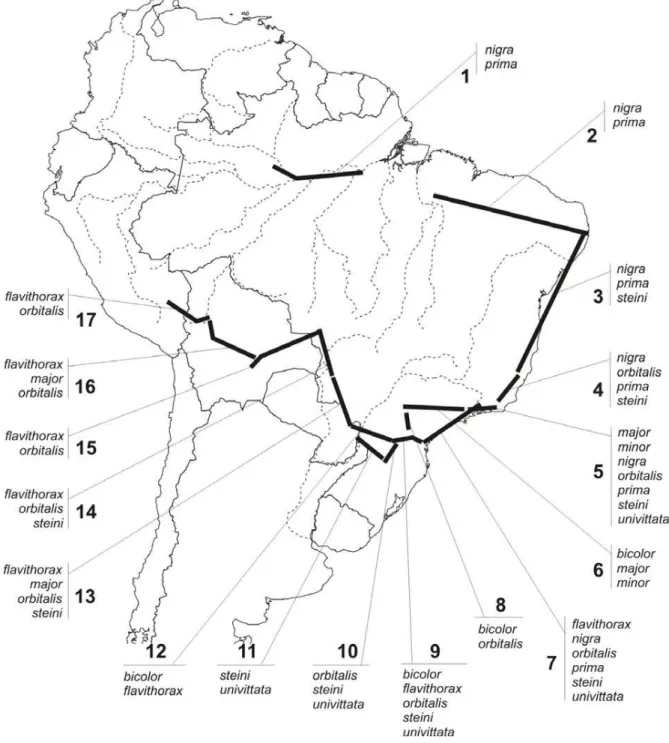
A number of generalised tracks obtained for
Polietina show congruence with the phylogenetic
pat-tern (Fig. 4). Tracks 1-5 and 7 comprise the
sister-spe-ciesP. nigra and P. prima, while tracks 1 and 2 are
sup-ported exclusively by that clade. The polytomic clade
P. minor + P. bicolor + P. univittata is present in the tracks 5, 6 and 9, although none of them is composed simul-taneously by the three species. And, tracks 13 and 16 are supported by the clade P. flavithorax + P. major.
Along with these tracks, track 5 is important because it contains nearly all species in clade B (Fig. 1), except forP. bicolor and P. flavithorax. However, these two spe-cies are present in other tracks contiguous with track
5: P. bicolor in track 6 (contiguous with track 5) and
P. flavithorax in track 7 (contiguous with and partly
over-lapping track 5). That area, supported by tracks 5-7, is spatially coincident with the “Atl component” of Camargo & Pedro (2003) based on distributional pat-terns of Meliponine bees, and could represent an im-portant area of endemism for the diversification of clade B. Similarly, the remaining tracks discussed above may represent areas of endemism for the species in question, especially tracks comprising closely related species. Generalised tracks might also indicate coinci-dent or isolated dispersal events (Craw et al., 1999), however, if phylogeny-supported, a track can indicate an area of endemism or the pre-existence of ancestral
biota for the concerned species. For example, generalised tracks formed by the sister-species P. prima
andP. nigra probably indicate that the geographical area
along which exists congruence in the distribution of these two contemporaneous species is a historically area, with importance to their diversification context. Most generalised tracks were based on the distri-bution of species comprising clade B, and are concen-trated in the SE component of Amorim & Pires (1996). This corroborates the suggestion that diversification of clade B is associated with that component (Nihei, 2004b). Clade A, on the other hand, was represented in several tracks only by P. orbitalis (widespread over SE component) (Fig. 4). With regard to the remainder of clade A, P. rubella, P. concinna and P. wulpi occur from southern Central America northward through Mexico to the southern USA, whereas P. flavidicincta is restricted to eastern Amazonian forests (see Figs. 2-3). The scarce geographical data for the species of clade A was the major limitation for generalised tracks in the Mesoamerican areas. Nevertheless, further collecting efforts on these areas could provide a rather sound and consistent analysis with regard to species of clade A and to Mesoamerica.
With respect to the subregions postulated by Morrone (2001b), some generalised tracks support some of his subregions. Tracks 3-12 are coincident with the Paraná subregion; and the individual tracks of
P. bicolor (Fig. 2A), P. minor (Fig. 2F), and P. univittata
(Fig. 3E), three closely related species that form a clade (Fig. 1), are exclusive to that subregion. The Amazo-nian subregion is supported by tracks 1 and 15-17 al-though they are restricted to the south of the Amazon River, and there is only one exclusive individual track, that of P. flavidicincta (Fig. 2C).
We compared the distributional patterns of
Polietina with the patterns of the Muscidae genera
stud-ied by Carvalho et al. (2003). From that comparision, we intended to recognise eventual similarities between the patterns observed in Polietina and taxa belonging to the same family. In that study, those authors analysed the tracks of three muscid genera: Cyrtoneurina Giglio-Tos, 1893, Cyrtoneuropsis Malloch, 1925 and
Bithoracochaeta Stein, 1911 (Figs. 6A-B, 7). Track 5 of
Polietina is spatially coincident with track “g” of
Cyrtoneurina (Fig. 6A), tracks “u” and “v” of
Cyrtoneuropsis (Fig. 6B), and track “d” of Bithoracochaeta
(Fig. 7). Track 1 of Polietina is coincident with tracks “r” and “n” of Cyrtoneuropsis, while track “f ” of
Cyrtoneurina superimposes to track 4 and partly to track
3 of Polietina. Of the tracks of Cyrtoneurina, Cyrtoneuropsis
FIGURE 4. Generalised tracks obtained for Polietina, each one numbered and indicated its composing species.
one was supported by the phylogenetic pattern avail-able for each genus (Pamplona, 1999; Couri & Motta, 2000). Track “g” of Cyrtoneurina comprised four spe-cies, three of which (C. geminata, C. costata, C. crispaseta)
are closely related taxa (Pamplona, 1999). Also, track “d” of Bithoracochaeta comprised two closely related, but not sister, species.
In this analysis, ten nodes were identified for
Polietina (Fig. 5). Node “h” demarcates the southern
distribution of clade P. nigra + P. prima, whereas node “i” delimits the northern distribution of both clades
P. minor + P. bicolour + P. univittata and P. flavithorax +
P. major (see more on node “i” below, in comparison
FIGURE 5. Biogeographical nodes identified from the generalised tracks of Polietina.
nodes “c” and “j” (nodes as ‘distribution margins’ sensu Heads, 2004).
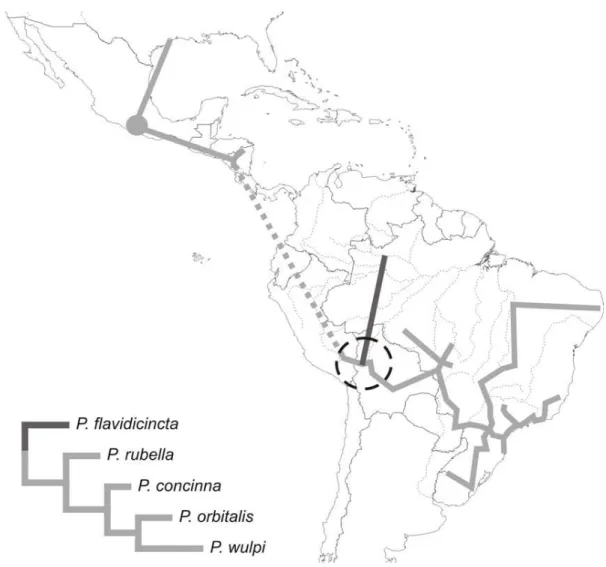
Some interesting information on vicariance, not recognised when analysing the generalised tracks and nodes, was possible to obtain only when considering the individual tracks isolatedly (Figs 8-9). Individual tracks of sister-species have indicated the possible lo-cation of areas of ancient vicariance among these
spe-cies. Figure 8 shows the individual tracks of the clade
P. concinna + P. rubella + P. wulpi + P. orbitalis connected altogether, and the probable area of vicariance of that clade and the most basal species of clade A,
P. flavidicincta. And Figure 9 shows the individual tracks
P. prima + P. nigra and P. flavithorax + P. major). The vicariance spots in the Amazon domain (Fig. 9) were not recognised in the nodes analysis (Fig. 5), on the other hand, the large area of vicariance recognised within the Atlantic Forest is partially represented by the nodes “h” and “i” (Fig. 5). Furthermore, the vicariance spot located more centrally in the Amazon domain is partially represented by the generalised track 1 (Fig. 4), whereas, the vicariance spot in Atlantic For-est is represented by several tracks (3, 4, 5, 6, 7).
We identified the nodes for the genera studied in Carvalho et al. (2003) (Figs. 6A-B, 7) and compared
withPolietina. There is only one node congruent among
Polietina (node “i”), Cyrtoneurina, Cyrtoneuropsis and
Bithoracochaeta on the Atlantic Forest domain. Unlike
the other genera, with no recognized nodes in Amazo-nian Forest or Central America, Cyrtoneuropsis has five nodes in those areas. For Polietina, this can be explained because most of the species are distributed southward to the Amazon River (Figs. 2-3), yet in Cyrtoneuropsis
most species occur in northeastern South America and Mesoamerica (see fig. 4 of Carvalho et al., 2003).
Morrone (2003) identified four generalised tracks in the Neotropics on the basis of the distributional patterns of freshwater decapods of the family Trichodactylidae. The generalised tracks (named Car-ibbean, Amazonian, Chacoan and Paraná) strongly sup-port the previously proposed subregions of Morrone (2001b). Morrone (2003) also identified three nodes: 1) in the southwest Colombia, between the Caribbean and Amazonian tracks; 2) in Bolivia, between the Ama-zonian and Chacoan tracks; and 3) in the border re-gion of Argentina-Paraguay-Brazil, between the Chacoan and Paraná tracks. In the nodes of Trichodactylidae and Polietina, two nodes are nearly coincident. Node “a” of Polietina is congruent with the Bolivian node of Trichodactylidae, and node “e” is nearly congruent with the Argentina-Paraguay-Brazil node. These two nodes are clearly within and between the boundaries of the Amazonian and Chacoan, and the Chacoan and Paraná subregions, showing that the distributional patterns of Trichodactylidae and Polietina
are congruent with that classification proposal of Morrone (2001b).
The nodes identified and discussed here may rep-resent areas of great importance for the historical con-text of the diversification of these taxa, especially if one regards nodes as biogeographic boundaries of relict fragments of different ancestral biota coming into contact in the present day (Crisci et al., 2003). Biogeo-graphic nodes may also serve as the basis for the selec-tion of priority areas for the proposiselec-tion of conserva-tion units (Grehan, 1993; Luna et al., 2000), particu-larly if identification of the nodes is supported by phylogeny, i.e. they are meaningful within an evolution-ary context. It means that the generalised tracks, as well as the nodes, are not randomly composed by two or more unrelated species; they are comprised by spe-cies with a common history on Earth. To identify the nature of biogeographic nodes is a very complex task. Some studies have been concerned to present and dis-cuss the nature of biogeographic nodes on theoretical
grounds (Heads, 1989, 2004), however, in practice, it is very complicate to ‘give’ a node a specific nature and a scientific explanation. In the present study, we provided some examples where a biogeographic node could indicate the existence of an area of ancient vicariance (see node “a” of Fig. 5, and the area of vicariance of Fig. 8; and nodes “h” and “i” and the area of vicariance on Atlantic Forest indicated in Fig. 9). Morrone (2001a, also Morrone & Crisci, 1995) stressed the importance of an integrative view in the biogeographic practice, and recommended the recon-ciliation of different methodologies, each one being used for a specific aim within the study. In the present study, we did not apply any additional methodology other than the panbiogeographic tools used to recognise and support the nodes, however, we have sustained our discussion on the basis of the phyloge-netic relationships among the species of Polietina.
cause sister-taxa are contemporaneous in the time scale and share a common history on Earth, the generalised tracks formed by them are historically more impor-tant than tracks comprised randomly by taxa derived from distant lineages. The same interpretation can be extended to biogeographic nodes, i.e., where a given generalised track comprised by clade X meets another track comprised by clade Y forming a node and know-ing that clades X and Y are sister-groups.
We believe that our results, in addition to earlier works, provides an accumulative basis for further stud-ies focusing the study of biogeographic homologstud-ies within the Neotropical region. For example, the na-ture of nodes was not fully demonstrated herein, al-though we hope subsequent studies can advance on this subject and identify possible ancient geological events responsible for the location of the nodes recognised here.
RESUMO
Durante as últimas décadas, a Região Neotropical tem sido classificada em unidades históricas menores (áreas de endemismo), entretanto, muitos desses estudos não têm se preocupado em propor uma classificação sob uma perspectiva evolutiva. Conseqüentemente, uma determinada classificação pode considerar unidades biogeográficas que não representem realmente unidades naturais. No presente estudo, o padrão de distribuição do gênero Polietina Schnabl & Dziedzicki, 1911 (Diptera, Muscidae), com 15 espécies, é analisado pela aplicação de ferramentas da Pan-biogeografia para reconhecer e propor áreas de homologia primária na região Neotropical. A análise e discussão dos resultados aqui obtidos serão conciliados às informações fornecidas pela hipótese filogenética disponível para o gênero.
PALAVRAS-CHAVE: Muscini, Neotropical, Pan-biogeografia, análise de traços, nós, biogeografia.
ACKNOWLEDGEMENTS
We would like to thank Carlos Lamas and José Ricardo Mermudes (Museu de Zoologia, Universidade de São Paulo) for comments, and James Roper (Curitiba) for the English revision. John Grehan (Buffalo Museum of Science) provided critical comments that improved substantially the manuscript. The senior author is grate-ful to Jayme Prevedello (Universidade Federal do Paraná, Curitiba) for sharing his doubts on the nature of nodes, which influenced the senior author to add some comments on the topic. Financial support from CAPES (proc. n. 0321/03-6 to SSN) and CNPq (proc. n. 141936/2000-2 to SSN, and 304148/2002-4 to CJBC) during the senior author’s Doctorate studies, and from FAPESP (proc. n. 04/13663-9).
REFERENCES
Albuquerque, D.O. 1956. Fauna do Distrito Federal. XIII. Sôbre o gêneroPolietina Schnabl & Dziedzicki, 1911, com descrições de espécies novas (Diptera, Muscidae). Boletim do Museu Nacional,
Nova Série, Zoologia, 139:1-31.
Amorim, D.S. & Pires, M.R.S. 1996. Neotropical biogeography and a method for maximum biodiversity estimation. In: Bicudo, C.E.M. & Menezes, N.A. (Eds.), Biodiversity in Brazil, a first approach. CNPq, São Paulo, p.183-219.
Camargo, J.M.F. & Pedro, S.R.M. 2003. Meliponini neotropicais: o gênero Partamona Schwarz, 1939 (Hymenoptera, Apidae, Apinae) – bionomia e biogeografia. Revista Brasileira de Entomologia, 47:311-372.
Carvalho, C.J.B. de; Bortolanza, M.; Silva, M.C.C. & Soares, E.D.G. 2003. Distributional patterns of the Neotropical Muscidae (Diptera). In: Morrone, J.J. & Llorente, J. (Eds.), Una perspectiva latinoamericana de la Biogeografía. Las Prensas de Ciencias, Facultad de Ciencias, UNAM, Mexico D.F., p.263-274.
Carvalho, C.J.B. de & Couri, M.S. 2002. Basal groups. Part I. In: Carvalho, C.J.B. de (Ed.), Muscidae (Diptera) of the Neotropical Region: taxonomy. Editora Universidade Federal do Paraná, Curitiba, p.17-132.
Cracraft, J. 1985. Historical biogeography and patterns of differentiation within the South American avifauna: areas of endemism. In: Buckley, P.A.; Foster, M.S.; Morton, E.S.; Ridgely, R.S. & Buckley, F.G. (Eds.), Neotropical ornithology. Ornithological Monographs 36. The American Ornithologists’ Union, Washington, D.C., p.49-84.
Couri, M.S. & Carvalho, C.J.B. de. 1996. Duas novas espécies de
Polietina Schnabl & Dziedzicki (Diptera, Muscidae) do Brasil.
Revista Brasileira de Zoologia, 12:825-831, [1995].
Couri, M.S. & Carvalho, C.J.B. de. 1997. Revision of Polietina Schnabl & Dziedzicki (Diptera, Muscidae) and considerations on its new systematic position. Revista Brasileira de Zoologia, 14:255-281. Couri, M.S. & Motta, H.C.G. 2000. Análise cladística de Bithoracochaeta
Stein (Diptera, Muscidae). Revista Brasileira de Entomologia,
44:105-108.
Couri, M.S. & Pamplona, D.M. 1997. Sobre a identidade de quatro espécies descritas em Cyrtoneurina Giglio-Tos com diagnoses e redescrição (Diptera, Muscidae). Revista Brasileira de Biologia,
57:411-415.
Craw, R.C.; Grehan, J.R. & Heads, M.J. 1999. Panbiogeography: tracking the history of life. Oxford University Press, New York. Crisci J.V.; Katinas, L. & Posadas, P. 2003. Historical biogeography: an
introduction. Harvard University Press, Cambridge. Grehan, J.R. 1993. Conservation biogeography and the biodiversity
crisis: a global problem in space/time. Biodiversity Letters,
1:134-140.
Harold, A.S. & Mooi, R.D. 1994. Areas of endemism: definition and recognition criteria. Systematic Biology, 43:261-266. Heads, M.J. 1989. Integrating earth and life sciences in New Zealand
natural history: the parallel arcs model. New Zealand Journal of Zoology, 16:549-585.
Heads, M.J. 2004. What is a node? Journal of Biogeography,
31:1883-1891.
Luna, I.; Alcántara, O.; Morrone, J.J. & Espinosa, D. 2000. Track analysis and conservation priorities in the cloud forests of Hidalgo, Mexico. Diversity and Distribution, 6:137-143. Morrone, J.J. 2001a. Homology, biogeography and areas of
endemism.Diversity and Distributions, 7:297-300.
Morrone, J.J. 2001b. Biogeografía de América Latina y el Caribe. Manuales & Tesis SEA 3. Sociedad Entomológica Aragonesa, Zaragoza. Morrone, J.J. 2003. Homología biogeográfica primaria de la familia Trichodactylidae (Crustacea: Decapoda). In: Morrone, J.J. & Llorente, J. (Eds.), Una perspectiva latinoamericana de la Biogeografía.
Las Prensas de Ciencias, Facultad de Ciencias, UNAM, Mexico D.F., p.241-245.
Morrone, J.J. 2004. Panbiogeografía, componentes bióticos y zonas de transición. Revista Brasileira de Entomologia, 48:149-162. Morrone, J.J. & Crisci, J.V. 1995. Historical biogeography:
introduction to methods. Annual Review of Ecology and Systematics,
26:373-401.
Morrone, J.J. & Márquez, J. 2001. Halffter’s Mexican Transition Zone, beetle generalized tracks, and geographical homology. Journal of Biogeography, 28:635-650.
Nihei, S.S. 2002. Polietina Schnabl & Dziedzicki (Diptera, Muscidae): description of the male of P. major Albuquerque and female of P. wulpi Couri & Carvalho. Revista Brasileira de Entomologia,
46:529-533.
Nihei, S.S. 2004a. Review of the type material of three species of
Polietina Schnabl & Dziedzicki (Diptera, Muscidae). Revista Brasileira de Entomologia, 48:21-25.
Nihei, S.S. 2004b. Sistemática e biogeografia de Muscini (Diptera, Muscidae).
Tese (Doutorado). Universidade Federal do Paraná, Curitiba. Nihei, S.S. & Carvalho, C.J.B. de. 2004. Description of the male of
Polietina prima (Couri & Machado) and new synonymies in the genus Polietina Schnabl & Dziedzicki (Diptera, Muscidae). Studia Dipterologica, 10:665-672.
Pamplona, D.M. 1999. Nova caracterização de Cyrtoneurina Giglio-Tos, 1893 e descrição de Paracyrtoneurina gen. nov. (Diptera, Muscidae).Revista Brasileira de Zoologia, 43:9-24.
APPENDIX
Geographical data of Polietina compiled for the biogeographic analysis (in the brackets, the latitude and longitude, respectively).
Polietina bicolor: BRAZIL: Rio de Janeiro: Tinguá (-22.600, -43.433), Angra dos Reis (-23.000, -44.3000), Itatiaia
(-22.5000, -44.5667), Rio de Janeiro (-22.9000, -43.2333); Paraná: Jundiaí do Sul (-23.4500, -50.2833), Guarapuava (-25.3833, -51.4500), Ponta Grossa (-25.0833, -50.1500); PARAGUAY, Canindeyú, Reserva Natural Bosque Mbaracayú (-24.0000, -55.4166).
Polietina concinna: USA, Texas, Galveston (29.300, -94.783); MEXICO, Guerrero, Xucumanatlan [Xocomanatlan,
Chilpancingo de Los Bravo] (17.5500, -99.6333).
Polietina flavidicincta: BOLIVIA, La Paz, Mapiri (-15.2500, -68.1667); BRAZIL, Amazonas, Santa Izabel, Rio
Ne-gro, Pico da Neblina, 2030m (-0.4000, -65.0333).
Polietina flavithorax: BRAZIL: Amazonas, Reserva Ducke (-02.8833, -59.9666); Rondônia, Guajará-Mirim, R. Pacaás
Novos (-11.1833, -64.8500); Mato Grosso, Cáceres (-16.067, -57.683); Mato Grosso do Sul, Miranda (-20.1666, 56.5166); Rio de Janeiro, Parque Nacional do Itatiaia (-22.5000, -44.5667); Paraná: Curitiba (-25.417, -49.417); Morretes (-25.4667, -48.8167); São José dos Pinhais (-25.5167, -49.2167); PERU, Ucayali, Meshagua [Mishagua], Urubamba [rio] (-11.2047, -72.9922); BOLIVIA: La Paz, Sarampioni, Mapiri (-15.2500, -68.1667); Santa Cruz:
Las Trancas (-18.100, -63.3167); Vallegrande, Masicurí (-18.8000, -63.7666); Beni, Yacuma (-15.1667, -67.0667);
Cochabamba, Ayopaya (Seque Rancho, Rio Cotacajes) (-16.5333, -66.8833); PARAGUAY, Canindeyú, Reserva Natural
Bosque Mbaracayú (-24.0000, -55.4166).
Polietina major: BRAZIL: Espírito Santo, Itaguaçu (-19.8000, -40.8500); Mato Grosso do Sul, Salobra [Miranda] (-20.1666,
-56.5166);Rio de Janeiro, Teresópolis (-22.4000, -42.9500); Rio de Janeiro (-22.8833, -43.2166); Itatiaia (-22.5000, -44.5667); Deodoro (-22.8547, -43.3847); São Paulo, Boa Esperança do Sul (-21.9833, -48.3833); PARAGUAY,
Canindeyú, Reserva Natural Bosque Mbaracayú (-24.0000, -55.4166); BOLIVIA: Beni: Yacuma (-15.1667, -67.0667);
Cochabamba, Ayopaya (Rio Cotacajes) (-16.5333, -66.8833).
Polietina minor: BRAZIL: Mato Grosso do Sul, Maracaju (-21.6333. -55.1500); Rio de Janeiro, Angra dos Reis (-23.000,
-44.3000); Teresópolis (-22.4500, -42.9833).
Polietina nigra: COSTA RICA, Puntarenas: P.N. Corcovado (8.4500, -83.5166); PANAMA, Canal Zone, Madden
(9.1667, -79.5500); TRINIDAD & TOBAGO, Trinidad, B.W.I. [aproximated by the capital Puerto España] (10.65, -61.5166); BRAZIL: Roraima, Serra Pacaraima (4.4500, -61.1333); Amazonas: Reserva Ducke (26 km NE Manaus) (-02.8833, -59.9666); Manaus (-3.1133, -60.0253); Parque Nacional do Jaú (Rio Carabinani) (-02.0100, -61.6000);
Pará: Benevides (-1.3667, -48.2500); Santarém (-2.433, -54.700); Maranhão, São Pedro da Água Branca (-04.9833,
-48.1333);Pernambuco, Vicência (-7,6667, -35,3333); Bahia, Una (10 km SE São José) (-15.3000, -39.0667); Rio de
Janeiro: Teresópolis (-22.4333, -42.9833); Angra dos Reis (-23.000, -44.3000); Palmeiras (-22.0500, -41.4833); Rio
de Janeiro (-22.8833, -43.2166); Paraná: Antonina (-25.4500, -48.7167).
Polietina orbitalis: BRAZIL: Maranhão: Carolina, Serra Grande (-07.0666, -47.4000); Carolina, Fazenda Marajá
(-07.2500, -47.3666); Pernambuco: Vicência (-7.6667, -35.3333); Rondônia, Ouro Preto d’Oeste (-10.6666, -62.3000);
Goiás: Corumbá (-15.9167, -48.8000); Jataí (-17.8833, -51.7167); Distrito Federal, Planaltina (15º35’S/47º42’W);
Mato Grosso: Barra do Bugres (-15.0833, -57.1833); Cáceres (-16.067, -57.683); Sinop (-12.5166. -55.6166); Chapada
dos Guimarães (-15.4333. -55.7500) Mato Grosso do Sul: Maracaju (-21.6333. -55.1500); Miranda (-20.1666, -56.5166);
Minas Gerais: Viçosa (-20.7500, -42.8833); Espírito Santo, Itaguaçu (-19.8000. -40.8500); Rio de Janeiro: Angra dos
(-21.9833, -48.383); Eldorado Paulista (-24.5333, -48.1000); Itu (-23.2667, -47.3167); Jundiaí (-23.1833, -46.8667); Nova Europa (-21.7667, -48.5500); São Paulo (-23.5333, -46.6167); Paraná: Antonina (-25.4500, -48.7167); Co-lombo (-25.2833, -49.2333); Curitiba (-25.417, -49.417); Engenheiro Beltrão (-23.7833, -52.2500); Fênix (-23.9000, -51.9500); Guarapuava (-25.3833, -51.4500); Jundiaí do Sul (-23.4500, -50.2833); Morretes (-25.4667, -48.8167); Ponta Grossa (-25.0833, -50.1500); São José dos Pinhais (-25.5167, -49.2167); Telêmaco Borba (-24.3500, -50.6167); Umuarama (-23.7500, -53.3333); Santa Catarina: Florianópolis (-27.5833, -48.5667); Nova Teutônia (-27.0500, -52.4000); Rio das Antas (-26.9167, -51.0667); Rio Grande do Sul: Arroio Grande (-32.2333, -53.0833); Quarai (-30.3833, -56.4500); PERU, Vilcanota (-14.4500, -70.9667); BOLIVIA: La Paz, Mapiri (-15.2500, -68.1667);
Santa Cruz, Loma Larga (-18.7500, -63.9000); Beni, Yacuma (-15.1667, -67.0667); PARAGUAY, Canindeyú, Reserva
Natural Bosque Mbaracayú (-24.0000, -55.4166).
Polietina prima: PANAMA, Darien, Santa Fé (8.4833, -80.8333); PERU, Huánuco, Tingo María (-9.3000, -75.9833);
BRAZIL:Amazonas: Parque Nacional do Jaú (Ig. Miracatu/Ig. do Gerlei) (-01.9500, -61.8166); Reserva Ducke (26 km NE Manaus) (-02.8833, -59.9666); Puruzinho (-5.8856, -64.4094); Restauração (-7.0500, -62.8833); Pará,
Santarém (-2.4333, -54.7000); Pernambuco, Vicência (-7,6667, -35,3333); Rondônia, Ariquemes (-09.7333, -61.8666);
Rio de Janeiro, Rio de Janeiro (-22.9000, -43.2333); São Paulo, Salesópolis (-23.5333, -45.8500); Paraná, Antonina
(-25.4500, -48.7167).
Polietina rubella: MEXICO, Guerrero, Omilteme [Omiltemi, Chilpancingo de Los Bravo] (17.5000, -99.6667).
Polietina steini: BRAZIL: Pernambuco, Vicência (-7.6667, -35.3333); Mato Grosso, Cáceres (-16.067, -57.683); Espírito
Santo, Itapina (-19.583, -40.617); Rio de Janeiro: Itatiaia (-22.5000, -44.5667); Petrópolis (-22.500, -43.100); São
Paulo, Barueri (-23.5167, -46.8833); Paraná, Marumbi (Rio Azul) (-25.7000, -50.817); Ponta Grossa (Vila Velha)
(-25.0833, -50.1500); Santa Catarina: Nova Teutônia (-27.0500, -52.4000); Colônia Hansa [Corupá] (-26.4166, -49.2333); PARAGUAY, Canindeyú, Reserva Natural Bosque Mbaracayú (-24.0000, -55.4166).
Polietina univittata: BRAZIL: Rio de Janeiro: Nova Friburgo (-22.267, -42.567); Petrópolis (-22.500, -43.100);
Teresópolis (-22.4333, -42.9833); São Paulo, Salesópolis (-23.533, -45.850); Paraná: Colombo (-25.2833, -49.2333); Curitiba (-25.417, -49.417); Guarapuava (-25.3833, -51.4500); Ponta Grossa (-25.0833, -50.1500); Santa Catarina,
Nova Teutônia (-27.0500, -52.4000); ARGENTINA, Misiones, Iguazu Nat. Park (-25.5666, -54.5666).
Polietina wulpi: MEXICO, Guerrero, Xucumanatlan [Xocomanatlan, Chilpancingo de Los Bravo] (17.5500, -99.6333);
NICARAGUA: Granada, Volcan Mombacho (11.8333, -85.9666); Matagalpa, Fuente Pura (13.0333, -85.9333);
General Information: Papéis Avulsos de Zoologia covers primarily the fields of Zoology, publishing original contributions in systematics, paleontology, evolutionary biology, ecology, taxonomy, anatomy, behavior, functional morphology, molecular biology, ontogeny, faunistic studies, and biogeography. Papéis Avulsos de Zoologia
also encourages submission of theoretical and empirical studies that explore principles and methods of systematics.
Lists and catalogs should be submitted to the Arquivos de Zoologia.
All contributions must follow the International Code of Zoological Nomenclature. Relevant specimens should be properly curated and deposited in a recognized public or private, non-profit institution. Tissue samples should be referred to their voucher specimens and all nucleotide sequence data (aligned as well as unaligned) should be submitted to GenBank (http://www.ncbi.nih.g ov/Genbank/) or EMBL (http://www.ebi.ac.uk/).
Peer Review: All submissions to Papéis Avulsos de Zoologia are subject to review by at least two referees and the Editor-in-Chief. Three legible copies (including photocopies of original illustrations) and original illustrations must be submitted; all authors will be notified of submission date. Authors may suggest potential reviewers. Communications regarding acceptance or rejection of manuscripts are made through correspondence with the first or corresponding author only. Once a manuscript is accepted providing changes suggested by the referees, the author is requested to return a revised version incorporating those changes (or a detailed explanation of why reviewer’s suggestions were not followed) within four weeks upon receiving the communication by the editor. Revised manuscripts must be submitted as both hard copy and electronic file (3.5" disk, Zip Drive, or CD Rom with text in Microsoft Word format). Figures and graphics should be sent separately (“.jpg”, “.tif ”, “.xls”, “.cdr”).
Proofs: Page-proofs with the revised version will be sent to the first or corresponding author. Page-proofs must be returned to the editor in two weeks, preferentially within 48 hours. Failure to return the proof promptly may be interpreted as approval with no changes and/or may delay publication. Only necessary corrections in proof will be permitted. Once page proof is sent to the author, further alterations and/ or significant additions of text are permitted only at the author’s expense or in the form of a brief appendix (“note added in proof ”).
Submission of Manuscripts: Manuscripts should be sent to the Editor-in-Chief (H. Zaher, Museu de Zoologia da USP, Caixa Postal 42.494, CEP 04218-970, São Paulo, SP, Brasil). Manuscripts are considered on the understanding that they have not been published or will not appear elsewhere in substantially the same or abbreviated form. The criteria for acceptance of articles are: quality and relevance of research, clarity of text, and compliance with the guidelines for manuscript preparation.
Manuscripts should be written preferentially in English, but texts in Portuguese or Spanish will also be considered. Studies with a broad coverage are encouraged to be submitted in English. All manuscripts should include an abstract in Portuguese and English regardless of the original language.
Authors are requested to pay attention to the instr uctions concerning the preparation of the manuscripts. Close adherence to the guidelines will expedite processing of the manuscript, whereas manuscripts deviating from the required form will be returned for revision prior to review.
Manuscript Form: Manuscripts should not exceed 100 pages of double-spaced typescript on 21 by 29.7 cm (A4 format) or 21.5 by 28 cm (letter format) paper, with wide margins. The pages of the manuscript should be numbered consecutively.
The text of articles should be arranged in the following order: Title Page, Abstracts, Body of Text, Literature Cited, Tables, Appendices, and Figure Captions. Each of these sections should begin on a new page. All typescript pages must be double-spaced.
(1) Title Page: This should include the title, author(s) name(s), institutions, and keywords in English as well as in the language of the manuscript, and a short de São Paulo, Caixa Postal 42.494, CEP 04218-970, São Paulo, SP, Brasil. E mail: [email protected].
Associate Editors: Carlos José Einicker Lamas (Universidade de São Paulo, Brasil), Antonio Carlos Marques (Universidade de São Paulo, Brasil), Mário César Cardoso de Pinna (Universidade de São Paulo, Brasil), Sergio Antonio Vanin (Universidade de São Paulo, Brasil).
Editorial Board: Aziz Nacib Ab’Saber (Universidade de São Paulo, Brasil); Rüdiger Bieler (Field Museum of Natural History, U.S.A.); Walter Antonio Pereira Boeger (Universidade Federal do Paraná, Brasil); Carlos Roberto Ferreira Brandão (Universidade de São Paulo, Brasil); James M. Carpenter (American Museum of Natural History, U.S.A.); Ricardo Macedo Corrêa e Castro (Universidade de São Paulo, Brasil); Darrel R. Frost (American Museum of Natural History, U.S.A.); William Ronald Heyer (National Museum of Natural
Kury (Museu Nacional, Rio de Janeiro, Brasil); John G. Maisey (American Museum of Natural History, U.S.A.); Naércio Aquino Menezes (Universidade de São Paulo, Brasil); Christian de Muizon (Muséum National d’Histoire Naturelle, Paris, France); Gerardo Lamas Müller (Museo de Historia Natural “Javier Prado”, Lima, Peru); Nelson Papavero (Universidade de São Paulo, Brasil); James L. Patton (University of California, Berkeley, U.S.A.); Richard O. Prum (University of Kansas, U.S.A.); Marcos André Raposo (Museu Nacional, Rio de Janeiro, Brasil); Olivier Rieppel (Field Museum of Natural History, U.S.A.); Miguel Trefaut Urbano Rodrigues (Universidade de São Paulo, Brasil); Randall T. Schuh (American Museum of Natural History, U.S.A.); Ubirajara Ribeiro Martins de Souza (Universidade de São Paulo, Brasil); Marcos Tavares (Universidade de São Paulo, Brasil); Paulo Emílio Vanzolini (Universidade de São Paulo, Brasil); Richard P. Vari (National Museum of Natural History, U.S.A.); Mario de Vivo (Universidade de São Paulo, Brasil); Paulo Secchin Young (Museu Nacional, Rio de Janeiro, Brasil).
INSTRUCTIONS TO AUTHORS (MAY 2002)
running title in the language of the manuscript. The title should be concise and, where appropriate, should include mention of families and/or higher taxa. Names of new taxa should not be included in titles.
(2) Abstract:All papers should have an abstract in English and another in Portuguese, regardless of the original language. The abstract is of great importance as it may be reproduced elsewhere. It should be in a form intelligible if published alone and should summarize the main facts, ideas, and conclusions of the article. Telegraphic abstracts are strongly discouraged. Include all new taxonomic names for referencing purposes. Abbreviations should be avoided. It should not include references. Abstracts should not exceed 350 words.
(3) Body of Text: The main body of the text should include the following sections: Introduction, Materials and Methods, Results, Discussion, and Acknowledgments at end. Primary headings in the text should be in capital letters and centered; the following text should begin on the next line, indented. Secondary headings should be in capital and lowercase letters and flush left; the following text should begin on the next line, indented. Tertiary headings should be in capital and lower case letters, in italics and indented; the following text should be on the same line and separated from the heading by a hyphen.
(4) Literature Cited: Citations in the text should be given as: Silva (1998)..., Silva (1998:14-20)..., Silva (1998: figs. 1, 2)..., Silva (1998a, b)..., Silva & Oliveira (1998)..., (Silva, 1998)..., (Rangel, 1890; Silva & Oliveira, 1998a, b; Adams, 2000)..., (Silva, pers. comm.)..., (Silva et al., 1998), the latter when the paper has three or more authors. The reference need not be cited when author and date are given only as authority for a taxonomic name. The literature section should be arranged strictly alphabetically and given in the following format:
Journal Article – Silva, H.R.; Oliveira, H. & Rangel, S. Year. Article title. Journal name, 00:000-000. Names of journals must be spelled out in full.
Books– Silva, H.R. Year. Book title. Publisher, Place.
Articles in Books – Silva, H.R. Year. Article title. In: Oliveira, H. & Rangel, S. (Eds.), Book title. Publisher, Place, p.000-000.
Articles in Larger Works – Silva, H.R. Year. Article title. In: H. Oliveira & S. Rangel (Eds.), Title of Larger Work. Serial Publication. Publisher, Place, p.000-000.
Dissertations and Theses – Silva, H.R. Year. Dissertation title. Ph.D. Dissertation, University, Place.
Eletronic Publications – Silva, H.R. Year. Article title. Available at: http:// www.mz.usp.br.
Tables: All tables must be numbered in the same sequence in which they appear in the text. Authors are encouraged to indicate where the tables should be placed in the text. They should be comprehensible without reference to the text. Tables should be formatted with horizontal, not vertical, rules. In the text, tables should be referred as Table 1, Tables 2 and 3, Tables 2-6. Use “TABLE” in the table heading.
Illustrations: Figures should be numbered consecutively, in the same sequence they appear in the text. Separate illustrations of a composite figure should be identified by capital letters and referred in the text as so (fig. 1A). Where possible, letters should be placed in the lower right corner of each illustration of a composite figure. Hand-written lettering on illustrations is unacceptable. Illustrations should be mounted on stout, white cardboard. Figures should be mounted in order to minimize blank areas between separate illustrations. High quality color or black and white photographs, and computer generated figures are preferable. Authors are encouraged to indicate where the figures should be placed in the text. Use “(Fig(s).)” and “Figure(s)” for referring to figures in the text, but “FIGURE(S)” in the figure captions and “(fig(s).)” when referring to figures in another paper.
For other details of manuscript preparation of format, consult the CBE Style Manual, available from the Council of Science Editors
(http://www.councilscienceeditors.org/publications/style.cfm).