ABSTRACT
Wizard CD Plus and ProTaper Universal: analysis
of apical transportation using new software
Daiana GIANNASTASIO1, Ricardo Abreu da ROSA2, Bernardo Urbanetto PERES3, Mirela Sangoi BARRETO4, Gustavo
Nogara DOTTO4, Milton Carlos KUGA5, Jefferson Ricardo PEREIRA6, Marcus Vinícius Reis SÓ7
1- Department of Endodontics, Pontiical Catholic University of Rio Grande do Sul - PUCRS, Porto Alegre, RS, Brazil.
2- Conservative Dentistry Department, Federal University of Rio Grande do Sul, Porto Alegre, RS, Brazil. 3- Private Practice, Charqueadas, RS, Brazil.
4- Department of Stomatology, Federal University of Santa Maria, Santa Maria, RS, Brazil.
5- Department of Restorative Dentistry, Araraquara Dental School, Univ. Estadual Paulista, Araraquara, SP, Brazil. 6- Department of Prosthodontics, Dental School, University of Southern Santa Catarina, Tubarão, SC, Brazil. 7- Department of Conservative Dentistry, Federal University of Rio Grande do Sul, Porto Alegre, RS, Brazil.
Corresponding address: Ricardo Abreu da Rosa - Rua Gomes Carneiro, 408 - Dores - Santa Maria - RS - Brasil - 97050-470 - Phone: +55 55 32215593 - e-mail: [email protected]
Submitted: March 7, 2013 - Modiication: August 6, 2013 - Accepted: August 15, 2013
O
bjective: This study has two aims: 1) to evaluate the apical transportation of the Wizard CD Plus and ProTaper Universal after preparation of simulated root canals; 2) to compare, with Adobe Photoshop, the ability of a new software (Regeemy) in superposingand subtracting images. Material and Methods: Twenty ive simulated root canals in
acrylic-resin blocks (with 20° curvature) underwent cone beam computed tomography before and after preparation with the rotary systems (70 kVp, 4 mA, 10 s and with the 8×8 cm FoV selection). Canals were prepared up to F2 (ProTaper) and 24.04 (Wizard CD Plus) instruments and the working length was established to 15 mm. The tomographic images were imported into iCAT Vision software and CorelDraw for standardization. The superposition of pre- and post-instrumentation images from both systems was performed using Regeemy and Adobe Photoshop. The apical transportation was measured in millimetres using Image J. Five acrylic resin blocks were used to validate the superposition achieved by the software. Student’s t-test for independent samples was used to evaluate the apical transportation achieved by the rotary systems using each software individually. Student's t-test for paired samples was used to compare the ability of each software in superposing and subtracting images from one rotary system per time. Results: The values obtained with Regeemy and Adobe Photoshop were similar to rotary systems (P>0.05). ProTaper Universal and Wizard CD Plus promoted similar apical transportation regardless of the software used for image’s superposition and subtraction (P>0.05). Conclusion: Wizard CD Plus and ProTaper Universal promoted little apical transportation. Regeemy consists in a feasible software to superpose and subtract images and appears to be an alternative to Adobe Photoshop.
Keywords: endodontics. Cone-beam computed tomography. Root canal preparation.
Tooth apex.
INTRODUCTION
endodontic treatment aims to disinfect and to shape the root canals in order to make easy the irrigation procedures and the placement of root
canal dressing of illing material9. The preservation of the radicular anatomy is one of the most important concerns during root canal preparation. Some enlargement techniques have been developed
to minimize errors, such as ledging, zipping, loss of working length, and apical transportation18. Apical
transportation is deined as the removal of canal
wall structure on the outside curve in the apical
half of the canal due to the tendency of iles to
restore themselves to their original linear shape during canal preparation3.
shaping with predictable results. Moreover, there is less iatrogenic damage even in severely curved root canals18. However, complete instrumentation of the root canals is critical especially at the apical third1. Rödig and Kahlmeier19 (2007) stated that in curved canals the instruments tend to straighten the root canal owing to the major cutting effect toward the inner aspect of the curvature at the cervical root third and toward the outer aspect of the curvature at the root canal end point. Previous reports had pointed that NiTi instruments tend to be more centered, rapid, and attain a more conservative shaping of canals than stainless steel instruments13. especially the centering ability of NiTi instruments is owed to their super elastic behavior and shape-memory, even though apical transportation occurs even when super elastic instruments are used.
Several reports about apical transportation have been published regarding ProTaper Universal instruments (Dentsply Maillefer, Ballaigues, Switzerland)9,12,24; however, there are few reports regarding Wizard CD Plus (Medin, Prague, Czech Republic). According to the manufacturers, Wizard CD Plus instruments present a triangular cross section, with no surface treatment, a working part
taper ratio of 10%, 8%, 6%, 4% and 2%, and
cutting edges discontinued by grooves in the helix, which were intended for machine preparation of root canals by means of the crown-down method. ProTaper Universal system has triangular convex cross section and three cutting edges with a negative cutting angle24. The shaping instruments have a progressive taper sequence (increasing from
tip to coronal), whereas the inishing instruments have a decreasing taper proile. It is claimed that
the progressive taper sequence will enhance the
lexibility of the iles in the middle and at the tip
region, and that the decreasing taper sequence
will enhance the strength of the iles while making
them rather stiff4.
In endodontics, apical transportation is evaluated after superposition and subtraction of two images (i.e., pre-operative and post-operative images)2,11,22. AutoCad22 and Adobe Photoshop (Adobe Systems Inc, San Jose, USA)9,11 are currently used for this purpose; however, the main disadvantage of the AutoCad and Adobe Photoshop is that both need manual superimposition of the images which depends on the operator.
In the beginning of the 2000s, the Brazilian National Institute for Space Research in partnership with the electrical and Computer engineering Department from University of California developed a computer program for mapping the earth through satellite images. Initially, it was developed for detecting areas of deforestation along the years. This software is called Regeemy - Image Registration and Mosaicking, Version 0.2.43 can
be downloaded from the Internet for free (http:// regima.dpi.inpe.br/download.html). This program automatically selects pixels of the same tone in two images and superposes them. Up to date, only one study used the Regeemy program to superpose images in Dentistry16. The authors evaluated the ability of the program in detecting simulated external root resorption.
In the endodontic context, the ability of Regeemy in superposing and subtracting tomographic or radiographic images is unknown. Thus, the aims of this study were: (1) to evaluate the apical transportation of the Wizard CD Plus and ProTaper Universal after preparation of simulated root canals; (2) to compare, with Adobe Photoshop, the ability of a new software (Regeemy) in superposing and subtracting images. The hypotheses were: (1) that Wizard CD Plus and ProTaper Universal would promote similar apical transportation; and (2) Regeemy would permit the superposition and subtraction of images.
MATERIAL AND METhODS
Twenty-ive simulated root canals made of clear
resin (endo Training Block; Dentsply Maillefer, Ballaigues, Switzerland) with an initial .02 taper, 0.15 mm diameter at the apex and 20° curvature were divided into two groups according to the rotary system (10 specimens per group) and one control group (n=5). every working length was established to 15 mm (1 mm shorter than the apex)
by inserting a size 15 K-ile (Dentsply Maillefer,
Ballaigues, Switzerland) into the simulated root canal. Thereafter, the samples had previously been numbered and properly positioned in devices
made of acrylic resin and, with the ile in position,
a cone beam computed tomography (CBCT) (iCAT
Cone Beam, Hatield, USA) was carried out. All
CBCT was acquired with the same setting at 70
kVp, 4 mA, 10 s and with the 8×8 cm ield of view
(FoV) selection. The data set consisted of axial, sagittal and coronal reconstructions; the size of the reconstructed voxels was 0.16 mm. Images were saved on a computer for further evaluation and comparison.
In control group, the specimens were subjected to a new CBCT under identical conditions to assess the feasibility of the software (Regeemy and Adobe Photoshop) in superposing and subtracting both tomographic images.
Simulated root canals in experimental groups were instrumented by the same operator, who was previously calibrated to each one of techniques described below. The resin blocks were mounted on a vise (Neboluz, São Paulo, Brazil) that kept
them ixed, without allowing the operator to see
ProTaper group was prepared with the ProTaper Universal System using the SX and S1 instruments for preparing the cervical third, followed by the S2 instrument in the middle third. A paint-brush movement was used with the S series instruments. The F1 and F2 instruments were later used at the working length, and each instrument was used in a uniform and continuous motion without applying pressure. Wizard CD Plus group was prepared using this system through the crown-down technique, with input motion, light apical pressure and
anti-curvature pressure. A 25.7 and a 30.6 ile were used in the middle third. Next, a 25.4 ile was used
in middle third and the beginning of the apical third
and inally 20.04 and 25.04 iles were used in full
working length. After each instrument change, a
size 10 K-ile was inserted up to the entire working length and the canal was irrigated with 1 mL of 2%
sodium hypochlorite. each instrument was used in three acrylic resin blocks and then discarded.
An endo Pro Torque (VK Driller equipamentos elétricos Ltd., Jaguaré, Brazil) electric motor was used for simulated root canals preparation, at a speed of 250 rpm with a torque of 2 N.cm. After canal preparation, the acrylic blocks underwent a second CBCT scan under the preoperative conditions as described previously.
Image standardization
The tomographic images from the simulated canals were edited in the iCAT® Vision and CorelDraw® software for precise standardization of the position of the acrylic resin block with regard to the X and Y axes.
Image subtraction
The subtraction of post-instrumentation and pre-instrumentation CBCT images of the acrylic-resin blocks was performed using the Regeemy
and Adobe Photoshop software according to their
tutorials. Once the inal images were obtained
(pre-instrumentation plus post-(pre-instrumentation image), they were saved in .tiff format.
Apical transportation analysis
The tips of the files in subtracted images were analysed using ImageJ software (National
Institutes of Health, Bethesda, USA) under 25%
magnification. The scale was calibrated using the bottom of the acrylic resin block (10 mm) as reference to convert pixels to millimetres.
A straight line was drawn joining the tip of the
iles in the subtracted images for measuring (Figure
1). This process was performed in all images and repeated three times at intervals of 48 hours, by one blinded examiner who had previously been calibrated to the measurement procedure.
Statistical analysis
The kappa test was used to analyze the agreement between the readings of the examiner at different times. Shapiro-Wilk normality test was used to assess if the data adhere to a Gaussian distribution. Student’s t-test for independent samples was used to compare the means of the apical deviations between the two groups. And
inally, Student’s t-test for paired samples was
used to compare the ability of each software in superposing and subtracting images from one rotary system per time. The signiicance level was
set at 0.05.
RESULTS
The intra-examiner agreement after three readings was 0.76. The Regeemy software provided the subtraction of the pre- and post-instrumentation tomographic images of the acrylic blocks, allowing
Figure 1- Exemples of the method used to assess the apical transportation. A) Pre-instrumentation image; B)
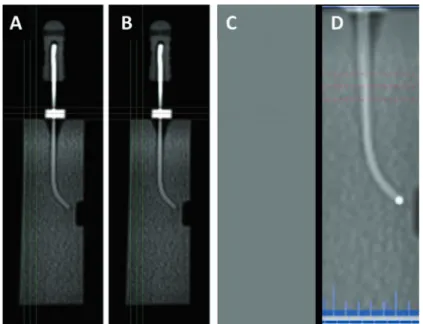
the analysis of apical transportation using ProTaper Universal and Wizard CD Plus systems. In control group, apical transportation did not occur (Figures
2A and 2B). The entire inal image presented
intermediate gray levels (128 grayscale value) when Regeemy was used (Figure 2C). Figure 2D
shows the coincidence of the tips of the iles in pre-
and post-operative images when Adobe Photoshop was used. The Student’s t-test did not reveal any difference between the experimental groups (P>0.05). Wizard CD Plus and ProTaper Universal presented few apical transportation regardless of the software used for image superimposition and subtraction (P>0.05) (Table 1). The values of apical transportations achieved using the Regeemy were similar to those obtained using Adobe Photoshop (P>0.05).
DISCUSSION
Both acrylic resin blocks and extracted human teeth are used for apical transportation analysis. extracted human teeth provide similar conditions to the clinical situation when compared with acrylic resin blocks. Moreover, they present actual surface texture, hardness and cross-sectioning dentin areas5. However, natural teeth present variation in morphology which impairs the comparison of the experimental groups9. On the other hand, acrylic resin blocks allow the observation of the preparation in three dimensions along the whole canal length and a direct comparison of the shaping ability of different instruments14. In addition, they provide standardized length, diameter and angle of curvature of the simulated root canals9,23. From a statistical point of view, the standard deviation might increase whenever a range of curvatures is
Software Groups Mean Standard
Deviation (±)
Lower 95% CI Upper 95% CI
Protaper 0.46A mm 0.16 mm 0.35 mm 0.58 mm
Regeemy
Wizard CD Plus 0.44A mm 0.25 mm 0.26 mm 0.62 mm
Protaper 0.42A mm 0.28 mm 0.0 mm 1.02 mm
Adobe Photoshop
Wizard CD Plus 0.48A mm 0.22 mm 0.0 mm 0.91 mm
Table 1- Means, standard deviations and conidence intervals of apical transportation after using the two rotary systems
and both software
The Student's t-test did not reveal any signiicant difference between the experimental groups (P>0.05)
Figure 2- A and B) In control group, ive specimens were subjected to two CBCT under identical conditions; C) Result of
a superposition and subtraction using Regeemy (Note the intermediate gray levels); and D) Result of a superposition and
used, as opposed to the use of standardized acrylic resin blocks where this problem is minimized22. The uses of acrylic resin blocks facilitate the evaluation of the feasibility of the Regeemy in comparison with Adobe Photoshop in superposing and subtracting images. However, owned to the difference between materials nature (i.e. acrylic resin and dentin), care should be taken in the extrapolation of these
indings to clinical use where dentine is involved.
Both rotary systems promoted similar apical deviation after preparation of the simulated root
canals (P>0.05). Therefore, the irst hypothesis was conirmed. Similar to other studies that have
compared different rotary Ni-Ti systems regarding the apical transportation, the present study did not
detect signiicant differences between the ProTaper
and Wizard CD systems8,12,15,20,22. Good lexibility and the centralizing ability of root preparation by
the F2 (ProTaper) and 25.04 iles (Wizard CD Plus)
likely contributed to the small and similar apical transportation values.
Different cross-sectional geometries of rotary instruments are believed to increase cutting
eficiency, consequently reducing contact areas
and torsional loads2. It is also known that the mass of the instrument plays an important role on the centering ability of these instruments. ProTaper Universal presents multiple tapers over the length of their cutting blades. It also presents a triangular convex cross section with shallow U-shaped grooves. All these features try to
improve the lexibility of the larger instruments2. Despite presenting the same taper along the entire cutting blades, Wizard CD Plus promoted similar apical transportation in comparison with ProTaper Universal. Thus, continuous and multiple tapers did
not inluence the apical transportation in simulated
root canals.
The indings regarding Wizard CD Plus are
scarce. Up to date, only one study evaluated this rotary system6. The indings of the present study agree with those published in a master’s dissertation in the year of 20126. Apical transportation occurred
in all groups. Moreover, the authors did not ind
differences regarding the apical transportation between Wizard CD Plus and other two rotary systems (ProTaper and Wizard Navigator). The author stated that irregularities in Wizard CD Plus surface may have contributed with a poor standardization of centering ability, which was corroborated by the high standard deviations observed. The same did not occur in this study, in which Wizard CD Plus’ standard deviation was similar to that observed in the ProTaper group6. According to Grazziotin-Soares, et al.10 (2011), ProTaper instruments present lower flexibility after the third use. Thus, in order to avoid apical transportation originating from repeated
preparation, each instrument was used in only three acrylic resin blocks and then discarded.
Regardless of the inal instrumentation size, the
risk of transportation always increases in curved canals with an increase of file size23. Schafer and Vlassis21 (2004) stated that ProTaper may induce apical transportation towards the outer aspect of the root canal especially because of the progressive tapers along the cutting surface of these instruments. The decreasing taper sequence
of the inishing iles enhances the strength of the iles, but it increases the stiffness of their tip21. On that basis, in this study the canal preparation was performed up to F2 instrument in ProTaper group. Other reason for using F2 instruments was to permit direct comparison with Wizard CD Plus size 25.04, which has similar mass and identical diameter of the tip. Wizard CD Plus is a new rotary system and due to that there are no studies related to its behavior regarding cyclic fatigue and number of uses. Closing partially this gap, Wizard CD Plus seems to promote similar apical deviation
when compared with ProTaper iles in acrylic resin
blocks. However, further investigations are needed to secure a better indication of its use in clinical practice.
Clinically, it seems questionable whether these comparably small values in apical transportation
have any clinical signiicance. Anyway, the apical
transportation values for the two systems are believed to be reliable because of the comparison of a new software with a current one (Adobe Photoshop) to superpose and subtract images. The Student’s t-test for paired samples revealed that the readings performed by each software were similar (P>0.05). Thus, the second hypothesis
was conirmed.
The subtraction of one image from another requires superposing these images in order to analyze the differences that have occurred over time. even small differences can be visualized through image subtraction methods and programs17. Regeemy software subtracts the structures that have not changed between two radiographic/ tomographic images pixel by pixel, resulting in a third image that is surrounded by a neutral gray background with grayscale values of approximately 128 for the unchanged areas. Patchy areas in the pre- and post-operative images are conventionally shown by a dark-gray shade or black (with grayscale values approaching zero) and by a light-gray tone or white (with light-grayscale values close to 255)7. Adobe Photoshop transforms each image
to 50% transparency. However, the process of
must be aligned manually and this process may be
inluenced by the operator. To avoid this drawback,
the present study performed three superposition processes and three readings per resin block in both software. Therefore, the readings achieved using Regeemy and Adobe Photoshop were similar for the rotary systems.
The effectiveness of the software in superposing and subtracting pre- and post-instrumentation images was confirmed by the control group. All the specimens from the control group were exactly superposed. After the subtraction process using Regeemy the final images were always with a 128 grayscale value. These values indicate that no apical transportation occurred. When Adobe Photoshop was used, the accuracy of the superposition process was assessed after
marking the tip of the ile in each image. If the points were coincident at the inal image, then
the superpose process was correct. The inclusion of a control group aimed to validate the methods for superimposition and subtraction of the CBCT images from the experimental groups.
Besides being originally developed to map the deforestation in native areas, Regeemy was used
for the irst time in Dentistry in 20057. This software has proven to be an alternative technique to current ones for subtracting radiographic/tomographic images. It reduces the variation of gray levels in the subtracted image, indicating that the software superposes the pre- and post-operative images more accurately than a priori tools (i.e., ilm, phosphor plates, radiographic ilm holders)7. In addition, six years later, Ono, et al.16 (2011) used this software to correct geometric discrepancies and equalize the contrast of two sequential radiographs before the use of the digital subtraction technique in cases of simulated root resorption.
The main dificulty that occurs when working
with Adobe Photoshop is that this software is not widely available because they are limited to institutions or are too expensive to be easily purchased. Regeemy closes this gap because it is a program that can be downloaded for free upon registration with the DPI-INPe. This program provides the necessary support for research because it performs superimposition, subtraction and geometric correction of images by automatically marking multiple control points with the same software7. Moreover, it allows a practical and simple process, with few variations, and costless7.
CONCLUSIONS
Two conclusions can be drawn: (1) Wizard CD Plus and ProTaper Universal systems promoted slight and similar apical transportation after the
preparation of simulated canals; (2) Regeemy consists in a feasible software to superpose and subtract images and appears to be an alternative to Adobe Photoshop.
REFERENCES
1- Aguiar CM, Mendes DA, Câmara AC, Figueiredo AP. Assessment of canal walls after biomechanical preparation of root canals instrumented with ProTaper Universal rotary system. J Appl Oral Sci. 2009;17:590-5.
2- Aguiar CM, Sobrinho PB, Teles F, Câmara AC, Figueiredo JA. Comparison of the centring ability of the ProTaper™ and ProTaper Universal™ rotary systems for preparing curved root canals. Aust endod J. 2013;39:25-30.
3- American Association of endodontists. Glossary of endodontic terms. 7th ed. Chicago: AAe; 2003.
4- Bergmans L, Van Cleynenbreugel J, Beullens M, Wevers M, Van Meerbeek B, Lambrechts P. Progressive versus constant tapered shaft design using NiTi rotary instruments. Int endod J. 2003;36:288-95.
5- Bertrand MF, Lupi-Pégurier L, Médioni e, Muller M, Bolla M. Curved molar root canal preparations using Hero 642 rotary nickel-titanium instruments. Int endod J. 2001;34:631-6. 6- Burgel MO. Avaliação da centralização do preparo do canal radicular e da fadiga do instrumento comparando três sistemas rotatórios de níquel-titânio [dissertation online]. Porto Alegre
(RS): Pontiical Catholic University of Rio Grande do Sul; 2012
[cited 2013 Aug 06]. Available from: http://tede.pucrs.br/ tde_busca/arquivo.php?codArquivo=4185.
7- Dotto GN. Registro de radiograias periapicais para a técnica
de subtração [thesis online]. São José dos Campos (SP): Univ. estadual Paulista; 2005 [cited 2013 Aug. 2013]. Available from: http://www.athena.biblioteca.unesp.br/exlibris/bd/ bsj/33004145081P0/2005/dotto_gn_dr_sjc.pdf.
8- García M, Duran-Sindreu F, Mercadé M, Bueno R, Roig M. A comparison of apical transportation between ProFile and RaCe rotary instruments. J endod. 2012;38:990-2.
9- González Sánchez JA, Duran-Sindreu F, de Noé S, Mercadé M, Roig M. Centring ability and apical transportation after overinstrumentation with ProTaper Universal and ProFile Vortex instruments. Int endod J. 2012;45:542-51.
10- Grazziotin-Soares R, Barato Filho F, Vanni JR, Almeida S, Oliveira eP, Barletta FB, et al. Flexibility of K3 and ProTaper universal instruments. Braz Dent J. 2011;22:218-22.
11- Hartmann MS, Barletta FB, Camargo Fontanella VR, Vanni JR. Canal transportation after root canal instrumentation: a comparative study with computed tomography. J endod. 2007;33:962-5.
12- Hartmann MS, Fontanella VR, Vanni JR, Fornari VJ, Barletta FB. CT evaluation of apical canal transportation associated with
stainless steel hand iles, oscillatory technique and pro taper
rotary system. Braz Dent J. 2011;22:288-93.
13- Kum KY, Spängberg L, Cha BY, Il-Young J, Seung-Jong L, Chan-Young L. Shaping ability of three ProFile rotary instrumentation techniques in simulated resin root canals. J endod. 2000;26:719-23.
14- Martins RC, Bahia MG, Buono VT. Geometric and dimensional characteristics of simulated curved canals prepared with ProTaper instruments. J Appl Oral Sci. 2010;18:44-9.
15- Oliveira CA, Meurer MI, Pascoalato C, Silva SR. Cone-beam computed tomography analysis of the apical third of curved roots after mechanical preparation with different automated systems. Braz Dent J. 2009;20:376-81.
17- Ostuni J, Fisher e, van der Stelt P, Dunn S. Registration of dental radiographs using projective geometry. Dentomaxillofac Radiol. 1993;22:199-203.
18- Özer SY. Comparison of root canal transportation induced by three rotary systems with noncutting tips using computed tomography. Oral Surg Oral Med Oral Pathol Oral Radiol endod. 2011;111:244-50.
19- Rödig THM, Hülsmann M, Kahlmeier C. Comparison of root canal preparation with two rotary NiTi instruments: ProFile .04 and GT Rotary. Int endod J. 2007;40:553-62.
20- Santos MD, Marceliano MF, Silva e Souza PR. evaluation of apical deviation in root canals instrumented with K3 and ProTaper systems. J Appl Oral Sci. 2006;14:460-4.
21- Schäfer e, Vlassis M. Comparative investigation of two rotary nickel-titanium instruments: ProTaper versus RaCe. Part 1. Shaping ability in simulated curved canals. Int endod J. 2004;37:229-38.
22- Setzer FC, Kwon TK, Karabucak B. Comparison of apical
transportation between two rotary ile systems and two hybrid
rotary instrumentation sequences. J endod. 2010;36:1226-9 23- Silva KT, Grazziotin-Soares R, Limongi O, Irala Le, Salles AA. Wear promoted in the apical third of simulated canals after instrumentation with ProTaper universal system. J Appl Oral Sci. 2009;17:501-7.