Original article (short paper)
Prevalence of coronary heart disease risk factors
in physical education students
Osvaldo Costa Moreira Cláudia Eliza Patrocínio de Oliveira Universidade Federal de Viçosa, Viçosa, MG, Brazil
Dihogo Gama de Matos
Universidad de Trás-os-Montes y Alto Douro, Vila Real, Portugal
Robert C. Hickner
East Carolina University, Greenville, United States
Renata Aparecida Rodrigues de Oliveira Universidade Federal de Viçosa, Viçosa, MG, Brazil
Felipe José Aidar
Universidade Federal de Sergipe, São Cristóvão, SE, Brazil
Maria de los Ángeles Rodríguez-Gázquez
Universidad de Antioquia, Medellín, Colombia
Abstract––To establish the prevalence of coronary risk in physical education students, and compare risk between the genders and the years of course. We evaluated 246 physical education students using RISKO questionnaire to determine eight risk factors: age, heredity, body weight, smoking, physical inactivity, hypercholesterolemia, hypertension and sex. Students had mean coronary risk score of 16.03 ± 3.52 points, rated “below-average risk.” Men had signiicantly greater risk compared to women. No difference was found between the years of course. The prevalence of risk factors were heritability (58.37%), physical inactivity (32.65%), hypercholesterolemia (32.24%), overweight (27.35%), smoking (3.67%) and hypertension (2.45%). The coronary risk of physical education students was rated as below average, being higher among men than women, and no difference in risk between years of course. The most prevalent risk factors were heredity, physical inactivity, overweight and hypercholesterolemia.
Keywords: health, epidemiology, cardiovascular disease, primary attention
Resumo––“Prevalência de fatores de risco de doença coronariana em estudantes de educação física.” Estabelecer
a prevalência de risco coronariano em estudantes de educação física, e comparar o risco entre os gêneros e os anos de curso. 246 estudantes de educação física foram avaliados por questionário Risko, que avalia oito fatores de risco: idade, hereditariedade, peso corporal, tabagismo, inatividade física, hipercolesterolemia, hipertensão e sexo. Os alunos tiveram média do escore de risco coronariano de 16,03 ± 3,52 pontos, classiicados como “de risco abaixo da média.” Os homens tiveram risco signiicativamente maior em comparação com as mulheres. Não foram encontradas diferenças entre os anos de curso. A prevalência de fatores de risco foram herdabilidade (58,37%), inatividade física (32,65%), hipercolesterolemia (32,24%), sobrepeso (27,35%), fumo (3,67%) e hipertensão arterial (2,45%). O risco coronariano de estudantes de educação física foi classiicada como abaixo da média, sendo maior entre os homens do que as mulheres, e não houve diferença no risco entre os anos de curso. Os fatores de risco mais prevalentes foram hereditariedade, sedentarismo, excesso de peso e hipercolesterolemia.
Palavras-chave: saúde, epidemiologia, doenças cardiovasculares, atenção primária
Resumen––“Prevalencia de factores de riesgo de enfermedad coronaria en los estudiantes de educación física.”
fueron encontradas diferencias en el riesgo para los años del curso. Los factores de riesgo más prevalentes fueron hereditariedad (58,37%), inactividad física (32,65%), hipercolesterolemia (32,24%), sobrepeso (27,35%), tabaquismo (3,67%) y hipertensión arterial (2,45%). El riesgo cardiovacular de los estudiantes de educación física fue clasiicado como bajo el promedio, presentandose más elevado en los hombres y sin diferencias entre los años del curso. Los factores más prevalentes fueron hereditariedad, inactividad física, sobrepeso y hipercolesterolemia.
Palabras claves: salud, epidemiología, enfermedades cardiovasculares, la atención primaria
Introduction
Chronic Non-Communicable Diseases (NCDs) are a major public health concern, representing a substantial portion of the expenses of the Health System and the Supplementary Health System (MHB, 2012). Estimates from the World Health Organization show that NCDs account for 63% of all 36 million deaths worldwide in 2008 (WHO, 2011). In Brazil, the NCDs are also important, accounting for 31.3% of deaths from car-diovascular disease and 72% of total deaths in 2007 (Schmidt et al., 2011). Historical mortality statistics available for the Brazilian state capitals indicate that the proportion of deaths from NCDs increased more than threefold between 1930 and 2006 (Malta et al., 2006).
Cardiovascular disease (CVD) is the NCD that stands out among all chronic degenerative diseases. CVD includes coro-nary atherosclerosis, strokes, hypertension and its complications, and is the largest cause of death in adults (Haskell et al., 2007).
According to the Ministry of health (MHB, 2009), 32% of all deaths in Brazil are a result of CVD, which is the highest rate of death from cerebrovascular diseases among American countries. Still, considering all age groups, CVD, especially coronary artery disease, cerebrovascular disease and heart failure, account for the highest number of deaths (Silva et al., 2005; Viebig et al., 2006).
Among the risk factors for CVD are overweight/obesity, physical inactivity, hypertension, smoking, diabetes mellitus, and dyslipidemia, whose prevalence depend on genetic and environmental characteristics and is inluenced by lifestyle habits such as diet and the level of habitual physical activity (Hjelmborg et al., 2008).
Epidemiological studies with college students, found low prevalence of CVD risk factors among this popula-tion, but data showed the need to turn our attention to this population, considering that individuals with high risk can develop CVD early in life (Coelho et al., 2005; Fisberg et al., 2001; Hazar et al., 2011; Moreira et al., 2011; Rabelo et al., 1999). In addition, those studies show that men have higher cardiovascular risk compared to women. Physical education students undergo physical strain during practical classes, making it necessary to establish coronary risk in this population during medical evaluation before partici-pation. The identification of risk factors would reduce the probability of occurrence of cardiovascular events during
In this sense, the determination of the prevalence of risk factors in a given population stratum, such as physical edu-cation students, gains importance by measuring the primary risk, a fact that could potentially contribute to the reduction of cardiovascular events in these students during practical classes. Further beneit is gained if this risk reduction can be used by the public health system and private pension companies to gain subsidies for the establishment of effective health promotion programs (Hazar et al., 2011).
Given the above, the present study aimed to establish the prevalence of coronary risk factors in physical education stu-dents in general, and to more speciically compare the coronary risk between the genders and levels of education.
Methods
We conducted an observational cross-sectional study, in 2013, in a representative sample of the population of students in physical education, Federal University of Viçosa, Campus Viçosa (UFV), which is located in Viçosa, Zone location Mata, the state of Minas Gerais. The study was conducted in three phases: 1) Approval of the project by the Ethics Committee for Research in Humans (reference number 187/2011/ Ethics Committee) and the research project at the Federal University of Viçosa record; 2) Participant recruitment, and explanation of the research, data collection procedures, and risks associated with study participation; 3) Individual application of questionnaires to all selected.
The sample size was calculated according to the equation proposed by Lwanga and Lemeshow (1991). A minimum sample of 158 individuals was required, considering the total number of students of the institution (332 students) and a standard er-ror of 5%, with a conidence interval of 98%. Considering the possibility of losses and refusals, the sample size was increased by 20%, seeking assurance that the minimum subject number was achieved. Accordingly, the minimum sample size required was 190 individuals.
with-evaluated, and divided into subgroups of the irst to the ifth year of the course for purposes of comparison. As inclusion criteria, all participants were regularly enrolled at UFV, belonged to the physical education course and signed the consent form. All data collection procedures met the Guidelines and Standards Regulating Research Involving Human Subjects (Resolution 466/12 of the National Health Council).
To collect data, we used the Risko questionnaire proposed by the Michigan Heart Association (MHA) (MHA, 1973). The form of the questionnaire followed the pattern used in other studies in Brazil (Hazar et al., 2010; Moreira et al., 2009; Moreira et al., 2006; Moreira et al., 2011). This questionnaire assesses eight risk factors, namely: age, heredity, body weight, smoking, phys-ical inactivity, hypercholesterolemia, hypertension and gender. Each risk factor has six response options, and every response is equivalent to a score that represents the entry for that coronary risk factor. The sum of the scores obtained from the responses to the eight risk factors corresponds to a score that represents the coronary risk. This coronary risk score is rated through a table formulated by MHA (MHA, 1973), which evaluates the individual as “well below average” for scores lower than 11 points; “below average” for scores between 12 and 17 points; “medium risk,” for scores between 18 and 24 points; “moderate risk” for scores between 25 and 31 points; “high risk,” for scores between 32 and 40 points; and “very high risk” for scores of more than 41 points.
The questionnaire was administered individually by a single evaluator. The participants completed the questionnaire with the least possible interference from the evaluator. All questions were answered by self-report. Therefore, all results in weight, exercise, cholesterol, blood pressure were derived from self-reported data.
The following criteria for consideration of risk factors as were used: age greater than or equal to 40 (Moreira et al., 2011); heredity, having at least 1 irst-degree relative with cardiovascu-lar disease in the family (Moreira et al., 2009); body mass, being more than three pounds overweight according to standardized scales (Hazar et al., 2010); smoking, daily, weekly or monthly for the last twelve months (Rodrígues, Pineda, & Vélez, 2010);
sedentary lifestyle, not participating in moderate or intense rec-reational exertion (ACSM, 2011); cholesterol above 200 mg / dl (Stone et al., 2013); and systolic blood pressure greater than or equal to 140 mmHg blood pressure (BSC, 2010).
Statistics
Data were stored in Excel® 2003 and analyzed in Sigma Stat
for Windows version 2.06 and Epi Info version 7 programs. Data were analyzed using the Kolmogorov-Smirnov test. Data are presented as mean ± standard deviation. The Student t test was used to compare coronary risk between gender. We used the one-way ANOVA test with Tukey post hoc comparison to compare coronary risk among students of different years of study. A signiicance level of p < .05 was adopted for all com-parisons. Moreover, there was the chi-square (χ2) test to check for differences in the prevalence of each risk factor by gender.
Results
One hundred and one males and 145 females were studied. The mean age of the sample was 22.26 ± 2.93 years (range: 18-34 years).The men had a mean age of 21.77 ± 2.40 years and women 22.59 ± 3.20 years.
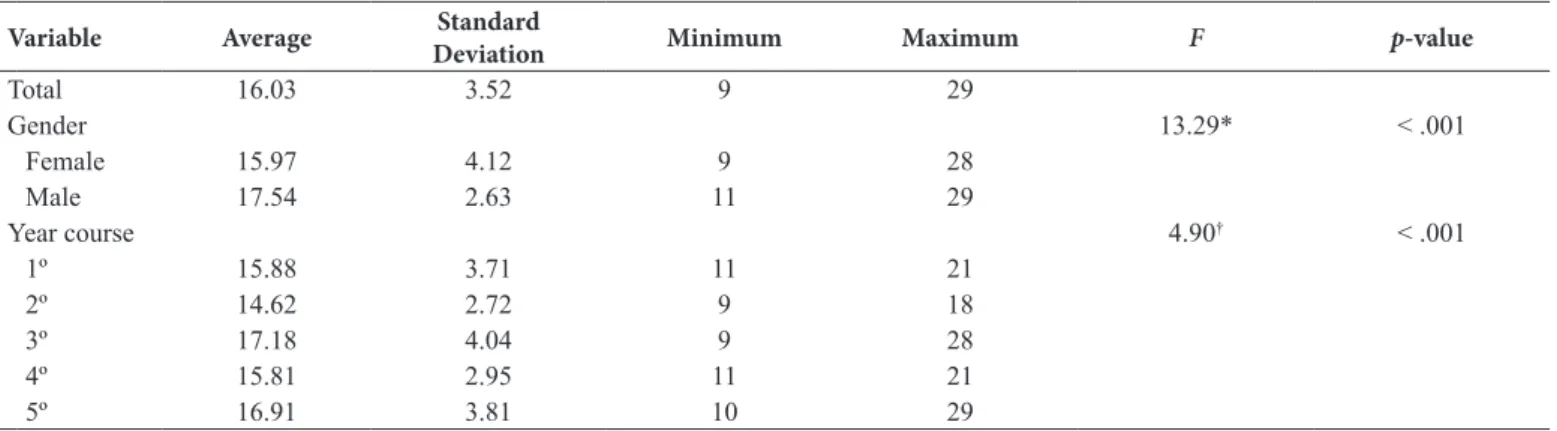
The average coronary risk score for all participants was 16.03 ± 3.52 points (range: 9-29 points). Men scored higher (p < .001), with a mean score of 17.54 ± 2 64 points (range 11-29 points). Women had a mean score of 14.96 ± 3.66 points (range 9-28 points). The score obtained in the whole sample (men and women) fell within the category of “below-average risk,” according to the classiication of MHA (MHA, 1973).
The mean scores for coronary risk of the sample, seg-mented by year of study and gender, are presented in Table 1. Participants in the irst, second, fourth and ifth years of the physical education program of study were classiied as “below average.” Participants in the third year of study had rating of “medium risk.”
Table 1. Comparison of coronary risk scores by year of study and gender.
Variable Average Standard
Deviation Minimum Maximum F p-value
Total 16.03 3.52 9 29
Gender 13.29* < .001
Female 15.97 4.12 9 28
Male 17.54 2.63 11 29
Year course 4.90† < .001
1º 15.88 3.71 11 21
2º 14.62 2.72 9 18
3º 17.18 4.04 9 28
4º 15.81 2.95 11 21
5º 16.91 3.81 10 29
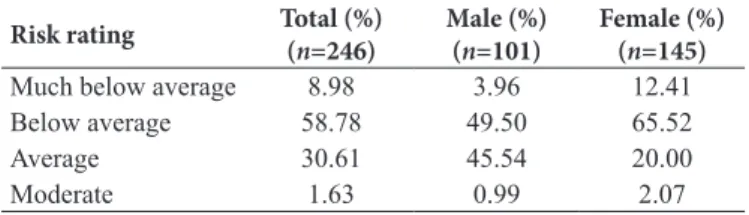
The percentage distribution of coronary risk in participants, total and by gender, lies in detail in Table 2. Men had more than twice the risk of women.
Table 2. Distribution of coronary risk. Table 2. Distribution of coronary risk.
Risk rating Total (%) (n=246)
Male (%) (n=101)
Female (%) (n=145)
Much below average 8.98 3.96 12.41
Below average 58.78 49.50 65.52
Average 30.61 45.54 20.00
Moderate 1.63 0.99 2.07
The prevalence of each coronary risk factor is presented in Table 3. The six predictor variables that were most prevalent in the responses to the questionnaire were heredity, sedentary lifestyle, hypercholesterolemia, obesity, smoking and hyper-tension, respectively.
Women showed higher prevalence of risk factors and hered-itary hypercholesterolemia. Men had higher prevalence rates for risk factors of sedentary lifestyle, smoking and hypertension. No differences were found between genders for the overweight risk factor.
Table 3. Prevalence of coronary risk factors by gender.
Risk fator Total Male Female χ2 p value
Heredity 58.37 47.52 65.52 7.85 .005
Sedentary 32.65 42.57 25.52 7.81 .005
Hypercholesterolemia 32.24 22.77 38.62 6.79 .009
Overweight 27.35 28.71 26.21 0.14 .71
Smoking 3.67 7.92 0.69 8.52 .004
Hypertension 2.45 5.94 0.00 8.38 .004
Discussion
The data from the current study indicate a “below average risk” (16.03 ± 3.52 points) according to MHA for this sample of physical education students (MHA, 1973). This inding, coupled with the fact that less than 2% of the assessed had “moderate risk” and that no cases of “high risk” and “very high risk” were observed, can be considered a positive and beneicial inding. In other studies conducted in college students (Moreira et al., 2011) and physical education students (Hazar et al., 2010), risk scores of 17.5 ± 4.59 and 16.3 ± 3.74 points and prevalence of almost 10% and 3.45% (moderate risk), respectively were reported.
Despite the low risk in the students assessed, attention is still required because they have relatively low average age and the presence of cases of moderate risk indicates the need to adopt a healthy lifestyle because one of the deleterious effects of aging is increased cardiovascular risk (Sjöström, Lystig, & Lindroos, 2011).
The coronary risk score of the sample was higher in men compared to women (p < .001). This is similar to that observed in the literature (Coelho et al., 2005; Hazar et al., 2010; Moreira et al., 2011). The protection against coronary risk in women may be explained by many factors: better vascular endothelial function, increased levels of endothelial progenitor cells that participate
female sex hormones that all delay the formation of atherogenic plaque (Vaccarino et al., 2011).
The most prevalent risk factor was heredity, with 58.37% of the sample having at least 1 irst degree family member with cardiovascular disease. Similar indings were reported in physical education students of the Federal University of Viçosa, with 63.3% prevalence (Moreira et al., 2011). In another study in college students in the area of health Recife / PE were reported to have 66.4% prevalence (Petribu, Cabral, & Arruda, 2009). Furthermore, physical therapy students had a prevalence of 63.54% (Correia, Santos, & Cavalcante, 2010). It is noteworthy that the family history of cardiovascular risk is a powerful and independent risk factor associated with acute myocardial infarction (Haskell et al., 2007), which has no modiiable characteristic, so is necessary to adopt measures to achieve the lowest risk from other risk factors that can be modiied to help prevent coronary artery disease.
The second most prevalent risk factor was physical inactivity, which was present in 32.65% of the sample. National data indicate that the prevalence of physical inactivity in Brazil, adding individ-uals who report physical inactivity together with those who have insuficient levels of physical activity, ranges between 56.90% and 72.10% (MHB, 2012). Speciically for college students, some studies found a prevalence of 41.70% for sedentary lifestyle in college students in the health area of Recife / PE (Correia et al., 2010); 44.44% in physical therapy students (Jorgensen et al., 2009); 43.10% in medical students of São José do Rio Preto / SP (Coelho et al., 2005); and 24.14% in physical education students (Hazar et al., 2010). The prevalence of physical inactivity in the current study participants was less than that of other studies. This inding should be viewed as beneicial because a sedentary lifestyle is associated with the development of NCDs and levels of physical activity have a dose-response effect on various health indicators (Jorgensen et al., 2009).
However, in the case of physical education students, even though the prevalence of physical inactivity is below the national average, the numbers found can be considered high, since it was expected that this group was physically active because they know the beneits of regular physical exercise.
Hypercholesterolemia was reported in 32.24% of the sample, placing this risk factor third in prevalence of the measured risk factors. Similar prevalence has been reported by Hazar et al. (2010), with 32.41% prevalence in physical education students (Moreira & Marins, 2006), with 32.9% prevalence in academics, with 30.1% prevalence in medical students (Coelho et al., 2005); and 30.5% prevalence in administrative staff of UFV (Moreira et al., 2009). Although the current data are in agreement with the cited studies, the prevalence of hypercholesterolemia is noteworthy because it is a young population with a mean age of 22.26 ± 2.93 years. It is known that higher concentrations of total cholesterol are associated with increased low density lipoproteins, which are related to the increased incidence of CVD, particularly when these atherogenic lipoproteins are oxidized (Noda et al., 2010).
Brazil, have found the prevalence of excess weight (overweight and obesity) to be between 18.02% and 38.10% (Correia et al., 2010; Hazar et al., 2010; Moreira et al., 2011). Despite the prevalence of overweight in the sample being within the range found in other studies on college students, it is necessary to consider that this is a sample of university students who are studying physical education. Thus, it was expected that this prevalence would be lower compared to other studies of the general college population. The relatively high incidence of overweight in the current study sample may be related to over-eating (energy intake) relative to energy expenditure, leading to a positive energy balance (Shool, Hand, & Blair, 2014). This inding is of concern because excess weight is associated with increased overall morbidity and mortality, due to coronary heart disease and stroke, among other diseases (Moreira et al., 2009). The risk factor of smoking was present in 4.1% of the sample. In Brazil, the Ministry of Health estimates that approximately 18.8% of the population are smokers (22.7% of men and 16% women) (MHB, 2012). Studies on college students, suggest the prevalence rates of smoking of 5,52% (Hazar et al., 2010), 14.40% (Rodrigues et al., 2010) and 14.65% (Moreira et al., 2011). Despite the smoking rates in the current study being below the national average, and below the values reported in other stud-ies of college students, this risk factor deserves attention because smoking is a powerful CVD risk factor and acts synergistically with other coronary risk factors to greatly increase the level of risk and the likelihood of death (Zheng et al., 2014).
In this sense, the development of strategies for pre-partici-pation evaluation and prevention of coronary risk should, focus mainly on overweight, hypercholesterolemia, and sedentary lifestyle because these risk factors were the most prevalent in the physical education students studied. This may lead to programs that reduce the probability of future occurrence of cardiovascular events in these students who may be at elevated risk during times of signiicant physical demand, such as in practical physical education classes (Hazar et al., 2010). Moreover, an intervention to reduce these risk factors will also prevent the development of other risk factors such as hypertension.
There are limitations with questionnaires as data collection instruments. However, the questionnaires constitute a quick and low cost method of assessment strategy, and can aid in deter-mining the level of cardiovascular risk and physical health of the participants. Questionnaires are particularly valuable when there is no impossibility of conducting clinical consultations.
Conclusion
From the results of this study it can be concluded that the coronary risk presented by the evaluated students of physical education is rated as below average. This risk is greater in men and is not related to the year of the study. Moreover, in isolation, the coronary risk factors most prevalent were heredity, sedentary lifestyle, hypercholesterolemia and overweight.
Despite the small percentage of risk presented, it is interesting that there was the presence of moderate risk in some of these stu-dents who will be professionals involved in primary health care.
References
American College of Sports Medicine (2011). Position stand. Quantity and quality of exercise for developing and maintaining cardiore-spiratory, musculoskeletal, and neuromotor itness in apparently healthy adults: guidance for prescribing exercise. Medicine and Science in Sports and Exercise, 43, 1334-1359.
Brazilian Society of Cardiology (2010). VI Brazilian Guidelines of Hypertension. Brazilian Archives of Cardiology, 95, 1-51. Coelho, V.G., Caetano, L.F., Liberatore Júnior, R.D.R., Cordeiro, J.A.,
& Souza, D.R.S. (2005). Lipid proile and cardiovascular risk fac -tors in medical students. Brazilian Archives Cardiology, 85, 57-62. Correia, B.R., Cavalcante, E., & Santos, E. (2010). The prevalence of
risk factors for cardiovascular disease in college students. Brazilian Journal Clinical Medicine, 8, 25-29.
Fisberg, R.M., Stella, R.H., Morimoto, J.M., Pasquali, L.S., Philippi, S.T., & Latorre, R (2001). Lipid proile of nutrition students and its association with cardiovascular disease risk factors. Brazilian Archives of Cardiology, 76(2), 137-147.
Haskell, W.L., Lee, I.M., Pate, R.R., Powell, K.E., Blair, S.N., & Franklin, B (2007). Physical Activity and Public Health: Updated Recommendation for Adults From the American College of Sports Medicine and the American Heart Association. Circulation, 116, 1081-93.
Hazar, M., Moreira, O.C., Carneiro Júnior, M.A., Teodoro, B.G., & Oliveira, C.E.P (2010). Determining the prevalence of coronary risk factors in Physical Education students of a private college of Minas Gerais. Brazilian Journal of Science Moviment, 18(2), 58-66. Hjelmborg, J.V., Fagnani, C., Silventoinen, K., McGue, M., Korkeila, M.,
Christensen, K., &. Kaprio, J. (2008). Genetic inluences on growth traits of BMI: a longitudinal study of adult twins. Obesity, 16, 847–852. Jorgensen, T., Andersen, L.B., Froberg, K., Maeder, U., Smith, L.V.H. &
Aadahl, M. (2009). Position statement: Testing physical condition in a population - how good are the methods? European Journal of Sport Science, 9(5), 257-267.
Lawanga, S,K & Lemeshow, S. (1991). Sample size determination in health studies: a practical manual. Books, Geneva.
Malta, D.C., Cezário, A.C., Moura, L., Morais Neto, O.L., & Silva Júnior, J.B. (2006). Construction of the surveillance and prevention of non-communicable chronic diseases in the context of the national health system. Epidemiology and Health Services, 15, 47-64. Michigan Heart Association (MHA) (1973). RISKO. Lancet, 2, 243-4. Ministry of Health of Brazil (MHB) (2012). Secretariat of Health
Surveillance Secretariat Strategic and Participative Management. Vigitel Brazil 2011: surveillance of risk and protective factors for chronic diseases through telephone survey. Brasilia: Ministry of Health 2012 Available at: http://www.sbpt.org.br/downloads/ arquivos/vigitel_2012.pdf. Accessed: 10/06/2014.
Ministry of Health of Brazil (MHB) (2009). Department of Science and Technology of the Ministry of Health (Decit). ELSA Brazil: largest ep -idemiological study in Latin America. Journal of public health, 43, 1-2. Moreira, O.C., Costa, E., Oliveira, C.E.P., Oliveira, R.A.R., & Brito,
I.S.S. (2011). Coronary risk factors in students of a private university. Brazilian Journal of Science and Moviment, 19(2), 61-69. Moreira, O.C., & Marins, J.C.B. (2006). Study of coronary risk in
Moreira, O.C., Oliveira, C.E.P., Teodoro, B.G., Souza, G.C., Lizardo, F.B., Santos, L.A., & Marins, J.C.B. (2009). Risk factors for car-diovascular disease in administrative staff of the Federal University of Viçosa. Bioscience Journal, 25(5), 133-140.
Moreira, O.C., Oliveira, C.E.P., Doimo, L.A., Laterza, M.C., Monteiro, W.D., & Marins, J.C.B. (2011). Association between cardiovascular risk and hypertension in academics. Brazilian Journal of Physical Education and Sports, 25, 395-404.
Noda, H., Iso, H., Irie, F., Sairenchi, T., Ohtaka, E., & Ohta, H. (2010). Association between non-high-density lipoprotein cholesterol concentrations and mortality from coronary heart disease among Japanese men and women: the Ibaraki Prefectural Health Study. Journal of Atherosclerosis Thrombosis, 17, 30-36.
Petribu, M.M.V., Cabral, P.C., & Arruda, I.K.G. (2009). Nutritional status, food consumption and cardiovascular cliff: study in college. Nutritional Journal, 22, 837-846.
Rabelo, L.M., Viana, R.M., Schimith, M.A., Patin, R.V., Valverde, M.A., & Denadai, R.C. (1999). Risk factors for atherosclerotic disease in students of a private university in São Paulo - Brazil. Brazilian Archives Cardiology, 72, 569-574.
Rodríguez, M.A., Pineda, S.A., & Vélez, L.F. (2010). Snuff con-sumption characteristics of nursing students at the University of Antioquia (Colombia). Investigation Education Enfermaria, 28, 370-383.
Schmidt, M.I., Duncan, B.B., Silva, G.A., Menezes, A.M., Chor, D., & Menezes, P.R. (2011). Chronic non-communicable diseases in Brazil: burden and current challenges. Lancet, 377, 1949-1961. Shook, R.P., Hand, G.A., & Blair, S.N. (2014). Top 10 research ques
-tions related to energy balance. Research Quartely Exercise & Sport, 85, 49-58.
Silva, M.A.M., Rivera, I.V., Pinheiro, A.J.T., Alves, S.W.S., Moura, A.A., & Carvalho, A.C.C. (2005). Prevalence of cardiovascular risk factors in children and adolescents from schools in the city of Maceió. Brazilian Archives of Cardiology, 84, 387-392.
Sjöström, C.D., Lystig, T., & Lindroos, A.K. (2011). Impact of weight change, secular trends and ageing on cardiovascular risk factors: 10-year experiences from the SOS study. International Journal of Obesity, 35(11), 1413–1420.
Stone, N.J., Robinson, J., Lichtenstein, A.H., Bairey Merz, C.N., Blum, C.B., & Wilson, P.W. (2013). ACC/AHA guideline on the treatment of blood cholesterol to reduce atherosclerotic cardiovascular risk in adults: a report of the American College of Cardiology/American Heart Association Task Force on Practice Guidelines. Journal of American College of Cardiology, S0735-1097(13), 6028-6032. Vaccarino, V., Badimon, L., Corti, R., Marzilli, M., Pries, A., &
Bugiardini, R. (2011). Working Group on Coronary Pathophysiology and Microcirculation. Ischaemic heart disease in women: are there sex differences in pathophysiology and risk factors? Position paper from the working group on coronary pathophysiology and micro-circulation of the European Society of Cardiology. Cardiovascular Research, 90, 9-17.
Viebig, R.F., Valero, M.P., Araújo, F., Yamada, A.T., & Mansur, A.J. (2006). Cardiovascular Health Proile of an Adult Population from the Metropolitan Region of São Paulo. Brazilian Archives of Cardiology, 86, 353-360.
World Health Organization. (2011). Noncommunicable diseases
coun-Zheng, W., McLerran, D.F., Rolland, B.A., Fu, Z., Boffetta, P., & He, J. (2014). Burden of total and cause-speciic mortality related to tobacco smoking among adults aged ≥ 45 years in Asia: a pooled analysis of 21 cohorts. PLoS Medicine, 22, 11(4):e1001631.
Authors’ note
Osvaldo Costa Moreira is afiliated with the Biological Science and Health Institute, Federal University of Viçosa, Viçosa, Florestal Cam -pus, Minas Gerais, Brazil, and with the Biomedicine Institute of Uni-versity of Leon, León, Spain.
Cláudia Eliza Patrocínio de Oliveira is afiliated with the Biomed -icine Institute of University of Leon, León, Spain and the Physical Education Department, Federal University of Viçosa, Viçosa, Minas Gerais, Brazil.
Dihogo Gama de Matos is afiliated with the Department of Sport Sci -ences, Exercise and Health, University of Trás-os-Montes and Alto Douro (UTAD), Vila Real, Portugal.
Robert C. Hickner is afiliated with the Departments of Kinesiology and Physiology, Center for Health Disparities Research, Human Per -formance Laboratory, East Carolina University, Greenville, USA, and with the Department of Biokinetics, Exercise and Leisure Sciences, College of Health Sciences, University of KwaZulu-Natal, Westville Campus, Westville, South Africa.
Renata Aparecida Rodrigues de Oliveira is afiliated with the Physical Education Department, Federal University of Viçosa, Viçosa, Minas Gerais, Brazil.
Felipe José Aidar is afiliated with the Department of Physical Ed -ucation and the Graduate Program in Physical Ed-ucation, Federal University of Sergipe, São Cristóvão, Sergipe, Brazil.
Maria de los Ángeles Rodríguez-Gázquez is afiliated with the Nurse Faculty, University of Antioquia, Medellín, Colombia.
Corresponding author Osvaldo Costa Moreira
Federal University of Viçosa, Campus Florestal
Rodovia LMG 818, Km 6, Campus Universitário, Florestal 35690-000 MG, Brazil
Phone: +55 (31) 3536 – 3407 E-mail: [email protected]
Manuscript received on November 26, 2014 Manuscript accepted on November 19, 2015