ARTICLE
Prevalence and risk factors for stroke in a
population of Southern Brazil
Prevalência e fatores de risco para AVC numa população do sul do Brasil
Leslie Copstein1, Jefferson Gomes Fernandes2, Gisele Alsina Nader Bastos3
Stroke is a pathological entity with high prevalence and severe impact in afected individuals, both in developed coun-tries and those in developing. However, two-thirds of deaths caused by stroke occur in low and middle-income countries1.
Currently, stroke can be considered the greatest public health problem in Brazil and in many countries of Latin America1,2. Although scarce, Brazilian epidemiological
studies show elevated mortality3-5 and high prevalence of
sequels in survivors, such as physical disability, post-stroke depression and dementia6,7. Brazilian data are not known,
but in United States, in 2008, the cost of care with disabil-ity caused by stroke was estimated in 18.8 billion dollars,
while productivity loss and premature deaths had cost of 15.5 billion dollars8.
In addition, in the last 20 years, many studies have report-ed decreasing incidence of stroke in developreport-ed countries9. he
reasons for this trend are not totally known, but it can be at-tributed to better knowledge and management of risk factors. Even in middle and low-income countries there have been re-ports of cases of stroke reduction during this period, although less pronounced as compared to developed countries1,10. It is
possible that, in Latin America, the reduction is related to bet-ter control of risk factors, but also to technological advances and improvement in the quality of health services1,5.
Study carried out at Institute of Education and Research, Moinhos de Vento Hospital, Porto Alegre RS, Brazil.
1Graduate Program in Family and Community Medicine, School of Health Management, Moinhos de Vento Hospital, Porto Alegre RS, Brazil; 2Institute of Education and Research, Moinhos de Vento Hospital, Porto Alegre RS, Brazil;
3School of Health Management, Moinhos de Vento Hospital, Porto Alegre RS, Brazil.
Correspondence: Leslie Copstein; Rua Reis Louzada 189 / apto. 802; 90630-130 Porto Alegre RS - Brasil; E-mail: [email protected]
Support: The research was conducted in the framework of the philanthropic project “Development of techniques of operation and management of health services in a intramunicipal region of Porto Alegre – Restinga and Extremo-Sul districts”, in accordance with the program of support for the institutional development of the Sistema Único de Saúde (PROADI-SUS), signed between the Brazilian Ministry of Health and the Hospital Association Moinhos de Vento.
Conflict of interest: There is no conlict of interest to declare.
ABSTRACT
Stroke is the leading cause of death in many countries of Latin America. Population studies are necessary in this region. Objectives:To evaluate the prevalence of stroke and its risk factors in a population of vulnerable communities of southern Brazil. Methods: Population-based cross-sectional study with systematic sampling. Individuals aged 20 and over were included (n=3,391). Individuals with previous diagnosis of stroke or identiied by a validate stroke questionnaire were compared with those without stroke in many variables. Results: 285 individuals (8.4%) had previous stroke. The group without stroke showed greater average of years of study than the group with stroke (p<0.001). Multivariable analysis identiied as risk factors for stroke (p<0.05): age from 40 to 59, age from 60 to 79, widowhood, present smoking, previous smoking, hypertension and ischemic heart disease. Conclusion: The indings in this population indicate the need of preventive cost-effective public health policies in Brazil.
Key words: stroke, cross-sectional studies, socioeconomic factors, prevalence, Latin America.
RESUMO
O acidente vascular cerebral (AVC) é a principal causa de morte em muitos países da América Latina. Objetivos: Avaliar prevalência e fatores de risco para AVC em população de comunidades vulneráveis no sul do Brasil. Métodos: Estudo transversal de base populacional com amostragem sistemática. Foram incluídos os indivíduos a partir de 20 anos de idade (n=3.391). Indivíduos com prévio diagnóstico de AVC ou identiicados por questionário validado para AVC foram comparados àqueles sem AVC em diversas variáveis. Resultados: 285 indivíduos (8,4%) referiram AVC prévio. O grupo sem AVC teve maior média de anos de estudo que o grupo com AVC (p<0,001). Foram identiicados como fatores de risco para AVC (p<0,05): idade de 40 a 59 anos, idade de 60 a 79 anos, viuvez, tabagismo no presente, tabagismo no passado, hipertensão arterial sistêmica e doença isquêmica do coração. Conclusão: São necessárias no Brasil políticas de saúde pública preventivas e custo-efetivas.
Palavras-Chave: acidente vascular cerebral, estudos transversais, fatores socioeconômicos, prevalência, América Latina.
Several factors are now well established as risk for stroke. For ischemic stroke, they have been identiied as risk factors: age, hypertension (HTN), dyslipidemia, diabetes mellitus, smoking, asymptomatic carotid stenosis and non-valvular atrial ibrillation11. HTN and oral anticoagulation therapy are
the factors most frequently associated to intracerebral hem-orrhage12, while HTN, smoking and alcohol consumption have
been reported as risk factors to subarachnoid hemorrhage13.
Nevertheless, the heterogeneity of the pathology and pe-culiarities of diferent countries and populations may evi-dence new risks for stroke, modiiable or not. Socioeconomic variables14, ethnic factors, dietary habits and even endemic
diseases, like Chagas disease in Brazil15, can pose risks for
dif-ferent subtypes of stroke. hus, steady and standardized sur-veillance, performed in diferent regions, will provide infor-mation to enable collective health strategies for prevention and management of risk factors.
All the former elements considered, the present study aimed to assess the prevalence of stroke survivors, their sociodemo-graphic proile and the occurrence of risk factors in the popu-lation of a vulnerable community in Southern Brazil, a middle-income country with a highly racially mixed population.
METHODS
From July through December 2009, an epidemiological survey was performed in a capital city in Southern Brazil, with the purpose of planning a net of health services to be ofered to this community, in which approximately 100,000 people live in a vulnerable situation. Part of the data collected was analyzed to produce this cross-sectional study, which in-cluded all individuals aged 20 or over.
Porto Alegre City has 1,409,939 inhabitants16 and 110
dis-tricts. he survey was carried out in 5 districts, whose as-semblage has 121 census tracts, of which 117 are household sectors and were included in the sample. In them, 32,067 homes were identiied and 29,929 were inhabited houses. For the population-based survey, 1,750 households were select-ed. he quotient set the value of the systematic jump, equal to 17. he sample size was calculated in 440 individuals, with 95% level of conidence.
he survey was disclosed to the population through letter of presentation, posters and local radio stations and newspapers. Refusals were considered when the selected subject denied answering the questions at least three times and losses when the selected subject was not found by the same number of times. For quality control, new interviews were carried out by phone on 10% of the total sample, with a simpliied questionnaire.
he variables analyzed in this study are from the follow-ing questions: (a) Have you ever had stroke, thrombosis or ce-rebral ischemia? (b) Have you ever had paralysis on one side of your body that lasted longer than a day? (c) Have you ever
had paralysis on one side of your face that lasted longer than a day? (d) Have you ever had diiculty speaking which lasted longer than a day?
herefore, two groups were considered: individuals who reported symptoms or clinical diagnosis compatible with any kind of stroke and those who did not have such symptoms. he two groups were then compared with regard to risk fac-tors for stroke.
To obtain the results, the following independent variables were analyzed:
• Sociodemographic data – age (in years), gender, skin col-or (as observed by the interviewer), current marital sta-tus, degree of literacy, years of study and family income. • Current height and weight (self-reported, respectively in
centimeters and kilograms) and body mass index (BMI, calculated in kg/m2).
• Prior or current smoking/smoking time (months or years)/number of cigarettes per day.
• Have had medical diagnosis of hypertension/hyperten-sive parents history.
• Have had medical diagnosis of diabetes mellitus and/or high cholesterol.
• Evaluation of physical activity as the International Physical Activity Questionnaire (IPAQ) (short version). • Having been informed by a physician to have angina,
in-farction or heart attack, for individuals aged 40 and over. • Evaluation of chest pain or discomfort as the Rose
an-gina questionnaire (short version), for individuals aged 40 and over.
• Evaluation of peripheral occlusive arterial disease as the Rose questionnaire on intermittent claudication, for indi-viduals aged 40 and over.
• Evaluation of alcoholic beverages consumption as the Alcohol Use Disorders Identiication Test (AUDIT). Statistical analysis
Quantitative variables were presented as absolute data and percentages. Categorical variables were analyzed by Chi-square test. Multivariable analysis was done by Poisson re-gression with robust error variance.
he signiicance level used was p<0.05 and all the analy-ses were performed in SPSS version 15.0.
his study was approved by the Ethics Committee of Moinhos de Vento Hospital under Protocol 2009/28, and all individuals who had accepted to take part of the survey signed an informed consent.
RESULTS
Data from studied population
he majority were women (55.9%), Caucasian (77.7%), liter-ate (91.9%) and were married or had a common-law mar-riage (62.2%).
Age ranged from 20 to 96 years [mean 44.13, median 43, standard deviation (SD) 16.024, quartile irst (Q1) 30, quar-tile third (Q3) 56]. Family income ranged from zero to 40,000 reais/month (mean 2.045.88, median 1.550, SD 2.132.84, Q1 950, Q3 2.480) and years of study ranged from zero to 22 (mean 8.04, median 8, SD 3.518, Q1 5, Q3 11).
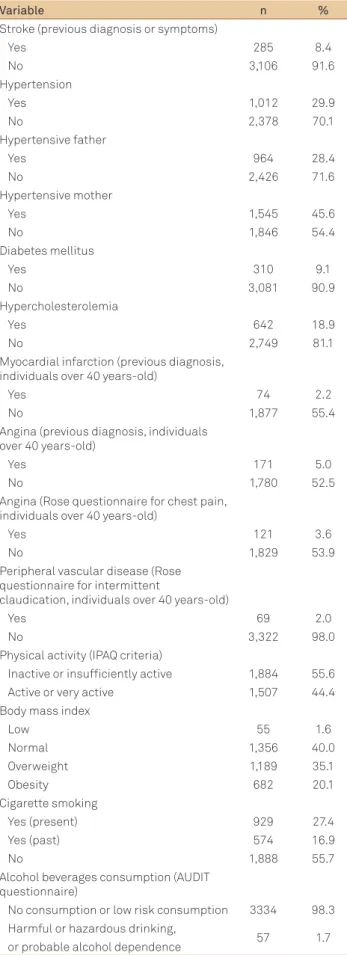
Of the individuals, 29.8% reported to be hypertensive, 28.4% reported having hypertensive father and 45.6% report-ed they had hypertensive mother.
he percentage of the ones who reported to be diabetic was 9.1%, and 18.9% reported present hypercholesterolemia.
Among the individuals aged 40 and over, 10.8% reported previous diagnosis of infarction, angina or symptoms of an-gina consistent with the Rose questionnaire for chest pain. Only 2% reported symptoms consistent with peripheral oc-clusive arterial disease, as the Rose questionnaire for inter-mittent claudication.
As to the level of physical activity, 55.6% of the respon-dents informed being inactive or insuiciently active. Of the individuals, 5.2% had the BMI above normal.
Of the individuals, 55.7% stated never having smoked and 98.3% informed do not consume alcoholic beverages or have low consumption risk.
Data relating to stroke
he individuals who reported diagnosis or symptoms consistent with prior stroke was 285 (8.4% of the sample) (Tables 1 and 2).
here was no statistically signiicant diference between the groups with and without stroke with respect to gender, ethnicity, family income, level of literacy, family history of hy-pertension, diabetes mellitus, hypercholesterolemia, BMI, physical activity level, peripheral occlusive arterial disease or alcohol consumption.
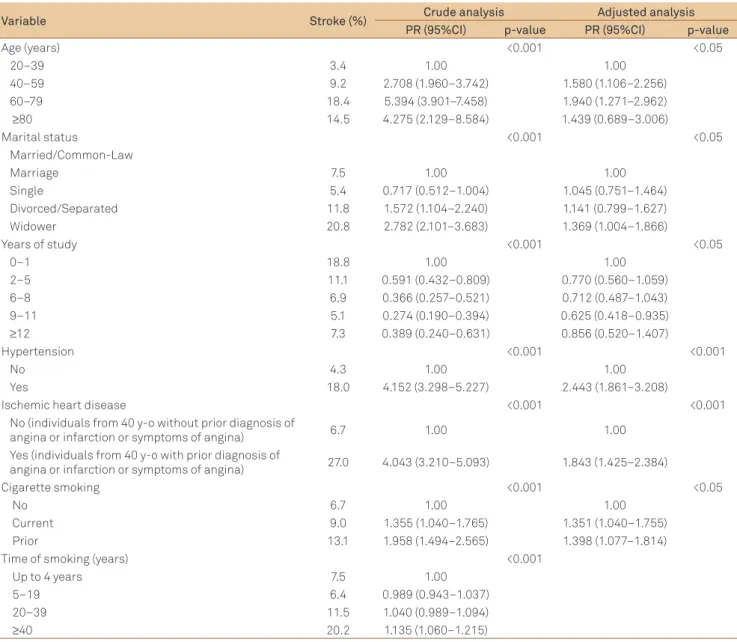
he group without stroke had the average years of study (8.12, SD 3.45) signiicantly greater than the group with stroke (7.09, SD 4.05) (p<0.001). For the multivariable analysis, we decided to categorize this variable into ive groups (Table 3). he group with 9 to 11 years of study was statistically signif-icant as a protective factor against stroke [prevalence ratio (PR)=0.625, conidence interval 95%CI 0.418–0.935] (p<0.05).
In multivariable analysis, were statistically signiicant risk factors for stroke (p<0.05): age 40 to 59 years (PR=1.580, 95%CI 1.106–2.256), age 60 to 79 years (PR=1.940, 95%CI 1.271– 2.962), marital status widower (PR=1.369, 95%CI 1.004–1.866), smoking at the present (PR=1.351, 95%CI 1.040–1.755), smok-ing in the past (PR=1.398, 95%CI 1.077–1.814), hypertension (PR=2.443, 95%CI 1.861–3.208) and coronary artery disease (PR=1.843, 95%CI 1.425–2.384). his last variable included all the individuals aged 40 and over that reported diagnosis of
angina, infarction or heart attack or symptoms of angina as the Rose questionnaire.
Among individuals with marital status widower, there was no statistically signiicant diference between genders.
Among the smoker respondents, there was no signiicant diference between the groups with and without stroke on the number of cigarettes smoked per day. he time of smoking in years was divided into categories; the χ2test of independence
showed statistical signiicance for the time of smoking equal or greater than 40 years as risk for stroke (PR=1.135, 95%CI 1.060–1.215) (p<0.001).
DISCUSSION
Although some stroke prevalence studies have already been carried out in Brazil17-19, the data is still insufficient
to provide a broad overview of the problem and the bur-den it represents.
Table 1. Demographical and socioeconomic data about adult population in vulnerable community. Porto Alegre, Rio Grande do Sul, 2009.
Variable n %
Gender
Male 1,496 44.1
Female 1,895 55.9
Skin color (observed)
Caucasian 2,636 77.7
Non-caucasian 750 23.3
Age (complete years)
20–39 1,399 42.7
40–59 1,278 39.0
60–79 551 16.8
≥80 51 1.6
Marital status
Married or in common-law marriage 2,108 62.2
Single 744 21.9
Divorced or separated 280 8.3
Widowed 259 7.6
Literacy
Literate 1,729 91.9
Just sign 59 3.1
Illiterate 93 4.9
Complete years of study
0–4 570 17.9
5–8 1,274 40.0
9–12 1,095 34.4
≥12 245 7.7
Family income (reais/month)
Until 1,019 999 29.5
1,020–3,060 1,850 54.5
3,061–7,650 489 14.4
7,651–15,300 38 1.1
Because of systematic sampling, probability proportional to the census tract and low percentages of losses and refus-als, this study has good inference power, so that the results can be generalized to similar communities.
However, being a cross-sectional study, it is vulnerable to the phenomenon of reverse causality, in which it is not possi-ble to determine what happened irst: exposure to risk factor or disease. Being also a population-based study, it is subject to ecological bias, once is not feasible to establish whether the individuals exposed are the same who have the disease. In addition, the level of exposure found will represent an av-erage and not individual values, but the results obtained here can later lead to more detailed analytical studies.
In addition to the analysis of risk factors, this study aimed to estimate the prevalence of non-fatal cases in the com-munity, in accordance to the international strategy of the World Health Organization (WHO) surveillance on stroke20.
Modiied from the Neurological Screening Questionnaire for Cerebrovascular Disease (NSQ-CVD)17, the data collection
instrument consists of a question about previous diagnosis of stroke and three more questions about symptoms related to stroke, of easy recognition by the general population. he cases were considered positive when any of the questions had airmative answer.
he NSQ-CVD questionnaire validation study was con-ducted in an elderly population ( from 80 years) in the mu-nicipality of Veranópolis, Brazil, in 199617. he NSQ-CVD
re-sembles almost in its entirety to the questionnaire used in this study, having only one more question: presence of numb-ness on one side of the body or face, lasting more than a day. In the validation study, this question had the lowest sensi-tivity (20%). he cases were also considered positive if there was airmative answer to any of the questions. he applica-tion of the full questionnaire reached 100% sensitivity, speci-icity of 50.9%, positive predictive value of 28% and negative predictive value of 100%.
More recently, Abe et al.21 conducted the study called
EMMA (Portuguese acronym for Mortality and Morbidity of Cerebrovascular Accident Study), to validate a questionnaire for stroke screening in a vulnerable community of São Paulo city, Brazil. he EMMA questionnaire21 consisted of six
ques-tions, one about previous diagnosis of stroke conirmed by a physician and ive about symptoms (including visual dei-cit). Individuals from 35 years were included; the cases were considered positive when there were airmative answer to two or more questions, if the previous diagnosis of stroke was included or to three of any questions, with conirmation by physician or not. he sensitivity found was 72.7%, speciicity of 94.4%, positive predictive value of 92.9% and negative pre-dictive value was 77.3%.
he symptoms questionnaires for stroke are therefore al-ready validated instruments for screening non-fatal cases in epidemiological studies, cost-efective and suitable to primary
Variable n %
Stroke (previous diagnosis or symptoms)
Yes 285 8.4
No 3,106 91.6
Hypertension
Yes 1,012 29.9
No 2,378 70.1
Hypertensive father
Yes 964 28.4
No 2,426 71.6
Hypertensive mother
Yes 1,545 45.6
No 1,846 54.4
Diabetes mellitus
Yes 310 9.1
No 3,081 90.9
Hypercholesterolemia
Yes 642 18.9
No 2,749 81.1
Myocardial infarction (previous diagnosis, individuals over 40 years-old)
Yes 74 2.2
No 1,877 55.4
Angina (previous diagnosis, individuals over 40 years-old)
Yes 171 5.0
No 1,780 52.5
Angina (Rose questionnaire for chest pain, individuals over 40 years-old)
Yes 121 3.6
No 1,829 53.9
Peripheral vascular disease (Rose questionnaire for intermittent
claudication, individuals over 40 years-old)
Yes 69 2.0
No 3,322 98.0
Physical activity (IPAQ criteria)
Inactive or insuficiently active 1,884 55.6 Active or very active 1,507 44.4 Body mass index
Low 55 1.6
Normal 1,356 40.0
Overweight 1,189 35.1
Obesity 682 20.1
Cigarette smoking
Yes (present) 929 27.4
Yes (past) 574 16.9
No 1,888 55.7
Alcohol beverages consumption (AUDIT questionnaire)
No consumption or low risk consumption 3334 98.3 Harmful or hazardous drinking,
57 1.7
or probable alcohol dependence
Table 2. Descriptive analysis of health variables in adult population of vulnerable community. Porto Alegre, Rio Grande do Sul, 2009.
care environments. he etiology of symptoms, such as hemi-plegia or hemiparesis, in adult patients is limited to stroke and head trauma in most communities20. he questionnaires
pos-sibly underestimate milder cases, but can identify cases with the highest degree of physical disability and require more re-sources for rehabilitation21.
In this study, we observed prevalence of 8.4% of self-report-ed stroke. Prevalence of 6.6% was found in the study conductself-report-ed by Abe et al. in São Paulo, with similar methodology18. he study
performed by Friedrichs et al. in Veranópolis city included in-dividuals from 80 years and found prevalence of 4.9%17. Study
conducted by Ferri et al.22 in urban and rural regions of China,
India and Latin America (Cuba, Dominican Republic, Mexico, Peru and Venezuela) assessed individuals from 65 years and found gross prevalence of stroke between 6 and 9% in urban ar-eas of Latin America. Two other studies in South America showed
lower prevalence, but in rural areas: 1.8% in Bolivia (adults from 35 years)23 and 0.8% in Argentina (adults from 40 years)24.
he identiication of risk factors for any pathology in a community is an essential point for planning collective health strategies. Many of the risk factors for stroke are well known, but their distribution in each community should be carefully evaluated. In addition, other factors previously un-suspected may be noted.
In this study, multivariable analysis identiied age from 40 to 79 years as a risk for stroke. he group from 80 years had no statistically signiicant risk, but there were a small number of individuals. It is well established that the greater the age, the greater the risk for ischemic stroke10. However, in this
popu-lation, the risk is already evidenced in an early age.
Widowhood had statistically signiicant association with occurrence of stroke in multivariable analysis. Several
Variable Stroke (%) Crude analysis Adjusted analysis
PR (95%CI) p-value PR (95%CI) p-value
Age (years) <0.001 <0.05
20–39 3.4 1.00 1.00
40–59 9.2 2.708 (1.960–3.742) 1.580 (1.106–2.256)
60–79 18.4 5.394 (3.901–7.458) 1.940 (1.271–2.962)
≥80 14.5 4.275 (2.129–8.584) 1.439 (0.689–3.006)
Marital status <0.001 <0.05
Married/Common-Law
Marriage 7.5 1.00 1.00
Single 5.4 0.717 (0.512–1.004) 1.045 (0.751–1.464)
Divorced/Separated 11.8 1.572 (1.104–2.240) 1.141 (0.799–1.627)
Widower 20.8 2.782 (2.101–3.683) 1.369 (1.004–1.866)
Years of study <0.001 <0.05
0–1 18.8 1.00 1.00
2–5 11.1 0.591 (0.432–0.809) 0.770 (0.560–1.059)
6–8 6.9 0.366 (0.257–0.521) 0.712 (0.487–1.043)
9–11 5.1 0.274 (0.190–0.394) 0.625 (0.418–0.935)
≥12 7.3 0.389 (0.240–0.631) 0.856 (0.520–1.407)
Hypertension <0.001 <0.001
No 4.3 1.00 1.00
Yes 18.0 4.152 (3.298–5.227) 2.443 (1.861–3.208)
Ischemic heart disease <0.001 <0.001
No (individuals from 40 y-o without prior diagnosis of
angina or infarction or symptoms of angina) 6.7 1.00 1.00 Yes (individuals from 40 y-o with prior diagnosis of
angina or infarction or symptoms of angina) 27.0 4.043 (3.210–5.093) 1.843 (1.425–2.384)
Cigarette smoking <0.001 <0.05
No 6.7 1.00 1.00
Current 9.0 1.355 (1.040–1.765) 1.351 (1.040–1.755)
Prior 13.1 1.958 (1.494–2.565) 1.398 (1.077–1.814)
Time of smoking (years) <0.001
Up to 4 years 7.5 1.00
5–19 6.4 0.989 (0.943–1.037)
20–39 11.5 1.040 (0.989–1.094)
≥40 20.2 1.135 (1.060–1.215)
Table 3. Stroke prevalence, crude analysis and adjusted analysis of risk factors according to independent variables of the study in adults of a vulnerable community. Porto Alegre RS, 2009.
1. Lavados PM, Hennis AJM, Fernandes JG, et al. Stroke epidemiology, prevention, and management strategies at a regional level: Latin America and the Caribbean. Lancet Neurol 2007;6:362-372. 2. World Health Organization. The World Health Report 2002. Reducing
risks, promoting healthy life. Geneva: World Health Organization, 2002.
3. De Carvalho JJ, Alves MB, Viana GÁ, et al. Stroke epidemiology, patterns of management, and outcomes in Fortaleza, Brazil: a hospital-based multicenter prospective study. Stroke 2011;42:3341-3346.
4. Goulart AC, Benseñor IM, Fernandes TG, et al. Early and one-year stroke case fatality in São Paulo, Brazil: Applying the World Health Organization’s Stroke STEPS. J Stroke Cerebrovasc Dis 2011. Epub ahead the print.
5. Cabral NL, Gonçalves AR, Longo AL, et al. Trends in stroke incidence, mortality and case fatality rates in Joinville, Brazil: 1995-2006. J Neurol Neurosurg Psychiatry 2009;80:749-754.
6. Glacomin KC, Peixoto SV, Uchoa E, Lima-Costa MF. A population-based study on factors associated with functional disability among older adults in the Great Metropolitan Belo Horizonte, Minas Gerais State, Brazil. Cad Saude Publica 2008;24:1260-1270.
7. Carod-Artal FG, Ferreira Coral L, Trizotto DS, Menezes Moreira C. Poststroke depression: prevalence and determinants in Brazilian stroke patients. Cerebrovasc Dis 2009;28:157-165.
8. Roger VL, Go AS, Lloyd-Jones DM, et al. Heart diseases and stroke statistics - 2012 update: a report from the American Heart Association. Circulation 2012;125:188-197.
9. Mirzaei M, Truswell AS, Arnett K, Page A, Taylor R, Leeder SR. Cerebrovascular disease in 48 countries: secular trends in mortality 1950-2005. J Neurol Neurosurg Psychiatry 2012;83: 138-145. 10. Rodríguez T, Malvezzi M, Chatenoud L, et al. Trends in mortality from
coronary and cerebrovascular diseases in the Americas: 1970-2000. Heart 2006;92:453-460.
11. Pinto A, Tuttolomondo A, Di Raimondo D, Fernandez P, Licata G. Cerebrovascular risk factors and clinical classiication of stroke. Semin Vasc Med 2004;4:287-303.
12. Elliott J, Smith M. The acute management of intracerebral hemorrhage: a clinical review. Anesth Analg 2010;110:1419-1427. 13. Linderkleiv H, Sandvei MS, Romundstad PR, et al. Joint effect on
modiiable risk factors on the risk of aneurysmal subarachnoid hemorrhage: a cohort study. Stroke 2012;43:1885-1889.
14. Furukawa TS, Mathias TA, Marcon SS. Stroke mortality by residence and place of death: Paraná State, Brazil, 2007. Cad Saude Publica 2011;27:327-334.
15. Lima-Costa MF, Matos DL, Ribeiro AL. Chagas Disease predicts 10-year stroke mortality in community-dwelling elderly: the Bambui cohort study of aging. Stroke 2010;41:2477-2482.
References
epidemiological studies mention this association25 although
the reasons for its occurrence are not yet clear. Some re-searchers suggest this association is more frequent in males26,
which was not found in this study.
Individuals with longer school education had observed lower occurrence of stroke, but there was no statistical sig-niicance regarding the monthly income. Several studies point to be the occurrence of stroke inversely proportional to socioeconomic factors of a population, such as monthly income and education level27. Such factors inluence access
to health services, lifestyle, understanding of pathologies and adherence to treatments1.
Smoking is causative factor of various pathological con-ditions, such as diferent types of cancer, chronic respiratory diseases, heart disease and stroke. In 1988, the Framingham study identiied smoking as independent risk factor for stroke, proportional to the number of cigarettes smoked per day28. Recent studies have identiied smoking as risk factor
for atherosclerosis of intracranial vessels, which is frequent cause of stroke29. he consumption of cigarettes is still
posi-tively associated with subarachnoid hemorrhage as indepen-dent risk factor and increasing the risk in the concomitant existence of hypertension12. In this study, current and prior
smoking were identiied in multivariable analysis as risk fac-tors for stroke and also was the time of smoking equal or greater 40 years.
Hypertension also was conirmed as a risk factor for stroke in multivariable analysis. It was considered hyperten-sive those individuals who had a previous diagnosis of hy-pertension; the blood pressure was not measured nor it was questioned use of antihypertensive drugs. hus, it is possible
that the number of hypertensive had been underestimated. Hypertension is the risk factor for stroke more often identi-ied in Latin American studies, although there are diferences in deinitions and methods1.
Coronary artery disease (CAD) was searched in individu-als from 40 years of age. It was considered as carrier of CAD the individual already informed about the diagnosis of angi-na, infarction or heart attack or even one that depicts symp-toms consistent with angina, according to the short version of Rose questionnaire. In multivariable analysis of this study, CAD was a factor associated with stroke. Recent studies have suggested that the atherosclerotic process occur simulta-neously in carotid, coronary and cerebral arteries30, but the
present study performs only the screening of symptoms and does not distinguish between the types of stroke.
Diabetes mellitus and hypercholesterolemia are patholo-gies notoriously established as risk factors for cardiovascu-lar and cerebrovascucardiovascu-lar disease of ischemic type, but in this study they were not statistically signiicant. Because they may be asymptomatic conditions, it is possible that many cases of hypercholesterolemia and chronic hyperglycemia are un-known on the part of individuals included in the survey.
16. Instituto Brasileiro de Geograia e Estatística. Dados do Censo 2010 publicado no Diário Oicial da União do dia 04/11/2010. Brasília, 2010. [cited 2012 Apr 29]. Available at http://www.ibge.gov.br/home/ estatistica/populacao/censo2010/tabelas_pdf/total_populacao_ rio_grande_do_sul.pdf
17. Friedrichs, Maurício André Gheller. Epidemiologia das doenças cerebrovasculares em uma população de idosos da cidade de Veranópolis, RS [tese] [cited 2012 Apr 04]. Available at http:// capesdw.capes.gov.br/capesdw/resumo.html?idtese=200277420 05019014P5
18. Abe IM, Lotufo PA, Goulart AC, Benseñor IM. Stroke prevalence in a poor neighbourhood of são paulo, brazil: applying a stroke symptom questionnaire. Int J Stroke 2011;6:33-39.
19. Pereira AB, Alvarenga H, Pereira RS Jr, Barbosa MT. Stroke prevalence among the elderly in Vassouras, Rio de Janeiro State, according to data from the Family Health Program. Cad Saude Publica 2009;25:1929-1936.
20. World Health Organization. The WHO stepwise approach to stroke surveillance. Overview and Manual (V. 2.0). Noncommunicable Diseases and Mental Health [cited 2012 Mar 05]. Available at www.who.int/entity/ncd_surveillance/steps/en
21. Abe IM, Goulart AC, Santos Júnior WR, Lotufo PA, Benseñor IM. Validation of a stroke symptom questionnaire for epidemiological surveys. São Paulo Med J 2010;128:225-231.
22. Ferri CP, Schoenborn C, Kalra L, Acosta D, et al. Prevalence of stroke and related burden among older people living in Latin America, India and China. J Neurol Neurosurg Psychiatry 2011;82:1074-1082. 23. Nicoletti A, Soia V, Giuffrida S, et al. Prevalence of stroke: a door-to-door
survey in rural Bolivia. Stroke 2000;31:882-885.
24. Melcon CM, Melcon CO. Prevalence of stroke in an Argentine community. Neuroepidemiology 2006;27:81-88.
25. Moon JR, Kondo N, Glymour MM, Subramanian V. Widowhood and mortality: a meta-analysis. PLoS One 2011;6:e23456.
26. Va P, Yang WS, Nechuta S, et al. Marital status and mortality among middle age and elderly men and women in urban Shangai. PLoS One 2011;6:e26600.
27. Cabral NL, Longo A, Moro C, et al. Education level explains differences in stroke incidence among city districts in Joinville, Brazil: a three-year population-based study. Neuroepidemiology 2011;36:258-264. 28. Wolf PA, D’Agostino RB, Kannel WB, Bonita R, Belanger AJ. Cigarette
smoking as a risk factor for stroke. The Framingham Study. JAMA 1988;259:1025-1029.
29. Kim DE, Lee KB, Jang IM, et al. Associations of cigarette smoking with intracranial atherosclerosis in the patients with acute ischemic stroke. Clin Neurol Neurosurg 2012;144:1243-1247.