a proposal for decision-making algorithms
José Humberto Tavares Guerreiro Fregnani 1, André Lopes Carvalho 2, Flávio Rocha Lima Paranhos 3, Luciano de Souza Viana 4, Sérgio Vicente Serrano 5, Flávio Cárcano 6, João Fernando Monteiro Ferreira 7, Sandra Solci Zier 8, Pollyana Anício Magalhães Gonijo 9, Cláudio
Gustavo Stefanof 10, Paulo Henrique Condeixa França 11, Maria Mercedes de Almeida Bendai 12, Gabriela Marodin 13, Jorge Alves de Almeida Venâncio 14
Abstract
The use of placebos in clinical research has been a mater of considerable debate in recent years, notably when the World Medical Associaion published, in 2002, a note of clariicaion for paragraph 29 of the Helsinki Declaraion.
Brazil is known for its strong opposiion to the lexible use of placebos. Both the Federal Council of Medicine and the Naional Health Council have published resoluions regulaing the use of placebos in Brazil, prevening their use if there is a more efecive therapeuic method already in place. The present study reinforces that posiion and aims to describe the various uses of placebos in clinical research, as well as examining the complex decisions relaing to the ethics of their use. Addiionally, the authors propose a relecion on the use of placebos through decision-making algorithms based on Brazilian ethical standards.
Keywords: Placebos. Control groups. Bioethics. Biomedical research. Helsinki Declaraion. Methods. Decision
support techniques. Resumo
Eicidade do uso de placebo em pesquisa clínica: proposta de algoritmos decisórios
O uso de placebo em pesquisa clínica tem sido moivo de debate nos úlimos anos, sobretudo após a Associação Médica Mundial publicar, em 2002, nota de esclarecimento do parágrafo 29 da Declaração de Helsinki. O Brasil
tem se destacado por sua posição irme e contrária ao uso lexível de placebo. Tanto o Conselho Federal de Medi-cina quanto o Conselho Nacional de Saúde editaram resoluções que normaizam seu uso no Brasil, de forma a não admii-lo em caso da existência de um método terapêuico melhor. O presente arigo reforça essa posição e tem por objeivo descrever as diversas aplicações de placebo em pesquisa clínica, bem como trazer à luz a complexa decisão sobre a eicidade de seu uso. Além disso, os autores propõem uma relexão acerca da uilização de placebo no âmbito da pesquisa, por meio de algoritmos decisórios baseados nas normaivas éicas brasileiras.
Palavras-chave: Placebos. Grupos controle. Bioéica. Pesquisa biomédica. Declaração de Helsinki. Métodos.
Técnicas de apoio para a decisão. Resumen
Éica del uso del placebo en la invesigación clínica: propuesta de algoritmos para la toma de decisiones El uso del placebo en la invesigación clínica ha sido un tema de debate en los úlimos años, sobre todo después de que la Asociación Médica Mundial publicara, en 2002, una nota aclaratoria del párrafo 29 de la Declaración de Helsinki. Brasil se ha destacado por su irme posición en contra de la uilización lexible del placebo. Tanto el Consejo Federal de Medicina como el Consejo Nacional de Salud editaron resoluciones que regulan el uso del placebo en Brasil, no admiiéndose su uso cuando existe un mejor método terapéuico. El presente arículo refuerza esa posi-ción y iene como objeivo describir diferentes usos del placebo en la invesigaposi-ción clínica, así como contribuir en la discusión sobre la éica de su uso. Además, los autores proponen una relexión sobre el uso del placebo en la in-vesigación a través de algoritmos para la toma de decisiones, los cuales se basan en las normaivas éicas de Brasil.
Palabras-clave: Placebos. Grupos control. Bioéica. Invesigación biomédica. Declaración de Helsinki. Métodos.
Técnicas de apoyo para la decisión.
1. Doutor[email protected] – Hospital de Câncer de Barretos, Barretos/SP 2.Doutor[email protected] – Hospital de Câncer de Barretos 3. Doutor [email protected] – PUC de Goiás, Goiânia/GO 4. Doutor [email protected] – Hospital de Câncer de Barretos 5.Doutor [email protected] – Hospital de Câncer de Barretos 6.Mestre [email protected] – Hospital de Câncer de Barretos 7.Doutor [email protected]– Rede D’Or São Luiz, São Paulo/SP 8. Graduada sandra@quantamn. com.br – Insituto de Neurologia de Curiiba, Curiiba/PR 9.Mestre [email protected] – Hospital Vera Cruz, Belo Horizonte/MG
10. Doutor [email protected]– Insituto Nacional do Câncer, Rio de Janeiro/RJ 11.Doutor [email protected] –Universidade da Região de Joinville (Univille), Joinville/SC 12.Mestre [email protected] – Secretaria Municipal da Saúde de Porto Alegre, Porto Alegre/RS
13.Doutora [email protected] – Hospital Moinhos de Vento, Porto Alegre/RS 14.Doutor[email protected] – Comissão Nacional de Éica em Pesquisa, Conselho Nacional de Saúde, Brasília/DF, Brasil.
Correspondência
José Humberto Tavares Guerreiro Fregnani – Rua Antenor Duarte Vilela, 1.331 CEP 14784-400. Barretos/SP, Brasil.
Declaram não haver conlito de interesse.
U
p
d
a
te
A
rt
ic
le
The use of placebos in clinical research has
caused much debate in recent years 1. In 2002, the
World Medical Associaion (WMA) issued a note of clariicaion for paragraph 29 of the Declaraion of Helsinki (DH), 2000 version, permiing the use of intervenions known to be less efecive than the best proven exising treatments, provided such use was jusiied by compelling and scieniically sound methodological reasons. Further controversy was generated when, in 2004, the WMA published an-other note of clariicaion, this ime for Aricle 30, relaxing the requirement to guarantee post-study access to intervenions that proved beneicial 2.
In 2008 the Brazilian Medical Associaion (As-sociação Médica Brasileira, AMB) held an event that brought together members of the Naional Research Ethics Commission (Comissão Nacional de Éica em Pesquisa, Conep), the Naional Health Council (Con-selho Nacional de Saúde, CNS), and the Federal Council of Medicine (Conselho Federal de Medici-na, CFM) as well as clinical research professionals, with the aim of discussing the DH. At the meeing, there was a consensus that Brazil should object to the notes of clariicaion to Aricles 29 and 30 of the DH. As a result, it was agreed to submit a proposal to maintain the drat of the original text of the DH in its 2000 version, without the notes of clariicaion, to the next General Assembly of the WMA in Seoul. In August 2008, before the General Assembly in Seoul, the CNS issued Resoluion 404, which incorpo-rated this posiion 3. The Brazilian proposal, however,
was not accepted at the General Assembly in Octo-ber of that year, although the Chairman of the Board of Ethics of the WMA and representaives of other countries such as Portugal, Spain, Uruguay, South Africa and the UK, voted in its favor (the US, how-ever, opposed the moion). The idea that the use of intervenions that were less efecive than the best available was permited under certain circumstances was therefore maintained 4. Since the decision Brazil
has no longer been a signatory to the DH.
Shortly ater the decision of the Gener-al Assembly in Seoul, the CFM issued Resoluion 1,885/2008, irmly establishing its posiion in re-laion to the use of placebos in research in Brazil. Aricle 1 included the following wording: The doctor shall not involve himself in any way with medical research involving human subjects which use place -bos in their experiments when eicient and efecive treatment for the disease under study exists5. The
same deontological ruling was included in 2009 by the CFM, when updaing its Code of Medical Ethics (CME), aricle 106 6.
The latest version of the DH, approved in For-taleza in 2013, maintained the same posiion as the Seoul version, including in Aricle 33 the following wording The beneits, risks, burdens and efecive -ness of a new intervenion must be tested against those of the best proven intervenion(s), except in the following circumstances: Where no proven intervenion exists, the use of a placebo, or no in -tervenion, is acceptable; or Where for compelling and scieniically sound methodological reasons the use of any intervenion less efecive than the best proven one, the use of a placebo, or no intervenion is necessary to determine the eicacy or safety of an intervenion and the paients who receive any in -tervenion less efecive than the best proven one, placebo, or no intervenion will not be subject to addiional risks of serious or irreversible harm as a result of not receiving the best proven intervenion.
Extreme care must be taken to avoid abuse of this opion [authors’ highlights] 7.
In 2012, the CNS enacted Resoluion 466, the main current ethical guidelines for research involv-ing humans in Brazil. Atenion should be drawn to item III.3.b of this resoluion, which states that research must fully jusify, where appropriate, the use of placebos in terms of non-maleicence and methodological necessity, as the beneits, risks, dii -culies and efeciveness of a new treatment method should be tested by comparing it with the best prov-en currprov-ent prophylacic, diagnosic and therapeuic
methods. This does not exclude the use of placebo or no treatment studies in which there are no prov-en methods of prophylaxis, diagnosis or treatmprov-ent [authors’ highlights] 8.
As a result of these controversial perspecives, the aim of this aricle was to analyze the main uses of placebos in research and to relect on situaions where there is an ethical jusiicaion for their use, in accordance with the regulaions in force in Brazil.
Use of placebos in clinical research
Of all the types of study in the ield of biomed-icine, randomized clinical trials and masked (blind) studies provide the best and most robust scieniic evidence. Randomizaion and masking are diferent procedures which prevent distorions in a study, pro-viding more reliable results. The irst allows research paricipants to be divided into diferent groups, with no selecion bias, while the second ensures that the outcomes observed in the study are free from the inluence of the researcher or research paricipant 9.
U
p
d
a
te
A
rt
ic
le
In masking, the researcher and/or research paricipant does not know which product is admin-istered to each group (experimental or control). Despite the relaive confusion about the terminolo-gy used to deine the type of masking, it is generally said that the study is “blind” (or “single-blind”) when only the research paricipant does not know what he or she is receiving. When the paricipant and the researcher do not know what is being given to each group, the study is called “double-blind”. There are even “triple-blind” studies when the paricipant, researcher, and whoever performs analysis are not aware of the product that each group receives 9-11.
The advantages of performing masking in a study are well established among the scieniic community. The process reduces the possibility of the researcher adoping diferent approaches for the control and experimental groups. In addiion, it prevents the survey paricipants having diferent or distorted percepions of their condiions 9-11. The ef -fects on the experimental and control groups in the event that the researcher and/or the paricipant is aware of the allocaion group are presented in Table 1 of the Appendix at the end of this aricle.
By knowing the group in which a paricipant is allocated the researcher may unconsciously favor the experimental group. Even outcomes as objecive as death can sufer from researcher interference if he or she has knowledge of group allocaion. For ex-ample, one can imagine a situaion in which paients with an advanced, incurable tumor are admited into a clinical trial to receive an experimental drug. Upon learning that a paricipant has been allocated to the experimental group, the researcher may behave in a more obsinate manner toward these paricipants in comparison with those belonging to the control group. Faced with serious complicaions during the study, a researcher’s behavior may change. He or she may, for example, refer the paricipants in the experimental group to the intensive care unit, or for hemodialysis, mechanical venilaion, or blood transfusion, or prescribe vasoacive drugs - in short, do everything possible to keep the research paric-ipant alive.
In the same situaion in the control group, the researcher could be driven towards less obsinate behavior, providing palliaive clinical support in the ward in order to relieve the paient’s pain with-out, however, employing the intensive therapeuic measures cited. In this hypotheical, but plausible, situaion, the experimental group would be favored, leading the study to the erroneous conclusion that the new drug increases the survival of these paients.
Another example would be the decision to request or not tests for a complaint of “chest pain” described by a paricipant in a study aiming to evaluate the cardiovascular safety of a drug. With knowledge of group allocaion, even if unintenion-ally, a researcher may underesimate complaints in the experimental group and overvalue them in con-trol groups. This distorion could lead the researcher to request less tesing to invesigate the complaint in the experimental group, leading to fewer cases being diagnosed with angina. The ariicial conclu-sion of the study would be that the experimental drug is safe from a cardiovascular point of view.
In the case of research paricipants, knowledge of group allocaion leads to diferent percepions of clinical condiion. For example, upon knowing that he or she has been allocated into the experimental group, a paricipant may describe an improvement in the intensity of symptoms simply because they believe that the new drug is superior to those oth-erwise available. Contrasingly, paricipants in the control group, upon knowing that they will not receive the new drug, may overstate the intensity of their symptoms. The natural but mistaken con-clusion of the study is that the new drug is able to improve the symptoms of paients. It is understand-able, therefore, that masking is an important tool to avoid distorions being introduced to the study by the researcher and/or research paricipant.
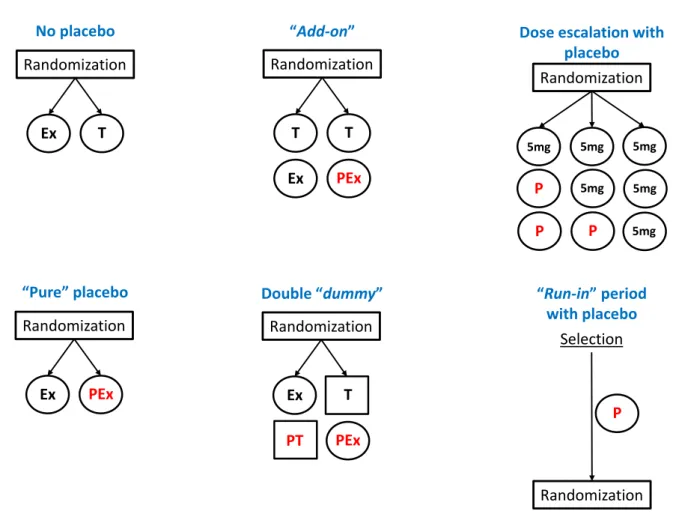
Masking can occur with or without the use of a placebo. In clinical placebo-controlled trials, the experimental group receives the intervenion in quesion and the control group receives a placebo. The term “pure placebo” is commonly used to show that the control group did not receive any interven-ion beyond the placebo itself (without an acive comparator) 9-11.
However, a placebo-controlled study design does not necessarily imply that the control groups remain without any kind of treatment. There are pla-cebo-controlled trials in which the new treatment and the placebo are added to exising treatments for certain clinical condiions (add-on type studies). There are even dummy type studies, in which the re-searcher uses more than one type of placebo in both the control and the experimental groups, to ensure masking. This is necessary when, for example, the experimental drug is a tablet with a diferent color and shape to the control drug.
In this case, so that the experimental group paricipant does not know which drug he or she is taking, a placebo tablet with the physical characteris-ics of the control product will also be administered.
U
p
d
a
te
A
rt
ic
le
In the control group, the placebo will have the same appearance as the experimental drug. In this exam-ple, paricipants from each group will receive two tablets, one a placebo and the other containing the acive drug (both experimental and control). The double-dummy study is one that uses two kinds of placebos to ensure masking 10,11.
A variaion of the dummy design is performed when the aim is to evaluate the escalaion of dosage in a masked form. In such situaions, a paricipant could calculate the dosage administered by count-ing the number of tablets that he or she receives. To ensure blinding, all paricipants receive the same number of tablets, but the tablets contain diferent proporions of placebo and experimental medicine. Figure 1 of the Appendix to this aricle summarizes the main types of randomized clinical trial, with and without a placebo group.
There are situaions where a placebo is admin-istered just prior to study randomizaion. This is the so-called run-in period, when all the paricipants (experimental and control) receive a placebo for a period of ime in a single-blind system 11. The goal
is to prepare the research paricipants for the main study (wash-out) which consists of adjustment of drug doses, standardizaion of procedures, conduct-ing of screenconduct-ing tests etc., so that it can be veriied if, in fact, they are eligible for the study before ran-domizaion.
Studies of paients with type II diabetes mel-litus oten employ a run-in period of a number of weeks in order to assess the compliance of par-icipants to non-pharmacological guidelines (diet, exercise and glucose and ketonuria monitoring). At the end of the run-in period, some individuals im-prove so much that they become ineligible for the study. The run-in period is not always carried out with placebos, but when it is, the aim is to exclude individuals who display a signiicant placebo efect, or to determine if there is a need to replace the pla-cebo used with another type. The use of a plapla-cebo run-in period should be evaluated with cauion, with the main issue is being the determinaion of whether the paricipant will be deprived or not of the necessary treatment for their clinical condiion.
It is worthwhile here relecing on the posiion of the CFM regarding the use of placebos in re-search. CFM resoluions 1885/2008 and 1931/2009 (Aricle 106) observed that doctors should not main-tain a relaionship of any kind with studies that use placebos when an eicient and efecive treatment for the disease being studied already exists 5,6. Such a warning applies perfectly to the “pure placebo”
scenario, which deprives a paricipant of an exising treatment solely due to the methodological need to evaluate the eicacy and safety of a new drug - something which is clearly unacceptable.
However, neither resoluion is clear on add-on type studies of controlled trials in which the new treatment and placebo are added to an exising treatment. If these regulaions are interpreted liter-ally, even this design would be ethically unacceptable to the CFM, which does not seem appropriate.
Jusiicaions for the use of placebos
Despite the fact that the debate surrounding placebos is primarily based on the existence or oth-erwise of a “best method”, the ethics of the use of placebos is not restricted to this criterion, and there exist other factors that deserve equal atenion, such as methodological necessity, non-maleicence, beneicence and jusice. Figure 2 of the Appendix shows the algorithms that have been proposed to help reach a decision on the ethics of placebo use in
clinical research.
Comparison of treatment with the “best method”
(non-deprivaion of treatment)
CNS Resoluion 466/2012 (Clause III.3.b) allows the use of placebos in clinical research pro-vided the experimental method is compared with the best current method (prophylacic, diagnosic or therapeuic). In the absence of a “best method”, the use of an isolated placebo (“pure placebo”) as a comparator is acceptable8.
It is worth discussing the concept of a “best current method” as described in the resoluion. The expression is oten interpreted as a situaion where the best method represents, for example, “the most modern”, “the gold standard”, “the most advanced”, “the most efecive”, and “what is available”, among other incorrect seings. Another common misun-derstanding is the assumpion that the existence of a “best method” of treatment can be deined simply because there may be several classes of drug for a paricular disease available on the market.
The fact that several drug opions exist does not necessarily imply that one of these represents a best (or most suitable) form of treatment for a specif-ic group of paients. Non-pharmacologspecif-ical measures, for example, are constantly used as the iniial treat-ment for various diseases, with paients with type II diabetes mellitus type an illustraive example.
U
p
d
a
te
A
rt
ic
le
Consider a group of paients who have recently been diagnosed with the disease and who have not yet been treated. The “best” method of treatment is not to ofer the most current drug or the latest of the numerous oral hypoglycemic opions avail-able on the market. In fact there is strong scieniic consensus and evidence that non-pharmacological measures such as exercise and a strict diet are efec-ive in controlling the disease in its early stages 12.
Therefore, proposing a study that ofers only non-pharmacological measures in the placebo group would be perfectly feasible from an ethical point of view, in these condiions. In contrast, the proposiion of a study with the same methodolog-ical design would be unethmethodolog-ical if there was the irrefutable recommendaion of the use of oral hy-poglycemic agents for the control of diabetes in the control group. Another example is to ofer clinical support to paients who are beyond any therapeuic possibility, when palliaive care measures represent the best course of acion in such cases.
The “best method” is not always the “gold standard” or the “most efecive method” in terms of treatment and diagnosis. By way of illustraion, surgery is considered the standard treatment for several tumors, but there are situaions which make it impossible to carry out, such as in paients with limiing health condiions that make it a risky pro-cedure. In this case, the best available treatment is not that which is considered standard, nor the most generally efecive, but what is best suited to that paricular stage of the disease and condiion. A com-plicaing factor in this assessment is the fact that there are oten several treatment opions available other than the standard, or even several alterna-ives, none of which has been proven to be beter than another. The deiniion of what is “best” for a paient is a complex task, requiring experise and clinical consideraion.
Some interpret the “best method” as that which is naturally available in a certain locality or community. Such an understanding is a dangerous error of interpretaion and harmful from an ethical point of view, creaing an opening for a treatment “double standard”. This misunderstanding alleged-ly jusiied numerous clinical trials for HIV drugs in Africa, where many paricipants received only place-bos on the grounds that medicaions for the disease were not ofered by local governments (local stan-dard) 13. Such a situaion is unacceptable, and the
“best method” cannot, under any circumstances, be considered that which is available due to local lo-gisical or economic issues. Such thinking obviously
disregards one of the basic principles of bioethics, equity.
It is also worth remembering Aricles 32 and 102 of the CME, which highlight the implicaions of placebo use, staing that it is forbidden for a doc-tor not to use all available means of diagnosis and treatment, scieniically recognized and within his or her reach, to help the paient [Aricle 32, authors’ highlights] and not to use the correct therapy when its use is permited in the country [Aricle 102, au-thors’ highlights] 6.
The ethical discussion about placebo use should not focus so much efort on determining what the “best method” is, but instead should be concerned more with whether the paricipant is deprived or not of treatment that would usually be provided in paients in the same clinical condiion. In general, treatments are by therapeuic guidelines developed by organizaions that are representaives of classes and associaions (guidelines), but can also be the result of pracical professional experience. Ater all, not every therapeuic procedure is planned and described by guidelines.
It is understandable, therefore, that deining a “best method” is a complex task that requires relecion and technical knowledge of the subject being assessed. It should be remembered that the “best method” of treaing a disease varies according to the characterisics of a group and a speciic sit-uaion. Thoroughly evaluaing the eligibility criteria (inclusion and exclusion) of a study helps to under-stand who the paricipants are, their speciiciies and the “best treatment” for them, which is not always the “gold standard”, “the most modern” or “the most efecive”, but the one that is the most ap-propriate for the clinical context in which the these paricipants ind themselves.
Evaluaing therapeuic guidelines recommend-ed by representaive organizaions can assist in understanding treatments. However, the deiniion of what is “best” for a paricular group of people de-pends on a degree of balance and common sense. The main issue this assessment should examine is wheth-er the group receiving the placebo is deprived or not deprived of a known treatment that should be used.
Methodological necessity
According to Brazilian regulaions, the use of placebos in clinical research is permited only where there is a jusiicaion and methodological need for the same 8. It is worth noing that the use of
place-bos is a bioethical issue and not solely a quesion of
U
p
d
a
te
A
rt
ic
le
scieniic methodology, involving a conlict of values between the interests of research sponsors, profes-sional responsibility and the autonomy of the paient. While necessary and desirable in clinical trials, masking is not always feasible. There are situaions where this procedure is considerably weakened by a paricular aspect of the experimental product, such as an adverse reacion, the lavor and format of the medicaion, the number of pills, the diferent forms of administraion, diferent infusion imes, and non-maskable procedures (diferent devices) 9.
In such cases it would be evident into which group a paricipant had been allocated if the experimental drug caused, for example, alopecia, and the con-trol drug did not. Likewise, masking would not be possible if one procedure was performed surgically and the other performed by endoscopy. It can be concluded here that the weakness of the masking process makes it useless, and would therefore not jusify the use of a placebo.
However, more commonly, masking failure occurs only in a group of individuals, and not all those who receive a certain medicaion. Paclitaxel, a chemotherapy treatment used in the treatment of various tumors, can trigger anaphylacic reac-ions during infusion. It is a known, though very rare reacion (<0.01%) 14. In this case, although there
is masking failure in the detecion of the event, it would not be suicient to completely derail the masking in the study.
More frequent adverse reacion characterisics result in greater and more signiicant weakening of masking. There is, therefore, no jusiicaion for pro-posing masking when 100% of individuals present characterisics of adverse reacions that may iden-ify their group. The deiniion of masking fragility is much more complex than it seems, especially when the characterisic event does not occur frequently. Individual weighing should in this case apply when jusifying the procedure.
Although there is no cutof point that exactly sipulates the degree of masking weakening allowed, it is worth noing that the World Health Organizaion (WHO) considers an adverse drug reacion incidence greater than 10% to be “very frequent” 15. This num
-ber cannot be used as an absolute parameter or as a mathemaical decision making tool, as it is an arbitrary deiniion. The weighing of the degree of masking weakening should include not only the frequency of adverse reacions, but also the type of reacion and the ease the researcher or paricipant has in idenifying it.
The use of placebos in clinical research is of
-ten jusiied by the methodological need to prove the eicacy of an experimental treatment 10, 16. It is not enough, however, to simply recognize this need, nor does it always translate into a plausible ethical jusiicaion. Consider, for example, a re-searcher who wishes to study the efeciveness of a new model of parachute to prevent injury pro-duced by free falls. So that the efeciveness of the device can be demonstrated in staisical terms and produce robust scieniic evidence, the study de-sign would require a randomized trial with a group of people jumping from the plane with parachutes, and another group doing the same without para-chutes.
The diference in the number of deaths would surely result from the use or not of the new device. This would demonstrate the unquesionable efec-iveness of the parachutes. In this study, while the methodological necessity of a control group is evi-dent, there is no ethical jusiicaion for it. Smith and Pell used this example in a provocaive aricle which demonstrated the obsinacy of clinical trials to prove, at any cost, the efeciveness of a treatment 17.
In recent years, the pharmaceuical industry has not invested enough in research that includes genuine pharmacological innovaion, instead pre-ferring to focus its eforts on the producion of imitaion drugs (me too) for the renewal of pat-ents 18. The use of placebos in clinical trials with
imitaion drugs has nothing to do with scieniic or methodological issues. In reality, economic and regulatory issues prevail, as it is much simpler, fast-er and cheapfast-er to demonstrate the supfast-eriority of a new drug by comparison with a placebo than by comparison with standard or similar medicine. This clearly greatly facilitates the process of registering the drug with regulatory agencies 19.
The ethics of placebo use in clinical research are directly related to the jusiicaion of masking, and not to the necessity of proving efeciveness. If there is no reason for masking, equally there is no need for the use of placebo.
Non-maleicence
A placebo should not result in addiional risks or harm to those who receive it. Item III.3.b of CNS resoluion 466/2012 clearly warns of the issue of non-maleicence in studies using placebos. Further-more, Item III.1.b states that the ethics of research imply (...) weighing risks and beneits, both known and potenial, individual or collecive, commited to
U
p
d
a
te
A
rt
ic
le
maximizing beneits and minimizing harm and risk [authors’ highlights] 8.
It is noteworthy that even the most seeming-ly innocuous placebos, such as tablets, may have adverse efects. These are called “nocebo efects”, deined as negaive responses to intervenion with a
placebo 20. The belief that the use of a placebo does
not bring risks and harm to research paricipants is therefore misguided.
There are two fundamental aspects to be examined in the assessment of risks and possible damage caused by a placebo: the type and period of administraion. It is easy to accept a study that proposes taking a placebo tablet once per day for a week. However, not all situaions involving place-bo use are as simple when it comes to weighing the potenial risk and harm to a research paricipant. Would it be unethical, for example, to ask someone to ingest a placebo tablet daily for ten years? Would it be ethically acceptable to request the infusion of a placebo subcutaneously, which causes less discom-fort than when administered in small amounts, in a single dose? Perhaps most people would answer yes to this last quesion. But if the study involved the subcutaneous administraion of a placebo three imes a day for 12 months, it is likely that a consid-erably smaller proporion of people would judge the study as ethical.
Considering other situaions, what would the reacion be to a placebo administered intravenous-ly? Would it be acceptable from an ethical point of view to propose the intravenous infusion of a place-bo to paients who were already using an indwelling catheter? On the one hand, the discomfort of ve-nipuncture is avoided because of the existence of the catheter, on the other, the more frequent use of the device increases the chance of contaminaion, which would result in its removal. And in the case of paricipants who do not have a catheter, would it be ethically jusiiable to propose installing the device so that the paricipant could receive the placebo more comfortably (for example, a long-term venous catheter)? All these situaions become even more complicated when it comes to the study of children. There is no single or correct answer to the above quesions. In fact, the decision about the ethics of placebo use, with respect to the aspect of non-maleicence, depends on the weighing of its potenial risks. Oten there is no objecive assess-ment criteria, but only consideraion of the route of administraion and ime of exposure to the placebo and the age range of the paricipants. While subjec-ive, one way to relect on this issue is to put oneself
in the place of the paricipant and ask “would I ac-cept the risks, discomforts and harm caused by the placebo for myself or someone in my family?”
The answer to this quesion is obviously sub-jecive, yet it contains a fundamentally guiding character. It cannot in essence, be weighted by the individual or guided by interests. If a researcher, for example, puts himself in the paricipant’s posiion, he or she may be willing to assume greater risks and discomforts for himself or herself due to being moi-vated by the success of the study and convinced that the experimental drug will bring beneit. The assess-ment of the risks, discomforts and harm caused by the placebo must be free of conlicts of interest, and based, above all, on a consensus among peers who analyze the ethics of its use.
Beneicence and jusice
The most obvious beneit that individuals in the placebo group may gain from paricipaing in a survey is post-study access to the product be-ing invesigated, should it prove beneicial. On this subject, CNS Resoluion No. 466/2012 (item III.3.d) deines a role for the study: to guarantee for all paricipants at the end of the study, provided by the sponsor, free and unlimited access to the best prophylacic, diagnosic and therapeuic methods found to be efecive [authors’ highlights]. Item V.4, meanwhile includes the following wording: In the area of health research, as soon as the signii -cant superiority of one intervenion over another or other comparaive intervenion(s) is proven, the re -searcher should assess the possibility of adaping or suspending the study in order to ofer the beneits of the best regime to all [authors’ highlights]8.
It is, however, necessary to consider the possi-bility of situaions where it is not feasible to provide the invesigaional product at the end of the study, and there is therefore no reason to ensure post-study access to the control group. This is the case, for example, in clinical trials with devices used during surgery, where the beneit is only valid during the procedure, or, in placebo-controlled clinical trials for the treatment of an acute but self-limiing condi-ion, such as a cold or a similar infecion. At the end of the study, research paricipants from both the control and the experimental group, will no longer sufer from the medical condiion that led them to take part in the survey; therefore, the provision of the invesigaional product is no longer applicable.
Fatal diseases with a high demand for new treatments, such as cancer, for example, are oten
U
p
d
a
te
A
rt
ic
le
the subject of simultaneous studies with diferent drugs but the same goal. However, the conclusion of one study may occur before the other, changing the current treatment guidelines and someimes gener-aing a new therapeuic standard. If the last study to be completed shows posiive results which are inferior to the irst, it is necessary to weigh the ben-eit and jusice of providing post-study medicaion when there is a more favorable opion available. Again, the ethical posiion will depend upon a tech-nical and expert judgment of the disease treatment opions in quesion at that ime.
Ensuring that the invesigaional product is provided free of charge to the placebo group at the end of the study is not just a mater of charity, but above all of jusice towards those who collaborated as a control group. Therefore, the guarantee of post-study access to the control group is another element to be considered in assessing the ethics of placebo
use in clinical research.
Final consideraions
This paper presents a proposal of systemaiza-ion of the analysis of placebo use in clinical trials in the light of CNS Resoluion 466/2012. It is essenial-ly based on the anaessenial-lysis of ive inseparable criteria: non- deprivaion of treatment, methodological ne-cessity, non-maleicence, beneicence and jusice. For a study to be deemed ethical, it is necessary that the previously menioned criteria are fully complied with. If one fails, the use of placebo cannot be jusiiable.
The epistemological keys set out in this work have their roots in the principlism of Beauchamp and
Childress 21. It should be noted that the discussion
about the use of placebos in clinical research should not only take into account biological vulnerability, as highlighted by Garrafa 1. In a Brazilian context, social
vulnerability is as or more important than biological vulnerability, although the two are also inseparable. This concern is at the heart of intervenion bioeth-ics, which has as one of its focuses the criicism of the double standard in clinical research 22.
The alleged objecivity of the four tradiional principles is a limiing factor for a more comprehensive analysis. Intervenion bioethics requires a socio-polit-ical context, taking into account other categories of bioethical pracice foundaions, such as “care”, “re-sponsibility”, “solidarity”, “commitment”, “otherness”, “tolerance”, “prevenion”, “cauion”, “prudence” and “protecion” (of the socially excluded) 23. Paranhos,
Garrafa and Melo 24 argue that the UNESCO Universal
Declaraion on Bioethics and Human Rights 25 is a key
document for supporing bioethical analysis involving the harm and beneits of clinical research.
In the present study the proposed algorithms are a long way from represening the truth, being open to criicism and adjustment. They are addi-ional tools which will bring more objecivity to a discussion that is guided in most cases, by passion and even by a misguided preconcepion regarding the use of placebos. There is no intenion to reduce ethical analysis to algorithms or Manichean debate. Bioethical decisions are mulifaceted, and depend on a signiicant degree of weighing. The intent of the proposed algorithms is to assist in the complex decisions that surround the ethical use of placebos in clinical research, without replacing human judge-ment regarding such resoluions.
All the authors, except Jorge Alves de Almeida Venâncio, are part of Research Ethics Commitees. José Humber -to Tavares Guerreiro Fregnani, Flávio Rocha Lima Paranhos, João Fernando Monteiro Ferreira, Cláudio Gustavo Stefanof, Paulo Henrique Condeixa França, Maria Mercedes de Almeida Bendai, Sandra Solci Zier and Pollya -na Anício Magalhães Gonijo are members of the Naio-nal Research Ethics Commission (Conep). Jorge Alves de Almeida Venâncio is the coordinator of Conep. Gabriela Marodin is assistant coordinator of Conep.
References
1. Garrafa V. Declaración de Helsinki y sus repeidos “ajustes” – un tema faigoso… Revista Lasallista de Invesigación. 2014;11(1):35-40.
2. Millum J, Wendler D, Emanuel EJ. The 50th anniversary of the Declaraion of Helsinki: progress but many remaining challenges. JAMA. 2013;310(20):2143-4.
3. Conselho Nacional de Saúde. [Internet]. Resolução CNS nº 404, de 1º de agosto de 2008. [acesso 14 ago 2015]. Brasília: Diário Oicial da União, nº 186, p. 45, 25 set. 2008. Seção 1. 2008 Disponível: htp://conselho.saude.gov.br/resolucoes/2008/Reso_404.doc
4. Freitas C, Schlemper Jr. B. Progress and challenges of clinical research with new medicaions in Brazil. In: Homedes N, Ugalde A, editors. Clinical trials in Lain America: where ethics and business clash. Cham (Switzerland): Springer; 2014. p. 151-71.
U
p
d
a
te
A
rt
ic
le
5. Conselho Federal de Medicina. [Internet]. Resolução CFM nº 1.885, de 23 de outubro de 2008. É vedado ao médico paricipar de pesquisa envolvendo seres humanos uilizando placebo, quando houver tratamento disponível eicaz já conhecido. [acesso 14 ago 2015]. Brasília: Diário Oicial da União, nº 208, p. 90, 22 out. 2008. Seção 1. 2008 Disponível: htp://www.portalmedico.org.br/ resolucoes/CFM/2008/1885_2008.htm/resolucoes/CFM/2008/1885_2008. htm
6. Conselho Federal de Medicina. [Internet]. Resolução CFM nº 1.931, de 17 de setembro de 2009. Aprova o Código de Éica Médica. [acesso 14 ago 2015]. Brasília: Diário Oicial da União, nº 183, p. 90-2, 24 set. 2009. Seção 1. 2009
Disponível: htp://www.portalmedico.org.br/resolucoes/cfm/2009/1931_2009.htm
7. Associação Médica Mundial. [Internet]. Declaração de Helsinque da Associação Médica Mundial (WMA): princípios éicos para pesquisa médica envolvendo seres humanos. [s/d.] [acesso 14 ago 2015]. Disponível: htp://www.amb.org.br/_arquivos/_downloads/491535001395167888_ DoHBrazilianPortugueseVersionRev.pdf
8. Conselho Nacional de Saúde. [Internet]. Resolução CNS nº 466, de 12 de dezembro de 2012. [acesso 14 ago 2015]. Brasília: Diário Oicial da União, nº 112, p. 59-62. Seção 1. 2012 Disponível: htp://conselho.saude.gov.br/resolucoes/2012/Reso466.pdf
9. Schulz K, Grimes D. The Lancet handbook of essenial concepts in clinical research. Horton R, foreword author. Philadelphia: Elsevier; 2006. (The Lancet Handbooks).
10. Internaional Conference on Harmonisaion of Technical Requirements for Registraion of Pharmaceuicals for Human Use. [Internet]. ICH harmonised triparite guideline: choice of control group and related issues in clinical trials E10. 2000 [acesso 14 ago 2015].
Disponível: htp://www.ich.org/ileadmin/Public_Web_Site/ICH_Products/Guidelines/Eicacy/E10/ Step4/E10_Guideline.pdf
11. Chin R, Lee B. Principles and pracice of clinical trial medicine. Amsterdam/Boston: Elsevier/ Academic Press; 2008.
12. American Diabetes Associaion. Standards of medical care in diabetes-2014. Diabetes Care. 2014;37(Suppl 1):S14-80.
13. Lurie P, Wolfe SM. Unethical trials of intervenions to reduce perinatal transmission of the human immunodeiciency virus in developing countries. N Engl J Med. 1997;337:853-6.
14. Agência Nacional de Vigilância Sanitária. [acesso 2014]. Disponível: htp://htp://www.anvisa.gov. br/datavisa/ila_bula/frmVisualizarBula.asp?pNuTransacao=10700412013&pIdAnexo=1908792 15. World Health Organizaion. [Internet]. Programme for Internaional Drug Monitoring.
Pharmacovigilance. Glossary of terms in pharmacovigilance. [acesso 14 ago 2015]. Geneva: WHO; 2013 Disponível: htp://www.who-umc.org/graphics/27400.pdf
16. Temple R, Ellenberg SS. Placebo-controlled trials and acive-control trials in the evaluaion of new treatments. Part 1: ethical and scieniic issues. Ann Intern Med. 2000;133(6):455-63.
17. Smith GC, Pell JP. Parachute use to prevent death and major trauma related to gravitaional challenge: systemaic review of randomised controlled trials. BMJ. 2003;327(7429):1459-61. 18. Angell M. The truth about the drug companies. How they deceive us and what to do about it. New
York: Random House; 2005. Capítulo 5, “Me Too” drugs – the main business of the pharmaceuical industry; p. 74-93.
19. Goldacre B. Beter than nothing. In: Bad Pharma. How Drug Companies Mislead Doctors and Harm Paients. Toronto: MacClelland & Stewart; 2014. p. 130-2.
20. Tavel ME. The placebo efect: the good, the bad, and the ugly. Am J Med. 2014;127(8):484-8. 21. Beauchamp TL, Childress JF. Principles of biomedical ethics. 7ª ed. New York: Oxford University
Press; 2013.
22. Garrafa V, Porto D. Intervenion bioethics: a proposal for peripheral countries in a context of power and injusice. Bioethics. 2003;17:399-416.
23. Garrafa V. Da bioéica de princípios a uma bioéica interveniva. Rev. Bioéica. 2005;13(1):125-34. 24. Paranhos FRL, Garrafa V, Melo R. Estudo críico do princípio de beneício e dano. Rev. bioét.
(Impr.). 2015;23(1):12-9.
25. United Naions Educaional, Scieniic and Cultural Organizaion. [Internet]. Universal Declaraion on Bioethics and Human Rights. [acesso 14 ago 2015]. Paris: UNESCO; 2005 Disponível: htp:// portal.unesco.org/en/ev.php-URL_ID=31058&URL_DO=DO_TOPIC&URL_SECTION=201.html
Paricipaion of the authors
The iniial text of this aricle was prepared by José Humberto Tavares Guerreiro Fregnani. All the authors paricipated in the discussion of the theoreical bases for the creaion of the ethical analysis algorithms and the criical revision of the text. Due to their involvement in the CEP System /Conep, all the others contributed, in an expressive and wide-ranging manner, to the discussion and elaboraion of the decision-making algorithms, based on real case studies, in which there was a need for relecion on the ethics of placebo use in clinical study.
Recebido: 14.12.2014 Revisado: 14. 7.2015 Aprovado: 23. 7.2015
U
p
d
a
te
A
rt
ic
le
465
Rev. bioét. (Impr.). 2015; 23 (3): 456-66
htp://dx.doi.org/10.1590/1983-80422015233082
Appendix
Table 1. Efects on experimental and control groups when the allocaion is known by the researcher and/or research paricipant in a clinical trial
Who knows
allocaion Item afected
Group afected
Control Experimental
Researcher Conduct related to treatment, dose adjustment,
instrucions etc. Less obsinate More obsinate
Interpretaion of informaion supplied by the
paricipant Less favorable More favorable
Evaluaion of paricipant by researcher Less favorable More favorable
Paricipant Percepion of paricipant of own condiion Less favorable More favorable Paricipant’s adherence to instrucions given by
researcher Less adherence More adherence
Paricipant seeks alternaive treatment Greater chance Less chance Paricipant abandons study Greater chance Less chance Source: based on Schulz and Grimes 9.
Figure 1. Schemaic representaion of the main designs of randomized clinical trials with and without placebos
Key: (Ex) experimental treatment; (T) most appropriate treatment for clinical condiion of a speciic group of paricipants; (PT) placebo of T; (PEx) placebo of Ex; (P) Placebo
Randomization
Ex T
Randomization
Ex PEx
Randomization
T T
Ex PEx
Randomization
Ex T
PT PEx
No placebo “Pure” placebo
“ ” Double “ ”
Randomization
5mg 5mg
P
Dose escalation with placebo
P P
5mg
5mg 5mg
5mg Randomization
“ ” period
with placebo
Selection
P
Randomization
Ex T
Randomization
Ex PEx
Randomization
T T
Ex PEx
Randomization
Ex T
PT PEx
No placebo “Pure” placebo
“Add-on” Double “ ”
Randomization
5mg 5mg
P
Dose escalation with placebo
P P
5mg
5mg 5mg
5mg Randomization
“ ” period
with placebo
Selection
P
Randomization
Ex T
Randomization
Ex PEx
Randomization
T T
Ex PEx
Randomization
Ex T
PT PEx
No placebo “Pure” placebo
“ ” Double “ ”
Randomization
5mg 5mg
P
Dose escalation with placebo
P P
5mg
5mg 5mg
5mg Randomization
“ ” period
with placebo
Selection
P
Randomization
Ex T
Randomization
Ex PEx
Randomization
T T
Ex PEx
Randomization
Ex T
PT PEx
No placebo “Pure” placebo
“ ” Double “ ”
Randomization
5mg 5mg
P
Dose escalation with placebo
5mg
5mg 5mg
“ ” period
with placebo
Selection
P
Randomization
Ex T
Randomization
Ex PEx
Randomization
T T
Ex PEx
Randomization
Ex T
PT PEx
No placebo “Pure” placebo
“ ” Double “dummy”
Randomization
5mg 5mg
P
Dose escalation with placebo
P P
5mg
5mg 5mg
5mg Randomization
“ ” period
with placebo
Selection
P
Randomization
Ex T
Randomization
Ex PEx
Randomization
T T
Ex PEx
Randomization
Ex T
PT PEx
No placebo “Pure” placebo
“ ” Double “ ”
Randomization
5mg 5mg
P
Dose escalation with placebo
P P
5mg
5mg 5mg
5mg Randomization
“Run-in” period
with placebo
Selection
P
U
p
d
a
te
A
rt
ic
le
R e v. b io é t. (Im p r.) . 2 0 1 5 ; 2 3 (3 ): 4 5 6 -6 6 Et h ic s o f t h e u se o f p la ce b o s i n cl in ic al re se ar ch : a p ro p o sa l fo r d ec isi o n -m aki n g a lg o rit h m s ht p:/ /d x.d oi.o rg /1 0.1 59 0/1 98 3-8 04 22 01 52 33 08 2 Fi g u re 2 . A lgo rith m fo r th e d ec isio n ab ou t th e e th ics of plac eb o u se in cli nic al tr ial s * Th e W orl d He al th O rgan iza io n ( W HO ) c on sid ers an ad ve rse dr ug re ac io n in cid en ce gr ea ter th an 10 % to be “v ery fre qu en t”. Ho w ev er, th is n um be r c an no t b e u se d as an ab so lut e p ar am ete r ab ou t th e f rag ility of m as kin g, as it is an ar bitr ar y d ei nii on . Yes NON-DEPRIVATION
Is the placebo necessary for the masking (blinding) of the group(s)?
NON-MALEFICENCE
Are the risk, discomfort and harm caused by the placebo to the
participants in the study acceptable?
(method of administration, time of use, age group involved, etc.) Will the placebo group be deprived
of treatment that is usually available to patients in the same
clinical condition?
Consider the eligibility criteria of the study to understand the clinical context of the research participants
and the treatment indicated.
The best treatment does not represent the “most modern”, “the gold standard”, “the most effective”
or “what is available”, but what is recommended for the group of
participants.
Não
The use of the placebo is justified for this criterion. Test for other
criteria. There is no
ethical justification for the study and the use of
the placebo.
The use of the placebo is justified for this criterion. Test for other
criteria. There is no
methodologic al justification
for the study and the use of
the placebo.
There is no ethical justification for the study and the use of
the placebo. Even with masking, can the
groups be identified by the researcher and/or the
research participant?
(EXAMPLES: adverse reaction characteristics in only one of the groups, different pills, different dosage times,
non-masked procedures, etc.)
Yes No
No Yes
The use of the placebo is justified for this criterion. Test for other
criteria.
BENEFICENCE AND JUSTICE
Is the placebo group guaranteed access to the treatment (or procedure) being studied if it proves
to be beneficial?
(free access, for as long as necessary)
There is no ethical justification for the study and the use of
the placebo.
No Yes
The use of the placebo is justified for this criterion. Test for other
criteria.
No Yes
Yes No
Should placebo group receive the
treatment (or procedure) being
studied?
Fragilização
Harmful Use Iniquity
Very frequent?
Yes No
Deprived of treatment
METHODOLOGICAL NECESSITY