176
ORIGINAL ARTICLE
EXERCISE AND SPORTS MEDICINE CLINIC
A COMPARATIVE STUDY OF CARDIOVASCULAR
RESPONSES TO TWO REST INTERVALS
BETWEEN CIRCUIT RESISTANCE EXERCISES IN
NORMOTENSIVE WOMAN
Hamid Arazi1, Ahmad Ghiasi1 Sepideh Asgharpoor1
1- Physical Education School & Sport Science, Department of Exercise Physiology, University of Guilan, Rasht, Iran.
Mailing address:
Physical Education School & Sport Science, University of Guilan, Rasht, Iran.
P.O. Box: 1438
E-mail: [email protected]
ABSTRACT
Introduction: Hypertension is a cardiovascular disorder which occurs in approximately one billion indivi-duals worldwide and represents an important risk factor for cardiovascular disease. Objective: To compare the cardiovascular responses during recovery after two protocols of circuit resistance exercises (CRE) with different rest intervals (RI). Twelve normotensive females (aged 21.3 ± 1.3, yrs; height 163.5 ± 5.9 cm and weight 57.5 ± 8.9 kg) performed two CRE with RI of 30 (RI30s) and 40 (RI40s) seconds between the exercises, randomly. Methods: The protocols consisted of three circuits of six exercises with 10 repetition maximum (10RM) and 2 minute rest between circuits, followed by a 60 minute recovery period. Measurements were taken before exercise, at the end of last exercise (R1) and each 10 min of post-exercise recovery (R10, R20, R30, R40, R50 and R60). Analysis of Variance (ANOVA) with Repeated Measures (group × time) was used to analyze data, followed by post-hoc Bonferroni test, for p≤0.05. Results: In comparison of rest values, systolic blood pressure (SBP), diastolic blood pressure (DBP), heart rate (HR) and rate pressure product (RPP) at R1 after exercise trials with RI30s and RI40s increased significantly. Post-exercise hypotension (PEH) of SBP was observed after CRE with RI30s (at R20, R30, R40, R50 and R60) and RI40s (at R30, R40, R50 and R60), whereas PEH of DBP was observed only after CRE with RI30s at R60. Except for time after CRE with RI30s at R10, no significant change of HR was observed in all measured moments during recovery period of trials. RPP returned to the rest values after exercise trials at R10 and then decreased significantly after CRE with RI30s at R60 and after CRE with RI40s at R40, R50 and R60. Conclusion: In all measured moments, there were no significant differences between experimental sessions in post-exercise levels of SBP, DBP, HR and RPP. In conclusion, CRE with RI30s and RI40s between the exercises can lead to occurrence of PEH similarly in magnitude and duration and approximately provides same cardiovascular responses after exercise. Our findings suggest a potentially positive health benefit of strength training.
Keywords: post-exercise hypotension, systolic blood pressure, diastolic blood pressure, heart rate,
rate pressure product.
INTRODUCTION
Hypertension is a cardiovascular disorder that affects approxi-mately 1 billion individuals worldwide, represents an important risk factor for cardiovascular disease1. There are many options for
trea-ting hypertension and preventrea-ting risk factors associated with car-diovascular diseases2, including physical exercise. Both acute and
chronic exercises have been recommended as a non-pharmacolo-gical and less expensive treatment for hypertension3. It has been
shown that a single physical exercise session has an important effect on reducing blood pressure (BP) to levels below those of pre-exer-cise resting4, 5. This phenomenon is named post-exercise
hypoten-sion (PEH) and has been widely investigated because of its impor-tance for the treatment and prevention of arterial hypertension6, 7.
The mechanisms responsible for PEH remain unclear and may be related to reduction in cardiac output and/or in peripheral vascular resistance4, 5. PEH may be associated with a shift in the baroreflex
control and reduction in the alfa-adrenergic responsiveness, as well as to an increased secretion of humoral, hormonal, and local subs-tances associated with vasodilation in response to exercise4, 5. PEH
has been demonstrated after aerobic exercise7 while after resistance
exercise controversial results have been observed, such as increase8,
maintenance9, 10, or even decrease11, 12. Although some studies
de-monstrate the occurrence of PEH in resistance exercises, there is still no consensus on an ideal protocol (frequency, intensity and volume) to enhance this effect13. In this sense, some researchers reported
that RE intensity affects the duration (longer PEH in the protocol with the highest intensity), but not the magnitude of the post-exer-cise hypotensive response14, 15, and different training methodologies
(set repetition vs. circuit format) do not affect the magnitude or duration of the post-RE hypotensive response15. In addition to the
variables previously studied (exercise intensity, volume and sequen-ce), other variables such as the amount of muscular mass involved, number of repetitions, type of training and rest interval (RI) between the exercise setscan affect the hemodynamic responses to a bout of resistance exercises16, 17. Although RI was considered one of the
main variables of resistance exercise by Ratamess et al18, there are
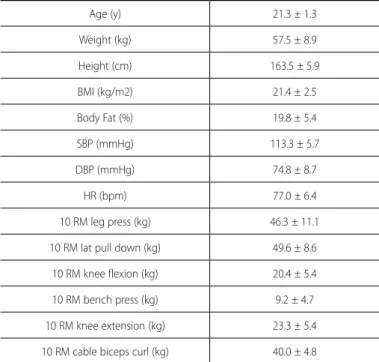
177 Table 1. Physical and cardiovascular characteristics of the participants
Age (y) 21.3 ± 1.3
Weight (kg) 57.5 ± 8.9
Height (cm) 163.5 ± 5.9
BMI (kg/m2) 21.4 ± 2.5
Body Fat (%) 19.8 ± 5.4
SBP (mmHg) 113.3 ± 5.7
DBP (mmHg) 74.8 ± 8.7
HR (bpm) 77.0 ± 6.4
10 RM leg press (kg) 46.3 ± 11.1
10 RM lat pull down (kg) 49.6 ± 8.6
10 RM knee flexion (kg) 20.4 ± 5.4
10 RM bench press (kg) 9.2 ± 4.7
10 RM knee extension (kg) 23.3 ± 5.4
10 RM cable biceps curl (kg) 40.0 ± 4.8
٭data are presented as means ± standard error of mean (SEM).
cardiovascular responses. RI length influences on the removal of metabolites produced during muscle contraction and contributes to the reduction of muscle fatigue. Thus, it can influence the car-diovascular responses to weightlifting training18.
Therefore, the objective of the present study was to investigate and compare the effects of different RI between circuit training exercises (30s and 40s; the ratio of exercise to rest was approximately 1 to 1.5 and 1 to 2, respectively) on the cardiovascular responses in non-hypertensive young females.
MATERIALS AND METHODS
Subjects
Twelve healthy sedentary females volunteered to participate in this study. All of the participants were non-smokers, had no history of cardiovascular disease in themselves or their families, were not taking any medication, engaged in regular physical activity < 2 h per week, and were not in menstrual cycle. Subjects who presented body mass index (BMI) ≥ 24 kg/m2 and fat mass > % were excluded.
Complete advice about possible risks and discomfort was given to the participants, and all of them give their written informed con-sent to participate. Their physical and cardiovascular characteristics are shown in table 1. All procedures were in accordance with the Declaration of Helsinki and the study was approved by the Ethcis Committee of the School.
PROCEDURES
Before initiating the tests, the participants underwent an ana-mnesis, a clinical evaluation and BP, body fat mass, body mass in-dex, weight and height measurements. Subsequently all of them underwent familiarization session and participated in 10RM test. Afterwards, participants carried out two experimental sessions on distinct days and with a minimum of 72 h intervals: (1) circuit resis-tance exercises (CRE) with 30s RI between exercises (RI30) and (2) CRE with 40s RI between exercises (RI40). The RI30 and RI40 sessions
were performed in a randomized order. Pre and post-exercise values of BP, HR and rate pressure product (RPP: an index of myocardial oxygen consumption) were measured and analyzed.
The participants were instructed not to ingest alcoholic or ca-ffeinated drinks, not to perform strenuous physical activity in the previous 48 h and to have their last meal 2 h before the beginning of the experimental sessions, which occurred at 2:00-4:00 PM to control diurnal BP variation. The laboratory had mean temperature of 20.6 ± 0.80C and mean relative air humidity of 79 ± 5%
Blood pressure measurements
After a 5-min rest in seated position, BP was measured three times during two different visits to the laboratory. On the occasion of each visit, BP was measured by the same experienced observer using a standard mercury sphygmomanometer (ALPK2, Japan), taking the first and the fifth phases of Korotkoff sounds as SBP and DBP values, respectively. Participants were excluded if the average of the last two values obtained during each visit for SBP and DBP was greater than 139 and 89 mmHg, respectively.
10RM test
At least 7 days prior to the experiments, participants performed a maximal 10 repetitions test (10RM) in the leg press, lat pull-down, knee flexion, bench press, knee extension, and biceps curl after 15 min warm-up consisting of 5 minutes of slow running, 5 minutes of static stretching, and 5 minutes of dynamic exercise. Each individual was given up to five tries, in order to determine the load, with a five minute interval between them. Additionally, before the 10RM tests, participants underwent familiarization session and became familiar the standard exercise techniques.
Exercise protocols
Initially, the volunteers remained seated on a comfortable chair for 20 min, with BP and HR being measured each 5 min from 10th
178
Figure 1. Changes in systolic and diastolic. blood pressure during recovery after exercise trials with RI30s and RI40s. # p < 0.05 vs. rest.
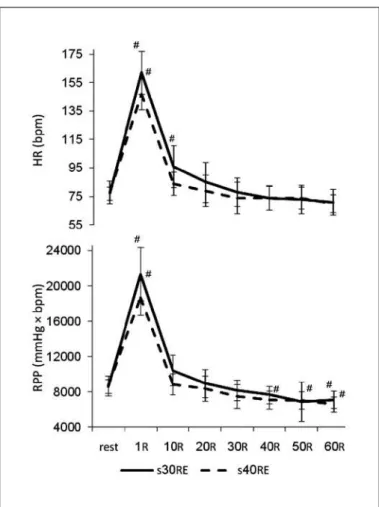
Figure 2. Changes in heart rate and rate pressure product during recovery after exercise trials with RI30s and RI40s. # p < 0.05 vs. rest.
Statistical analysis
Analysis of Variance (ANOVA) with repeated measures (group × time) was used to analyze data and when the difference presented was significant, the Bonferroni pos-hoc test was used for multiple comparisons, with a value of p≤0.05.
RESULTS
In all measured time, no significant differences were was ob-served between experimental sessions in pre and post-exercise level of SBP, DBP, HR and RPP.
Blood pressure
BP responses during the different experimental sessions are shown in Figure 1. Regarding SBP measurements compared to rest values, there was significant increase at R1 after exercise trials with RI30s and RI40s, and then significant decrease at R20, R30, R40, R50 and R60 for RI30s and at R30, R40, R50 and R60 for RI40s.
DBP increased significantly at R1 after two trials and decreased significantly only at R60 after RI30s. Post-exercise DBP at R10, R20, R30, R40 and R50 after two trials and at R60 after trials with RI40s did not differ from that measured at rest.
Heart rate
HR responses during the different experimental sessions are shown in Figure 2. Compared to the pre-exercise values, HR was significantly higher than baseline values at R1 and R10 after exercise trial with RI30s and at R1 after RI40s. Exercise trials decreased HR levels less than the rest values during the recovery period (R40, R50, R60), although this decrease was not statistically significant.
Rate pressure product
RPP responses during the different experimental sessions are shown in Figure 2. Compared to the pre-exercise values, RPP was significantly higher than baseline values at R1 after exercise trials. RPP levels decreased less than the rest values significantly during the recovery period of exercise trial with RI30s at R60 and after exercise trial with RI40s at R40, R50 and R60.
DISCUSSION
179 HR and RPP. Based on previous studies, the data about PEH and
resistance exercise are still scarce and controversial results have been reported. Increase8, maintenance9, 10 or even decrease11, 12 in
post-resistance exercise BP has been observed. The present study found a significant PEH of SBP compared to pre-exercise measurements in the protocols tested. The reduction in blood pressure levels after a single exercise session is in agreement with the results obtained by other studies that observed PEH after resistance exercises3, 11, 12, 15.
Simão et al15 compared the effect of intensity, volume and
ses-sion format on post-resistance exercise hypotensive response and observed significant post exercise reduction of SBP after the pro-tocols. Mohebbi et al11 and Rezk et al12 also reported significant
post-exercise reduction in SBP after two RE sessions with different intensities in normotensive young individuals. Mota et al3 observed
PEH of SBP after circuit model for resistance exercise composed by 13 resistance exercises performed with 20 repetitions at 40% 1RM and 30 seconds rest interval between exercises. In contrast to the results of the present study, Veloso et al10 observed no change in
SBP after resistance exercise with different rest intervals between resistance exercise sets and reported no significant differences be-tween the protocols in the SBP responses. Raglin et al21 evaluated
university athletes (15 men and 11 women) after performance of a resistance exercise session at 70% to 80% of 1RM and did not find significant differences between post-exercise measurements and rest measurements of SBP. Rodriguez et al 22 observed no significant
variance in the SBP after both traditional multiple set and tri-set methods where six upper limb exercises were used for two distinct muscular groups (chest and back). Moreover, Polito et al23 failed to
induce a hypotensive response in SBP following three series of 12 maximal repetitions of knee extension unilaterally and bilaterally.
The differences between the results found in the present stu-dy and those reported by Veloso et al10 and Raglin et al21 may
be attributed to the differences in the protocols used as well as differences between subjects. Veloso used a protocol in which the load decreased at each set, with the purpose of maintaining the same work volume (load × repetitions) in all protocols. On the other hand, the differences between the results found in the present study and those reported by Rodriguez et al22 and Polito et al23 may
be related to the involvement of muscle mass in exercise. In the present study that performed 3 circuit of 6 exercises for upper and lower limbs, exercising muscle mass was higher than in Rodriguez et al22 and Polito et al23 studies that used lower and upper limb
exercises, respectively. One of the physiological mechanisms that could explain the inluence of muscle mass on blood pressure after resistance exercise is the reduction in vascular resistance, caused by the liberation of vasodilating endothelial substances (e.g., nitric oxide and prostaglandins).
Regarding DBP, compared to pre-exercise values, except for time after exercise trial with RI30s at R60, no significant PEH of DBP was observed in all measured moments during recovery period of trials.
In Simão et al15 study, significant post-exercise decrease in DBP
was also observed 10 minutes after completion of a protocol of 12 repetitions with a load of 50% of 6RM. Rezk et al12 also found
significant post-exercise decrease in DBP; however, the duration of PEH was longer (30 minutes) than that found by Simão et al15. In
contrast, Rodriguez et al22 and Polito et al23 did not observe
signifi-cant variance in the DBP after resistance exercise. Also, Veloso et al10
observed no changes in DBP after resistance exercise with 2 min RI between resistance exercise sets but, significant reduction in DBP occurred after 1 and 3 min RI, and no significant differences were reported between the protocols in the DBP responses.
Similarly to the results of the present research, Mohebbi et al11,
Polito et al24 and MacDonald et al25 observed significant PEH of SBP
and no changes of DBP following resistance exercise. One of the possible explanations for SBP’s higher sensitivity to PEH would be the posture subjects adopt after the exercise. Although all mentioned studies have chosen the seated position to assess arterial pressure, it was observed that the post-exercise SBP declines more soundly in the seated position rather than in the supine position26.
Possible mechanisms involved in mediating post-exercise reduc-tion in arterial blood pressure include decreased stroke volume and cardiac output; reduction in limb vascular resistance, total peripheral resistance, and muscle sympathetic nerve discharge4, 5. Rezk et al12
assessed some mechanisms of BP control such as systolic volume, peripheral vascular resistance, and cardiac output after a resistan-ce exercise session and observed decrease in the systolic volume and cardiac output, no change of the peripheral vascular resistance and, consequently, a reduction in BP. According to these authors, the systolic volume remained below resting levels for 90 minutes. In this study, HR returned to rest value after exercise trials with RI30s and RI40s, respectively from R20 and R10. In relation to post--resistance exercise heart rate (HR) responses, the results are also controversial and less conclusive. Some investigators have observed increase11, 12 while no change9, 23 of HR during the recovery period
was reported either. It seems that reduction in cardiac output due to decrease in the systolic volume and no change of HR has been the main cause of PEH in this study.
The present study demonstrated that the RPP returned to rest value after exercise trials from R10 and then decrease below the rest value significantly. It has been suggested that HR is the most important factor to determine RPP27, and because in all measured
moments RPP changes were consistent with HR, tthis fact was con-firmed by the present study.
Additionally, there may be reduction in vascular resistance influen-ced by accumulation of metabolites produinfluen-ced in muscle contraction, which, according to MacDonald et al5, is one of the factors accounting
for vasodilation and subsequent decrease in peripheral vascular re-sistance. A greater accumulation of metabolites in the protocol with lower RI (30s) that had been demonstrated by Ratamess et al18 and
Crisafulli et al28 could explain the longer post-exercise decrease in
SBP and DBP that was found in the present study.
CONCLUSION
180
weightlifting training18, we found no significant differences between
experimental sessions in post-exercise level of SBP, DBP, HR and RPP in all measured moments. However, levels of all cardiovascular variables after exercise trial with RI30s were over RI40s.
We suggest further studies to evaluate the effects of other RE varia-bles on PEH in different populations such as those of elderly and hyper-tensive individuals. Additionally, the physiological mechanisms involved in post resistance exercise hypotension need to be better explained.
ACKNOWLEDGEMENTS
The authors gratefully acknowledge all the subjects who took part in this study for their cooperation. The authors also acknowledge the financial support of the Department of Physical Education and Sport Science, University of Guilan, Iran.
All authors have declared there is not any potential conlict of interests concerning this article.
REFERENCES
1. Chobanian AV, Bakris GL, Black HR, Cusman WC, Green LA, Izzo JL. The seventh report of the Joint National Committee on Prevention, Detection, Evaluation, and Treatment of High Blood Pressure: The JNC 7 report, JAMA 2003;289:2560-72.
2. Nilsson PM. Optimizing the pharmacologic treatment of hypertension: BP control and target organ protection. Am J Cardiovasc Drugs 2006;6:287-95.
3. Mota MR, Pardono E, Lima LCJ, Arsa G, Bottaro M, Campbell CSG, et al. Effects of treadmill running and resistance exercises on lowering blood pressure during the daily work of hypertensive subjects. J Strength Cond Res 2009;23:2331-8.
4. Kenney MJ, Seals DR. Post-exercise hypotension key features, mechanisms, and clinical significance. Hypertension 1993;22:653-64.
5. MacDonald JR. Potential causes, mechanisms, and implications of postexercise hypotension. J Hum Hypertens 2002;16:225-36.
6. Halliwill JR. Mechanisms and clinical implications of post-exercise hypotension in humans. Exerc Sports Sci Rev 2001;29:65-70.
7. Pescatello LS, Franklin BA, Fagard R, Farquhar WB, Kelley GA, Ray CA. American College of Sports Medicine. Position stand. Exercise and Hypertension. Med Sci Sports Exerc 2004;36:533-53.
8. O’Connor PJ, Bryant CX, Veltri JP, Gebhardt SM. State anxiety and ambulatory blood pressure following resistance exercise in females. Med Sci Sports Exerc 1993;25:516-21.
9. Roltsch M H, Mendez T, Wilund KR, Hagberg JM. Acute resistive exercise does not affect ambulatory blood pressure in young men and women. Med Sci Sports Exerc 2001;33:881-6.
10. Veloso J, Polito MD, Riera T, Celes R, Vidal JC, Bottaro M. Effects of Rest Interval between Exercise Sets on Blood Pressure after Resistance Exercises, Arq Bras Cardiol 2010;94:482-7.
11. Mohebbi H, Rahmaninia F, Vatani DSh, Faraji H. Post-exercise responses in blood pressure, heart rate and rate pressure product in endurance and resistance exercise. Med Sport 2010;63:209-19.
12. Rezk CC, Marrache RC, Tinucci T, Forgaz CL. Post-resistance exercise hypotension, hemodynamics, and heart rate variability: influence of exercise intensity. J Appl Physiol 2006;98:105-12.
13. Hamer M. The anti-hypertensive effects of exercise: integrating acute and chronic mechanisms. Sports Med 2006;36:109-16.
14. Polito MD, Simao R, Senna GW, Farinatti PTV. Hypotensive effects of resistance exercises performed at
different intensities and same work volumes. Rev Bras Med Esporte 2003;9:74-7.
15. Simao R, Fleck SJ, Polito M, Monteiro W, Farinatti P. Effects of resistance training intensity, volume and session format on the postexercise hypotensive response. J Strength Cond Res 2005;19:853-8.
16. Collins MA, Cureton KJ, Hill DW, Ray CA. Relationship of heart rate to oxygen uptake during weight lifting exercise. Med Sci Sports Exerc 1991;23:636-40.
17. Rozenek R, Rosenau P, Stone MH. The effects of intensity on heart rate and blood lactate responses to resistance training. J Strength Cond Res 1993;7:51-4.
18. Ratamess NA, Falvo MJ, Mangine GT, Hoffman JR, Faigenbaum AD, Kang J. The effect of rest interval length on metabolic responses to the bench press exercise. Eur J Appl Physiol 2007;100:1-17.
19. Dentry JM, Piette RJ, Brasseur LA. Hemodynamic determinants of exercise ST-segment depression in coronary patients. Circulation 1970;42:593-9.
20. Kitamura K, Jorgensen CR, Gobel FL, Taylor HL, Wang Y. Hemodynamic correlates of myocardial oxygen consumption during upright exercise. J Appl Physiol 1972;32:516-22.
21. Raglin JS, Turner PE, Eksten F. State anxiety and blood pressure following 30 min of leg ergometry or weight training. Med Sci Sports Exerc 1993;25:1044-8.
22. Rodriguez D, Polito MD, Bacurau RFP, Prestes J, Pontes FL. Effect of different resistance exercise methods on post-exercise blood pressure. Int J Exerc Sci 2008;1:153-62.
23. Polito MD, Rosa CC, Schardong P. Acute cardiovascular responses on knee extension at different performance modes. Rev Bras Med Esporte 2004;10:177-80.
24. Polito MD, Farinatti PTV. The effects of muscle mass and number of sets during resistance exercise on postexercise hypotension. J Strength Cond Res 2009;23:2351-7.
25. MacDonald JR, MacDougall JD, Interisano SA, Smith KM, McCartney N, Moroz JS. Hypotension following mild bouts of resistance exercise and submaximal dynamic exercise. Eur J Appl Physiol 1999;79:148-54.
26. Raine NM, Cable NT, George KP, Campbell IG. The inluence of recovery posture on post-exercise hypotension in normotensive men. Med Sci Sports Exerc 2001;33:404-12.
27. Mayo JJ, Kravitz L. A review of the acute cardiovascular responses to resistance exercise of healthy young and older adults. J Strength Cond Res 1999;13:90-6.