228 Rev Bras Med Esporte – Vol. 17, No 4 – July/August, 2011
Physical Activity and Aging Male Symptoms
in a Southern Brazilian Population
Leandro Quadro Corrêa1 Airton José Rombaldi2 Marcelo Cozzensa da Silva2
1. Atlântico Sul College/ Educational Anhanguera. 2. Master’s Course in Physical Education/UFPel.
Mailing address: Airton José Rombaldi
Endereço: Rua Luis de Camões, 625, Bairro Três Vendas – 96055-630 – Pelotas, RS.
E-mail: [email protected]
ABSTRACT
The aim of this study was to verify the association of aging male symptoms with physical activity in leisure and commuting time in men aged 40 years or older from Pelotas, a city in Southern Brazil. Methods: a population-based cross-sectional study was carried out including 421 men, living in the urban area. To verify the aging male symptoms, the Aging Males’ Symptoms Scale (AMS) was used and to evaluate physical activity level, the International Physical Activity Questionnaire (IPAQ), long version was used. Results: the prevalence of sedentarism in the leisure and commuting physical activ-ity domains was of 82.9% (CI 95% 78.9-86.4). The psychological, somatic and general score of aging significantly differed between sedentary and active men (p<0.05; p=0.001; p=0.02 respectively). The severity of the general score was also more prevalent among sedentary subjects (p=0.01), with 90% of them presenting severe symptoms. Conclusion: psychological, somatic and general scores symptoms, as well as their severity were lower among those subjects who reached the current recommendations for physical activity during leisure and commuting time.
Keywords: motor activity, cross-sectional studies, epidemiology, male symptoms.
INTRODUCTION
Aging male is a result of a complex multifactorial process and the symptoms related to it are consequence of three distinct fac-tors: psychological, somatic and sexual, being the sum of these the diagnosis of the general symptomatology (1).
Aging male is followed by signs and symptoms which remind of androgenic deficiency in young adults, such as decrease in muscular mass and strength; increase of abdominal fat (especially visceral, with insulin resistance and atherogenic lipid profile); de-crease in libido and sexual life; osteopenia; dede-crease of cognitive performance; depression; insomnia; sudoresis and decrease of ge-neral wellness. Such symptoms can affect the quality of life and increase the risk for non-transmissible chronic diseases in men aged over 40 years(2,3).
Epidemiological evidence has stated that physical activity is able to provide a series of benefits to physical and mental health, as well as to play a protective role on countless diseases, including cardiovascular, hypertension, type II diabetes, osteoporosis, some types of cancer, anxiety, depression, as well as to decrease the risk of early mortality in those individuals with good physical fitness and with high energetic expenditure(4-7).
Despite the many benefits of physical activity to health and quality of life, there is still a very high number of sedentary or phy-sically inactive individuals. Moreover, the literature has shown an inverse association between physical activity and population strata with more advanced ages (4,8,9).
Regarding the aging male, there are few studies verifying the association between physical activity and symptoms of aging male. The existing studies are limited to describe the prevalence of these symptoms in some populations (1,10,11).
Thus, the present study had the aim to verify the association between the aging male and the level of physical activity in leisure and commuting time in a representative male sample aged 40 or older and who reside in the city of Pelotas, RS.
METHODS
A cross-sectional populational-based study was carried out in the urban area of the city of Pelotas. This southern city of Rio Grande do Sul, has 340,000 inhabitants, from whom, ap-proximately 112,000 (32% of population) present age equal or above 40 years.
The Brazilian Institute of Geography and Statistics divides this city in 404 urban census sectors, out of which 45 were drawn to be included in the study. In each census sector drawn the starting point of the study was identified, from which the households to be visited were systematically selected. After the starting point was identified the following households were selected respecting a set interval of five residences, until 20 households in each sector had been reached. The total number of 900 households was selected where all men who presented age 40 or older were initially consi-dered illegible for the study.
Exclusion criteria were institutionalized individuals (old age ho-mes, hospitals, prisons and military headquarters), individuals with severe motor disability (tetraplegic, cerebral palsy, among others) and individuals who were not able to answer and/or understand the questionnaire.
In order to verify the prevalence of the aging male symptoms, the AMS scale (The Aging Male's Symptoms Scale) composed of 17 questions divided in three groups of symptoms: psychological (five questions), somatic (seven questions) and sexual (five questions)
ORIGINAL ARTICLE EXERCISE AND SPORTS
229
Rev Bras Med Esporte – Vol. 17, No 4 – July/August, 2011
was used. The general sum of the questions, whose results may range from one to five points, was considered as the general score of the symptoms(1).
The general score of the symptoms was dichotomized so that those who presented score ≥ 37 were classified as presenting aging symptoms, while those with values lower were classified as symptomless (10).
The psychological, somatic and sexual symptoms were dicho-tomized as the general score of symptoms and were classified as having psychological symptoms the subjects who presented score ≥ 12 points; with somatic symptoms, the subjects who presented score ≥ 13 points; and with sexual symptoms those who presented score ≥ 8 points.
The general score of the aging male symptoms was also cate-gorized so that those with scores between 27 and 36 points were considered as presenting “mild/light symptoms”; those with scores between 37 and 49 points were considered as presenting “moderate symptoms”; and those with score equal or 50 or higher, as presenting “severe symptoms”(1).
In order to quantify the level of physical activity (active/seden-tary), the leisure and commuting sections of the International Physical Activity Questionnaire(IPAQ), long version were used. The subjects who reached 150 minutes of physical activities per week (min/week) were considered active, according to the ACSM recommendations(12).
A standardized questionnaire was used to investigate the sub-jects’ characteristics. The variables were: age (complete years), skin color (white or non-white, according to the interviewer's percep-tion), marital status (with a partner, without a partner), economical level (A, B, C, D/E)(13), schooling (years of schooling), smoking (current
smoker, ex-smoker, never smoked), BMI (normal, overweight, obe-sity – calculated from the self-reported weight and height)(14) and
health self-perception (excellent, very good, good, average, poor). The questionnaire was pre-tested in a pilot study carried out in a census sector not included in the final sample.
Both instruments were applied face-to-face, except for the sec-tion of sexual symptoms which was applied to ensure the con-fidentiality of information, did not expose the interviewees and minimized the studies resusals (men who answered the question-naire received an envelope with the questions and immediately after concluding had this envelope sealed). Those men who could not read or understand the questions could ask the interviewers for some help.
The questionnaires were applied by interviewers from both gen-ders, with a minimum complete high school educational level and who received 40-hour training for application of the instrument, but who did not receive information on the study’s aims or hypotheses. The interviewers individually performed the interviews. The advisors of the field work reapplied the interviews in 10% of the sample, ran-domly selected, with a reduced questionnaire containing key-ques-tions selected from the instrument for quality control of the study.
Sample size was calculated using a prevalence of 20% of aging male symptoms for men aged 40 years or older(1), an acceptable
error of four percentage points and significance level of 95%. The sample size was initially calculated in 384 men. Ten percent was added to this value for losses and resusals, being the final necessary sample hence of 422 subjects aged 40 years or older.
Database was built in the Epi Info 6.0 program and each ques-tionnaire was entered twice. Data were analysed with the STATA 9 program. A descriptive analysis of the subjects of the sample was performed in relation to their aging male symptoms, the level of physical activity in leisure and commuting time and the socioeco-nomical, demographic, behavior and health variables. The crude analysis between the outcome and level of physical activity was tested through the chi-square test for proportion difference and chi-square test for linear tendency. The significance level adopted was p < 0.05.
This study was approved by the Ethics Committee in Research of the Physical Education College of the Federal University of Pelo-tas (protocol 005/2008) and the data were collected after written informed consent from the subjects.
RESULTS
421 men aged 40 years or older were studied in 876 households and the total of losses and resusals was 8.3%. The sample effect found (0.7) was sufficient to keep the reliability power and level predicted by the study.
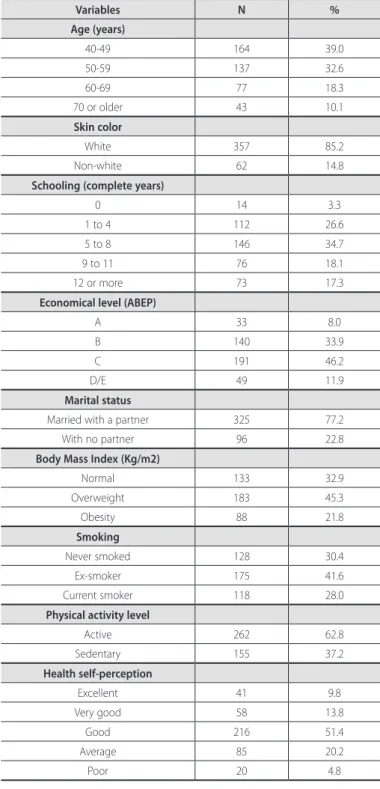
Table 1 presents the sample description according to sociode-mographic, economical and behavior variables. Age mean of the interviewees was 54.5 ± 10.5 years and approximately 72% of these subjects were aged between 40 and 59 years. Out of these men, 66.5% still had a job outside their homes. Approximately 85% of the interviewees was white; out of which about 80% were from the economical levels B and C and mean of 7.2 ± 3.9 years of schooling. Of the subjects, 77,2% were married or lived with a partner; approxi-mately 70% of the men were smokers or ex-smokers; and about 67% presented BMI corresponding to overweight or obesity.
Around 82% of the interviewed men (IC95% 78.9-86.4) were classi-fied as sedentary in leisure and commuting time. When this variable was categorized, it was observed that 25.2% were classified as phy-sically inactive (zero min/week of physical activity); 57.7% as insuffi-ciently active (between 10-149 min/week of physical activity) and 17.1% as sufficiently active (150 min/week or more of physical activity).
Regarding the aging male symptoms, 42.2% (IC95% 37.3-47.4)
pre-sented psychological symptoms; 35.9% (IC95% 31.1-40.9) presented
somatic symptoms; 64.4 % (IC95% 59.4-69.1)presented sexual symp-toms and 20% (IC95% 16.1-24.3) of the subjects presented general
symptoms according to figure 1.
230 Rev Bras Med Esporte – Vol. 17, No 4 – July/August, 2011
Psychological symptoms
Somatic symptoms
Sexual sumptoms
General symptoms
Psychological symptoms
Somatic symptoms Sexual symptoms General symptoms
% aging sympt
oms
100 90 80 70 60 50 40 30 20 10 0
42.2%
35.9%
64.4%
20.0%
Figure 1. Prevalence of the aging male symptoms.
Figure 2. Association between aging symptoms and physical activity level in leisure and commuting time. *p < 0.05; #p = 0.01; £p = 0.02 – chi-square test.
Sedentary
Active
Psychological
symptoms Somatic symptoms Sexual symptoms General symptoms
% of the t
yp
es the aging sympt
oms ac
cor
ding
to the ph
y
sic
al ac
tivit
y le
v
el
100 90 80 70 60 50 40 30 20 10 0
44.5*
39.5#
66.1
22.2£ 31.0
18.3
56.1
9.1
Variables N %
Age (years)
40-49 164 39.0
50-59 137 32.6
60-69 77 18.3
70 or older 43 10.1
Skin color
White 357 85.2
Non-white 62 14.8
Schooling (complete years)
0 14 3.3
1 to 4 112 26.6
5 to 8 146 34.7
9 to 11 76 18.1
12 or more 73 17.3
Economical level (ABEP)
A 33 8.0
B 140 33.9
C 191 46.2
D/E 49 11.9
Marital status
Married with a partner 325 77.2
With no partner 96 22.8
Body Mass Index (Kg/m2)
Normal 133 32.9
Overweight 183 45.3
Obesity 88 21.8
Smoking
Never smoked 128 30.4
Ex-smoker 175 41.6
Current smoker 118 28.0
Physical activity level
Active 262 62.8
Sedentary 155 37.2
Health self-perception
Excellent 41 9.8
Very good 58 13.8
Good 216 51.4
Average 85 20.2
Poor 20 4.8
Table 1. Characteristics of the men sample aged 40 years or older from the city of Pelotas, RS, 2007 (n = 421).
Figure 3. Severity of the general symptoms of aging male symptoms according to physical activity level in leisure and commuting time (p = 0.01).
Light symptoms Moderate symptoms Severe symptoms
P
re
v
alenc
e of se
v
erit
y of aging
gener
al sympt
oms
100 90 80 70 60
50 40 30 20
10 0
85.8 90.0
10.0 14.1
7.4 92.6
Sedentary Active
DISCUSSION
The aim of this study was to verify the association between the aging symptoms in a representative sample of men aged 40 years or older from a southern Brazilian city, considering that the existing studies were carried out in other countries and developed to determine only the prevalence of these symptoms(1,10,11), which
pointed to the lack of evidence concerning its association with the physical activity level in these populations.
The results showed that the psychological and somatic symp-toms, besides the ageing general score, were significantly more prevalent in those men who were classified as sedentary in the leisure and commuting time compared with those who were phy-sically active in these physical activity domains (p < 0.05; p = 0.001; p = 0.02, respectively).
Concerning the psychological symptoms, studies have shown that habitual physical activities reduce the chance of anxiety and depression onset(15),besides reducing sleep disorders(16) and
impro-ving quality of life(17,18).
Regarding somatic symptoms, physical activities are able to prevent loss of muscular mass and strength and minimize the risk of fractures and the compromising of quality of life of subjects in the age group(19,20). Moreover, they contribute to the increase
of cardiorespiratory fitness(19,21) as well as bone mineral density(22),
besides improving the lipid profile(23) and reducing the percentage
of fat and its markers(24), which are somatic characteristics of aging.
231
Rev Bras Med Esporte – Vol. 17, No 4 – July/August, 2011
symptomatology of aging male, the benefits of this behavior are also effective for the aging general score having presented lower prevalence among those men who were active when compared with the physically inactive, since the general score is partly a con-sequence of these two symptoms.
Although association between sexual symptoms and the level of physical activity has not been found in the studied domains, it is important to highlight the high prevalence of this kind of symptom in the studied population (64.4%), since this is a kind of problem which can affect quality of life of men in the age group studied(1,25).
Differences between the types of psychological and somatic symptoms according to physical fitness were found(15-24); likewise,
concerning the general score, regardless of the severity of symp-toms, it was observed that these were less prevalent amongst the physically active subjects in comparison with the inactive ones. Such lower prevalence in the active subjects is also attributed to the collection of protective effects of physical activity, both acute and chronic.
This Brazilian study of population grounding was a pioneer in verifying the association of the aging male symptoms with the physical activity level in the leisure and commuting domains, with a few number of losses and resusals
One of the challenges of this study was the collection of intima-te information. However, in order to avoid inintima-terviewees’ embarrass-ment, this part of the instrument was confidentially applied since we knew that the subjects could underestimate this information and consequently influence on the result of the general score. Never-theless, it seems this fact did not occur, due to the high prevalence of the sexual symptoms.
One of the limitations of the present study was the used design, which did not allow identifying whether the physically inactive men before the age of 40 years presented higher prevalence of symp-toms compared with the ones who were not.
The present study provides information that practice of physical activities in in leisure and commuting time is able to decrease the onset of the psychological and somatic symptoms and consequen-tly the general score of aging male. Further studies in other regions of the country and which preferably use longitudinal design, are necessary to verify the association mentioned in this study.
All authors have declared there is not any potential conflict of interests concerning this article.
REFERENCES
1. Heinemann LAJ, Zimmermann T, Vermeulen A, Thiel C. A new “aging male’s symptoms” (AMS) rating scale. The Aging Male 1999;2:105-14.
2. Martits AM, Costa EMF. Hipogonadismo masculino tardio ou andropausa. Rev Assoc Med Bras 2004;50:349-62.
3. T’sjoen G, Goemaere S, De Meyere M, Kaufman JM. Perception of males’ aging symptoms, health and well-being in elderly community-dwelling men is not related to circulating androgen levels. Psychoneuroendocrinology 2004;29:201-14.
4. Pate RR, Pratt M, Blair SN, Haskell WL, Macera CA, Bouchard C, et al. Physical activity and public health: a recommendation from the Centers for Diseases and Control and Prevention and the American College of Sports Medicine. JAMA 1995; 273:402-7.
5. Lee IM, Paffenbarger RS. Associations of Light, Moderate, and Vigorous Intensity Physical Activity with Longevity: The Harvard Alumni Health Study. Am J Epidemiol 2000;151:293-9.
6. Bauman AE. Updating the evidence that physical activity is good for health: an epidemiologic review 2000-2003. J Sci Med Sport 2004;7:6-19.
7. Manini TM, Everhart JE, Patel KV, Sschoeller DA, Colbert LH, Visser M, et al. Daily Activity Energy Expenditure and Mortality Among Older Adults. JAMA 2006;296:171-9.
8. Brasil. Ministério da Saúde. Secretaria de Vigilância em Saúde. Secretaria de Gestão Estratégica e Participativa. Vigitel Brasil 2006: vigilância de fatores de risco e proteção para doenças crônicas por inquérito telefônico / Ministério da Saúde. Brasília: Ministério da Saúde, 2007. 297 p.
9. Hallal PC, Victora CV, Wells JC, Lima RC. Physical inactivity: prevalence and associated variables in Brazilian adults. Med Sci Sports Exerc 2003;35:1894-900.
10. Ichioka K, Nishiyama H, Yoshimura K, Itoh N, Okubo K, Terai A. Aging males’ symptoms scale in Japanese men attending a multiphasic health screening clinic. Urology 2006;67:589-93.
11. Akinyemi A, Bamiwuye O, Inathaniel T, Ijadunola K, Fatusi A. The Nigerian Aging Males’ Symptoms scale. Experience in elderly males. The Aging Male 2008;11:89-93.
12. Haskell WL, Lee I-M, Pate RR, Powell KE, Blair SN, Franklin BA, et al. Physical Activity and Public Health: Updated Recommendation for Adults from the American College of Sports Medicine and.the American Heart Association. Med Sci Sports Exerc 2007;39:1423-34
13. http://www.abep.org. Acessado em 25 de setembro de 2008.
14. World Health Organization. Physical status: the use and interpretation of anthropometry. Report of a WHO Expert Committee. Geneva: World Health Organization; 1995. (WHO Technical Report Series, 854).
15. Wiles NJ, Haase AM, Gallacher J, Lawlor DA, Lewis G. Physical Activity and Common Mental Disorder. Am J Epidemiol 2007;165:946-54.
16. Tanaka H, Shirakawa S. Sleep health, lifestyle and mental health in the Japanese elderly: ensuring sleep to promote a healthy brain and mind. Sleep health, lifestyle and mental health in the Japanese elderly: ensuring sleep to promote a healthy brain and mind. J Psychosom Res 2004;56:465-77.
17. Shibata A, Oka K, Nakamura Y, Muraoka I. Recommended level of physical activity and health-related quality of life among Japanese adults. Health Qual Life Outcomes 2007;28:64.
18. Vuillemin A, Boini S, Bertrais S, Tessier S, Oppert JM, Hercberg S, et al. Leisure time physical activity and health-related quality of life. Prev Med 2005;41:562-9.
19. Nóbrega ACL, Freitas EV, Oliveira MAB, Leitão MB, Lazzoli JK, Nahas RM, et al. Posicionamento oficial da Sociedade Brasileira de Medicina do Esporte e da Sociedade Brasileira de Geriatria e Gerontologia: atividade física e saúde no idoso. Rev Bras Med Esp 1999;5:207-11.
20. Deschenes MR. Effects of aging on muscle fibre type and size. Sports Med 2004;34:809-24.
21. Mazzeo R, Cavanagh P, Evans WJ, Fiatarona M, Hagberg J, McAuley E, et al. Exercise and physical activity for older adults. Med Sci Sports Exerc 1998;30:992-1008.
22. Remes T, Väisänem SB, Mahonen A, Huuskonen J, Kröger H, Jurvelin JS, et al. The association of bone metabolism with bone mineral density, serum sex hormone concentrations, and regular exercise in middle-aged men. Bone 2004;35:439-47.
23. Rauramaa R, Tuomainen P, Väisänen S, Rankinen T. Physical activity and health-related fitness in middle-aged men. Med Sci Sports Exerc 1995;27:707-12.
24. Wagner A, Simon C, Ducimetière P, Montaye M, Bongard V, Yarnell J, et al. Leisure-time physical activity and regular walking or cycling to work are associated with adiposity and 5 y weight gain in middle-aged men. Int J Obes Relat Metab Disord 2001;25:940-8.