Motor learning in mobile (cell phone) device in Down
syndrome patients - pilot project
Lilian Del Ciello de MenezesI, Karen da Silva Cortez GomesII, Thais MassettiI, Talita Dias da SilvaIII, Weliton Folli PossebomIV, Camila Miliani CapeliniI, Carlos Bandeira de Mello MonteiroII
DOI: 10.5935/MedicalExpress.2015.04.05
I Universidade de São Paulo, Faculdade de Medicina, Programa de Pós-Graduação em ciências da Reabilitação, São Paulo, Brazil II Universidade de São Paulo, FAculdade de Filosoia, Letras e Ciências Humanas, São Paulo, Brazil
III Universidade Federal de São Paulo, Escola Paulista de Medicina, Programa de Pós-Graduação em CArdiologia, São Paulo, Brazil IV UNESP Universidade Estadual Paulista, Departamento de Escrita Cientíica, São Paulo, Brazil
OBJECTIVE:The objective of this study was to verify if individuals with Down syndrome have improved performance in completing a virtual maze task using a mobile phone.
METHOD: For this task, 30 teenagers and young adults were evaluated, 15 Down syndrome patients and 15 typically developed controls. The execution of the task was to play a maze on a mobile phone. The subjects performed 30 repetitions of the maze game in the acquisition phase, ive repetitions for retention and ive for transfer phase. A repeated measures ANOVA was used to compare blocks (irst and last - A1 - A6 acquisition blocks, retention A6 - R and transfer A6 - T) and Groups (Down syndrome and typical development).
RESULTS: The results showed that both groups had signiicant improvement over time in the acquisition phase, the retention and transfer tests showed that there was performance consolidation for both groups, but with longer movement time in the Down syndrome group.
CONCLUSION: Comparing the two groups, individuals with Down syndrome required more time to run the maze in all phases of the task.
KEYWORDS: Down syndrome; Motor learning; Virtual reality.
Menezes LC, Gomes KSC, Massetti T, Silva TD, Possebom WF, Capelini CM, Monteiro CBM. Motor learning in mobile (cell phone) device in Down syndrome patients - pilot project. MedicalExpress (São Paulo, online). 2015;2(4):M150405.
Received for Publication on May 25, 2015; First review on June 03, 2015; Accepted for publication on July 10, 2015
E-mail: [email protected]
■
INTRODUCTIONDown syndrome (DS) is caused by trisomy of human chromosome 21 (Hsa21)1 and results in a large number of phenotypes. Wuang et al.2 note that individuals with DS exhibit delays in motor milestone attainment, sensorimotor performance deficit, and significant limitations in both intellectual functioning and adaptive behaviour.
According to Rodenbush et al.3 the biomechanical alterations characteristic of individuals with DS such as hypermobility, hypotonia, and ligament laxity are responsible for the delayed acquisition of motor develoment milestones. Mancini et al.4 claim that children
with DS have development levels significantly below
children with typical development in all areas related to
global and fine motor skills, and this difference can be magnified as time progresses.
Later, the changes in motor development observed in individuals with DS are considered the most frequent
cause of learning difficulties.1 Considering the importance of learning motor functions for people with DS,5Gimenez et al.6investigated whether the acquisition of motor skills
and the synchronisation time on different tasks differs in
individuals with DS compared to typical development. Possebom et al.7investigated learning through a maze
task performed on a computer by individuals with DS and
found an improvement in performance and acquisition
task of adapting the phases of retention and transfer.
Motor learning is characterized by intrinsic changes that determine the ability of an individual to
perform certain tasks, leading to improved performance
For this study, a maze was customized with a unique path; thus the route to be followed by the ball was the same
in all trials. The time taken to move the virtual ball through the maze path to the final stop was timed by the game.
Procedures
The participants were positioned comfortably in a chair adjusted according to size and needs along with a footrest so that they were positioned properly to enable
task execution.
Before starting the task, the operation of the game
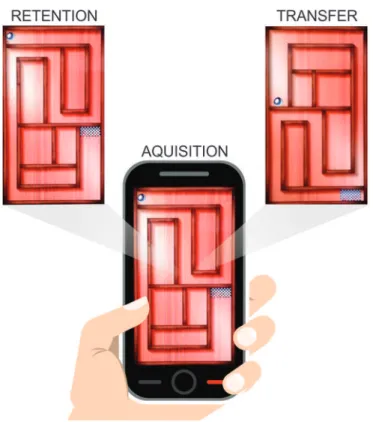
was verbally explained and a demonstration was offered by the examiner. Runtime was noted in each experimental stage, as explained below: acquisition (A), retention (R), and transfer (T). The customized game used in this study consisted of a maze with a path that required eight basic movements for the virtual ball to reach the end of the labyrinth.
According to the protocol, the acquisition phase
consisted of 30 repetitions of the maze task, divided into 6 blocks of five repeats each (A1 to A6). A five-minute interval
of rest followed, during which participants were not in
touch with the task. The retention phase (R) followed, in which five replicates of the same maze acquisition were
performed. Immediately after the retention, the transfer
(T) test was applied, whereupon five repetitions were performed with a new maze configuration, with a totally
opposite path (inverted vertically and horizontally) to
the acquisition and retention phases. The time taken to complete the task was noted for the 30 repeats of the acquisition phase, for the five repeats of the retention and five of the transfer test.
Data analysis
After collection, the data were analysed by means
of blocks of five attempts for each phase of the study (acquisition A1-A6, retention R, and transfer T). The
dependent variables were submitted to a 2 (group: DS vs. TD) by 2 (blocks) ANOVA with repeated measures on
the last factor. For the factor block separate comparisons were made for acquisition (first acquisition block A1 versus
final acquisition block A6), retention (A6 versus retention
block R) and transfer (A6 versus transfer block T). All
results are presented as means (M). Post-hoc comparisons were carried out using Tukey-HSD (Honest Significant
Differences) test (p < 0.05).
■
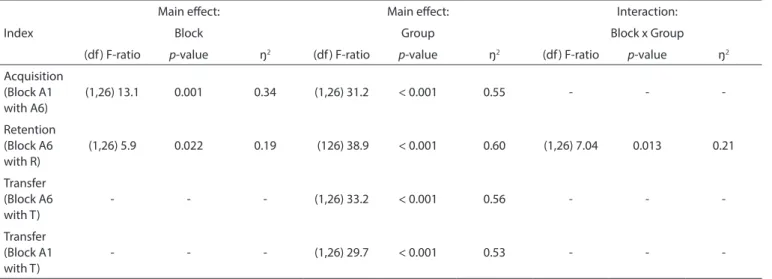
RESULTS AcquisitionTable 1 summarizes all statistical data relating to the analysis of the results. A significant improvement in movement time from A1 to A6 was observed for both groups,
to objectifying the given task, arising from the experience
and practice, resulting in the acquisition, retention, and
transfer of motor skills.9,10 Although there are studies on DS in the area of motor learning,7,11-13 it seems worthwhile to develop research that incorporates advances in technology
that enable tasks not only in real, but also in virtual environments. Virtual reality (VR) is a new technology that
allows users to interact with a scene in three dimensions
generated by a computer during a certain task execution,
allowing and providing increased visual, sensory, and
auditory feedback.14
In addition to computers, televisions, projectors and wireless devices, new technologies such as smart cellphones, may offer diverse opportunities for learning
through motor tasks. Mobile devices enable control over
movement and mobile use in terms of time and place, as well as in terms of communication with others, and interaction with virtual objects.
Therefore, the objective of this study was to verify if individuals with DS are capable of acquiring improved
performance in the execution of a virtual maze task using a mobile phone. As a working hypothesis for this project, people with DS may adapt to the maze task with cellphones
and thus display performance improvement with practice.
■
MATERIALS AND METHODA total of 30 adolescents and young adults participated in this study: 15 patients with a diagnosis
of Down syndrome (DS-group), seven male, eight female,
aged 22.2 ± 7.2 (min: 10/max: 34) years old. The control
group consisted of 15 typically developed (TD-group)
volunteers, matched by age (22.2 ± 7.2 years old) and
gender (seven male, eight female) with DS- group. This
study was approved by the ethics committee on research the ABC medical school under case number CAEE: 39122214.6.0000.0082.
All participants evaluated were able to perform the grip movement to hold the mobile phone with one or both hands. Individuals with comorbidities and functional
disabilities that would impede the completion of the task
were excluded.
Instrument
For data collection, we used a mobile phone set
(smartphone brand Nokia®) and a game called Marble Maze Classic®, in which the person must drive a virtual ball through a predetermined path in a maze with the goal of
reaching a final target in the shortest time possible.
Simulating a wooden table with walls that enclose
the path of the labyrinth, the virtual ball makes its way by
as shown in Figure 1. For DS-group movement time fell from 9912 ms to 7539 ms, whereas for TD-group the fall was from 5433 ms to 3894 ms. Both reductions were significant (mean of both groups fell from 7672 ms to 5716 ms). The intergroup difference was significant, showing that DS-group performed more slowly (M = 8725 ms) than TD-group (M = 4664 ms).
These results are displayed in Figure 2.
Retention
The comparison between A6 and the retention in
phase R showed a significant effect for blocks, groups and interaction between blocks and groups (Table 1). The post hoc test showed that for the DS-group, the movement time
in R (M = 6782 ms) was better than in A6 (M = 7539 ms);
for the TD-group this improvement was not significant
(M = 3927 ms to A6 = 3894 ms, respectively). This result indicates that the learning in both groups had consolidated.
Also, as expected, the movement time of the DS-group was greater (M = 7160 ms) than the TD-group (M = 3911 ms).
These data are displayed in Figure 2.
Transfer
In the comparison between A6 and transfer block T, there were no significant effects or interactions for blocks, suggesting
that learning was consolidated in the groups. However, an effect remained present between groups (Table 1), in which the
DS-group had a larger movement time (M = 8275 ms) when compared to TD-group (M = 4172 ms) as shown in Figure 2.
■
DISCUSSIONThis study aimed to determine whether individuals with Down syndrome are capable of developing improved performance in the execution of a virtual maze task using a mobile phone.
The results confirm the initial hypothesis: in the acquisition phase Down syndrome individuals and normal controls showed significant improvement in the time between the initial performance (block A1) and end (A6 block). Initially, the participants had inconsistent movements, but performance time decreased with practice over the later attempts, characterizing an improvement in performance through practice in the maze task. However, an effect remained present between groups in which the DS-group had a larger movement time when compared to TD-group.
The comparison between the groups showed that the Down syndrome individuals had greater difficulty in carrying out the task as evidenced by the longer time required for execution. These data confirm the results of Palisano et al.,15 which indicated that individuals with the syndrome need more time to learn certain movements as they increase in complexity when compared to individuals with normal development.
Another relevant factor in the assessment of motor learning is the data found in the retention phase, where the performance was retested after a period without contact
with the task. The results showed a significant reduction of time effect between the respective starting blocks of acquisition and the retention block, especially in the
group with DS. This means that both groups had improved performance in retention phase. The result of this was that
successful practice leads to better representation of skill,
resulting in greater retention of the same.16
In addition to the improved performance in the acquisition and retention phases, it is important to note that participants maintained the reduction of time during the
transfer phase of the task. It may be stated that regardless of the difficulty encountered in the maze task in the cell
phone, participants were able to maintain performance allowing an adaptation from a stabilisation phase, featuring the motor learning.
Table 1 - Statistical data of the results from acquisition, retention and transfer phases.
Index
Main efect: Main efect: Interaction:
Block Group Block x Group
(df ) F-ratio p-value ŋ2 (df ) F-ratio p-value ŋ2 (df ) F-ratio p-value ŋ2
Acquisition (Block A1 with A6)
(1,26) 13.1 0.001 0.34 (1,26) 31.2 < 0.001 0.55 - -
-Retention (Block A6 with R)
(1,26) 5.9 0.022 0.19 (126) 38.9 < 0.001 0.60 (1,26) 7.04 0.013 0.21
Transfer (Block A6 with T)
- - - (1,26) 33.2 < 0.001 0.56 - -
-Transfer (Block A1 with T)
- - - (1,26) 29.7 < 0.001 0.53 - -
Figure 1 - Experimental design of the mazes in the acquisition, retention, and transfer phases.
Figure 2 - Duration of movements to complete the maze task by blocks for the Experimental and Control groups.
In the comparison between the groups, individuals
with DS took more time for task execution in all phases of the task when compared to the TD-group. Possebom
et al.7 evaluated individuals with DS in maze task in the computer, and also found that both people with Down syndrome and normally developed individuals were able to satisfactorily cope with the phases of acquisition, retention, and transfer, but in all stages, persons with DS
had significantly lower results when compared to
TD-group; they claim that these data become relevant from the interventional point of view on these subjects, either
in rehabilitation or in physical activity. The motor deficit
in individuals with DS is not necessarily a consequence of changes in their genetic material, because they have great potential for improvement in their motor performance,13
but some factors may directly influence performance in
motor learning people with DS.
Meegan et al.17 compared motor learning in individuals with DS with different feedbacks, and demonstrated a level lower efficiency and increased numbers of errors during performance when compared with participants in the visual-motor performance group.
Considering the knowledge-of-result that
participants had at the end of each trial, Salmoni et al.18
showed that this knowledge-of-result imparted at the right time positively influenced the outcome of the task.
Similar results were found by Chiviacowsky et al.19
They compared different frequency results of knowledge and found no significant differences in relation to a throwing task with the dominant hand performed by individuals with DS, concluding that high or low knowledge-of-result frequencies can be effective for learning motor skills in
adults with DS.
The use of Virtual Reality games can emphasize an
improvement in the participation of the individual and encourage activities in daily life and can be achieved with the higher performance of sensory, motor and cognitive functions in a way that stimulates and motivates individuals in their own recovery.20
Continuous advances in VR technology along
with cost savings have supported the development of systems with greater accessibility and usefulness aimed exclusively at changes in the physical, psychological and cognitive domains.21 There are different possibilities
of using the knowledge of VR in persons with DS, as in
computer games, video games, and tablets; however, the use of a mobile phone as interactive technology is
a viable option and a low-cost technology accessible
to many.
We believe that other studies with a larger number
of participants, checking the influence of the inversion of
the drawings and the maze, will be important in future studies.
■
CONCLUSIONWe conclude that the process of motor learning in
individuals with DS through the maze task in mobile phone
showed improved performance, as evidenced by a reduced time in the retention phase and maintenance in the transfer
phase, confirming the occurrence of motor learning.
■
ACKNOWLEDGEMENTWe gratefully acknowledge financial support
from the Brazilian fostering agency Coordenação de
4. Mancini MC, Silva P, Gonçalves SC, Martins SdM, Sampaio R. Comparação do desempenho funcional de crianças portadoras de
síndrome de Down e crianças com desenvolvimento normal aos 2 e 5 anos de idade. Arq Neuropsiquiatr. 2003; 61(2B):409-415. 5. Lam MY, Hodges NJ, Virji-Babul N, Latash ML. Evidence for slowing
as a function of index of difficulty in young adults with Down
syndrome. Am J Intellect Dev Disabil. 2009;114(6):411-26.
6. Gimenez R, Stefanoni FF, Farias PB. Relação entre a capacidade de sincronização temporal e os padrões fundamentais de movimento
rebater e receber em indivíduos com e sem Síndrome de Down. Rev Bras Ciênc Mov. 2007; 15(1):95-101.
7. Possebom WF, Silva TD, Ré AHN, Massetti T, Belisário LZ, Ulian E, et al. Aprendizagem motora em pessoas com síndrome de Down.
Tarefa de Labirinto no Computador. Temas sobre Desenvolvimento.
2013;19(104):54-60.
8. Schmidt RA, Lee TD. Motor control and learning: a behavioral emphasis. Champaign. IL: Human Kinetics; 1999.
9. de Mello Monteiro CB, Massetti T, da Silva TD, van der Kamp J, de Abreu LC, Leone C, Savelsbergh GJ. Transfer of motor learning from
virtual to natural environments in individuals with cerebral palsy.
Res Dev Disabil. 2014;35(10):2430-7.
10. Lee TD, Wishart LR. Motor learning conundrums (and possible
solutions). Quest. 2005;57(1);67-78.
11. Almeida GL, Corcos DM, Latash ML. Practice and transfer effects
during fast single-joint elbow movements in individuals with Down syndrome. Phys Ther. 1994;74(11):1000-12. Discussion 1012-6 12. Chiviacowsky S, Machado C, Marques AC, Schild JFG, Drews RR.
Motor learning and Down syndrome: effects of reduced relative
frequency of knowledge of results. Rev Bras Cineantropom Desempenho Hum. 2013;15(2):225-32.
13. Latash ML. Learning motor synergies by persons with Down
syndrome, J Intellect Disabil Res. 2007;51(Pt 12):962-71. 14. Saposnik G1, Teasell R, Mamdani M, Hall J, McIlroy W, Cheung D,
et al. Effectiveness of virtual reality using Wii gaming technology
in stroke rehabilitation: a pilot randomized clinical trial and proof of principle. Stroke. 2010;41(7):1477-84.
15. Palisano RJ1, Walter SD, Russell DJ, Rosenbaum PL, Gémus M,
Galuppi BE, et al. Gross motor function of children with down syndrome: creation of motor growth curves. Arch Phys Med
Rehabil. 2001;82(4):494-500.
16. Chiviacowsky S, Tani G. Efeitos da frequência do conhecimento
de resultados na aprendizagem de uma habilidade motora em
crianças. Rev. Paul. Educ. Fís. 1993;7(1):45-57.
17. Meegan S, Maraj B, Weeks D, Chua R. Gross motor skill acquisition
in adolescents with Down syndrome, Down Syndr Res Pract.
2006;9(3):75-80.
18. Salmoni AW, Schmidt RA, Walter CB. Knowledge of results and motor learning: a review and critical reappraisal. Psychol Bull.
1984;95(3):355-86.
19. Chiviacowsky S, Wulf G, Machado C, Rydberg N. Self-controlled feedback enhances learning in adults with Down syndrome, Braz J Phys Ther. 2012;16(3):191-6.
20. Courbois Y, Farran EK, Lemahieu A, Blades M, Mengue-Topio H, Sockeel P. Wayfinding behaviour in Down syndrome: a study with virtual environments. Res Dev Disabil. 2013:34(5):1825-31. 21. Rizzo AA, Strickland D, Bouchard S. The challenge of using virtual
reality in telerehabilitation. Telemed J E Health.
2004;10(2):184-95.
■
AUTHOR CONTRIBUTIONSAll authors participated in the acquisition of data and revision of the manuscript. All authors determined the design, interpreted the data and drafted the manuscript.
All authors read and gave final approval for the version
submitted for publication.
■
DECLARATION OF CONFLICT OF INTEREST Authors reports no conflict of interest. They arecollectively responsible for the content and writing of this paper.
APRENDIZADO MOTOR PARA PORTADORES DE SÍNDROME DE DOWN USANDO UM TELEFONE CELULAR - PROJETO PILOTO
OBJETIVO: O objetivo deste estudo foi verificar
se os indivíduos com síndrome de Down melhoram o
desempenho em uma tarefa de labirinto virtual usando um telefone celular.
MÉTODO: Para esta tarefa, foram avaliados 30
adolescentes e adultos jovens, onde 15 eram parte do grupo experimental e 15 do grupo controle.
RESULTADOS: Os resultados mostraram que ambos
os grupos apresentavam uma melhoria significativa ao
longo do tempo nas fases de aquisição e de retenção.
Na fase de transferência, eles foram capazes de manter
o desempenho, permitindo uma adaptação da fase de estabilização, que caracteriza a aprendizagem de motora.
CONCLUSÃO: Comparando os dois grupos, os
indivíduos com SD tem necessidade de um tempo maior
para completar o labirinto em todas as fases da tarefa.
PALAVRAS-CHAVE: síndrome de Down,
aprendiza-gem motora, realidade virtual.
■
REFERENCES1. Lana-Elola E, Watson-Scales SD, Fisher EM, Tybulewicz VL. Down
syndrome: searching for the genetic culprits. Dis Model Mech.
2011;4(5):586-95.
2. Wuang YP, Chiang CS, Su CY, Wang CC. Effectiveness of virtual reality using Wii gaming technology in children with Down syndrome.
Res Dev Disabil. 2011;32(1):312-21.
3. Rodenbusch TL, Ribeiro TS, Simão CR, Britto HM, Tudella E, Lindquist AR. Effects of treadmill inclination on the gait of children