Original Article
Artigo Original
Maria Silvia Cárnio1
Beatriz Campos Magalhães de Sá1
Laís Alves Jacinto1
Aparecido José Couto Soares1
Descritores
Avaliação Linguagem Memória Aprendizagem Escolaridade Keywords
Evaluation Language Memory Learning Education
Correspondence address:
Maria Silvia Cárnio
Rua Cipotânea, 51, Cidade Universitária, São Paulo (SP), Brasil, CEP: 05360-160. E-mail: [email protected]
Received: 09/02/2014
Study carried out at the Reading and Writing Laboratory of the Department of Physical Therapy, Speech Language Pathology and Audiology and Occupational Therapy of the School of Medicine of Universidade de Paulo – FMUSP – São Paulo (SP), Brazil.
(1) Department of Physical Therapy, Speech Language Pathology and Audiology and Occupational Therapy of the School of Medicine of Universidade de São Paulo – FMUSP – São Paulo (SP), Brazil.
Financial support: Conselho Nacional de Desenvolvimento Cientíico e Tecnológico – CNPq and Rectory for Research of Universidade de São Paulo.
Conlict of interests: nothing to declare.
Phonological short-term memory and phonological
awareness in students from the Elementary School
Memória de curto prazo fonológica e consciência fonológica
em escolares do Ensino Fundamental
ABSTRACT
Objectives: To characterize and compare the performance of students at the beginning and at the end of the elementary school in Short-Term Phonological Memory (STPM) and Phonological Awareness (PA).
Methods: We assessed 80 students of both the genders who showed adequate linguistic and academic performance. The sample comprised 40 students in 1st grade and 40 in 5th grade from a public state school with mean age of 6.2 and 9.8 years, respectively. The STPM was assessed using a standardized test of Pseudoword Repetition. PA was assessed through a Sequential Assessment Test (CONFIAS). Results: No difference was found between the students of 1st and 5th years in STPM both in total score and concerning the similarity of the pseudowords. Regarding PA, there was a signiicant difference among the percentage distribution of correct answers in syllabic and phonemic tasks, and the students from 5th grade presented better performance. Conclusion: At the beginning and at the end of the elementary school, there is no difference in STPM performance. On the other hand, there is difference in PA, which highlights the inluence of schooling on PA development. The correlation between STPM and PA only in 5th-year students suggests that, at the beginning of literacy, STPM cannot be considered as a predictor to children’s performance in PA. Nevertheless, as the schooling advances, there is inluence of PA on STPM.
RESUMO
Objetivos: Caracterizar e comparar o desempenho de escolares no início e término (1° e 5° ano) do Ensino Fundamental I, nas habilidades de Memória de Curto Prazo Fonológica e Consciência Fonológica. Métodos: Foram avaliados 80 escolares, de ambos gêneros, com bom desempenho escolar e linguístico, sendo 40 do 1º ano e 40 do 5º ano de uma escola estadual com média de idade, respectivamente, de 6,2 e 9,8 anos. Para a avaliação da Memória de Curto Prazo Fonológica (MCPF) foi utilizado um teste padronizado de repetição de pseudopalavras. A Consciência Fonológica (CF) foi avaliada por meio de um Instrumento de Avaliação Sequencial - CONFIAS.
INTRODUCTION
Phonological Awareness (PA) is a metalinguistic skill that consists of the ability to identify, manipulate, and segment the minimum units of speech and contribute to the establishment of phoneme–grapheme association. It can be analyzed in two skill levels: syllabic and phonemic(1,2).
There is a reciprocal relationship between the development of phonological awareness and the development of reading and writing. The syllabic awareness, present in preschool, is developed to the level of the phoneme, favoring the acquisi-tion of reading and writing skills. As linguistic tasks become more complex and the reading experience increases, the skills of phonological awareness are enhanced(2,3).
The phonological system processes information verbally encoded with two components: the phonological short-term memory (phonological loop), responsible for the storage of information for a short period of time; and subvocal feedback (articulatory loop), which rescues the verbal material in decline and keeps it in memory(4), assisting in the processing and
orga-nization of language.
Phonological operational memory or working memory will be named in this study as Short-Term Phonological Memory (STPM). However, when making comments on other studies, the terms used by the authors in their publications will be main-tained. The STPM consists of a processing system that stores and manipulates information in a short period of time, which remain activated by repetition or by transfer to the long-term memory(5,6).
The temporary storage in memory has limited capacity, but we consider that with childhood development there is increased retention of phonological information.
Working memory and its relationship with language has been studied by many researchers, with variations on the objectives, procedures and/or instruments, and sample types (typical and/ or some kind of linguistic change subjects, different ages, and different levels of schooling)(4-8).
There are several ways to assess the STPM, but there is still no consensus on the most appropriate way. Instant replay of let-ters, digits, pseudowords, and nonwords were used. The results showed that the maturation and development of memory occur according to chronological age and educational level(7,8).
Researchers(9-11) have demonstrated the role of phonological
awareness in the schooling process and vice versa.
The relationship between verbal short-term memory (working memory/phonological operational memory) and PA has aroused the interest of researchers, with various studies approaching dif-ferent age groups, educational levels, objectives, and language development (with and/or without disorders. Overall, it appears that memory and phonological awareness are interrelated and often inseparable and dependent on chronological age, matu-rity, and level of education of the subjects(6,8,12-16).
This study is relevant and differs from the above-mentioned literature as it has as objective to characterize and compare the performance of the students at the beginning and end (1st and
5th years) of the elementary school in the STPM and PA skills.
Although national studies(8,12-16) have evaluated these skills in
the students of the elementary school, this is the irst study
in literature to make a comparative analysis between the 1st- and 5th-year students of the elementary school through the overall results accuracy for each test and analysis of each group in each subtest of the studied skills.
In this way, it is relevant to investigate and understand the inluence of formal education process both in the STPM and in the PA, according to the advancement of education.
METHODS
This research was conducted after approval of the Institutional Ethics Committee under nº 402/11 and signature of informed consents by parents and/or guardians.
Materials and procedures
Procedures for selection of subjects
This study comprised 80 students, of both genders, 40 stu-dents of 1st year and 40 stustu-dents of 5th year of a public elemen-tary school, with mean age of 6.2 and 9.8 years, respectively. They met the following inclusion criteria: signature of the free informed consent; absence of complaints or cognitive, auditory, and/or visual impairment indicators; no prior or current oral language disorders absence of failure in school history and/or current learning dificulties; no psychological or speech lan-guage pathology and audiology treatment, and tutoring.
Parents and/or guardians responded to an anamnesis related to information on the overall development of language in their children and conirmation of the inclusion criteria.
The students underwent an individual screening that con-sisted of audiological evaluation, using the pediatric audiometer Interacoustics – PA5, to exclude hearing loss that could inlu-ence the patient’s performance in the applied tests.
In addition, a speech and audiology screening was held at a predetermined room by the school board. Each child was individually evaluated through the Phonology test (Imitation) of the Child Language Test ABFW(17), and the oral counting
story elicited by an image of action(18), in which the
phonologi-cal, syntactic, semantic, and pragmatic aspects of the language were observed.
Specifically, for the students of 5th year, the School
Performance Test (SPT) was used to assess written language, consisting of three subtests: reading, writing, and arithmetic(19).
The same was applied individually and interpreted in accor-dance to the descriptions of the instrument’s manual, in order to achieve the overall performance of each student. We only sampled children with performance ranked as average or higher, according to the standard test for 5th-year students. This test was not applied to the students of 1st year, as it requires alpha-betical writing level, absent in most children of that year.
The students who met the inclusion criteria comprised the sample, and the others were referred for speech and audiology therapy services and/or other speciic locations.
Procedures for application of Experiment Tests
medium, and high similarities, respectively), following the pho-nological structure of Brazilian Portuguese. The students were evaluated individually in a speciic location free of noise. At the time, they were instructed to repeat the pseudoword immedi-ately after the assessor pronounced it. The score followed the criteria proposed by the test: correct answers worth one point and incorrect answers, zero. Therefore, 40 points are equiva-lent to 100% accuracy.
To evaluate the PA, we used the Sequential Assessment (CONFIAS)(21), containing two parts: syllabic level, consisting
of nine items (synthesis, segmentation, identiication of ini-tial syllable, rhyme identiication, word production with given syllable, identiication of medial syllable, rhyme production, exclusion, and transposition) and phonemic level, consisting of seven items (production word that begins with the given sound, initial phoneme identiication, inal phoneme identii-cation, exclusion, synthesis, segmentation, and transposition). For both parts, the score followed the criteria established by the authors (correct answers worth one point and incorrect, zero), with the possibility of reaching 40 points in syllabic part and 30 in phonemic. The test was applied orally and was provided visual support.
Data analysis
Initially, a descriptive analysis of the data obtained in each test was performed. For comparing STPM and PA skill results, response variable was considered as the overall percentage of scores in each of them.
To compare the means of the total percentage of correct answers in both grades and tests, the technique of analysis of variance (ANOVA) was used with repeated measures, consid-ering two factors: school year (1st and 5th years) and applied
evidence, in STPM and PA. To ind the differences between the mean values, we used the Bonferroni procedure.
Pearson correlation coeficient was calculated to measure the correlation between total scores on tests of STPM and PA in each school year. Statistical analysis was performed with the aid of Minitab applications (version 16) and SPSS (version 18). In the hypothesis test, 0.05 was set as signiicance level. Consequently, it was found that the assumptions for the applica-tion of ANOVA were not valid when considering the subtests in
isolation. For this reason, we chose to use an inferential analy-sis, using a nonparametric test.
Thus, to compare both the school grades as to each of the subtests of the evidence of STPM and PA, the Mann-Whitney test was used.
RESULTS
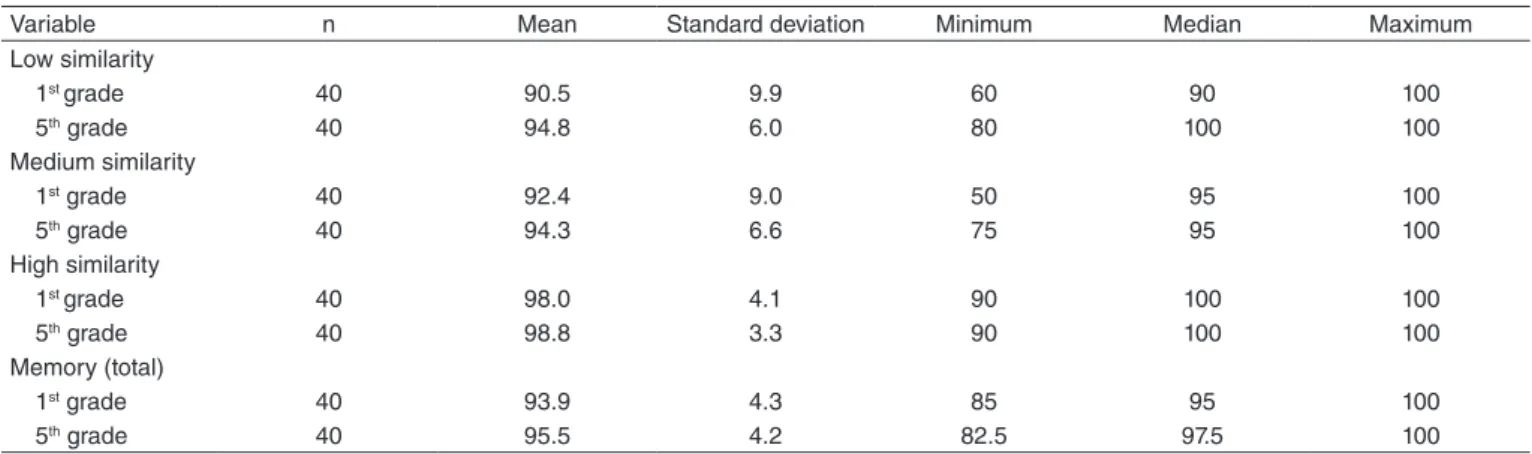
In STPM test, the average of the total score among the stu-dents of 1st and 5th years were similar, with greater discrep-ancy observed in the pseudowords of low similarity (Table 1). Similar results were obtained in inferential analysis between both grades, considering each subtest, as shown in Figure 1.
This type of analysis has conirmed that there was no statistical difference between the distributions of the score percentages in subtests of low (p=0.056), mean (p=0.257), and high (p=0.366) similarities in both school grades. However, the p-value obtained in the subtest of low similarity was close to 0.05.
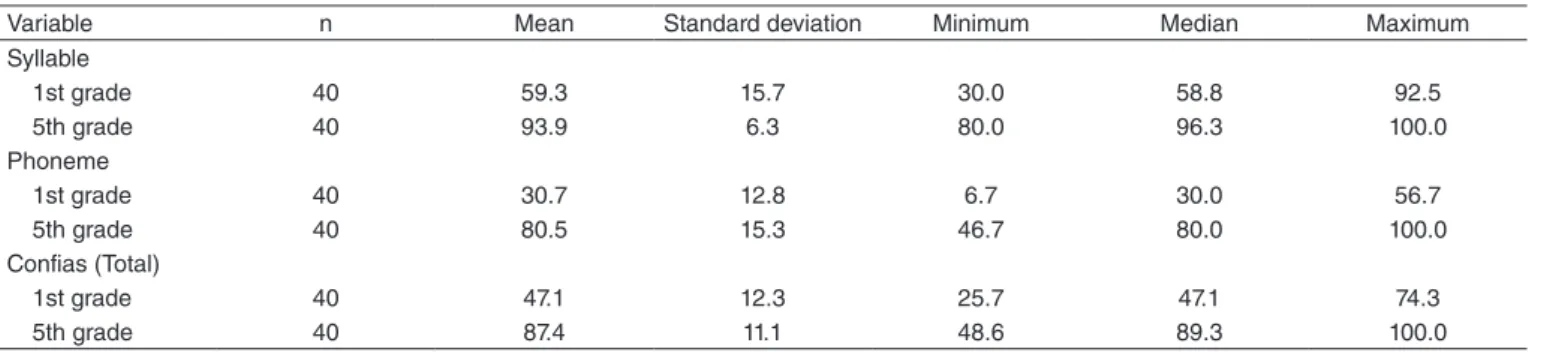
Regarding the PA test, it was observed that the average per-centage of correct answers in 5th-year students was higher than those in 1st-year students, both in syllabic tasks (p<0.001) and in phonemic tasks (p<0.001) (Table 2).
By inferential analysis of the students of 1st and 5th years,
considering each subtest of the PA test, we found similar results (Figure 2).
The results of inferential analysis showed that there was a signiicant difference between distributions of score percentages in the syllabic awareness subtest (p<0.001) and the phonemic awareness (p<0.001) in both school grades, and the students of 5th year tend to have higher percentage of correct answers
than 1st-year students.
ANOVA with repeated measures showed that the difference between the students of 1st and 5th years depends on the test
(p<0.001) and that the difference between both the tests (STPM and PA) is not the same in both grades that is, there is interac-tion effect between school examinainterac-tion and year (Figure 3). We observed that, in 1st-year students, the average percentage
of correct answers in the STPM test was higher than the aver-age percentaver-age of correct answers in the PA test (p=0.010). This difference was not observed in the students from 5th grade
(p>0.999), as they showed high scores in both the tests applied.
Table 1. Percentage of hits in the Short-Term Phonological Memory per school year
Variable n Mean Standard deviation Minimum Median Maximum
Low similarity
1st grade 40 90.5 9.9 60 90 100
5th grade 40 94.8 6.0 80 100 100
Medium similarity
1st grade 40 92.4 9.0 50 95 100
5th grade 40 94.3 6.6 75 95 100
High similarity
1st grade 40 98.0 4.1 90 100 100
5th grade 40 98.8 3.3 90 100 100
Memory (total)
1st grade 40 93.9 4.3 85 95 100
In STPM, there is no signiicant difference between mean percentage of correct answers when comparing both the school years (p=0.840). There was difference in PA, since the average percentage of correct answers by 5th-year students is greater
than in 1st-year students (p<0.001).
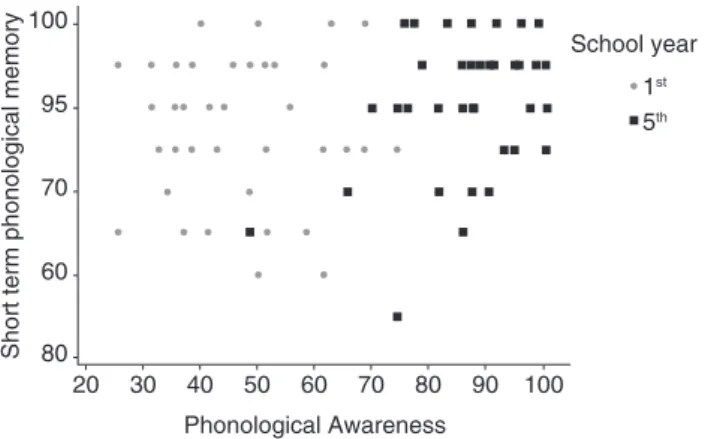
The score behavior in both the events (STPM and PA) in each school grade is illustrated in the scatter diagram (Figure 4). There has been no trend in the cloud of points equivalent to 1st
-year students. In contrast, it was observed in 5th-year students
that the performance on a test tends to increase as the highest score in another.
While determining values of the Pearson correlation coef-icient (r) between scores on both the tests in each group (1st
year: r=0.02 [p=0.923]; 5th year: r=0.41 [p=0.008]), it was
pos-sible to observe that there was no correlation between PA and STPM in 1st-year students. However, in 5th-year students, there
was a positive correlation between the tests applied. Thus, the students in 5th year showed that, the better the score in PA, the
better the performance in the STPM test.
DISCUSSION
The results shown in Table 1 and Figure 1 indicated that, in the STPM test, the students of 1st and 5th years did not
dif-fer in relation to the total score, even when compared by sub-tests of low, medium, and high similarity, reaching almost the maximum scores.
In this research, we expected to have a signiicant difference between the students of 1st and 5th years, both in performance
of the subjects in PA tasks and in the STPM for predicting the inluence of the literacy process in its beginning and end, as described in literature(12,22,23). However, this did not occur in the
pseudowords repeat test (STPM), supporting a national study(3)
whose results showed that short-term memory skills and access to mental lexicon of children of the elementary school do not depend on age and education.
A possible explanation for the performance of similarity in STPM in such different grades may result from phonological similarity of the pseudowords used in the test, a fact that favors the retention process and correct repetition of the target stimu-lus and enables greater success, regardless of education(13,24,25).
The pseudowords facilitate the storage of phonological infor-mation in STPM due to its associations with actual words of the language(25). The data from this study support this
hypoth-esis, as there was a greater difference between the groups in the words of low similarity. Therefore, we can speculate that if there were a greater number of pseudowords of low similar-ity, the difference in score between 1st- and 5th-year students
could have been higher.
In phonological proximity, the long-term memory may inlu-ence the short-term by means of the lexicality effect. This effect, known as reintegration, attempts to repair incomplete or dif-fuse phonological representations (pseudowords) using per-manent representations of long-term memory(26). This recall is
Table 2. Percentage of hits in the Phonological Awareness test per school year
Variable n Mean Standard deviation Minimum Median Maximum
Syllable
1st grade 40 59.3 15.7 30.0 58.8 92.5
5th grade 40 93.9 6.3 80.0 96.3 100.0
Phoneme
1st grade 40 30.7 12.8 6.7 30.0 56.7
5th grade 40 80.5 15.3 46.7 80.0 100.0
Confias (Total)
1st grade 40 47.1 12.3 25.7 47.1 74.3
5th grade 40 87.4 11.1 48.6 89.3 100.0
100
90
80
70
60
50
1st
School year
Low similarity Medium similarity High similarity
5th 1st
* *
5th 1st 5th
Percentage of hits
Figure 1. Box-plots of the percentage of hits in the subtests of the
Short-Term Phonologycal Memory test
100
80
60
40
20
0
1st
School year
Syllable Phoneme
5th 1st 5th
Percentage of hits
Figure 2. Box-plots of the percentage of hits in the subtests of the
100
80 90
70
60
50
Memory Phonological Awareness
School year 1st
5th
Mean of the percentage of hits
Figure 3. Means of the percentage of hits in the Short-term Phonological
Memory test and in the Phonological Awareness test in each school year
100
95
70
60
80
School year
1st
5th
20
Short term phonological memory
30 40 50 60 70 80 90 100
Phonological Awareness
Figure 4. Scatter diagram of the grades in the Short Term Phonological
Memory test and in the Phonological Awareness test in each school year
facilitated especially if there is, besides phonological similar-ity, a relationship with the semantic value.
One study(27) analyzed four variables that inluence
short-term memory: lexicality, frequency, phonological similarity of nonword, and familiarity with the language. On the basis of their indings, the authors emphasized the importance of evaluating the STPM through nonwords, so as not to activate long-term memory for reintegration.
The aforementioned variables can account for the simi-larity in performance of the groups of this study, as phono-logical similarity and familiarity with the language were present in pseudowords of the test. The Pseudoword Repeat Test(20) was validated for Brazilian Portuguese-speaking
children, with scientific rigor and, therefore, selected for this study, considering the lack of memory tests for the age group studied.
In future researches, the use of tests that have nonwords preferably with various extensions is suggested. However, if pseudowords are used, it is indicated that an equivalence in their number of similarity is made (low, medium, and high), maintaining the variability of extension. Thus, one can have a more sensitive tool for analyzing the STPM of the students of early grades of the elementary school.
This study encourages reflection about the use of pseudo-words and nonpseudo-words in the assessment of STPM. Nonpseudo-words, such as those used in other studies(23,25), purely activate
the phonological system, ensuring greater accuracy in the evaluation of STPM skills. In this case, the only factor that can influence the storage capacity is the extension(12,25).
Therefore, nonwords appear to provide more consistent data on the STPM(8).
Regarding PA (Table 2 and Figure 2), mean score of 1st
-year students were signiicantly inferior to the mean of 5th
-year students, mainly in the syllabic tasks. This corroborates other studies, which highlight that the PA ability evolves with schooling and that there is a strong relationship of reciprocity between PA and development of reading and writing(3,21,28-30).
These data can be justiied by the use of the synthetic method in the researched school, which reinforces the work in this regard. In addition, studies describe that the syllabic awareness is gained before phonemic, and the latter has its development and improvement with schooling(12,28-30).
The indings of this research also reinforces studies(13,28-30)
that claim that, before formal schooling, children already possess the primary levels of PA — for example, syllabic awareness, which in turn helps in learning and is improved based on it, evolving to phonemic recognition, and conirm-ing the bond of reciprocity between the acquisition of read-ing and writread-ing and PA. Thus, the school has a fundamental role in inding a work involving the handling and the relec-tion of smaller sound segments in order to facilitate reading and writing learning(3,29).
Another relevant aspect to be highlighted is the fact that the students from the 5th year of this study did not reach the maximum score in CONFIAS, as that test was standardized for children with a mean age of seven years and medium/high socioeconomic status. Thus, it is speculated that extrinsic factors can inluence the performance in PA as reported in a national study(13), because the students of this research are from a low
socioeconomic community. It should be emphasized the impor-tance of using another PA assessment tools that address nor-mative data for the different education levels covered in this study, eliminating the possible inluence of extraneous variables.
The data indicated a positive correlation between STPM and PA found in the 5th-year group, that is, the better the PA
score, the better was the performance in STPM, which was not observed in 1st-year students (Figure 4). A possible
expla-nation for this correlation in children with higher education may be the most signiicant domain in handling syllables and phonemes, which was settled with formal education, increas-ing the phonological information storage (phonological buf-fer). The correlation described in this study was also found in another national research(14).
The innovative contribution of this study was the lack of correlation between PA skills and STPM veriied in the 1st
CONCLUSION
This study shows that, at the beginning and at the end of the elementary school, STPM skills are similar. The same is not true for PA, as there is difference between the performance of the students of 1st and 5th years, showing the inluence of
edu-cation on the development of PA.
The fact that there is correlation between STPM and PA only for the students of 5th year suggests that, in the beginning of literacy, STPM cannot be considered a predictor of the perfor-mance of the children in PA. However, with the advancement of education, there is an inluence of PA in STPM. Thus, these data indicate that, when analyzing the performance of the stu-dents, the range of education and its relation to the tests applied should be considered.
*MSC directed the research design, contributed to the analysis and interpretation of the data, and to the drafting, supervision, and editing of the manuscript; BCMS e LAJ were responsible for the collection, tabulation, and analysis of the data and for drafting of the manuscript; AJCS contributed to the analysis and the interpretation of the data and with the drafting and editing of the manuscript.
REFERENCES
1. Wocadlo C, Rieger I. Phonology, rapid naming and academic achievement in very preterm children at eight years of age. Early Hum Dev. 2007;83(6):367-77. 2. Capellini SA, Oliveira AM, Pinheiro FH. Eficácia do programa de
remediação metafonológica e de leitura para escolares com diiculdade de aprendizagem. Rev Soc Bras Fonoaudiol. 2011;16(2):189-97. 3. Tenório SMPCP, Avila CRB. Processamento fonológico e desempenho
escolar nas séries iniciais do ensino fundamental. Rev CEFAC. 2012;14(1):30-8.
4. Baddeley A. Working memory and language: an overview. J. Commun. Dis. 2003;36(3):189-208.
5. Baddeley A. The episodic buffer: a new component of working memory? Trends Cognit. Sci. 2000;4(1):417-23.
6. Alloway TP, Gathercole SE, Willis CE, Adams A. A structural analysis of working memory and related cognitive skills in young children. J. Experim. Child Psychol. 2004;87(2):85-106.
7. Vaz IA, Cordeiro PM, Macedo EC, Lukasova K. Memória de trabalho em crianças avaliada pela Tarefa de Brown-Peterson. Pró-Fono Rev Atual Cient. 2010;22(2):95-100.
8. Grivol MA, Hage SRV. Memória de trabalho fonológica: estudo comparativo entre diferentes faixas etárias. J Soc Bras Fonoaudiol. 2011;23(3):245-51. 9. Cunningham AJ, Carroll JM. Reading-related skills in earlier e later
schooled children. Sci Stud Read. 2011;15(3):244-66.
10. Furnes B, Samuelsson S. Phonological awareness e rapid automatized naming predicting early development in reading e spelling: Results from a cross-linguistic longitudinal study. Learn Individ Differ. 2011;21:85-95.
11. Ukrainetz TA, Nuspl JJ, Wilkerson K, Beddes SR. The effects of syllable instruction on phonemic awareness in preschoolers. Early Child Res Q. 2011;26(1):50-60.
12. Gindri G, Keske-Soares M, Mota HB. Memória de trabalho, consciência fonológica e hipótese de escrita. Pró-Fono R Atual Cient. 2007;19(3):313-22. 13. Soares AJC, Jacinto LA, Cárnio MS. Memória operacional fonológica
e consciência fonológica em escolares ao final do ciclo I do ensino fundamental. Rev. soc. bras. fonoaudiol. 2012;17(4):447-453.
14. Cardoso AM, Silva MM, Pereira MMB. Consciência fonológica e a memória de trabalho de crianças com e sem diiculdades na alfabetização. CoDAS. 2013;25(2):110-114.
15. Silva C, Capellini AS. Desempenho de escolares com e sem transtorno de aprendizagem em leitura, escrita, consciência fonológica, velocidade de processamento e memória de trabalho fonológica. Rev. Psicopedagogia. 2013;30(91):3-11.
16. Nunes C, Frota S, Mousinho R. Consciência Fonológica e o Processo de Aprendizagem de Leitura e Escrita: Implicações Teóricas para o Embasamentoda Prática Fonoaudiológica. Rev CEFAC. 2009;11(2):207-12. 17. Wertzner HF. Fonologia. In: Andrade CRF, Bei-Lopes DM, Fernandes
FDM, Wertzner HF. ABFW: Teste de Linguagem Infantil nas Áreas de Fonologia, Vocabulário, Fluência e Pragmática. Carapicuíba (SP): Pró-Fono, 2000.
18. Mayer M. Frog, where are you? New York: Ed. Pinguin; 1969. 19. Stein LM. Teste de Desempenho Escolar (TDE). São Paulo: Casa do
Psicólogo; 1994.
20. Santos FH, Bueno OFA. Validation of the Brazilian Children´s Test of Pseudoword Repetition in Portuguese speakers aged 4 to 10 years. Braz J Med Biol Res. 2003;36(11):1533-47.
21. Moojen S, Lamprecht R, Santos RM, Freitas GM, Brodacz R, Siqueira M et al. Consciência Fonológica – Instrumento de Avaliação Sequencial (CONFIAS). Casa do Psicólogo: São Paulo; 2003.
22. Gindri G, Keske-Soares M, Mota HB. Comparação do desempenho de crianças pré-escolares e de primeira série em tarefas envolvendo a memória de trabalho. R Soc Bras Fonoaudiol. 2005;10(4):201-6.
23. Cunha VLO, Capellini SA. Desempenho de escolares de 1ª a 4ª série do ensino fundamental nas provas de habilidades metafonológicas e de leitura – PROHMELE. Rev Soc Bras Fonoaudiol. 2009;14(1):56-68. 24. Rodrigues A, Bei-Lopes DM. Memória operacional fonológica e suas
relações com o desenvolvimento da linguagem infantil. Pró-Fono Rev Atual Cient. 2009;21(1):63-8.
25. Rodrigues A, Bei-Lopes D. Memória de curto-prazo fonológica em crianças pré-escolares. CoDAS. 2013;25(5):422-8.
26. Hulme C, Maughan S, Brown GDA. Memory for familiar and unfamiliar words: Evidence for a long-term memory contribution to short-term memory span. J Mem Lang. 1991;30(3):685-70.
27. Thorn ASC, Gathercole SE, Frankish CR. Reintegration and the beneits of long-term knowledge in verbal short-term memory: An evaluation of Schweickerts multinomial processing tree model. Cognitive Psychol. 1993;50(3)133-58.
28. Cárnio MS, Santos D. Evolução da consciência fonológica em alunos de ensino fundamental. Pró-Fono R. Atual. Cient. 2005;17(2):195-200. 29. Soares AJC, Cárnio MS. Consciência fonêmica em escolares antes e após
oicinas de linguagem. J Soc Bras Fonoaudiol. 2012;24(1):69-75. 30. Capellini SA, Conrado TLBC. Desempenho de escolares com e sem