Prevalence of common mental
disorders among the residents of
urban areas in Feira de Santana,
Bahia
Prevalência de transtornos mentais
comuns entre residentes em áreas
urbanas de Feira de Santana, Bahia
Saulo Vasconcelos Rocha
I,IIMaura Maria Guimarães de Almeida
ITânia Maria de Araújo
IJair Sindra Virtuoso Júnior
IIII Programa de Pós-Graduação em Saúde Coletiva da Universidade Estadual de
Feira de Santana (UEFS), Bahia.
II Núcleo de Estudos em Saúde da População, Universidade Estadual do
Sudoeste da Bahia.
III Instituto de Ciências da Saúde da Universidade Federal do Triângulo Mineiro.
Correspondence to: Saulo Vasconcelos Rocha. Universidade Estadual de Feira de Santana – UEFS, Centro de Pós-graduação em Saúde Coletiva, Núcleo de Epidemiologia, BR 116, Km 03 - CEP 44031-460, Feira de Santana, BA. E-mail: [email protected]
Abstract
Objective:To describe the prevalence of
common mental disorders according to socio-demographic characteristics, lifestyle and medical conditions among residents in urban areas of Feira de Santana, Bahia, Brazil. Methods: A cross-sectional study was carried out, including a random sample of the urban population of Feira de Santana, over the age of 15 years. A speciic form was used to obtain information about socio-demographic aspects, lifestyle and disease frequency. In addition, the SRQ-20 was used to measure common mental disorders (CMD). The statistical analysis adopted a significance level of p≤ 0.05; prevalence ratios and respective 95% conidence in-tervals were calculated. Results: A total of 3,597 individuals were analyzed, of which 71.4% were females. The global prevalence of CMD was 29.9%. Data analysis revealed that socio-demographic characteristics (sex, education level, income), lifestyle and clinical conditions were associated with the prevalence of CMD. Conclusion: The pres-ent study enabled the estimation of CMD prevalence in the urban population of a city located in Northeastern Brazil and the identiication of characteristics associated with this prevalence, which may interfere with their mental health. In this sense, mu-nicipal health care policies should include actions aimed at encouraging participation in leisure activities, as well as campaigns to control tobacco use and chronic diseases.
Key Words: Mental Health, Urban Health,
Resumo
Objetivo: Descrever a prevalência de
trans-tornos mentais comuns segundo caracterís-ticas sociodemográicas, hábitos de vida e presença de doenças crônicas entre residen-tes em áreas urbanas de Feira de Santana, Bahia. Métodos: Trata-se de um estudo epidemiológico de corte transversal com amostra da população de 15 anos de idade de Feira de Santana, aleatoriamente selecio-nada. Foi utilizado um formulário, contendo informações sociodemograicas, de hábitos de vida e doenças referidas. O SRQ-20 foi utilizado para mensuração de Transtornos Mentais Comuns (TMC). A análise estatísti-ca foi realizada com nível de signiicância p≤0,05, cálculo da razão de prevalência e intervalos de coniança de 95%. Resultados: Foram estudados 3.597 indivíduos; 71,4% do sexo feminino. A prevalência global de TMC foi 29,9%. A análise dos dados revelou que características sociodemográicas (sexo, renda e escolaridade), hábitos de vida e as condições clínicas estavam associadas à maior prevalência de TMC. Conclusões: O estudo permitiu estimar a prevalência de TMC na população urbana de um município localizado no nordeste do Brasil e identii-car identii-características associadas aos TMC que podem interferir na saúde mental das popu-lações estudadas. Neste sentido, as políticas de atenção a saúde mental do município devem contemplar ações direcionadas ao incentivo a participação em atividades de lazer além de campanhas de controle do uso de tabaco e doenças crônicas.
Palavras-chave: Saúde mental, Saúde da
População Urbana, Transtornos Mentais, SRQ-20.
Introduction
Psychological disorders are one of the main problems in modern times, affecting the health of populations and incurring high expenses for public health.
According to estimates of the World Health Organization (WHO)1, one out of every four people will suffer from a mental disorder in a certain stage of life. Mental or neurological disorders and psychosocial problems associated with alcohol and drug use affect approximately 450 million individuals.
Common mental disorders (CMD) include non-psychotic disorders and they are characterized by symptoms such as insomnia, fatigue, irritability, forgetfulness, difficulty in concentrating and somatic complaints 2.
CMD represent a psychiatric morbid-ity with signiicant prevalence in modern societies, affecting individuals in different age groups, causing suffering to both the individual and their family and community.
Studies conducted in Brazil and Latin American countries identiied high preva-lences of mental disorders (20.2%3 and 26.7%,4 respectively).
CMD are more frequent in women5;6;7, black and mixed individuals5;7, those with a low level of education6;8, those who are older13, those with a low income5, smokers13 and those with chronic diseases13.
Although the group of mental disorders represents approximately between 13% and 14% of the total burden of diseases, less than 1% of the total spending on health is invested in mental health1, thus creating a wide gap between demand and offer of mental health services. As a result of this difference, only part of the existing cases is identiied and treated, increasing social and economic costs due to such health problems (Almeida-Filho et al., 1997). These disorders are an important cause of missed work days, which indirectly leads to an increase in health service demand.
data on the mental health status of popula-tion groups are still scarce, causing a lack of information about psychiatric morbidity indicators.
The absence or lack of information about the mental health status of popula-tions is a factor that contributes to poor or inexistent mental health care, both in terms of the offer of services and develop-ment of policies on health protection and promotion.
Aiming to increase knowledge about the mental health status of populations, this study was conducted to estimate the preva-lence of common mental disorders in resi-dents of urban areas in the city of Feira de Santana, BA, Brazil, and to describe factors associated with the identiied prevalence.
In view of the growing prevalence of CMD in this population, there is the need of population surveys aimed at the iden-tiication of factors associated with these disorders, enabling health care strategies to be more based on mental health.
Methods
A cross-sectional descriptive study was conducted in the city of Feira de Santana, situated 116 km from Salvador, the capital of the state of Bahia, in Northeastern Brazil, between April and December 2007.
The city of Feira de Santana is the second largest city in Bahia and the 31st in the coun-try. It is situated on the plain between the
Recôncavo Baiano (the fertile coastal area of this state) and the semi-arid tablelands in Northeastern Bahia, with an estimated population of 535,820 inhabitants in 2006 8. The selection of study areas was per-formed with the adoption of random stratified sampling, according to sub-districts and based on census data from the
Fundação Instituto Brasileiro de Geograia e Estatística (Brazilian Institute of Geogra-phy and Statistics Foundation)8, where the household is the sampling unit.
The sample was obtained by considering an estimated prevalence of common mental disorders of 25% 1, sampling error of 3% and
confidence level of 95%. Based on these parameters, a sample of 800 individuals was established. Considering the design effect of the study (cluster sampling), the sample size was doubled, totaling 1,600 individuals. In addition, when refusals and losses of about 20% were considered, the deined sample size was 1,920 individuals.
The following procedures were adopted to select the sample: determination of the percentage of population representation per sub-district of urban area; deinition of per-centage in the sample of each sub-district, according to data on the population living in each sub-district; listing of census tracts in each sub-district; random selection of cen-sus tracts that were included in the sample of each sub-district; random selection of streets included in the sample, in each cen-sus tract; inclusion of all households on the selected streets in the sample; eligibility of all individuals aged 15 years or more, living in the households on the selected streets, who comprised the study sample. A total of up to three visits per household were con-ducted to reduce the percentage of losses. Data were collected with a form, applied to eligible residents of the selected hou-seholds. This instrument included socio-demographic information, characteristics of professional and household work, repro-ductive health aspects, information about self-reported diseases and lifestyle, such as: alcohol use, smoking habit, participa-tion in and time spent on leisure activities, practice of physical activities and mental health status.
The variables associated with lifestyle (alcohol use, smoking habit, participation in regular leisure activities and suficient leisure time) and clinical conditions (diabe-tes, hypertension, high cholesterol, obesity, cancer and heart diseases) were obtained from self-reports and evaluated using dicho-tomous questions (“yes” or “no”).
“pre-sence of chronic disease”. Thus, “pre“pre-sence of chronic disease” was considered when at least one of the six clinical conditions mentioned above was reported.
The Self Reporting Questionnaire (SRQ-20) was used to evaluate Common Mental Disorders (CMD). This instrument, deve-loped by the World Health Organization (WHO, 1994), was validated by Mari, Willia-ms9 (1986) and it is aimed at evaluating the level of suspected mental disorder, not providing a speciic diagnosis of the existing disorder. The SRQ-20 has an acceptable performance as a mental health tracking instrument10. A cut-off point of seven or more positive responses was considered to determine CMD, a procedure adopted in other studies.6, 10, 11
The SPSS statistical software, version 9.0, and the R 2.6.1 were used to create the database and analyze these data.
First of all, a descriptive analysis was made, considering socio-demographic variables, behavioral variables and clinical conditions, aiming to show the proile of the population studied.
The prevalences of CMD were estimated and stratiied, according to socio-demo-graphic variables (sex, age, income, level of education and marital status), lifestyle (alcohol use, smoking habit, participation in leisure activities and suficient leisure time) and clinical conditions (diabetes, hyperten-sion, high cholesterol, obesity, cancer and heart diseases).
Prevalence ratios and their respective 95% conidence intervals were calculated. Pearson chi-square test was used to evalu-ate the measure of statistical signiicance, adopting =5%.
Multiple logistic regression analysis (MLRA) with an exploratory purpose was performed to simultaneously evaluate the factors included in the study.
MLRA was conducted according to procedures recommended by Hosmer & Lemeshow (2000), including the following steps: 1) verification of assumptions; 2) selection of basic variables; 3) pre-selection of interaction terms; 4) evaluation
of confounding; and 5) the logistic regres-sion analysis per se. This logistic regresregres-sion adopted the backward procedure to select the best model. The complete model inclu-ded the socio-demographic variables (sex, age, income, level of education and marital status), lifestyle (alcohol use, smoking ha-bit, participation in leisure activities and suficient leisure time) and chronic diseases (presence/absence).
As the MLRA was developed to be used in case-control studies, producing OR me-asures, rather than PR, the use of OR esti-mates obtained from such analysis has not been recommended to study the effects of high frequency. Once the estimated preva-lence of mental disorders was high (higher than 25%), it was necessary to calculate PR estimates. Based on the parameters of the inal model, the prevalence ratios and respective conidence intervals were esti-mated, using the Delta Method, a program speciically developed for this end (Oliveira et al., 1996).
This research project followed the ethi-cal principles present in the Declaration of Helsinki and in Resolution196/96 of the
Conselho Nacional de Saúde (Brazilian He-alth Council). The research protocols were evaluated and approved by the Comitê de Ética em Pesquisa com Seres Humanos da Universidade Estadual de Feira de Santana
(Feira de Santana State University Human Research Ethics Committee – Oficial Opi-nion 042/06).
Results
A total of 3,597 individuals were analyzed. Individuals aged between 15 and 29 years (39.9%), females (71.4%) and those living with a partner (51.3%) predominated. Primary school level was more frequent (47.2%); 6.7% were illiterate and only 5.5% had a higher education level. Low monthly income was also predominant in the popu-lation studied (81.7% with a monthly inco-me of up to one minimum wage) (Table 1).
dise-ases. Among interviewees, 11.8% reported smoking and 28.1% reported regular alcohol use. When asked about their participation in leisure activities, only 15.4% did not partici-pate in leisure activities; 27.3% believed that the time available for leisure was suficient and 24.0% reported the presence of chronic diseases.
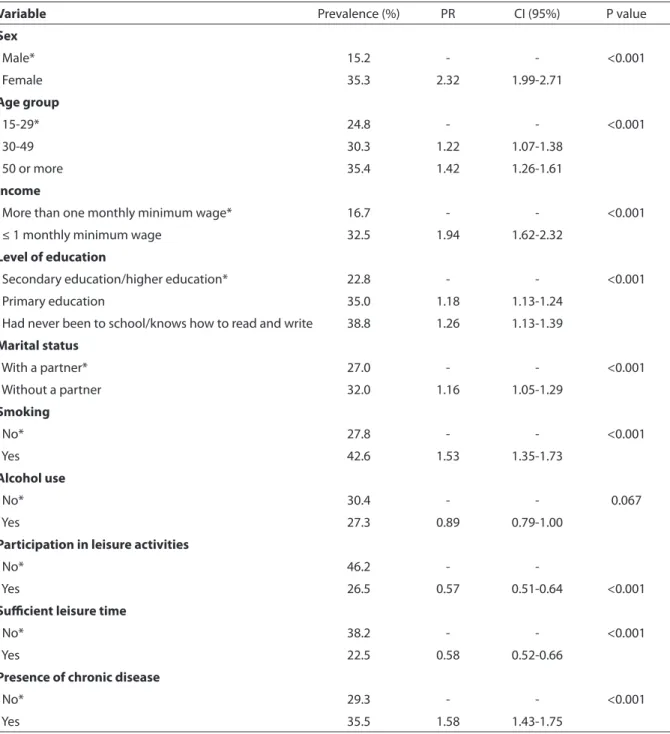
The global prevalence of CMD was 29.9%. The identiication of the prevalence of CMD, according to socio-demographic characteristics, is shown in Table 3. The prevalence of CMD was greater in women (35.3%). With regard to age group, this prevalence increased with age. Individuals with an income lower than or equal to one minimum wage had a higher prevalence of CMD (32.5%), when compared to those with an income higher than one minimum wage (16.7%). Individuals with a low level of education (38% of whom had never been
to school or could only read and write) and who lived without a partner (32.0%) showed higher prevalences of CMD.
In the multivariate analysis, the follo-wing variables remained in the inal model obtained: sex, level of education, income, smoking habit, suficient leisure time and presence of chronic disease – these varia-bles maintained a statistically signiicant association with CMD (Table 4).
Discussion
The prevalence of CMD was high (29.6%) in this study and it is characterized as a se-rious public health problem. The estimated prevalence was similar to the results found in population-based studies, conducted in different Brazilian regions, using the SRQ-20,5;7;11;13;14 and in other Latin American countries.4;16 In these studies, the prevalence
Table 1 - Distribution of residents in urban areas, according to socio-demographic aspects. Feira
de Santana, BA, Brazil, 2007.
Variable Frequencies
n %
Sex
Female 2,569 71.4
Male 1,028 28.6
Age (years)
15-29 1,400 38.9
30-49 1,197 33.3
50-69 770 21.4
70 and more 230 6.4
Marital status
With a partner 1,838 51.3
Without a partner 1,743 48.7
Level of education
Had never been to school/knows how to read and write 240 6.7
Primary education 1,692 47.2
Secondary education 1,457 40.6
Higher education 199 5.5
Monthly income*
Up to one minimum wage 2,938 81.7
More than one minimum wage 658 18.3
of CMD varied from 22.7%, in the city of Pelotas, Rio Grande de Sul11, to 35.0%, in the city of Olinda, Pernambuco7.
The high prevalence of CMD is an alar-ming fact, especially when compared to the estimate of the World Health Organization (WHO),1 which points to a mean preva-lence of 25% in urban populations. This information shows the need for policies that contribute to better direction of mental health in the city.
The results obtained in this study reveal that, with regard to socio-demographic cha-racteristics, women, individuals with an in-come equal to or lower than one minimum wage and those with low levels of education showed higher prevalence of CMD.
Findings of the present study are in agreement with those of other studies that point to female populations and low income and low level of education strata being more affected by psychiatric morbidities.4;5;15;17.
In the last decades, there have been considerable changes in the role of women in society, which may be contributing to the increase in mental health problems in this
population. Studies conducted in the Uni-ted States, Sweden and Holland observed that women are responsible for most of the household chores and child education,18 in addition to performing functions resulting from their inclusion in the formal job ma-rket, thus causing a work overload in the fe-male population. The excess of attributions can create conlicting situations, stress and suffering and also be associated with greater psychiatric morbidity6,18.
With regard to the positive association between level of education and CMD, the-se results are in agreement with indings from other studies, conducted in different populations5,19. Ludermir and Melo-Filho7 found that individuals with up to four years of education had 2.84 times more CMD than those with 11 years of education or more.
Access to school, which should occur since the irst years of life, is closely associa-ted with possibilities for the future. Murphy et al.20 emphasized that the level of educa-tion increases the possibility of choices in life; broadens the perspectives of inclusion in the job market, especially in better paid
Table 2 - Distribution of residents in urban areas, according to lifestyle and clinical conditions.
Feira de Santana, BA, Brazil, 2007.
Variable Frequencies
n %
Smoking
No 3,169 88.2
Yes 423 11.8
Alcohol use
No 2,586 71.9
Yes 1,010 28.1
Participation in leisure activities
No 3,044 84.6
Yes 552 15.4
Suicient leisure time
No 811 27.3
Yes 2,163 72.7
Presence of chronic disease
No 2,731 76.0
positions with higher social status; which, in their turn, could also promote the adoption of healthier behaviors and psychological well-being.
Income remained associated with CMD, even after adjustment for the remaining variables analyzed. This result corroborates
indings from studies conducted in other populations3,4,16. An insufficient income can lead to stressful and unsafe situations, aspects that trigger CMD. With regard to the association between age and CMD, it is clear that older individuals are more expo-sed to chronic diseases, mourning, marital
Table 3 - Prevalences of Common Mental Disorders, according to socio-demographic variables, lifestyle and chronic
diseases. Feira de Santana, BA, Brazil, 2007.
Variable Prevalence (%) PR CI (95%) P value
Sex
Male* 15.2 - - <0.001
Female 35.3 2.32 1.99-2.71
Age group
15-29* 24.8 - - <0.001
30-49 30.3 1.22 1.07-1.38
50 or more 35.4 1.42 1.26-1.61
Income
More than one monthly minimum wage* 16.7 - - <0.001
≤ 1 monthly minimum wage 32.5 1.94 1.62-2.32
Level of education
Secondary education/higher education* 22.8 - - <0.001
Primary education 35.0 1.18 1.13-1.24
Had never been to school/knows how to read and write 38.8 1.26 1.13-1.39
Marital status
With a partner* 27.0 - - <0.001
Without a partner 32.0 1.16 1.05-1.29
Smoking
No* 27.8 - - <0.001
Yes 42.6 1.53 1.35-1.73
Alcohol use
No* 30.4 - - 0.067
Yes 27.3 0.89 0.79-1.00
Participation in leisure activities
No* 46.2 -
Yes 26.5 0.57 0.51-0.64 <0.001
Suicient leisure time
No* 38.2 - - <0.001
Yes 22.5 0.58 0.52-0.66
Presence of chronic disease
No* 29.3 - - <0.001
Yes 35.5 1.58 1.43-1.75
separations, widowhood, social isolation, economic dificulties and unemployment, which could increase the occurrence of psychiatric morbidities13,21. However, in the present study, this association was not maintained after the multivariate analysis. The prevalence of CMD was higher in individuals who reported living without a partner (separated/divorced or widowed). Marriage enables greater social and family
support. Costa and Ludermir 14 emphasize that the perception of being loved and ca-red for is associated with lower indices of anxiety and depression.
The availability of suficient leisure time was a factor negatively associated with common mental disorders – the prevalence of CMD was lower in the group that repor-ted satisfactory time for these activities. Participation in leisure activities positively
Table 4 – Adjusted prevalence ratios with their respective 95% conidence intervals between
the characteristics studied and common mental disorders, obtained from the multiple logistic regression analysis.
Variable PR CI 95%
Sex
Male* 1.00
Female 2.72 2.16- 3.42
Age group
15-29* 1.00
30-49 1.01 0.80 - 1.26
50 or more 0.95 0.71 - 1.21
Income
More than one monthly minimum wage* 1.00
≤ 1 monthly minimum wage 1.89 1.44- 2.48
Level of education
Secondary education/higher education* 1.0
Primary education 1.75 1.18 - 1.70
Had never been to school/knows how to read and write 1.61 1.33 - 1.95
Marital status
With a partner* 1.00
Without a partner 1.13 0.91- 1.41
Smoking
No* 1.00
Yes 2.14 1.64 - 2.79
Participation in leisure activities
No* 1.00
Yes 0.52 0.16 - 1.64
Suicient leisure time
No* 1.00
Yes 0.52 0.47- 0.54
Presence of chronic disease
No* 1.00
Yes 1.68 1.35 - 2.10
inluences mental health status22. Araújo et al. 23 found that individuals who do not participate in leisure activities have almost two times more CMD than those who par-ticipated in such. In this sense, policies on mental health must include proposals to promote the practice of leisure activities in their actions, aiming to reduce the number of barriers that hinder or prevent access to these activities.
An interesting fact observed in this stu-dy, which will be analyzed in future studies, refers to the time dimension involved in leisure activities. Reporting participation in leisure activities or not was only statis-tically associated with mental disorders in the crude analysis; this association lost statistical signiicance when all variables of interest were simultaneously analyzed. However, with regard to the time spent on such activities, whether suficient or not, the association with CMD remained after ad-justment, evidencing that the time available for leisure activities was a relevant factor to observe a lower prevalence of CMD.
Smoking habit was positively associated with the prevalence of CMD. Goodwin et al. 24 found evidence linking pulmonary function to mental health problems, in a sample of adults, in the United States. Indi-viduals with a reduced pulmonary function, something frequently found in smokers, showed a higher prevalence of mental he-alth problems.
A survey conducted in individuals aged between 20 and 69 years, living in the city of Pelotas, Rio Grande do Sul, also observed that the smoking habit was positively asso-ciated with CMD13. Findings from studies performed in Brazil and abroad show the evidence of an association between smoking and psychiatric disorders.
There was not a statistically signiicant association between alcohol use and pre-valence of CMD. Studies have shown that alcohol consumption is not directly asso-ciated with a higher prevalence of CMD13; 19. Exposure to chronic diseases appears as an aspect associated with CMD13. In a survey conducted in an adult population of the city
of Pelotas, RS, Brazil, Coelho et al.19 found that individuals who were hypertensive or diabetic or with heart failure and who repor-ted more than ive chronic diseases showed higher prevalence of CMD.
The results obtained here must be eva-luated with caution, due to possible limita-tions of the study. Among such limitalimita-tions, those related to the cross-sectional design used in his study, which simultaneously evaluate variables of the effect of interest and their associated factors, should be emphasized. Thus, the reverse cause hypo-thesis cannot be disregarded, i.e. it is not possible to identify whether CMD inluen-ced the associated factors or vice-versa. The cross-sectional nature of this study prevents temporal antecedence analysis.
Another factor that must be considered in the analysis of the limitations of this study is the possibility of selection bias. Although the procedures comprising the sample were random, the sample composition obtained points to its possible distortion by sex, with a female over-representation. This study sought to conduct up to three visits per sample household to reduce the percenta-ge of losses of eligible individuals in each sample unit – one of these visits occurred at night time or on weekends – however, these procedures may not have been enou-gh to prevent losses of male individuals. It should be noted, nevertheless, that the results associated with CMD prevalences and the differences observed according to sex were similar to those obtained in other population-based studies (Costa and Lu-dermir, 200513, Anselmi et al., 20085). Thus, the results achieved here seem not to have originated from sample distortions that may have occurred.
could hinder the observation of differences between groups), a statistically signiicant association was found between this variable and mental disorders, in the population studied, conirming this to be a relevant va-riable for the occurrence of CMD (Murphy et al. 19). Consequently, the results found seem to support evidence of explanatory models of occurrence of common mental disorders in population groups.
The age group distribution in the sample studied was similar to the population com-position aged 15 years or more, in the city of Feira de Santana8.
With regard to the measurement of the effect on the mental disorder investigated (CMD), it should be emphasized that the research instrument used to assess mental disorders (SRQ-20) has been largely em-ployed in population studies in Brazil and such instrument shows good performance in the evaluation and screening for psychia-tric morbidity6,7,10-14. Data collection proce-dures were standardized and the research team was adequately qualiied. A Manual de Procedimentos e Condutas (Manual of Procedures and Conducts) was developed to guide and standardize ield work.
Despite these limitations, the study evaluated a relevant number of individuals (N=3,597), including population groups of all sub-districts of the city studied, which enabled the estimation of the prevalence of CMD in this city and the identiication of factors associated with its occurrence. The results obtained represent useful informa-tion for health management and they can
serve as input for public policies on mental health intervention.
Conclusion
This study enabled the prevalence of non-psychotic disorders to be assessed in the urban population of the city of Feira de Santana, Bahia, Brazil. In addition, it raised knowledge about factors associated with CMD in this population. A high prevalence of CMD was observed, surpassing the es-timates of psychiatric morbidity in popu-lations of the World Health Organization (WHO)1. Prevalence was more signiicant in women, those with a low monthly income and level of education, smokers, those who reported insuficient leisure time and those who reported having chronic diseases.
The results of the present study indicate that some of the variables emphasized, whi-ch were associated with common mental disorders, are subject to preventive inter-vention. The establishment of preventive actions can be regulated, in light of the indings of this study, by interventions that aim at greater social integration of individu-als through active leisure and anti-smoking activities and policies on better income dis-tribution and student access to and staying in school.
Conlicts of Interest
Authors declared there were no conlicts of interest in the present study.
Referências
1. Organização Mundial da Saúde. Relatório Mundial da Saúde. Saúde Mental: Nova concepção, nova esperança. Lisboa; 2002.
2. Goldberg D, Huxley P. Common mental disorders: a bio-social model. London: Tavistock; 1992.
3. Cury AF, Menezes P, Araya R, Zugaib M. Common disorders during pregnancy: prevalence and associated factors among low-income women in São Paulo, Brazil. Arch Womens Ment Health 2009; 12: 335-43.
4. Araya R, Rojas G, Fritsch R, Acuña J. Common mental disorders in Santiago, Chile. Br J Psychiatry 2001; 178: 228-33.
6. Araújo TM, Pinho OS, Almeida MG. Prevalência de transtornos mentais comuns em mulheres e sua relação com as características sociodemográicas e o trabalho doméstico. Rev Bras Saude Mater Infant 2005; 5: 337-48.
7. Ludermir AB, Melo Filho DA. Condições de vida e estrutura ocupacional associadas a transtornos mentais comuns. Rev Saude Publica 2002; 36: 213-21.
8. Instituto Brasileiro de Geograia e Estatística. Censo demográico de 1999/2000. Brasília; 2006.
9. Costa AG, Ludermir AB. Transtornos mentais comuns e apoio social: estudo em comunidade rural da Zona da Mata de Pernambuco, Brasil. Cad Saude Publica 2005; 21: 73-9.
10. Almeida-Filho N, Mari JJ, Coutinho E, Franca JF, Fernandes J, Andreoli, SB et al. Brazilian multicentric study of psychiatric morbidity. Methodological features and prevalence estimates. Br J Psychiatry 1997; 171: 524-9.
11. World Health Organization WHO. A User’s Guide to Self-Reporting Questionnaire (SRQ). Geneva: WHO; 1994.
12. Mari JJ, Williams P. A validity study of a psychiatric screening questionnaire (SRQ-20) in primary care in the city of São Paulo. Br J Psychiatry 1986; 148: 23-6.
13. Santos KOM, Araújo TM, Oliveira NF. Estrutura fatorial e consistência interna do Self-Reporting Questionnaire (SRQ-20) em população urbana Cad Saude Publica 2009; 25: 214-2.
14. Araújo TM, Carmo Júnior JJ, Almeida MG, Pinho OS. Prática de atividades de lazer e morbidade psíquica em residentes em áreas urbanas. Rev baiana saude publica 2007; 31: 294-310.
15. Hosmer DW, Lemeshow, S. Applied logistic regression(2nd ed.). New York: John Wiley e Sons; 2000.
16. Oliveira NF, Santana VS, Lopes AA. Razões de proporções e uso do método Delta para intervalos de coniança em regressão logística. Rev Saude Publica 1997; 31(1): 90-9.
17. Dias da Costa JS, Menezes AMB, Olinto MTA, Gigante DP, Macedo S, Britto MAP et al. Prevalência de distúrbios psiquiátricos menores na cidade de Pelotas, RS. Rev Bras Epidemiol 2002; 5: 164-73.
18. Patel V, Araya R, Chowdhary N, King M, Kirkwood B, Nayak S et al. Detecting common mental disorders in primary care in India: a comparison of ive screening questionnaires. Psychol Med 2008; 38: 221-8.
19. Lima MS, Soares BGO, Mari JJ. Saúde e doença mental em Pelotas, RS: dados de um estudo populacional. Rev Psi Clin 1999; 26(5): 225-35.
20. Puertas G, Ríos C, Del Valle H. Prevalencia de trastornos mentales comunes en barrios marginales urbanos con población desplazada en Colombia. Rev Panam Salud Publica 2006; 20: 324–30.
21. Gjerdingen D, McGovern P, Bekker M, Lundberg U, Willemsen T. Women’s work roles and their impact on health, well-being, and career: comparisons between the United States, Sweden, and The Netherlands.Women Health 2000; 31: 1-20.
22. Grifin JM, Fuhrer R, Stansfeld S, Marmot M. The importance of low control at work and home on depression and anxiety: do these effects vary by gender and social class? Soc Sci Med 2002; 54: 783-98.
23. Coelho FM, Pinheiro RT, Horta BL, Magalhães PVS, Garcias CMM, Silva CV. Common mental disorders and chronic non-communicable diseases in adults: a population based study. Cad Saude Publica 2009; 25: 59-67.
24. Murphy JM, Olivier DC, Monson RR, Sobol AM, Federman EB, Leighton AH. Depression and anxiety in relation to social status. Arch Gen Psychiatry 1991; 48: 223-9.
25. Losada A, Peñaranda AP, Sanchez ER, Marcos MAG, Rios CB, Carrera IRR, Torre MAC, Ortiz LG.Leisure and distress in caregivers for elderly patients. Arch Gerontol Geriatr 2009; 50: 347-50.