Introduction
In aqueous solutions molybdates, tungstates, vanadates, and to smaller extent, niobates, tantalates, and chromates, undergo complex hydrolysis-poly-merization reactions upon acidification. The major species generated by such reactions are isopo-lyanions, of which Cr2O72-, and heptamolybdate, Mo7O246-, are well-characterized examples [1]. There is no doubt that the formation of isopoly-tungstates on acidification of the solutions of normal tungstate, WO42-, is the most complex and the least understood system [2]. The difficulties are at least three fold. Firstly, there is the instability to obtain well-defined crystalline salts with many of the iso-polytungstate anions, and hence the structural basis remains somewhat speculative. Secondly many workers have used solutions containing buffers,
many of which contain anions that preferentially form complexes with the tetrahedrally coordinated normal tungstate rather than the octahedrally coor-dinated polytungstates. Thirdly the rates of forma-tion of some isopolytungstates are very slow [3,4].
Tungstate solutions can absorb considerable quantities of strong acid by mechanism leading to formation of isopolytungstates [5]. Despite exten-sive investigations the problem of number and position of the polymeric species has not been com-pletely solved. It is reported [4,6] that even in a solution initially containing only orthotungstate and acid may exist eight types of species with H+:WO
4 2-ratio as 1:3, 2:3, 7:6, 3:2 and 2:1. The degree of aggregation in solutions increases as the pH is lowe-red, and numerous tungstates M2IO.nWO3.mH2O, differing in the value of n, have been reported from the solutions at different pH’s [6]. The existence of www.scielo.br/eq
Volume 32, número 1, 2007
Potentiometric and conductometric studies on the system
acid-isopolytungstate and the formation of lanthanum
tungstates
S. Prasad1*, R. A.C. Santana1, A. R.N. Campos1, V. D. Leite2
1Department of Chemical Engineering, Universidade Federal de Campina Grande, 58109-970 Campina Grande, Paraíba, Brazil.
2Department of Chemistry, Universidade Estadual da Paraíba, 58109-790, Campina Grande, Paraíba, Brazil.
Abstract:The stoichiometry of the polyanions formed by the action of nitric acid on sodium tungstate (≤0.01M) has been studied by means of electrometric techniques involving pH-potentiometric and conductometric titrations. The well defined inflections and breaks in the titration curves provide evidence for the existence of the polyanions, para-W12O4110-and meta-W
12O396-corresponding to the ratio of H+:WO
42-as 7:6 and 9:6 in the pH ranges 5.7-6.0 and 3.6-4.1, respectively. The interaction of lanthanum nitrate with sodium tungstate solutions, at specific pH levels 8.0, 5.9 and 4.0 was also studied by pH and conductometric titrations, in aqueous and alcoholic media, with each of the reagents alternatively used as titrant. The electrometric experiments provide definite evidence of the formation of normal-La2O3.3WO3, para-5La2O3.36WO3and meta-La2O3.12WO3tungstates in the vicinity of pH 6.3, 5.0 and 4.2, respectively. Analytical investigations on the precipitates formed confirm the results of the electrometric study.
so many isopolyanions seems to be doubtful; more-over, there is a great variance in the results publi-shed by earlier workers which allows no satisfacto-ry interpretation of the mechanism of the condensa-tion process. A further verificacondensa-tion of the tungstate system seems very desirable with a view to ration-alizing the conflicting details of the previous work-ers by employing electrometric techniques, which have provided more conclusive evidences on such systems [7,8,9]. After establishing for suitable con-ditions for the stability of different tungstate polyan-ions, the investigations for the formation of lan-thanum tungastates as a function of pH were also carried out as no reference could be traced out in the literature about their formation.
Experimental details
Na2WO4.2H2O, La(NO3)3, HNO3 and ethanol of extra-pure grade were used, and their solutions were prepared with deionized distilled water. Concentration of the sodium tungstate solu-tion was further verified by tannin-antipyrine method [10a].
pH measurements were carried out on Metrohm Herisau pH-meter using Scott Gerate glass combination electrode. Conductance values were recorded by employing a Metrohm conduc-tometer. The sodium tungstate solution (25.00 mL) was placed in the cell each time and thermostated at 25.0±0.1oC. Using different concentrations of HNO3and Na2WO4, a series of glass electrode and conductometric titrations have been carried out.
The same concentrations of reactants were employed in conductometric and glass electrode titrations for the sake of comparison. The curves were plotted between pH and corrected conduc-tance vs. volume of HNO3 added. As the inflec-tions in pH titration curves were not strongly defined, differential graphs in dpH/dV were also drawn and end-points were marked by pronounced maxima in dpH/dV. A summary of the electrome-tric titrations of the acid system is given in Table 1. The formation of lanthanum tungstates was investigated by the action of lanthanum nitrate with different vanadate anions at specific pH levels 8.0, 5.9 and 4.0 using different concentrations of the reactants. A series of pH and conductometric titra-tions was performed by direct and reverse meth-ods, i.e. when lanthanum nitrate solution from the microburette was added to sodium tungstate solu-tion and vice versa (Table 2). 25.00 mL of ethano-lic solution (20%) was taken in the cell, which was thermostated at 25.0±0.1oC.
lan-thanum [10b] with oxalate. From the proportions of lanthanum and tungsten in the compounds thus obtained their composition was established. The results are summarized in Table 3. The analytical results were also confirmed by atomic absorption spectroscopy.
Results and Discussions
The pH titrations of the acid against so-dium tungstate are shown in Fig. 1 (curves 1 and 2). Two points of inflection were obtained; the first at H+:WO
42-as 7:6 corresponding to the
for-Table 2. Summary of results of electrometric study on formation of lanthanum tungstates.
mation of paratungstate and the second at H+:WO
42- as 9:6 due to the formation of paratungstate anions. In the first stage of the for-mation, when H+:WO
42-is less than 7:6, the addi-tion of the acid brings about a gradual change in pH with a rapid attainment of its equilibrium value. When the ratio of the acid to normal tungstate passed 7:6, the initial pH dropped sharply leading to the observed inflection due to the formation of paratungstate anion in the pH range 5.7-6.0. But in contrast to the earlier part of the titration, the pH value showed an increasing
tendency on waiting after each addition of the titrant and took a long time for attaining the equi-librium value, leading to a partial disappearance of the paratungstate A (HW6O215-) to a more sta-ble ion, paratungstate Z (W12O4110-). The increase in pH value observed on standing should be the result of an increase in negative charge (from -5 on HW6O215- to -10 on W
12O4110-) on the formation of higher polymer of a weaker acid. The existence of these two species is in agreement with the ultracentrifuge results [11-14]. The paratungstate formation may be repre-sented in a simplified way as follows:
6WO42-+ 7H+ = HW
6O215-+ 3H2O (fast) (1) 2HW6O215- = W
12O4110-+ H2O (slow) (2)
During the region of the second inflection in the titration curves, corresponding to the for-mation of metatungstate isopolyanions, the ten-dency to increase the pH value on waiting was again observed, leading to a conclusion that the formation of the final metatungstate species, W12O396-, is also a slow process and should be preceded by the formation of an unstable species HW6O203-, psedo-metatungstate [5,6]. The two stage reaction may be represented as follows:
6WO42-+ 9H+ = HW6O203-+ 4H2O (fast) (3) 2HW6O203- = W12O396-+ H2O (slow) (4)
It was observed that after passing the second inflection the pH value got stabilized and did not give any more inflection even with an addition of a lot excess of the acid (H+:WO
42-› 10:1) and hence not confirming the formation of the tungstic acid [2b].
Conductometric titrations between HNO3 and Na2WO4were also carried out employing the same concentrations of the reactants as in pH titra-tions for the sake of comparison of the results. The plots (Fig. 1, curve 3) of corrected conductance as a function of the volume of titrant yielded two well-defined breaks at the ratio H+:WO
42-as 7:6 and 9:6 corresponding to the formation of paratungstate and metatungstate, respectively, as suggested by the preceding pH study. In all these titrations the break corresponding to the addition of 1.5 equivalents of the acid per Na2WO4is strongly defined, followed by a sharp rise in conductance which was determined to be the same as expected for the addition of free acid to the system.
When a basic tungstate solution containing WO42-and Na+ is acidified, the tungstate ions have been found to condense in definite steps, as evidenced by the foregoing electrometric experiments, to form different isopolytungstate anions. The overall condensation process may be considered formally at least to begin with partial neutralization of the tungstate ions, and then expanding its coordination sphere from four to six by water molecules followed by the formation of a highly aggregated isopolyanion at lower pH value.
WO42-+ H+ = HWO
4- (5)
HWO4-+ 2H
2O = [WO(OH)5]- (6)
6[WO(OH)5]-+ H+ = HW6O215-+ 15H2O (7)
The condensation process may be repre-sented by the following general equation, which is almost similar to the one proposed by MacInnis and Kim [15]:
aH++ bWO
42- = cWxOyHzn-+ dH2O (8)
with the values for a and b as represented in Table 4.
It is quite probable that the highly charged species given in Table 4 may be hydrated; e.g., W12O4110- as H10W12O4610-, and W12O396- as H2W12O406- as suggested by Cotton and Wilkinson [6] or W12O4110- as W
12O40(OH)2 10-[16] and W12O396-as W
12O38(OH)26-as recently reported by Rozantsev and Sazonova [17].
The results of a careful pH and conducto-metric study on the acid tungstate system provid-ed definite evidence for the formation of para-W12O4110- (via HW6O215-) and meta-W12O39 6-(via HW6O203-) in the pH ranges 5.7-6.0 and 3.6-4.1, respectively. The observation of MacInnis and Kim [15] about the formation of W12O4620-, W3O114- and WO3.H2O, of Meier and Schwarzenbach [18] about H5W4O163-, of Simons [19] about W2O72- and of Timofeeva et al. [20] about W7O246-could not be confirmed by the study.
Formation of lanthanum tungstates
The above studies show that the addition of acid to Na2WO4solution under suitable condition causes the formation of paratungstate W12O41 10-and metatungstate W12O396-anions. Hence it was considered of interest to ascertain whether similar salts of heavy metals may be precipitated as a result of double decomposition. The reaction between lanthanum nitrate and different alkali tungstates has therefore been studied by means of pH and conductometric titrations. The solution of Na2WO4 was prepared in deionized distilled water. The solu-tions of sodium para- and meta-tungstates were prepared by adding 7 and 9 mol of HNO3to 6 mol of Na2WO4.
12Na2WO4+ 18HNO3= Na6W12O39+ 18NaNO3+ 9H2O (10)
Lanthanum normal tungstate
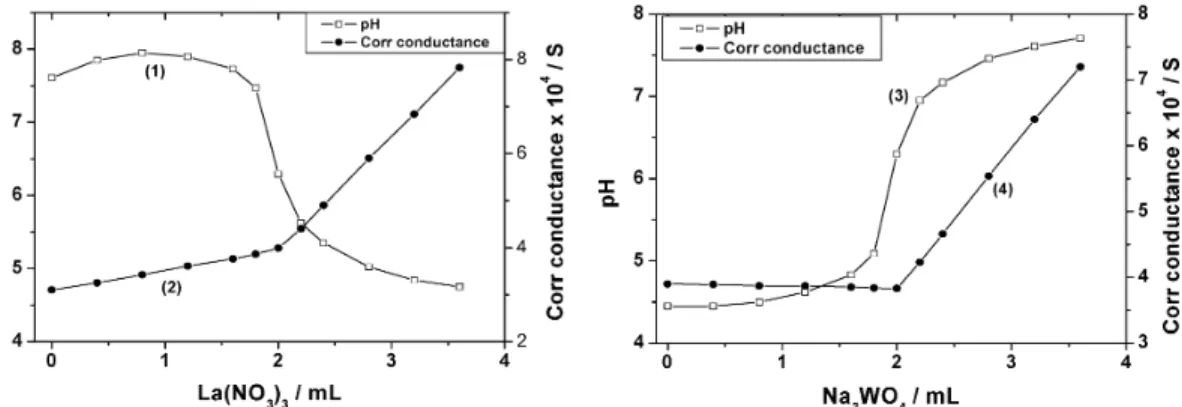
Figure 2 illustrates the curves of the pH and conductometric titrations performed between the solutions of the normal tungstate and lanthanum nitrate. In direct titrations (curve 1), when La(NO3)3solution (pH 4.3) was added to the Na2WO4solution (pH 8.0) a sharp fall in pH was noted with an inflection at molar ratio of La3+:WO
42-as 2:3 in the vicinity of pH 6.3, corresponding to the stoichiometry for the for-mation of lanthanum tungstate, La2O3.3WO3. This sharp fall in pH occurs because of the pres-ence of unreacted acidic (pH 4.3) La(NO3)3 in the cell just after completion of precipitation of lanthanum tungstate. In reverse titrations (curve 3), when Na2WO4 solution was added to the lanthanum nitrate solution, the pH first changed very slowly, but at the end-point it jumped upwards corresponding to the formation of the same compound in accordance with the follow-ing equation:
2La(NO3)3+ 3Na2WO4= La2O3.3WO3+ 6NaNO3 (11)
Employing similar concentrations of the reactants, both direct (curve 2) and reverse (curve 3) conductometric titrations between the solu-tions of La(NO3)3 and Na2WO4 gave well-defined breaks at 2:3 molar ratio of La3+:WO
42-, confirming the stoichiometry for formation of the cerium tungstate La2O3.3WO3, as suggested by the pH study.
Lanthanum paratungstate
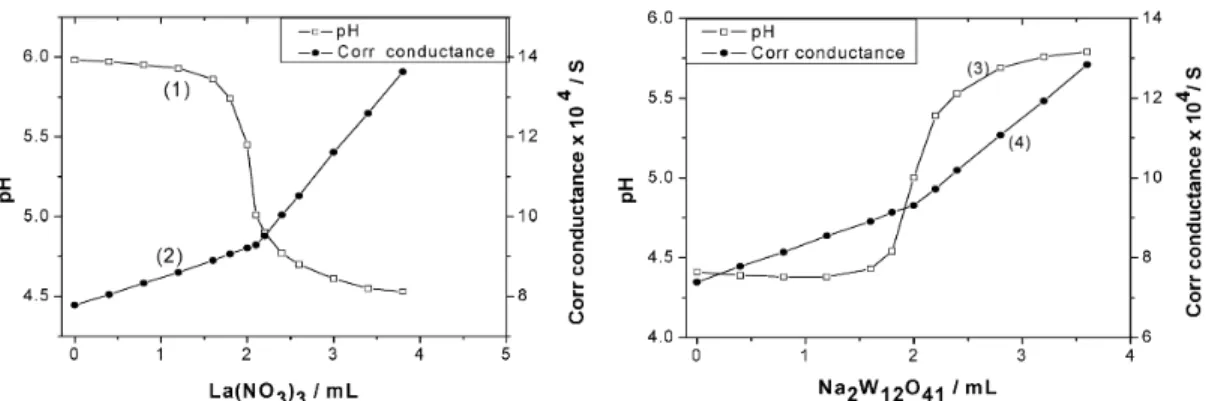
The solution of sodium paratungstate, Na10W12O41, was prepared by addition of nitric acid to Na2WO4in the molar ratio 7:6. Figure 3 illustrates the changes occurring in pH and con-ductance when La(NO3)3 solution (pH 4.3) is treated with Na10W12O41 solution (pH 5.9). In direct titrations (curve 1) when La(NO3)3 solu-tion was added from microburette to Na10W12O41 solution, a gradual change in pH was observed till at the stoichiometric end-point (the stage at which the reaction ends if simple double decom-position takes place), a sharp fall in pH was noted with the inflection corresponding to the molar ratio of La3+:W
12O4110- as 10:3, suggesting the formation of lanthanum paratungstate 5La2O3.36WO3in the vicinity of pH 5.0. In case of reverse titrations (curve 3) the first addition of Na10W12O41solution to La(NO3)3caused a slight decrease in pH till about half the volume of titrant required for the precipitation of lanthanum paratungstate was added. This initial lowering in pH value was due to the presence of hydrolyzed acid from the lanthanum salt. Later on, with the progress of the reaction, pH began to rise and a pronounced upward jump was obtained at the sto-ichiometric point corresponding to the formation of lanthanum paratungstate. Employing similar concentrations of the reactants a series of direct (curve 2) and reverse (curve 4) conductometric titrations were performed between the solutions of La(NO3)3 and Na10W12O41. The titration curves provide well-defined breaks at a point where the molar ratio of La3+:W
12O4110- is 10:3 (Table 2), thus confirming formation of the paratungstate as suggested by the pH study. The
formation of the paratungstate can be represented as follows:
10La(NO3)3+ 3Na10W12O41= (5La2O3.36WO3) + 30NaNO3 (12)
Lanthanum metatungstate
Sodium metatungstate, Na6W12O39, solution was prepared by addition of nitric acid to Na2WO4 in the molar ratio 3H:2W. Using different concentrations of the solutions of La(NO3)3and Na6W12O39, a series of direct and reverse conductometric titrations was carried out. The nature of these titration curves (Figure 4) is similar to those of the paratungstate. The curves provide breaks at molar ratio 2:1 of La3+:W
12O396- corresponding to the
stoichiometry for formation of lanthanum
Figure 3.Para-tungstate direct (1 and 2) and reverse (3 and 4) titrations. 1, 2: 25 mL of M/1200 Na10W12O41 titrated with M/30 La(NO3)3. 3, 4: 25 mL of M/900 La(NO3)3titrated with M/240 Na10W12O41
Figure 4.Meta-tungstate direct (1) and reverse (2) titrations. 1: 25 mL of M/750 Na6W12O39titrated with M/30 La(NO3)3. 2: 25 mL of M/1500 La(NO3)3titrated with M/240 Na6W12O39
metatungstate La2O3.12WO3 in the vicinity of pH 4.2, according to the reaction:
2La(NO3)3+ Na6W12O39 = La2O3.12WO3+ 6NaNO3 (13)
The pH titrations of this system did not provide reliable results for the formation of lan-thanum metatungstate, which may be ascribed to very close pH values of the reactants involved.
It was noted that after each addition of the titrant, it takes a little time for the pH and con-ductance values to become steady. A thorough stirring in neighborhood of the equivalence point has a favorable effect. The presence of ethanol (20%) improves position of the end-point and increases magnitude of the jump in pH curves, as it decreases solubility of the precipitates formed and minimizes hydrolysis and adsorption. For this reason all the titrations were performed in presence of 20% ethanol.
Conclusions
The results of the quantitative elemental analysis of the precipitates were used to calculate the proportions of the elements present in the compounds. From these proportions, the compo-sition of the compounds was established which was found to be the same as obtained by the elec-trometric techniques (see Table 3).
References
[1] M. T. Pope, B. W. Dale, Q. Revs.22 (1968) 527. [2] D. L. Kepert, in: A. F. Trotman-Dickenson, (Ex. Ed.), Comprehensive Inorganic Chemistry, Vol. 4, Pergamon Press, Oxford, 1973, pp. (a) 641, (b) 642, (c) 646.
[3] H. R. Craig, S. Y. Tynee, Inorg. Chem. 4 (1965) 997. [4] M., Grayson, (Ex. Ed.), Kirk-Othmer Encyclopedia of Chemical Technology.Vol.23, Wiley-Interscience, New York, 3rd edn., 1993, p.431.
[5] D. L. Kepert, in: F. A. Cotton, (Ed.), Progress in Inorganic Chemistry, Vol. 4, Interscience Publishers, New York, 1962, p. 199.
[6] F. A. Cotton, G. Wilkinson, Advanced Inorganic Chemistry, Interscience Publishers, New York, 3rd edn., 1972, p.952.
[7] S. Prasad, Can. J. Chem. 59 (1981) 563.
[8] S. Prasad, S. B. Gonçalves, J. B. Brito, Catal. Today, 57 (2000) 343.
[9] S. Prasad, T. L. M. Guimarães, J. Braz. Chem. Soc. 9 (1998) 253.
[10] A. I. Vogel, A Textbook of Quantitative Inorganic Analysis, Longmans, London, 3rd. Edn.,1968, p. (a) 567, (b) 541.
[11] K. F. Jahr, J. Fuchs, Angew. Chem. Intern. Ed. 5 (1966) 689. [12] J. Aveston, Inorg. Chem. 3 (1964) 981.
[13] O. Glemser, W. Holtje, Z. Naturforsch. 20b (1965) 398. [14] O. Glemser, W. Holznagel, W. Holtje, E. Schwarzmann, Z. Naturforsch. 20b (1965) 725.
[15] M. B. MacInnis, T. K. Kim, J. Chem. Tech. Biotechnol. 29 (1979) 225.
[16] M. del Arco, D. Carriazo, S. Gutierrez, C. Martin, V. Rives, Inorg. Chem. 43 (2004) 375.
[17] G. M. Rozantsev, O. I. Sazonova, Russ. J. Coord. Chem. 31 (2005) 552.
[18] J. Meier, G. Schwarzenbach, J. Inorg. Nucl. Chem. 8 (1958) 302.
[19] E. L. Simons, Inorg. Chem. 3 (1964) 1079.
[20] E. V. Timofeeva, G. A. Tsirlina, O. A. Petrii, Russ. J. Electrochem. 39 (2003) 716.
[21] A. Standen, (Ex. Ed.), Kirk-Othmer Encyclopedia of Chemical Technology, Vol.13, IntersciencePublishers, New York, 2ndEdn., 1967, p.782.
meta-La2O3.12WO3 in the vicinity of pH 6.3, 5.0 and 4.2, respectively. The pH values reported correspond to the 20% ethanol medium. As structure of these compounds is not known they are represented as double oxides, the manner which is usually adopted for such compounds [21].
Acknowledgement
The authors are indebted to the CNPq for financial assistance.
Recebido em: 03/01/2007 Aceito em: 05/04/2007
S. Prasad, R. A.C. Santana, A. R.N. Campos , V. D. Leite. Estudos eletrométricos sobre o sis-tema ácido-tungstato e a formação de tungstatos de metais pesados.
Resumo:A estequiometria de poliânions formados pela ação do ácido nítrico sobre a solução de tungstato de sódio (≤0,01M) foi estudada por meio de técnicas eletrométricas envolvendo titulações potenciométricas e condutométricas. As inflexões e degraus bem definidas nas curvas de titulações forneceram evidências convincentes pela existência de poliânions, para-W12O4110-e meta-W12O39 6-nas faixas do pH 5,7-6,0 e 3,6-4,1; correspondendo a razão H+:WO
42-como 7:6 e 9:6, respectivamente. A interação entre soluções de nitrato de lantânio e tungstato de sódio a específicos níveis de pH 8,0; 5,9 e 4,0 também foi estudada por titulações potenciométricas e condutométricas, nos meios aquoso e etanólico, com cada reagente usado alternadamente como titulante. Os experimentos eletrométricos forneceram evidências incontestáveis sobre a formação de tungstatos normal-La2O3.3WO3, para -5La2O3.36WO3e meta-La2O3.12WO3nas proximidades de valores de pH 6,3; 5,0 e 4,2; respectiva-mente. Investigações analíticas sobre os precipitados formados confirmam os resultados do estudo eletrométrico.