LOWER CIRCUIT OF THE URBAN ECONOMY
AND LOCAL CITIES-HYBRIDS
circuito inferior da economia urbana e cidades locais–híbridas
Cláudia Marques Roma *
Resumo
No período atual, marcado por processos de globalização e fragmentação, se dota o espaço de luidez, ciência, técnica, informação e racionalidade, no qual se inscreve, também, o aumento do desemprego e da precarização das relações de trabalho e da pobreza estrutural. Diante deste contexto, a teoria dos dois circuitos da economia urbana se reforça ainda mais como uma possibilidade de apreensão das dinâmicas urbanas contemporâneas. Neste sentido, no presente artigo discutimos a teoria dos circuitos da economia urbana para a realidade socioespacial de três cidades locais – híbridas –, localizadas no extremo oeste do estado de São Paulo – Brasil. Nossas análises pautam-se, principalmente, no entendimento das dinâmicas do circuito inferior da economia urbana, na possibilidade de leitura dialética entre ambos os circuitos e numa análise que engloba a divisão interurbana do trabalho. Por im, pensar o circuito inferior da economia urbana para realidade socioespacial de cidades locais – híbridas, permite-nos compreender a relação entre pobreza e circuito inferior.
Palavras-chave: Circuito inferior da economia urbana; Cidades locais – híbridas; Pobreza urbana.
Abstract
In the current period, marked by processes of globalization and fragmentation, endows luidity space, science, technique, information and rationality, in which part, also, the increase of unemployment, the precariousness of labour relations and structural poverty. In this context, the theory of the two circuits of the urban economy further strengthens as a possibility of seizure of contemporary urban dynamics. In this sense, in this article we discuss the theory of circuits of urban economics to three local cities socio-spatial reality – hybrid-, located in the extreme west of the State of São Paulo – Brazil. Our analyses are, mainly, in the understanding of the dynamics of the lower circuit of the urban economy, the possibility of dialectical reading between both circuits and, in an analysis that includes the interurban division of labor. Finally, think of the urban economy lower circuit for socio-spatial reality of local cities – hybrids, allows us to understand the relation between poverty and lower circuit.
Key words: Lower circuit of the urban economy; Local cities; Urban poverty hybrid.
Résumé
Dans la période actuelle, marquée par les processus de mondialisation et de fragmentation, l’espace est doté de luidité, de science, de technologie, d’information et de rationalité et s’y inscrit aussi la hausse du chômage et de la précarisation des relations de travail et de la pauvreté structurelle. Dans ce contexte, la théorie des deux circuits de l’économie urbaine est encore plus renforcée comme une possibilité de com-préhension des dynamiques urbaines contemporaines. En ce sens, dans cet article, on discute la théorie des circuits de l’économie urbaine au sein de la réalité socio-spatiale de trois villes locales – hybrides – situées à l’extrême ouest de São Paulo – Brésil. Nos analyses sont guidées, principalement, par la compréhension des dynamiques du circuit inférieur de l’économie urbaine, par la possibilité de lecture dialectique entre les deux circuits et par une analyse qui inclut la division interurbaine du travail. Enin, penser le circuit inférieur de l’économie urbaine pour la réalité socio-spatiale des villes locales – hybrides, nous permet de comprendre la relation entre la pauvreté et le circuit inférieur.
Mots-clés: Circuit inférieur de l’économie urbaine; Ville locales-hybrides; Pauvreté urbaine.
24
INTRODUCTION
To better understand the reproduction of inequality in the urban economy of the poorest coun-tries, geographers began to analyze the cities through two subsystems of the urban economy: the upper circuit or “modern” and the lower circuit or marginal (SANTOS, 2004 [1979]). But what would
you characterize each of the two circuits? What is the fundamental diference between them? The
two circuits theory, formulated in the 1970, has explanatory power to understand current processes in a period of globalization?
For Oliveira (2009), the circuits of the urban economy are expressions of the territorial divisions of labour in the places and stresses that discuss about them, as a result of the neoliberal project of the years 1990, becomes of extreme importance, because currently multiply the workers so-called “informal”, increase the social debt and accelerating the process of urbanization, intensifying the concentration of income and the segmentation of production and consumption that, to the author, it
is in the basis of the existence of the circuits. He points out that the intensiication of consumption
and circulation, in conjunction with the chronic unemployment and strengthening of urban poverty, focuses on the dynamics of the circuits, especially of the lower circuit.
Therefore, according to Oliveira (2009, p. 139):
Due to the characteristics of the current period, the theory of the two circuits, especially the lower circuit concept ofers possibilities really heuristics of interpretation of update dynamics of urban poverty.
Thus, it appears that, in the current period, marked by processes of globalization and
frag-mentation, endows luidity space, science, technique, information and rationality, in which part,
also, the increase in unemployment, the precariousness of labour relations and structural poverty. Therefore, the theory of the two circuits of the urban economy further strengthens as a possibility of seizure of urban dynamics.
In this sense, it is extreme relevance to understand the dynamics of the lower circuit of the urban economy in “local cities – hybrid”, whereas these localities are included in the urban ne-twork, while producers and in the condition of territorial division of work, process that produces transformations in the socio-spatial content of these localities.
But, also, because the dynamics of the urban economy of these cities, almost exclusively, its
into the lower circuit of the urban economy. In this sense, grasp the correlation between local cities
and lower circuit – hybrid will allow us: to understand the speciicities of this circuit for this urban
reality, the relationship between urban poverty and lower circuit and between intra and inter-urban scales.
Still, as the introductory note, we point out that in this work we will not delve in discussions on understanding of what are the local cities – hybrids. However, we point out that the local city are entered at the bottom of the urban complexity and meet, only, basic needs of the population, keeping a life of intense relationship as other localities, as conceptualized by Santos (1982). Therefore, we
follow the weights of Milton Santos to relect on the local cities – hybrid, which has at the base of
its contents the dynamics of local cities thought by that author.
On the process of globalization, of fragmented identities, expansion and qualiication of brazilian urbanization, agribusiness territorialisation and intensiication of lows of all kinds, the
relations and rural-urban dynamics, society-nature, material-immaterial change. The socio-spatial reality becomes increasingly complex, requiring new readings and, respectively, of the concepts that seek to explain it.
In this context, the prospect of the hybrid proves to be very interesting. The debates around
the issue of the hybrid that substantiate our relection, found in the discussions of the philosopher
25
and Silveira (2008) bring the philosophical dimension of the hybrid of Bruno Latour (1994) to the understanding of geographical space and/or territory used, which overcomes analytic dichotomies.
The analysis of Haesbaert (2008), the hybrid is the way to account for the complexity of the
contemporary world and not lose the speciics of particular sciences, emphasizes that the conceptual
hybridity brings us the reinvention of concepts through merges, process that indicates not only the merely overcoming old realities, but concomitant emergency of more complex situations, because,
“concepts, much more than mark diferences, must reveal multiplicities, connections, overlays,
which implies recognizing always links with other concepts, in the complexity of the questions that we intend to unravel “. To highlight, says that “in a world in which, it is said, we live more in
the ‘ cross ‘ the borders, work in well-deined areas becomes increasingly diicult and even coun -terproductive” (HAESBAERT, 2008, p. 398.399).
For Ciccolella (2010) the city mixed or hybrid consists of a territorial reality marked by growing
instability between networks fabric and places, lows and ixed, structures with time and diferent
speeds, a mix of order and chaos and unstable scenarios, leading to hybrid scenarios. Thus, “quizás deberemos acostumbrarnos a las ciudades the equipment as a result of processes sobreimpuestos violently on heredados territories: hybrid cities the mestizas” (CICCOLELLA, 2010, p. 11).
Given this conceptual debate that the noun – hybrid – seeks to highlight the relationship, the
mixing, blending and conlicts between the processes. That is, in these locations, the city of the
notable does not disappear to make way for the city economically, but we checked the permanence of the notables, with the insertion of the dynamics of the economic city, in a hybrid of relationships. In these cities, agriculture does not eliminate the rural dynamics, but there is a hybrid of relations between urban/rural/agricultural triad (ROMA, 2012). Also the limit between urban and non-urban should be thought of in a dialectical and contradictory process, in which, the hybrid between the relationships and dynamics will allow a comprehensive urban reading.
It is the hybrid relationship processes that allows us to understand that the transformations in the current period express changes, permanence and blends; and the intra- and inter-urban scales
intermingle; that dichotomy city and ield is not valid to understand the reality of brazilian society; and that poverty takes place in diferent dimensions and interlace. So, these are elements that pro -duce the content of the analysed cities, local towns, for your organization dynamics, that structure in their spaces, elements that characterize while local cities – hybrid (ROMA, 2012).
Thus, as empirical and analytical clipping, we will examine the socio-spatial reality of three towns located in the extreme west of the State of São Paulo: Flora Rica, Pracinha and Mariápolis, with the population of 1.752, 2.863 and 3.916 inhabitants, respectively (IBGE, 2010). The
metho-dological procedures followed, mainly in ield work with application of 75, 96, 63 questionnaires
applied to the population, the towns of Flora Rica, Pracinha e Mariápolis, respectively, in order to,
seizure of the living conditions of the population as well as population proile. For deinition of the
sample we use the methodology of “estimation of an average” developed and used by the laboratory of epidemiology and statistics at the Faculty of Medicine of the University of São Paulo .
Speciically, the lower circuit analysis of urban economy were interviewed almost all the sho -pping facilities and/or services, making 25, 15, 29 establishments for the cities Flora Rica, Pracinha and Mariápolis, respectively. The exception was few establishments which refused to take part in the research.
TYPOLOGY OF THE TWO CIRCUITS OF URBAN ECONOMICS: THE CHARACTERISTICS OF THE LOCAL CITIES IN HYBRID CIRCUIT
According to Santos (2004 [1979]), which would diferentiate the activities of top circuit and
26
monopolies, new technologies and holders of power in the inancial market. In turn, the lower cir -cuit is formed by small scale activities such as small traders, peddlers and hawkers, facing the local consumption market and the population with lower mobility (the poorest). This circuit, however, this is not a traditional sector because it is an indirect product of modernization and a part of its supply comes from the modern sector, which depends on (SILVEIRA, 2007).
Already the top marginal circuit, born mainly depending on the relevance to the movement, is close to the top circuit for the functionality of your work, but relates to the lower circuit by the behaviour of his actors (SILVEIRA, 2004). The top marginal circuit is important to disseminate new technologies entering in your dynamic something modern, but it is, at the same time, residual.
The analysis of Maria Laura Silveira, the city is not only place upper circuit, “but also of non--specialized work, production and banal services, consumption-related actions” (SILVEIRA, 2004, p. 60). So, for the author, the upper and lower marginal circuit, nowadays, are further development. She adds that the circuits of the urban economy are “communicating vessels, as being both a result of modernization, are currently the conditions of reproduction” (SILVEIRA, 2004, p. 66).
The circuits are not leakproof, and thus, cannot be analyzed separately, but are “vases
com-municants” (SILVEIRA, 2007), on the move. Each new territorial division of work modiies its
logical and the structuring of urban space.
In the metropolitan urban spaces, for example, many elements coexist constituents of two cir-cuits, however, in local cities – hybrid, the urban economy is marked, predominantly by the lower circuit. We should point out that this is not a typology, as there are links that articulate to the upper circuit, but the basis of the urban economy are related to the lower circuit.
However, we cannot work with the circuits of the urban economy in cities that feature only the dynamics of the lower circuit, as in the local cities – hybrid, because for the structuring of the circuits is required the dialectic between them.
Therefore, the lower circuit analysis of these locations is possible by the intense life of relations existing with other clusters that develop the upper circuit and superior dynamic marginal, allowing us the understanding of a political economy of urbanization and the city.
The complementarity of the circuits, through the interurban relationships, presented by the
access of the population to inancial institutions, to the supermarkets entered into the upper circuit
and upper marginal and at department stores such as Casas Pernambucanas and Casas Bahia, among
countless other nexus. In this process, the lower circuit in local cities – hybrids inds conditions for
breeding. This shows us that the urban economy is a sympathetic and contradictory set of divisions of labour, as indicated by Silveira (2004) to think about the cities.
The prevalence of lower circuit in the localities analyzed, does not mean that this population does not consume modern technical objects. On the contrary, the interdependence with the upper circuit and upper marginal by the interurban relations allows, as indicated by Silveira (2007, p. 12), “the participation of the poor in contemporary events”. And it is, in this sense, we agree with the author when says that all classes can consume out of circuits which are switched on.
The impoverished population of local cities – hybrid, even not having full access to the means of collective consumption – collective goods –, consumes some modern technical objects, but keeps the structural poverty. So, Silveira (2007) points out that there is a misconception when you intend to associate poverty and lack of consumption, because the credit is everywhere and social classes.
Therefore, upper and lower circuit correlate being opposed and complementary, and, in the
current period of globalization, the hybridism that exists in their relationship intensiies. Each cir -cuit presents its own characteristics, but the complementarity to the lower cir-cuit takes shape of domination (SILVEIRA, 2007).
In structuring the lower circuit in three cities analyzed (Flora Rica, Pracinha and Mariápolis), we note that the reasons that led the people to carry out the activities observed in these locations
27 inancial freedom, working on their own and, also, the lack of trade or services in the city. These
reasons show us two questions.
The irst is that one of the factors for the opening of a trade or service connected to the lower
circuit is the material poverty, because with little initial capital a citizen has the opportunity to in-crease their income, alternative to unemployment, in addition to work on your own and to own your own business. The second issue is related to the reduced amount of trades and existing services in these locations, as highlighted by the respondents, in other words, the lack of this type of activity to meet the need of the city, among others.
However, even with regard to reasons to carry out certain activity, stands out for the three cities, the issue of inheritance. This factor demonstrates that the dynamics of this circuit in the local
cities – hybrid it difers from other urban realities, because the inheritance issue indicates that the
opening and duration of the activities is not ephemeral. To put it another way, the mortality of these activities exists, but the strong permanence prevails.
Silveira (2004), by analyzing the city of São Paulo, says that thanks to low production costs, wide range of inputs, labor and customers comes up a considerable number of small businesses and even mortality is high, the demand enables that others can be born. In the local cities – hybrid, in contrast, where there is not the dynamism of large cities, is reduced the possibility of expanding the number of activities and the dynamics of opening new businesses.
This was relected when we analyze the opening time of the companies in the cities studied:
most businesses opened in Mariápolis are active for over ten years, a total of 57.14%; in Pracinha
most are opened between more than one to ive years, 46.67%, while companies from ive to ten
years correspond to 33.33%, and companies with more than ten years make up 20.00 %; in Flora Rica observes that the companies opened until a year meet a total of 12.00%, with more than one
to ive years, 32.00%, over ive to ten years, 28.00%, and with over ten years of openness present
a total of 28.00%.
Among the main characteristics that make up the upper and lower circuit, we highlight the changes that have occurred in both circuits in the era of globalization, based on technological
in-novation, telecommunications and greater and growing organization to global inancial markets.
TECHNOLOGY AND ORGANIZATION
In the lower circuit there’s a technology adoption, as we noted with the use of computers and credit card machines, because, of the companies interviewed, the computer make up 57.14%, 53.33% 28.00% and for Mariápolis, Pracinha and Flora Rica, respectively. Those with credit card machine match 25.00% 60.00% and 16.00%, respectively. So, even if at a slower pace, there’s a change in the characteristics of the lower circuit in these localities following the dynamics of transformations of the current period.
However, even with the introduction of technology, the work continues to be intensive, unlike what happens with the capital, because that generates income is the work, whether the familiar, do-mestic, or wage labour, of low-skill and remuneration. In this same sense, the organization remains primitive, as, for example, regarding inventories and price marking, requiring intensive work.
Thus, referring to these two variables, we observe that in the organization of stocks in Mariá-polis, 53.57% of companies carry out this procedure manually, 21.43% computerized and 14.29% use both forms; in Pracinha, 73.33% proceed manually and only 6.67% come from computerized form; already in Flora Rica, have 92.00% use the manual procedure and only 4.00% the compute-rized, and the demarcation of prices follows the same dynamics.
28
majority, there is no speciic tasks and, predominantly, the roles are not ixed. This means that the same person performs diferent activities in the same establishment, representing 96.43% of the
employees of the companies observed in Mariápolis, 63.33% in Pracinha and 88.00% in Flora Rica. Thus, the inclusion of technology does not modify substantially the organization and forms of work prevalent in the lower circuit of these cities. This same factor was observed for Montene-gro (2006) when working with the lower circuit in the city of São Paulo, demonstrating that these
dynamics can be occurring in diferent spaces.
CAPITAL
What substance the lower circuit is not, as we point out, capital intensive. On the questions
about the companies’ capital, we ind that, in all three cities, investments for improvement of es -tablishments is almost non-existent and, when it occurs, is limited to repairs on paint and minor reforms. Only one establishment in the city Mariápolis invests, annually, in return and maintenance of equipment (computers) and renewal of furniture.
The capital/billing companies is related to family income, because, even with the existence of
speciic bank account for the company - 57.17% of establishments of Mariápolis, 66.67% Pracinha
and 24.00% of Flora Rica - the separation between the capital of the company and the family income is only 28.57% to Mariápolis 46.67%, Pracinha and only 4.00% for Flora Rica.
Thus, with respect to the degree of capitalization of the companies, we observe that this is low and/or almost null. Among the elements already pointed, three factors stand out: a) material poverty, factor indicative of low degree of capitalization; b) low initial capital, whereas this type of trade and service does not require large capital investments; c) heritage, important factor to reality examined that permeates through the previous elements, such as material poverty, low capital investment, in addition to the intensive work. Opposite to the existing upper circuit of the urban economy with a high level of capitalisation.
ORGANIZATIONAL ARRANGEMENT
The few and small companies located in cities – hybrid are based in a non-bureaucratic organi-zational arrangement and keeps the form of family, typical of the hiring lower circuit of the economy, with little introduction of wage labor. This board features distributed as follows: to Mariápolis 53.57 family labor and 46.43% self-employment; to Pracinha 40.00% familiar, 46.67% self-employed and 13.33% mixed; for Flora Rica have 64.00% of family labor and 36.00% self-employed.
Due to the small size of establishments, in which the relationship with customers is direct and personalized, persists the registration system of expenses in notebooks, with monthly payment. Even though the adoption of new technologies have allowed the insertion of the credit system, based on debit and credit card-in some establishments of local cities – hybrids the vast majority of transactions still consists in record books.
This characteristic of the lower circuit present in local cities – hybrid bolstered due to pover-ty that exists in these spaces, in other words, the lack of credit or cash makes the poorest acquire
the products, even if these signiicantly more expensive, because of the possibility of credit via passbook, “spun”, besides the possibility of reducing the ofsets to other cities in order to acquire
goods and products.
The work of Montenegro (2006), based in the city of São Paulo, makes an interesting
counter-point to our study. Unlike local cities – hybrid for the metropolis, even with the intensiication of
the lower circuit, the forms of credits via credit card, cheque and bank prevails, making the “spun” almost non-existent.
STOCKS
29
based on just-in-time model, in which inventories are null or almost null, depending on demand. In
the lower circuit the reduced stocks continue to be characteristic, due to the limitation of inancial
establishments for realization of large stocks and also, in a sense, following the logic of the upper circuit and upper marginal.
With regard to stocks to city of Mariápolis, the most usual form of realization of requests is through the vendor, representing 39.29% of orders, followed by seller and telephone; seller, telephone and internet; phone, internet and other form (acquires directly in other cities), showing a variation, in the midst of these forms of application, between 17.14% and 17.86%. The time for receipt of goods varies from one to three days at 28.57% of cases while more than 15 days corresponds to 14.29% of cases. For Pracinha and Flora Rica have, respectively, 46.67% and 52.00% of the requests made by sellers, followed by seller and 33.33% telephone for Pracinha and, in the category of seller and otherwise (in other cities), 36.00% for Flora Rica. Regarding the time required for receipt of the goods, there is: one to three days corresponding to 60.00% of applications in Pracinha and 20.00%
in Flora Rica, followed by eight to ifteen days with 6.67 percent to Pracinha and four to seven days
corresponding to 48.00% of applications for Flora Rica.
We can observe that, even with the introduction of technology, in some companies the handling via internet are still limited, mainly to the cities of Pracinha and Flora Rica. This demonstrates, coupled with other factors, the lower circuit scored in the local cities – hybrid keeps, in its orga-nization, a dynamic of the territorial division of labour characteristic of an earlier time, but that is part of a new way of division of labor, changing the dynamics of structuring the circuit, without destroying the forms past.
PROFITS
For the lower circuit, although the proit per unit sold sales may seem high in comparison with
the prices of the merchandise acquired in the sub-regional cities (Lucélia, Adamantina, Dracena), how to inform respondents, he comes down in accordance with the small amount sold. This fact supports long-distance relations that are established between the local cities – hybrid and the larger towns of the region, determined precisely by the reduced supply and the high prices of products in the local establishments.
ADVERTISING
The advertising on the lower circuit passes null for small, but is existing. Among the three localities analyzed, the city of Mariápolis was the one that introduced the most in the dynamics of the lower circuit. Thus, of the companies interviewed, 64.29% have already performed some kind of advertisement while 35.71% declared that never took place. In Pracinha, 40.00% said to get the advertising feature and not 60.00%. And, for Flora Rica, only 8.00% of companies advertise while 92.00% never performed any kind of advertisement. The forms used for advertising: advertisements in AM and FM radios, the city’s newspaper, ads in the phone book, internet, brochures, speakers in car sound, plastic bags, calendars and advertisements in events held in the city.
CREDIT
As highlighted by Silveira (2007), the current transformations that occurred in the lower circuit can also be observed in relation to credit. The layers of the society entered the lower circuit shall
enjoy, increasingly, lines of credit, for the organization of the inancial system connected to the
upper circuit using the credit to drain the income of the inserted into lower circuit.
30
Silveira (2007), the expansion of nexus inancial – credit – relates to the population within the lower
circuit, draining the income of those who are entered for this circuit, increasing the poverty of the lower circuit and the connections between the circuits of the urban economy.
Still in the sense of the nexus between the circuits, we emphasize, again, life relationships, but also the presence of plants and/or sugar cane distilleries in the region and the Cooperativa de Consumo de Inúbia Paulista, which generate processes that strengthen the presence of the lower circuit of the urban economy in these localities.
The great quantity of plants and/or distilleries in the region of Nova Alta Paulista is guided in monoculture with concentration of land and income, evicting the peasants of their land. These, in turn, began to reside in the cities and, with time, experience even more impoverishment, participa-ting, as consumers – as I did – and, over time, are in the lower circuit while workers of that circuit. Thinking about mechanization of sugarcane, a process that begins to develop in the region, it can be said that the handymen that monoculture experience the replacement of human labor by mechanized and this process takes, consequently, to increased unemployment . In this sense, the lower circuit further enhances in these cities – hybrid perpetuating poverty, but being the only option of obtaining income.
Still in this sense, we underline the presence of Consumer Cooperative in the city of Inúbia
Paulista that generates a high low of people to the city, contributing to the strengthening and, at the
same time, weakening of the lower circuit. By enabling the various street vendors nearby, prolifera-tes the number of small trailers sell snacks, pastries etc. Also the number of sellers of clothing and other products increases and streamlines the lower circuit, but weakens the small business linked to lower existing circuit in the city, just by the presence of the cooperative .
Among the three cities analyzed, we can realize that Flora Rica, in structuring the lower circuit of urban economics, was the location that less absorbed the transformations of the current period. The dynamics of the lower circuit present in this cluster, one of the three cities, the most primitive organization model, with less insertion of technology, among others. And urban poverty, as in other locales, remains part of its structuring content.
Mariápolis and Pracinha, even more slowly, insert in dynamics of the lower circuit tangential transformations by the processes of technological modernization, but at the same time, keep cha-racteristic elements of the lower circuit of the urban economics observed in the 1970.
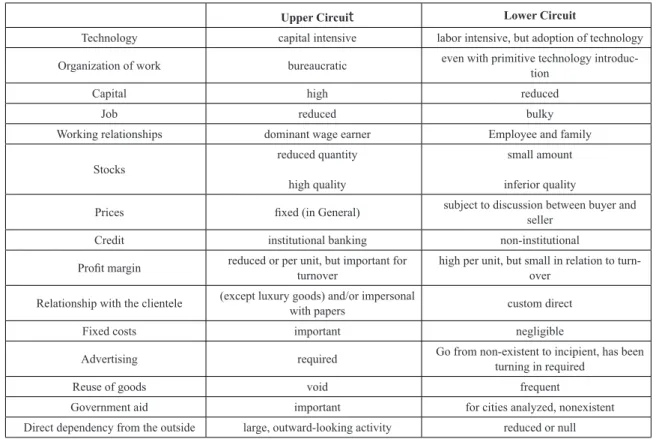
So, on the exposed, to the local cities – hybrid by us analyzed, we can relect about the cha -racteristics of the circuits of the urban economy, especially of the lower circuit. However, we point out that the weights on the top circuit, in table 1, have been substantiated by theoretical framework used in this work and, for the lower circuit, the information refers to dynamic present in local ci-ties – hybrid.
31
Table 1 - Characteristics of the two circuits of the urban economy
Upper Circuit Lower Circuit
Technology capital intensive labor intensive, but adoption of technology
Organization of work bureaucratic even with primitive technology
introduc-tion
Capital high reduced
Job reduced bulky
Working relationships dominant wage earner Employee and family
Stocks
reduced quantity
high quality
small amount
inferior quality
Prices ixed (in General) subject to discussion between buyer and
seller
Credit institutional banking non-institutional
Proit margin reduced or per unit, but important for turnover
high per unit, but small in relation to turn-over
Relationship with the clientele (except luxury goods) and/or impersonal
with papers custom direct
Fixed costs important negligible
Advertising required Go from non-existent to incipient, has been
turning in required
Reuse of goods void frequent
Government aid important for cities analyzed, nonexistent
Direct dependency from the outside large, outward-looking activity reduced or null
Source: Santos (2004 [1979]), Silveira (2004, 2007, 2008), Montenegro (2006) and ieldwork, 2012.
Therefore, we reinforced our understanding that, without taking into consideration the lower circuit, the understanding of the city is incomplete, especially if we consider, for the local cities – hybrid the relationship between lower circuit and poverty, “poverty and lower circuit appear to
relation of cause and efect undeniable” (Santos, 2004 [1979], p. 196). We will discuss this matter
in the next item.
POVERTY AND LOWER CIRCUIT OF URBAN ECONOMICS
As regards poverty and lower circuit of economy, Santos (1978) demonstrates that the approach
on urban poverty should be considered under the efects of modernization, both at the international
level as local, or the functioning of the poor economy with modern economy. Thus, to understand the urban poverty is essential to analyze the urban economy not as a single system, but compo-sed of two subsystems – upper and lower circuit circuit (SANTOS, 1978, p. 33). In this sense, to the local cities – hybrid you have to consider the urban poverty through the circuits of the urban economy. Linking poverty and lower circuit allows us to understand the material poverty which renders these spaces.
Santos (1978, p. 37) points out that the urban poverty, thought through the two subsystems of the urban economy, is related to the consumption and that urban society is split between those who have permanent access to goods and services and those who, with the same needs, are not in a position to satisfy them.
Following the line of thought of Santos (1978 and 2004 [1979]) and Côrrea (1999), we see that one of the main ways – but not exclusively – insertion of small towns in the urban network is
through the establishment of the lower circuit of the economy, noting, however, that this inding
32
lower circuit as there are links that articulate the upper circuit, too, if only because both comprise a whole that cannot be thought only from one of them.
The correlations of the circuits of the urban economy, Santos (1978, p. 34-35) explains that:
The upper circuit emanates directly from the technological modernisation, better represented in today’s monopolies, is not connected to the local or regional level, but within the structure of a country or countries.
The circuit below is formed of small-scale activities, serving mainly poor population; contrary to what occurs in the upper circuit, these activities are deeply implanted within the city, enjoying a privileged relationship with your region.
In order to think about the inancial nexus between the two circuits of the urban economy,
Silveira (2009, p 69) points out that:
The agents of the lower circuit that needed liquidity, became a captive clientele and dependent, and the pawnbroker was a trait d’union in urban economics. Financial banking institutions and non-bank shall fulill this role. We can say that, today, the top circuit recognizes the importance of debureaucratize the credit, to extend their proit opportunities and thus the requirements are minimal.
To provide the territory of technical, science and information, scientiic and technical-infor
-mational intensiies the luidity, reinforcing the importance of lows, especially in respect of the
use of money, even more concentrated in the region where it operates our area of research – which features an extreme division of labor and a relevant life of relationships (SANTOS AND SILVEI-RA, 2006 [2001]).
Even in this sense, Silveira (2009) adds that the commercial irms, becoming inancial, have
been oriented towards the lower layers, increasing consumption, but with less chance to produce. Thus, the consumption of the poor is increasingly upper circuit and perform, “as a consequence,
increases the distance between the upper circuit, more proit and less idle capacity, and the lower
circuit, each day more poor and indebted” (SILVEIRA, 2009, p. 72).
As discussed, the population of the local cities – hybrid have access to the nexus inancial
and more and more consumption is drained to the upper circuit and upper marginal, since the life of relationships is intense.
Therefore, Santos and Silveira (2006 [2001], p. 203) point to the efect of the size of the po -pulation:
The efect of size has an important role in interurban division and intraurban division of labor; the bigger and more populous cities, more able they are to shelter a wide range of activities and contain a larger list of professions, establishing thus a fabric of interrelations more efective from an economic point of view.
The population size is an important factor for urban functions are designed only to meet the basic needs of the population. In this context, these characteristics do not allow to develop a large number of jobs. Thus, unemployment becomes a latent issue in these urban spaces.
In the three cities studied, we found that the lack of employment opportunities is one of the main problems encountered, leading to a high material poverty. In the town of Pracinha, for exam-ple, of the respondents who are in active age, 36.92% declared work and 44.61% are not working at the moment by the lack of employment opportunities in the city. The services and gifts in these localities, trades in number and size reduced, generate a limited demand for labor that, in most cases, is supplied by the family work.
pur-33
chasing power, because they are occupations that usually require a low level of education, lack of
professional qualiication and, in general, are poorly paid, with emphasis on the following: diarist,
seasonal farm worker, maid, builder, farm worker (cutter of sugarcane), among others. The
occupa-tions declared by respondents that difer from the other were teacher, civil servant and farm worker,
as engineer, safety manager, etc.. Even in this sense, it has been found, among those interviewed,
only the occupation of teacher requires greater qualiications. For the cities analyzed, in addition to teacher, we found occupations that match higher qualiication and/or higher remuneration as,
for example, businessmen, lawyers, magistrates, doctors, veterinarians, engineers, among others. With respect to family income of respondents, we observed that in three towns just over 50% of respondents receive up to two minimum salaries, setting up an impoverished population.
We must consider that the prevalence of lower circuit in an urban economy encourages the creation of wealth, because its dynamics is based on intensive work, rather than capital intensive,
factor that provides job creation and diversiication of functions, but, even so, prevails the perpe -tuation of poverty.
Silveira (2007, p. 19), when working on this issue, consider that:
The problem is to imagine that this economy, which corresponds to most of the nation and the territory, does not create wealth, employment nor is productive. In fact, the lower circuit and so many times the upper circuit marginal create wealth more slowly and therefore less unevenly. With less capital creates more jobs.
In this direction, but still referring to the consumer market of the lower circuit, Silveira (2004, p. 66) highlights:
The concentration of poor in São Paulo ends up having a positive efect on the volumes produced and marketed. It creates a market that, despite individual demands is limited by the large number of families, an efect ampliied.
This dynamic is called economy of poverty, because these cannot consume a lot, but there are
many (SILVEIRA, 2004). Therefore, there is a clear diference between the dynamics of the lower
circuit in cities like São Paulo, and the lower circuit of local cities – hybrid. While the
concentra-tion of poor in the metropolis allows a positive efect on the volumes produced and marketed by
creating a consumer market, in local cities – hybrid even lower circuit being largely responsible for the movement of the urban consumer market economy is restricted and limited. Additonally, we must also consider the location of these clusters, the ability to purchase goods and products and the diversion of supply and demand of goods and products.
Thus, Santos (1985, p. 10) points out that the place attributes to components of space a particular
value. Each element of the space-men, irms, institutions, half-acquires speciic characteristics, even
though under the whole movement. The author points out that factories with the same economic
and political power feature diferentiations of results if we consider their locations and individuals
with the same training and virtues “do not have the same status as producers, consumers and even as citizens” (SANTOS, 1985, p. 10) because of the location.
Thus, be located in a local cities – hybrid, in the State of São Paulo is a major factor in the strengthening of urban poverty, as these spaces businesses, factories and individuals do not encounter the same conditions as producers, consumers and citizens, intensifying the rise in unemployment and a decrease in the value of the work.
The unemployment and low pay interfere with ability to purchase of goods and products that depend on the availability of economic resources, but also by the accessibility of good or service demanded “(SANTOS, 1985, p. 64).
Muni-34
cípios (FPM), for example, are the main sources of resources available to the government premises. In addition, the number of commercial amenities is reduced, there is high rate of unemployment
and low pay and public jobs, in many cases-especially those that require higher qualiication – are illed by persons resident elsewhere. These factors indicate that the ability of consumption of goods and services by the population coming up in inancial availability.
Another factor related to the access of goods and services refers to the accessibility, because their demand is met, for the most part, in larger cities. Thus, people need to move running on bus
timetables, inancial resources and time.
The existing establishments in the local cities – hybrid have a high ofer of goods and services.
The demand is shifted or supplied for subregional or medium-sized cities. This factor, in turn, redu-ces the existing supply in these cities due to lack of demand. In addition, this diversion of demand tends to raise the price of the products, reducing the clientele and, before long, these establishments will no longer be able to meet the local population that will seek the goods and products in other cores. This process is found in all the cities analyzed, the most emblematic of the city of Flora Rica, where only 10.53% of respondents declared purchase food in the city. With respect to the purchase of clothing, footwear and haberdashery just 3.94% of respondents the purchase exclusively in Flora Rica, while 2.64% claim to obtain these products in Flora Rica and elsewhere, factor attributed to high prices and reduced supply of products.
Santos (1985, p. 84), to analyze the factors listed above, points out that:
Makes it clear that the spatial organization and urban options have direct relation with the trends to reduction or increase in poverty. If the conditions for the organisation of the economy, society and space lead to worsen poverty, that is, to reduce the participation of urban and rural workers in the fruit of your work, the organisation of space and the resulting urban proile will be an additional factor of poverty, that is, make the poor become even poorer.
The author adds that the spatial organization tends to contribute to the increase in poverty and that poverty is also a factor in the organization of space, after all, the “conditions”, the “circu-mstances” and the kind of history, which is also geographical environment, must, in addition, be considered as “cannot be reduced to universal logic” (SANTOS, 2006, p. 125).
However, we can say that this close relationship of local cities – hybrid and lower circuit of the economy provides the structuring of poverty, that takes place in the incipient urban functions, in the precariousness of urban amenities, on the issue of unemployment and poor remuneration, in reducing the value of the work, on location, in the access to goods and products and the diversion
of demand. Therefore, the characteristics present in the local cities – hybrid ofer a space organi -zation – leading to urban poverty, and, as we point out above, “poverty and lower circuit appear to
relation of cause and efect cannot be denied” (SANTOS, 2004 [1979], p. 196). So, support with
Maria Laura Silveira that, in analyzing the lower circuit, points out the existence of structural po-verty as a product of the growing rationalization of society and of the territory, and this process of rationalization if globalizing also makes your products, such as poverty. “ Desse modo, la división del trabajo nacida del neoliberalismo ha sido productora de pobreza y deudas sociales “, and is with the superposition of the division of labour of large corporations based in science and technical
information and inancial mechanisms that the forms of work and devalue, “ de allí los mecanismos
de exclusión y pobreza “ (SILVEIRA, 2008, p. 1476).
FINAL CONSIDERATIONS
Analyzing some items of this typology in the theory of two circuits of the economy, what are
the main diferences between the two circuits and how the lower circuit-our focus of analysis – using
35
the reality of the urban economy, especially in a period marked by accelerated modernization pro-cesses, that lead the chronic unemployment, the obsolescence of knowledge, automation techniques, the concentration of property and the surplus, resulting in structural poverty (SILVEIRA, 2007).
To the reality of the urban economy of local cities – hybrid, the impounded circuit less than dynamic change on transformations present in the current period, but also found that some variables retain their characteristics while others merge.
For cities that hold in their urban economics the predominance of the lower circuit, as the local cities – hybrid we can only think issue of circuits attached to the long distance division of work analysis, because the relationship between the circuits is dialectics. In this sense, the relationship between intra and interurban scales allows us to show the dynamics of the circuit of the urban eco-nomy in the city’s production, that for the local – hybrid express themselves at the lower circuit.
Thus, we highlight that the lower circuit, in the context of the local cities – hybrid is productive and responsible for the generation of employment and income, enabling the survival, but features a few conditions to create wealth and employment for the small number of its consumer market,
working to keep the efects of the existing urban functions in these localities. These factors corro -borated to unemployment, poorly paid work and poverty are latent issues in these spaces.
BIBLIOGRAPHIC REFERENCE
CORRÊA, R. L. Globalização e reestruturação da rede urbana – uma nota sobre as pequenas cidades. In: Território. Ano IV, nº6. Rio de Janeiro: Garamond, 1999. p.43-53.
CICCOLELLA, Pablo. La ciudad mestiza: metrópoles latinoamericanas atrapadas entre la globalización y la inclusión social. In: Revista Tamoios, jul/dez, ano VI, n. 2, 2010.
HAESBAERT, R. Hibridismo, mobilidade e multiterritorialidade numa perspectiva geográica-cultural integradora. In: SERPA A. (org). Espaços culturais: vivências, imaginações e representações. Salvador: EDUFBA, 2008.
LATOUR, Bruno. Jamais fomos modernos: ensaios sobre antropologia simétrica; tradução de Carlos Irineu da Costa. Rio de Janeiro: Ed. 34, 1994.
MONTENEGRO, Marina R.. O circuito inferior da economia urbana na cidade de São Paulo no período da globalização. Universidade de São Paulo, Faculdade de Filosoia, Letras e Ciências Humanas, Departa -mento de Geograia. São Paulo, 2006. (Dissertação Mestrado em Geograia Humana).
OLIVEIRA, E. Luis. Divisão do trabalho e circuitos da economia urbana em Londrina – PR. Universidade de São Paulo, São Paulo Faculdade de Filosoia, Letras e Ciências Humanas, Departamento de Geograia, 2009. (Tese Doutorado em Geograia Humana).
ROMA, C. Marques; VIEIRA, Alexandre B. A centralidade urbana: uma análise a partir de uma cidade pequena. In. Anais do VII Encontro Nacional da ANPEGE. ANPEGE: Niterói, 2007.
ROMA, C. Marques. O rural, o urbano e o agrícola no movimento espiral do espaço: um híbrido. Fa-culdade de Ciência e Tecnologia, FCT - Unesp, Presidente Prudente, 2012. (Tese Doutorado em Geograia). SANTOS, Milton. Pobreza urbana. São Paulo: HUCITEC, 1978.119p.
SANTOS, Milton. O espaço dividido: os dois circuitos da economia urbana dos países subdesenvolvidos. Trad. MyrnaT.R. Viana. São Paulo: EDUSP, 2004 [1979]. 433 p.
SANTOS, Milton. A natureza do espaço: técnica e tempo, razão e emoção. São Paulo: Hucitec, 2006 [1996]. SANTOS, Milton. Espaço e Sociedade: ensaios. Petrópolis: Vozes, 1982.
SANTOS, Milton. Espaço e Método. São Paulo: Nobel, 1985.
SANTOS, Milton.; SILVEIRA, M. Laura. O Brasil: território e sociedade do século XXI. 9ª ed., Rio de Janeiro: Record, 2006 [2001].
36
SILVEIRA, Maria Laura. Crises e paradoxos da cidade contemporânea: os dois circuitos da economia urbana. X Simpurb, Florianópolis. 2007.
SILVEIRA, Maria Laura. Globalización y inanzas: circuitos de la economia urbana em la ciudad de San Pablo. IN: X Seminario Internacional de la RII, Santiago de Querétaro, México, maio de 2008.
SILVEIRA, Maria Laura. Finanças, consumo e circuitos da economia urbana na cidade de São Paulo. Caderno CRH, Salvador, v.22, n. 55, jan/abr. 2009.