Combination of topical agents and oxybutynin as a therapeutic
modality for patients with both osmidrosis and hyperhidrosis
ANDREA YASBEK MONTEIRO VARELLA1, JULIANA MARIA FUKUDA1* , MARCELO PASSOS TEIVELIS1, LUCAS LEMBRANÇA PINHEIRO1,CYNTHIADE ALMEIDA MENDES1, PAULO KAUFFMAN1,2, JOSÉ RIBAS MILANEZDE CAMPOS3,4, NELSON WOLOSKER1,2
1Division of Vascular and Endovascular Surgery, Hospital Israelita Albert Einstein, São Paulo, SP, Brazil
2Division of Vascular and Endovascular Surgery, Hospital das Clínicas da Faculdade de Medicina da Universidade de São Paulo (HC-FMUSP), São Paulo, SP, Brazil 3Division of Thoracic Surgery, Hospital Israelita Albert Einstein, São Paulo, SP, Brazil
4Division of Thoracic Surgery, HC-FMUSP, São Paulo, SP, Brazil
S
UMMARYStudy conducted at Hospital Israelita
Albert Einstein, and at Hospital das Clínicas da Faculdade de Medicina da
Universidade de São Paulo (HC-FMUSP), São Paulo, SP, Brazil
Article received: 7/19/2017
Accepted for publication: 9/9/2017
*Correspondence:
Address: Av. Albert Einstein, 627,
bloco A1, 4º andar, sala 423, Morumbi São Paulo, SP – Brasil
Postal code: 05652-000 [email protected]
http://dx.doi.org/10.1590/1806-9282.64.02.127
Introduction: The association of osmidrosis and hyperhidrosis often causes emotional and social problems that may impair the patients’ quality of life. The purpose of our study was to analyze the therapeutic results of oxybutynin and topical agents in 89 patients with both osmidrosis and hyperhidrosis.
Method: We conducted an observational study at two specialized centers of hyperhidrosis between April 2007 and August 2013. Eighty-nine (89) patients with both osmidrosis and hyperhidrosis were treated with oxybutynin and topical agents. Patients were evaluated before treatment and at 3 and 6 weeks after treatment started, by using the Quality of Life Questionnaire and the Sweating Evolution Scale.
Results: Before treatment, 98% of the patients presented with poor or very poor quality of life. After six weeks of treatment, 70% stated their quality of life as being slightly better or much better (p<0.001) and nearly 70% of the patients experienced a moderate or great improvement in sweating and malodor. Improvement in osmidrosis was significantly greater when the axillary region was the first most disturbing site of hyperhidrosis.
Conclusion: There was a significant improvement in quality of life and a reduction in sweating and malodor after six weeks of treatment with topical agents and oxybutynin in patients with both hyperhidrosis and osmidrosis. Therefore, clinical treatment should be considered before invasive techniques.
Keywords: Hyperhidrosis. Apocrine Glands. Muscarinic Antagonists. Sweat Gland Diseases.
I
NTRODUCTIONOsmidrosis (OH) is a disease caused by excessive secretion of the apocrine glands, resulting in malodor, mainly in the axillary and genital areas. It often causes emotional and social problems that may impair the patients’ qual-ity of life (QoL). Some patients with OH also have hyper-hidrosis (HH), which is characterized by the overproduc-tion of sweat by eccrine glands covering the body’s surface, predominantly in the palmar, plantar, axillary and cra-niofacial regions. When OH and HH occur together, the problem becomes even more distressing for patients.1
In our institution, many patients present with both HH and OH. In such cases, treatment includes oxybutynin
and topical agents. Oxybutynin is an anticholinergic drug that has been shown to decrease sweating and improve QoL with few side effects in more than 70% of the pa-tients.2-4 If this treatment fails, sympathectomy may be
the first surgical choice for palmar HH and can be con-sidered as a surgical alternative for axillary and facial HH because it is a definitive therapeutic option.5,6 The
topical agents used in our service are Sastid® (Stiefel, a
GSK company, Middlesex, United Kingdom), which is a soap containing salicylic acid and sulfur that has fun-gicidal and keratolytic action, and Clinagel® (Stiefel, a
To the best of our knowledge, no study has demon-strated the therapeutic results of the combination of oxybutynin and topical agents in patients with both OH and HH. This study aimed to analyze the therapeutic results of oxybutynin and topical agents in 89 patients with both OH and HH.
M
ETHODThis was a retrospective study with a review of the patients’ data at two specialized centers of HH (Hospital Israelita Albert Einstein and Hospital das Clínicas da Faculdade de Medicina da Universidade de São Paulo) between April 2007 and August 2013. Our study was conducted in accordance with the standards of the Ethics Committee for Analysis of Research Projects on Human Experimentation (Approval numbers at Plataforma Brasil: CAAE01582112.6.1001.0071 and CAAE01582112.2.3001.0068); all subjects gave informed consent. A total of 89 patients with both OH and HH in the axillary region and in other sites were treated with oxybutynin and topical agents. Follow-up was conducted 3 and 6 weeks after treatment started. Patients with com-pensatory HH were not included.
The group comprised 74 women (83%) and 15 men (17%), aged 5 to 57 years, with a median age of 27 years. The patients’ body mass index (BMI) ranged from 15.7 to 33.2 kg/m2, with a median of 23 kg/m2.
At the first visit, oxybutynin and both topical agents (Sastid® and Clinagel®) were introduced. The soap and
the gel were used once a day, daily.
Oxybutynin was prescribed for six weeks, in progres-sively increasing doses throughout treatment. At the first visit, patients were given 2.5 mg of oxybutynin to be taken once a day in the evening, for one week; they were then instructed to increase the dose to 2.5 mg twice a day from the 8th to the 21st day, after which a second visit was
scheduled (three weeks of treatment). After this period of time, the dose was increased to 5 mg twice a day from the 22nd to the 42nd day, after which a third visit was
sched-uled (six weeks of treatment).
The patients were evaluated three times: at the first visit (before medications) and after the 3rd and 6th weeks,
using the QoL questionnaire7 and the Sweating
Evolu-tion Scale.
Patients answered the QoL questionnaire at the first visit and after six weeks of treatment. The QoL question-naire consists of 20 specific questions about HH/OH, divided in five domains. Each domain or group contains five degrees of answers and the patient indicated only one, with scores ranging from 20 to 100. According to the scoring system, a higher score reflects a poorer QoL. QoL
before treatment was considered very poor if the sum of points was greater than 83; poor if the sum was from 68 to 83; good if the sum was 52 to 67; very good if the sum was 36 to 51; and excellent if the sum was 20 to 35.
At the 6th week of treatment, QoL was classified as
much worse when the total score was greater than 83; slight-ly worse when the total score was between 68 and 83; the same when the total score was between 52 and 67; slight-ly better when the total score was between 36 and 51; and much better when the total score was between 20 and 35.
The Sweating Evolution Scale is based on the patient’s subjective perception of improvement in HH/OH after treatment. It was used at the second and third visits for all study participants. The scale ranges from 0 to 10, with 0 representing no improvement and 10 representing absence of HH. If the score was between 1 and 4, the improvement was considered slight; if the score was between 5 and 7, the improvement was considered moderate; and if the score was between 8 and 10, the improvement was considered great.
We analyzed the number and sites with HH symp-toms in addition to axillary OH (HH sites associated with OH); the distribution of patients according to site of com-plaint; the association between OH and HH (sites of HH and the most disturbing complaints of the patients); the number of patients who mentioned OH as the first, sec-ond, third, or fourth complaint; the impact of OH on QoL before treatment; the effect of treatment on QoL; and the improvement in malodor and sweating after treatment.
The numerical variables were expressed by using mean and standard deviation, with normality being verified with the Shapiro-Wilk test. When normality could not be assumed, the variables were described as median and interquartile range. Categorical variables were described by using absolute and relative frequencies.
The Wilcoxon rank-sum test was used to analyze the self-reported improvement in malodor and sweating over the consecutive medical visits and to compare the thera-peutic results between OH and HH. The same test was used to compare the impairment in QoL throughout the treatment. McNemar’s test was used to compare categor-ical levels of malodor improvement.
The results were presented using p values. The sig-nificance level for all tests was p=0.05.
R
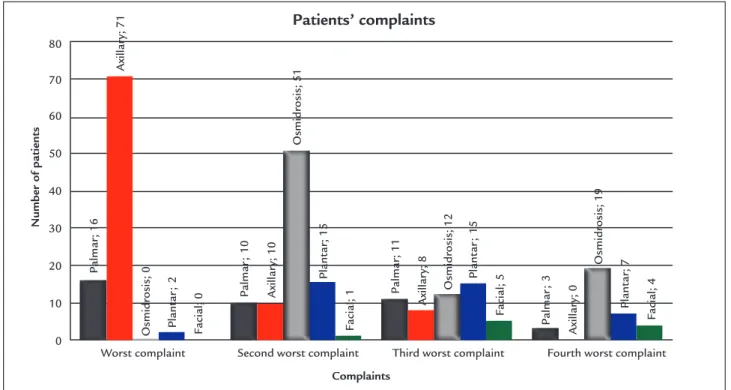
ESULTSsecond most disturbing complaint. Figure 1 shows the most disturbing sites of complaint by patients.
The number of body sites affected by HH and their locations are presented in Table 1. Most patients (86%) had HH in one, two or three sites in addition to OH. The other 14% of patients had HH in four or more sites.
The sites of HH that were associated with axillary malodor are shown in Table 1. Palmar or plantar HH were present in almost half of the patients.
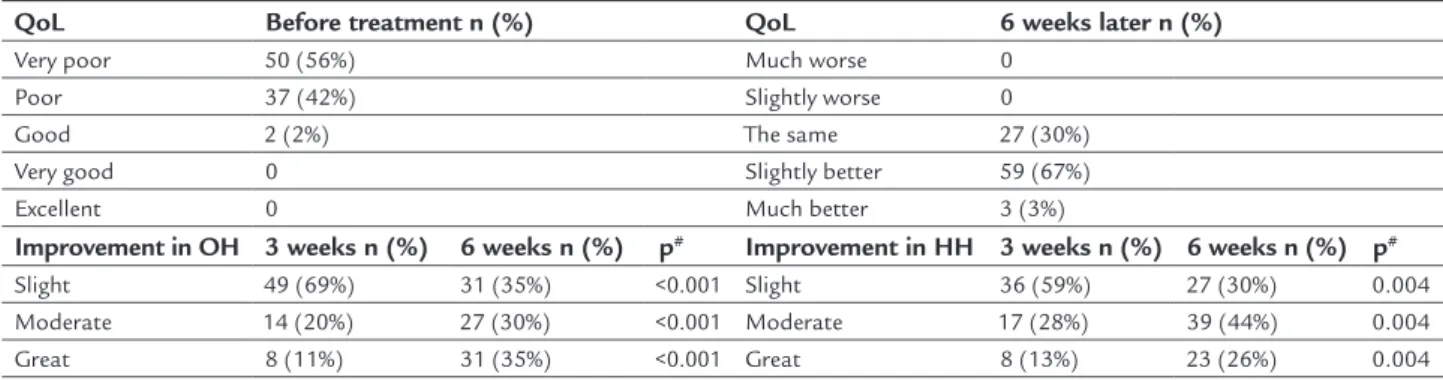
The effect of OH and HH on QoL before and after six weeks of treatment as well as the evolution of OH and HH (considering OH and the most disturbing site of HH in each patient) after 3 and 6 weeks according to the Sweat-ing Evolution Scale are presented in Table 2.
Before treatment, almost all patients (98%) ranked their QoL as poor or very poor. After six weeks of treat-ment, the improvement in QoL was substantial and most patients (70%) considered their QoL as slightly or much better, with a statistically significant difference (p<0.001). After three weeks of treatment, we observed an improve-ment of 31% in symptoms of OH and a 41% improveimprove-ment in symptoms of HH, with no statistical difference. After six weeks of treatment, nearly 70% of the patients experienced moder-ate to great improvement in symptoms of both OH and HH. Considering only OH, we observed that patients tak-ing subdoses of oxybutynin (results of three weeks) showed less improvement. However, when the full dose of
oxybu-tynin was taken (results of six weeks), patients experienced a significant improvement. The same occurred with HH symptoms, showing that clinical efficacy depends on the correct oxybutynin dose.
We also observed that the improvement in OH symp-toms was significantly greater when the axillary region was the first most disturbing site of HH if compared to the results in patients with plantar and palmar areas as the first most disturbing sites of HH.
D
ISCUSSIONOH is a disease that disrupts patients’ social and profes-sional lives. Its prevalence is about 4.5% in Han Chinese.8
The exact etiology of OH has not been elucidated yet,9
but it is known to be a familial hereditary disease, with the involvement of genetic mechanisms and the influence of androgens on the secretion of the apocrine glands.8,10-12
The influence of sex hormones on the pathophysiology of OH justifies its larger frequency during puberty.8
Similar to other authors, we observed a higher fre-quency of OH among female patients, although the rea-son is unknown.13,14 Nokita et al.15 suggested that
cul-tural, psychological, hormonal and physiologic factors may make women more sensitive to malodor.
Surgical excision of the subcutaneous tissue and/or the overlying skin, which entails a complete excision of the apocrine and eccrine glands,16 can be performed to
FIGURE 1 Distribution of patients according to sites of complaint.
Patients’ complaints
Number of patients
Worst complaint Second worst complaint Third worst complaint
80
70
60
50
40
30
20
10
0
Fourth worst complaint
Complaints
Palmar
; 16
Palmar
; 10
Palmar
; 11
Palmar
; 3
Plant
ar
; 2 Plant
ar
; 15
Plant
ar
; 15
Plant
ar
; 7
Facial; 0 Facial; 1
Facial; 5 Facial; 4
Axillar
y; 71
Axillar
y; 10
Axillar
y; 8
Axillar
y; 0
Osmidrosis; 0
Osmidrosis; 51
Osmidrosis; 12
TABLE 1 Number and locations of hyperhidrosis sites in addition to axillary osmidrosis. Hyperhidrosis sites associated with osmidrosis.
Number and locations of hyperhidrosis sites n %
1 site 29 33
Axillary 29 33
2 sites 19 22
Axillary and Palmar 8 9.5
Axillary and Plantar 8 9.5
Axillary and Legs 1 1
Axillary and Back 1 1
Axillary and Facial 1 1
3 sites 28 31
Axillary and Palmar and Plantar 19 22
Axillary and Palmar and Abdominal 2 2
Axillary and Palmar and Facial 1 1
Axillary and Palmar and Scalp 1 1
Axillary and Palmar and Legs 1 1
Axillary and Thorax and Legs 1 1
Axillary and Thorax and Back 1 1
Axillary and Facial and Back 1 1
Axillary and Plantar and Inguinal 1 1
4 sites 9 10
Axillary and Palmar and Plantar and Facial 5 6
Axillary and Palmar and Plantar and Back 1 1
Axillary and Palmar and Plantar and Legs 1 1
Axillary and Abdominal and Back and Breast 1 1
Axillary and Abdominal and Back and Thorax 1 1
5 sites 2 2
Axillary and Plantar and Abdominal and Legs and Inguinal 1 1
Axillary and Palmar and Plantar and Back and Backside 1 1
6 sites 2 2
Axillary and Back and Breast and Plantar and Facial and Backside 1 1
Axillary and Back and Breast and Plantar and Facial and Palmar 1 1
Total 89 100
Axillary hyperhidrosis n=89 (100%)
Facial hyperhidrosis n=11 (12%)
Palmar hyperhidrosis n=40 (45%)
Plantar hyperhidrosis n=39 (44%)
Other sites of hyperhidrosis n=18 (20%)
Male 15 (17%) 6 (55%) 8 (20%) 7 (18%) 2 (11%)
Female 74 (83%) 5 (45%) 32 (80%) 32 (82%) 16 (89%)
TABLE 2 Quality of life before treatment and six weeks later. Evolution of osmidrosis and hyperhidrosis after 3 and 6 weeks of treatment.
QoL Before treatment n (%) QoL 6 weeks later n (%)
Very poor 50 (56%) Much worse 0
Poor 37 (42%) Slightly worse 0
Good 2 (2%) The same 27 (30%)
Very good 0 Slightly better 59 (67%)
Excellent 0 Much better 3 (3%)
Improvement in OH 3 weeks n (%) 6 weeks n (%) p# Improvement in HH 3 weeks n (%) 6 weeks n (%) p#
Slight 49 (69%) 31 (35%) <0.001 Slight 36 (59%) 27 (30%) 0.004
Moderate 14 (20%) 27 (30%) <0.001 Moderate 17 (28%) 39 (44%) 0.004
Great 8 (11%) 31 (35%) <0.001 Great 8 (13%) 23 (26%) 0.004
QoL: quality of life; OH: osmidrosis; HH: hyperhidrosis.
reduce malodor and sweating. Minimally invasive proce-dures17-20 such as liposuction, laser therapy, subdermal
shaving, microwave-based device and ultrasonic surgical aspiration are also used to reduce malodor and sweating caused by the excessive secretion of these glands.
However, recurrence of malodor is more frequent with minimally invasive procedures. Complete excision of the glands, although having a lower recurrence rate, leads to significant scarring, longer periods of bandaging and a higher risk of complications.10,17
Nonsurgical methods for the treatment of HH and OH include topical antiperspirants, iontophoresis, Botox injection and the use of anticholinergic drugs.9,21,22 Unless
there are formal contraindications such as closed-angle glaucoma, intestinal obstruction and severe dermatologic complaints, we empirically treat our patients with both HH and OH with a soap containing salicylic acid and sul-fur (SASTID®) which has a fungicidal and keratolytic action,
associated to a gel containing topical antibiotic (CLINA-GEL®), combined with oxybutynin. The oxybutynin is an
anticholinergic drug used for HH with a high efficacy rate and scientific evidence to support its use.3,23
All the patients with OH had an association with axillary HH. In Western countries, people tend to ask for treatment of HH rather than of OH. In Asian countries, patients are more concerned about controlling OH.24 This is the reason
why most of the studies on OH are from Asian countries. In our study, all the patients sought medical care for HH rather than for OH. The fact that we are a referral center for patients with HH may also account for why all the patients in our study had HH.
The axillary region was the only HH site in patients presenting with malodor, while excessive sweat was present in different sites of the body. HH was more frequent in the axillary region, a fact noted by all the patients. The palmar region was the second most affected site of HH (45%) fol-lowed by the soles (44%); the other sites of HH were present in 20% of the patients. These rates are similar to those of the population affected by HH.25 The face was affected by
excessive sweat in 12% of the patients in our study, probably because our sample had a median age of 27 years; the symp-toms of facial HH commonly start in adulthood and patients tend to seek treatment for this condition in their 40s.26
To the best of our knowledge, no previous study has evaluated QoL in patients with both HH and OH. Most studies analyze only the improvement in symptoms and the presence of complications related to the therapy. In our study, however, we evaluated patients’ QoL before treatment and six weeks after treatment started. Seventy percent (70%) reported that their QoL had improved
slightly or was much better after six weeks of treatment. Before treatment, none of the patients considered their QoL very good or excellent; only 2% reported it as good.
The treatment of both OH and HH with the combina-tion of topical agents and subdoses of oxybutynin (clini-cally insufficient dose) led to a significantly lower improve-ment when compared to patients using topical agents and the full dose of oxybutynin (10 mg). The full dose of oxybutynin was effective (moderate or great improvement) in reducing malodor in 65% of the patients; 70% experi-enced a reduction in sweating and 70% reported that their QoL was slightly or much better than before treatment.
We have not found any study that evaluated the results in patients with both HH and OH who had been treated with noninvasive methods. Comparing our results with other publications, we achieved similar results to those of Seo et al.,27 who showed 72.1% of good to excellent results in patients
with axillary OH after liposuction with curettage. The same author reported that 8 out of 43 patients (19%) had compli-cations such as ecchymosis, focal skin necrosis, induration, hematoma and seroma. Lee et al.28 reported that excellent
results were achieved in 76% of the patients and 22% experi-enced good results after tumescent liposuction with dermal curettage for treatment of axillary HH and OH. Other surgi-cal treatments showed higher rates of satisfaction among patients (80.6% to 98.9%), but these patients experienced a higher number of complications (10.7% to 45.2%).29-31
A weakness of our study is the assessment of the relative influence of topical agents on the amelioration of OH. Would the results be different if patients had re-ceived only oxybutynin or just topical treatment? Only a prospective and randomized study (with a topical agent as placebo) could definitely provide an answer to this question; such a trial is under consideration in our centers. Nevertheless, because all of our patients presented with HH in at least one site in addition to OH, oral and topical treatment were beneficial to the majority of the patients. Although the treatment of OH with topical agents and oxybutynin is not the solution for every patient, it is effective for most of them. Therefore, they should be used as the first alternative at the beginning of the treatment for patients with OH associated with HH before indicat-ing other therapeutic modalities.
C
ONCLUSIONR
ESUMOUso combinado de agentes tópicos e oxibutinina para tratamento de pacientes com osmidrose e hiper-hidrose
Introdução: A associação entre osmidrose e hiper-hidro-se com frequência causa problemas emocionais e sociais que podem deteriorar a qualidade de vida dos pacientes. O objetivo deste estudo foi analisar os resultados tera-pêuticos do uso de oxibutinina associada a agentes tópi-cos em 89 pacientes com osmidrose e hiper-hidrose.
Método: Nós conduzimos um estudo observacional em dois centros especializados em hiper-hidrose entre abril de 2007 e agosto de 2013. Oitenta e nove (89) pacientes com osmidrose associada a hiper-hidrose foram trata-dos com oxibutinina e agentes tópicos. Os pacientes fo-ram avaliados antes do tratamento e após 3 e 6 semanas do início do tratamento, por meio do Questionário de Qualidade de Vida e da Escala de Evolução da Sudorese.
Resultados: Antes do tratamento, 98% dos pacientes apre-sentavam qualidade de vida ruim ou muito ruim. Após seis semanas de tratamento, 70% classificou sua qualidade de vida como sendo pouco ou muito melhor (p<0.001) e apro-ximadamente 70% dos pacientes relataram melhora mo-derada ou grande de sudorese e odor. Houve melhora sig-nificativamente maior da osmidrose quando a região axilar era o sítio em que a hiper-hidrose mais incomodava.
Conclusão: Houve melhora significativa da qualidade de vida e uma redução da sudorese e do odor após seis se-manas de tratamento com agentes tópicos e oxibutinina em pacientes com hiper-hidrose associada a osmidrose. Dessa maneira, a terapia clínica deve ser considerada an-tes de técnicas invasivas.
Palavras-chave: Hiperidrose. Glândulas Apócrinas. Anta-gonistas Muscarínicos. Doenças das Glândulas Sudoríparas.
R
EFERENCES1. Hamm H, Naumann MK, Kowalski JW, Kütt S, Kozma C, Teale C. Primary focal hyperhidrosis: disease characteristics and functional impairment. Dermatology. 2006; 212(4):343-53.
2. Wolosker N, Schvartsman C, Krutman M, Campbell TP, Kauffman P, Campos JR, et al. Efficacy and quality of life outcomes of oxybutynin for treating palmar hyperhidrosis in children younger than 14 years old. Pediatr Dermatol. 2014; 31(1):48-53.
3. Wolosker N, Campos JR, Kauffman P, Neves S, Munia MA, Jatene FB, et al. The use of oxybutynin for treating axillary hyperhidrosis. Ann Vasc Surg. 2011; 25(8):1057-62.
4. Wolosker N, Campos JR, Kauffman P, Yazbek G, Neves S, Puech-Leão P. Use of oxybutynin for treating plantar hyperhidrosis. Int J Dermatol. 2013; 52(5):620-3. 5. Wolosker N, Campos JR, Kauffman P, Oliveira LA, Munia MA, Jatene FB. Evaluation of quality of life over time among 453 patients with
hyperhi-drosis submitted to endoscopic thoracic sympathectomy. J Vasc Surg. 2012; 55(1):154-6.
6. Campos JRM, Kauffman P, Wolosker N, Munia MA, Werebe EC, Andrade Filho LO, et al. Axillary hyperhidrosis: T3/T4 versus T4 thoracic sympathectomy in a series of 276 cases. J Laparoendosc Adv Surg Tech A. 2006; 16(6):598-603. 7. Amir M, Arish A, Weinstein Y, Pfeffer M, Levy Y. Impairment in quality of life among patients seeking surgery for hyperhidrosis (excessive sweating): preliminary results. Isr J Psychiatry Relat Sci. 2000; 37(1):25-31. 8. Chen H, Yang G, Li Y, Li X, Du J. Expression of apolipoprotein D and
androgen receptor in axillary osmidrosis and its molecular mechanism. Int J Clin Exp Med. 2013; 6(7):497-503.
9. Mao GY, Yang SL, Zheng JH. Etiology and management of axillary bromidrosis: a brief review. Int J Dermatol. 2008; 47(10):1063-8. 10. Park YJ, Shin MS. What is the best method for treating osmidrosis? Ann
Plast Surg. 2001; 47(3):303-9.
11. Nakano M, Miwa N, Hirano A, Yoshiura K, Niikawa N. A strong association of axillary osmidrosis with the wet earwax type determined by genotyping of the ABCC11 gene. BMC Genet. 2009; 10:42.
12. Sun Y, Long J, Wang Y. [Correlation between ABCC11 gene single nucleotide polymorphism and the incidence of axillary osmidrosis in Chinese Han population]. Zhong Nan Da Xue Xue Bao Yi Xue Ban. 2013; 38(11):1141-5. 13. Morioka D, Ohkubo F, Amikura Y. Clinical features of axillary osmidrosis: a
ret-rospective chart review of 723 Japanese patients. J Dermatol. 2013; 40(5):384-8. 14. Lee JC, Kuo HW, Chen CH, Juan WH, Hong HS, Yang CH. Treatment for axillary osmidrosis with suction-assisted cartilage shaver. Br J Plast Surg. 2005; 58(2):223-7.
15. Nokita M. [Osmidrosis axillae]. Kangogaku Zasshi. 1970; 34(8):84-90. 16. Liu Q, Zhou Q, Song Y, Yang S, Zheng J, Ding Z. Surgical subcision as a
cost-effective and minimally invasive treatment for axillary osmidrosis. J Cosmet Dermatol. 2010; 9(1)44-9.
17. Lee HC, Chen CC, Lee WY, Chuang HU, Kao MC. Axillary hyperhidrosis and osmidrosis treated by ultrasonic surgical aspiration compared with transthoracic endoscopic sympathectomy. Surg Neurol. 2008; 70(Suppl 1):S1:64-8. 18. Kim HG. A new osmidrosis procedure, the scrape and suction technique:
review of 4,322 patients. Aesthetic Plast Surg. 2014; 38(2):282-7. 19. Jung SK, Jang HW, Kim HJ, Lee SG, Lee KG, Kim SY, et al. A prospective,
long-term follow-up study of 1,444 nm Nd:YAG Laser: a new modality for treating axillary bromhidrosis. Ann Dermatol. 2014; 26(2):184-8. 20. Shim HS, Min SK, Lim JS, Han KT, Kim MC. Minimal subdermal shaving
by means of sclerotherapy using absolute ethanol: a new method for the treatment of axillary osmidrosis. Arch Plast Surg. 2013; 40(4):440-4. 21. Li WW, Liu ZF, Cui YN, Zeng A. [Comparison study on the efficacy of three
methods for the treatment of osmidrosis]. Zhonghua Zheng Xing Wai Ke Za Zhi. 2010; 26(5):348-50.
22. Guillet G, Zampetti A, Aballain-Colloc ML. Correlation between bacterial population and axillary and plantar bromidrosis: study of 30 patients. Eur J Dermatol. 2000; 10(1):41-2.
23. Wolosker N, Campos JR, Kauffman P, Puech-Leão P. A randomized placebo-controlled trial of oxybutynin for the initial treatment of palmar and axillary hyperhidrosis. J Vasc Surg. 2012; 55(6):1696-700.
24. Qian JG, Wang XJ. Effectiveness and complications of subdermal excision of apocrine glands in 206 cases with axillary osmidrosis. J Plast Reconstr Aesthet Surg. 2010; 63(6):1003-7.
25. Lear W, Kessler E, Solish N, Glaser DA. An epidemiological study of hyperhidrosis. Dermatol Surg. 2007; 33(1 Spec No.):S69-75.
26. Wolosker N, Campos JR, Kauffman P, Munia MA, Neves S, Jatene FB, et al. The use of oxybutynin for treating facial hyperhidrosis. An Bras Dermatol. 2011; 86(3):451-6.
27. Seo SH, Jang BS, Oh CK, Kwon KS, Kim MB. Tumescent superficial liposuction with curettage for treatment of axillary bromhidrosis. J Eur Acad Dermatol Venereol. 2008; 22(1):30-5.
28. Lee D, Cho SH, Kim YC, Park JH, Lee SS, Park SW. Tumescent liposuction with dermal curettage for treatment of axillary osmidrosis and hyperhidrosis. Dermatol Surg. 2006; 32(4):505-11.
29. Yoshikata R, Yanai A, Takei T, Shionome H. Surgical treatment of axillary osmidrosis. Br J Plast Surg. 1990; 43(4):483-5.
30. Endo T, Nakayama Y. Surgical treatment of axillary osmidrosis. Ann Plast Surg. 1993; 30(2):136-9.
31. Tung TC, Wei FC. Excision of subcutaneous tissue for the treatment of axillary osmidrosis. Br J Plast Surg. 1997; 50(1):61-6.