Project for an Online Art Gallery
as Social Cooperative
Carolina Marques de Carvalho
Dissertation submitted as partial requirement for the conferral of
Masters in International Management
Supervisor:
Prof. Gonçalo Pernas, ISCTE Business School, Invited Assistant
Professor, Marketing Department, Operations and General
Manager of IBS, Vice-President of Audax – Entrepreneurship
Center of ISCTE-IUL
i
Index
Index ... i
Index of Tables and Figures ... iii
Resumo ... iv Abstract ... v Executive Summary ... vi 1. Literary Review ... 1 2. Business Concept ... 9 3. Market Analysis ... 11
3.1 Target Market & Market Size ... 11
3.1.1 The global art market ... 11
3.1.2 The online art market ... 11
3.1.3 The street/urban street art market ... 12
3.2 Social target market ... 12
3.3 Economic conditions of the market ... 12
3.4 Competition and market unhappiness ... 13
3.5 Summary Opportunity ... 13 3.6 SWOT analysis ... 13 3.6.1 Internal analysis... 14 3.6.2 External analysis ... 15 3. Development Strategy ... 17 4- Implementation Policies ... 20 4.1 Organization ... 20 4.1.1 Financial Management ... 20 4.1.2 Commercial Management ... 21 4.1.3 I.T. Development... 21
ii 4.2 Marketing ... 21 4.2.1 Target market ... 22 4.2.2 Product ... 22 4.2.3 Price ... 23 4.2.4 Place ... 23 4.2.5 Promotion ... 23 4.3 Legal Aspects ... 25
4.3.1 Call Culture European Union Support Program ... 25
4.3.2 Artists’ and Customers’ Disclaimer ... 26
4.3.1 Statutes of MEcenas Cooperative ... 26
5- Financial Evaluation ... 27
5.1 Cash Flow projections ... 27
5.2 Balance Sheet projections ... 32
5.3 Start-Up requirements projections ... 33
6- Exit Strategy ... 34
7- Bibliography ... 35
8- Annexes ... 37
iii
Index of Tables and Figures
Figure 1 – MEcenas Strategy Map ……… 18
Table 1.1 – Cash flow projection in Year 1……….28
Table 1.2 – Cash flow projection in Year 2……….29
Table 1.3 – Cash flow projection in Year 3……….30
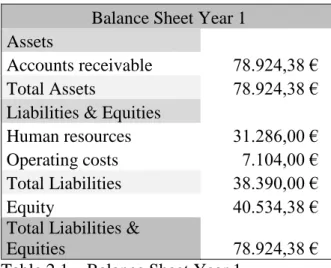
Table 2.1 – Balance Sheet Year 1……….31
Table 2.2 – Balance Sheet Year 2……….31
Table 2.3 – Balance Sheet Year 3……….31
iv
Resumo
Até agora, todo o negócio da comercialização de arte foi quase maioritariamente dominado por galerias de arte que cobram a artistas uma quantia considerável de comissão pela venda das suas peças, normalmente por volta de 40%, e que trabalham apenas com artistas já minimamente conhecidos. Este projeto é o planeamento da abertura de uma galeria de arte online, pelo nome de MEcenas, que tem como objetivo ajudar novos artistas a conquistarem o seu espaço no mercado e conseguirem alguma notoriedade, ao mesmo tempo que são disponibilizadas peças de arte a uma fatia da sociedade cada vez maior que escolhe ter na sua vida quotidiana todos os benefícios do convívio com a arte. Este projeto possibilita também uma fonte de rendimento para estes estudantes, que muitas vezes não têm acesso a trabalho relacionado com a sua área de formação, e gera uma possibilidade de promoção para as escolas de arte conquistarem notoriedade através dos trabalhos dos seus alunos.
Palavras-chave: Negócio, Gestão, Cultura, Social Classificações: Z00, M00
v
Abstract
So far the business behind the commercialization of art work has been mainly in the hands of physical art galleries that charge the artists a considerable amount of commission, usually around 40%, and work only with already known artists. This project is the planning of an online art gallery, by the name of MEcenas, that aims to help young artists that are still in school to achieve some levels of projection in the market while, at the same time, making art and culture available at a reasonable price so that an increasing portion of society may introduce its benefits into their daily lives. This project creates also the possibility for the art students to gain some income, that is often scarce, as well as it creates the opportunity for several art schools to be promoted through the work done by their students.
Keywords: Business, Management, Culture, Social Classifications: Z00, M00
vi
Executive Summary
Este projeto tem como objetivo o desenvolvimento de uma galeria de arte online, construída como uma organização do Terceiro Sector, uma cooperativa cultural. As cooperativas baseiam-se em valore de ajuda e responsabilidades próprias, democracia, igualdade e solidariedade. Na tradição dos seus fundadores, os membros das cooperativas acreditam nos valores éticos da honestidade, transparência e responsabilidade social. Os objetivos da cooperativa MEcenas são criar uma oportunidade para alunos de escolas de arte e jovens artistas de ganharem o seu espaço e notoriedade no mercado e ao mesmo tempo de providenciar à sociedade em geral o acesso à arte, beneficiando de todos os seus objetivos, a um preço mais baixo do que o normal neste setor ao mesmo tempo que é gerada uma fonte de rendimento para os artistas, através de uma plataforma online que os próprios podem utilizar para vender as suas peças, o que pode também trazer notoriedade às escolas de onde os mesmos provêm.
Ao longo desta tese são estudados vários artigos acerca de cooperativas e organizações do Terceiro Sector e como estas influenciam o mercado e a sociedade. É também desenvolvido o conceito de negócios assim como realizada uma análise de mercado. Com outros elementos como a organização da cooperativa e a sua análise financeira, o objetivo desta tese é de estabelecer a viabilidade desta iniciativa que se provaria benéfica para todas as partes, incluindo a sociedade no seu geral, que estaria extremamente mais exposta aos benefícios trazidos pela arte e a cultura. No final poderão ser encontradas as estratégias de saída da organização nos três cenários possíveis.
1
1. Literary Review
During the last few years, especially after the 90's, social entrepreneurship has taken a major role being for its practical effects on the social life or, on an academic point of view for the research and literature it has been dedicated to. When it comes to social entrepreneurship, it appears in the form of a sub discipline within the field of entrepreneurship (Certo and Miller, 2008). This topic has been achieving growing rates of importance in the academic scene, the corporate field and the field of social economy. However, being this such a recent topic of study there is a variety of definitions over this concept. From these definitions of social entrepreneurship and of social entrepreneurs we can emphasize the definition from Leadbetter (1997) "The use of the entrepreneur's behavior to achieve social profit instead of economic profit, or that the profit generated by market activities is used for the benefit of a specific group that is in a disadvantaged situation in that time."; Alford et al (2004) "It creates innovative solutions that address immediate social problems and puts ideas, abilities, resources and social arrangements that are necessary to the social changes"; Said School (2005) "A professional, innovative and sustainable approach to the systematic changes that work through the social flaws of the market."; Peredo and Mclean (2006) "Social entrepreneurship is created when someone or some group... tries to obtain social value... demonstrating an ability to recognize and profit of opportunities... employs innovation... accepts an above average risk... and possesses extraordinary resources... in the pursuit of a social enterprise."
Hayek (1945), Kirzner (1973) and Schumpeter (1942) have proposed a type of social entrepreneurs that they have divided into 3 different categories:
● The first category is the Bricoleur Social, this category is inspired by Hayek and
refers to entrepreneurs that think and act on opportunities that answer locally to the social needs for which they are motivated to act upon and for which they have the necessary abilities and resources. This entrepreneur works under a small scale, locally, and often over the subject of nature. Needs for this kind of social entrepreneurship are often scattered and unidentified, so this entrepreneur is a key player in the identification and action taken upon these needs and problems, as their actions help maintain the social harmony when facing social matters. Acting over a local scale allows them only access to limited resources that can be found in the area, however, being in the area, this allows the entrepreneur to have a quick
2
response time to the social matters in question. The laws and regulations of the local authorities, however, the contingencies for these entrepreneurs rely mainly on the fact that the limited resources that are locally available limit the possibility of giving a solution to other types of situations or even to expand geographically.
● The Social Builder, inspired by Kirzner, are the entrepreneurs that build and
operate under different structures in order to provide a solution for the social needs that the state, agencies and other enterprises are not providing. They work either in a small local scope or in a bigger international scope. This type of entrepreneurship is designed in a way that will allow to create a solution for a present social need. Behind this type of entrepreneurship lies a need for social responses that the State, agencies or other enterprises cannot provide, mainly due to laws, regulation, reasons of political nature, inefficiencies or a simple lack of will. These entrepreneurs have filled the gaps that the society has left behind but is in need of solutions. Offering a solution for many of these situations, filling in the social needs within large organizational structures. The solutions offered are often products and social services that create new social balances that were already in need. Competition is not a problem, being that these type of organizations most commonly act upon an unanswered need. Oftentimes the entrepreneur and his organization is seen as an "escape valve" that prevents negative publicity as well as social problems that might affect the State and other enterprises in an extremely adverse way. The limitations of this kind of entrepreneurship rely in the resources, both human and financial, that are required to the fulfillment of the task at hand.
● The Social Engineer, inspired by Schumpeter, is based on the mission of creating
new and more efficient social systems that will replace the current ones when these prove to be insufficiently responding to relevant social needs. These entrepreneurs work in a large national and international scope, trying to provide sustainable structures that will defy the current order. When there is a shift in the social needs, it is not possible to answer to these needs within the framework of the existing structures, therefore, these entrepreneurs will try to shift these structures or even create new ones. Within the social balance, these organizations will fragment the existing parameters and the current balance, in order for it to be more socially efficient. Until the moment that the existing social platforms and the people accountable for those platforms supply enough answers to the social
3
needs, these entrepreneurs can count on complete popular support. However, they are seen as illegitimate by the platforms that are already at work, for they are their competition, this reaction brings bigger scrutiny over their activities and may even experience some attempts to undermine their efforts to promote change. This reaction may inhibit their ability to raise human and financial resources within the traditional sources, consequently these entrepreneurs may see their activity restrained by the parties that supply the resources in need.
Analyzing these types of entrepreneur one might reach the conclusion that these three types operate within extremely diverse frameworks, locally or globally, we may in this emphasize the importance that these social actors have within the society as social innovators, with a focal role in the inclusion of the marginalized populations.
The lack of conceptual agreement in this topic has created difficulties to the process of assessing the social impacts generated by these social enterprises. This difficulty is created as well by the lack of standardized criteria for the analysis and evaluation of the results of such organizations. We cannot evaluate the results obtained by these organizations from the profit that they have generated but by the social benefits that the societies that these organizations operate upon would come to enjoy. In order for this appraisal to be accurate there is a need to create new metrics that will be able to account for the number of direct and indirect beneficiaries of these initiatives.
Social entrepreneurship may also be looked upon through a double perspective, as a fundamental mechanism for the integration and social inclusion of risk groups, and the satisfaction of social needs through the creation of new organizations or the reform of already existent platforms.
Given the current global context, where the social inequalities and imbalances have grown bigger and more urgent, these initiatives offer efficient solutions to the challenges that are portrayed to the societies nowadays, and that have affected society athwart.
Charles Guides states that the ones that make the association based socialism are "(...) les socialiste qui voient dans la libre association, sous des formes diverses, une solution suffisante de la question sociale." (Guide, 1899). These are the people who see in free association a solution enough for the social matters that need to be addressed.
4
Social economy's development process started upon the attempt to find a balance between the individual and collective interests, starting by the internalization of moral principles of behavior through social reforms. These reforms should focus the importance of duty on ethics and the collective interest on the democratic state.
In the IXX century Europe, the traces of the origins of social economy start to be found, however, in this time the associations, or even only a small voluntary group did not exist if it did not have connections to the Church, the State or some other institutional power.
The legal framework that was used to make up the organizational forms, we now know as part of the social economy weren't created until the end of the XIX century and the beginning of the XX century.
Social economy has always had a strong link with the characteristics of the society where it is included. This path has been a solution to a middle way between capitalism and the centralized socialism. By definition, the social economy is "(...) the upshot of groups and communities working at the local level (...)" (Jacques Defourny and Patrick Develtere 1999:9), as this shows, the social economy is often affected by the shifts in the economy and the society of the groups and communities that it is operating in. As social, religious and cultural values change, the social economy is affected and transformed by these changes. The social economy works under a different premise than the market economy, instead of the pursuit of individual accomplishment, it seeks the well-being of the community.
We should, in order to correctly comprehend this matter, always assume that since science is a social product, made by men, for men, it is not admissible that it would ever turn against the society from which it was born, nor is it admissible that science would perfect itself in detriment of the society that mothered it. Therefore, social economy as a science needs to subordinate its purpose and goal to a general principle of justice, which is one of the main bases to life within a society. Séve (1974) and Blaug (1993) have aimed to establish social economy as economics that aims to organize work for the most perfect preservation of society and of the individual while conquering freedom, equality and fraternity.
5
Associations were then created as a way to balance work with social justice, while enterprises, as associations of capitalists, demand the inferiority of workers. Capitalism would come to transform a good principle (the freedom guaranteed by competition) into a reality that contradicts the principle of freedom, and exploits both workers and consumers. The capitalist production is not proportionally balanced according to the real needs of the individuals because it is not based upon the value of the use of the goods, but on the value of the commercialization of those goods. This leads us to reflect over the fundamentals of the economic science, to make a critic over the capitalist competition as a resource allocation and distribution rule and regulation of economic activities.
The consideration over the evolution of the associations sparks the debate about self-management, economic democracy and the capitalist market, right inside of the economic thinking within the confrontation between the conventional thoughts and the heterodox currents between the self-managed enterprise and the capitalist conventional enterprise.
Justice in the economic market cannot be discussed without the debate over the core of "normal" economy. The French "associationnistes" show that we cannot criticize economy in the name of ethics without questioning ourselves about its foundations reaching at least the conclusion that the regulation of the markets is an extremely important matter for social science that sits between political choices and economic bindings. The gradual evolution of the State encourages some new economic models, promotes the social side of economy, as per example cooperatives.
Research by Demoustier and Rousseliere (2004) states that cooperatives do not bring new ideas or procedures, they stimulate the competition and help the market to evolve and progress through a path where competition works as it should instead of manipulating the market through speculation, which, in its turn creates economic crisis that have come to most commonly hurt the working class the most.
“ (...) la liberté consiste non pas seulement dans le droits accordés mais dans le pouvoir donné à l'homme d'exercer, de développer ses facultés (...) " (Buchez 1866). We must wonder if the existence of a society that is tolerant with the social inequalities will invalidate the real possibility of the emancipation of the individuals, according to Buchez, freedom does not consist only in the rights granted, but also in the power given to Man to exercise and develop his faults. Therefore we may open a debate over the ethical matters
6
that revolve over the evolution of the market economy, such as, the separation of the morals and ethical values from economy, the capitalist right to separate the worker from the fruits of their work over a salary and of how the market keeps creating competition not over products by the consumer but over production units between enterprises, thus damaging the society's gains once again.
According to Defourny and Develtere (1999), the main operating mechanisms of the social economy are the "association", the "mutuelle", and the "coopérative". The characteristics of these mechanisms are described as follows:
● "Association" is a mechanism that provides services to its members and to the wider community. Generally an association will provide non-market goods and services and, depending on the implementation methods, both members and the community may take advantage of the goods and services that are provided. Either private individuals or corporate entities may take part of a membership and the democratic principle of "one person, one vote" is applied at a general assembly. These associations achieve their financial resources through donations and dues, given that when members resign from the organization, their dues are not reimbursed. Members are not ever given any distribution of surpluses. The surplus is always reinvested into the organization.
● "Mutuelle" is an organization that provides services to its members and their dependents. These organizations provide mostly non-market services, and serve each member according to their needs; the members of this type of organization can only be private individuals and the democratic principle "one person, one vote" is applied at general meetings of the membership. A "mutuelle" will get their financial support from regularly obtained dues, when members resign, they are not entitled to any reimbursement of the dues that they have paid. Although the surplus is never distributed amongst the members, it results in a reserve fund, lower dues or increased benefits for the members.
● "Coopérative" provides goods and services to its members and, in some
circumstances, to the community in general. Each member benefits from these in proportion to the way that each member contributes to the co-operative. Within this type of organization we may find either private individuals or corporate entities. The democratic principle of "one person, one vote" is applied at general meetings of the membership. Financial resources are found through subscriptions
7
to capital shares and contributions made at regular intervals, however, contrary to the previously explained types, when members leave the co-operative they recover their financial contribution. The surplus is partially refunded to members and may serve as a reserve fund to improve the co-operative itself.
Enterprises such as co-operatives, associations, and mutual benefit societies are all included within the social economy. All of these organizations follow the ethics that conveys to the same principles, such as, placing service to its members or to the community ahead of profit; autonomous management that does not belong to the public sector; a democratic decision-making process; the primacy of people and work over capital in the distribution of revenue. As we can see, according to these characteristics, these are organizations that do not work as a tool in the service of capital investment.
Social economy is not recognized by the type of activity, its members, or the role that each member plays within that organization, it is defined by the priorities given to the surpluses of its activity. The main difference between the social economy and non-profit organizations is essentially the democratic decision making process that so profoundly characterizes the social economy organizations, however, the characteristic that most defines the non-profit organizations is the prohibition of the distribution of profits.
Cooperatives are, however, considered the most challenging of the social economy organizations to categorize as they too economically oriented to be considered non-profit as well as too socially to be considered as an economic for-profit organization. These organizations rise from the principle that efficiency and democracy cannot and should not be separated, therefore, they represent a combination of non-profit economic management, economic entrepreneurship and distribution of surpluses.
The balance between the social and economic side of the organizations is easier to achieve in cases where the cooperative does not evolve in a competitive environment.
Distribution of surpluses is the challenging aspect of cooperatives when it comes to establish its definition. This characteristic is also what attributes cooperatives to the third sector and not to social economy.
The third sector coexists with market economy and state economy, it is characterized by an autonomous management outside from the state, free adherence,
8
democratic management and main importance given to people and their work over the profit. The legal framework for this sector has been evolving and it represents a new developmental stage, recognizing its strong role in the resolution of social conflicts. The main developmental trends of the third sector happened when the state retracted from providing to social needs and the transformations that occurred in market and work policies.
The state was and is unable to satisfy all of the social needs, which creates a social crisis that is worsened by the economic crisis, being that the economic enterprises do not provide products and services that cater to all of the needs of the society.
From an economic standpoint the third sector is relevant for they act within a set of needs that the state does not provide and in market niches that are too specific and small to be attractive to big enterprises. The organizations from the third sector also act upon the unemployment rates, being that it creates the positions, they fight against social inequalities and develop local economies. In Portugal this has been a developing trend, the number of structures under these formats have increased, political measures have grown to support these organizations, and a Social Employment Market has been created, which indicates consolidation and development of the third sector in this country.
9
2. Business Concept
MEcenas’ goal is to provide an online platform for young artists to promote their art, to gain exposure, create an opportunity for financial gains for young artists, and, at the same time, to provide the opportunity for the public to decorate their houses with modern and affordable art, whilst assisting a young artist to create their name in this market.
The project is based upon the creation of an online platform that through agreements made with art students from several countries allows the up-and-coming artists to promote their artwork, such as installations, sculptures, street art, photography, paintings or other pieces. This initiative comes from the belief that this is a strong opportunity for artists to promote their work, with the social benefits of the developing contact with art, as well as creating an opportunity for the society and consumers to be a part of this project, creating it as a cultural cooperative.
This cooperative would offer direct contact between the artist and the consumer, through an organized and developed platform which would be completely adapted to the artists’ and the consumers’ needs. Through the agreements made with several universities, MEcenas would be able to certify the authenticity of the artwork being sold and create a direct link between the consumer and the provider.
There would be a direct link also between the artists and the platform which would guarantee full support when it comes to the platform itself and the cooperative. However, the young artists would be able to use MEcenas independently, uploading images of their artwork and guaranteeing the sales through direct contact with the client.
Artists would be the ones in charge of the shipment of the artwork, the client would after receiving the piece that they ordered, click on the package as received which would automatically transfer the payment due to the artist, with MEcenas’ commission already discounted.
Both the clients and the artists would have their own individual profiles and would not be bound to the cooperative itself. This option would be well advertised in the platform and members of the cooperative would only be asked to participate in terms of marketing and promotion. All of the surpluses of the cooperative would be reinvested into
10
the platform, enhancing it and eventually developing it into other forms and other products.
Through the agreements made with the universities MEcenas would also have a contact person within the universities that would hand out information and clarifications about the platform and perhaps would be able to guarantee some quality standards. The platform would operate under a diverse offer of services, with some add-ons for the artists, such as a better positioning on the platform, or for the clients, such as promotions or discounts.
This platform would also provide other ways to purchase the art other than the direct sale, such as auctions, where, if the artist comes to the conclusion that his piece is more valuable than his other work and that it will have a big impact on the market, he can chose a starting price and a deadline and sell their work through an online auction.
MEcenas would also provide a record for what has been sold in the past, a bit like a traditional gallery that provides new artists with the record of what has been sold in the gallery, this is a way of showing the success rate of other artwork that has been sold though this platform.
A mobile application would be developed along with the progression of the platform. This mobile application would be developed specifically for the needs of the costumers and would feature the most recent pieces for sale, the auctions that are being made in the moment and also the products offered for costumers that suit the best with the choices that they have made in the past. Through social networks, such as Facebook, Twitter and Pinterest, the organization would also promote the sales in a way similar to the mobile application.
11
3. Market Analysis
3.1 Target Market & Market Size
Since MEcenas is an online platform, the potential of the company´s geographical scope of action is mostly global. Nevertheless, in terms of the market entry a target market analysis seems appropriate in order to determine possible countries and regions. Therefore the following three different market dimensions will be examined: (1) The global art market, (2) the online art market and (3) the street art/urban art market.
3.1.1 The global art market
In 2012 the total size of the global art market was estimated to $56 billion. This is a consequence of the steady growth that this market has had after the economic crisis of 2010. The market has recovered and steadily grew in the last five years, its share in this period remained highly concentrated. Based on data from art auction revenues the biggest and fastest growing markets are China, USA, Great Britain, France and Germany.
3.1.2 The online art market
Although the percentage of online sales currently takes only circa 1, 5% of the global art market there is a clear trend that online art sales will increase in the future. The forecasted growth rates for 2012 accounted 19%. Artists, museums and even traditional galleries are using the web in order to sell art objects to their customer (Push factor). In this connection, limited edition prints and photography have been seen as the most suitable mediums to sell through online channels. However, costumers increasingly use the Internet in order to buy art directly without seeing the physical object in advance (Pull factor).
12
3.1.3 The street/urban street art market
According to art experts the "urban" or "street" art market will attract several more investors in the future. In the world's oldest and largest auction houses of fine art and antiques for instance, Sotheby`s, Bonham’s or Phillips de Pury, urban art auctions already take place since more than 10 years. Street artist such as Banksy and Shepard Fairey are currently selling their works of art in galleries for thousands of dollars. Celebrities and famous artists visit exhibitions and buy these street art objects. In total this market is increasingly penetrating the contemporary art world and becoming a considerable international market.
3.2 Social target market
This initiative does not focus on a very specific customer. In general the targeted customer can be described as an art interested active Internet user.
The cultural background of the costumer is also an important characteristic when defining the targeted costumers. Products like art have an especially strong cultural reference. For instance, the factors that influence the appreciation of art may differ between European and Asian countries.
Another important customer characteristic is the age, in order to define a targeted market. This enterprise focuses on a younger customer base, given that they constitute an increasing potential of the lower end of the online art market: Younger buyers purchase art products mainly to a lower price, they are more interested in street and urban art and buy comparatively more products online.
3.3 Economic conditions of the market
Another factor, which must be taken into account in the opportunity analysis, is the economic market condition since luxury goods like art are highly dependent on macroeconomic developments and on income shares. The connection can be simplified as follows: the richer the country is, the higher the average public expenditure on art. Indeed, it has been shown that the five biggest art markets lead the list of countries sorted by gross domestic product.
13
3.4 Competition and market unhappiness
The art industry is highly fragmented market with a large number of small and independent players. In general it can be distinguished between traditional art distribution forms such as galleries, ateliers, auction houses, amongst others and online retailers. Since online platforms provide artists a larger potential target audience, in the last years many companies like ARTSY, VIP, ARTSPACE, ARTFINDER, SAATCHI ART, ART.COM, etc. entered in this market. But nevertheless, all of these firms target different buyers, price segments and products. For instance, most of the competitors are focusing on photography at a middle price segment. In contrast, there are few business concepts offering unique art at a low price. Especially within the non-profit sector there is limited competition.
3.5 Summary Opportunity
The global art market constitutes a big and increasing industry. Also its two relevant submarkets, the online art market and the street art/urban art market were steadily growing in the last years.
Especially the trend of e-commerce seems to completely change the prevailing market conditions in the future. Within the online market there is a high demand of limited edition prints and photographs and on the other hand there are only a few provider which offer unique works at a lower price segment. As a result there is a strong potential of the lower end of the online art market.
From the perspective of the artists the opportunity involves the possibility to diversify and broad their income and potential target audience. Especially for newcomer artists who face a lot of competition, platforms such as this enterprise can mean a big move up on the career ladder.
3.6 SWOT analysis
The following analysis outlines the most significant strengths and weaknesses internal to MEcenas, and the opportunities and threats that exist in the environment. The goal is to leverage the strengths in order to take advantage of the opportunities that the market presents, develop the topics that are weaknesses, furthermore it aims to devise contingency plans to address threats if those should become a reality.
14
3.6.1 Internal analysis Strengths
The strengths behind this project reside on the fact that it needs any physical resources or inventory and so it has an extremely light costs structure. This means that not only it would be easier for the organization to turn its earnings into surpluses but also would ease the transformation of the cooperative should an exit strategy be necessary. The fact that this cooperative would not have a great need for physical assets means as well that it is in fact easily reallocated either from city to city or even from country to country according to what would serve the best the interests of the cooperative and its members.
MEcenas would be built under a format which also reveals to be a strength. A cooperative is a lighter format fiscally wise, which would allow this initiative to have a lighter structure, and therefore would be less burdened by the state. This will also allow any member of the society to join MEcenas and to give their input for the enterprise, which would possibly bring a bigger acceptance within the surrounding society and would increase the chances of success within a relatively local market.
The main strengths are listed as follows:
Weaknesses
MEcenas’s greatest weakness is the fact that the development of this initiative resides on the success that it will make in the market. Should the market be less receptive to this initiative than what was initially projected, MEcenas will fail. When referring to
No need for physical resources or inventory;
Extremely light costs structure;
Uncomplicated physical reallocation of headquarters;
15
the market, we must contemplate that not only the costumers would come from market acceptance but also the artists and sellers. Therefore, its main weaknesses is the extreme volatility of the market, and that the main factor for success resides only in the success of this project in its online platforms. Although the inexistence of a physical inventory is interpreted above as a strength, this may also be considered as a weakness, the lack of a physical inventory means that MEcenas needs to have an extremely strong impact, due to the fact that its income would solely reside on the commission made from the sales of others.
The main weaknesses are listed as follows:
3.6.2 External analysis Opportunities
The extremely rapid growth of the art market and the expansion of online shopping platforms are two of the main opportunities now present that may leverage the strengths of this initiative towards success. Since the physical resources needed for this platform to function are much reduced, MEcenas would also be able to take advantage of the current market trends that, due to the financial crisis, has increased the value of most of all the physical resources and assets available for consumption. This initiative would not have a specific need for most of them, neither would it be bound to a specific location, being therefore able to move according to other opportunities that may arise in the market. Governmental trends show that the state is increasingly disinterested of individual pursuits and decreasingly able to take care of social needs of the society. Therefore,
Success resides solely on online art market acceptance;
Has a reduced costumer spectrum;
No physical inventory, decreased security;
Market volatility;
16
MEcenas would not face competition, governmentally wise and would be able to count on the support of the society in general, as a cultural cooperative.
One can also consider as an opportunity the fact that the legislation, organization and steadily growing acceptance of the third sector, this would widely help MEcenas to be able to grow in a cooperative setting, within the social economy.
The following summarizes potential opportunities for MEcenas:
Threats
The main threats faced by MEcenas would be, first and foremost, competition. This organization would operate within a highly competitive and highly innovative market. The fact that the success of the initiative resides solely on its acceptance within the online art market reduces substantially its chances of success which combined with the high volatility of the market makes this a somewhat daring enterprise. MEcenas would have to face also the fact that the recession that has been felt within the Portuguese economy has reduced the governmental funding to the third sector.
The following summarizes potential threats possibly felt by MEcenas:
Rapid growth of the art market;
Rapid and sustainable growth of online shopping platforms;
Diminished need for physical assets and resources;
Current governmental trends;
17
3. Development Strategy
According to the International Organization of Industrial, Artisanal and Service Producers’ Cooperatives, despite the fact that cooperatives support the shock of the economic recession in a more mitigated way than other enterprises, one must take in consideration the amount of effort that cooperatives are obligated to undertake towards its savings, rationalizing their resources and reinvesting the cooperative’s surplus back into the production tool. The cooperative development strategy must avail itself of the good practices that exist in the entrepreneurial world, in a way that they may assure the continuity and stability of the organization.
MEcenas’ development strategy is based on a model that serves the cooperative’s financial and social objectives. The key priorities established for this cooperative are the following:
Ensure a sustainable base for the venture that allows it to grow and adapt to the changing environment;
Build a well-constructed and efficient platform creating partnerships with art schools and artists that consistently produce pieces of art to sell over time; Promote the work done by the artists and allow them to create their name and
assure their weight and position in the market;
Ease the access to works of art to the society in general, especially to the members of society that do not have the financial ability to purchase the pieces from already well-known artists or galleries;
Highly competitive market;
Highly innovative market;
Market reveals to be highly volatile;
Recession of the Portuguese economy created disinvestment of the
18
Promote the importance and value of art within the society allowing more people to decorate and surround their current life with the pieces sold through MEcenas at an affordable price.
19
Table 1: MEcenas Strategy Map
Source: Teach for America Strategy Map (adapted), 2004
Social Impact Allow young artists to achieve
higher levels of exposure and recognition
Allow a bigger portion of society to be able to bring into their homes pieces of art at a lower price
Make the benefits brought by the contact with culture and art available to a broader scope of the population
Internal Operations
Build the platform over which MEcenas will operate.
Create agreements with art schools and promote the platform to artists and consumers. Build a customer base.
Grow the platform in
promotion to other consumers and artists and expand the field of action
Financial Perspective
Sustainable Revenue Base - Reinvest Surpluses into the evolution of the organization
Organizational Capacity
Build a profitable and sustainable platform
Build an attractive opportunity for any prospective member of the cooperative
20
4- Implementation Policies
4.1 Organization
MEcenas’ would work with an extremely light human resources team composed solely by 5 people, which is the minimum amount of members of a cooperative in Portugal, this number would increase over time with the evolution of the organization bringing more people into the cooperative.
These members would have specific jobs, tasks and responsibilities and would be in charge of the growth of the organization. The different offices that would make up the management of MEcenas are: financial management, commercial management and IT development. Some of the initial members of the cooperative would collaborate only with promotion, through social networks or others and would not play an active role in the management of the organization itself.
4.1.1 Financial Management
The financial management of MEcenas would be performed by one member alone, who would check all the financial movements of the organization. The cooperative would be the entity to whom the pieces sold are paid, and would then transfer to the artists their part of the sale, which would be the full price the piece was sold at minus MEcena’s commission.
This commission would be extremely cheaper than the traditional galleries’ commission, being merely 15% to 20% of the price of the piece. A finance manager of this cooperative would be in charge of making sure that every piece sold and received has been paid. As well as having the responsibility of paying the commission to the due artist. MEcena's finance manager would also carry the responsibility of answering any messages of complaints in this area, either from clients who could not proceed with the payment, clients who have paid but not received the piece, or artists who have sent the piece but didn't get paid.
21
4.1.2 Commercial Management
The commercial management of the cooperative would be entrusted to two different members. One of these members would be responsible for the contacts with the art schools and "up and coming" artist. This person would travel through the network of schools that MEcenas would work with promoting this initiative with the new students as well as with professors that might be interested in the project and would be willing to represent the school through a contact person. The role of this commercial agent would also be to show to the schools how beneficial this initiative would be for their institutions, being that the represented students would represent the school that they were educated, or are being educated at.
The second commercial agent would have the responsibility of reaching out to prospective customers. This person would have to work through social events, social media and marketing technics in order to guarantee a comfortable and consistently growing customer base that would be able to support the cooperative.
4.1.3 I.T. Development
This member would be an extremely technologically savvy person who would maintain and develop the online platform, the I.T. developer would take care of MEcenas’ website platforms, as well as develop mobile applications that would accompany the evolution of the market in this sector.
Technology is a rapidly developing and changing field of expertise, therefore this member would have the responsibility to accompany the changes that may happen in this sector and keep MEcenas on the forefront of technology.
4.2 Marketing
MEcenas would strive to be an efficient provider of an online platform which would allow artists to get the desired visibility and the society to buy affordable art to welcome into their daily life. The marketing strategy of this organization would not only promote its activities but would also attempt to successfully communicate the value of these activities to prospective cooperative members. The growth strategy for this initiative is based on a continuous effort to improve the main platform, growing in popularity in
22
order to achieve a bigger customer base, and identifying opportunities to expand MEcenas into other fields of action that might be developing within the market.
4.2.1 Target market
MEcenas would have as a targeted customer the technologically present art enthusiast who feels an interest in unknown artists, in other terms, this main customer might be identified as an art enthusiastic hipster.
This means that the only obstacle that would exist for anyone to use MEcenas would be if that person is technologically impaired and doesn’t know how to use online platforms, this is niche that is not familiar with the use of technology is an extremely small part of the western society that will be targeted by the initiative. Therefore, this market characteristics mean that the organization will have a quite considerable amount of the society to promote the activities to.
4.2.2 Product
Like many cooperatives and organizations from the Third Sector, MEcenas would not have a physical product per se but will offer a service through its platform. The platform would create access to affordable art pieces which are the product that the artist would sell. The cooperative would facilitate the contact between otherwise unknown artist and the customers looking to bring art and all of its benefits into their lives.
This product would be categorized into different formats as follows:
Direct sale between the artist and the customer
23
4.2.3 Price
The overall decision of the price of the piece is decided by the artist. However, MEcenas would have a standard minimum selling price which would allow the cooperative to make a surplus from the commission that it would take from that transaction. When quantifying the salaries from the members and the cost of the online platform and mobile applications, the organization would be able to pinpoint a minimum selling price that the artists could raise according to their own standards.
The minimum price to be set by MEcenas would be of 15,00€ per piece. The reasoning behind this number will be shown in the Financial Evaluation of the initiative in the next chapter of the thesis.
4.2.4 Place
MEcenas would have its space online. It would focus on the main markets in Europe and Asia for its potential and will primarily be located in Portugal. The decision to locate the cooperative in Portugal is that, although the Third Sector isn’t as developed as in other European countries, in Portugal the cooperatives have multiple tax benefits which would help to financially develop the organization without such a heavy fiscal responsibility. In Portugal we may also recognize the success that several artists have had and are still having, which would open the door to acquire a grey angel who would promote this initiative and notarize it with some recognition in the early beginning of the activity.
4.2.5 Promotion
Communication would be of pivotal importance for the success of MEcenas, it is not something that this organization would be able to afford to ignore. A business may have developed terrific products and put together a supremely talented management team, but ultimately success hinges on persuading significant numbers of customers to selects that company’s products or services rather than buying from someone else. Growing a business comes down to the ability to sell, communicating to the prospective customers what you have to offer. (Hill, 2015)
24
MEcenas’ communication strategy is made to achieve the following goals: 1. Making target customers aware of the opportunities offered by
MEcenas;
2. Making artists aware of the opportunities offered by MEcenas; 3. Attracting prospective members of the cooperative;
4. Show innovation among competitors and attract the market.
In order to inform and motivate target publics the organization would use the following communication vehicles:
Personal Marketing:
MEcenas would act on a person-to-person basis. Personal marketing allows multiple kinds of relationships to spring up, through networking and even personal connections. The focus of this marketing, supported by exhibitions and social events, would be to enlarge the professional network base of the artists, thus increasing the customer base and creating as well significant contacts for MEcenas, who in these events would be able to attract more people to be a part of the cooperative.
Web Marketing:
The main promotional tool to be used by MEcenas would be communication through social networks. This promotion wouldn’t be done by the members of the cooperative alone but also by the users of the initiative who would be able to share their purchases on their social networks profiles which would also promote MEcenas through their connections.
Website
Social Media
Exhibitions
Social Events
Word of Mouth
25
Word of Mouth:
The artists’ and customers’ satisfaction would eventually lead to promoting MEcenas, for free, and through one of the most effective marketing tool, the hearsay.
According to Nielsen, 92% of consumers believe recommendations from friends or family over all forms of advertising. In a recent study made by the American Marketing Association, 64% of marketing executives indicated that they believe word of mouth is the most effective form of marketing. In order to execute this and explore this opportunity to its fullest, one must acknowledge that 100 extremely satisfied customers and 100 extremely satisfied artists would be more effective marketing wise than 200 Facebook “likes”. Therefore, in order to make word of mouth a proper marketing and communication tool, one must focus on “connecting”, instead of “collecting”. (Whitler, 2014)
4.3 Legal Aspects
In this chapter there are explained the “Call Culture European Union Support Program”, which is a program from which MEcenas would benefit immensely, the disclaimers for the artists and customers and finally the statutes of the cooperative, to be built as a cultural cooperative, under the Portuguese regulations, are briefly explained in this chapter and may be found integrally in Annexes.
4.3.1 Call Culture European Union Support Program
Within this Program we can find three subprograms of which our project falls to the category of European Cooperation Project within the subprogram Culture. The regulations of the program are quite simple. It's priorities are to support activities that allow cultural and creative agents to acquire competences, giving incentives to the adaptation to digital technologies, testing innovative approaches to the broadening the audience and bringing in new commercial and management models; to support activities that allow the cultural and creative agents to cooperate on an international level and translate that into their activities and careers; to support the broadening of audiences, in a way of stimulating the interest for art work and improving the access that exists to them. With the broadening of the audiences it is intended to help European artists and their work to reach out to the maximum number of people possible.
All of the countries located in the European Union are eligible for this program and although the first document states that the involved organizations have to be cultural
26
organizations in activity for more than two years, the regulation states that small and medium companies are also eligible for this program. For the small-scale cooperation project there must exist one head of the project and two partners, which have to be present in at least three different countries. The grant is of 200.000,00€ which can't be equivalent to more than 60% of the entire budget.
4.3.2 Artists’ and Customers’ Disclaimer
“The artist, because of having taken the initiative of his creation, remains the bearer of the rights of author of his or her work, as defined by law. The rights of representation and of reproduction of the works presented on the site MEcen.as belong to their authors and to the MEcenas Cooperative. Their conjoint authorization is necessary for all exploitation of these rights. Your rights to the purchased work are therefore limited to a right to private use, excluding any right of representation and of reproduction.”
“All of the elements present on the site and the site in itself are protected by the right of the author, right of trademarks, of designs, and models and/or all other intellectual property rights. By item, which we understand to be non-exhaustive: the photographs, images, designs, illustrations, texts, videos, logos, screen savers, backgrounds, trademarks, models and software… These articles belong to the company MEcenas Cooperative or are utilized with the permission of their owners. Therefore, all reproduction, representation, utilization, adaptation, modification, incorporation, translation, commercialization, partial or integral by whatever procedure or on whatever medium that may be (paper, digital…) are forbidden, without the advanced written authorization of MEcenas Cooperative”.
4.3.1 Statutes of MEcenas Cooperative
These statutes were written in accordance to the Portuguese regulations for cultural cooperatives, because they were prepared according to these regulations, a translation was made from Portuguese to English. In annexes is the English version of this document.
27
5- Financial Evaluation
The financial evaluation and financial structure of a cooperative resembles in many ways that of other enterprises. The financial analysis of these organizations does include the true market value of the assets of the business. Within this chapter the financial elements that will be analyzed are Cash Flow projections, Balance Sheet projections and Start-Up requirements projections.
This financial evaluation is made under the following assumptions:
Assuming a tendency for economic recovery as shown during the last two
years;
Assuming a tendency for an increasing number of Third Sector organizations;
Assuming the there are no unforeseen changes in the governmental policies
over cooperatives’ fiscal benefits.
5.1 Cash Flow projections
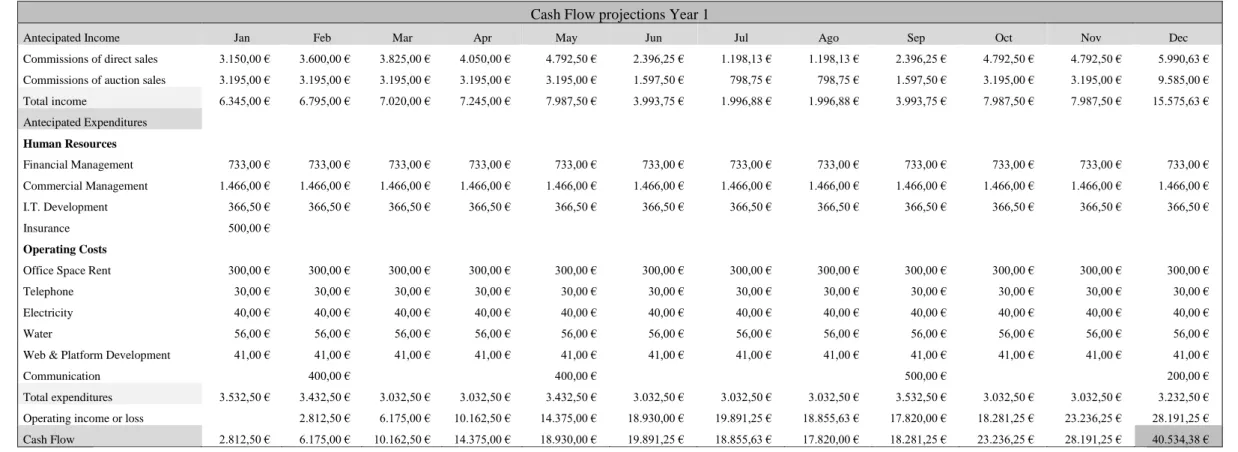
The Cash Flow projection that is presented below shows a forecast of MEcenas’ income and expenditures on a monthly basis, enabling to determine where the expenses are made and where the income originates from.
Cash flow can be extremely challenging to predict, especially due to the sales forecast, this will be calculated through the size of the market and the amount of students from art schools in Europe, being that, during the first year, will be applied a rate of 1% of adhesion from this students. It is therefore established that the average of pieces sold per month will be 2 per student, the calculations will be made in accordance to these parameters.
The stipendiary members of the cooperative are to receive the following monetary compensation:
1. Financial Manager: 733 € 2. Commercial Manager A: 733 € 3. Commercial Manager B: 733 €
28
4. I.T. Developer: 366.50 € - Above minimum wage, assuming 20 hours of work per week.
5. Insurance cover for personnel accidents: 500€ / annually
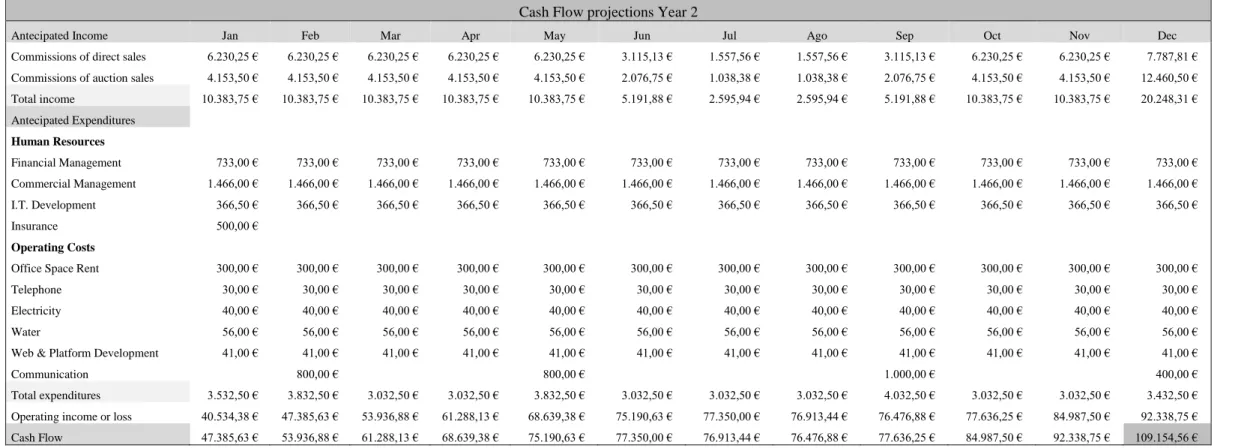
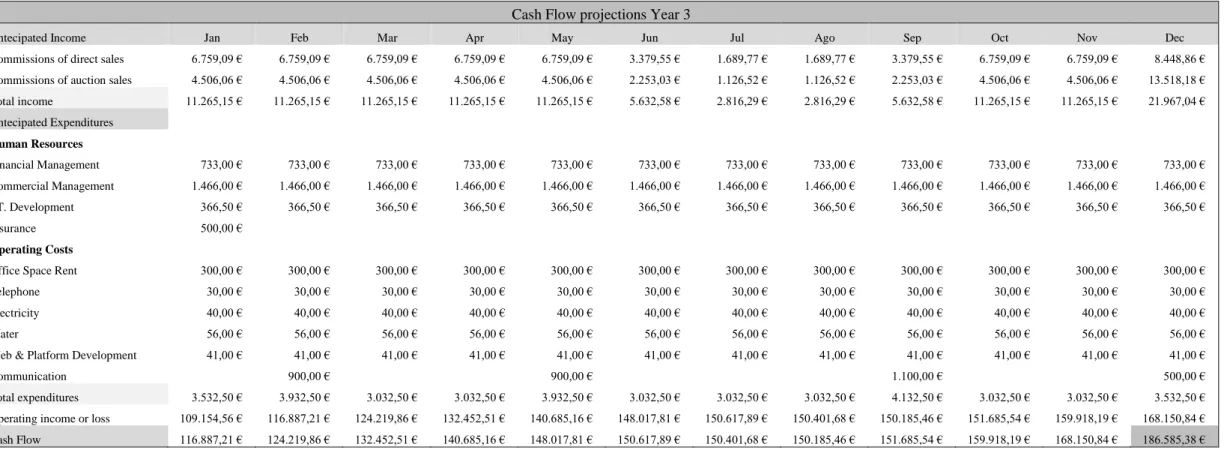
The rent that will be assumed in MEcenas’ Cash Flow tables is the average cost of a 20 square meters office in the center of Lisbon. The number of students is assumed to be 1% of the total of art students in some countries in Europe, during Year 1, the countries explored will be Portugal, Spain. During the following years, this scope expects to be enlarged, for Year 2, in the same countries the percentage of students connected to MEcenas is expected to increase by 0.3%, and the number of pieces sold per student are expected to maintain the same number, and for Year 3 it is expected to increase with schools from Belgium with 1% acceptance rate.
29 Cash Flow projections Year 1
Antecipated Income Jan Feb Mar Apr May Jun Jul Ago Sep Oct Nov Dec
Commissions of direct sales 3.150,00 € 3.600,00 € 3.825,00 € 4.050,00 € 4.792,50 € 2.396,25 € 1.198,13 € 1.198,13 € 2.396,25 € 4.792,50 € 4.792,50 € 5.990,63 € Commissions of auction sales 3.195,00 € 3.195,00 € 3.195,00 € 3.195,00 € 3.195,00 € 1.597,50 € 798,75 € 798,75 € 1.597,50 € 3.195,00 € 3.195,00 € 9.585,00 € Total income 6.345,00 € 6.795,00 € 7.020,00 € 7.245,00 € 7.987,50 € 3.993,75 € 1.996,88 € 1.996,88 € 3.993,75 € 7.987,50 € 7.987,50 € 15.575,63 € Antecipated Expenditures Human Resources Financial Management 733,00 € 733,00 € 733,00 € 733,00 € 733,00 € 733,00 € 733,00 € 733,00 € 733,00 € 733,00 € 733,00 € 733,00 € Commercial Management 1.466,00 € 1.466,00 € 1.466,00 € 1.466,00 € 1.466,00 € 1.466,00 € 1.466,00 € 1.466,00 € 1.466,00 € 1.466,00 € 1.466,00 € 1.466,00 € I.T. Development 366,50 € 366,50 € 366,50 € 366,50 € 366,50 € 366,50 € 366,50 € 366,50 € 366,50 € 366,50 € 366,50 € 366,50 € Insurance 500,00 € Operating Costs
Office Space Rent 300,00 € 300,00 € 300,00 € 300,00 € 300,00 € 300,00 € 300,00 € 300,00 € 300,00 € 300,00 € 300,00 € 300,00 € Telephone 30,00 € 30,00 € 30,00 € 30,00 € 30,00 € 30,00 € 30,00 € 30,00 € 30,00 € 30,00 € 30,00 € 30,00 € Electricity 40,00 € 40,00 € 40,00 € 40,00 € 40,00 € 40,00 € 40,00 € 40,00 € 40,00 € 40,00 € 40,00 € 40,00 € Water 56,00 € 56,00 € 56,00 € 56,00 € 56,00 € 56,00 € 56,00 € 56,00 € 56,00 € 56,00 € 56,00 € 56,00 € Web & Platform Development 41,00 € 41,00 € 41,00 € 41,00 € 41,00 € 41,00 € 41,00 € 41,00 € 41,00 € 41,00 € 41,00 € 41,00 €
Communication 400,00 € 400,00 € 500,00 € 200,00 €
Total expenditures 3.532,50 € 3.432,50 € 3.032,50 € 3.032,50 € 3.432,50 € 3.032,50 € 3.032,50 € 3.032,50 € 3.532,50 € 3.032,50 € 3.032,50 € 3.232,50 € Operating income or loss 2.812,50 € 6.175,00 € 10.162,50 € 14.375,00 € 18.930,00 € 19.891,25 € 18.855,63 € 17.820,00 € 18.281,25 € 23.236,25 € 28.191,25 € Cash Flow 2.812,50 € 6.175,00 € 10.162,50 € 14.375,00 € 18.930,00 € 19.891,25 € 18.855,63 € 17.820,00 € 18.281,25 € 23.236,25 € 28.191,25 € 40.534,38 €
Table 1.2 – Cash flow projection in Year 2
Cash Flow projections Year 2
Antecipated Income Jan Feb Mar Apr May Jun Jul Ago Sep Oct Nov Dec
Commissions of direct sales 6.230,25 € 6.230,25 € 6.230,25 € 6.230,25 € 6.230,25 € 3.115,13 € 1.557,56 € 1.557,56 € 3.115,13 € 6.230,25 € 6.230,25 € 7.787,81 € Commissions of auction sales 4.153,50 € 4.153,50 € 4.153,50 € 4.153,50 € 4.153,50 € 2.076,75 € 1.038,38 € 1.038,38 € 2.076,75 € 4.153,50 € 4.153,50 € 12.460,50 € Total income 10.383,75 € 10.383,75 € 10.383,75 € 10.383,75 € 10.383,75 € 5.191,88 € 2.595,94 € 2.595,94 € 5.191,88 € 10.383,75 € 10.383,75 € 20.248,31 € Antecipated Expenditures Human Resources Financial Management 733,00 € 733,00 € 733,00 € 733,00 € 733,00 € 733,00 € 733,00 € 733,00 € 733,00 € 733,00 € 733,00 € 733,00 € Commercial Management 1.466,00 € 1.466,00 € 1.466,00 € 1.466,00 € 1.466,00 € 1.466,00 € 1.466,00 € 1.466,00 € 1.466,00 € 1.466,00 € 1.466,00 € 1.466,00 € I.T. Development 366,50 € 366,50 € 366,50 € 366,50 € 366,50 € 366,50 € 366,50 € 366,50 € 366,50 € 366,50 € 366,50 € 366,50 € Insurance 500,00 € Operating Costs
Office Space Rent 300,00 € 300,00 € 300,00 € 300,00 € 300,00 € 300,00 € 300,00 € 300,00 € 300,00 € 300,00 € 300,00 € 300,00 € Telephone 30,00 € 30,00 € 30,00 € 30,00 € 30,00 € 30,00 € 30,00 € 30,00 € 30,00 € 30,00 € 30,00 € 30,00 € Electricity 40,00 € 40,00 € 40,00 € 40,00 € 40,00 € 40,00 € 40,00 € 40,00 € 40,00 € 40,00 € 40,00 € 40,00 € Water 56,00 € 56,00 € 56,00 € 56,00 € 56,00 € 56,00 € 56,00 € 56,00 € 56,00 € 56,00 € 56,00 € 56,00 € Web & Platform Development 41,00 € 41,00 € 41,00 € 41,00 € 41,00 € 41,00 € 41,00 € 41,00 € 41,00 € 41,00 € 41,00 € 41,00 €
Communication 800,00 € 800,00 € 1.000,00 € 400,00 €
Total expenditures 3.532,50 € 3.832,50 € 3.032,50 € 3.032,50 € 3.832,50 € 3.032,50 € 3.032,50 € 3.032,50 € 4.032,50 € 3.032,50 € 3.032,50 € 3.432,50 € Operating income or loss 40.534,38 € 47.385,63 € 53.936,88 € 61.288,13 € 68.639,38 € 75.190,63 € 77.350,00 € 76.913,44 € 76.476,88 € 77.636,25 € 84.987,50 € 92.338,75 € Cash Flow 47.385,63 € 53.936,88 € 61.288,13 € 68.639,38 € 75.190,63 € 77.350,00 € 76.913,44 € 76.476,88 € 77.636,25 € 84.987,50 € 92.338,75 € 109.154,56 €
31 Cash Flow projections Year 3
Antecipated Income Jan Feb Mar Apr May Jun Jul Ago Sep Oct Nov Dec
Commissions of direct sales 6.759,09 € 6.759,09 € 6.759,09 € 6.759,09 € 6.759,09 € 3.379,55 € 1.689,77 € 1.689,77 € 3.379,55 € 6.759,09 € 6.759,09 € 8.448,86 € Commissions of auction sales 4.506,06 € 4.506,06 € 4.506,06 € 4.506,06 € 4.506,06 € 2.253,03 € 1.126,52 € 1.126,52 € 2.253,03 € 4.506,06 € 4.506,06 € 13.518,18 € Total income 11.265,15 € 11.265,15 € 11.265,15 € 11.265,15 € 11.265,15 € 5.632,58 € 2.816,29 € 2.816,29 € 5.632,58 € 11.265,15 € 11.265,15 € 21.967,04 € Antecipated Expenditures Human Resources Financial Management 733,00 € 733,00 € 733,00 € 733,00 € 733,00 € 733,00 € 733,00 € 733,00 € 733,00 € 733,00 € 733,00 € 733,00 € Commercial Management 1.466,00 € 1.466,00 € 1.466,00 € 1.466,00 € 1.466,00 € 1.466,00 € 1.466,00 € 1.466,00 € 1.466,00 € 1.466,00 € 1.466,00 € 1.466,00 € I.T. Development 366,50 € 366,50 € 366,50 € 366,50 € 366,50 € 366,50 € 366,50 € 366,50 € 366,50 € 366,50 € 366,50 € 366,50 € Insurance 500,00 € Operating Costs
Office Space Rent 300,00 € 300,00 € 300,00 € 300,00 € 300,00 € 300,00 € 300,00 € 300,00 € 300,00 € 300,00 € 300,00 € 300,00 € Telephone 30,00 € 30,00 € 30,00 € 30,00 € 30,00 € 30,00 € 30,00 € 30,00 € 30,00 € 30,00 € 30,00 € 30,00 € Electricity 40,00 € 40,00 € 40,00 € 40,00 € 40,00 € 40,00 € 40,00 € 40,00 € 40,00 € 40,00 € 40,00 € 40,00 € Water 56,00 € 56,00 € 56,00 € 56,00 € 56,00 € 56,00 € 56,00 € 56,00 € 56,00 € 56,00 € 56,00 € 56,00 € Web & Platform Development 41,00 € 41,00 € 41,00 € 41,00 € 41,00 € 41,00 € 41,00 € 41,00 € 41,00 € 41,00 € 41,00 € 41,00 €
Communication 900,00 € 900,00 € 1.100,00 € 500,00 €
Total expenditures 3.532,50 € 3.932,50 € 3.032,50 € 3.032,50 € 3.932,50 € 3.032,50 € 3.032,50 € 3.032,50 € 4.132,50 € 3.032,50 € 3.032,50 € 3.532,50 € Operating income or loss 109.154,56 € 116.887,21 € 124.219,86 € 132.452,51 € 140.685,16 € 148.017,81 € 150.617,89 € 150.401,68 € 150.185,46 € 151.685,54 € 159.918,19 € 168.150,84 € Cash Flow 116.887,21 € 124.219,86 € 132.452,51 € 140.685,16 € 148.017,81 € 150.617,89 € 150.401,68 € 150.185,46 € 151.685,54 € 159.918,19 € 168.150,84 € 186.585,38 €