CUIDADO É FUNDAMENTAL
UNIVERSIDADE FEDERALDO ESTADODO RIODE JANEIRO. ESCOLADE ENFERMAGEM ALFREDO PINTO
INTEGRATIVE REVIEW OF THE LITERATURE DOI: 10.9789/2175-5361.rpcfo.v12.8264
CUIDADO É FUNDAMENTAL
UNIVERSIDADE FEDERALDO ESTADODO RIODE JANEIRO. ESCOLADE ENFERMAGEM ALFREDO PINTO
R E V I S T A O N L I N E D E P E S Q U I S A
PREPARATION OF PARENTS OF PRETERM NEWBORN FOR
HOSPITAL DISCHARGE: PROPOSAL FOR A PROTOCOL
Preparo dos pais de recém-nascido pré-termo para alta hospitalar: proposta
de um protocolo
Preparación de los padres de recién nacido pre-término para alta hospitalaria:
propuesta de un protocolo
Fabiana Vargas dos Reis Silva1, Tatiana de Oliveira Gomes2, Cristiano Bertolossi Marta3, Marcelle Campos
Araujo4, Elzeni dos Santos Braga5 How to cite this article:
Silva FVR, Gomes TO, Marta CB, Araujo MC, Braga ES. Preparation of parents of preterm newborn for hospital discharge: proposal for a protocol. Rev Fun Care Online. 2020 jan/dez; 12:386-392. DOI: http://dx.doi. org/10.9789/2175-5361.rpcfo.v12.8264.
ABSTRACT
Objective: to map in the literature the criteria for preparing the parents for discharge from the PTNB and to
propose a protocol for this purpose. Methodology: qualitative and exploratory bibliographical review. Results: Three categories emerged from the search: parent education for newborn care, limitations and challenges faced by the parenting team and the strategies used by the parenting team. The protocol for the preparation of parents with guidelines on feeding, bathing, sleeping, skin care and warning signs was proposed. Discussion: The results point out the importance of parents’ preparation for the discharge of a preterm newborn, evidencing that the maintenance of health when at home is directly related to such preparation. Final considerations: Considering the discussion, a systematic process for the implementation of such action should be established.
Keywords: Infant, Premature; Patient Discharge; Nursing.
1 Graduated in nursing from the University of Grande Rio - UNIGRANRIO. Specialist in Neonatal Nursing at Veiga de Almeida University (2018). Update in Teaching by Fundação Getúlio Vargas. Nurse on duty at UPH Equitable Park. Email: [email protected] 2 Junior technologist in the position of neonatal nurse at Fernandes Figueira Institute / Oswaldo Cruz Foundation - (IFF / FIOCRUZ).
Nurse Doctoral Student, Graduate Program in Nursing and Biosciences (PPGENFBIO), Federal University of the State of Rio de Janeiro- (UNIRIO). Master in Nursing, Federal University of the State of Rio de Janeiro. Member of the research group LACUIDEN. Email: [email protected]
3 Nurse. Post Doctorate in Nursing. Associate Professor, Department of Nursing Fundamentals, School of Nursing, State University of Rio de Janeiro. General Coordinator, Graduate Nursing in High Complexity, Veiga de Almeida University. Research Director at Veiga de Almeida University. Lead Researcher at the Center for the Evaluation of Technologies and Economics in Patient Health and Safety (NATESSP) at Veiga de Almeida University. Email: [email protected]
4 Nurse. Master by UNIRIO. Hospital Management Specialist by Fiocruz / HSL. Specialist in neonatology in the molds of residence at IFF / FIOCRUZ. Manager of UCINCO / UCINCA / IFF / FIOCRUZ. Nurse of the NICU of HUPE / UERJ. Email: [email protected] 5 Nurse. Master by EEAN / UFRJ. Hospital Management Specialist by Fiocruz / HSL. Specialist in Cardiology in the mold of residence by UNIRIO / INL / MS. Specialist in Pediatric Nursing by EEAN / UFRJ. Manager of the NICU-SURGICAL / IFF / FIOCRUZ. Technical Coordinator of the Graduate Neonatal Nursing at UVA. Email: [email protected]
RESUMO
Objetivo: levantar na literatura os critérios para preparo dos pais para
alta do RNPT e propor um protocolo para este fim. Metodologia: revisão bibliográfica integrativa, qualitativa e exploratória. Resultados: Emergiram da busca três categorias: educação dos pais quanto aos cuidados ao recém-nascido; limitações e desafios enfrentados pela equipe para o preparo dos pais e estratégias utilizadas pela equipe para o preparo dos pais. Propôs-se o protocolo com orientações sobre alimentação, banho, sono, cuidados com a pele e sinais de alerta. Discussão: Os resultados apontam a importância do preparo dos pais para a alta do pré-termo, evidenciando que a manutenção da saúde quando em domicilio, terá direta relação com tal preparo. Considerações finais: Diante do discutido, há necessidade de se estabelecer um processo sistemático, para a implementação de tal ação.
Descritores: Recém-Nascido Prematuro; Alta do Paciente; Enfermagem.
RESUMÉN
Objetivo: levantar en la literatura los criterios para la preparación
de los padres para el alto del RNPT y proponer un protocolo para este fin. Metodología: revisión bibliográfica integrativa, cualitativa y exploratória. Resultados: emergieron de la búsqueda tres categorías: educación de los padres en cuanto a los cuidados al recién nacido; limitaciones y desafíos enfrentados por el equipo para la preparación de los padres y estrategias utilizadas por el equipo para la preparación de los padres. Se propuso el protocolo orientaciones sobre alimentación, baño, sueño, cuidados de la piel y señales de alerta. Discusión: Los resultados apuntan la importancia de la preparación de los padres para el alta del pre-término, evidenciando que el mantenimiento de la salud cuando en domicilio, tendrá una directa relación con tal preparación. Consideraciones finales: Ante la discusión, hay una necesidad de establecer un proceso sistemático, para la implementación de tal acción.
Descriptores: Recien Nacido Prematuro; Alta del Paciente; Enfermería.
INTRODUCTION
Prematurity leads to hospitalization and separation, therefore in this process parents tend to experience what are described as stages of grief: denial, isolation, anger, bargaining, depression, and acceptance(1).
It should be noted that preterm newborns (PTNB) are those born with gestational ages of less than 37 weeks, and are considered high-risk newborns (NB) as they are exposed to situations where there is an increased risk of unfavorable developments. They require priority and specialized attention(2). It is important to note that, in the case of infant mortality in the first year of life, neonatal death represents almost 70% of the total(3).
We emphasize the importance of the nursing professional, understanding that they are a key part in the process of hospitalization of preterm infants, since they are responsible for direct care of hospitalized newborns. In addition, although hospitalization is often a long-term process, the favorable outcome expected is discharge, therefore parents need to be prepared to take their child home.
The preparation of parents should start as soon as they are hospitalized, so that the bond between parents and the child develops, since failure in this interaction and lack of
affection, coupled with the insufficient development of attachment, may lead to failure in developing brain connections leading to impairments in cognitive and affective skills(2).
That leads to the question that guides this study: what criteria have been established and used by nurses to prepare parents of preterm infants admitted to the NICU for discharge?
Considering the characteristics of care that the PTNB presents, both during hospitalization in the NICU and after discharge, and understanding that in the latter case it will be provided mostly by their parents, this study can provide inputs to the nursing care to the PTNB and their parents thus contributing to the minimization of injuries to this newborn. This study may also provide support to the professionals, by pointing out evidence-based practices.
This work is also justified by the large number of premature newborns born in Brazil. According to the Department of Information of the Unified Health System (DATASUS), in 2016 2,857,800 children were born in Brazil, more than 11% of them prematurely, requiring hospitalization in a NICU. Significantly, around 4% of these were concentrated in the southeastern region of the country(4).
Based on the above evidence, this study aims to identify in the literature the criteria for the preparation of parents of preterm infants for discharge and propose a protocol for this purpose.
METHODOLOGY
This is an integrative bibliographic review using a qualitative and exploratory approach, which aims to synthesize results previously obtained on a theme, providing broad information and what constitutes it in a body of knowledge(5).
The search was based on the PICO strategy, according to the guiding question, when the acronyms correspond, respectively, in Portuguese: P (patient) - Preterm infants admitted to the NICU; I (intervention) - Hospital discharge; C (comparison) - not applicable and, O (outcome) - Preparation of parents for hospital discharge.
Data collection took place between March and May 2018 in the databases of the Virtual Health Library (VHL) and Nursing Database (BDENF), using the Boolean operator and keywords focusing on prematurity and parent preparation for discharge.
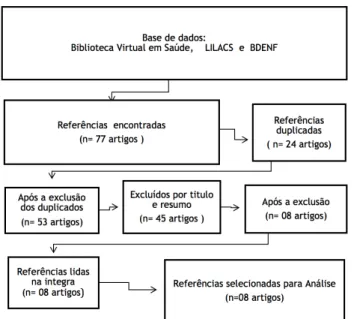
The inclusion criteria were: all articles, published from 2010, available in full, in Portuguese, English and Spanish. Duplicate articles, those outside the theme of this study and those dealing with the kangaroo method were excluded because it is a specific method that is not exclusive to preterm infants. We found 77 articles, 24 of which were duplicated in databases, leaving 53 articles. Another 45 were excluded after reading the title and abstract, leaving eight articles, which after analysis fit the proposed theme. The sequence of the search and selection of articles is shown in flowchart 1.
Flowchart 1 - Search Flowchart
Data treatment was categorized by defining an operation to classify the elements of a set by differentiation and then to reassemble them according to gender(6).
RESULTS
The reference analysis shows that of the eight (08) studies, six (06) were performed in Brazil and 02 in Colombia. Of these, only one proposed to approach the subject from the point of view of parents, while three (03) aimed to understand the point of view of nursing professionals and the other four (04) deal with integrative review. The synthesis of knowledge was then established in three categories, each with distinct thematic groups described in table 1.
Table 1 - Data categorization
Parents education on care for newborn
Feeding Care and hygiene Alerts
Breastfeeding Bath, sleep, skin care Health problems Limitations and Challenges Facing Staff who Prepare Parents
Social issues Relationships Professional
Financial difficulties; Absence / abandonment
of the family; Maternal addictions; Intellectual and cognitive limitations;
Maternal inexperience. Communications between team and family Reduced staff; Lack of preparation standardization Strategies used by the team to prepare parents Practical activities Theoretical
activities
Kangaroo method Use of educational
teaching material; Direct supervised care
Guidance at
discharge Kangaroo clinic.
Parental education on newborn care
The preparation of parents for the discharge of preterm infants goes through several stages and these need to take
into account the care needs of the newborn and the ability of the parents to care. Teaching parents basic childcare is critical in helping them develop a sense of competence(11). Regarding feeding, early weaning occurs in many cases, either because of the mother’s insecurity regarding the volume of milk ingested, or malformations and other pathologies associated with prematurity. Some mothers claim that their babies are very fragile and believe they do not produce enough milk to meet their demands(12,13).
The importance of guidance and teaching as to how the child can be fed, either by gavage or maternal breast is highlighted in some studies. The complexity of the transition between cupping and cup feeding requires mothers to feel supported in this process, especially if there was little contact during the period of hospitalization in the NICU(11,12, 14).
Mothers should be prepared for breastfeeding, even if this does not become a future reality, being important guidelines regarding breast milking, correct handling, difficulties of the breastfeeding process and the demystification of some concepts regarding breastfeeding. The fact is that satisfactory breastfeeding after discharge from preterm infants is closely linked to the support and guidance received during your child’s NICU stay(13,14).
Regarding hygiene care, as basic and routine as it may seem, it is stressful for parents when at home, because prematurity naturally generates a feeling of insecurity, especially regarding the handling of their baby(12-15).
Skin care, hygiene and sleep are some of those evidenced in the references analyzed. Caregiving is understood differently and when we compare the point of view of parents who relate to newborns with affection and that of the professionals who usually relate to meeting basic physiological needs, we infer that there may be interference between what is said by the professional and what is understood by the parents(14-16).
It is important to remember that the simple act of bathing a child can be something totally new to the mother, and so such care needs to be taught. Studies show that guiding only on the care and hygiene of preterm infants is insufficient to gain confidence to provide care after discharge(12-14).
The PTNB is a clientele that demands a lot of attention given its fragility and/or morbidities that are associated with prematurity. While hospitalized in the NICU babies are under continuous monitoring and, in this sense, any sign of change in their clinical condition is readily perceived.(13)
Studies bring to light parents’ reports that they are generally uncomfortable with taking their child home, claiming that they will not know how to take care of them and especially will not be able to recognize early signs and symptoms that might suggest an illness(11, 12, 17).
Limitations and Challenges Facing Staff in
Educating Parents
When dealing with social issues, financial difficulties stand out. In general, preterm hospitalizations are long, resulting in an unexpected and in many cases unsustainable expenses for the family. Linked to the financial issue is the absence of the family in the NICU(11,14).
Studies show that many mothers are often unable to be present in the NICU because they live far from the unit, have other small children, and the units do not have maternal accommodation, leading to absences and limiting the time for the preparation of these parents for their child’s discharge(11,14,17).
Other limitations in the studies refer to mothers addicted to drugs, with intellectual and cognitive limitations, all factors that suggest that preparation for discharge may be impracticable(12,14,15).
Maternal inexperience can also make it difficult for the nursing staff to prepare for discharge, leading to an increase in hospital readmissions of infants, especially due to the lack of maternal skills in home care for preterm infants(15-17).
Regarding relationship issues, communication is an important factor and is part of the routine of every health professional. In the process of hospitalization of preterm infants in the NICU, this communication also extends to the baby’s family. The fact is that the anxiety and stress generated by the hospitalization of a child can prevent the assimilation of information provided by professionals. At another extreme, the professional’s concern about the family’s presence in the care environment can undermine his/her willingness to provide parents with the necessary guidance. Successful preparation of parents for discharge of preterm infants depends on the fluidity of this relationship(14,18).
Team’s lack of communication with the family also puts a burden on the mother when she feels responsible for assimilating all the information provided to her and the responsibility of passing on the information about her child to the family(15).
For the professional, some of the limitations and challenges faced by the team to prepare parents originate within the team itself when some intrinsic situations represent a challenge to overcome. Reduced number of nurses in most NICUs, as well as the demand for care for hospitalized babies, associated with bureaucratic and sometimes managerial actions, lead to a lack of time to prepare parents(11,12,15). In this sense, mothers who have been in hospital for long periods with their children report the fact that nurses did not have enough time to instruct them, given the shortage of staff and excessive workload(12-15).
Another challenging and limiting issue in the professional’s work aimed at preparing parents for discharge is the systematization and recording of actions. The lack of systematization of the parental preparation process together with the lack of standardization of information shared with parents creates stress, wastes time, interferes with learning and increases insecurity in some cases(12,14,18).
A study brings some reports showing that educational actions performed informally, generated little learning, increasing anxiety and stress. There are also some reports that indicate divergence among professionals in the guidelines as well as the amount of information provided(12).
There is no consensus in the literature consulted when guidance to parents should be initiated. Some point out that the best time would be immediately after the baby’s
hospitalization, others point out that this process begins only after the baby’s clinical stability is achieved(14,15).
The one-to-one strategy shows the importance of standardization in the preparation process when using protocols and other tools to implement targeted and unified actions where everyone speaks the same language, minimizing the occurrence of confusion by parents about the information they hear. In addition, the entire process should be recorded and attached to the baby’s medical record(11).
Strategies used by the team to prepare parents
Just as the care provided to preterm infants is fully individualized, so is the care directed to their parents. In this sense the professional uses different strategies in order to succeed in preparing parents for home care of their children. The references analyzed point to practical resources used during the hospitalization period of babies in order to equip their parents. Directly supervised care was mostly indicated as a strategy with better outcomes for the preparation of parents of preterm infants. In addition, the interactive process favors mental well-being of the family and demonstrably shortens the length of hospitalization for the babies(11-17).
In addition, involving the family in the care of preterm infants not only promotes parental bonding, but also reduces fear of parents after discharge. In this process, the nurses performed the procedures explaining to parents and then the parents performed the procedures and were observed and guided by the nurse(17). Involving mothers in direct care of their child, in addition to minimizing fears and anguish, brings empowerment, reinforcing their understanding that as a mother, she also contributes to the reestablishment of her child’s health(14).
Notably direct care comprises basic actions such as hygiene and bathing, changing diapers and feeding. However, mothers also perform more complex actions such as monitoring vital signs, respiratory physiotherapy and observation for signs of injury(16).
Another strategy includes the use of teaching materials in parent preparation process. Studies show that the use of instructional material is a necessary and effective tool in guiding families, especially if associated with family participation in the care of preterm infants(16,17).
Similarly, studies show actions related to the elaboration and successful use of primer material (guidebook) for maternal instruction, associating teaching practices, in a simple and clear language, so that later, when at home, the family has information on care of their baby, if in doubt(16,17).
Within the context of educational activities for the preparation of parents, a subject that emerges from the references used is the guidance given at the time of discharge from the PT. In many NICUs this is the main strategy used, and studies indicate that some professionals believe that performing such an action is sufficient to equip parents to take care of their child when at home.
The guidelines provided to parents at discharge relate to: feeding, hygiene, eliminations, attachment, risk signs,
vaccination schedule, growth and development, among others. However, studies draw attention to the fact that during hospital discharge, mothers carry a very high emotional burden, which makes their concentration and learning process difficult at this time(15,16). As previously indicated, guidelines given at discharge can make it difficult to understand and may lead to mistakes. Moreover they can be made mechanically, not taking into account the individuality of each family and each baby(14).
Although it is not the focus of the study, it is worth noting that some studies recommend kangaroo method as a strategy to prepare parents for discharge of preterm infants. Mothers felt relieved and safer when they received the news that they were referred to the kangaroo program because they knew their babies would receive interdisciplinary follow-up after discharge(11).
In Brazil, studies show that reference to the kangaroo outpatient clinic after discharge from the hospital unit and the use of the method as continuity of care during NICU hospitalization favors the father / mother / baby bond, breastfeeding and family teaching preparing them for care after discharge(14-18).
Protocol Proposal
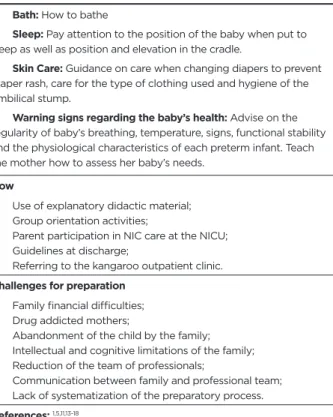
In view of the literature, table 2 details a proposal for the protocol for preparation of parents for preterm infants discharge from hospital.
Table 2 - Protocol proposal for discharge of preterm infants
Proposed Protocol for Parent Preparation for Discharge of PTNB. Literature indicates that the parents’ lack of preparation for the discharge of preterm infants is a major factor in their health problems, which in some cases deteriorate and lead to readmission of the baby.
The objective is to perform a systematic preparation of parents for discharge from preterm care, so that there is a satisfactory home care, avoiding health problems for the newborn.
In this sense, highlighted below are some important measures to be implemented to prepare parents for the discharge of preterm infants. It is important to emphasize that the preparation of parents should be initiated in parallel to the hospitalization of the baby or as soon as viability and hemodynamic stability are established.
The preparation of parents for the discharge of preterm infants needs to be systematic, individually planned, within the needs presented by each newborn and their family.
Who advises: Multidisciplinary Team
Guidance on: Feeding, Bathing, Sleeping, Skin Care and Baby Health Warning Signs
Feeding: Advice on the correct feeding of preterm infants is essential for maintaining their growth. It is necessary for the mother to understand the importance of breastfeeding for her baby, therefore the mother is encouraged to maintain lactation through pumping. Stimulating preterm newborn skills during hospitalization, aiming for future satisfactory suction is also part of this process. The guidelines below are based on the results. The mother should be taught how to handle the latch correctly, the correct frequency, which should be every three hours and that there is no need to offer water; guidance on what position to offer the breast to the baby as well as reflux and choking. Guidance on the use of the bottle and the type of breastfeeding, whether exclusive or mixed. Guidance on the transition from gavage / cup to breastfeeding and the use of tube.
Proposed Protocol for Parent Preparation for Discharge of PTNB. Bath: How to bathe
Sleep: Pay attention to the position of the baby when put to sleep as well as position and elevation in the cradle.
Skin Care: Guidance on care when changing diapers to prevent diaper rash, care for the type of clothing used and hygiene of the umbilical stump.
Warning signs regarding the baby’s health: Advise on the regularity of baby’s breathing, temperature, signs, functional stability and the physiological characteristics of each preterm infant. Teach the mother how to assess her baby’s needs.
How
Use of explanatory didactic material; Group orientation activities;
Parent participation in NIC care at the NICU; Guidelines at discharge;
Referring to the kangaroo outpatient clinic. Challenges for preparation
Family financial difficulties; Drug addicted mothers;
Abandonment of the child by the family; Intellectual and cognitive limitations of the family; Reduction of the team of professionals;
Communication between family and professional team; Lack of systematization of the preparatory process. References: 1,5,11,13-18
DISCUSSION
Based on the above it is clear that considering the large number of preterm infants in Brazil, the professionals involved in the care of these patients should be more concerned with the maintenance of their care at home. That said, improving the quality of the preparation of the parents of the PTNB that suits their needs is at the very least urgent. Thus, although there is a discussion already established on this subject, its incipience is evident, requiring new publications that discuss the subject in a more detailed and systematic manner, given its relevance. It is noteworthy that ensuring continuity of care for preterm infants at home is closely linked to the preparation of parents for discharge(19). Breastfeeding was the most discussed subject in the researched references, pointing to the importance of this subject for maternal and child health, in addition to bonding. The literature points out the repercussions of breastfeeding, which include: reduced child mortality, protection against diarrheal diseases and respiratory infections, promotion of growth and cognitive development, among others(3).
When it comes to preterm infants, the demands are differentiated, which also applies to food. Consideration should be given to the existing recommendation on the benefits of breastfeeding for preterm infants, understanding that the benefits of human milk are unattainable by other types of milk(2). However, as the results have shown, it is challenging to continue breastfeeding at home after discharge.
The lack of systematization in the process of preparing parents for discharge of preterm infants was evident in the results obtained. Despite the identification of some preparation methods for these parents, the publications do not have a clear and detailed description of the guidelines
that are offered to them. The lack of systematization and lack of records generate redundant and fragmented orientations, thus impairing the learning process(19).
Among the references analyzed, only one shows the implementation of protocols for the parental preparation systematized in its entirety and registered in the PNB records(11). It is safe to say that this type of implementation provides the process with safety, precision and measures for mitigation of failures.
Another fact to be highlighted is the kangaroo method. While not the focus of this study, it emerges in some reports as one of the methods used within the process of preparation of parents aiming to improve the quality of care given to newborns as well as their families through early skin-to-skin contact between mother / father and the baby, encouraging affective bonding, thermal stability, breastfeeding stimulation and the development of the baby(20).
FINAL CONSIDERATIONS
After the birth of a child, hospital discharge is the moment most expected by parents, however, this can also be a time of great stress, given the complexity that often involves the care of preterm infants.
One of the possibilities to minimize this stress is the empowerment of parents. They need to feel empowered to care for their child after discharge, so the nursing professional must play not only the role of the PTNB caregiver, but also the parent’s instructor, preparing them to assume such care.
Reviewed literature emphasizes the importance of preparing parents for the discharge of preterm infants pointing out that maintaining the health of this baby at home is directly related to such preparation. However it is clear that this process should be systematic and qualified.
In terms of implications for nursing staff, we understand that the use of institutional protocols for the preparation of parents for the discharge of preterm infants can promote a more practical, clean, didactic and above all organized process. In addition, the record of these actions needs to be accessible and provide basis for future interventions if needed.
Moreover, the lack of detail in the information provided and the unclear description of the methods used by nursing teams, as well as the evidence of the lack of systematization in the preparation of parents leads to conclude that more research is necessary and that that new publications should address the issue in greater detail.
It is also worth noting that the present study, fulfilling the proposed objective, made it possible to further analyse the subject addressed through the consulted literature. As a limitation we point out the limited number of publications as well as the absence of descriptors specifically aimed at the preparation of parents as a task for the nursing team.
REFERENCES
1. Araújo LA, Reis AT. Enfermagem na prática materno-neonatal. Rio de Janeiro: Guanabara Koogan, 2014.
2. Ministério da Saúde (BR). Secretaria de Atenção à Saúde. Departamento de Ações Programáticas Estratégicas. Atenção à saúde do recém-nascido: guia para os profissionais de saúde. 2º ed. atual. V. 4 – Brasília: Ministério da Saúde, 2014. Disponível em: http://www. redeblh.fiocruz.br/media/arn_v4.pdf.
3. Ministério da Saúde (BR). Secretaria de Atenção à Saúde. Departamento de Ações Programáticas Estratégicas. Atenção à saúde do recém-nascido: guia para os profissionais de saúde. 2º ed. atual. V. 1 – Brasília: Ministério da Saúde, 2014. Disponível em: http://bvsms.saude.gov.br/ bvs/publicacoes/atencao_saude_recemnascido_profissionais_v1.pdf. 4. Ministério da Saúde (BR). Sistema de informação de nascidos vivos-
DATASUS. Disponível em: http://tabnet.datasus.gov.br/cgi/deftohtm. exe?sinasc/cnv/nvrj.def.
5. Ercole FF, Melo LS, Alcoforado CLGC. Revisão Integrativa versus Revisão Sistemática. Rev Min Enferm [Internet]. 2014 [Citado em 05 maio 2018]; 18(1):1-260. Disponível em: http://www.reme.org.br/ artigo/detalhes/904.
6. Bardin L. Análise de conteúdo. 1 ed. São Paulo: Edições 70, 2016. 7. Costenaro RGS, Correa DAM, Ichisato SMT. Cuidados de enfermagem
em neonatologia. 1ºed. Porto Alegre: Moriá, 2017.
8. Couto FF, Praça NS. Preparo dos pais de recém-nascido prematuro para alta hospitalar: uma revisão bibliográfica. Esc Anna Nery Rev Enferm [Internet]. 2009 [Citado em 05 maio 2018]; 13(4):886-91. Disponível em: http://www.scielo.br/pdf/ean/v13n4/v13n4a27.pdf. 9. Carmo CMA, Oliveira ED, Pontes KAES, Araújo MC. Procedimentos
de enfermagem em neonatologia: rotinas do Instituto Fernandes Figueira/Fiocruz. Rio de Janeiro: Revinter, 2012.
10. Tamez RN. Enfermagem na UTI neonatal: assistência ao recém-nascido de alto risco. 5°ed. Rio de Janeiro: Guanabara Koogan, 2016. 11. Raffray M, Semenic S, Galeano SO, Marín SCO. Barriers and facilitators
to preparing families with premature infants for discharge home from the neonatal unit. Perceptions of health care providers. Invest Educ Enferm [Internet]. 2014 [Citado em 06 maio 2018]; 32(3):379-392. Disponível em: http://aprendeenlinea.udea.edu.co/revistas/index. php/iee/article/view/ 20699 /17367.
12. Alcantara KL, Brito LLMS, Costa DVS, Façanha APM, Ximenes LB, Dodt RCM. Orientações familiares necessárias para uma alta hospitalar segura do recém-nascido prematuro: revisão integrativa. Rev enferm UFPE on line [Internet]. 2017 [Citado em 06 de maio 2018];11(2):645-55. Disponível em: https://periodicos.ufpe.br/ revistas/revistaenfermagem/article/download/11984/14542
13. Custodio N, Abreu FCP, Marski BSL, Mello DF; Wernet M. Alta da unidade de cuidado intensivo neonatal e o cuidado em domicílio: revisão integrativa da literatura. Rev Min Enferm [Internet]. 2013 [Citado em 06 de maio 2018]; 17(4): 984-991. Disponível em: http:// pesquisa.bvsalud.org/brasil/resource/pt/lil-711435
14. Schmidt KT, Terassi M, Marcon SS, Higarashi IH. Práticas da equipe de enfermagem no processo de alta do bebê pré-termo. Rev Bras Enferm [Internet]. 2013 [Citado em 04 de maio 2018]; 66(6):833-9. Disponível em: http://www.scielo.br/pdf/reben/v66n6/04.pdf 15. Duarte AS, Santos WS, Silva LDB, Oliveira JD, Sampaio KJAJ.
Promoção da saúde às genitoras de bebês prematuros: ação da enfermagem na alta hospitalar. Rev Rene [Internet]. 2010 [Citado em 07 de maio 2018];11(3):162-170. Disponível em: https://www.redalyc. org/articulo.oa?id=324027971017.
16. Chiodi LC, Aredes NDA, Carmen GSS, Fonseca LMM. Health education and the family of the premature baby: an integrative review. Acta Paul Enferm [Internet]. 2012 [Citado em 07 de maio 2018]; 25(6):969-74. Disponível em: http://www.scielo.br/pdf/ape/v25n6/ v25n6a22.pdf
17. Galeano SPO, Marín SCO, Semenic S. Preparing for post-discharge care of premature infants: Experiences of parentes. Invest. Educ. Enferm [Internet]. 2017 [Citado em 06 de maio 2018]; 35(1): 100-108. Disponível em: http://aprendeenlinea.udea.edu.co/revistas/index. php/iee/%20article%20/view/327350/20784492
18. Schmidt KT, Bessa JB, Rodrigues BC, Arenas MM, Corrêa DAM, Higarashi IH. Recém-nascidos prematuros e a alta hospitalar: uma revisão integrativa sobre a atuação da enfermagem. Rev Rene [Internet]. 2011 [Citado em 06 de maio 2018]; 12(4):849-58. Disponível em: http://www.periodicos.ufc.br/rene/article/view/4356. 19. Veronez M, Higarashi IH. Protocolo para a alta de bebê pré-termo:
subsídios para a construção de uma proposta. Rev enferm UERJ [Internet]. 2016 [Citado em 05 de maio 2018]; 24(3):e7505. Disponível em: http://www.facenf.uerj.br/v24n3/v24n3a06.pdf.
20. Ministério da Saúde (BR). Secretaria de Atenção à Saúde. Departamento de Ações Programáticas Estratégicas. Atenção humanizada ao recém-nascido de baixo peso: Método Canguru. 2. ed. Brasília: Editora do Ministério da Saúde, 2011. Disponível em: http://bvsms.saude.gov. br/bvs/publicacoes/metodo_canguru_manual_tecnico_2ed.pdf> Received in: 25/10/2018 Required revisions: 15/05/2019 Approved in: 22/07/2019 Published in: 23/03/2020 Corresponding author
Fabiana Vargas dos Reis Silva
Address: Rua Olímpia, lote 11 quadra 07, Bairro Pilar
Duque de Caxias/RJ, Brazil
Zip code: 25215-100 E-mail address: [email protected] Telephone number: +55 (21) 98319-7786