http://dx.doi.org/10.1590/1413-70542016405031716
Physalis size reduction for potted ornamental plant use
Redução do porte de fisális para fins ornamentais como planta envasadaEmily Bosch1*, Francine Lorena Cuquel1, Grasiela Bruzamarello Tognon1
1Universidade Federal do Paraná/UFPR, Curitiba, PR, Brasil
*Corresponding author: [email protected]
Received in August 31, 2015 and approved in December 7, 2015
ABSTRACT
The consumer’s constant search for novelties in the area of ornamental plants has inspired the use of species that are normally used
for other purposes, such as fruit-bearing plants, to be introduced into floriculture. The physalis, a fruit-bearing plant, with a beautiful accrescent fruiting calyx that envelops the berry, can be used for these purposes. However, this plant can reach 70 cm high, which makes it unviable to be used as an indoor plant. The objective of this research was to decrease the size of the physalis (Physalis angulata) for
ornamental use, pot it and apply the plant growth regulator Paclobutrazol (PBZ). The PBZ growth regulator was applied only once, via foliar spray at the concentrations of 0, 30, 60, 90, 120 and 150 mg a.i L- 1, as well as via irrigation in the substrate at concentrations of 0, 5, 10, 15, 30 and 60 mg a.i L- 1. Along with the quantitative variables, a plant acceptability test was carried out when it was considered ideal for commercialization. The obtained results clearly show that it is possible to reduce the size of the physalis for use as a potted plant by using PBZ with foliar applications at the concentration of 90 mg a.i L-1 or by using irrigation applications directly in the substrate at a concentration of 5 mg a.i L-1.
Index terms: Physalis angulata; plant regulator; Paclobutrazol; sensorial analysis; ornamental fruit bearing plants.
RESUMO
A constante busca dos consumidores de plantas ornamentais por novidades estimula que espécies utilizadas para outros fins, como as plantas frutíferas, possam ser introduzidas na floricultura. O fisális, uma planta frutífera, cujos frutos são envolvidos por um belo cálice em forma de balão, pode ser utilizado para este fim. Entretanto, essa planta pode chegar a 70 cm de altura, o que inviabiliza o seu cultivo em vasos como planta de interior. Objetivou-se com essa pesquisa diminuir o porte de plantas de fisális (Physalis angulata) para uso
ornamental envasado com a aplicação do regulador vegetal Paclobutrazol (PBZ). Para isso utilizou-se o regulador vegetal PBZ, uma única vez, via pulverização foliar nas concentrações de 0, 30, 60, 90, 120 e 150 mg i.a L-1, e via irrigação do substrato nas concentrações de 0, 5, 10, 15, 30 e 60 mg i.a L-1. Adicionalmente as variáveis quantitativas, foi aplicado um teste de aceitabilidade das plantas no momento em que se considerava ideal para comercialização. Os resultados obtidos demonstraram que é possível a redução do porte de fisális para uso como planta envasada utilizando PBZ com aplicação foliar na concentração de 90 mg i.a L-1 ou com aplicação via irrigação do substrato na concentração de 5 mg i.a L-1.
Termos para indexação: Physalis angulata; regulador vegetal; Paclobutrazol; análise sensorial; frutífera ornamental.
INTRODUCTION
The consumer’s constant search for novelties in the area of ornamental plants (Noordegraaf, 2000) has inspired the use of species that are normally used for other purposes, such as fruit-bearing plants, to be introduced into
floriculture. The physalis (Physalis angulata L.), known for its delicious fruit (Rufato et al., 2012), could become
a good alternative for the floriculture sector, with its
beautiful calyx that envelops the berry, its many branches
and alternating bright green leaves. However, the physalis
plant can reach 70 centimeters tall (Lorenzi; Matos, 2002),
exceeding the desired aesthetic standards for potted plants.
The reason being is that the potted plant’s maximum height
must be two to three times the height of the pot in order for it to grow successfully (Barbosa, 2003; Brum et al., 2007).
Reducing the size of ornamental plants is frequently
performed with plant growth regulators. They act within
the plant, reducing elongation of the internodes (Silva
et al., 2003). PBZ (Paclobutrazol) ([(2RS-3RS)-1-(4-clorofenil)4,4-dimetil-2-(1,2,4-triazol-1-y)-pentan-3-ol]) is a plant growth regulator widely used in floriculture and
can be applied by both foliar spray or in substrate form
(Syngenta, 2012; Zeneca, 2015).
In most studies with herbaceous species, just one PBZ application, in varying concentrations of 15 to 150 mg a.i L-1 by foliar spray, is enough (Grossi et al., 2005;
physalis plant (Physalis angulata) for ornamental use
by applying the Paclobutrazol (PBZ) plant growth regulator.
MATERIAL AND METHODS
The experiments were carried out in a greenhouse covered with a low-density polyethylene film (from November/2013 to February/2014), in Curitiba, PR (25°24’38.9”S 49°14’57.0”W). The climate in the
region is subtropical and humid (Cfb) according to the Köppen climate classification (Instituto Agronômico
do Paraná-Iapar, 2014), with an average temperature of approximately 23 °C in the summer, capable of rising
above 32 °C on hotter days. According to information from the Paraná Meteorological System (Sistema Meteorológico do Paraná-Simepar, 2014), during the summers of 2013/2014, the maximum temperature registered at 35.5 °C.
The physalis (P. angulata) seeds were sown 2,5 months before the experiment in expanded polystyrene
trays filled with commercial substrate, which were
then placed in a greenhouse, receiving daily irrigation
manually. Transplanting took place when the seedlings reached approximately ten centimeters high. The seedlings were grown in 15 pots (15 cm in diameter and 12 cm high, with a volume of 2.0 L), one of the most common vases used for growing indoor plants. They were filled with substrate composed of 70% pine bark and 30% sandy-clay soil.
The PBZ – Cultar® containing 25% of the active
ingredient (a.i) Paclobutrazol – was used in one of the experiments as a foliar spray at concentrations of 0, 30, 60, 90, 120 and 150 mg a.i L-1. In another experiment, it
was applied directly to the substrate, via manual irrigation at concentrations of 0, 5, 10, 15, 30 and 60 mg a.i L-1. The
control treatment was handled without a plant growth regulator added, receiving the same amount of water that was used in the solution containing the product. Both
scale that was structured with nine points ranging from “I really didn’t like it” (lowest score) to “I really liked it a lot” (highest scored) (Dutcosky, 2013). The following descriptors were used for evaluation: plant height, number of fruit per plant and appearance of the plant. Additionally, the following questions were asked: Would you buy this product? If so, what would be the main reason why you would buy it?
All the plants were later analyzed for height, the
number of fruit per plant, the diameter of the plant, the length of the fruit peduncle and the dry mass of the aerial
part.
The plan used for this experiment was completely randomized with eight repetitions per treatment. The results obtained were submitted to variance analysis and, afterward, were checked for the normality assumptions of waste, waste homoscedasticity, lack of waste and the additivity model. They also underwent a regression analysis.
RESULTS AND DISCUSSION
Application of PBZ via foliar spray
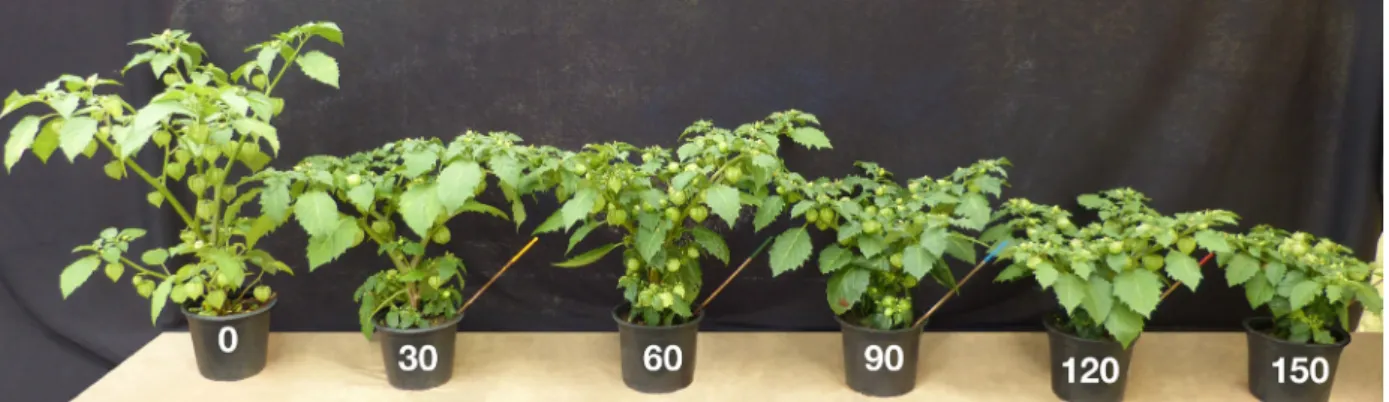
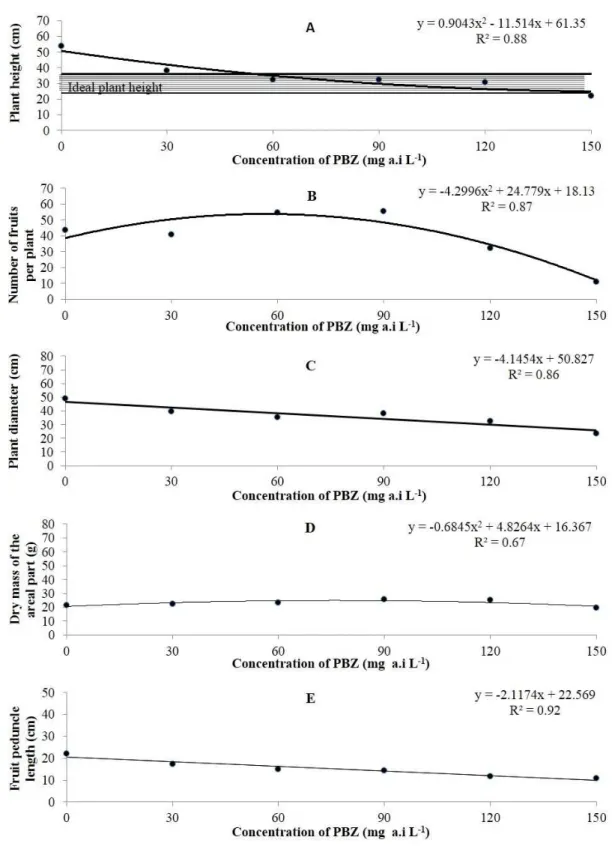
The PBZ applied via foliar spray led to a decrease in plant height (Figure 1 and 2A). This result was also reported by Grossi et al. (2005), Moraes et al. (2005) and Pinto et al. (2006) in other ornamental potted plants. It is caused by the PBZ action in the plant’s metabolism,
inhibiting the natural production of gibberellins and
decreasing elongation and cell division (Basra, 2000).
The proper height of the plants to maintain their proportionality and recommended commercial
standards for potted plants was from 24 to 36 cm (two
or three times the height of the vase), according to
Figure 1: Effects of concentrations of 0, 30, 60, 90, 120 and 150 mg a.i L-1 of Paclobutrazol (PBZ) applied via foliar
spray, one single time, to physalis plants (Physalis angulata L.).
The application of PBZ spray resulted in various effects in the number of fruit (Figure 2B), reaching a maximum of 54 fruits per plant with a spray concentration of 60 mg a.i L-1, following a reduction in the number of
fruit per plant with the other concentrations. A similar effect using PBZ was reported by Matsoukis et al. (2001) with Lantana camara.
Previous studies have indicated that the PBZ
effect of increasing the number of fruit per plant could
be related to the decrease of plant growth, followed by
change in the photoassimilates distribution standard,
channeling it toward reproductive development (Khalil; Ali, 2013). However, at high concentrations, the PBZ also inhibits gibberellic acid biosynthesis (Rademacher, 2000), which causes a delay in flowering and consequently entails a lower number of fruit on the plants. In cases where the fruit is the decorative
element, the number of fruit can be a decisive factor
for the consumer when buying and, therefore, would be a deciding factor when choosing the regulating concentration to be applied.
The diameter of the plant decreases when the PBZ concentration is increased (Figure 2C), confirming the studies of Grossi et al. (2005) and Tinoco et al. (2011).
The reduced diameter is probably related to the reduction of internode elongation, due to inhibiting gibberellin
biosynthesis. Reducing the plant’s diameter makes it
more compact, preventing the substrate from being
apparent when looking at it from above. This is a desirable
characteristic and serves as a quality standard for some
potted plants such as chrysanthemums, Thanksgiving cactus, gerbera and the kalanchoe (Instituto Brasileiro de Floricultura-Ibraflor, 2012).
The dry mass of the areal part (Figure 2D) in all the PBZ concentrations tested were similar. However, the plants that did not receive an application of the regulator were approximately 70% higher (data not numerically quantified) than those treated with PBZ. One can, therefore, assume that PBZ gives plants a smaller but fuller appearance. Perhaps this phenomenon explains, according to Berova and Zlatev (2000), findings in tomato plants where PBZ applications decreased plant height while maintaining the amount of leaves and increasing the number of fruit per plant.
The physalis fruit peduncle length decreased with increasing concentrations of PBZ (Figure 2E), agreeing with Pinto et al. (2006). Gibberellins are a growth-promoting hormone that acts along the cellular walls; it affects the permeability of the membrane, enzyme activity and carbohydrate mobilization as well as cell elongation (Taiz; Zaiger, 2009). Therefore, the stock reduction is due to PBZ action that inhibits gibberellin biosynthesis. When the peduncle is shorter, the fruit is closer to the leaf, which improves the aesthetic effect by making it more compact and accentuating the contrast between the leaf and the fruit.
Acceptability test of PBZ application via foliar spray Plants sprayed with PBZ at concentrations of 90 and 120 mg a.i L-1 received the highest scores by
Figure 2: Effects of different concentrations (mg a.i L-1) of Paclobutrazol (PBZ) applied via foliar spray, in a single
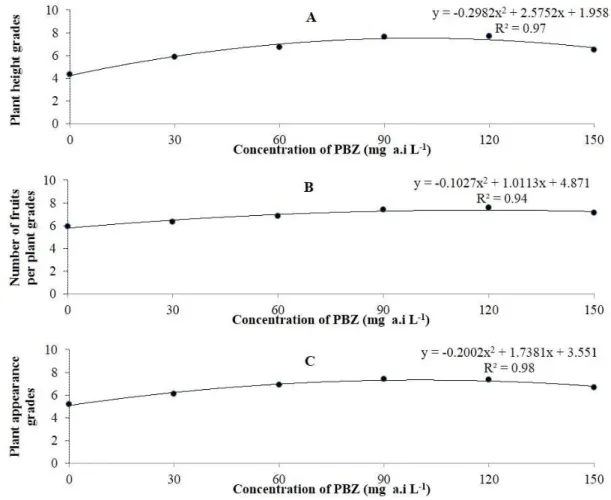
Figure 3: Effects of different concentrations of Paclobutrazol (PBZ), applied one single time via foliar spray, on the grading of height (A), number of fruit per plant (B) and appearance (C) of physalis (P. angulata) by hedonic evaluations carried out by 60 untrained judges.
The 90 mg a.i L-1 concentration generated the
greatest quantity of fruit (Figure 2B), which can be directly related to the evaluators’ opinions (Figure 3B) that gave a 7.6 grade for the required number of fruits. This proves that consumers of potted fruit plants prefer plants with more fruit.
At the time of evaluation, one evaluator noted
that the fruit were in different stages of development, confirming what Lorenzi and Matos (2002) claimed regarding physalis fruit production, which begins around the 3rd and 4th months after sowing, spanning a period of about six months. This type of effect could encourage people to purchase this product as the plants will continue to bear fruit after purchase.
Grades the judges gave that were above 7.0 for plant appearance (Figure 3C) were for those that received concentrations of 90 to 120 mg a.i L-1. Maybe
this acceptance was due to the large quantity of fruit on the plant, the plant’s greatest aerial dry weight, a plant height between 24 and 36 cm and an average plant diameter of 31 cm, showing the greatest commercial potential.
Those products that were most preferred by the judges were the ones that received concentrations of 90 and 120 mg a.i L-1, and according to the judges’ statements,
the choice was due to the highest quantity of fruit and the plant’s proportionality within the vase. However, due to the higher costs of applying PBZ at higher concentrations, and similar results between concentrations of 90 and 120 mg a.i L-1, it is recommended to use the lower
concentration (90 mg a.i L-1)of PBZ applied via foliar
spray on physalis plants.
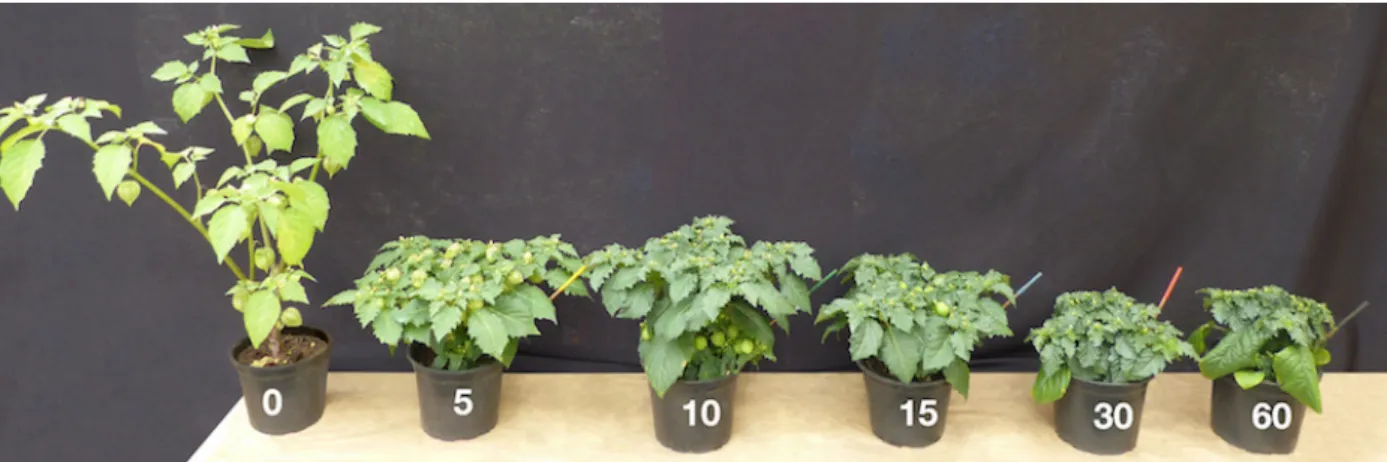
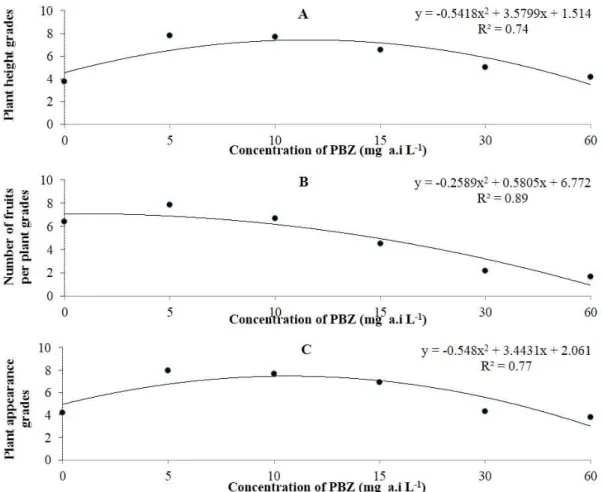
Figure 4: Effects of concentrations of 0, 5, 10, 15, 30 and 60 mg a.i L-1 de Paclobutrazol (PBZ) applied via substrate,
one single time to physalis plants (Physalis angulata L.). The height of the plants was reduced by applying PBZ (Figure 4 and Figure 5A), confirming studies from Ochoa et al. (2009) and Larcher et al. (2011). The plant growth regulator action of reducing the size of the plants occurs by inhibiting gibberellin synthesis, which
is responsible for the expansion and elongation of the
meristem cells that form the internodes (Taiz; Zeiger, 2009).
PBZ caused crinkled leaves and stunted growth for plants exposed to concentrations of 30 and 60 mg a.i
L-1 (Figure 4), making it unviable to commercialize the
plants. The same phytotoxic symptoms were reported by Grossi et al. (2005) and by Moraes et al. (2005). Visual symptoms of phytotoxicity were not found in the other concentrations tested.
The dry mass of the areal part (Figure 5B) was lower in plants treated with PBZ compared to plants that received no plant growth regulator application. This may have occurred due to the reduced internodal distance. This causes the plants to become so compact that the lower leaves probably did not receive enough light for
At concentrations of 5, 10 and 15 mg a.i L the plant diameters were up to 33% lower than those observed in plants that received no regulating application (Figure 5C). From these concentrations, one could observe that the diameter reduction created more compact plants, thus blocking the substrate from being viewed from above. However, with concentrations of 30 and 60 mg a.i L-1, the
reduction of the plant’s diameter was so great that they became disproportionate to the vase and the substrate was apparent, proving it impossible to recommend this concentration.
The biggest fruit amount (44 fruits per plant) (Figure 5D) was obtained without PBZ application. This result shows that this product is not necessary for improving this plant feature.
At concentrations of 30 and 60 mg a.i L-1 the
effect of using PBZ was so great that, at the time of evaluation, the plants had no fruit at all (Figure 5D). Late flowering due to using PBZ was also reported on physalis plants (P. peruviana) by Yadava (2012). This
Figure 5: Effects of different concentrations (mg a.i L-1) of Paclobutrazol (PBZ) applied via substrate irrigation in
Figure 6: Effects of different concentrations of Paclobutrazol (PBZ), applied one single time, via substrate irrigation, graded on height (A), the number of fruit per plant (B) and appearance (C) of physalis (P. angulata) by hedonic evaluations using 60 untrained judges.
the evaluators (7.5) in regard to plant height. These plants showed respective heights of 24 and 36 cm (Figure 5A), confirming recommendations by Barbosa (2003) and Brum et al. (2007).
The concentration of 5 mg a.i L-1 generated the
greatest amount of fruit (Figure 5D), which can be directly
height (24 to 36 cm) and an average plant diameter of 30
cm, illustrating the possibility of commercializing potted
physalis. However, plants receiving higher concentrations were not evaluated well because this use of PBZ drastically
reduced the height and diameter of the plant; they did not
Products preferred by 97% of the judges were those that had received concentrations of 5 and 10 mg a.i L-1 and
according to the judges, their choice was due to a greater quantity of fruit and the plant proportionality to the vase. When considering the cost of applying higher
concentrations of the product, the results indicate that
the concentration of 5 mg a.i L-1 PBZ via substrate
irrigation of one single application is the most optimal
for the physalis.
When asking the judges if they would buy the product, 100% of them said yes, and 86% of them said they would be inspired to buy the potted physalis because of the beautiful calyx, while the other 14% attributed their decision just because the product was a novelty.
CONCLUSION
The appropriate physalis size for potted cultivation
can be obtained by the foliar application of 90 mg a.i L-1 of
PBZ or by application to the substrate of 5 mg a.i L-1 PBZ.
REFERENCES
BARBOSA, J. G. Chrysanthemums: Seedling production,
cultivating for flower cuts, potted cultivation, hydroponic cultivation. Aprenda Fácil. 2003, 232p.
BASRA, A. S. Plant Growth Regulators in Agriculture and horticulture: Their role and commercial uses. 1.ed. New
York: Food Products Press. 2000, 262p.
BOUMAZA, R. et al. Sensory profiles and preference analysis in ornamental horticulture: The case of the rosebush. Food Quality and Preference. 21(8):987-997, 2010.
BEROVA, M.; ZLATEV. Z. Physiological response and yield of paclobutrazol treated tomato plants (Lycopersiconsculentum
Mill.). Plant Growth Regulation. 30(2):117-12, 2000.
BRUM, B. et al. Growth, cycle duration and production of chrysanthemum inflorescence multiflora under different number of pruning and pot sizes. Ciência Rural.
37(3):682-689, 2007.
DUTCOSKY, S. D. Análise Sensorial de Alimentos.Curitiba: Editora Universitária Champagnat, 2013, 123p.
GROSSI, J. A. S. et al. Effects of paclobutrazol on growth and fruiting characteristics of cv. Pitanga ornamental Pepper. Acta Horticulturae.683:333-336, 2005.
INSTITUTO AGRONÔMICO DO PARANÁ-IAPAR. Cartas climáticas do Paraná. 2014. Available in: <http://www.iapar.
br/modules/conteudo/conteudo.php?conteudo=863>. Access in: April 10, 2015.
INSTITUTO BRASILEIRO DE FLORICULTURA-IBRAFLOR. Release imprensa.Campinas 2012. 4p. Available in: <http://www. ibraflor.com/publicaoes/vw.php?cod=183>. Access in: August 26, 2015.
KHALIL, H. A; ALY, H. S. Cracking and fruit quality of pomegranate (Punica granatum L.) as affected by pre-harvest sprays of some growth regulators and mineral nutrients. Journal of HorticulturalScience & Biotechnology. 5(2):71-76, 2013.
SISTEMA METEOROLÓGICO DO PARANÁ - SIMEPAR.
Comercialização e cessão de dados agrometeorológicos. Curitiba, 2014. Available in: <www.simepar.br>. Access in: Aug. 20, 2015.
LARCHER, F. et al. Reducing peat and growth regulator input in camellia pot cultivation. Horticultural science.
38:35-42, 2011.
LARCHER, W. Ecofisiologia Vegetal. São Carlos: Rima Artes e Textos, 2000, 531p.
LORENZI, H.; MATOS, F. J. A. Plantas medicinais no Brasil: native, exotica and cultivated. Nova Odessa, SP: Instituto Plantarum, 2002. 576p.
MATSOUKIS, A. S. et al. Responses of Lantana camara sub sp. camara to paclobutrazol and shading. Canadian Journal of Plant Science. 8(4):761-764, 2001.
MILANDRI, S.; LAUBSCHER, C. P.; NDAKIDEMI, P. Hydroponic
culture of Gladiolus tristis: Application of paclobutrazol
for flowering and height control. African Journal of
Biotechnology. 7(3):239-243, 2008.
MORAES, P. J. et al. Ornamental tomato growth and fruiting response to paclobutrazol. Acta Horticulturae.
683:327-332, 2005.
NOORDEGRAAF, C. V. An approach to select new ornamental crops. Acta Horticulturae. 541:75-78, 2000.
OCHOA, J. et al. Distribution in plant, substrate and leachate of paclobutrazol following application to containerized Nerium oleander L. seedlings. Spanish Journal of Agricultural Research. 7(3):621-628, 2009.
PINTO, A. C. R. et al. Growth retardants in the production of potted flowering saffron-of-Cochin plants. Bragantia. 65(3):369-380, 2006.
RADEMACHER, W. Growth retardants: Effects on giberellin byosyntesis and other metabolic pathways. Annual Review of Plant Physiology and Plant Biology. 51:5001-5031,
2009, 819p.
TEKALIGN, T.; HAMMES, P. S. Growth and biomass production in potato grown in the hot tropics as influenced by Paclobutrazol. Plant Growth Regulation.45:37-46, 2005.
TINOCO, S. A. et al. Production and quality of zonal geranium plants (Pelargoniumx hortorum L. H. Bailey) in response to application of chlormequat, daminozide and paclobutrazol
L.). American Journal of Plant Physiology. 7:143-148, 2012.
WHIPKER, B. E. Bedding plant height control strategies. Commercial Floriculture Research and Extension, Raleigh: North Carolina State University, v.3, p.1-5, 2001.
ZENECA. Bonzi – plant growth facilities. 2015. Available in: